
California turns pilot pay into a very different conversation than most states. Airline pilots in California earn an average of $227,870 annually, which is 193% above the national average, according to CareerExplorer’s California pilot salary data. That headline number gets attention, but it also hides the part that matters most to a new aviator. High pay in this state is real, but it’s tied to a very specific path, and the first stretch of that path can feel a lot leaner than people expect.
That’s why “pilot salary california” shouldn’t be reduced to one average. A student doing a discovery flight over the Inland Empire, a CFI grinding through long days at a towered airport, a charter pilot flying business clients into Van Nuys, and a senior airline captain based at LAX are all in the same state, but they’re living very different versions of the career.
California rewards skill, seniority, and aircraft complexity. It also rewards pilots who make smart training decisions early, understand where the money is, and avoid wasting years in the wrong seat.
Your Aviation Career in the Golden State
A lot of people start this search because they want one answer. What do pilots make in California? The better question is which pilot you want to become.
The state gives you several real lanes. You can chase the airline route, build toward charter or corporate flying, move into helicopters, or use instruction and rental access to build time efficiently while keeping your options open. California’s airspace helps shape that opportunity. Busy airports, complex radio work, instrument environments, affluent charter markets, and major airline hubs all sit inside one state.
A realistic first step is learning in the same conditions you’ll later get paid to handle. Training at a towered airport matters. Working around multiple runways matters. Learning to stay ahead of radios, sequencing, and changing traffic flows matters. Students comparing programs often start by reviewing flight schools in California and then narrowing down based on fleet access, instructor quality, and how efficiently they can move from one rating to the next.
Most people don’t wash out because they can’t fly. They stall because they underestimate the middle of the journey, where money is tight and consistency matters more than excitement.
California can absolutely lead to a six figure cockpit career. But the pilots who get there fastest usually aren’t the ones chasing the flashiest path. They’re the ones who train with purpose, protect their momentum, and understand that the first good decision often matters more than the first big paycheck.
The California Pilot Salary Landscape in 2026
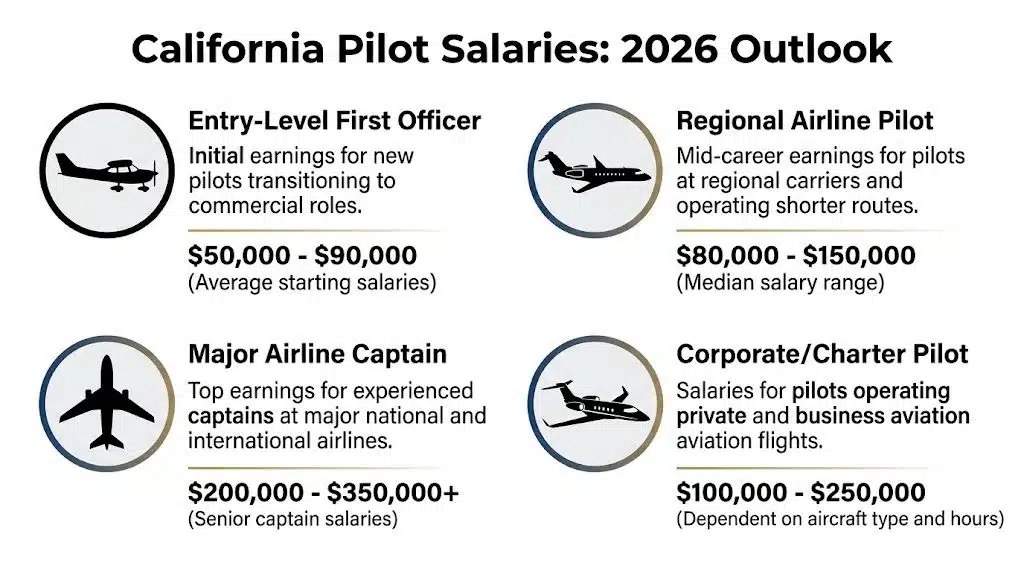
California pilot pay can stretch from modest hourly instruction income to senior airline compensation that clears a quarter million a year. The spread is wide because this state supports nearly every serious flying track at once, from time-building at local airports such as Chino to legacy airline, charter, and corporate jobs based around Los Angeles, Orange County, the Bay Area, and San Diego.
The clearest statewide benchmark comes from the Bureau of Labor Statistics. California airline pilots earned an average annual salary of $286,040 in 2023, according to BLS occupational wage data for airline pilots, copilots, and flight engineers. That number gets attention, but it only makes sense if you understand which jobs sit underneath it and how long it takes to reach them.
What the pay ranges actually look like
Salary websites often blend different aircraft types, seniority levels, and employment models. A first-year CFI in Chino, a midsize charter captain in Van Nuys, and a widebody major-airline captain based at LAX all count as “pilots,” but they are not playing the same pay game.
For practical planning, use the ranges below.
| Pilot Role | Entry-Level Range | Mid-Career Average | Senior/Top 10% Range |
|---|---|---|---|
| Airline pilot | Early pay varies by carrier, seat, and reserve status | $220,401 projected median as of January 2025 per CareerExplorer’s California pilot salary page discussion of Salary.com data | CareerExplorer notes that top airline earners in California can surpass $700,000 at the major-airline level |
| Private jet or Part 135 pilot | Entry pay varies widely by operator, schedule, and aircraft | $129,202 average annual salary in California per Simple Flying’s summary of California private jet pilot pay | Simple Flying reports top private jet earners in California exceeding $172,708 |
| Early commercial pilot | Base salary around $28,342 in Southern California time-building roles per PayScale’s Los Angeles commercial pilot salary page | PayScale shows much stronger total compensation within 1 to 4 years for some commercial pilots in Los Angeles | Senior outcomes depend heavily on niche, aircraft, and operator |
| CFI | Often lower than Part 135 work, especially at the start | Income depends on student flow, weather, aircraft availability, and how many billable hours you actually fly | Usually capped unless instruction is combined with ferry, contract, or specialized flying |
That gap between categories is the point. California does not have one pilot salary market. It has several, and your certificates, total time, multi time, turbine exposure, and schedule flexibility decide which one you enter.
Why the higher-paying jobs cluster in California
The state pays well for three practical reasons.
Airlines need crews in major hubs. Charter operators serve dense business markets and wealthy client bases. Employers also have to compete with California housing, insurance, and commuting costs, especially near airports where the better jobs are concentrated.
There is also a skill premium here. Pilots who train and work in congested Class B and Class C airspace, busy IFR systems, marine layers, mountain weather, and high-tempo radio environments tend to be more useful to operators that care about judgment and consistency. That does not guarantee higher pay by itself, but it helps explain why California remains a strong earning state for experienced pilots.
Gross pay is only part of the picture. If you are comparing offers, base locations, or whether commuting is worth it, review the tax side too through 2024 California Tax Brackets. A good salary can feel a lot smaller after state taxes, airport-area rent, and a long reserve commute.
What an aspiring pilot should take from these numbers
Early flying jobs usually pay for progression, not comfort. That is why so many California pilots instruct first, pick up traffic watch, aerial survey, banner tow, skydive, or right-seat charter work, and then move on as soon as the logbook supports a better seat. Around airports like KCNO, the main question is not whether the first job looks glamorous. The question is whether it gives you steady hours, better decision-making habits, and a clean path to the next employer.
I tell students to judge pay in phases.
Phase one is training. Phase two is time-building. Phase three is career pay.
If your goal is airline or top-tier corporate income, the smartest move is usually the one that gets you flying consistently without dragging out the low-paying phase. Programs that connect training to an earning path can help shorten that gap, especially if you are trying to manage ratings, instructor time, and cash flow at the same time. For pilots weighing that route, paid pilot training options in California are worth comparing against the traditional self-funded path.
Averages are useful, but they do not write your career for you. The pilots who reach six figures fastest in California usually do three things well. They train efficiently, build time in jobs that insurers and recruiters respect, and move on before they get stuck in a low-hour role that stopped helping six months earlier.
Your Path from Student Pilot to Airline Pay
In California, the jump from paying for flight time to getting paid for flight time is the longest stretch of the career. It is also the stretch that determines whether you arrive at an airline with a strong résumé or just a thick logbook.

Stage one through commercial
The sequence is familiar. The way you move through it is what changes your timeline and your earning power.
Private Pilot Certificate
During this stage, pilots build habits that stick. Checklist discipline, airspace awareness, basic weather judgment, and clean radio work matter more than flashy maneuvers. Around Southern California airports, students who learn to stay ahead of the airplane early usually spend less money fixing weak fundamentals later.Instrument Rating
This rating changes the quality of your flying. It forces precision, scan discipline, and better cockpit workload management. In California, where marine layers, busy Class C and B airspace, and crowded frequencies are part of normal flying, instrument training also makes you more useful to future employers.Commercial Pilot Certificate
Commercial training sharpens accuracy and consistency. At this point, the question changes from “can you fly?” to “can you fly to a professional standard every time?” Employers care about that difference, and insurers do too.Multi-engine and instructor certificates
If your target is an airline seat, multi-engine time matters. So does getting into a job that keeps you flying several times a week instead of once in a while. For many California pilots, that means earning the CFI, then adding CFII and often MEI to widen the kinds of students and aircraft they can teach in.
A structured path can help if you want your ratings and first paid flying job to connect cleanly. That is why many students compare paid pilot training programs in California with the slower, pieced-together route.
The middle stage decides your career speed
This part is rarely glamorous. It is where pilots instruct, ferry airplanes, fly traffic watch, tow banners, work aerial survey, or pick up right-seat charter time. Around airports like Chino, the best option is usually the one that gives you steady hours, real decision-making, and a hiring story that makes sense to the next operator.
Pay is usually modest at first. As noted earlier, PayScale’s Los Angeles commercial pilot data shows how wide the spread can become once a pilot moves from pure time-building into stronger commercial roles. The reason is straightforward. Employers are not paying only for total time. They are paying for usable time, judgment, and the kind of experience that lowers their risk.
I have seen plenty of pilots lose a year here by chasing cheap hours instead of good hours.
The pilots who move up fastest usually do four things well:
- They keep training and flying continuity. Long layoffs cost money twice. Skills get rusty, and proficiency flights replace productive training.
- They build time employers respect. Cross-country work, instrument flying, instruction, and multi-engine exposure carry more weight than local laps that do not add much depth.
- They learn to operate in busy environments. A pilot who is comfortable at towered airports with compressed radio calls and changing traffic flows is easier to trust in charter or airline training.
- They leave on time. A first job should build experience, not become a holding pattern. Once the logbook supports the next seat, it is time to apply.
Here’s a useful reality check before the next step:
Building toward ATP eligibility
Airline hiring has a clear gate. You need the flight time and qualifications for the ATP track, but total time alone does not tell the whole story. A logbook full of disconnected hours can meet the minimum and still leave a pilot less prepared for training than a lower-time pilot with stronger instrument, teaching, and cross-country experience.
That is why airport choice matters. Training and instructing out of a place with towered traffic, real airspace complexity, and frequent weather decisions tends to produce sharper pilots. A student who spends years avoiding busy airports may save stress in the short term and pay for it later during interviews, checkrides, and airline training events.
Common delays are predictable. Students switch instructors too often, postpone instrument training, or rent aircraft without any hour-building plan. The better approach is boring but effective. Pick a route, train consistently, build time with a purpose, and review your next hiring target before your current job stops helping.
The last jump to airline pay
Once you meet ATP requirements and get hired into an airline pipeline, compensation starts working differently. Seniority begins on day one. Fleet assignment, seat, domicile, contract pay rates, and upgrade timing start driving your income more than the small hourly differences that mattered during training.
That is why the California roadmap matters. The six-figure cockpit jobs at the end are built on choices made much earlier, often while you are instructing at a local airport and trying to decide whether another 100 hours in the same role is helping or just delaying the next step. The cleanest path is usually simple. Train well, teach or fly in roles that build respected experience, hit ATP eligibility without wasting time, then move into the pay systems that reward seniority and aircraft responsibility.
Deconstructing Pay by Pilot Role and Region
A California pilot can log the same total time as another pilot and still earn far less, or far more. The difference usually comes from the seat, the operation, the airport network around that job, and how predictable the pay system is.
Corporate and charter pay by location
California private aviation is fragmented. Van Nuys, San Jose, Orange County, Oakland, Burbank, Long Beach, and the Inland Empire do not hire the same way, schedule the same way, or pay for the same kind of flying.
As noted earlier, private jet pay in California can reach strong six figures. The important part is why some markets pay more. San Jose and other tech-centered areas tend to support higher-end corporate travel, more last-minute trips, and aircraft that demand polished customer handling along with solid IFR judgment. Van Nuys and Orange County can offer similar upside, but the lifestyle cost is schedule volatility. You may earn more for being available on short notice, repositioning often, and operating for principals who expect flexibility.
That trade-off matters. A charter or corporate pilot may post a better annual number than a regional airline first officer for a period of time, but the quality of that income can be less stable if the operator has weak benefits, inconsistent scheduling, or limited upgrade options.
Why airline pay pulls ahead over time
Airline compensation wins on structure. Once you are in a seniority system, each year can improve your pay, schedule, and aircraft opportunities in a way many charter departments cannot match.
If you want a clearer picture of that first airline step, this first officer salary guide gives useful context on the right-seat pay band that starts many long-term airline careers.
Three factors usually separate average airline earnings from top airline earnings:
- Seniority drives monthly schedule control, vacation, premium trip access, and pay progression.
- Seat changes the math quickly. Captain pay is a different category from first officer pay.
- Equipment matters because larger aircraft and longer-haul fleets often sit on higher pay rates.
I have watched pilots focus too much on year-one pay and ignore base assignment, reserve time, and upgrade potential. That is how someone accepts a job with a decent headline number but a weak long-term outcome.
Region changes the job, not just the paycheck
Los Angeles and the Bay Area produce some of the highest-paying flying in the state, but they also bring heavier traffic, higher living costs, and more competition for the best seats. Chino, Riverside, Bakersfield, Fresno, and other secondary airports usually are not where the top salaries sit. They are often where careers get built efficiently.
That distinction gets missed in a lot of salary roundups. An airport like Chino can be a strong place to instruct, build multi time, stay around active owners and operators, and position yourself for the next paying job. Van Nuys may look better on paper, but if your commute, rent, and duty-day unpredictability are draining you, the higher gross income does not always leave you better off.
Here is the practical breakdown:
| Path | What usually raises pay | What often weakens the overall deal |
|---|---|---|
| Airline | Seniority growth, captain upgrade, larger equipment, favorable base | Commuting, reserve time, slow movement at a crowded domicile |
| Corporate | Larger aircraft, strong chief pilot, repeat clients, demanding business market | On-call schedule, uneven benefits, small department risk |
| Charter | High trip volume, turbine time, IFR-intensive flying, cabin-class aircraft | Constant phone availability, variable company culture, duty-day fatigue |
| Instruction and time-building | Busy student pipeline, multi access, strong local network, steady flying days | Modest pay, cancellation risk, burnout, limited ceiling without a transition plan |
The important question is not which category posts the biggest average. It is which seat gives you better income now without slowing down the next move.
A pilot stuck in a comfortable but stagnant right-seat charter role can lose years of airline seniority. A CFI earning less in the short term at a productive California airport can build cleaner experience, make better contacts, and step into a much stronger pay system later. That is how pilot earnings separate in this state.
How to Actively Increase Your Pilot Earnings
Early flying jobs reward strategy more than optimism. If you want to increase your income, don’t just ask where the hourly rate looks highest. Ask which path builds the hours, ratings, and credibility that lead to better-paying work next.
A key problem in early career planning is that CFI pay can stay stagnant while Part 135 roles show far stronger hourly rates, which is exactly why the California Part 135 salary discussion at ZipRecruiter matters. A lot of pilots drift into instruction by default. Some should. Some shouldn’t. The right choice depends on whether instruction is helping you accumulate useful time efficiently or just keeping you busy.
Moves that usually help
- Add ratings that change your marketability. Instrument and multi-engine capability open more doors than repeating basic VFR flying.
- Build time in aircraft that employers respect. Multi-engine time is hard to fake later if you neglected it early.
- Choose jobs that improve your résumé, not just your logbook. Employers notice IFR exposure, complex operations, and consistency.
- Stay around operators and instructors who know hiring pipelines. Good introductions shorten dead periods between jobs.
- Protect your reputation. Aviation is a small community. The pilot who shows up prepared gets recommended.
Moves that often waste time
Some time-building jobs give you hours but not much else. If you’re barely flying in relevant conditions, rarely dealing with structured procedures, or not progressing into more advanced responsibilities, you can spend a long time feeling productive while not becoming much more employable.
That’s especially true when pilots chase the cheapest possible hour instead of the most useful hour. A low-cost hour that doesn’t move you toward better work can be more expensive in the long run than a slightly pricier hour that builds the right experience.
Decision filter: If a job gives you pay today but weakens your position for better flying next year, it may not be the bargain it looks like.
For pilots who want to accelerate earnings, the pattern is simple. Build ratings that matter. Build hours that hiring managers trust. Move out of low-ceiling roles as soon as your experience supports it. California offers excellent pay, but it pays pilots for capability, not for merely being present at the airport long enough.
Buying an Airplane The Safe Way
For some pilots, ownership is more than a lifestyle goal. It’s a tool. Owning an airplane or helicopter can support instruction, personal travel, partnerships, time-building, or a broader business plan. It can also become a financial trap if you buy emotionally and inspect casually.

Start with the mission, not the paint
Most bad aircraft purchases begin with a romantic idea. The buyer falls in love with speed, ramp appeal, or a low asking price before defining what the aircraft needs to do.
Write the mission down first. Personal travel. Primary training. Instrument platform. Multi-engine time-building. Helicopter proficiency. Occasional family trips. Frequent business hops. If the airplane doesn’t fit the mission cleanly, pass.
Renting often makes more sense when your mission is still changing. Ownership starts to make more sense when your schedule is regular, your flying profile is stable, and you can absorb maintenance surprises without damaging your training or business cash flow. If you’re weighing financing structures, this overview on whether leasing equipment is better than buying it is useful as a framework for thinking through cash preservation, flexibility, and commitment.
The safe buying sequence
Use a disciplined order. Don’t skip ahead because the seller sounds honest.
Verify records early
Ask for complete logbooks, engine and prop documentation, damage history, and avionics details before you spend energy negotiating.Run a title and lien check
You need to know who owns the aircraft and whether anyone else has a claim on it.Hire your own pre-buy inspector
Not the seller’s mechanic. Yours. Ideally someone who knows that make and model well.Treat the pre-buy like a decision gate
It is not a ceremonial step. If corrosion, poor repairs, missing logs, deferred maintenance, or questionable modifications show up, be willing to walk.Get insurance quotes before closing
Insurance can change the economics of ownership fast, especially for lower-time pilots or complex aircraft.Review where the aircraft will live and who will maintain it
Hangar access, tiedown conditions, local maintenance support, and parts availability affect your actual ownership experience more than the purchase price does.
What buyers miss most often
The purchase price is only the first invoice. The actual ownership test is what happens after the first discrepancy list.
Common misses include:
- Underestimating downtime: An airplane in maintenance doesn’t help you build time.
- Ignoring model-specific issues: Every airframe has quirks. Learn them before you buy.
- Overbuying capability: A more advanced aircraft can create more training, insurance, and maintenance burden than your mission justifies.
- Skipping a realistic exit plan: If your goals change, can you sell the aircraft without taking a painful hit?
Buy the cleanest records and maintenance history you can find, not the most exciting panel for the money.
Airplanes and helicopters need different thinking
Helicopter buyers need the same discipline, but with an even stronger focus on maintenance pedigree, component status, and access to mechanics with deep knowledge of the type. A cheap rotorcraft can become expensive very quickly if its records, inspections, or parts outlook are weak.
For many pilots, the safest answer is still to rent until mission clarity improves. Ownership can be excellent when it fits your flying life. It’s risky when it’s used to compensate for impatience, ego, or bad math.
Your Career Takes Flight at DuBois Aviation
Pilot salary california is attractive because the ceiling is real. Airline compensation can become exceptional. Corporate and charter flying can also produce strong careers. But none of that matters if the foundation is weak.
The pilots who reach the better-paying seats usually have three things in common. They train consistently. They make smart choices during the low-pay phase. They build experience that means something to the next employer.
That’s the part aspiring aviators should focus on. Not just how much a California pilot can make, but what kind of pilot companies want to hire, insure, and upgrade. A clean private foundation, serious instrument work, disciplined commercial training, and deliberate time-building still beat shortcuts.
DuBois Aviation gives students access to airplane and helicopter training at Chino Airport with one-on-one instruction, rental options, simulator support, and a fleet that includes Piper Cherokees, a Cessna 150, a Mooney M20B, a Piper Apache, Robinson helicopters, and an Enstrom. For a student trying to move from first lesson to professional flying, that kind of training environment matters because it keeps progress tied to real aircraft, real radio work, and real scheduling discipline.
If you’re serious about earnings, think beyond the headline salary. Ask where you can train regularly, build useful hours, add ratings in the right order, and avoid expensive detours. California has the demand. The key question is whether your training plan matches the market you want to enter.
If you’re ready to start that path, DuBois Aviation offers flight training, aircraft rental, helicopter instruction, and career-focused programs at Chino Airport for pilots building from first lesson through advanced ratings.


