
Your first officer salary can swing from $70,000 to well over $250,000 a year, and it all comes down to where you’re flying. If you start at a regional airline, you can expect to earn between $70,000 and $90,000 right out of the gate. But land a first officer spot at a major carrier like Delta or United, and you’re looking at a first-year salary deep into the six figures.
That massive jump in pay is exactly why so many pilots aim for a career with a legacy or major cargo airline—it’s where the financial rewards really take off.
What a First Officer Really Earns in 2026
The dream of becoming an airline pilot is almost always born from a love of flying, but let's be honest—it’s the promise of a stable, rewarding career that keeps that dream alive. Getting a handle on the first officer salary landscape is one of the most important things you can do as you map out your future. Yes, the investment in flight training is a big one, but the return on that investment starts the second you step onto the flight deck.
We’re in a great time for the industry. Pilot compensation has seen some serious growth lately, a direct result of the high demand for skilled aviators. To give you some perspective, the median annual wage for airline pilots and copilots hit $226,600 in 2024, which was a jump of over 3% from the year before.
This upward trend really stands out when you compare different types of airlines. Let’s look at some 2026 estimates for a brand-new first officer:
First-Year First Officer Salary at a Glance (2026 Estimates)
Thinking about where you want to end up? This table gives you a quick snapshot of what a first-year FO can expect to earn at different types of U.S. airlines.
| Airline Type | Typical First-Year Salary Range |
|---|---|
| Regional Airline | $70,000 – $90,000+ |
| Major Airline (Legacy) | $102,000 – $250,000+ |
| Major Cargo Airline | $95,000 – $240,000+ |
| Corporate/Business | $80,000 – $150,000+ |
As you can see, the path you choose makes a huge difference in your starting pay. At a major airline like Delta, a new FO could earn between $102,000 and $250,000, while a new hire at United might see a salary between $91,000 and $219,000. These figures show just how lucrative a career at a major carrier can be from day one. You can get a better sense of your earning potential by understanding what commercial pilots make.
How Your Aircraft Determines Your Paycheck
When it comes to your salary as a first officer, the single biggest factor is the type of aircraft you fly. It’s a simple rule of thumb in aviation: bigger jets mean bigger paychecks. Think of it this way—a commercial driver operating a standard delivery van gets paid differently than one certified to haul oversized, hazardous materials. The principle is exactly the same in the cockpit.
Why? Larger and more complex aircraft, like a Boeing 777, carry more passengers over longer distances, demand more advanced training, and come with a greater level of responsibility. Airlines structure their pay scales to reward pilots for stepping up to fly these bigger machines. An aircraft’s weight, range, and passenger count are all baked into the salary equation.
This chart really drives the point home, showing the massive pay jump from a regional carrier to a major airline.
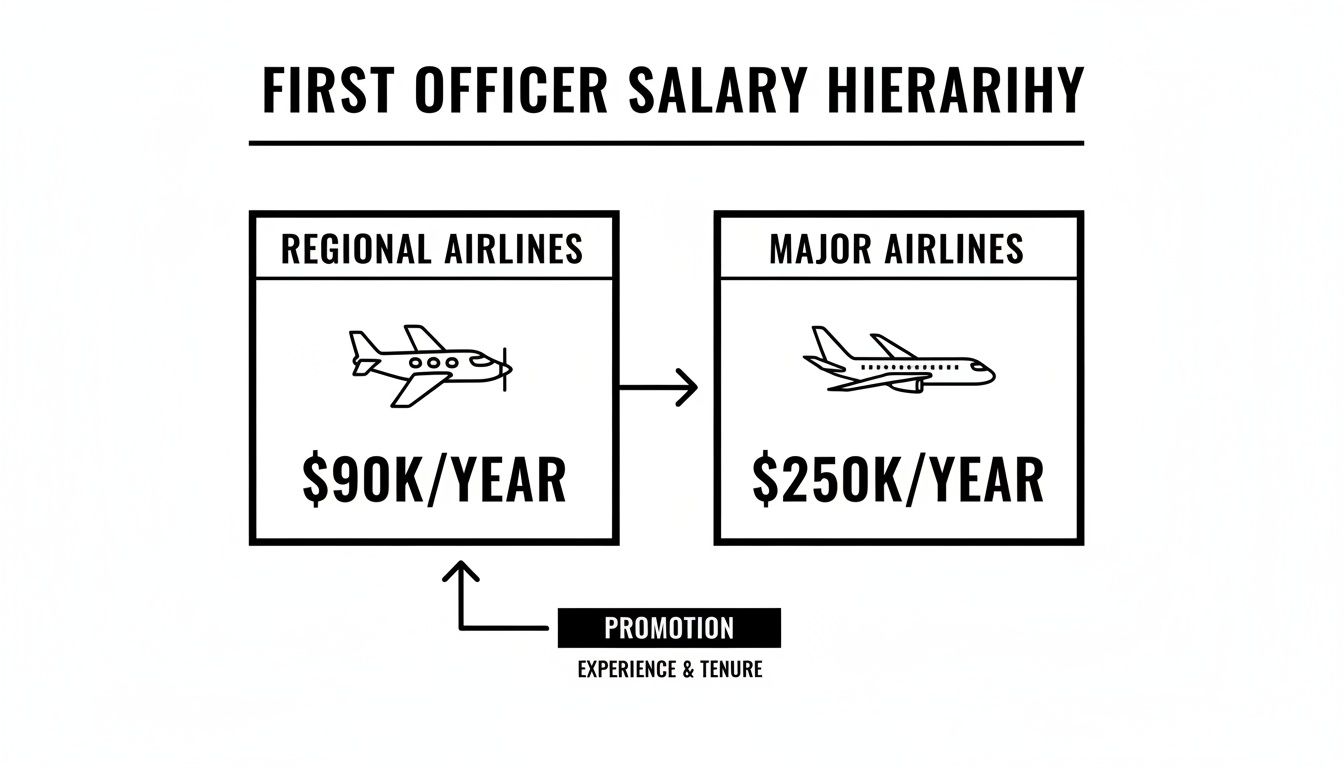
As you can see, the path to a top-tier salary runs directly through the cockpit of a larger plane.
Regional Jets: The Starting Point
For most new airline pilots, the journey begins at a regional carrier. This is where you’ll get your hands on jets like the Embraer 175 or the CRJ900. These are the workhorses of the domestic sky, connecting smaller cities to the major hubs and building your flight hours.
While the experience is absolutely vital, the pay reflects the smaller scale of the operation. Your first assignment as a newly-hired first officer will be to get "type-rated" on one of these aircraft. You can get a deeper look at this career stage in our guide explaining what defines a regional airline.
A pilot's career path is a ladder, and each new aircraft type rating is a step up. Your goal is to keep climbing toward the larger, more complex aircraft that command higher salaries and international routes.
Coming in, a first-year FO at a regional can expect an hourly rate of $85 to $95. With guaranteed hours, this usually translates to a starting salary in the $75,000 to $95,000 range. It’s a good living, but the real money is waiting at the next level.
Narrowbody and Widebody Aircraft: The Goal
The most significant leap in pay happens when you make the move to a major airline and start flying bigger iron. These aircraft fall into two main categories: narrowbodies (like the Boeing 737 and Airbus A320) and widebodies (like the Boeing 777 or Airbus A350).
Because these jets are more complex, fly longer international routes, and carry hundreds of passengers, the pay scale is substantially higher. A first-year FO at a major could see an hourly rate of $120 to $150, pushing their initial annual salary to $110,000 to $150,000 or more right out of training.
Looking ahead, the numbers get even better. Based on the latest analysis of pilot salaries for 2026, experienced narrowbody pilots could be earning between $250,000 and $350,000. That’s the career goal you’re aiming for.
The Hidden Boosters in Your Pilot Paycheck
A first officer's salary is much more complex than a simple hourly wage. It's best to think of your hourly rate as the foundation, with several other income streams stacked on top that build your true annual earnings. Getting a handle on these "hidden boosters" is the key to comparing job offers and really understanding your financial future as a pilot.
One of the first you'll encounter is per diem. This is a tax-free daily allowance the airline pays you for meals and other small expenses whenever you're on a trip. While it might only be a few dollars an hour, this really adds up. Over a year, we’re talking thousands of tax-free dollars that go straight into your bank account.
Beyond the Hourly Rate
Your hourly rate and per diem are just the beginning. Airlines use a whole menu of financial incentives to bring in and keep good pilots, and these can seriously inflate your annual income.
These extra pay components can make a huge difference:
- Signing Bonuses: When pilot demand is high, it’s not uncommon to see airlines offer massive one-time bonuses—sometimes hitting $50,000 or more—just for signing a contract.
- Overtime Pay: If you fly more than your monthly guaranteed hours, you get paid extra for it. This "premium pay" is often set at 150% or 200% of your normal hourly rate.
- Profit Sharing: Many of the major airlines give back a slice of their annual profits to employees. This often shows up as a hefty yearly bonus that can boost your salary by 10% to 20%.
- Holiday Pay: Working on major holidays like Christmas or Thanksgiving almost always comes with premium pay, often double your normal rate.
It’s also smart to look for ways to keep more of what you earn. For example, many pilots can reduce their tax burden by properly tracking business mileage for tax deductions for travel to and from the airport.
The Power of Pilot Unions
So, who do you thank for these robust pay structures? In large part, it's the powerful pilot unions, like the Air Line Pilots Association (ALPA). These organizations are central to a pilot's financial career, negotiating the contracts that define nearly every part of the job through collective bargaining.
A union contract is the rulebook for your career. It sets your hourly wages, defines your work rules, guarantees your minimum monthly hours, and dictates how your pay increases with seniority.
These contracts are what create a transparent and predictable career path. They lock in the exact pay scales for each aircraft and year of service, making sure every pilot is paid fairly and consistently. Without these hard-fought agreements, the high salaries and strong benefits that pilots enjoy today simply wouldn't exist. They are the ultimate backstop for your earning potential.
Your Financial Journey From First Officer to Captain
A pilot’s career isn’t a straight line; it’s a journey of compounding returns. That initial first officer salary is just the starting block. With every new rating and each year you log in the cockpit, you're not just gaining experience—you're unlocking a whole new level of earning potential.
To see how this plays out, let's follow the career of a pilot we'll call "Alex." Like many new pilots, Alex starts out at a regional airline. The pay is modest, but the goal here isn't just the paycheck. This is the proving ground, the place to build invaluable flight hours and master the systems of a modern jet from the right seat.
The Five-Year Mark
Fast forward five years, and Alex's financial world looks completely different. After putting in two or three years at a regional, gaining the necessary experience and flight time, Alex successfully lands a job with a major carrier. This one move represents the single biggest pay jump most pilots will ever see.
Making the leap from the right seat of a CRJ to a Boeing 737 means a huge bump in hourly pay. It also comes with far better benefits and the chance to get a piece of the company’s success through profit sharing. At this point, Alex's annual income has easily doubled from that first regional salary, now sitting comfortably in the six-figure range.
Think of your career progression like a financial snowball. That first push at the regionals is the hardest part. But once it starts rolling and you make the move to a major airline, it picks up speed and grows bigger and bigger with every year.
The Ten-Year Milestone
A decade into the career, Alex is a senior first officer at a major airline. By now, they might be flying widebody jets on lucrative international routes. Seniority is king at the airlines, and it brings automatic pay raises every single year, all spelled out in the pilot union contract.
Even flying the same plane in the same seat, a pilot's pay increases annually. Alex's first officer salary is now pushing the top of its scale, and the ultimate goal—the captain's seat—is finally on the horizon. When you factor in per diem, overtime, and profit sharing, the total compensation package is substantial.
Achieving the Captain's Seat
Sometime between the 10- and 15-year mark, an opening appears. Alex bids for and successfully completes captain upgrade training. For most pilots, this is it—the final, major leap in pay and responsibility.
As a brand-new captain on a narrowbody jet, Alex's hourly rate is now nearly double what it was as a top-earning senior first officer. The responsibility is immense, but so are the financial rewards.
Over a 30-year career, a pilot who follows this path to become a captain at a major airline can expect to earn millions. It's a powerful reminder of the incredible long-term value that comes from investing in a top-tier aviation career.
A Pilot's Guide to Buying and Selling Aircraft
Once you start earning a solid first officer salary, that thought you've been pushing to the back of your mind starts to get a lot louder: Maybe I could own my own plane. What once felt like a distant dream suddenly seems within reach, whether you're imagining a helicopter for weekend adventures or a fixed-wing for personal travel.
For many of us, a professional career in aviation just fuels a deeper personal passion for flying. Owning an aircraft is the natural next step. But it's a huge milestone, and you want to get it right.
The Safe Way to Buy an Airplane
Buying an aircraft isn’t like buying a car. It's a massive investment, and a moment of impatience can lead to years of headaches and unexpected bills. You have to be methodical.
Here's a breakdown of the process that seasoned owners follow to protect themselves:
Define Your Mission: Before you even start browsing listings, you have to be brutally honest about what you'll use the plane for. Are you planning short, local hops for fun, or do you need to fly the family across several states? The answer dictates everything—speed, range, payload, and ultimately, your operating costs. A good place to start is to see how popular models stack up, like in our comparison of the Piper Cherokee vs. the Cessna 172.
Secure Your Financing: Get your money sorted out before you fall in love with a plane. Talk to lenders who specialize in aviation financing. Walking into a negotiation pre-approved not only gives you a firm budget but also shows the seller you’re a serious, credible buyer.
Conduct a Pre-Purchase Inspection (PPI): This is the single most important step. Never, ever skip it. You need to hire a trusted, independent A&P mechanic—someone with no connection to the seller—to conduct a thorough inspection. They are your eyes, looking for the hidden corrosion, engine issues, or shoddy repairs that could turn your dream into a money pit.
Manage the Paperwork: Paperwork is everything in aviation. Always run a full title search to make sure there are no outstanding liens on the aircraft. From there, use a well-regarded aviation escrow service to handle the money. This protects both you and the seller, ensuring funds are only transferred once every condition of the sale has been met.
Preparing to Sell Your Aircraft
When the time comes to sell, the tables are turned. Getting a fair price and attracting qualified buyers takes the same level of care you used when you bought the plane. A well-prepared aircraft simply sells faster and for more money.
First things first: get your logbooks in order. They're the aircraft's complete history, and any serious buyer will scrutinize them. A clean, complete, and organized set of logs immediately builds trust.
Next, get the aircraft detailed, inside and out. A professional cleaning makes a world of difference and shows you've cared for your machine. Then, write a compelling listing with high-quality photos from every angle, and be transparent about the aircraft’s specs, equipment, and maintenance history.
Finally, think about demo flights. Have a clear, firm plan for how they'll be conducted. This is about managing the process safely and making sure only serious, qualified pilots are in the left seat.
How Quality Training Directly Boosts Your Earning Potential
A high first officer salary isn't something you just fall into—it’s built on the foundation you lay from your very first flight lesson. Think of your training as the most critical investment you'll make in your entire career. The quality of that initial training directly impacts how quickly you reach a six-figure income.
Choosing the right flight school isn't about finding a famous brand. It's about immersing yourself in an environment that mimics the real world of airline operations. When you learn to fly at a busy, towered airport, you’re not just going through the motions. You’re mastering the complex radio calls and airspace procedures you'll use every single day as a professional pilot.
Building a Competitive Edge from Day One
This kind of real-world proficiency is what makes you stand out to recruiters. Airlines aren't just looking for someone with a pilot certificate; they want pilots who can immediately and confidently step into the fast-paced, demanding environment of commercial flying.
Training in a challenging setting builds the right kind of muscle memory. It means that when you walk into an airline interview, you’re not just reciting what you read in a book—you’re speaking from genuine, firsthand experience.
The most valuable thing you bring to an airline isn’t just your license. It's your proven ability to operate safely and think on your feet in a complex environment.
This level of experience comes from a few key elements in your training:
- Diverse Fleet Experience: Getting comfortable in different aircraft, especially mastering a multi-engine airplane, shows airlines you can adapt to new systems and flight characteristics. This is a non-negotiable skill for a professional career.
- One-on-One Instruction: Personalized time with a seasoned instructor is invaluable. It ensures you don’t just pass your checkrides, but that you truly understand the "why" behind every maneuver and decision, leaving no gaps in your knowledge.
Ultimately, your flight training sets the entire pace for your career. By choosing a program that pushes you and mirrors the professional world from the start, you build the exact skills that put you at the top of the hiring pool. This is how you climb the seniority list faster, reach that impressive first officer salary sooner, and get on the path to the captain’s seat years ahead of schedule.
Answering Your Top Questions About Pilot Salaries
As you map out your career path, you're bound to have questions about how pilot pay really works. Let's tackle some of the most common ones we hear from aspiring pilots.
How Long Does It Take to Move From a Regional to a Major Airline?
The jump from a regional airline to a major carrier typically takes anywhere from two to five years. This is the time when you're building the critical flight hours and real-world experience that the majors demand.
Of course, this isn't a hard-and-fast rule. We've seen a lot of hiring surges lately that have opened the door for well-prepared pilots to make the move even faster. The key is getting high-quality training in complex environments, which makes you a much more attractive candidate right out of the gate.
Think of your time at a regional airline as your big-league training camp. It's where you polish your skills and prove you're ready for the majors, where your first officer salary will really take off.
Do Cargo Pilots Make as Much as Passenger Airline Pilots?
Absolutely. In many cases, they actually earn more. First officers flying for top-tier cargo operations like FedEx or UPS often find their paychecks are just as good, if not better, than those at the major passenger airlines.
Why? It comes down to the aircraft. Cargo pilots are often at the controls of the largest, heaviest jets on long-haul international routes. Their compensation directly reflects the complexity and responsibility of flying that kind of equipment around the globe.
What Is a Scope Clause and How Does It Protect Pilot Pay?
A scope clause is one of the most important parts of a pilot union's contract, and it's a huge reason pilot salaries have remained so strong. In simple terms, it's a rule that limits which aircraft can be flown by an airline's regional partners.
This prevents a major airline from outsourcing flights on larger jets (like a Boeing 737 or Airbus A320) to regional carriers, where pilots are paid on a lower scale. By keeping those bigger planes "in-house," the scope clause protects jobs and pay for pilots at the mainline airline, ensuring a high first officer salary remains the industry standard.
Ready to build the foundation for your own high-earning aviation career? DuBois Aviation provides the real-world training and expert instruction you need to stand out. Explore our Airline Career Program.


