
Understanding Regional Airlines and Their Role
Ever booked a flight on American, United, or Delta, only to show up at the gate and see a smaller jet with a different name on the side, like "American Eagle," "Delta Connection," or "United Express"? You’ve just encountered a regional airline.
These carriers are the essential connective tissue of the U.S. air travel system. They act as feeder carriers, operating the shorter routes that bring passengers from smaller communities into the massive hub airports of their major airline partners.
What many people don't realize is that these are entirely separate companies. Their business model is built on a special partnership with the major airlines, typically called a capacity purchase agreement.
Under this arrangement, the major airline essentially hires the regional to fly specific routes for them. The major carrier handles all the marketing, ticketing, and pricing, while the regional airline focuses purely on the operational side of things: crewing the planes, maintaining the fleet, and flying the schedule.
The core job of a regional airline is to provide consistent, reliable service on routes that aren't a good fit for a major carrier's larger aircraft. They keep smaller cities connected to the global travel network.
This setup works beautifully for both sides. Major airlines can offer a much larger route map without the cost and complexity of operating smaller planes. In return, regional airlines get a predictable and stable source of revenue, insulated from the risks of ticket sales.
Regional vs Major Airlines at a Glance
To put it all into perspective, let's break down the key operational differences between the regionals and the majors they fly for.
| Characteristic | Regional Airline | Major Airline |
|---|---|---|
| Primary Role | Connects smaller cities to major hubs ("feeder") | Connects major hubs and international destinations |
| Aircraft Type | Smaller jets and turboprops (e.g., CRJ, E-Jet) | Large jets (e.g., Boeing 737, Airbus A320) |
| Passenger Capacity | Typically 50-76 seats | Typically 150-300+ seats |
| Route Structure | Short-haul, high-frequency flights | Long-haul domestic and international flights |
| Branding | Often operates under partner's brand (e.g., United Express) | Operates under its own well-known brand (e.g., United) |
As you can see, each type of airline has a distinct and specialized role in the industry. They aren't competitors; they're partners that depend on each other to build a comprehensive national and international network.
The Business Behind the Regional Airline Model
Ever noticed how your ticket might say "American Airlines," but the plane you board is a smaller jet branded as "American Eagle"? That’s the regional airline business model in action, and it’s built on a fascinating partnership with the major carriers.
At the heart of this relationship is something called a capacity purchase agreement (CPA). It's not your typical business arrangement. Think of it this way: a major airline like United is the general contractor for a massive construction project. They handle the big-picture stuff—designing the routes, selling the tickets, and putting their brand on the final product. But for certain jobs, like flying shorter routes to smaller cities, they subcontract the work to a specialized crew—the regional airline.
How Capacity Purchase Agreements Work
Under a CPA, the major airline essentially "buys" all the seats on a regional carrier's flight. The major takes on all the commercial risk. They're the ones responsible for:
- Ticket Sales: Setting the prices and making sure the flight is full.
- Marketing and Branding: The flight operates under their banner, like Delta Connection or United Express.
- Fuel Costs: In most cases, the major airline even pays for the fuel.
So, what does the regional airline do? They focus purely on the operational side of things. They provide the aircraft, the pilots and flight attendants, and the maintenance to fly the routes laid out by their major partner. In return, they get a fixed fee for each flight they operate. This gives them a steady, predictable source of revenue without having to worry about the unpredictable nature of ticket sales.
Of course, this creates a very dependent relationship. The regional carrier operates on incredibly thin margins and their entire business hinges on keeping those contracts with the majors. If a major airline decides to cut back on flights during an economic downturn, the regional carrier is the first to feel the pinch.
A key takeaway from the RAA 2025 conference was just how sensitive this industry is to economic shifts. Experts highlighted that regional airlines lean heavily on their major partners, who not only buy their capacity but often cover major expenses like fuel, underlining the high-stakes dependency of the model. You can dive deeper into these trends with analysis from AirInsight.
This entire structure shapes the regional airline world, making it a fast-paced environment where efficiency is everything. It provides a fantastic, structured pathway for new pilots to build experience, but it also highlights the economic realities that define a career in this crucial part of the aviation industry.
Fleet Focus: The Aircraft That Define Regional Flying
Chances are, your first flight on a smaller connecting route put you on one of the workhorse aircraft of the airline industry. These aren't the giant Boeing 777s or Airbus A380s that handle international flights; we're talking about the smaller, incredibly efficient jets and turboprops that are the backbone of regional aviation.
For any pilot starting their career, these are the planes that mark the transition from the training environment to the professional flight deck.
You'll quickly find that two names show up constantly on the ramps at regional airports: Embraer and Bombardier (now Mitsubishi). Their jets are the undisputed kings of connecting smaller cities to the major airline hubs, and as a regional pilot, you’re almost guaranteed to spend a lot of time in one.
The Modern Regional Jet
So what makes these planes the perfect tool for the job? They hit a sweet spot, balancing passenger comfort with the rugged economics needed to fly shorter routes profitably, often into airports that can't handle a larger jet.
- Embraer E-Jet (E175): Pilots and passengers love this one. It’s known for a comfortable 2-2 seating layout, which means no one gets stuck with a middle seat. Typically configured for about 76 passengers, it has a surprisingly spacious feel for a regional aircraft.
- Bombardier/Mitsubishi CRJ (CRJ-700/900): The CRJ family really pioneered the modern regional jet market. The CRJ-700 and CRJ-900 are true workhorses, seating anywhere from 65 to 76 passengers. They make it possible for airlines to offer jet service on routes that couldn't support a bigger mainline plane.
These aircraft are built for flights that are generally under two hours. Their efficiency—lower fuel burn and maintenance needs—is what makes the entire regional airline business model work.
The connection between an airline and its fleet can be incredibly strong. Think of the now-defunct UK carrier Flybe; it was completely synonymous with the Dash 8/Q400, a highly efficient turboprop that was perfect for its short-hop domestic network.
From Training Aircraft to Regional Jet
As a student at a school like DuBois Aviation, you start your journey in a Cessna or a Piper. That's step one. The next giant leap in your professional career is stepping onto the flight deck of an E175 or a CRJ.
This isn't just a small step up; it's a fundamental shift. You go from flying a single-piston-engine plane by yourself to operating a complex, multi-crew, turbine-powered jet. The skills you master here—managing sophisticated glass-cockpit avionics, communicating effectively as a crew, and operating in the fast-paced airline system—are precisely what the major airlines are looking for when they hire for their widebody fleets.
The Regional Airline Pilot Career Path
For any pilot with their sights set on the major airlines, the regional carriers aren't just a stepping stone—they're the main highway. Think of it as the most proven and reliable route to a long-term career in the cockpit of a large airliner. This is where pilots forge their skills and build the experience that the "majors" demand.
The entire journey from a newly minted commercial pilot to an airline captain is a game of hours. Specifically, you need to log 1,500 flight hours to earn your Airline Transport Pilot (ATP) certificate, which is the top-tier license required for airline jobs. Regional airlines are custom-built to help you do just that. They call it "hour building," and it’s the critical phase where you transition from student to professional.
Landing your first job as a First Officer at a regional airline is where the real learning begins. You're no longer just flying; you're operating in a two-pilot crew, managing sophisticated jet systems, and navigating the busiest and most complex airspace in the world, day in and day out. It’s this intense, real-world experience that makes you a valuable candidate for the major airlines down the line.
The Typical Career Progression
So, what does this path actually look like? It’s a pretty well-trodden road.
- You'll start as a First Officer at a regional airline like SkyWest, Republic, or Envoy Air.
- After a few years, once you’ve built enough flight time and experience, you can upgrade to Captain at that same regional.
- With captain time on your logbook, you become a top-tier applicant for a First Officer position at a major carrier like Delta, United, or American.
This progression—from a small trainer plane, to a regional jet, and finally to a major airline’s wide-body aircraft—is the standard playbook for an airline career.
This infographic shows exactly what that fleet progression looks like for a typical pilot.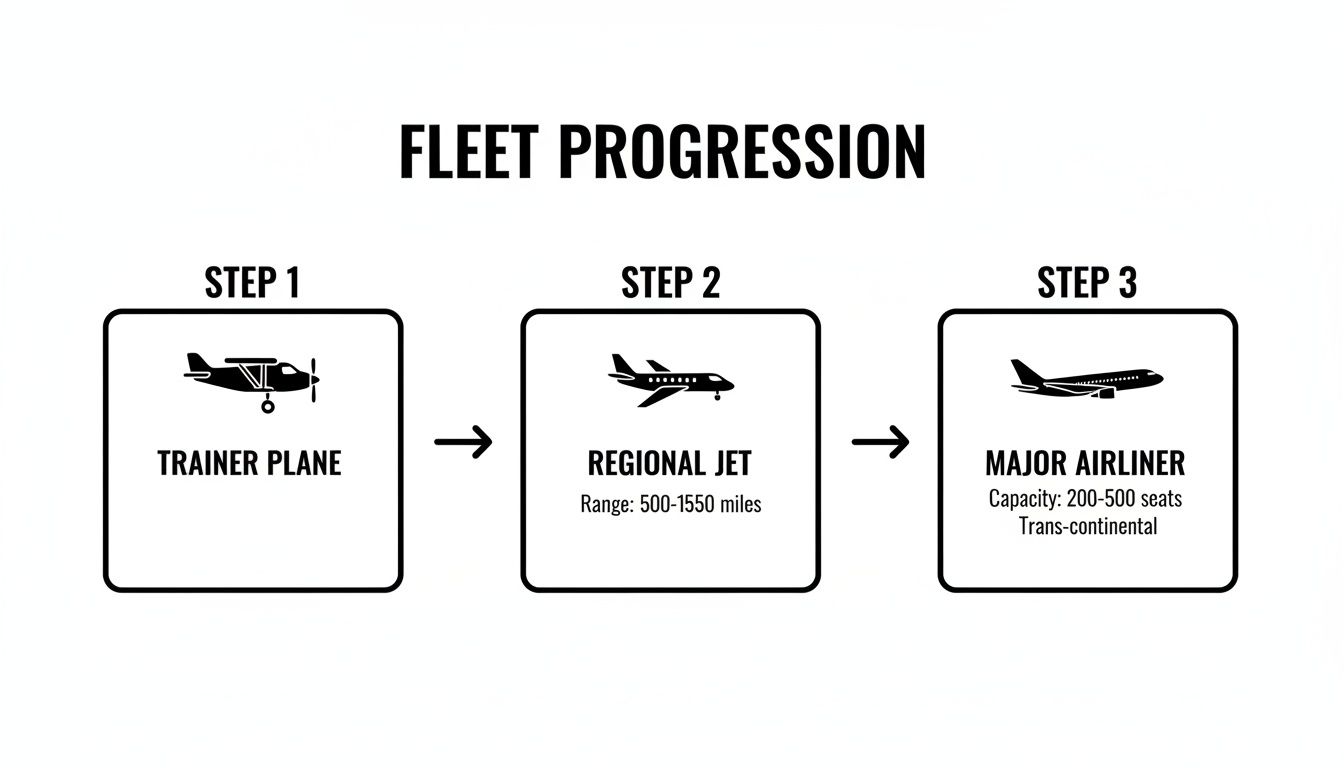
You can see the clear jump from the aircraft used in training to the jets that define regional and major airline flying.
The regional airline job is the essential bridge. It’s where pilots take the skills they learned in flight school and temper them in the fire of daily airline operations, turning raw talent into the polished expertise needed to command a multi-million dollar airliner.
This structured pathway is why starting at a regional is such a fundamental part of the journey. If you want to dive deeper, we’ve laid out the entire process in our detailed guide on the airline pilot career path.
Of course, none of this happens without a solid foundation. It all starts with high-quality flight training to get the licenses and ratings you need to even be considered for that first regional airline job. Your success in flight school is the launchpad for everything that follows.
How to Buy Your First Airplane the Safe Way
Even while building a career with a regional airline, many pilots hold onto a different dream: owning their own plane. Bringing home your first airplane or helicopter is an amazing feeling, but it’s a process you have to get right. Think of it less like buying a car and more like acquiring a high-performance, specialized piece of machinery—doing your homework upfront is the key to making it a secure and exciting journey, not a stressful one.

Before you even start looking at listings, you need to get brutally honest about your mission. What are you actually going to do with this aircraft? Are you just looking for a simple, fun machine for weekend joyrides? Or do you need something more capable for cross-country business trips? Your answer will point you toward the right type of aircraft and, just as importantly, establish a realistic budget.
Budgeting Beyond the Purchase Price
The sticker price is just the beginning. First-time owners are often surprised by the ongoing costs, which can be significant. A realistic budget must account for these recurring expenses.
- Maintenance and Inspections: Annual inspections are required by law, and you can bet that unexpected repairs will pop up. Smart owners set aside a dedicated maintenance fund from day one.
- Insurance: This is a major yearly expense that can fluctuate wildly based on the aircraft model and your own flight experience.
- Hangar or Tie-Down Fees: Your plane needs a home. These monthly storage fees are a permanent part of the cost of ownership.
- Fuel Costs: This is the most obvious variable, but it's crucial to factor it into your regular operating budget.
The single most important step in buying an aircraft is the pre-buy inspection. This is a thorough, top-to-bottom examination of the airframe, engine, and all its logbooks. It absolutely must be performed by a qualified, independent A&P (Airframe and Powerplant) mechanic who has no connection to the seller. This inspection is your best and only defense against hidden, costly problems that could turn your dream into a nightmare.
Navigating the Final Steps
Once the pre-buy inspection is finished and you’re ready to commit, it’s time for the paperwork. You'll need to conduct a title search to make sure there are no hidden liens on the aircraft, then complete the official FAA bill of sale and registration documents.
This part of the process can be tricky if you've never done it before, so getting guidance is a smart move. Many pilots turn to aviation service centers that specialize in aircraft sales and management. If you’re looking for that kind of expert help, our partners at Threshold Aviation Group can guide you through these final, crucial steps to make sure everything is handled correctly and securely.
Qualifying for a Regional Airline Pilot Job
So, you’ve set your sights on the flight deck of a regional airliner. Getting there isn't a mystery; it’s a well-defined path built on earning the right licenses, ratings, and experience. Think of it as a series of building blocks, each one setting you up for the next.
It all starts with your Commercial Pilot License (CPL). This is the foundational certificate that legally allows you to get paid for flying. But to get noticed by the airlines, you need to go further.
From there, you’ll add two crucial ratings. The Instrument Rating (IR) is non-negotiable—it proves you can safely fly the aircraft through clouds and poor weather by relying solely on your instruments. You'll also need a Multi-Engine Rating (ME) to be qualified to operate the kinds of twin-engine aircraft that regionals fly.
Building Your Hours and Experience
With your licenses and ratings in hand, the next mission is all about building flight time. The big ticket is the Airline Transport Pilot (ATP) certificate, the highest-level license a pilot can hold. To get it, you’ll need 1,500 total flight hours.
Some pilots can get there a bit faster with a Restricted ATP (R-ATP), which lowers the requirement to 1,000 or 1,250 hours for those who, for example, graduate from an approved university aviation program.
So, how do you log all those hours? The most common and effective way is by becoming a Certificated Flight Instructor (CFI). It’s a fantastic job—you get paid to fly while teaching the next generation of pilots, which sharpens your own skills and decision-making like nothing else. We cover all the specifics in our guide to getting your commercial pilot license.
Training at a busy, towered airport provides a significant advantage. Learning to navigate complex airspace and communicate with Air Traffic Control from day one builds the real-world skills and confidence that airlines actively seek, preparing you for success from your very first flight.
The industry is hungry for sharp, well-trained pilots. With airlines projected to fly 5.2 billion passengers globally in 2025, the demand is clear. This trend, combined with ongoing efforts to hire more air traffic controllers, makes pilots who are comfortable and confident in busy airspace incredibly valuable. You can dive deeper into the latest industry projections with this aviation performance tracking for April 2025.
Finally, when it’s time to apply, keep in mind that most airlines use software to screen applications before a human ever sees them. It’s smart to learn how to create resumes that beat the bots to make sure your hard-earned qualifications get the attention they deserve.
Frequently Asked Questions About Regional Airlines
As you map out your path to the flight deck, a few common questions always seem to pop up about working for a regional carrier. Let's tackle some of them head-on.
Is the Pay at a Regional Airline Good?
It absolutely can be, especially now. The old narrative of scraping by as a regional pilot is largely a thing of the past. Due to high demand, regional airlines have significantly increased first-year officer pay, with many pilots earning $90,000 or more in their first year when you factor in signing bonuses.
While it's true that major airline salaries are higher, the compensation at the regional level is more than enough to build a great life while you gain invaluable turbine experience.
What’s the Lifestyle Like for a Regional Pilot?
Your lifestyle is largely determined by your "base"—the city where you start and end your trips. If you live in your base city, you get to come home after every trip. Many pilots, however, choose to "commute" by flying from their home city to their base to start a work trip.
Schedules are built on seniority. New pilots can expect to work more weekends and holidays, but as you build time with the airline, you gain more control over your schedule. A typical trip might involve flying for 3-4 days and then having several days off.
Is Working for a Regional Airline a Good Career?
Yes, for two main reasons. For many, it's the perfect long-term career. They enjoy the routes, the aircraft, and the company culture, and they build a fantastic life as a respected captain at their regional airline.
For others, it's a critical stepping stone to a major airline like Delta, American, or United. The experience gained flying a regional jet is precisely what majors look for. Most pilots at major airlines today spent several years flying for a regional carrier first.
No matter your ultimate goal, a job at a regional airline is a major accomplishment. It means you’ve made it to the professional leagues of aviation, flying sophisticated jet aircraft and taking on the immense responsibility of passenger safety.
Ready to start your journey to the flight deck and, eventually, a career with a regional airline? DuBois Aviation provides the expert, one-on-one instruction you need to achieve your goals safely and efficiently. Start your adventure with us by visiting https://duboisaviation.com.