
You're standing on the ramp with the airplane fueled, preflight done, headset plugged in, and a passenger who's already taking photos. The haze over the hills doesn't look terrible, but it isn't clean either. The wind is a little more active than forecast. Ground control is busy. Nothing is screaming “cancel,” which is exactly why this moment matters.
Most bad flying decisions don't start with drama. They start with a pilot talking himself into “good enough.”
Go no go criteria aren't just a checklist item for a practical test. They're the discipline of deciding what conditions you will accept, what you won't accept, and what will make you stop even when the airplane is ready and the schedule says go. That applies before departure, during approach, and even when you're looking at buying or selling airplanes and helicopters. The safest flight is often the one you never take, and the smartest aircraft deal is often the one you walk away from.
Table of Contents
- The Most Important Flight You Never Take
- The PAVE Checklist Your Four Pillars of Safety
- Building Your Personal Minimums Template
- The Go No Go Decision Flow in Action
- Training Your Decision Making Muscle
- Go No Go Criteria for Buying an Aircraft
- Putting It All Together at Chino Airport
The Most Important Flight You Never Take
At a busy airport like KCNO, a no-go decision rarely feels heroic. It usually feels inconvenient.
You may have a Piper Cherokee sitting on the line, a smooth engine start in your future, and a simple local flight in mind. Then you notice the visibility isn't developing the way you expected. The windsock is moving more than you like. The route that looked easy on paper now has enough friction built into it that your margin is shrinking before you've even called for taxi.
That is the go/no-go moment. Not in cruise. Not during the debrief. Right there, while you still have complete control over the outcome.
According to the FAA Helicopter Flying Handbook, citing National Transportation Safety Board statistics, approximately 80% of all aviation accidents are linked to decision-making failures, with the go/no-go decision identified as a critical point where accidents originate. That should change how every pilot thinks about preflight risk. The issue usually isn't some dramatic mechanical event. It's a pilot continuing when the safer call was to stop.
Practical rule: If the flight only works when every variable behaves, it doesn't work.
Students sometimes think good judgment means pushing through mild uncertainty with confidence. It doesn't. Good judgment means recognizing when uncertainty is the hazard.
The flight you cancel because the haze is thicker than expected, because the crosswind doesn't match your comfort level, or because you're mentally behind the airplane won't make a story. It also won't make an accident report. That's the point. A strong pilot doesn't prove skill by launching into a marginal setup. A strong pilot protects options by saying no early.
The PAVE Checklist Your Four Pillars of Safety
When pilots talk about go no go criteria, the best place to start is PAVE. It gives structure to what otherwise becomes wishful thinking.
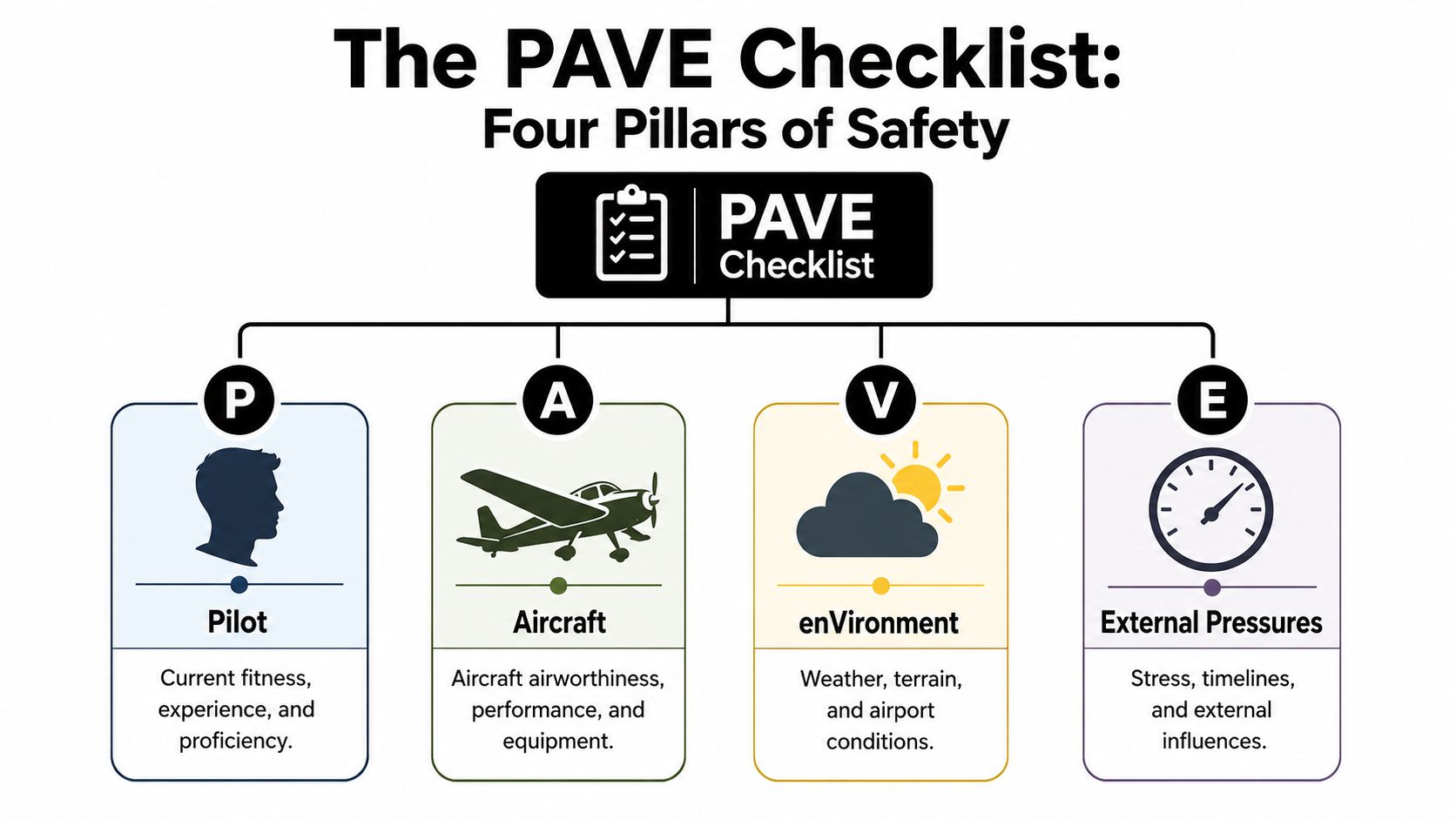
Without structure, pilots tend to overweight one factor and ignore the others. They'll focus on weather but skip a hard look at their own fatigue. Or they'll trust the airplane because it flew yesterday without checking whether today's runway, loading, and density altitude change the picture.
Pilot
Start with yourself, not the airplane.
Use the I'M SAFE habit: illness, medication, stress, alcohol, fatigue, and eating. Then go one step further. Are you current, or are you proficient for this specific flight? There's a difference. A pilot can be legal and still not be sharp enough for a gusty pattern, a short flight with heavy radio work, or a cross-country that may require rerouting.
Ask yourself:
- Fitness today: Are you tired, distracted, dehydrated, or mentally rushed?
- Proficiency for this mission: Have you flown recently in winds, traffic, or airspace complexity similar to what you're about to enter?
- Skill honesty: If conditions worsen slightly, will your workload stay manageable?
Aircraft
The airplane gets a vote. So does the helicopter. It just doesn't get the only vote.
Aircraft risk includes maintenance status, equipment function, fuel planning, performance, weight and balance, and whether the machine matches the mission. A basic trainer may be perfectly airworthy and still be the wrong tool for a hot day, a heavy load, or a route with limited outs.
A useful way to think about this pillar is simple: airworthy doesn't automatically mean suitable.
Environment
Many pilots become too casual because the conditions look merely annoying instead of obviously dangerous.
Expert-defined no-go parameters for general aviation include a mandatory runway length of at least 2,500 ft (paved) with zero tailwind component upon landing, and a strict prohibition on operations if moderate icing or any freezing precipitation is forecast. That's practical guidance because environment risk tends to stack. A little wind, a little contamination, a little forecast uncertainty, and a little terrain can combine into a very bad day.
Check the environment in layers:
- Weather trend: Is it improving, holding, or slowly getting worse?
- Runway reality: Surface, length, slope, and tailwind matter more than optimism.
- Airspace and terrain: Busy radios and nearby rising terrain increase workload fast.
Don't ask whether the weather is legal. Ask whether it leaves you room to be wrong.
External Pressures
This pillar causes a lot of bad launches because it doesn't look like weather or maintenance. It looks like a commitment.
A passenger took time off. A friend is waiting. You booked the airplane. You don't want to disappoint anyone. Those pressures are real, and they subtly distort judgment. The answer is to name them directly.
Here's what doesn't work: “I'll just be extra careful.”
Here's what does work:
| Pressure source | Bad response | Better response |
|---|---|---|
| Passenger expectation | Launch to avoid awkwardness | Brief the delay or cancellation early |
| Schedule pressure | Compress planning | Add decision checkpoints before engine start |
| Pride | Prove capability | Protect standards |
| Rental timing | Hurry the preflight | Accept that losing the slot is cheaper than forcing the flight |
Building Your Personal Minimums Template
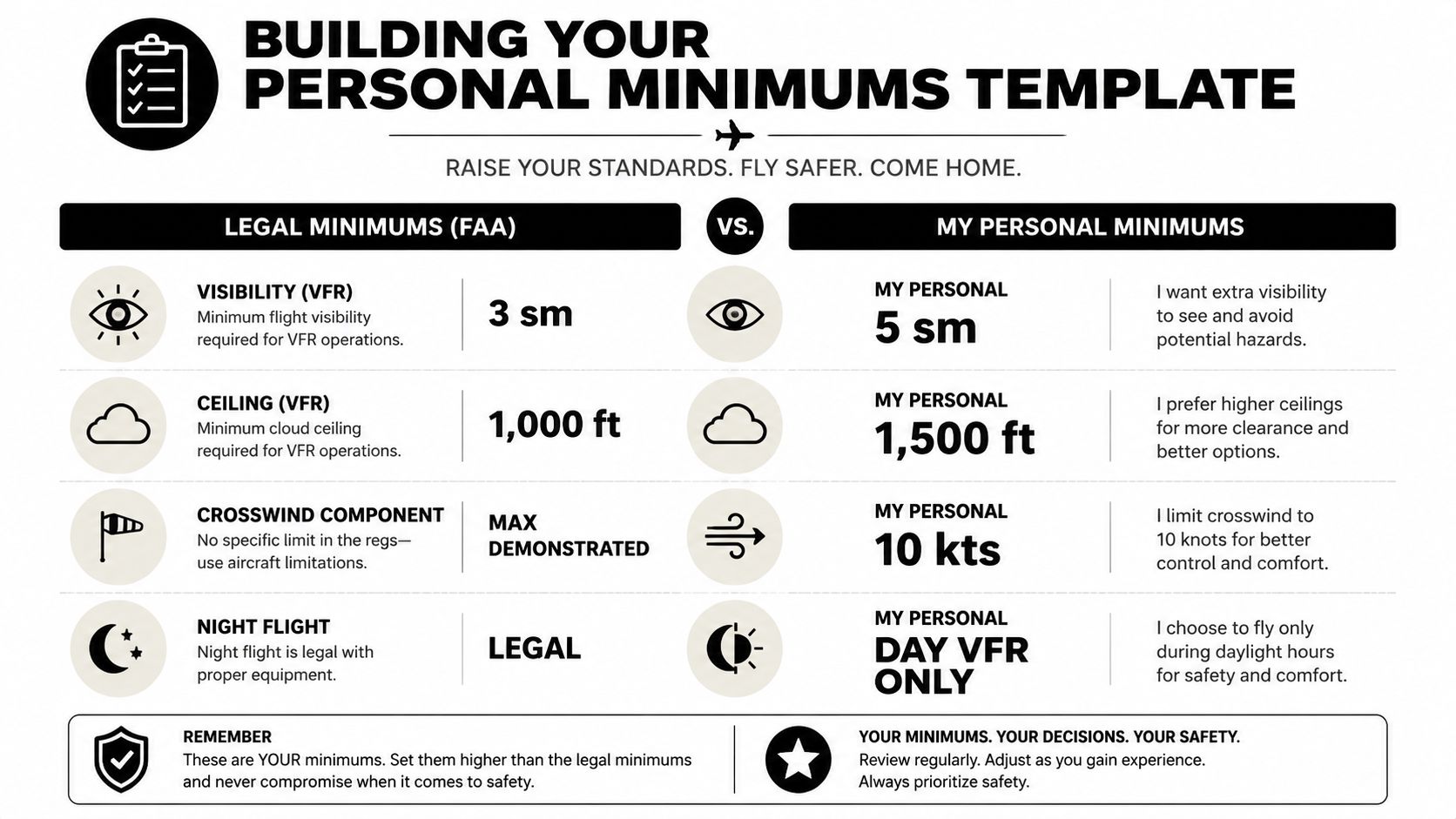
Legal minimums are not a personal safety strategy. They're a floor.
A private pilot certificate doesn't mean every legal day is a smart day to fly. Your recent experience, sleep, aircraft familiarity, route complexity, and weather trend all matter. Go no go criteria become powerful when you write them down as personal minimums and treat them as binding.
Legal Is Not Personal
A student pilot, a rusty private pilot, and a current instrument pilot may all look at the same weather briefing and reach different decisions. That's normal. The mistake is pretending one line in the regulations answers all three situations.
What matters is building a buffer between legal and wise. The point isn't to impress anyone with conservative numbers. The point is to define limits before emotion enters the room.
That logic shows up far outside aviation. In other fields, teams use qualification gates because decisions drift when people rely on enthusiasm alone. The same discipline behind a guide to qualifying leads applies in the cockpit. Set pass or fail criteria first, then evaluate against them objectively.
A Working Personal Minimums Template
A useful template is short enough to use and specific enough to stop rationalization.
| Category | My current limit | Notes |
|---|---|---|
| Day VFR visibility | Write your number | Increase margin if rusty |
| Ceiling for local flights | Write your number | Use a higher ceiling for training days with more task loading |
| Surface wind | Write your number | Separate steady wind from gusts |
| Crosswind component | Write your number | Base it on demonstrated comfort, not ego |
| Night flying | Allowed or not today | Tighten after any break from flying |
| Fuel reserve | Write your rule | Add margin for delays and vectors |
| Passenger flights | More restrictive or same | Many pilots should tighten standards with non-pilot passengers |
| Alternate plan | Required or not | Decide when a backup airport is mandatory |
Use the same approach for helicopters. Build criteria around visibility, wind, route options, mission pressure, and what landing areas remain available if conditions tighten.
For fixed-wing pilots, performance planning belongs inside this template. If you haven't recently worked through takeoff and landing calculations, refresh your habits with these aircraft performance charts. Numbers only help if you use them before you taxi.
When to Tighten and When to Expand
Personal minimums should move. They just shouldn't move casually.
A useful rule is to tighten after a layoff, after a bad lesson, after a high-workload flight, or after switching to an unfamiliar aircraft. Expand only after repeated success in training with an instructor, and only one variable at a time. Don't lower the ceiling minimum and increase your wind limit on the same day.
That idea matches a broader lesson from structured decision systems. This discussion of evolving go/no-go criteria notes that 48% of project failures stem from inadequate mid-cycle criteria recalibration rather than initial vetting errors. In flying, the lesson is straightforward. The standards that protected you last season may not fit your current proficiency, aircraft, or mission.
Personal minimums should be written in pencil, but changed with discipline.
A pilot who flew hard crosswinds every week last month may responsibly accept a condition that the same pilot should decline after time away. That isn't inconsistency. That's maturity.
The Go No Go Decision Flow in Action
Written standards matter most when the day gets busy.
What the Flow Looks Like on a Real Flight Day
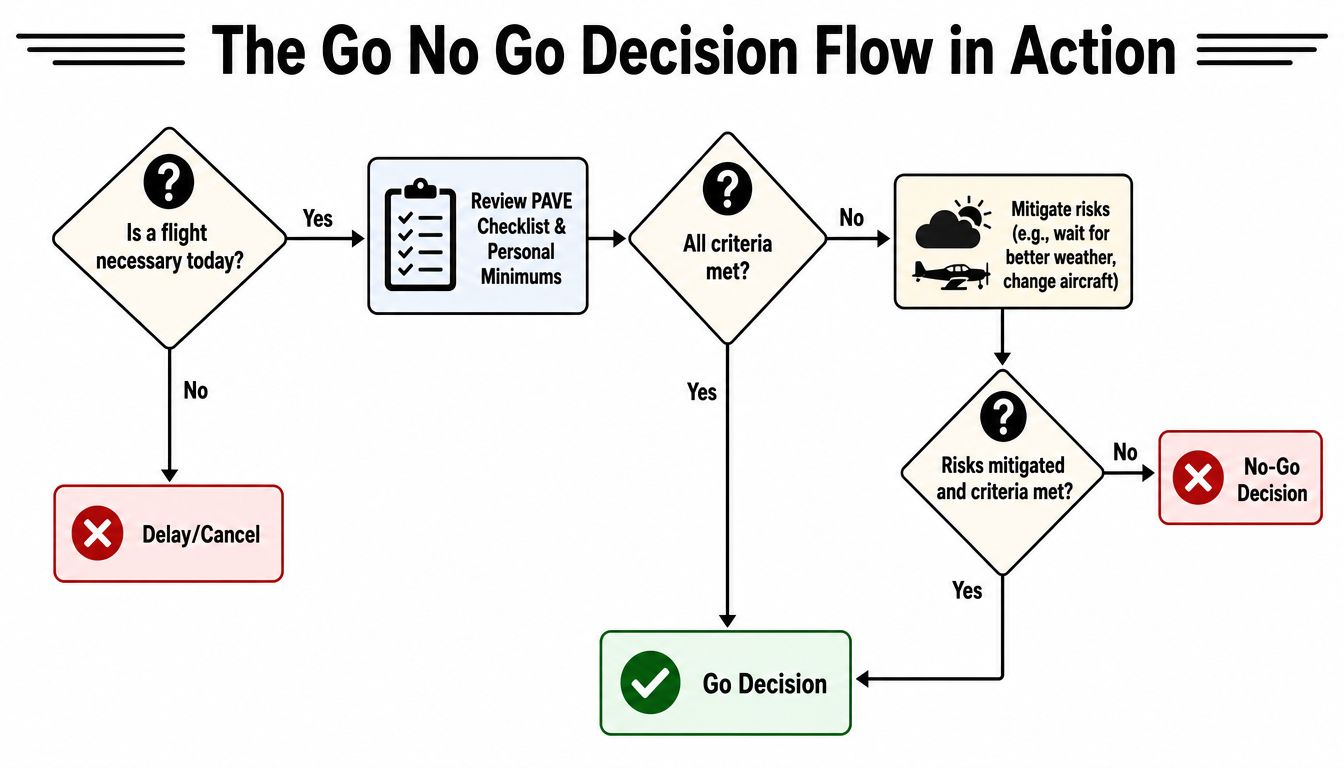
A practical flow looks like this:
- Ask whether the flight needs to happen now. A local proficiency flight isn't the same as repositioning for maintenance or returning from a trip.
- Review your PAVE factors. Don't do this mentally while walking to the airplane. Slow down and make yourself answer.
- Compare the day against your personal minimums. If one item misses, stop there.
- Try real mitigations. Delay for better conditions, change the route, reduce weight, bring an instructor, or switch aircraft if that lowers risk.
- Re-evaluate. If the mitigation doesn't clearly restore margin, the answer is no-go.
That sequence keeps you from using “maybe” as a substitute for judgment. It also prevents the common trap of treating every problem as manageable, an error arising from the discovery of any action.
The In Flight No Go Decision
The same logic applies in the air, especially on approach.
A go-around is not a failure. It is a no-go decision executed at the right time. Yet pilots often continue unstable approaches anyway. According to Skybrary's review of go-around decision making, only 17% of accident or incident flight crews initiated go-arounds when conditions clearly indicated that a go-around should have been conducted. That tells you the issue isn't knowledge alone. It's commitment bias.
For transport category aircraft, refined go-around criteria discussed by NASA at 300 ft call for airspeed within 0/+10 knots of target, glideslope deviation less than 1 dot, localizer deviation less than 1 dot, and a rate of descent that does not trigger TAWS activation. General aviation pilots don't need to copy airline procedures word for word to learn from the principle. If the approach is unstable, close to the ground, and trending worse, stop trying to salvage it.
A clean go-around is evidence of good judgment, not weak judgment.
The landing you force from a bad setup teaches the wrong lesson. The go-around you execute on time builds a habit that may save your life later.
Training Your Decision Making Muscle
Good aeronautical decision making isn't something pilots either have or don't have. It's trainable.
Why Rehearsal Works
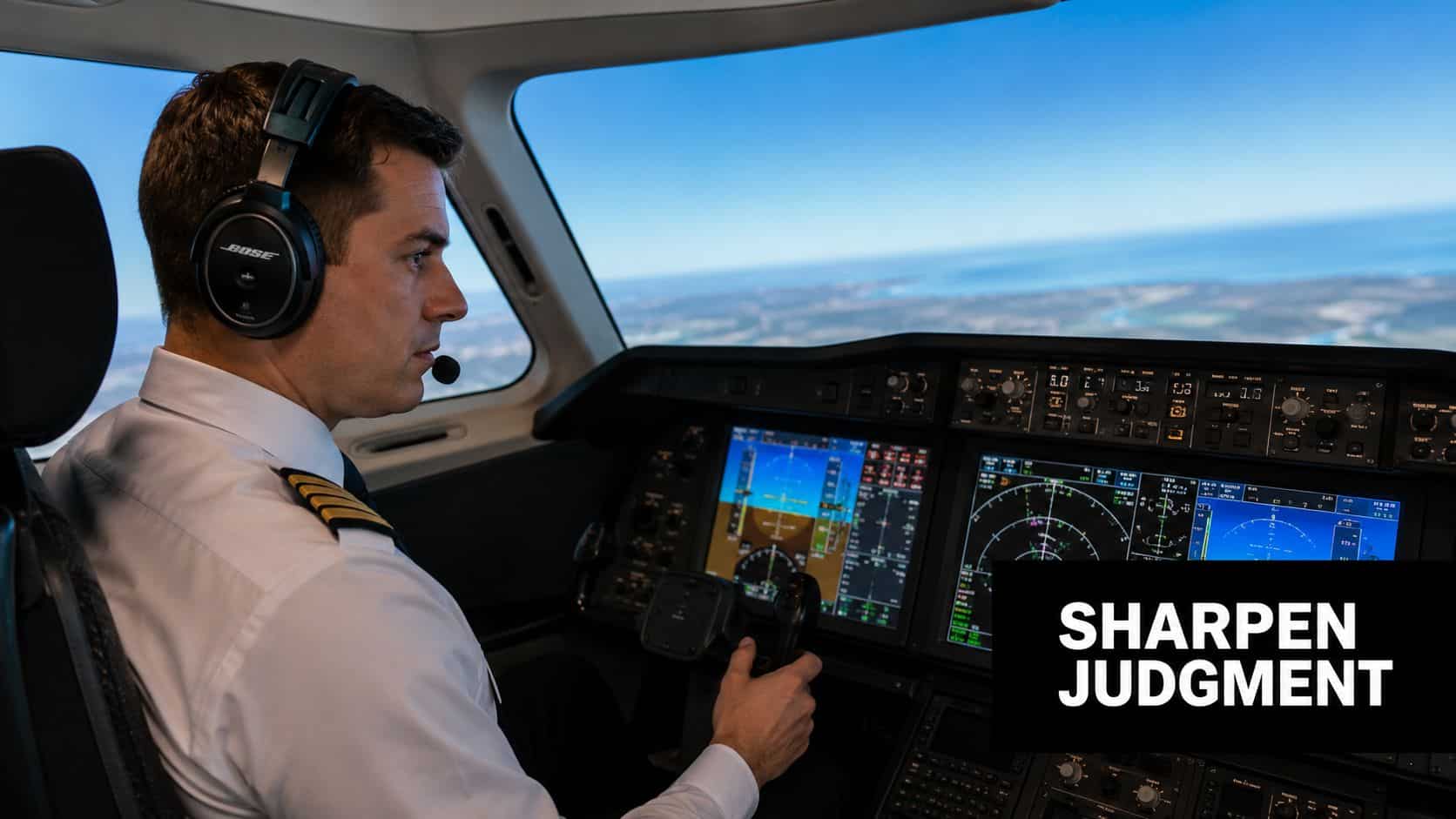
Pilots usually make poor decisions when workload rises faster than they can process it. Training helps because it shortens the delay between noticing a problem and acting on it. In a simulator, you can safely practice deteriorating weather, changing ceilings, rough radio environments, equipment distractions, and missed approach decisions without paying for the lesson with bent metal.
That's why scenario-based work matters more than memorizing a checklist. You want to recognize a bad setup early, not debate it late. If you want to sharpen that habit, this article on how to improve decision making is a solid companion read.
Good Practice Scenarios
Bring these into your next lesson or simulator session:
- Borderline departure scenario: Plan a local flight, then have your instructor introduce lower-than-expected visibility or stronger winds before engine start.
- Pattern pressure scenario: Fly normal traffic, then add spacing delays, radio congestion, and a gusty final to see when you choose to go around.
- Diversion scenario: Launch with one plan, then practice changing destinations because the original plan no longer fits your minimums.
- Passenger pressure scenario: Role-play a non-pilot passenger asking whether the flight is still fine. Practice the explanation as much as the decision.
Training works best when the standards are spoken out loud. Say the trigger. Say the limit. Say the reason. A pilot who can clearly verbalize a no-go call on the ground is much more likely to make the right one in the air.
Go No Go Criteria for Buying an Aircraft
Buying an airplane or helicopter is one of the biggest go/no-go decisions most pilots ever make. It's easy to get emotionally attached to a listing, especially when the paint looks sharp, the photos are flattering, and the seller sounds confident. That's how people buy trouble.
The safer approach is to treat the purchase like a high-stakes preflight. Your decision has to survive a mechanical review, a paperwork review, and a mission review. If one of those fails, you don't “hope for the best.” You walk.
How to Buy an Airplane the Safe Way
A sound purchase starts with a real pre-buy inspection. According to AOPA's guidance on buying an aircraft, a safe aircraft purchase requires a pre-buy inspection that explicitly evaluates mechanical condition, cosmetic condition, and the legal status of the aircraft, including airworthiness, registration, and operating limitations, to avoid hidden liabilities.
That standard matters because buyers often focus on cosmetics first and airworthiness second. The airplane may present well and still carry maintenance discrepancies, documentation problems, or equipment issues that change the entire deal.
Use a checklist mindset:
- Mechanical condition: Engine health, airframe condition, corrosion, recurring squawks, and whether repairs were done correctly.
- Cosmetic condition: Paint and interior matter, but only after the aircraft proves sound.
- Legal status: Confirm airworthiness, registration, and operating limitations before you think about closing.
- Records quality: Review complete logs and compare them to what the airplane is advertised to be.
The document side deserves its own stop point. The ARROW checklist explained in Plane & Pilot remains a useful legal verification tool: Airworthiness Certificate, Registration, Radio License, Operating Limitations, and Weight and Balance. That same guidance also notes the buyer should confirm the annual inspection is current and the pitot-static check is up to date.
If logbooks are messy, missing, or inconsistent, treat that as a major warning. Before money changes hands, review the aircraft's documentation with the same seriousness you'd apply to maintenance records before flight. This overview of aircraft maintenance records is helpful if you want a cleaner framework for what to inspect and what questions to ask.
What Buyers and Sellers Miss
The next no-go item is mission fit. A legal airplane can still be the wrong airplane.
One practical buying rule from this aircraft-buying discussion is to verify the useful load capacity, especially whether the aircraft can realistically carry four people plus fuel and bags. Many four-seat airplanes sound right for the mission until you do honest weight-and-balance math. That mismatch leads to disappointment at best and unsafe loading decisions at worst.
For people looking to buy or sell airplanes and helicopters, deals often drift off course. Sellers naturally present the machine in its best light. Buyers naturally picture the missions they want to fly. The discipline is to compare the actual payload, range, equipment, and maintenance status against the actual mission, not the imagined one.
A few listing red flags deserve immediate scrutiny:
- Registration questions: Verify where the aircraft is registered and whether that status creates extra complexity.
- Model specifics: Check the exact model year and any manufacturer changes that affect parts, systems, or resale.
- Price alignment: Compare the asking price against aircraft of the same year and model with similar equipment and record quality.
There's one more rule I'd treat as absolutely essential. The pre-buy inspection should be done by a technician who knows that exact model. In this discussion of pre-buy practice, the point is clear: a generic inspection can miss model-specific issues, and a proper review often means taking the airplane apart enough to look underneath components and follow the manufacturer's checklist.
That advice applies to helicopters too. A rotorcraft purchase has its own inspection demands, paperwork details, and maintenance traps. The principle doesn't change. If the inspection isn't specific, independent, and thorough, you don't have enough information for a go decision.
Putting It All Together at Chino Airport
A pilot launching from KCNO has more to think about than winds and fuel. Busy pattern traffic, multiple runways, radio timing, and the possibility of delays all affect workload before the wheels move.
A good local go/no-go routine accounts for that. If the weather is merely acceptable but the airport is busy, your true margin may be smaller than it looks. If you're already feeling behind, adding a high-traffic Class D environment can turn a manageable flight into one where you spend the first part of the lesson catching up instead of staying ahead.
Build a local addendum to your own checklist. Include radio readiness, likely delay tolerance, preferred runway scenarios, alternate taxi expectations, and whether today is a day for pattern work, local maneuvering, or staying on the ground. A windy afternoon with heavy traffic may be a fine day for an experienced pilot and the wrong day for a student working on confidence.
That's the larger lesson behind go no go criteria. They aren't there to make you timid. They're there to make you consistent. The pilot who makes calm, early, structured decisions on the ramp is usually the same pilot who makes calm, early, structured decisions in the flare, in the clouds, and at the negotiating table when an aircraft deal doesn't pass inspection.
The standard should be simple. If the conditions, the pilot, the aircraft, or the pressure around the flight don't support a clear yes, the answer is no.
If you want help building safer go/no-go habits, refining your personal minimums, or training in the practical environment of Chino Airport, DuBois Aviation offers airplane and helicopter instruction, simulator training, and ongoing proficiency support with experienced instructors who understand how good decisions are built.