
A lot of pilots think decision-making shows up only in emergencies. It doesn't. It shows up in the first weather briefing, in the fuel stop you almost skip, in the crosswind landing you continue a little too far, and in the aircraft listing that looks clean until you start reading the logs.
That's why how to improve decision making matters so much in aviation. In a cockpit, every choice has timing, consequences, and trade-offs. You rarely get the luxury of perfect information. You do get a chance to build a process that keeps you from making a bad situation worse.
The good news is that sound judgment isn't magic. It's a trainable skill. Pilots build it the same way they build landings, instrument scans, and radio discipline. Repetition. Structure. Honest review.
The Moment of Choice in the Cockpit
You're on final into Chino. Airspeed is under control, runway picture looks right, and the approach feels routine. Then a gust shifts the airplane, your sight picture changes, and the landing you had a second ago is gone.
That's the moment students remember. Not because it's dramatic, but because it strips away the idea that flying is a sequence of memorized procedures. In that instant, you have to decide whether to correct, go around, or force a landing that no longer fits the conditions.
A pilot's judgment works the same way a good instrument scan works. It's continuous. You don't glance once and declare yourself informed. You keep updating the picture. That's why situational awareness and decision-making are tied together. If your mental model is stale, your next control input will be too. A useful primer on that connection is this guide to situational awareness in aviation.
Judgment starts before the emergency
Most bad decisions in aviation don't begin with a single reckless act. They begin with a chain of small allowances.
You accept a departure with marginal rest.
You shave a fuel margin because the flight is short.
You continue because the weather is “about what you expected.”
That pattern isn't unique to flying. In any high-risk environment, the danger often shows up before the crisis fully forms. The same mindset behind recognizing thin ice dangers applies in the cockpit. Early warning signs matter most when they still give you room to change course.
Good pilots don't wait for certainty. They act when the trend is wrong.
Skill matters, but judgment keeps skill useful
You can fly a steep turn to standards and still make poor choices. You can also be behind the airplane for a moment and recover well because your decision process stays intact.
That's the lesson. Great pilots aren't born with special instincts. They learn to recognize a decision point early, slow down mentally, and choose the action that protects options instead of shrinking them.
Building Your Mental Cockpit Core Decision Frameworks
When pressure rises, vague advice like “use good judgment” is useless. Pilots need a repeatable framework. Not because frameworks make flying rigid, but because they keep your thinking organized when conditions are changing fast.
Use a simple loop under pressure
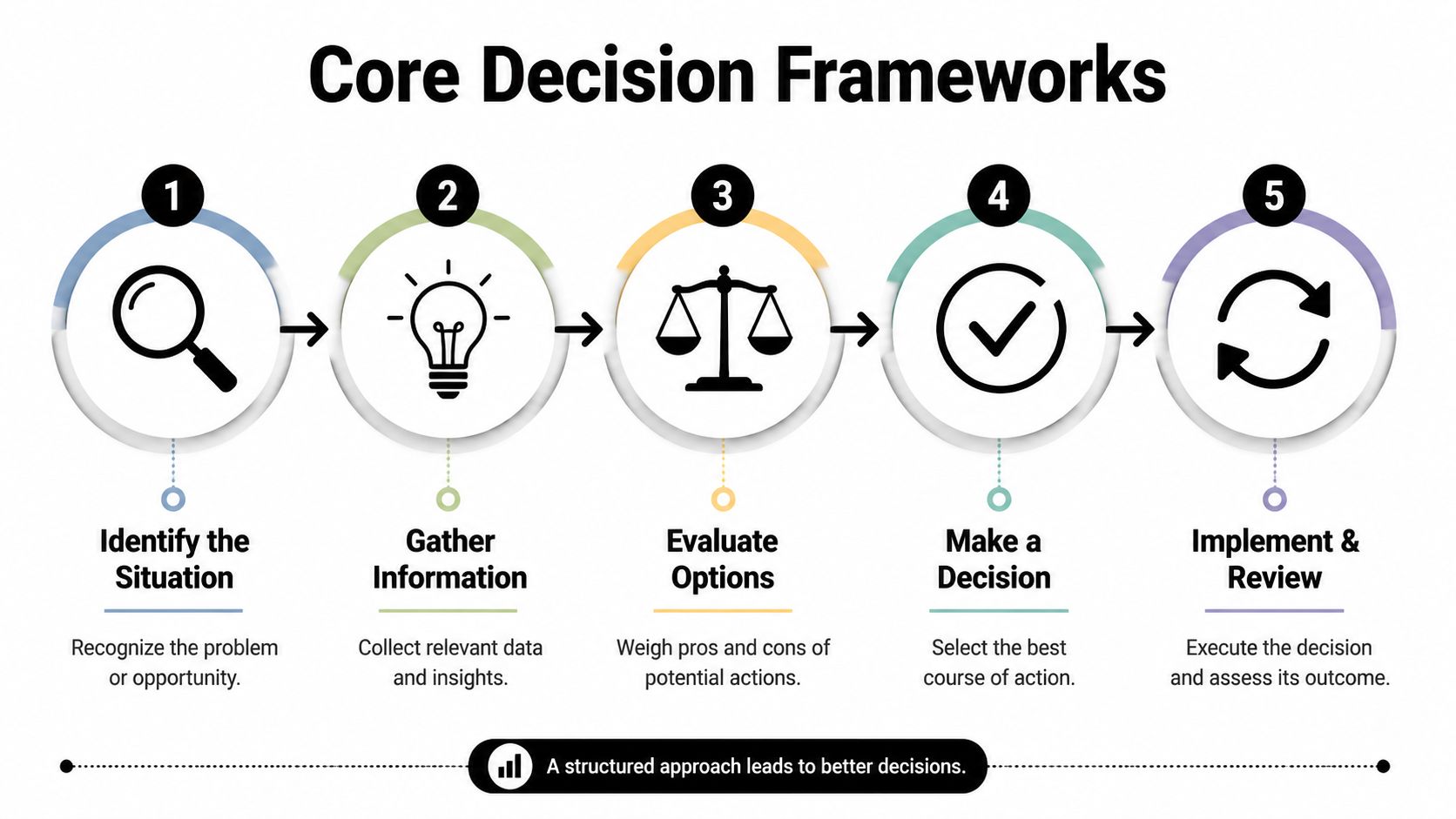
The most practical version looks like this:
- Identify the situation
- Gather information
- Evaluate options
- Make a decision
- Implement and review
That sequence matches current guidance that decision quality improves when people define objectives, collect and prepare data, analyze what it means, implement the choice, and evaluate results against clear measures, as described in this discussion of data-driven decision making. The same source notes that highly data-driven organizations are 3 times more likely to report significant improvements in decision-making. In a cockpit, your “data” is your instrument scan, outside visual picture, ATC communications, aircraft performance, weather updates, and your own status as a pilot.
What ADM looks like in real flying
Aeronautical Decision Making, or ADM, is often taught as a formal concept. In practice, it's disciplined thinking in the airplane.
Here's what that looks like on an ordinary cross-country:
Before takeoff
You define the mission. Are you trying to build night currency, get lunch, practice instrument procedures, or move people on a schedule? If you don't name the objective, you'll make poor trade-offs later.In cruise
You notice the headwind is stronger than expected. That's not just a performance note. It affects fuel, daylight, and the pressure you may feel to keep pushing.Approaching destination
Ceiling and visibility are still legal, but the trend is deteriorating. ADM asks a harder question than “Can I?” It asks “Should I continue based on my actual proficiency, alternates, and margin?”
Practical rule: If your plan only works when every assumption stays favorable, it isn't a strong plan.
The OODA loop in pilot language
The OODA loop is another useful model. Observe, Orient, Decide, Act.
Pilots already do this, but many do it inconsistently. The gain comes from making each step deliberate.
| Step | In the cockpit it means |
|---|---|
| Observe | Scan instruments, listen to ATC, look outside, note weather, traffic, and aircraft cues |
| Orient | Put those cues in context. Is the oil pressure trend meaningful? Is this delay affecting fuel? |
| Decide | Pick a course of action before the situation picks one for you |
| Act | Execute clearly, then watch for the result and adjust |
A student pilot often gets stuck between Orient and Decide. They see the problem but hesitate because they're still trying to make the facts feel comfortable. That delay is costly. If the approach is unstable, go around. If the weather trend is wrong for your proficiency, divert. If the engine indication doesn't fit normal, treat it like information, not an annoyance.
Why frameworks beat intuition alone
Intuition has a place. Experienced pilots recognize patterns quickly. But intuition without structure can drift into wishful thinking.
A framework gives you three things intuition alone often doesn't:
- A trigger to act
- A way to compare options
- A method to learn afterward
That last point matters. If you don't review outcomes, you never sharpen the framework. You just repeat habits and hope they're good ones.
Recognizing and Caging Your Cognitive Biases
The most dangerous instrument in many cockpits is the unchecked human mind. A pilot can have current charts, a healthy engine, and plenty of fuel, then still make a poor decision because the brain edits reality to match what it wants.
That's why the hard part of decision-making isn't only reading conditions correctly. It's noticing when your own thinking has become unreliable.
What bias sounds like in the cockpit
Get-there-itis rarely announces itself by name. It sounds more respectable than that.
It sounds like, “We're almost there.”
It sounds like, “The weather at the field was better an hour ago.”
It sounds like, “I've handled worse.”
Confirmation bias is just as common. You expect the rough-running engine to smooth out because you want it to be minor. You expect the cloud layer to open because the last METAR looked manageable. So you collect only the clues that support continuation.
Invulnerability bias shows up in experienced pilots too. Time in type can create discipline, but it can also create overconfidence. The pilot starts treating abnormal as familiar, and familiar as safe.
Use decision aids before your brain bargains with you
Aviation keeps rediscovering a simple truth. Under uncertainty, decision quality improves when options, risks, and benefits are made explicit, and decision aids work best when they are built directly into the workflow, as described in AHRQ's guidance on shared decision-making. In pilot terms, that means checklists, personal minimums, stabilized approach criteria, and pre-briefed diversion triggers need to exist before the pressure hits.
Here's the difference:
Weak method
“I'll see how I feel when I get there.”Strong method
“If the crosswind exceeds my personal limit, I'll divert. If the approach is unstable by my gate, I'll go around.”
The best time to defeat a bad in-flight argument is on the ground, before that argument exists.
A short self-brief that catches trouble
When a flight starts drifting, use a short verbal check:
What am I assuming?
Name the assumption out loud. “I'm assuming the weather ahead is not getting worse.”What evidence would prove me wrong?
Force disconfirming data into the picture.What option preserves the most margin?
Safer decisions usually keep time, fuel, altitude, and runway available.Would I advise a student to continue?
This one cuts through ego fast.
Bias control is a cockpit habit
You don't eliminate bias. You cage it.
That means building friction into risky decisions. Slow the process down enough to challenge your first answer. Read the checklist instead of relying on memory. Ask for another set of eyes when another pilot is available. If you're flying single-pilot, act like your future self will have to defend the choice in a debrief.
Pilots get into trouble when they treat confidence as evidence. It isn't. Evidence is evidence.
From Theory to Practice with Checklists and Simulators
Decision-making gets stronger when you train it as a physical cockpit habit, not as a motivational slogan. That's why the pilot who uses a checklist properly often makes better choices than the pilot who relies on memory and pride.
Checklists are decision tools, not memory crutches
A good checklist does more than prevent omissions. It forces a decision point.
A before-takeoff checklist asks whether the aircraft is configured. An emergency checklist asks whether you've identified the failure correctly. A personal go/no-go checklist asks whether the flight still fits your real limits, not your ambitions for the day.
Students sometimes rush checklists because the airplane feels ready. That's backward. The checklist is what tests whether “ready” is true.
Consider how much cleaner your judgment becomes when key choices are preloaded:
Weather trigger
“If convective activity is building on my route, I won't launch unless I have a realistic alternate plan.”Fuel rule
“If the reserve picture is tightening, I stop negotiating with myself and land.”Approach gate
“If I'm unstable, I go around. No salvaging.”
Simulators let you rehearse judgment without paying for mistakes in the air
A simulator is valuable because it isolates decision quality. You can create weather pressure, equipment issues, task saturation, or missed approach confusion without putting the airplane at risk.
That matters because many pilots have practiced maneuvers more than they've practiced choices. They can fly the hold. They haven't rehearsed the moment they decide not to continue to the approach.
If you want a broader sense of flight simulator types and costs, it helps to understand that not every simulator serves the same purpose. For pilot training, the point isn't novelty. The point is to repeat realistic decisions until your response becomes organized instead of reactive.
One practical option for structured instrument and scenario training is an instrument rating simulator, which lets pilots rehearse workload management, procedural choices, and abnormal situations in a controlled setting.
A quick example helps:
Train the decision, not just the maneuver
A useful simulator session isn't just “engine failure after takeoff.” It's more specific.
Low-altitude failure
Do you lower the nose immediately, or do you spend a dangerous second hoping the engine comes back?Missed approach in weather
Do you clean up in sequence, manage power, and follow the published procedure, or do you chase the airplane?Diversion workload
Can you brief, aviate, guide, and communicate without letting one task erase the others?
Repetition builds speed. Review builds judgment.
That's why post-scenario debriefs matter so much. The learning isn't only in what you did. It's in what cue you missed, what assumption you made, and what earlier decision would have made the whole sequence easier.
The Ultimate Decision How to Buy an Airplane Safely
Buying an airplane or helicopter is one of the biggest judgment tests most pilots will ever face. The danger isn't only spending money badly. It's buying the wrong machine for the mission, missing maintenance issues, or letting excitement outrun evidence.
That's where many buyers go wrong. They shop by appearance, cruise speed, panel glamour, or a story the seller tells well. Safe acquisition starts the same way safe flying does. Define the mission, gather reliable information, compare options objectively, and don't let pressure rush the choice.
Start with mission, not metal
The cleanest way to avoid a bad purchase is to define what the aircraft must do.
Research on expert decision-making argues that Multi-Criteria Decision Analysis, or MCDA, is especially useful for major choices because it forces you to define objectives, weight them, and then score options against those criteria instead of chasing a proxy metric, as discussed in this article on expert decision-making and MCDA. In aircraft buying, that means you don't buy based on speed alone if your real need is payload, short-field performance, training utility, maintenance support, or insurance practicality.
A simple buyer worksheet should include factors like:
| Criterion | Why it matters |
|---|---|
| Mission fit | Local training, personal travel, time-building, business use, utility work, or rotorcraft mission |
| Budget reality | Not just purchase price, but maintenance, hangar, fuel, training, and insurance |
| Supportability | Parts availability, mechanic familiarity, and local service knowledge |
| Pilot fit | Your experience level, transition training needs, and workload tolerance |
| Exit flexibility | How easy the aircraft may be to sell later if your mission changes |
What a safe buying process looks like
The safest buyers move in sequence.
First, they narrow the field. A Cherokee, Mooney, Cessna 150, Robinson, or Enstrom may each be sensible in the right mission and a mistake in the wrong one. The right answer depends on use case, not desire.
Second, they study the records. Logbooks matter because they reveal whether the airplane has been maintained consistently, whether major repairs are documented, and whether gaps raise questions. Missing entries don't automatically condemn an aircraft, but they should slow you down and sharpen your review.
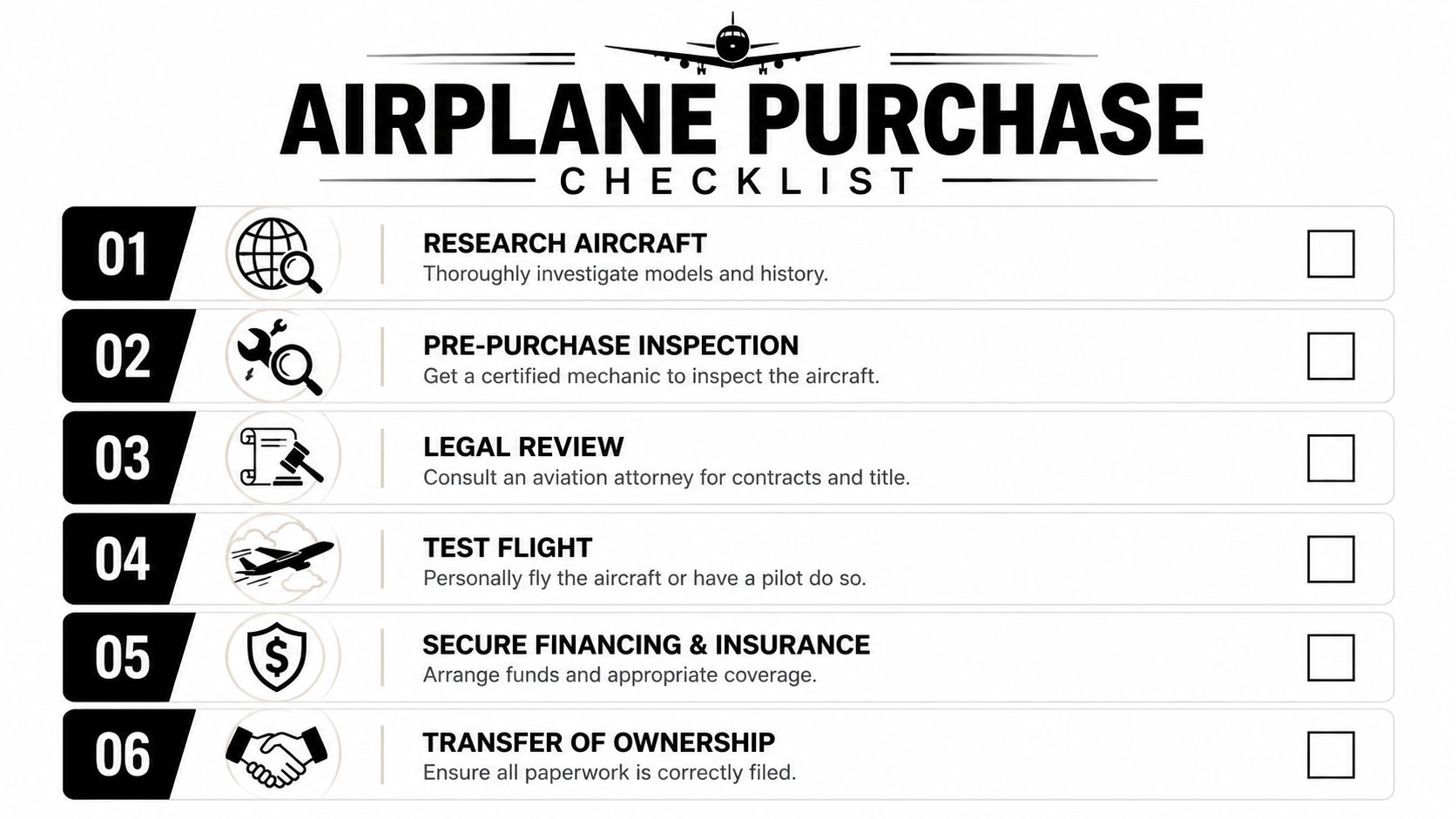
Third, they arrange a pre-buy inspection with a mechanic who works for the buyer, not the seller. That distinction matters. A pre-buy isn't a ceremonial glance. It should verify condition, documentation, airworthiness concerns, signs of corrosion or damage, and anything model-specific that deserves scrutiny.
If you aren't willing to walk away after the inspection, you aren't really conducting an inspection.
Red flags buyers should treat seriously
Some issues are obvious. Others get minimized because the aircraft is attractive, nearby, or priced to create urgency.
Watch for patterns like these:
Vague maintenance history
If the explanation for missing or confusing records depends on optimism, assume you need more proof.Panel-first selling
New avionics don't erase airframe, engine, rotor, or structural concerns.Pressure to move fast
Time pressure is a classic decision trap. If the deal falls apart because you asked for proper inspection and review, that tells you something useful.Mismatch between mission and aircraft
A fast airplane can be the wrong trainer. A cheap helicopter can become an expensive ownership lesson if support and maintenance access are poor.
Buying and selling safely use the same discipline
Sellers benefit from the same structured thinking. If you're selling an aircraft, organized records, clear maintenance history, and realistic representation reduce friction and lower the chance of disputes later. Clean decision-making helps both sides.
Test flights and legal review also belong in the process. The flight should verify that the aircraft behaves as represented. The paperwork should confirm title, terms, and transfer details clearly. Financing and insurance should be lined up before the last-minute scramble starts driving decisions.
For many buyers, an experienced instructor, A&P, aviation attorney, or acquisition specialist is the missing piece. That isn't weakness. It's good crew coordination applied to ownership.
Becoming a Captain of Your Decisions
Pilots sometimes talk about judgment as if it arrives with a certificate. It doesn't. A new private pilot can make an excellent conservative call. An experienced pilot can still talk themselves into a poor one.
What separates strong decision-makers is the loop they run after the choice. They don't stop at “nothing bad happened.” They review what they saw, what they missed, and what they'll do earlier next time.
Debrief every flight, even the ordinary ones
The best post-flight review is short and honest.
Ask yourself:
- What was the key decision of the flight?
- What information did I rely on?
- What did I ignore because it was inconvenient?
- What would I brief differently next time?
Guidance on decision quality increasingly points to a closed-loop evidence process. Identify the decision, gather trustworthy information, compare alternatives, execute, then review outcomes with postmortems and feedback, as outlined in this article on improving decision-making skills. That's as true after a routine local flight as it is after a weather diversion or an aircraft purchase.
Use the people around you well
No pilot improves in isolation for long. Instructors, mechanics, dispatchers, mentors, and other pilots all sharpen judgment when you use them correctly.
That's one reason crew concepts matter even in small-aircraft flying. Good crew resource management isn't only for airline cockpits. It's the habit of using available people, tools, and procedures before you get boxed into a bad outcome. This overview of crew resource management is a useful reminder that disciplined teamwork starts with communication and humility.
The pilot in command still makes the call. The smart pilot makes it with every available resource.
Decision-making gets better when you treat it like a flight skill. Brief it. Practice it. Debrief it. Tighten it after every sortie. Do that long enough, and your judgment becomes less dramatic, more consistent, and far more dependable when the day stops being easy.
If you want structured help building that kind of judgment, DuBois Aviation offers airplane and helicopter training, rental access, and simulator-based practice at Chino Airport. For pilots working on private, instrument, commercial, or recurrent proficiency, good instruction doesn't just teach control inputs. It teaches how to make better choices before the airplane makes them for you.


