
You're on downwind, the lesson has been normal, and then the instructor pulls the power to idle and says, “Engine failure. Where are you going?” That moment is where glide ratio stops being a quiz answer and becomes a decision tool. If you know what your airplane can do, you start working the problem. If you don't, you waste altitude guessing.
Student pilots often hear a simplified version of the topic. Divide distance by altitude, memorize a ratio, and move on. That's not wrong, but it's incomplete. In a real engine-out, the airplane you're flying at that moment matters. Your speed matters. Wind matters. Configuration matters. So does how quickly you lower the nose and stop trying to save altitude that isn't there.
Around Chino, with traffic, runways, industrial areas, and open ground all competing for your attention, that judgment has to be calm and fast. Knowing how to calculate glide ratio helps, but knowing how to apply it is what keeps the airplane inside its performance envelope and gives you usable options.
Why Every Pilot Must Master Glide Ratio
The first job after an engine failure is to keep flying the airplane. The second is to decide where it can still go. Glide ratio sits right in the middle of that decision.
A student's first reaction is often to look for the nearest runway and hope the airplane can make it. That's backwards. First establish the correct pitch for best glide. Then ask what is within reach. A pilot who understands glide ratio doesn't chase a field that only works on paper. That pilot picks the option that fits the airplane's real performance right now.
In the cockpit, this is a planning tool
In a training airplane, the difference between a good decision and a bad one is often simple. One pilot turns too early toward a runway that's just out of range, gets low, and starts stretching the glide. Another pilot accepts what the airplane can do, keeps the speed where it belongs, and lands under control in a more realistic spot.
Practical rule: The airplane won't glide farther because you want it to. It will only glide as well as you manage speed, configuration, and judgment.
That's why this topic matters for every level of pilot. Private students need it for simulated engine failures. Instrument students need it because systems and weather can compress your options quickly. Aircraft owners need it because performance numbers in the book mean something only if the airplane and the pilot can reproduce them.
It builds disciplined airmanship
When pilots learn how to calculate glide ratio the right way, they stop treating emergency procedures as memorized scripts. They start thinking in terms of range, altitude, and trade-offs.
That's the habit you want. Not panic. Not optimism. Just a quick, disciplined question: based on this airplane, in these conditions, what can I reach?
The Basic Glide Ratio Formula Explained
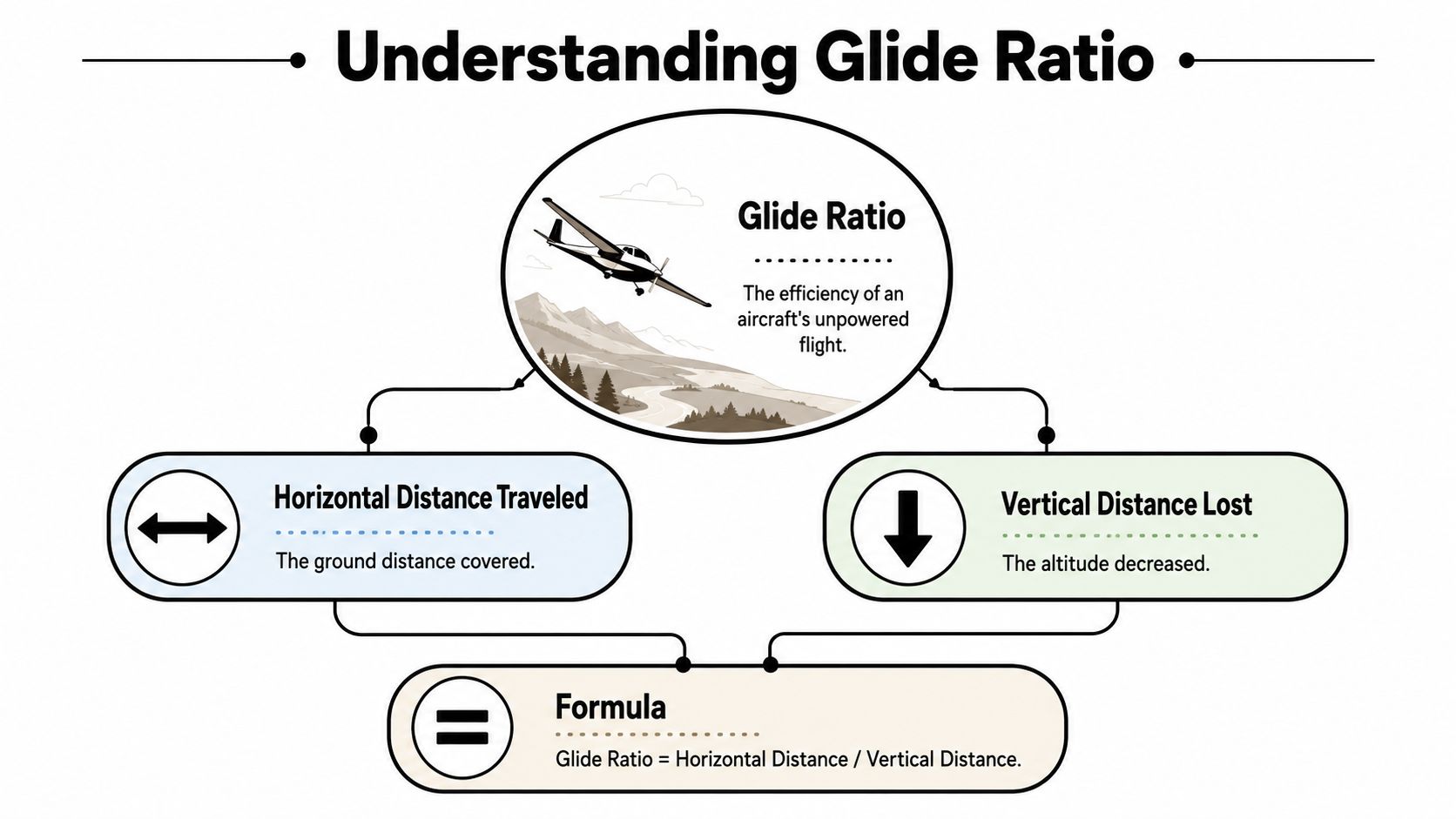
The concept of glide ratio is simple. It compares how far the airplane moves forward to how much altitude it loses on the way down.
Formula: horizontal distance traveled divided by vertical distance lost.
If an airplane moves forward ten units while descending one unit, the glide ratio is 10:1. It doesn't matter whether those units are feet, meters, or miles and thousands of feet, as long as you use the same type of unit consistently.
What the formula means in plain language
Think of glide ratio as an efficiency measure for unpowered flight. A higher ratio means the airplane covers more horizontal distance for the same amount of altitude lost. A lower ratio means it descends more steeply.
The easiest way to visualize it is this:
- Horizontal distance traveled means how far forward the airplane goes over the ground or through the air, depending on the context of the calculation.
- Vertical distance lost means how much altitude you gave up to get there.
- The ratio tells you the shape of the glide path.
That's why pilots often talk about whether a field is “within glide.” They're comparing available altitude to expected forward travel.
A clean example
Say you lose the engine and you have 1,000 feet of altitude available above your intended touchdown area. If your airplane can produce a 10:1 glide in still air under ideal conditions, the rough estimate is that it can travel 10,000 feet forward before reaching that touchdown point.
That example is useful because it teaches the relationship. Lose one unit vertically, gain ten units horizontally. The ratio doesn't tell you time. It tells you reach.
Glide ratio answers one question very well: how much distance can I trade for altitude if I fly the airplane correctly?
What this formula does not tell you
Many basic guides halt prematurely at this point. The formula gives you a starting point, not a complete answer for a real emergency.
It doesn't tell you whether you're flying at the correct best glide speed. It doesn't tell you what a headwind is doing to your ground distance. It doesn't tell you whether your flaps are out, whether you're heavy, or whether you've delayed lowering the nose after the power loss.
So yes, learn the formula. Use it. But don't confuse a clean equation with a cockpit decision. The calculation is the beginning of the problem, not the end of it.
Finding and Using Your Aircraft's Glide Performance
An engine failure at 4,500 feet gives you very little time to go hunting through the book. The work starts before the flight. Pilots need to know their airplane's glide data well enough to pitch promptly, stabilize the descent, and judge what is reachable.
The POH is the first place to get that data. It gives you the manufacturer's recommended best glide speed, usually listed as Vg, and it tells you the assumptions behind that number. Those assumptions matter. A memorized speed without the attached conditions can put you on the wrong side of the performance you expected.
In our training airplanes, I want students to know two things cold. First, where to find glide information in the POH. Second, how to turn that book figure into something usable in the cockpit. A Cherokee, Cessna 150, and Mooney may all be simple singles from the student's point of view, but they do not reward the same sight picture or energy management in an engine-out glide.
What to pull from the POH
Look for the items that affect an immediate engine-out response and a realistic range estimate:
- Best glide speed. This is your initial pitch target after power loss.
- Configuration assumptions. Clean airframe versus drag-producing configuration changes the result.
- Weight notes. Some POHs specify how the recommended glide speed changes with loading.
- Test-condition context. Book performance comes from controlled flights, not your exact airplane on your exact day.
I also tell students to note whether the POH gives only a speed, or whether it also gives a distance, descent profile, or chart. That difference matters. A single Vg number helps you hold the airplane in the right energy state. A chart helps you decide whether a field, road, or runway is worth committing to.
There is a useful parallel with maneuvering speed and how it changes with weight. The published number is only part of the story. The pilot still has to know the loading, the assumptions, and how the airplane behaves on that flight.
Training aircraft do not all glide the same way
Students often assume two light airplanes will glide about the same because they occupy the same mission. In practice, the differences are obvious once the engine goes quiet. Propeller drag, wing efficiency, flap design, landing gear configuration, and plain airframe cleanliness all show up fast.
A Cessna 150 typically asks for disciplined speed control because it gives up energy quickly if the nose is mishandled. A Cherokee is honest and predictable, but it still needs prompt pitch control and clean configuration if you want the book result. A Mooney will often carry farther, which is useful, but it can also tempt a pilot into delaying the landing decision because the airplane appears to be doing better than the trainer they learned in.
That trade-off matters in real flying. Better glide performance can buy options, but it can also encourage late decisions.
Here is the quick-reference format I use when teaching students to build their own aircraft notes from the POH.
| Aircraft Model | Best Glide Speed (Vg) | Maximum Glide Ratio (L/D) |
|---|---|---|
| Piper Cherokee PA-28 | Check the specific aircraft POH | Check the specific aircraft POH or derive from approved performance data |
| Cessna 150 | Check the specific aircraft POH | Check the specific aircraft POH or derive from approved performance data |
| Mooney M20B | Check the specific aircraft POH | Check the specific aircraft POH or derive from approved performance data |
| Piper Apache | Check the specific aircraft POH | Check the specific aircraft POH or derive from approved performance data |
Build a cockpit-ready reference
A personal reference card helps. It does not replace the POH, and it should never conflict with it. It gives you a fast way to recall the numbers and notes that matter when the workload spikes.
Include:
- Your aircraft's best glide speed
- Any weight-related note from the POH
- Clean-configuration reminder
- A short note on expected local factors, such as terrain, typical wind patterns, or runway options along your common routes
Keep it simple enough to read in one glance.
The pilot who understands where the number came from usually handles the emergency better than the pilot who memorized a speed and stopped there. That is also why glide performance belongs in any aircraft buying decision. If you are renting, transitioning, or comparing airplanes before purchase, published cruise numbers only tell part of the story. You should also know how that specific aircraft type behaves when the engine is no longer part of the plan.
Adjusting for Reality: Wind, Weight, and Speed
You lose the engine at 5,500 feet over rolling country west of DuBois. A runway sits off the nose and looks reachable. Before you commit, three questions matter fast. What is the wind doing, are you at best glide for this weight, and is the airplane clean?
Wind changes the decision, not just the math
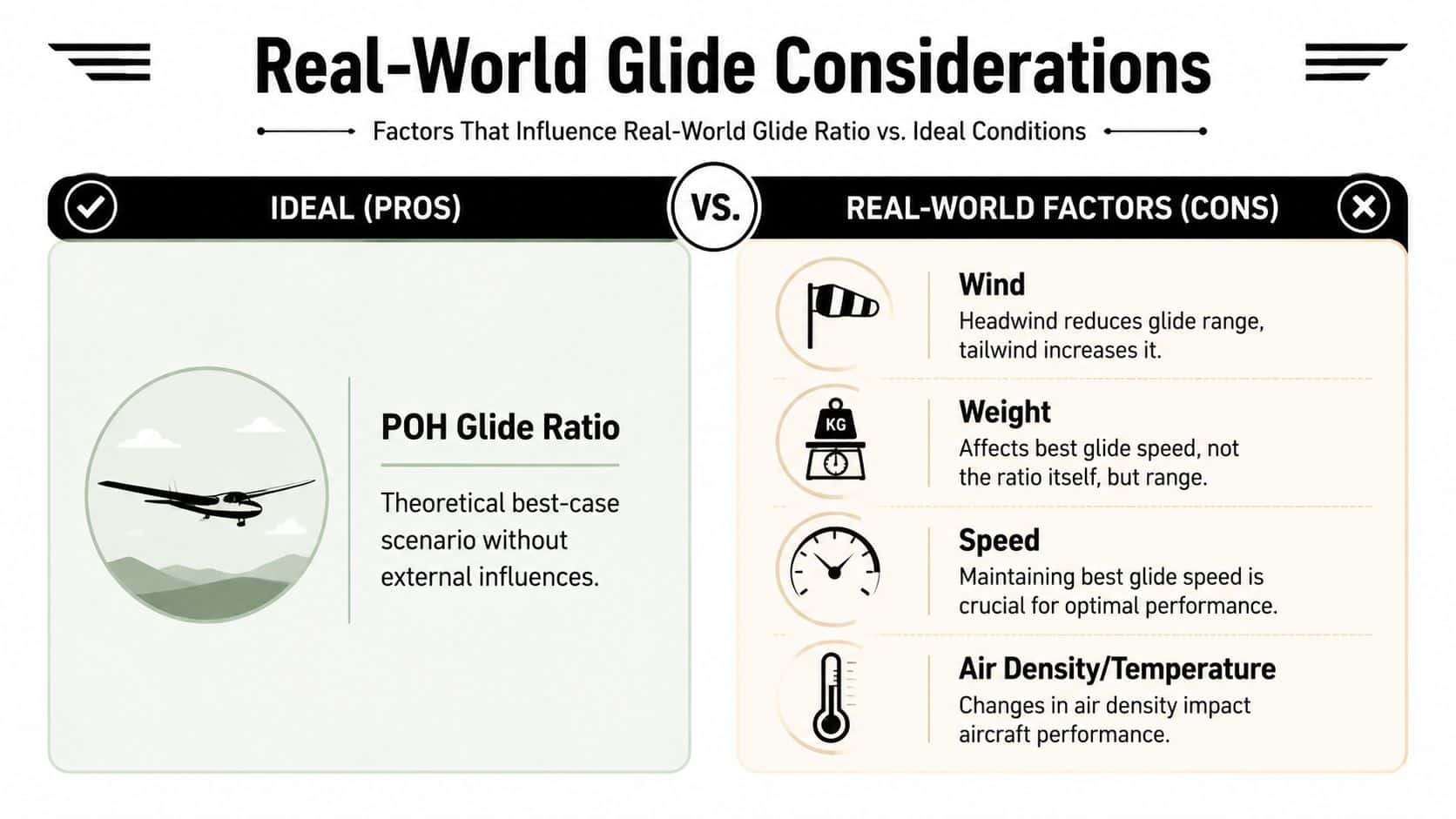
Glide ratio is measured through the air. Landing options are measured on the ground. That gap is where pilots get fooled.
A headwind can turn a comfortable still-air arrival into a stretch. A tailwind can make a field look easy to reach, then leave you high, fast, and poorly positioned when you get there. In our training fleet, a Cherokee and a Cessna 150 will both show the same basic problem, but the lower-performance airplane gives you less margin for a bad guess.
The practical habit is simple. In an engine-out, pick a landing area that works with the wind picture you have, not the one you wish you had. If the wind is on the nose, choose closer sooner. If it is behind you, guard against overshooting and arriving with too much energy.
Best glide speed only helps if you actually fly it
Book glide performance assumes the airplane is flown the way the manufacturer intended. Once speed wanders, the paper number stops meaning much.
Too slow, and induced drag builds quickly. Too fast, and parasite drag starts wasting altitude. Both mistakes shorten range. I see the slow-side error more often in training because pilots pull back when the ground rises in the windshield. That feels safer right up until the sink rate increases.
Use the published best glide speed for your aircraft and the weight guidance in the POH. As noted earlier, FAA guidance makes the same point. Speed, loading, and configuration all affect the distance available in a glide.
Common training errors show up fast here:
- Nose held too high, which trades airspeed for drag and sink
- Flaps added early, before the pilot has the field made
- Fixation on one runway or field, instead of updating the plan as the picture changes
- Delayed cleanup, with drag left out after the emergency starts
Weight matters in a similar way to other performance speeds. If you want a related example, our article on how to calculate maneuvering speed shows how loading changes the speed target you should fly.
Weight changes the target. Configuration changes the outcome.
Weight does not usually change the airplane's best lift-to-drag ratio much. It does change the speed where you get it. Heavier airplanes need a higher best glide speed. Lighter airplanes need less. In a PA-28, that difference may not look dramatic on paper, but in the cockpit it affects pitch picture, descent planning, and how quickly you bleed energy in the turn.
Configuration is even less forgiving. Flaps, landing gear, a windmilling prop, or an unplanned slip all change the descent path right now, not in theory. A clean airplane at the correct speed gives you the widest set of options. Drag devices are tools for the point when you know you have the field, not for the moment you are still trying to get there.
I tell students to treat the published glide ratio as a starting reference. The actual number is whatever this airplane, in this condition, is giving you today. Wind, weight, speed control, and configuration decide whether a runway is reliably in range or only looked that way for a moment.
In-Flight Calculation Methods and Modern Tools
In the airplane, you need a method that is quick enough to use and simple enough to trust. Some pilots prefer a mental estimate. Others like an E6B. In a glass cockpit, glide rings and moving maps can give you an immediate picture. None of those tools replace judgment, but each can help you make a faster range decision.
Mental math and the E6B
The oldest method is still useful. Start with your aircraft's known or estimated glide performance, then convert altitude into range. If the airplane roughly gives you a certain amount of forward reach per unit of altitude in still air, you can make a fast first cut without touching any electronics.
The E6B is slower, but more structured. It works well in preflight and in ground training because it forces you to think about altitude, distance, and wind as separate variables. That discipline matters. Students who practice the math on an E6B usually become better at rough estimates in the cockpit because they understand what they're estimating.
Glass panels and moving maps
Modern avionics changed the presentation, not the fundamentals. A glide ring on a Garmin display can show an estimated area you may be able to reach. That's valuable because it turns a number into a shape. You can glance at the map and see whether an airport, road, or field falls inside or outside that ring.
The same caution always applies. The ring is only as useful as the assumptions behind it. If the wind is unfavorable, your speed is off, or the aircraft data isn't representative, the picture can mislead you.
For pilots flying with tablets, an iPad setup for pilots can add practical situational awareness when it's used correctly and backed up by training.
Here's a useful cockpit mindset:
- Use mental math first so you can make an immediate decision.
- Use the panel map second to confirm or challenge that first impression.
- Use the tablet as support, not as a substitute for aircraft control.
Training the eye and the hand
Tools either help or hurt. If a pilot stares at the display and forgets pitch, the airplane stops giving useful performance. If the pilot flies best glide first and then uses the display to refine the plan, the technology does its job.
A short visual review can help tie those methods together:
Don't use a tool to answer a question you should have answered with pitch control five seconds earlier.
That's why I still teach this from the outside in. First, control the airplane. Second, pick the area. Third, use tools to improve the plan if time and altitude allow.
From Glide Performance to a Safe Aircraft Purchase
If you're buying an airplane, glide performance is more than an academic spec. You're buying the aircraft's real handling, real performance, and real margins. The safe way to buy an airplane is to verify those things, not assume them.
A seller can hand you logbooks, a POH, and a clean walkaround airplane. That still doesn't prove the aircraft is delivering the kind of performance you expect. Before purchase, you want to know whether the airplane is correctly rigged, maintained, loaded within limits, and operating as the book says it should. Glide characteristics are part of that broader picture.
What buyers should verify
A careful buyer looks past appearance and asks practical questions:
- Does the aircraft match its paperwork. Equipment, weight-and-balance records, and installed modifications all matter.
- Does the airplane fly as expected. Not just cruise or climb, but basic handling and descent behavior too.
- Has a trusted mechanic inspected it thoroughly. A pre-purchase inspection is where many expensive surprises are caught.
If you're comparing aircraft, it helps to understand how loading affects what you feel in flight. A weight-and-balance reference such as this Cessna 172N weight and balance sheet is part of the same ownership mindset. Numbers in the book only protect you if the aircraft you buy conforms to them and you know how to use them.
A safe purchase process applies to helicopters too. Different aircraft types solve emergencies differently, but the principle is the same. Know the machine, verify the records, and confirm that the performance you're counting on is real.
If you want help turning performance numbers into real cockpit skill, DuBois Aviation offers flight training, aircraft rental, and practical instruction at Chino Airport that lets pilots practice these decisions in the airplane, in the simulator, and in the context of real ownership questions.