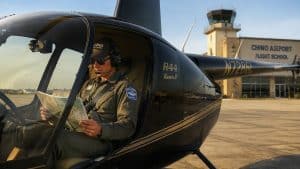
You're planning a student cross-country out of Chino. The route looks simple enough on the iPad at first. Then your sectional shows a big labeled block of airspace somewhere along the way, and the questions start piling up fast.
Can I fly through that? Is it always active? Do I need clearance? If I'm talking to ATC, am I covered, or am I still responsible?
That moment is where a lot of pilots first meet special use airspace. It can feel like chart clutter until you realize it's one of the places where good planning directly protects you from both legal trouble and very real hazards. Around Southern California, that matters. Flights from KCNO toward the desert, the coast, or the mountains can put you near military activity, security-driven procedures, and busy training corridors.
A student pilot doesn't need to become an airspace lawyer. You need a usable framework. Know what the area is, whether it's active, who controls it, and what your safe alternatives are. That's the difference between feeling boxed in by the chart and using it like a professional.
Your First Encounter with Special Use Airspace
A common Chino training scenario goes like this. You're planning a flight eastbound, maybe toward the mountains, maybe just far enough to build cross-country time and sharpen pilotage. You zoom out on the sectional and see a charted area with a bold label like MOA. If you're new, your first instinct is often the same: “I should stay away from that thing.”
That instinct isn't wrong. It's just incomplete.
The United States manages over 1,200 distinct special use airspace zones covering about 15% of the nation's total airspace volume, and roughly 45% of those designations are Military Operations Areas. That's why this isn't some niche topic for military pilots only. It's part of normal flight planning in the national system, especially if you train in the western U.S. where military activity is woven into everyday routing.
Why students get tripped up
Most students learn chart symbols before they learn chart decision-making. You memorize what a Class C shelf looks like. You memorize what a restricted area label looks like. But a symbol alone doesn't tell you what to do next.
With special use airspace, the right question usually isn't “Is this bad?” It's “What kind of area is this, and what are today's rules?”
That's a big mindset shift.
Practical rule: Treat special use airspace like weather. The boundary matters, but the status matters more.
From Chino, that mindset pays off quickly. You're already learning in busy airspace with nearby Class C and Class B structure, tower communications, and routes that can tighten up fast. Adding SUA awareness doesn't mean you need to fear every shaded area on the chart. It means you build a habit: identify it, decode it, verify it, then decide.
A better way to think about it
For a student pilot, special use airspace is less like a brick wall and more like a room with posted rules on the door. Some rooms are closed all the time. Some are open if you ask. Some are active only during certain periods. Some are legal to enter, but smart pilots still think twice.
That's why your first encounter with an MOA or restricted area shouldn't end with confusion. It should trigger a process.
What Is Special Use Airspace Really
The FAA's definition is the one that matters in the cockpit. Under 14 CFR Part 73, special use airspace is airspace of defined dimensions where activities must be confined because of their nature, or where limits are imposed on non-participating aircraft operations. The FAA's guidance also makes the pilot's workflow practical: determine the airspace type, whether it's active, and whether access requires coordination or is prohibited under the FAA Aeronautical Information Manual section on special use airspace.
That sounds formal, but the everyday meaning is simple. Something important or hazardous is happening there, so the system needs a way to separate that activity from aircraft that aren't part of it.
The conference room analogy
Think of an office building with shared conference rooms.
One room is reserved for a sensitive security meeting. Nobody enters.
Another room is reserved for a live equipment test. You might enter, but only if the people running it say it's safe.
Another room is reserved for a training session. You can walk through, but you'd better do it carefully because people are moving around and not focused on you.
That's how special use airspace works. It isn't one giant category of “don't go there.” It's a family of airspace tools, each created for a different operational reason.
What your job is as pilot in command
Student pilots often want one universal answer. “Can I enter special use airspace or not?”
The system doesn't work that way. Your job is to answer three smaller questions:
- What type is it
- Is it active right now
- What does entry require
If you skip any one of those, you can make a bad decision even if your chart reading is technically correct.
Why this matters near KCNO
Flying out of Chino already teaches you that airspace is procedural. You don't just point the airplane and hope the chart works itself out. You brief frequencies, altitudes, transitions, and backup plans. Special use airspace fits that same discipline.
The safest pilots don't label SUA as “dangerous” or “fine.” They label it “understood” or “not yet understood.”
There's another point students miss. A chart boundary can stay the same while the operational reality changes completely. The area may be available at one time of day and unusable later. That's why experienced pilots don't treat SUA as a static picture. They treat it as a live operating environment.
Decoding the Different Types of Special Use Airspace
Special use airspace gets easier once you stop trying to memorize it as a blur of chart symbols. Each type has a purpose. Each type asks a different question from the pilot.
Prohibited areas
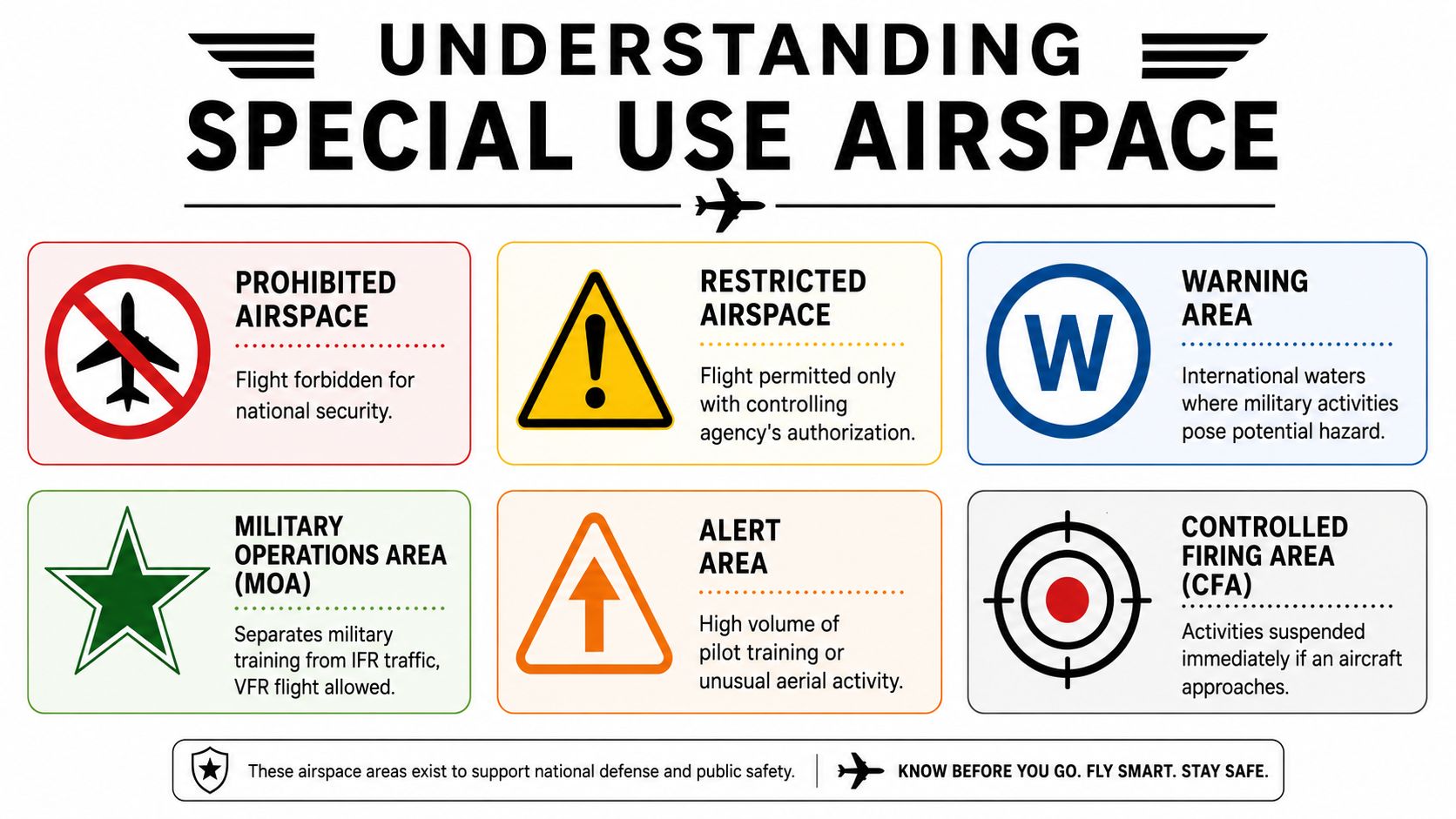
This is the easiest category to understand. Prohibited areas are the hard no of the system. If you think of airspace as roads, this is a road with a locked gate and a guard at the entrance.
For practical flying, the takeaway is simple. Don't plan through one. Don't negotiate with one. Build your route somewhere else.
Restricted areas and warning areas
Restricted areas exist where operations can be hazardous to non-participating aircraft. That hazard can be time-based, so legal access depends on whether the area is active and whether you have the required coordination.
A useful analogy is a live-fire range with a schedule. If nothing is happening and the controlling agency approves transit, the route may be available. If activity is underway, the same piece of sky has a completely different meaning.
Warning areas are similar in spirit, but they're used to warn pilots about hazardous activity over offshore or international waters rather than domestic sovereign airspace.
Military Operations Areas
MOAs confuse students more than any other category because they aren't automatically forbidden to VFR traffic. A military operations area is better understood as a place where military training is separated from IFR traffic, while VFR aircraft may still be there.
That doesn't make it casual. It makes it judgment-based.
In Southern California, that matters because pilots leaving Chino for desert routes may encounter planning decisions where an MOA is legal to cross but not always wise to cross.
If you want a broader airspace foundation before sorting out the higher-altitude system, DuBois Aviation also has a useful guide on Class A airspace.
Alert areas and controlled firing areas
Alert areas tell you to raise your traffic scan. They identify places with a lot of training activity or unusual aerial operations. Think of them as “heads up” airspace, not “stay out” airspace.
Controlled firing areas are different. Pilots often overthink them because they sound severe. In practice, CFAs aren't depicted on charts in the way other SUA is because the activity is suspended when an aircraft approaches.
National Security Areas and the D.C. example
Security has shaped modern airspace too. The Washington, D.C., Special Flight Rules Area was established in 2005, and the National Security Area designation grew after 9/11, creating airspace that can require specific flight plans, transponder codes, or voluntary avoidance depending on the area and the procedures in effect.
You don't need to fly anywhere near Washington to learn the lesson. Airspace rules sometimes exist for security as much as traffic flow or hazard separation.
Special Use Airspace Quick Comparison
| SUA Type | Purpose / Hazard | VFR Entry Rules | IFR Clearance |
|---|---|---|---|
| Prohibited | National security or highly sensitive protection | Don't enter | Not available through the area |
| Restricted | Hazardous operations | Enter only when permitted and properly coordinated | ATC handles routing based on status and coordination |
| Warning | Hazardous activity offshore | Not prohibited, but caution is the point | ATC routing depends on operation and status |
| MOA | Military training activity | VFR may enter, but caution and advisories matter | IFR separation and routing depend on activity |
| Alert Area | High training or unusual aerial activity | Permitted, heightened vigilance required | Normal IFR operations with awareness of surrounding activity |
| CFA | Hazardous activity suspended for approaching aircraft | No special pilot action | No special pilot action |
How to Identify SUA on Aeronautical Charts
The chart gives you more than a boundary. It gives you the start of a briefing. That's how you should read it.
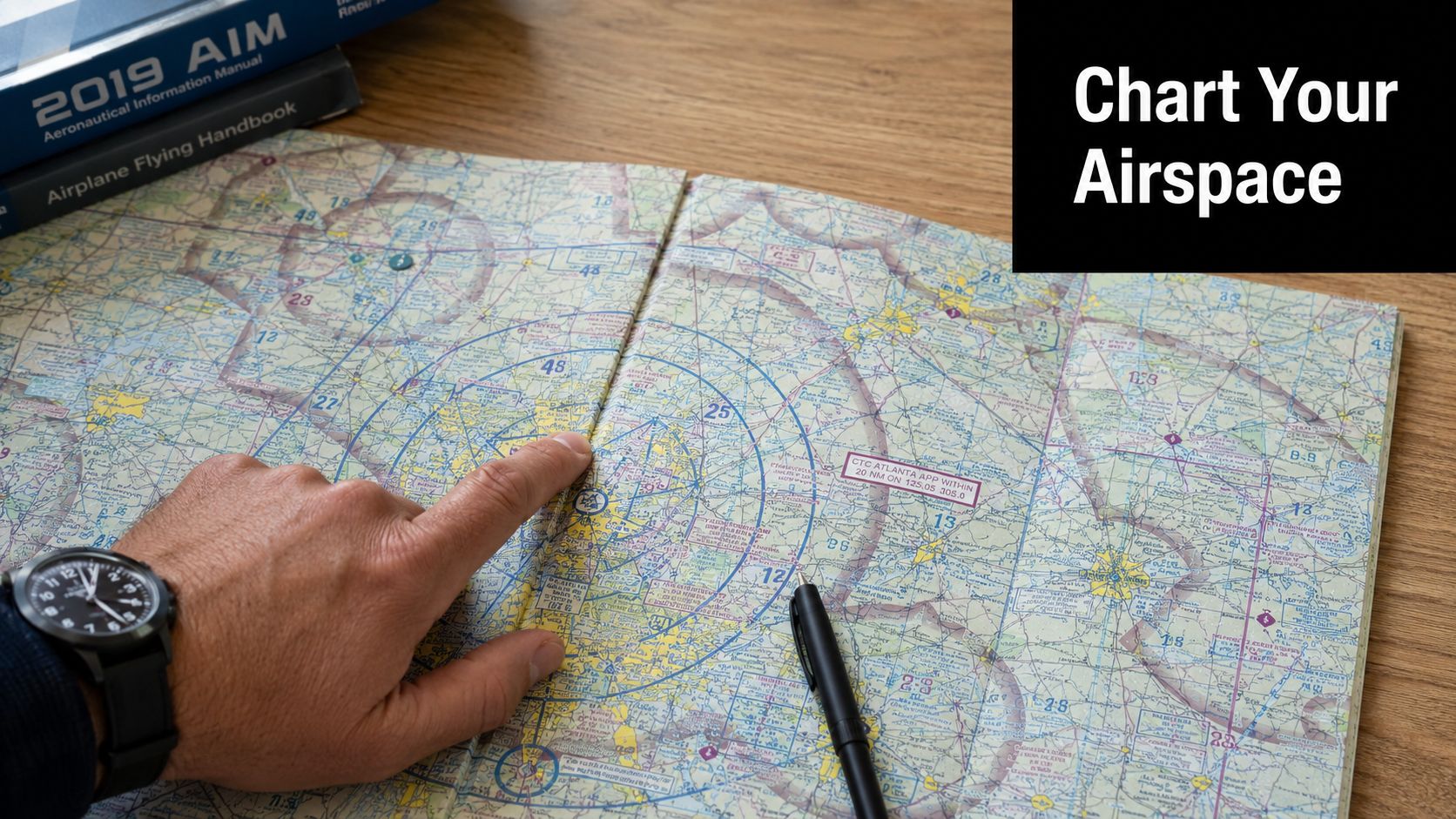
Around Southern California, your sectional can get crowded fast. Chino, Ontario, Riverside, the Los Angeles basin, mountain terrain, and desert airspace all compete for your attention. A student pilot can stare at the page and miss the one thing that matters most: the little box of information tied to the SUA boundary.
Start with the border, then find the label
When you spot hatched or outlined airspace, don't stop at the shape. Find the area name or designation. Then locate the chart text that tells you its vertical limits, hours, and controlling agency.
That information turns a symbol into an operational decision.
Three chart-reading habits help a lot:
- Read the floor and ceiling: A route may be clear at one altitude and a problem at another.
- Look for hours or notes: If the chart references scheduled use or other timing language, don't assume the area is inactive just because it looks quiet.
- Write down the frequency: If you might need the controlling agency or ATC, have that frequency ready before engine start.
For tablet users, articles on cockpit workflow like this guide to iPad use for pilots can help you organize charts, frequencies, and route notes without turning your screen into a distraction.
Use the chart as a preflight script
When I teach this out of KCNO, I have the student physically point at each SUA-related item and answer out loud:
- What is it?
- What are the lateral boundaries?
- What altitude does it affect?
- Who controls it?
- What will I do if it's active?
That method slows you down in a good way.
If you can't explain the label in plain English, you're not ready to launch through or near it.
A visual walkthrough can help if chart symbology still feels abstract.
What students often miss
The biggest miss isn't failing to see the airspace. It's failing to connect the airspace to the route. A student may say, “I'm not going through that restricted area,” while planning an altitude that clips its upper limits or a reroute that puts them close enough to need a fresh frequency plan.
Good chart reading is active. You're not just identifying symbols. You're asking how those symbols affect climb, cruise, descent, radio workload, and alternates.
Safe Operating Rules Inside Special Use Airspace
The safest way to think about special use airspace is this. It's usually more of a scheduling problem than a geography problem.
A line on the chart shows you where the issue lives. It doesn't tell you whether the issue exists right now. FAA guidance emphasizes that pilots should request the current status from the using or controlling agency because hazardous activity, including artillery firing, is often time-based. A restricted area may be available for transit when inactive, but when active it can contain severe hazards, as described in this practical discussion of special use airspace procedures for pilots.
Why timing changes everything
Students often build a route, glance at the airspace, and move on. That's backwards. Your route may only be workable if the timing works.
If an area is inactive, your direct path might be fine.
If it's active, the same route might become unusable or just poor judgment.
If activity changes while you're airborne, you need a second plan already in your head.
That's why professionals brief SUA the way they brief fuel or weather. Not as background information, but as a decision point that can change the flight.
VFR habits that keep you safe
For VFR pilots, legal and smart are not always the same thing. Some SUA can be entered under certain conditions, but that doesn't mean you should press ahead casually.
Build these habits:
- Verify status before launch: Don't rely on yesterday's app view or a memory from your last lesson.
- Get the right frequency in reach: Write the controlling agency or ATC frequency where you can see it without digging.
- Use flight following when practical: Extra traffic information helps when the airspace is legal but busy or unpredictable.
- Carry a reroute in mind: If the answer in flight is “unable,” you should already know your next turn.
IFR is different, but not magic
Students working toward instrument training sometimes assume IFR means the system solves everything. ATC does provide separation and routing support, but the pilot still benefits from understanding why a route was amended or why a clearance avoids a familiar area.
Knowing the SUA picture improves your instrument scan of the whole flight. You're not just obeying vectors. You understand the reason behind them.
A cockpit decision test
When you're approaching SUA, ask yourself:
| Question | Why it matters |
|---|---|
| Is it active right now | The answer changes the operational meaning of the route |
| Do I need permission, advisories, or complete avoidance | Different SUA types demand different responses |
| If denied, where do I go next | Good decisions happen faster when the backup is already briefed |
A pilot who treats SUA as a timing-and-coordination issue is usually ahead of the airplane. A pilot who treats it as a colored shape on a chart is often late.
A DuBois Aviation Guide to Local SUAs
A student launching from Chino doesn't need an abstract lesson. You need a realistic one.
Say you're planning an eastbound flight from KCNO toward the desert. The weather is good. Your nav log is clean. You've got checkpoints, fuel, and alternates. Then your route planning starts brushing up against military airspace east of the basin.
A practical planning flow from Chino
Before the flight, I'd want a student to do four things on paper or in the EFB:
- Mark every affected area along the route: Not just the one you think you might enter.
- Note the altitude relationship: Some routes are simple if you stay below or above the affected block.
- List the frequencies you may need: Don't leave this buried in chart clutter.
- Sketch a simple bypass route: Not a perfect bypass. Just a safe one you can fly without hesitation.
That last point matters. Student pilots lose time and situational awareness when they start inventing a reroute in real time.
What the radio picture often feels like
Out of Chino, your workload already includes departure instructions, traffic, nearby shelves, and sequencing around busy SoCal traffic flow. If you're headed toward an area with military activity nearby, the radio can sound fast even when nothing is technically going wrong.
You may hear something like a suggestion to remain clear, a frequency to contact for status, or an instruction that makes it clear your direct route isn't the best option today. None of that should feel surprising if you planned well.
Near special use airspace, calm pilots sound calm because they made the decision on the ground, not because they're improvising better in the air.
When to go around instead of asking through
Students love the idea of the direct route. In training, direct isn't always the safest choice.
Go around when:
- Your workload is already high: Busy frequency, unfamiliar area, or strong winds.
- The time savings are small: A minor detour is often the better trade.
- You're unsure of the status: Uncertainty is a reason to widen the route, not narrow it.
Request transit when the status is clear, the route benefit is meaningful, and you're ready with the right frequency, altitude plan, and backup.
At a school environment like DuBois Aviation, where training happens from a busy towered airport with both airplane and helicopter operations, these local planning habits become part of everyday airmanship rather than a special topic reserved for checkride prep.
From Airspace to Ownership A Guide to Buying an Aircraft
Many pilots who start by learning route planning eventually ask a different question: should I buy my own airplane, or even a helicopter?
That jump is exciting, but it can go wrong when a buyer shops with emotion first and mission second.

Start with the mission, not the paint
A safe purchase starts by defining what the aircraft must do.
Will you use it for local proficiency flights out of Chino?
Weekend trips with one passenger?
Instrument training?
Time-building?
Occasional mountain flying?
Helicopter sightseeing and rotorcraft training progression?
Those answers narrow the field fast. A pretty airplane with the wrong payload, avionics, maintenance history, or operating cost is still the wrong airplane.
The safer buying checklist
Here's the framework I recommend to pilots who are serious about ownership:
- Set an accurate budget: Include more than the purchase price. Think about insurance, storage, scheduled maintenance, and the first round of squawks you'll almost certainly address after closing.
- Build a small team: A trusted A&P mechanic, a CFI who understands your mission, and an insurance contact can save you from expensive blind spots.
- Get a true pre-buy inspection: Use a mechanic who works for you, not the seller. If the aircraft is a helicopter, use someone with real make-and-model familiarity.
- Review the logs carefully: Missing entries, unclear maintenance history, or major gaps should slow the process down.
- Confirm paperwork status: Registration, airworthiness documentation, equipment lists, and operating limitations all need a clean review.
What buyers often underestimate
The biggest mistake isn't usually overpaying. It's buying an aircraft that doesn't match your actual flying.
A student or newly certificated pilot may think ownership will solve scheduling or travel goals, then realize the airplane they bought is too complex, too expensive to insure, or poorly suited for the flights they really make. The safe way to buy is to choose the mission first, the machine second, and the deal terms last.
A good aircraft should expand your flying, not pressure you into flying a mission you're not ready for.
Your Preflight Checklist for Special Use Airspace
Special use airspace gets manageable when you reduce it to repeatable actions. A clean preflight flow beats memory every time.
The five checks that matter
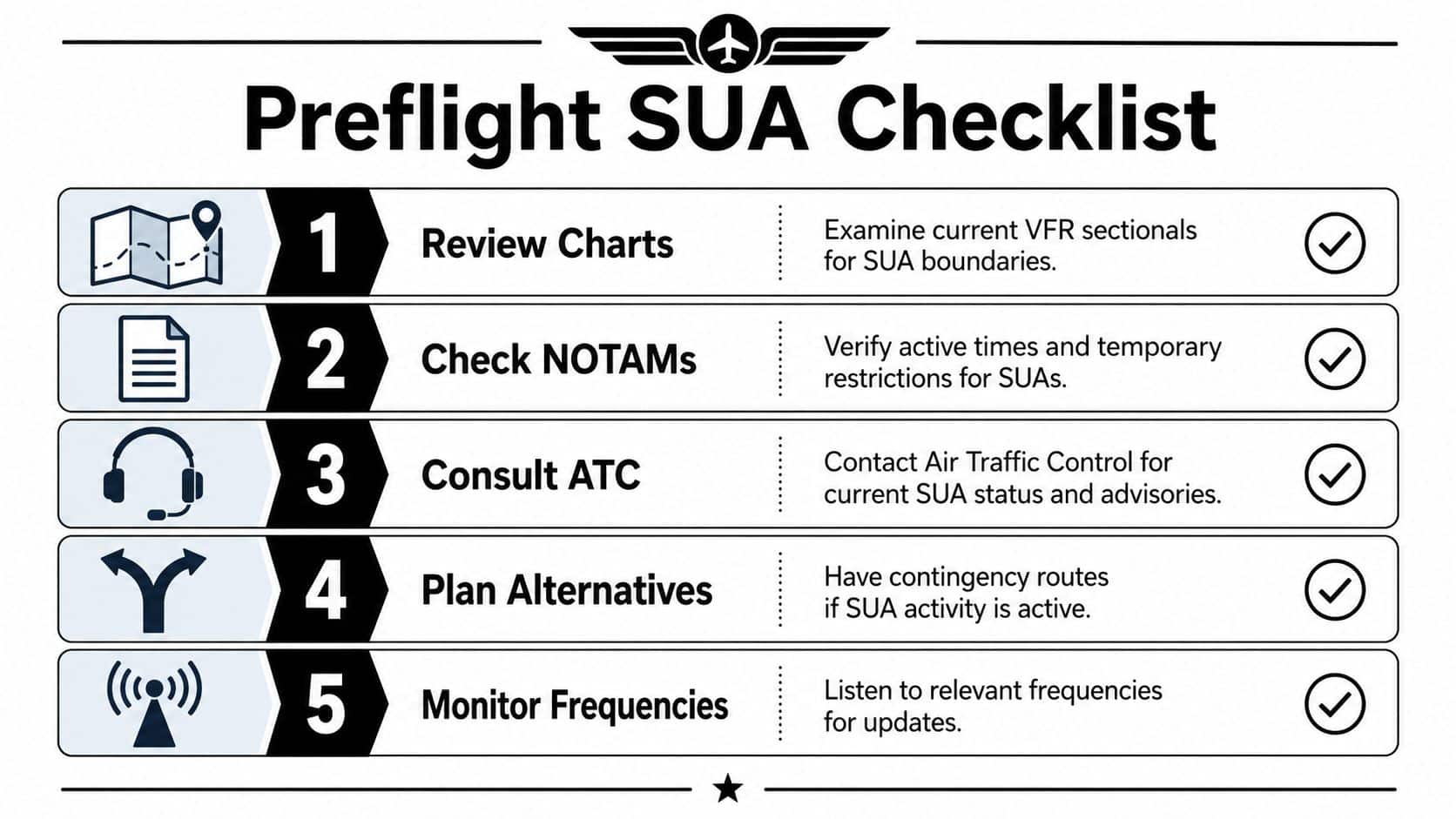
Keep this short checklist in your kneeboard notes or planning app, especially on VFR cross-countries. For students building habits, pairing it with a structured VFR cross-country planning workflow makes it easier to catch airspace issues before they become cockpit problems.
- Review charts: Identify every special use airspace area on or near your route.
- Check NOTAMs: Verify whether timing or temporary activity changes your plan.
- Consult ATC or the controlling agency: Know who you'll call and what question you're asking.
- Plan alternatives: Have a simple reroute and altitude option ready.
- Monitor frequencies: Stay ahead of updates once airborne.
The mindset to keep
Special use airspace isn't there to trap you. It's there to separate incompatible operations. When you respect that purpose, your planning gets clearer.
The student pilots who do best with SUA don't memorize the chart harder. They ask better questions, earlier.
If you're training out of Chino and want help turning airspace knowledge into practical decision-making, DuBois Aviation offers airplane and helicopter instruction at KCNO in the kind of busy Southern California environment where these skills become real, fast.