
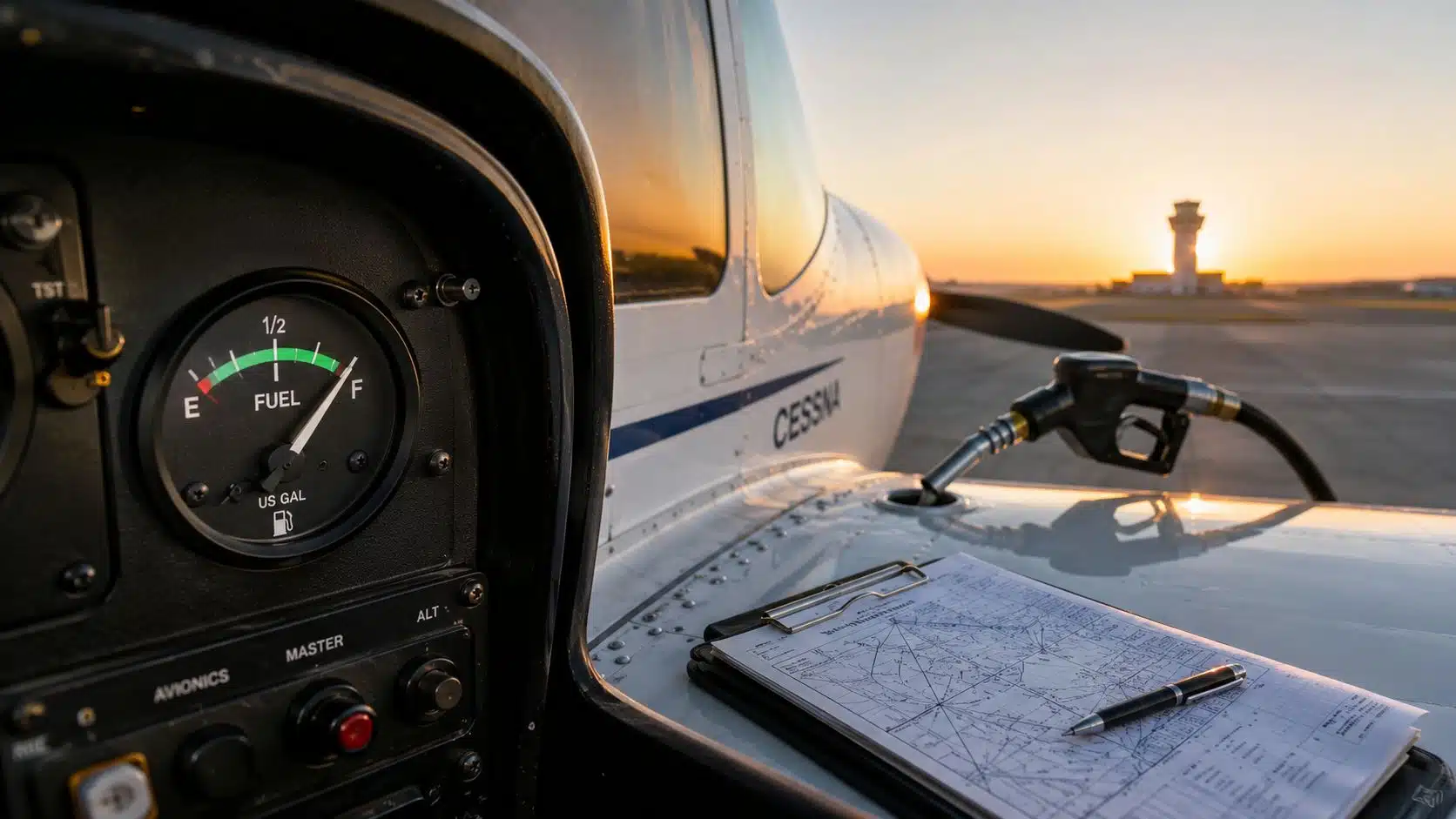
You're at the run-up area, the tower is moving traffic fast, and you're waiting behind a Bonanza while a Skyhawk gets cleared ahead of you. The plan looked clean on paper, but now the day has changed, the wind's not what you expected, and the fuel picture has to hold up in real time. That's where fuel management strategies stop being a spreadsheet topic and become a cockpit habit that keeps a flight legal, practical, and calm.
At a busy Class D field like KCNO, fuel planning isn't separate from flying. It's part of the same decision chain as taxi, sequencing, alternates, and whether you keep going or stop and reassess. A pilot who treats fuel like a checkbox can end up with a technically legal plan that doesn't fit the day. A pilot who treats fuel like a live control item has more options, more margin, and fewer surprises.
Table of Contents
- Why Fuel Planning Is a Pilot Skill, Not Just Arithmetic
- The Core Vocabulary of Fuel Planning
- Running the Preflight Calculation Step by Step
- Choosing an Alternate That Will Actually Help
- Engine Leaning Made Simple
- What Changes in a Helicopter
- The Mistakes That Actually Get Pilots
- A Preflight Quick-Reference You Can Actually Use
Why Fuel Planning Is a Pilot Skill, Not Just Arithmetic

The most common mistake I see from students is thinking fuel planning is finished once they've written down a departure fuel number. At a towered airport like KCNO, that number starts changing the moment you're behind another aircraft in sequence, because taxi time, run-up time, and a late runway change all eat into the cushion you thought you had. If you've ever sat in the run-up area watching traffic flow while your head recalculates, you already understand why this is a flying skill and not just math.
A good fuel plan is a decision tool. It tells you whether the flight still works when the tower delays you, when the headwind picks up, or when the destination looks worse than it did in the briefing room. That's why strong pilots use fuel as part of go and no-go criteria, not as an afterthought after the engine is already running. Go and no-go criteria for pilots belong in the same conversation as weather, runway length, and alternates.
Practical rule: if you can't explain where every gallon is going, you don't really have a plan yet.
KCNO makes that lesson obvious because the airport environment forces real choices. You're dealing with three runways, instrument approaches, mixed piston traffic, and sequencing that can change your departure timing in a hurry. That's perfect training. It forces you to stop thinking like a passenger and start thinking like a pilot who has to protect margin while the situation is still evolving.
The rest of this guide builds that habit from the ground up, from first solo to commercial work. The goal is simple, a fuel plan that still makes sense after ATC, weather, and traffic have all had their say.
The Core Vocabulary of Fuel Planning
Before any fuel calculation means anything, you need the words that make the calculation readable. Burn rate, usable fuel, reserve fuel, and alternate fuel are not airline jargon. They're the basics that let you look at a POH and translate it into a real decision.
A road trip offers a useful analogy. The mission is the drive, the tank is the wallet, and the reserve is the part you refuse to spend unless the day goes sideways. In an airplane, that cushion matters even more because fuel isn't just for arrival, it's for weather changes, sequencing delays, and the kind of unexpected diversion that turns a short hop into a longer day.
What the main terms actually mean
Gallons per hour is the engine's appetite at a given power setting. Usable fuel is the amount you can count on, not just what the tank shape suggests. VFR reserve is the fuel you keep untouched by plan. Alternate fuel is what gets you from the destination to the backup field if the first one isn't usable.
Holding fuel is the fuel you need if you're asked to wait. Bingo fuel is the point where you stop being casual and start protecting the flight. In training airplanes, these numbers are usually easier to think about in gallons per hour than in miles per gallon, because most lessons are short, local, and pattern-based.
A simple way to read the POH is to ask three questions. How much fuel can I use? How fast will I burn it? How much do I need to keep in reserve? Once you can answer those, the POH stops feeling like a technical book and starts functioning like a planning sheet.
| Flight Type | Minimum Reserve | Practical Trainer Interpretation |
|---|---|---|
| Day VFR | 30 minutes | Enough to land with cushion after minor delays or a small route change |
| Night VFR | 45 minutes | The reserve you want to protect more aggressively when visibility and options matter more |
The phrase to remember is this, planning fuel is not the same as legal fuel. Legal is the floor. Good judgment is what keeps the flight comfortable.
Running the Preflight Calculation Step by Step
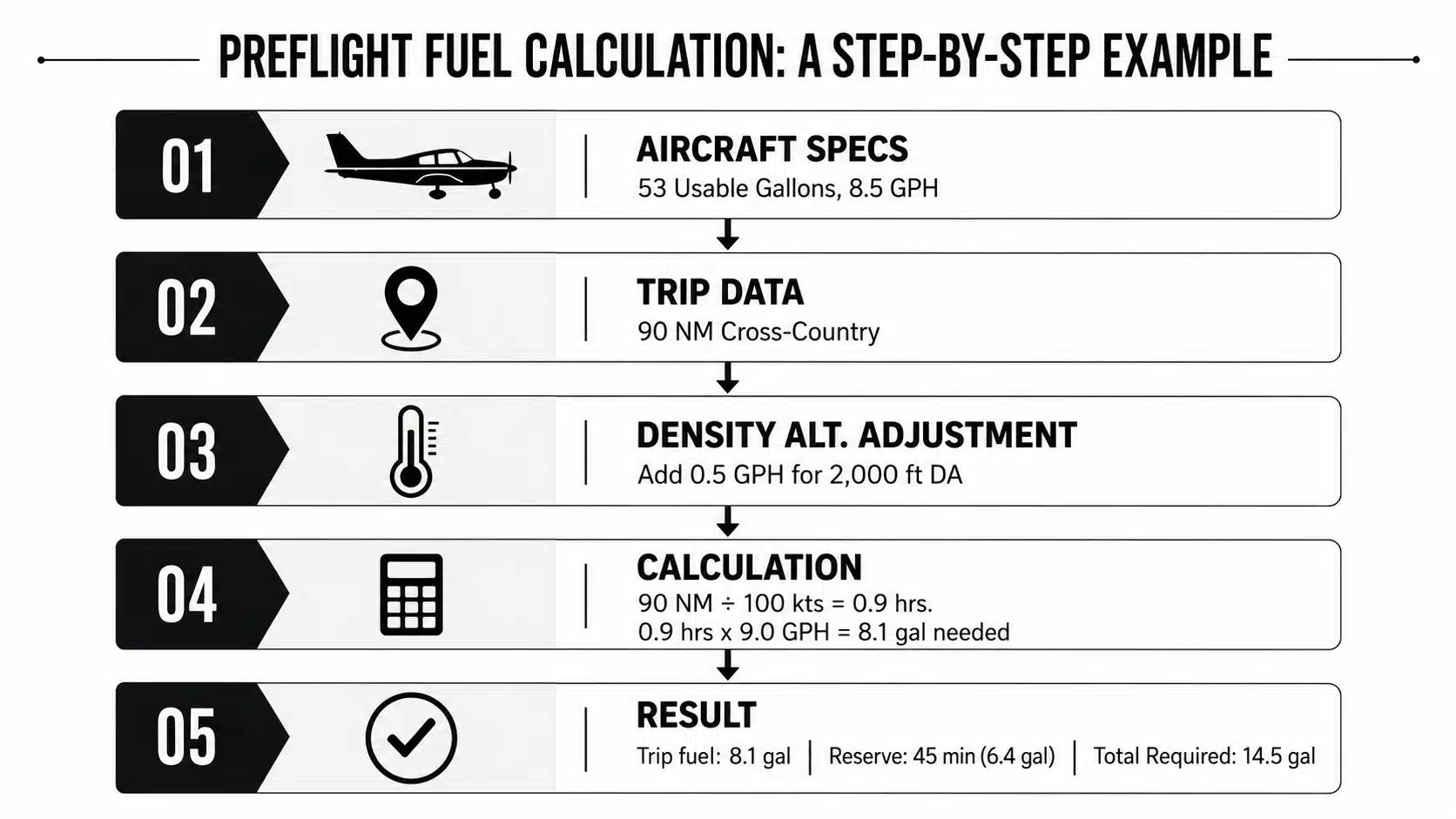
A Cherokee-class trainer gives you a clean example because the numbers are plain enough to work by hand. Use 53 usable gallons, a cruise burn of 8.5 GPH, a 90-nautical-mile cross-country, and a 2,000-foot density altitude adjustment. Then make the calculation honest by including taxi, climb, and a real alternate instead of pretending the airplane leaves the ramp already in cruise.
Start with time, not gallons
First, estimate time en route. If you expect about 100 knots groundspeed, then 90 NM ÷ 100 knots = 0.9 hours. That's the trip time before you add taxi, climb, or any delay. If the wind is against you, or the day is hot enough to soften climb performance, the actual number gets worse, not better.
Now multiply trip time by burn rate. If density altitude pushes the effective burn to about 9.0 GPH, then 0.9 hours × 9.0 GPH = 8.1 gallons for the cruise segment. That's the part many students do correctly. The mistake comes next, when they stop too early.
Add the parts people forget
Taxi fuel matters because the engine is still burning while the airplane is not making progress. Climb fuel matters because you're not at the cruise setting yet, and that transition consumes more than people expect. Reserve fuel matters because the flight isn't over when you reach the destination area, it's over when you're on the ground and the engine is shut down.
If a pilot forgets taxi and climb, a plan that looked solid can become marginal fast. A flight that seemed to have comfortable excess fuel may suddenly feel tight after a delay on the ramp, a climb into warmer air, and a longer-than-expected arrival sequence. That's why the arithmetic is the easy part. The discipline is adding the “boring” fuel that protects the day.
Here's the same logic in plain terms: trip fuel + taxi fuel + climb fuel + reserve fuel = actual go/no-go number. The numbers change by aircraft and conditions, but the method doesn't. If you want a broader refresher on range and endurance logic, this training guide on range and endurance fits well with this math.
A legal plan can still be a bad plan if it ignores the time you'll spend not cruising.
Choosing an Alternate That Will Actually Help
An alternate that satisfies the rulebook is not always the alternate that saves your day. Around the LA basin, that matters because distances can be short on paper while weather and traffic change the practical picture completely. From KCNO, you might look at SNA, ONT, or RIV and think the closest field is automatically the best answer. It isn't.
Pick the field that can actually accept you
A useful alternate has three qualities. It should be reachable with the fuel you have, it should have a weather picture that gives you a better outcome, and it should offer services or access that match the kind of airplane you're flying. A pilot who chooses only by distance can end up at a field that's close but operationally awkward.
TAFs and METARs matter here because they help you compare the likely picture at your destination and your backup. If two fields are equally legal, the better choice is often the one with the clearer ceiling and visibility trend, not just the one with the shorter taxi route. That's where real-world planning gets more honest than classroom planning.
Treat the alternate as part of the route
Filing a “default” alternate is easy. Filing a real one takes more thought. If ATC reroutes you, or if your first choice closes, the alternate can become the place that keeps the flight from turning into a scramble. That's why the backup should fit the aircraft, the fuel state, and the day, not just the paper requirement.
The point is not to maximize options forever. The point is to make the next choice obvious when the first choice stops working. A good alternate is one you'd be willing to land at if the weather worsened, the destination tightened up, or the tower gave you a route that burned more fuel than expected.
Engine Leaning Made Simple
Running full rich all the time is easy, but easy doesn't mean efficient. In a normally aspirated trainer, the engine can burn extra fuel without making extra useful power once you're away from the takeoff setting. Leaning lets you trim that waste, and in cruise it usually gives you a cleaner-running engine and a more sensible fuel bill.
Lean at altitude, then confirm the engine is happy
The practical sequence most CFIs teach is simple. Get to a safe cruise altitude, set your power, then lean gradually until the engine responds the way the POH expects. After that, enrich slightly if needed so the engine runs smoothly and stays out of the rough edge of the mixture curve. That approach works well in Cherokees, Mooneys, and the Cessna 150 when they're being flown in the normal, conservative range.
On the ground, leaning usually isn't worth the risk for most training flights. Taxi, run-up, and takeoff are busy phases, and pilots have enough to monitor without making mixture management a guessing game. During long descents, over-aggressive leaning can also create problems, including plug fouling if the engine spends too much time in an unhappy transition zone.
Different trainers demand different respect
A Cherokee often gives the student a comfortable place to learn the process because the airplane is stable and the burn changes predictably. A Piper Apache, with its higher-compression engine management demands, asks for more caution and more attention to procedure. The mechanic of leaning is the same, but the tolerance for sloppy execution isn't.
The best way to think about it is this. Leaning isn't a trick to squeeze the airplane. It's part of fuel management discipline. If you know how to lean correctly, you stop throwing away fuel that does nothing useful and start flying a more deliberate cruise profile.
Rule of thumb: if you're not sure where the mixture belongs, stay conservative and use the POH, not habit.
What Changes in a Helicopter
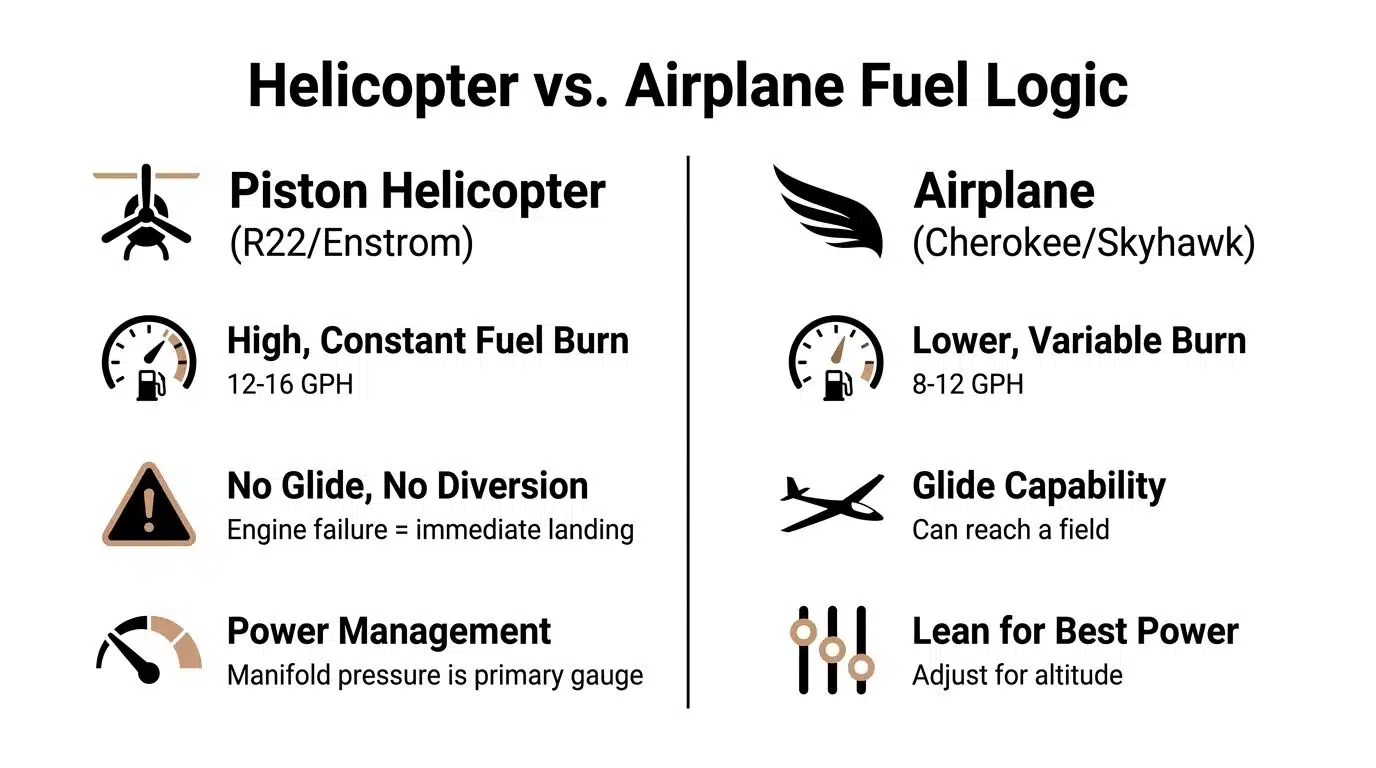
A Robinson R22 doesn't think about fuel the way a Cherokee does, because the rotorcraft mission eats fuel differently. Hover work is expensive, cruise is only part of the story, and the margin after an engine problem is very different from what a fixed-wing student expects. That changes how you plan, even when the weather looks benign.
Hover, glide, and fuel age all matter more
Hover operations consume more fuel than ordinary cruise because the helicopter is asking the engine to do more work without the benefit of efficient forward motion. That means a short local flight can burn more than a student expects if the mission includes hovering, pattern work, or repeated power changes. In a fixed-wing trainer, the airplane can often glide to a landing area if the engine quits. In an R22 or similar rotorcraft, that cushion is much smaller and the pilot has less room to improvise.
Fuel age matters too, especially in helicopters that may sit between flights. A helicopter fuel plan has to respect what's in the tank now, not just what was loaded earlier in the week. That's why helicopter instructors tend to treat published VFR reserves as a floor, not a target.
The same conservative mindset applies to the engine and the mission. A helicopter pilot doesn't want to be clever with fuel. They want the machine to remain boringly predictable.
Multi-engine context helps frame the standard
A multi-engine helicopter changes the fuel and redundancy conversation again, but that's outside the basic trainer world. The useful lesson for a Robinson or an Enstrom student is simpler. You plan earlier, with more margin, and you treat the reserve as protection, not as something to “use up” just because the chart says you can.
For rotorcraft training, that conservatism is a safety habit. It's also a mindset check. Fixed-wing pilots sometimes bring airplane assumptions into helicopter flying, and that's when they get surprised. The right habit is to respect the helicopter's different fuel logic from the beginning.
Robinson helicopter training at DuBois Aviation sits in that same world of disciplined planning and conservative judgment, even before the first engine start.
The Mistakes That Actually Get Pilots
The same fuel mistakes show up again and again because they're easy to make when the rest of the flight feels normal. A student looks at the POH, sees a good number, and forgets that the airplane will still be burning fuel while taxiing. Another pilot leans too aggressively and then spends the next part of the flight managing roughness instead of efficiency. These are training errors, but they're also the kind of errors that become expensive if nobody catches them early.
The habits that prevent the same errors
- Forgetting taxi and run-up fuel: Build a fixed allowance into every preflight, even when the ramp looks short. The cost of the habit is tiny, and the payoff is that your plan reflects reality instead of hope.
- Misreading the fuel after refueling: Visually verify the quantity and confirm the tanks match the plan before start. Don't trust a quick glance when the airplane has just come off a busy line.
- Not checking tank selection: Verify selector position before takeoff and again in the flow. A correct fuel load means little if the engine isn't drawing from the tank you thought it was.
- Planning to a number instead of a weather condition: If you ignore wind, the estimate is fiction. Use the forecast and then give yourself room for the day to worsen.
- Leaning too long or too aggressively: Correct leaning is a technique, not a contest. If the engine isn't smooth and happy, back up and reset.
A solo cross-country can expose all of that at once. A student may think 4.2 hours of fuel is enough for a 3.5-hour flight, then arrive low because the headwind was stronger than expected and the preflight never weighted the wind correctly. The legal number was there. The judgment wasn't.
The fix is not panic. The fix is a cockpit routine that checks the same items every time so the airplane doesn't surprise you.
A Preflight Quick-Reference You Can Actually Use
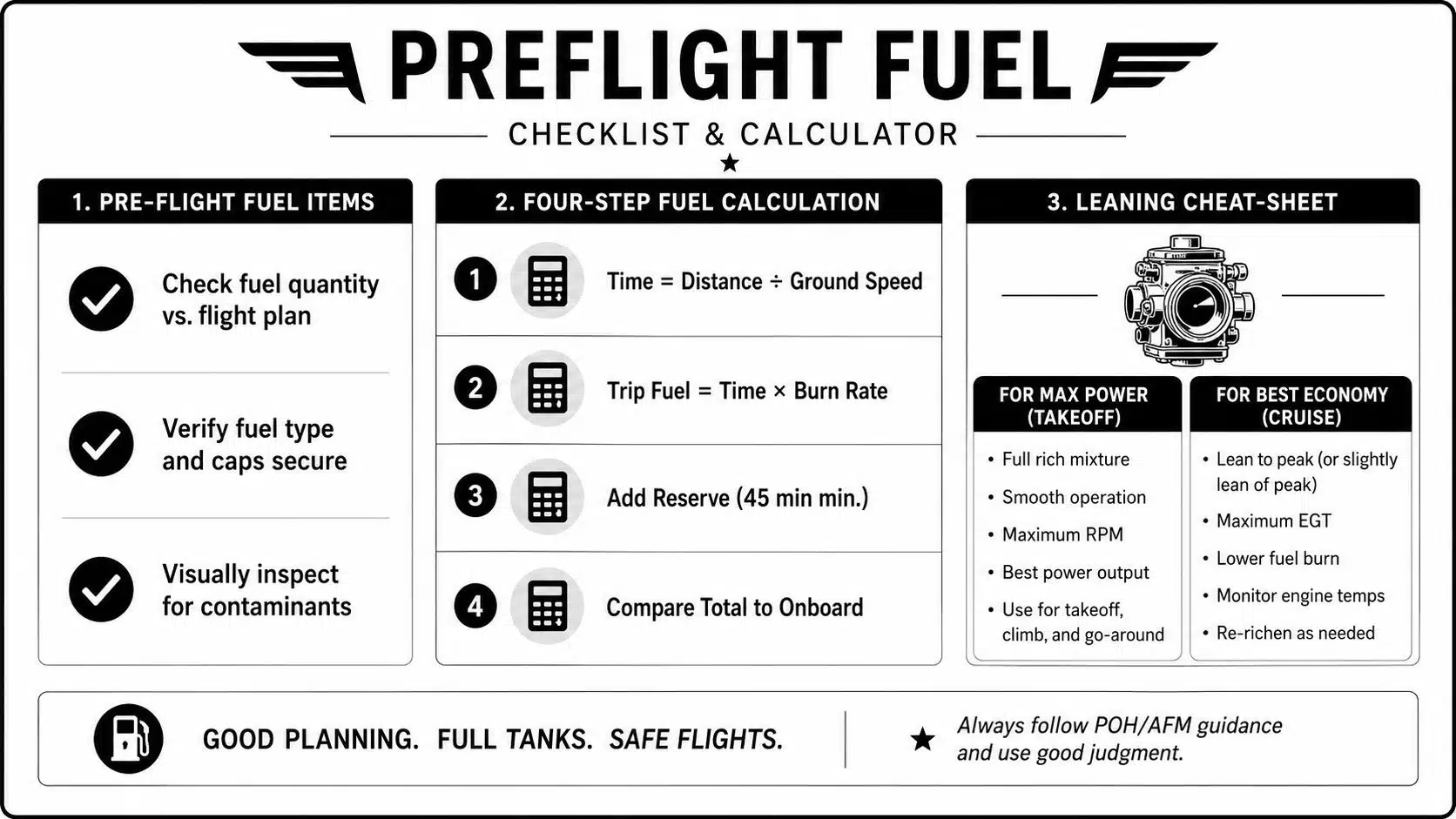
A good fuel card fits in your kneeboard because it's simple enough to use under pressure. Start with the airplane or helicopter itself, then work the route, then compare the result to what's on board. That structure keeps the plan usable when the day gets busy.
The core checklist
- Check fuel quantity versus the flight plan: Confirm usable fuel, not just tank capacity.
- Verify fuel type and caps secure: Make sure the right fuel is on board and the airplane is sealed up correctly.
- Visually inspect for contaminants: A good plan starts with clean fuel, not assumptions.
- Time equals distance divided by ground speed: Use the day's real wind, not last week's habit.
- Trip fuel equals time times burn rate: Apply the POH burn at the actual cruise setting.
- Add reserve fuel: For VFR planning, protect the appropriate day or night reserve.
- Compare total to onboard fuel: If the margin is thin, reduce the mission or delay the launch.
For many cross-country instructors, the one-third rule is a planning philosophy, not a regulation. If one-third of your fuel is gone before you've reached the midpoint, that's a strong signal to reassess the day instead of hoping the rest of the flight behaves better than the first half.
Keep one more question in your head before every takeoff. Is this the plan you'd still accept if ATC delayed you, the weather slid down a little, or the destination stopped being your best option? If the answer is no, the plan needs work, not rationalizing.
DuBois Aviation builds this kind of decision-making into real training at KCNO, where tower work, weather changes, and active traffic force pilots to manage fuel like professionals. If you want instruction that connects the numbers to actual cockpit choices, visit DuBois Aviation and see how their one-on-one training can help you turn fuel planning into a habit you trust every flight.


