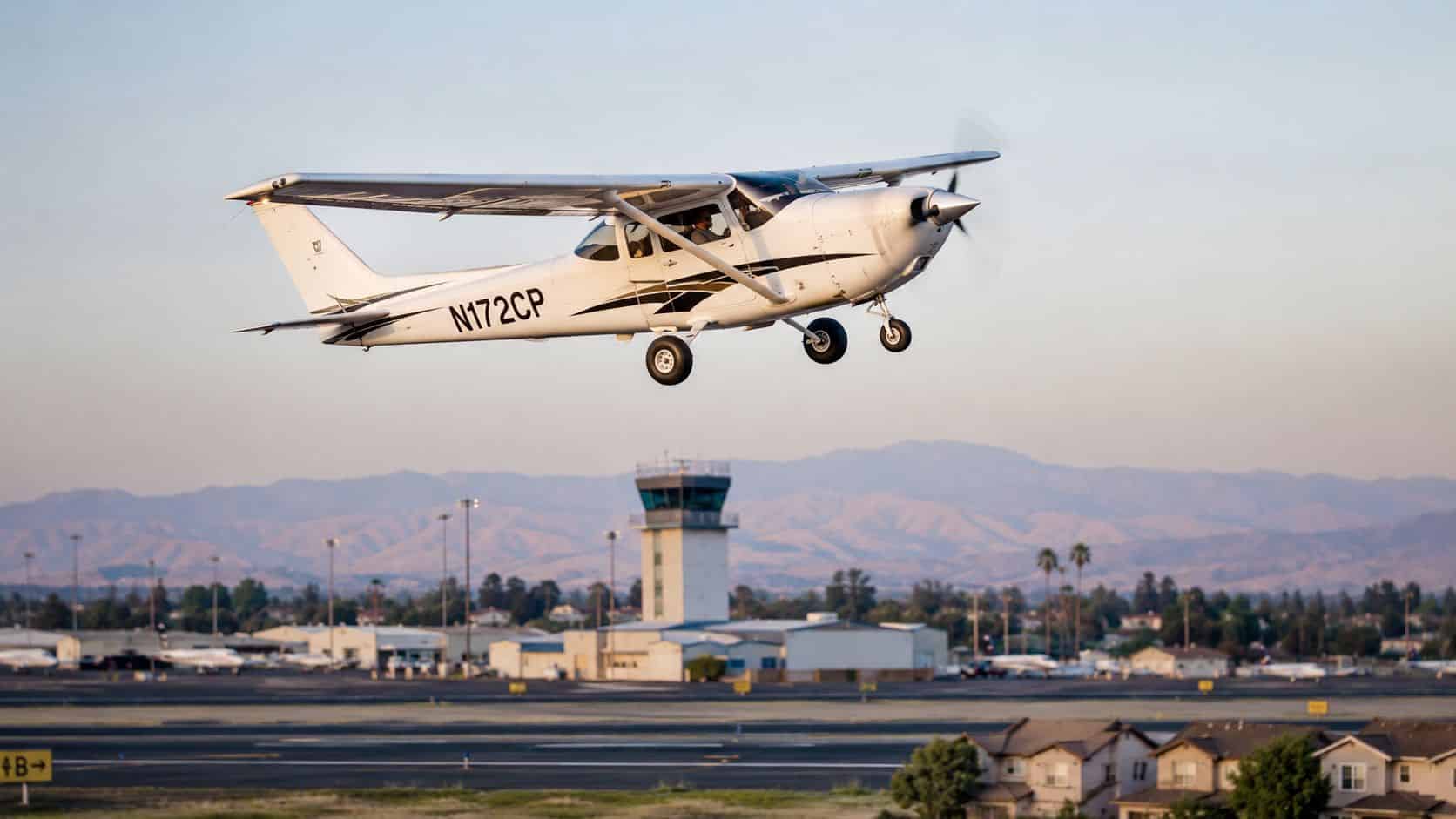
A Cessna 172 is holding short at Chino Airport, the morning pattern is building, and nearby residents are starting their day. The correct noise abatement procedures depend on more than a memorized turn or reduced-power setting. Pilots must use current airport guidance, follow ATC instructions, and protect safety of flight first. Noise reduction supports community relations and helps keep training and general aviation operations viable, but it never justifies an unstable climb, an unsafe pattern, or a deviation from an assigned clearance.
Table of Contents
- How to Use Noise Abatement Procedures at Chino Airport
- Find and Interpret Current KCNO Guidance
- Plan and Fly a Quieter Departure
- Manage Arrivals and Traffic Pattern Noise
- Avoid Common Noise Compliance Mistakes
- Know Which Rules and Techniques Apply
- Build a Practical Chino Noise Checklist
How to Use Noise Abatement Procedures at Chino Airport
Noise abatement procedures are airport-specific operating practices intended to reduce noise impacts on surrounding communities. The FAA's explanation of noise abatement procedures emphasizes that airports may publish standardized arrival and departure profiles, rather than applying one universal rule to every field. At KCNO, the pilot's job is to translate the current published guidance into a safe decision for the runway, aircraft, traffic flow, and weather in use.
Three priorities govern every flight:
- Current published guidance comes first. The latest Chart Supplement entry, airport material, NOTAMs, and applicable operating rules define what the airport expects.
- ATC instructions control the operation. A controller may assign a runway, heading, vector, or pattern adjustment that differs from a preferred noise technique.
- Safety of flight wins. Terrain clearance, aircraft performance, wake turbulence, traffic separation, stabilized approaches, and go-around decisions outrank noise reduction.
Before engine start, the pilot should identify the active runway, review runway-end notes, check operating-hour language, and determine whether a recommendation is mandatory or voluntary. On the ground, the pilot should confirm the clearance, taxi route, and any departure heading before adding power. In the air, the pilot should fly the assigned route and profile while using approved aircraft techniques that preserve climb performance and control margins.

Practical rule: A noise procedure is a decision framework, not a rigid script. The correct action can change when the runway, wind, traffic, aircraft weight, or controller instruction changes.
A student or renter should brief the intended profile aloud before takeoff. That briefing might include the expected heading, climb target, likely turn point, and the condition that would cancel the noise technique, such as conflicting traffic or a safety concern. The same discipline applies to touch-and-go operations, where repeated pattern work can create more community exposure and more opportunities for an unauthorized turn or poorly timed configuration change.
Find and Interpret Current KCNO Guidance
General aviation advice can't establish what Chino requires. Pilots should begin with the current FAA Chart Supplement entry for KCNO, then compare it with the airport's published noise information and any applicable local operating notices. The airport's A/FD remarks, runway-end notes, and published pattern information may contain different types of guidance, so each statement deserves careful classification.
A note may describe a mandatory operating restriction, a preferred runway or route, a voluntary quiet-hour request, or a safety-related traffic-flow procedure that happens to reduce noise. Those categories matter. FAA guidance distinguishes mandatory “Curfew Hrs” from voluntary “Quiet Hrs” when airport information identifies operating-time limits, as explained in this FAA presentation on noise-abatement charting.
Pilots should also check NOTAMs for temporary runway closures, displaced thresholds, procedure changes, or other conditions that can alter the expected path. Initial contact with ATC is the right time to verify the active runway, departure instructions, and any uncertainty about a published noise note. A controller can clarify the operational plan, but the pilot remains responsible for understanding the aircraft's limitations and complying with applicable published requirements.
| Source of Chino guidance | Authority level | Update frequency |
|---|---|---|
| Current Chart Supplement entry | Published FAA airport information | Check before each flight |
| Airport noise-abatement page or notice | Local airport guidance, subject to its stated language | Check for revisions |
| NOTAMs | Temporary operational information | Check before each flight |
| ATIS and ATC instructions | Current traffic and clearance information | Recheck during the operation |
| A/FD remarks and runway-end notes | Published airport remarks | Verify against the current entry |
The KCNO airport information used for local planning should be treated as a planning aid, not a replacement for current FAA publications or controller instructions. Outdated briefings create compliance errors because a pilot may follow a once-familiar route that no longer matches the active runway or current airport direction.
Plan and Fly a Quieter Departure
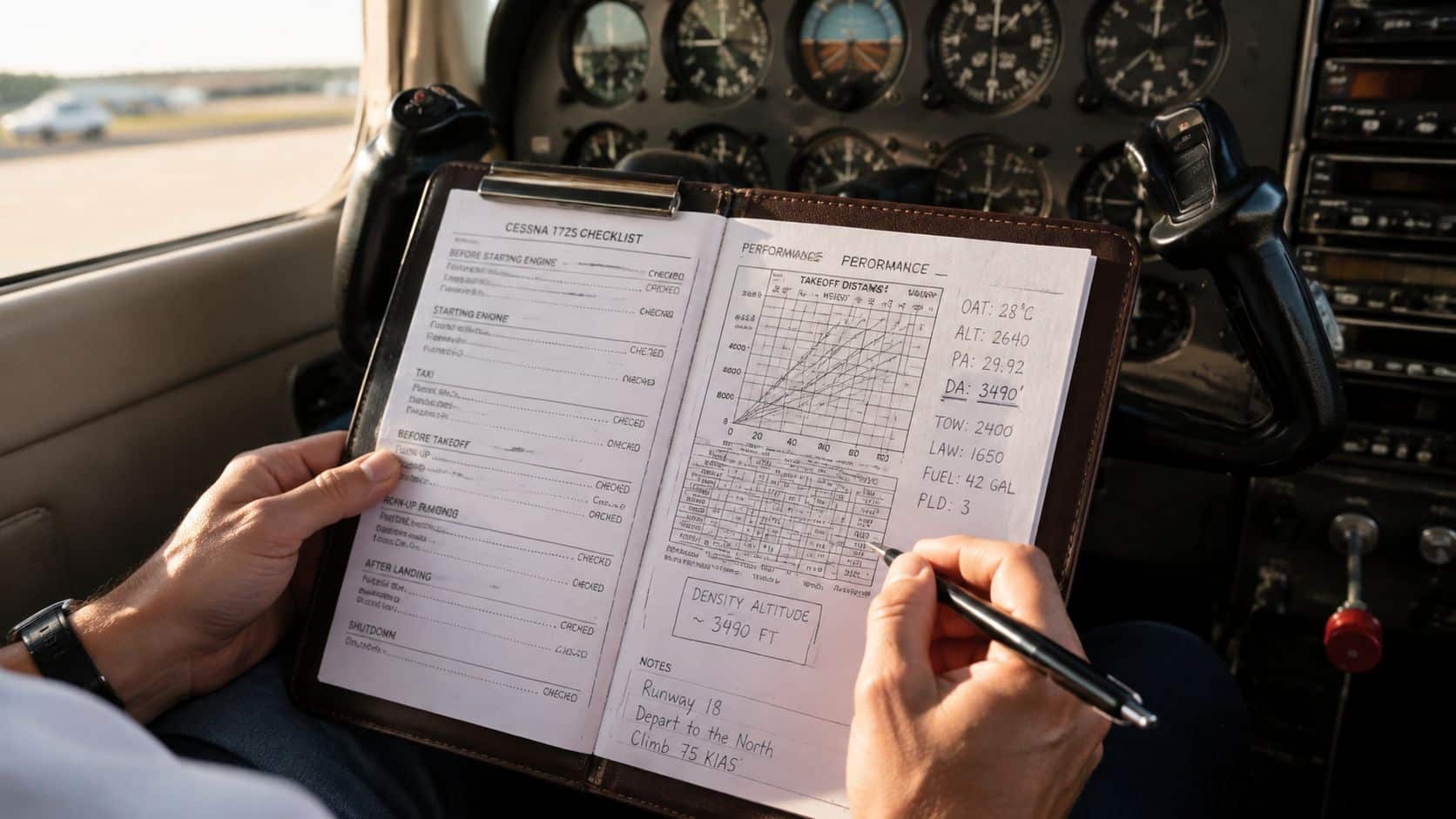
A quieter departure starts with performance planning, not with an abrupt power reduction after liftoff. Density altitude, takeoff weight, runway length, wind, and aircraft condition all affect the climb gradient. A heavily loaded airplane on a warm day may need more runway and more sustained power to reach a safe altitude than the same airplane flown lightly in cool air.
The runway-length planning guidance helps frame that decision before the aircraft moves. The pilot should calculate the takeoff performance, identify the expected climb profile, and determine when a thrust reduction could occur without sacrificing the required climb or obstacle clearance. Noise goals can't replace the aircraft flight manual, operating handbook, or instructor-approved technique.
A departure workflow that protects margins
- Before start: Review the active runway, wind, aircraft weight, density altitude, published route, and expected ATC instructions.
- Before taxi: Brief the takeoff path, initial heading, climb speed, configuration changes, and the trigger for abandoning the noise profile.
- During the takeoff roll: Apply power smoothly and confirm engine indications, directional control, and acceleration. A rushed or partial power application doesn't make the operation safer or quieter.
- After liftoff: Establish the aircraft's approved climb profile. Retract gear and flaps at the manufacturer's or instructor's recommended speeds, not at an improvised point selected only to reduce sound.
- During climb: Use best-angle or best-rate performance as appropriate for the obstacle and traffic situation. Reduce thrust only when the aircraft's performance and published procedure support it.
Runway selection involves more than choosing the runway with the shortest taxi. Wind and runway performance remain primary considerations, while the route over noise-sensitive areas can influence a safe preference when the airport and ATC plan permit it. A pilot shouldn't request a less suitable runway merely to avoid a neighborhood if the change creates a tailwind, poor climb performance, or a traffic conflict.
The same principle applies to turns. If a published departure heading or local recommendation delays a turn, the pilot should continue it only while the aircraft remains clear of terrain and traffic and the clearance permits it. If ATC assigns an earlier or later turn, the assigned instruction controls. If the instruction is unclear, the pilot should clarify it rather than guessing.
Manage Arrivals and Traffic Pattern Noise
A quiet arrival starts before entering the pattern. Check the current airport guidance, runway in use, local operating hours, and expected traffic flow. At Chino, an arriving pilot may be asked to extend downwind, accept a vector, follow slower traffic, or adjust spacing. Those ATC instructions control the flight. A preferred noise-sensitive-area track never overrides a clearance, traffic requirement, or safe aircraft handling.
A stabilized approach usually produces less unnecessary noise than a late correction followed by abrupt power changes. Use the airport's published pattern structure, choose a predictable descent, and configure the aircraft at points that preserve airspeed, altitude, and control. For instrument arrivals, review the applicable instrument approach procedure guidance before departure, then compare it with the runway configuration and any visual-pattern instructions in effect.
Consider a light trainer following traffic ahead. Gliding farther, delaying configuration, or turning base early may appear quieter, but those choices can create an excessive descent, a rushed final turn, or reduced spacing. Keep the aircraft's energy under control. If spacing requires a wider pattern, use the assigned extension rather than improvising a shortcut. If the approach no longer meets stabilized-approach criteria, discontinue it.
Arrival decisions in context
| Phase | Quieter technique | Safety constraint |
|---|---|---|
| Pattern entry | Join at the published altitude with appropriate spacing | Follow ATC, traffic flow, and wake-turbulence requirements |
| Downwind | Configure progressively and maintain a stable track | Do not stretch the pattern beyond control or spacing margins |
| Base leg | Use a controlled descent and timely turn | An extended base or vector may be required for traffic |
| Final | Align early enough for a stabilized approach | Go around if noise reduction causes instability |
| Landing rollout | Use only approved braking and reverse-thrust practices | Reverse thrust applies only where the aircraft procedure permits it |
A complex aircraft may permit limited reverse thrust or a reduced-power rollout, depending on its approved procedure and runway condition. In a trainer, propeller and flap settings should support predictable energy management, not just produce a lower sound level.
Base-leg extensions require judgment. They may keep the aircraft away from one noise-sensitive area while placing it over another neighborhood, increasing track length, or demanding a steep correction to final. Noise reduction can shift the footprint instead of removing it. ICAO reports reductions of about 2 to 9 dB and 23% to 42% reductions in noise contour area for procedure programs, with results depending on the runway, route, and monitoring program described in the ICAO noise-abatement operational procedures guidance.
A safe, predictable go-around protects the aircraft, traffic pattern, and community better than a low, fast, or poorly aligned continuation. Compliance means following published requirements and ATC instructions, not merely avoiding a noise-sensitive area.
Avoid Common Noise Compliance Mistakes
A frequent mistake is treating a preferred departure turn as permission to turn early. A pilot may believe an early turn avoids homes, yet the aircraft could still be inside a published routing requirement, conflicting with traffic, or operating contrary to the clearance. A voluntary quiet-hour request also isn't a waiver to disregard an assigned heading or airport procedure.
Another error involves stretching the glide to reduce engine noise. Extending downwind, delaying gear or flap changes, or reducing power below the aircraft's normal approach plan can remove energy and altitude margins faster than the pilot expects. The result may be a steep base turn, an unstable final, or a go-around launched from an awkward position.
Pilots also assume that one heading benefits every neighborhood equally. Noise contours move with runway use, wind, climb performance, track concentration, and the location of sensitive areas. An airport may reduce exposure in one corridor while concentrating operations in another. The FAA reports that noise exposure in the United States fell from roughly 7 million people in the mid-1970s to just over 400,000, while the ratio improved from 1 exposed person per 30 enplanements in 1975 to more than 2,100 enplanements per exposed person today. The FAA uses a 65 dB DNL threshold in policy assessments, as documented in its history of aviation noise policy.
The useful lesson isn't that every local technique will work everywhere. It's that coordinated procedures, aircraft technology, planning, and monitoring can change exposure at scale. At the cockpit level, the pilot should avoid four shortcuts:
- Early turns: Don't turn before the clearance, published procedure, or safe traffic plan allows it.
- Forced quiet approaches: Don't trade airspeed, altitude, or alignment for a lower-power arrival.
- Premature shutdowns: Don't shut down an engine or alter ground operations outside the aircraft and airport procedure.
- Boundary thinking: Don't assume noise responsibility ends at the airport perimeter. The route, pattern, and climb profile still affect surrounding communities.
Know Which Rules and Techniques Apply
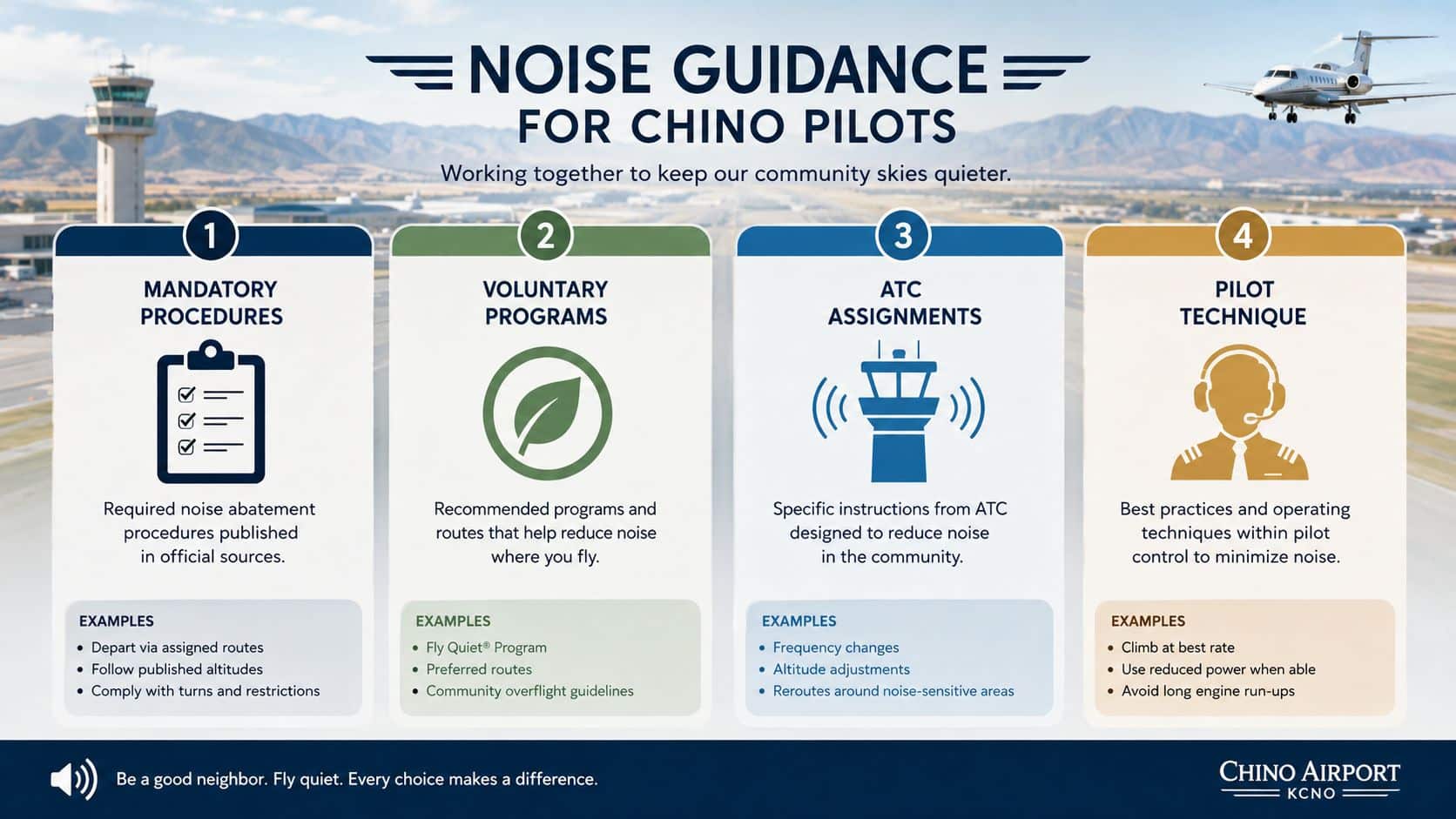
Pilots need a clear hierarchy because “noise abatement” can describe several different things. A published restriction, a voluntary request, an ATC assignment, and a pilot technique may appear next to one another in airport information, but they don't carry the same authority.
| Guidance category | What it means | Pilot response |
|---|---|---|
| Published mandatory procedure | A rule, restriction, curfew, or required operating profile identified as mandatory | Comply unless safety or an applicable higher-priority instruction requires clarification |
| Voluntary noise program | A preferred time, route, runway, or technique requested by the airport | Follow when practical and safe, but don't treat it as permission to disregard ATC |
| ATC assignment | A current clearance, heading, vector, runway, or spacing instruction | Read back and comply, then ask for clarification if needed |
| Pilot technique | A power, configuration, routing, or planning choice within the aircraft's limits | Use only when it preserves safety and meets the first three categories |
FAA guidance under 14 CFR Part 161 treats runway preference, arrival and departure profiles, flight tracks, taxiing, engine run-ups, operating hours, and restrictions differently depending on the type of operation and limitation involved. The regulation's categories can be reviewed in the current text of 14 CFR 161.7. A pilot shouldn't infer that a local recommendation has the force of a federal operating restriction without checking its actual wording and legal basis.
The broader aviation framework uses layered measures. ICAO identifies preferential runways and routes, displaced thresholds, approach and landing procedures, NADPs, and other operating procedures as parts of noise management. Its review also notes that monitoring is important because operators need evidence that a procedure changes exposure as intended, rather than moving noise to another corridor.
Before acting on any instruction, the pilot should ask:
- Who issued it? Airport publication, regulation, ATC, or personal technique?
- What language applies? Required, prohibited, preferred, recommended, or advisory?
- What changes today? Runway, weather, traffic, NOTAMs, aircraft weight, or performance?
- What cancels it? Terrain, traffic, unstable energy, communication failure, or another safety issue?
- Can the pilot comply without guessing? If not, clarify before maneuvering.
This labeling prevents courtesy from being confused with compliance. It also gives students and renters a repeatable method for handling unfamiliar airports nationwide.
Build a Practical Chino Noise Checklist
This checklist is a memory aid for KCNO operations. It doesn't replace current airport publications, NOTAMs, the aircraft operating handbook, weather evaluation, or ATC instructions.
Before engine start
- Review current sources: Check the Chart Supplement, airport notices, applicable noise page, A/FD remarks, and NOTAMs.
- Classify each item: Mark every instruction as mandatory, voluntary, ATC-related, or pilot technique.
- Assess performance: Consider aircraft weight, density altitude, wind, runway condition, expected climb, and available runway.
- Brief the route: Identify the runway, initial heading, likely turn, pattern plan, and the point where safety concerns cancel the noise technique.
- Check operating hours: Confirm whether time language describes a curfew or a voluntary quiet period.
Taxi and takeoff
- Confirm the clearance: Read back the runway, route, heading, and any restriction that affects the departure.
- Use controlled ground power: Avoid unnecessary run-ups or prolonged engine operation when airport guidance provides a quieter alternative.
- Protect takeoff margins: Apply power smoothly, verify aircraft indications, and use the approved configuration schedule.
- Follow the assigned path: Don't make an early turn or power reduction because it appears quieter from the cockpit.
Climb and pattern work
- Maintain the planned profile: Use the appropriate climb speed and thrust setting for the aircraft and conditions.
- Respect traffic flow: Extend, turn, or adjust spacing when directed. Don't force a preferred noise track into a conflict.
- Keep touch-and-goes disciplined: Rebrief the next departure before each circuit, especially when runway or controller instructions change.
Approach, landing, and shutdown
- Stabilize early: Use predictable configuration and descent management. Go around if noise reduction compromises the approach.
- Use aircraft-approved techniques: Apply limited reverse thrust, reduced power, or other methods only when permitted by the aircraft procedure and runway conditions.
- Complete the operation properly: Taxi and shut down according to airport guidance, aircraft requirements, and local safety considerations.
- Record lessons: Students and renters should note current local guidance, ATIS or clearance details, and questions for the next instructor briefing.
A disciplined pilot can also ask the local instructor or FBO for the latest Chino notes, record the clearance during training when practical, and monitor updates to formal noise compatibility planning. FAA Part 150 planning is designed to quantify exposure, map contours, and evaluate mitigation before and after implementation, so useful operational metrics include contour changes, runway-use compliance, and adherence to prescribed profiles. The checklist works best when it supports those habits instead of replacing judgment.
DuBois Aviation provides one-on-one airplane and helicopter training, aircraft rental, instrument and commercial instruction, multi-engine training, and CFI, CFII, and MEI preparation at Chino Airport. Pilots can visit DuBois Aviation to ask about course availability, schedule a school tour, or request training information focused on disciplined KCNO departures, arrivals, radio work, and safety-first noise procedures.