
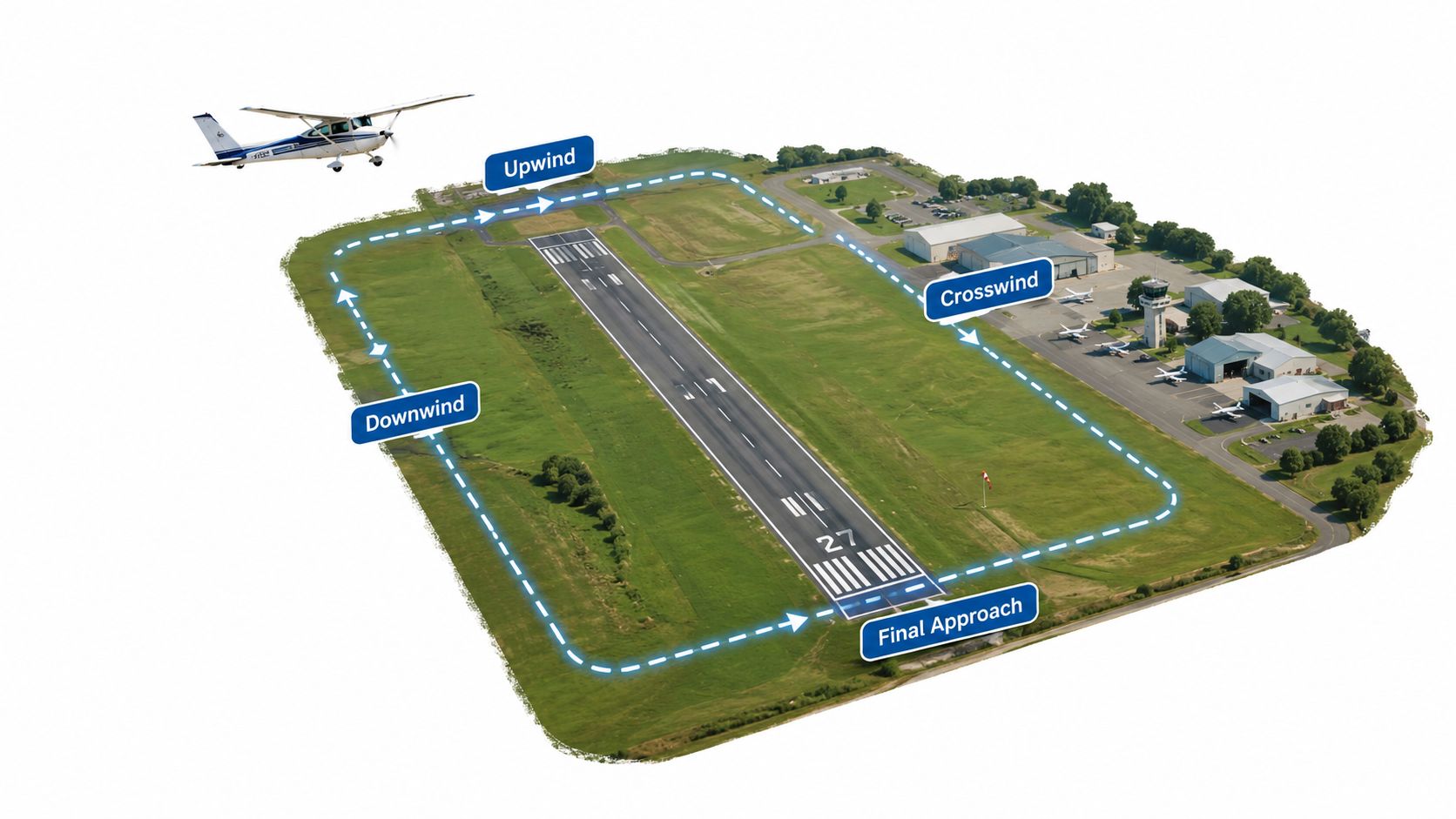
You're ten miles north of Chino Airport, preparing for a first solo, when the tower says, “Expect left traffic, Runway 26R.” Air traffic patterns are the organized flow of arriving, departing, and sequencing aircraft around a runway. They tell pilots where to look, when to turn, how to communicate, and when to go around. Once the rectangle becomes a three-dimensional traffic system rather than a diagram to memorize, pattern work becomes calmer and more predictable.
Table of Contents
- Why the Traffic Pattern Matters on Every Flight
- The Geometry of a Standard Traffic Pattern
- Standard Pattern Altitudes and Why They Differ
- Pattern Entry and Exit Procedures Step by Step
- Radio Calls and Common Student Mistakes
- Towered Versus Non-Towered Pattern Differences
- Helicopter and Wake Turbulence Considerations
- Practical Training Scenarios at Chino and Beyond
Why the Traffic Pattern Matters on Every Flight
A traffic pattern is a shared operating structure around an airport. It normally includes upwind, crosswind, downwind, base, and final, with each leg giving pilots a predictable location for traffic scanning, configuration changes, and spacing decisions. Nearly every training flight spends time inside this structure, whether the lesson involves takeoffs and landings, emergency procedures, instrument approaches, or a return from a cross-country flight.
At a towered airport such as Chino, the controller actively sequences aircraft and may assign a specific runway, entry leg, or traffic order. At a non-towered airport, pilots must coordinate through position reports, visual scanning, and standard entry procedures. The setting changes the communication method, but the need for a predictable path remains.
Four jobs the pattern performs
- Collision avoidance: Standard turns and recognizable legs help pilots anticipate where other aircraft should appear.
- Wake turbulence spacing: Larger and faster aircraft can leave hazardous disturbed air near the runway and approach path. Pilots must account for aircraft category, position, and time separation.
- Runway efficiency: Sequencing lets aircraft depart, land, extend, and go around without every pilot improvising a route.
- Right-of-way compliance: The pattern operates alongside the see-and-avoid and right-of-way requirements in 14 CFR 91.113. A clearance doesn't remove a pilot's responsibility to avoid other aircraft.
The FAA's standard pattern structure also creates common visual reference points. Pilots know where to expect an aircraft turning base, where a departing airplane may crosswind, and where a final approach should develop. At a busy field, those expectations reduce surprises and make radio calls more useful.
Practical rule: If the pattern feels rushed, the safest response usually isn't to fly faster. Stabilize the airplane, simplify the next decision, and make the next predictable move.
Pattern proficiency supports every later stage of training. Private pilots use it to build basic traffic awareness. Instrument students must return from an approach and integrate with visual traffic. Commercial and instructor candidates must demonstrate judgment, communication, and go-around decisions. The same foundation remains valuable for multi-engine, helicopter, and career-track operations.
The Geometry of a Standard Traffic Pattern
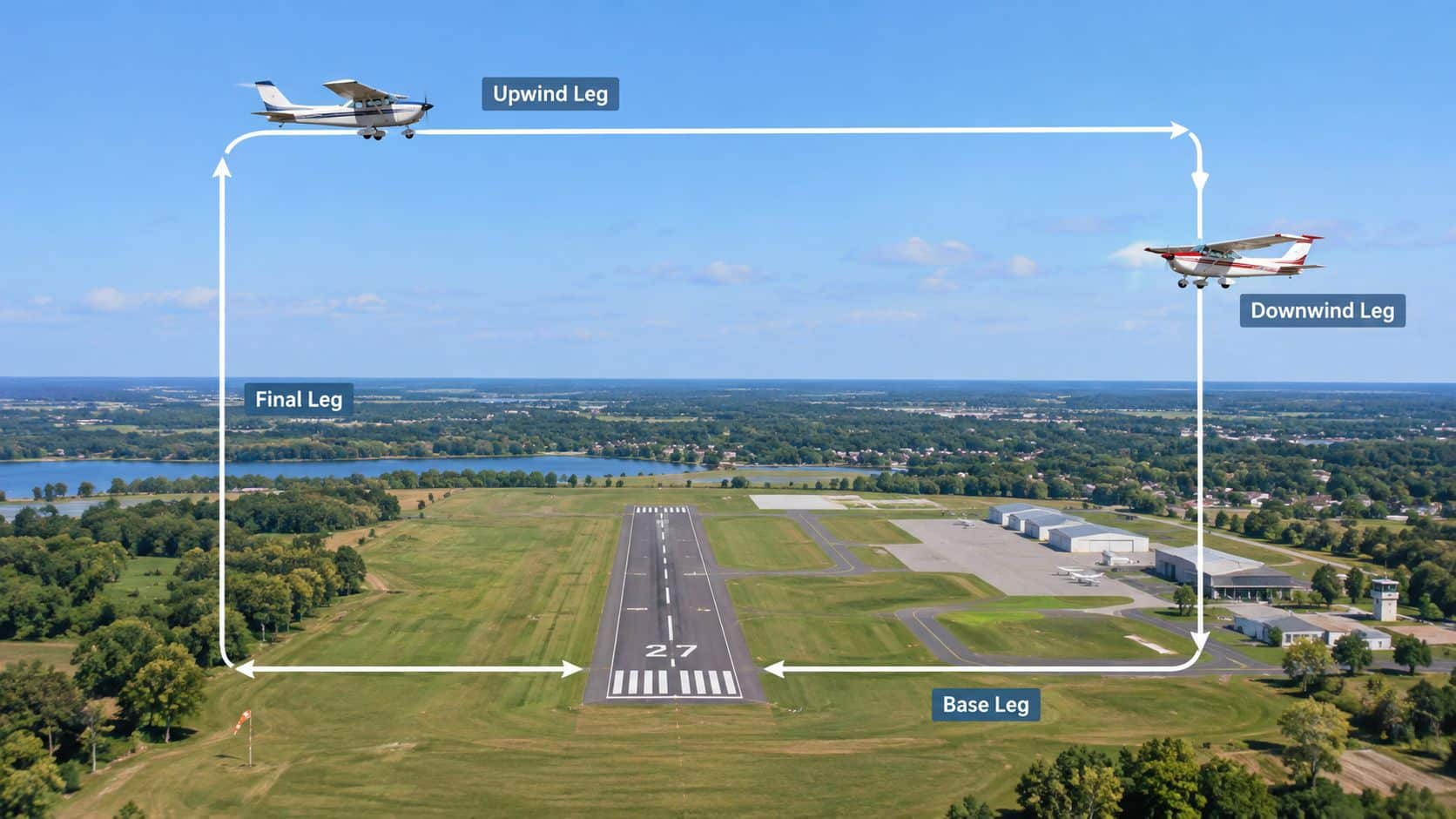
The standard pattern is a rectangle aligned with the active runway. The airplane doesn't need to trace a perfect shape, but each leg should place the aircraft where other pilots and the tower expect it to be.
Reading the five legs
Upwind follows the runway heading after takeoff. The pilot maintains directional control, climbs, and watches for departing and arriving traffic before turning.
Crosswind carries the airplane away from the departure end and into the lateral space used by the downwind leg. The turn shouldn't be based only on habit. The pilot must consider the assigned procedure, traffic, wind, and any tower instruction.
Downwind is parallel to the runway and flown opposite the landing direction. Here the pilot completes the before-landing flow, judges spacing, reduces power as appropriate, and prepares for the base turn. Abeam the touchdown area is a useful configuration reference, not a command to make an abrupt change.
Base is perpendicular to the runway and leads toward the approach end. The pilot manages the descent and monitors whether the turn will intercept final without overshooting or cutting inside another aircraft.
Final is aligned with the runway centerline. The airplane should be configured and stabilized before reaching the low part of the approach. Large corrections on final often indicate that the setup on downwind or base needs improvement.
The FAA describes a standard entry in level flight at pattern altitude abeam the runway midpoint, with the aircraft remaining at pattern altitude until abeam the landing runway threshold on downwind. The final turn should be completed at least one-quarter mile from the runway, as stated in the FAA Aeronautical Information Manual traffic-pattern guidance.
How altitude supports the rectangle
For airplanes, the FAA recommends a 1,000-foot AGL pattern unless an airport publishes another altitude. The same guidance identifies large and turbine-powered aircraft as using at least 1,500 feet AGL, or 500 feet above the established pattern altitude. That vertical separation helps slower training aircraft and faster transport-category traffic operate in a more orderly environment.
Chino's three parallel runways make the geometry especially important. A pilot must identify the assigned runway, choose the correct downwind, and understand how base legs and final approaches relate to adjacent runway operations. The rectangle is therefore more than runway alignment. It is a lateral and vertical system for keeping traffic understandable.
Standard Pattern Altitudes and Why They Differ
The familiar airplane pattern altitude is 1,000 feet AGL, unless the airport publishes a different value. The FAA's AIM paragraph 4-3-3 states that airplane traffic pattern altitude is generally 1,000 feet above ground, while local airport procedures can establish another altitude.
A pilot calculates the practical altitude from field elevation. If the airport's elevation is shown in official airport information, the pilot adds the published AGL pattern altitude to that elevation. The chart supplement remains the place to check for airport-specific pattern notes, noise procedures, runway information, and other operating details.
Why vertical discipline matters
Altitude discipline gives pilots a predictable scan. An aircraft entering the pattern from above shouldn't descend through established traffic without a clear plan. An aircraft departing should climb in the published or assigned direction rather than wandering through another runway's flow.
At Chino, the airplane pattern exists inside a busy Southern California airspace environment. The pilot must coordinate the assigned runway and pattern with surrounding Class C and Class D operations, rather than treating the local rectangle as isolated airspace.
Helicopter operations can use a different profile. FAA advisory material commonly places helicopter pattern operations at 700 feet AGL or lower, depending on local procedures and the helicopter's performance. Noise-sensitive airports may also publish special altitudes or routes. Those instructions take priority over a pilot's remembered “standard.”
Entry decisions at the correct altitude
A pilot arriving from a higher cruise altitude should plan the descent early enough to reach the correct entry altitude without diving toward the pattern. Common entries include:
- 45-degree downwind: Arrive level at pattern altitude and merge where established downwind traffic can see the aircraft.
- Midfield crosswind: Cross the airport at a suitable altitude and descend or join only when the procedure and traffic picture support it.
- Straight-in or direct base: Use only when cleared, coordinated, or appropriate to the airport's traffic flow, with especially careful scanning.
- Departure or go-around: Continue the assigned or expected path, and ask for clarification if the next turn or altitude isn't clear.
A stabilized approach decision begins before final. If spacing, alignment, airspeed, or runway availability isn't assured, the pilot should follow the aircraft's go-around procedure rather than forcing the landing.
Pattern Entry and Exit Procedures Step by Step
Before a dual lesson, a CFI should have the pilot brief the runway, traffic direction, entry altitude, expected entry leg, and likely exit. The purpose isn't to recite a script. It is to ensure the pilot can make one predictable decision before the workload rises.
The normal arrival
The standard arrival at many airports is the 45-degree entry to downwind. The pilot approaches the downwind entry point at pattern altitude, identifies aircraft already established, and merges without cutting across the flow.
FAA guidance recommends entering level at pattern altitude abeam the runway midpoint. For a standard left pattern, the pilot turns left through crosswind, downwind, base, and final unless the airport publishes a right-hand pattern or ATC assigns another route. FAA guidance on traffic-pattern direction explains that left-hand turns are standard unless markings or published information indicate otherwise.
The legs provide usable reference points:
- Upwind: Continue along the departure runway heading after takeoff.
- Crosswind: Turn away from the runway in the assigned direction after establishing the departure.
- Downwind: Fly parallel to the runway at pattern altitude, generally with enough lateral spacing to support a normal base and final.
- Base: Turn perpendicular toward the approach end and manage descent, airspeed, and spacing.
- Final: Align with the runway centerline and confirm that the landing area is available.
Less common entries and exits
A straight-in approach can work at a towered field when ATC assigns it or at a non-towered field when it doesn't disrupt existing traffic. A midfield crosswind entry may be appropriate when arriving from above the pattern, but the pilot must avoid descending through established aircraft. A direct base entry requires even more scanning because it bypasses the visual setup provided by downwind.
For departures, the pilot may continue straight out, turn crosswind as instructed or published, or extend the departure pattern when traffic requires it. FAA guidance recommends a 45-degree exit turn after reaching pattern altitude when leaving the pattern and when that path is compatible with local procedures.
The go-around decision
A pilot shouldn't wait until the airplane is almost on the runway to decide whether the landing is assured. If the runway picture, alignment, airspeed, or spacing isn't acceptable by roughly 50 to 100 feet AGL, the pilot should initiate the aircraft's go-around procedure, following the POH, local procedure, and ATC instruction. That altitude is a practical training decision point, not a universal regulatory threshold.
A clear tower call might sound like:
“Chino Tower, Cessna 12345, left downwind Runway 26R, touch and go.”
At a non-towered airport, the pilot could transmit:
“Chino traffic, Cessna 12345, entering left downwind Runway 26R, full stop, Chino.”
The first-solo mistakes are predictable. Students sometimes join the wrong runway at a parallel-runway airport, omit the callsign, turn base without checking for traffic, or continue a poor approach because they feel committed. A disciplined pilot pauses outside the flow, listens, identifies the active runway, and then enters where other pilots can understand the aircraft's path.
Radio Calls and Common Student Mistakes
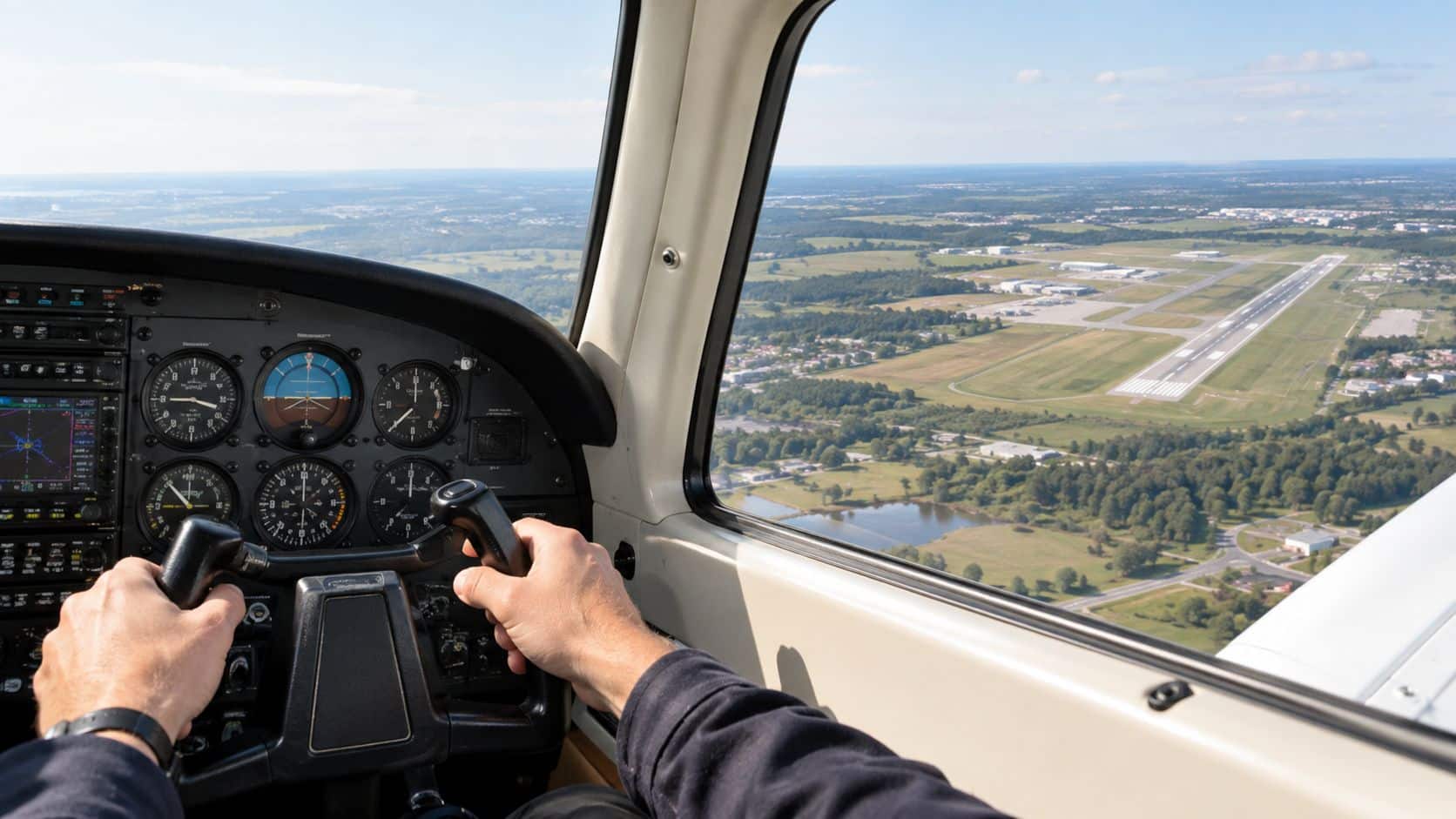
Radio calls should give other pilots three pieces of information: who is transmitting, where the aircraft is, and what it will do next. The call should be short enough to understand while another pilot is flying a turn or scanning for traffic.
At a non-towered airport, an initial call might be:
“Chino traffic, Cessna 12345, ten miles north, inbound for full stop, Runway 26 Right.”
A position report should identify the runway and leg:
- “Chino traffic, Cessna 12345, entering left downwind Runway 26R, full stop.”
- “Chino traffic, Cessna 12345, left base Runway 26R.”
- “Chino traffic, Cessna 12345, final Runway 26R.”
- “Chino traffic, Cessna 12345, clear of Runway 26R.”
At a towered field, the exchange may be more direct:
“Cessna 12345, downwind, Runway 26L, touch and go.”
The pilot should read back the runway and relevant instruction, then continue listening. Clear transmission technique matters too. Pilots learning the practical habits of concise, respectful communication can use this guide to two-way radio protocol as a supplementary reference, while DuBois Aviation flight service frequencies can help students review the frequencies used during flight planning and operations.
Common first-solo errors
- Wrong parallel runway: The pilot hears “26” but misses whether the controller assigned left or right.
- Incomplete position: “Downwind” without the runway or airport leaves other pilots guessing.
- Blocked transmission: The pilot keys the microphone over another call instead of waiting and listening.
- Premature descent: The pilot descends or turns base before confirming the aircraft is positioned correctly.
- Failure to extend: A slower aircraft ahead requires more spacing, but the student turns base at the usual point.
At an unfamiliar airport, listening for one complete lap before transmitting can reveal the active runway, pattern direction, traffic order, and local rhythm. The pilot still must make required calls, but the first scan of the frequency often prevents a needless surprise.
Towered Versus Non-Towered Pattern Differences
A Class D airport such as Chino and a quiet rural field use the same basic geometry, but the pilot's responsibility changes. At Chino, the tower may assign the runway, entry, sequence, and spacing. At a non-towered field, the pilot must announce intentions and fit into the existing flow without assuming that silence means the pattern is empty.
| Element | Towered Class D | Non-Towered |
|---|---|---|
| Runway and sequence | ATC assigns or confirms the runway and traffic order | Pilots determine the active runway from wind, published information, visual cues, and traffic calls |
| Pattern entry | Follow the assigned entry, such as right base or number two behind traffic | Use a standard, recognizable entry, commonly the 45-degree downwind |
| Communication | Make the requested call, acknowledge instructions, and read back clearances | Self-announce position and intentions on the CTAF |
| Spacing | The controller sequences aircraft, but pilots still monitor traffic and wake risk | Each pilot builds spacing through visual scanning, radio coordination, extensions, and go-arounds |
| Conflicting information | Ask ATC for clarification before maneuvering | Remain predictable, continue scanning, and resolve uncertainty before joining |
A tower instruction might be, “Enter right base Runway 26R, number two, follow the Cessna on a two-mile final.” The pilot should identify that traffic, read back the assignment, and avoid turning based solely on a memorized pattern point. A non-towered pilot has no equivalent sequencing instruction, so the arrival call and visual integration carry more weight.
Class C airports generally require two-way communication before entry and rely on active ATC sequencing. Class B airports involve more extensive clearances and controller-managed flow well outside the local pattern. In every case, the pilot should verify the airport's status, frequencies, runway configuration, and published procedures before taxi.
Wake turbulence and runway-incursion risk both make spacing decisions more than a matter of convenience. Before taxi, the pilot should brief the likely runway, traffic direction, crossing points, hold-short instructions, and the action to take if the sequence becomes unclear.
Helicopter and Wake Turbulence Considerations
Wake turbulence changes the pattern from a simple timing exercise into a risk-management problem. Every aircraft produces counter-rotating vortices while generating lift, and the risk is greatest at low altitude near takeoff and landing. FAA guidance advises pilots to avoid the area below and behind the generating aircraft, where an encounter can be hazardous.
The timing benchmark is specific. FAA procedures call for four minutes behind a super aircraft and three minutes behind a heavy aircraft on the same runway or closely spaced parallel runways, with pilots able to request more spacing when conditions warrant, as explained in FAA wake turbulence avoidance guidance.
A jet ahead of a training airplane
Suppose a student is arriving for Runway 26R behind a Cessna Citation. The tower may extend the downwind, delay the base turn, or issue another spacing instruction. The student shouldn't turn early just because the runway appears open. The correct response is to identify the preceding aircraft's category, maintain the assigned sequence, and ask for clarification if the interval isn't understood.
A pilot briefing wake risk should identify:
- The aircraft ahead and its likely wake category.
- The runway or parallel-runway relationship.
- The touchdown area and expected flight path.
- The time or distance needed before turning base or landing.
- The go-around action if spacing deteriorates.
The DuBois Aviation wake turbulence avoidance resource provides a useful training reference for reviewing these decisions before a busy pattern lesson.
Helicopters change the visual picture
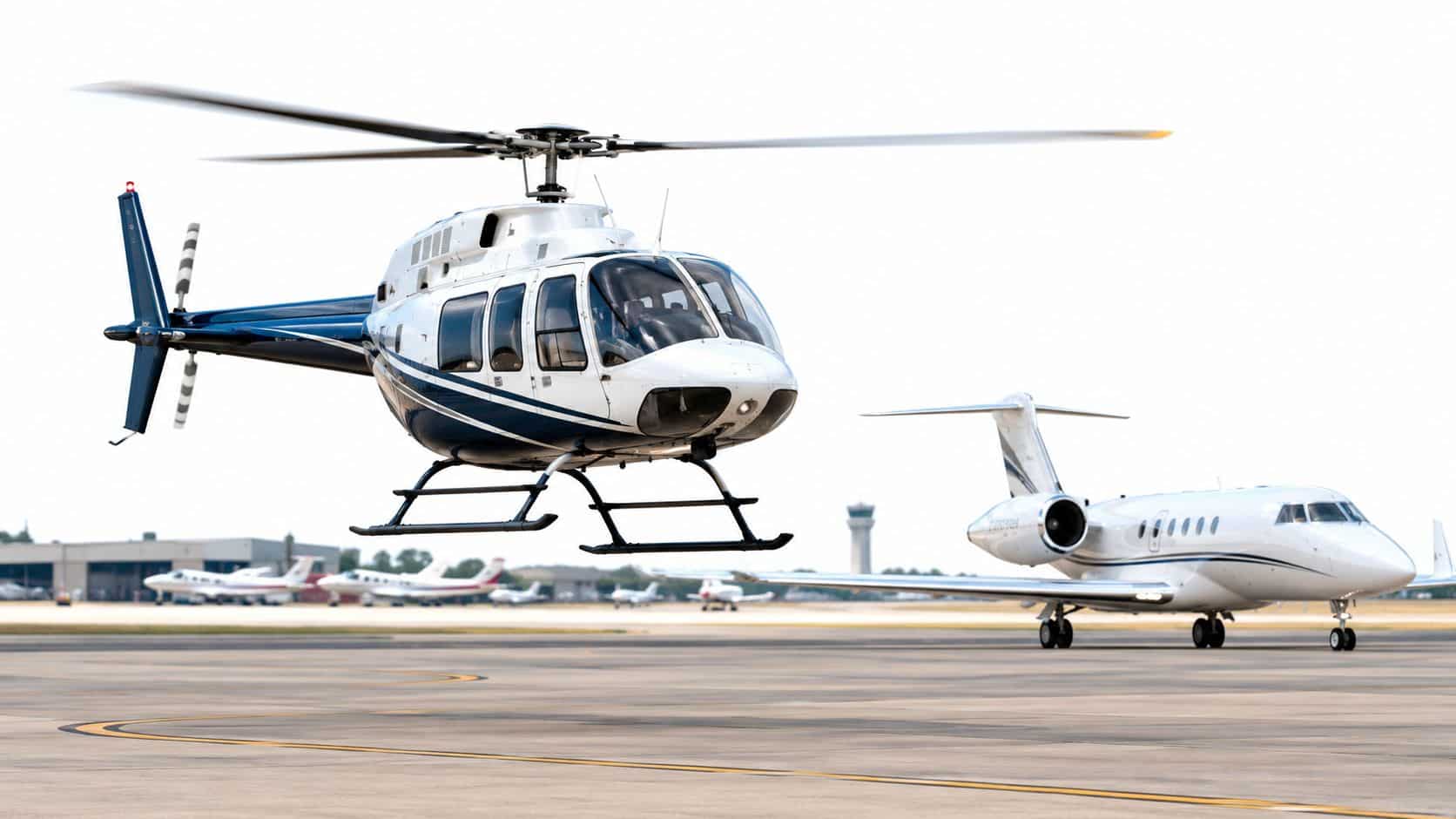
Helicopters may operate on different routes and altitudes from fixed-wing traffic. Local procedures can place helicopter patterns at 700 feet AGL or lower, and a helicopter may use a parallel path, hover-taxi route, or direct movement to a ramp instead of flying the fixed-wing rectangle.
At Chino, a Robinson R44 lifting from a helicopter ramp may be moving while a Piper Archer turns final. The two aircraft might not share the same altitude or pattern leg, but they can still converge near a runway, taxiway, or approach corridor. Radio awareness and an outside scan matter more than altitude alone.
A useful pre-landing briefing sounds like this: “Traffic ahead is a jet, runway is 26R, touchdown point is beyond the preceding aircraft's landing area, and the approach will be abandoned if spacing isn't assured.” The same discipline helps during a discovery flight, a rental checkout, or a student practice session.
Practical Training Scenarios at Chino and Beyond
Pattern practice becomes more useful when each repetition has a defined objective. At KCNO, a CFI can adjust the lesson for runway assignment, traffic volume, aircraft performance, and the student's workload without reducing the exercise to repeated touch-and-go landings.
Scenario one for a discovery flight
A discovery-flight student joins left traffic for Runway 26L through a 45-degree midfield entry near the soccer fields. The instructor's objective is visual orientation: identify the runway, locate the downwind, recognize the touchdown area, and maintain a stable scan while the airplane lands long to avoid a displaced threshold.
The radio script stays simple:
“Chino Tower, Cessna 12345, inbound from the north, with information Alpha, request left traffic Runway 26L.”
The debrief checks whether the student could point to each leg, identify the assigned runway, and explain why the airplane didn't use the displaced portion of the runway.
Scenario two behind mixed traffic
A private pilot returning from Cable is sequenced behind a slow Skyhawk on an 8,500-foot final, while a Baron is established on a five-mile straight-in. The objective is judgment under changing sequence instructions. The pilot should maintain the assigned runway, confirm which aircraft is being followed, extend or adjust as directed, and avoid turning base based on the first traffic that becomes visible.
A strong debrief asks:
- Which aircraft controlled the immediate sequence?
- When did the pilot first recognize the need for spacing?
- Was the runway assignment repeated correctly?
- What would trigger a go-around?
Scenario three for helicopter integration
A helicopter student lifts from the helipad, climbs to 700 feet AGL, and crosses midfield eastbound without entering the fixed-wing pattern, following local procedures and ATC instructions. The objective is to distinguish helicopter routing from fixed-wing geometry while maintaining an effective scan for aircraft operating on nearby runways.
The practice flow for any pattern lesson is consistent:
- Obtain the airport information and identify the active runway.
- Confirm the traffic direction, assigned entry, and altitude.
- Listen before transmitting or acknowledge the tower instruction.
- Locate preceding and crossing traffic.
- Configure by leg, not by habit alone.
- Extend, delay, or go around when spacing or stability requires it.
- Clear the runway, complete the after-landing flow, and review the sequence before shutdown.
Students preparing for solo work or cross-country returns can review DuBois Aviation student pilot flight training at Chino Airport and ask an instructor to tailor a pattern proficiency flight around radio work, runway selection, wake spacing, and go-around decisions.
Frequently asked questions
What is a standard air traffic pattern?
A standard pattern is a rectangular flow around a runway with upwind, crosswind, downwind, base, and final legs. Left turns are standard unless the airport publishes a right-hand pattern or ATC assigns another procedure.
What altitude should an airplane use in the pattern?
The FAA recommends 1,000 feet AGL for airplane traffic patterns unless the airport publishes a different altitude. Large and turbine-powered aircraft use at least 1,500 feet AGL, or 500 feet above the established pattern altitude, under the FAA guidance cited earlier.
Can a pilot make a straight-in approach?
A straight-in approach can be appropriate when ATC assigns or approves it, or when it doesn't disrupt traffic at a non-towered airport. The pilot must scan carefully, communicate clearly, and avoid creating an unexpected conflict with aircraft established in the pattern.
What should a pilot do if the approach becomes unstable?
The pilot should initiate the aircraft's go-around procedure rather than force the landing. A decision made while there is still adequate altitude and runway awareness is safer than a late correction close to the surface.
How does a towered airport differ from a non-towered airport?
At a towered field, ATC sequences aircraft and issues runway or entry instructions. At a non-towered field, pilots self-announce, observe existing traffic, and conform to the published or standard pattern. In both environments, pilots remain responsible for traffic awareness and safe aircraft control.
Why do helicopters require extra attention in the pattern?
Helicopters may use different altitudes, routes, and ramp procedures from fixed-wing aircraft. Their path can intersect a runway or final approach without matching the fixed-wing rectangle, so pilots need an outside scan and clear radio awareness.
DuBois Aviation provides airplane and helicopter training at Chino Airport, including instruction in traffic-pattern entries, radio work, landing, wake-turbulence spacing, and go-around decisions. Visit DuBois Aviation to request training information or schedule a pattern proficiency flight before a solo, rental checkout, or cross-country return.


