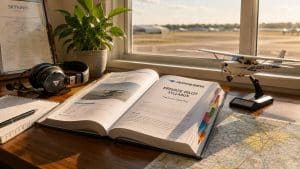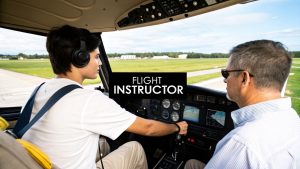
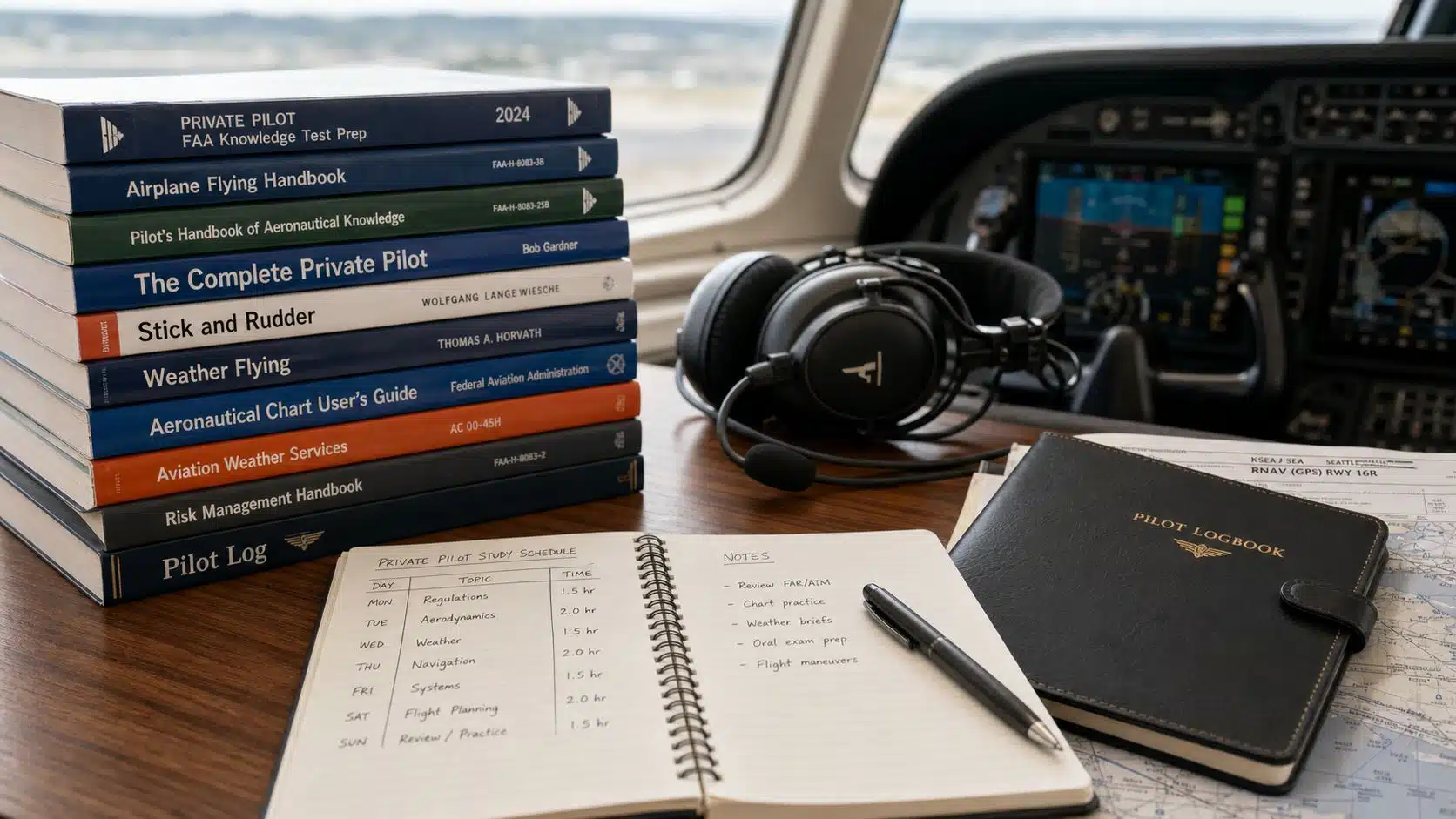
What separates a student pilot who dreads ground study from one who walks into lessons prepared? Usually, it's not raw talent. It's whether the student has a small, well-chosen book stack and knows how to use each title for a specific training job. The best private pilot training books don't just help you pass a written test, they help you build the judgment, phraseology, and maneuver knowledge that show up in the airplane.
A lot of beginners think they need one perfect textbook. That's the wrong model. A better approach is to pair an FAA foundation book with a maneuver guide, a standards document, and one or two books that fit your learning style. That is also how many flight schools structure study around their syllabus, including Jeppesen-based programs that break learning into lessons, stage checks, and recurring review. For reference on book anatomy and how training materials get organized, see this overview of book structure for publishing professionals.
The list below focuses on what works in training, not what merely looks impressive on a shelf.
Two practical options worth comparing
These are specific products pilots commonly compare for this type of flying. Confirm compatibility with your aircraft and instructor before ordering.
 Textbook used at DuBoisJeppesen Guided Flight Discovery Private Pilot TextbookCheck current availability on Amazon (paid link)
 2027 regulations and AIM referenceASA 2027 FAR/AIM - SoftcoverCheck current availability on Amazon (paid link)
Table of Contents
- 1. FAA Pilot's Handbook of Aeronautical Knowledge PHAK, FAA-H-8083-25C
- 2. FAA Airplane Flying Handbook AFH, FAA-H-8083-3C
- 3. FAA Airman Certification Standards, Private Pilot Airplane ACS, FAA-S-ACS-6C
- 4. Jeppesen Guided Flight Discovery Private Pilot Manual, Jeppesen
- 5. Jeppesen Private Pilot Maneuvers Manual
- 6. Rod Machado's Private/Commercial Pilot Handbook
- 7. ASA The Complete Private Pilot
- 8. The Pilot's Manual Ground School
- 9. ASA 2025–2026 Private Pilot Test Prep
- 10. Say Again, Please, A Pilot's Guide to Radio Communications
- Top 10 Private Pilot Training Books, Comparison
- Your Cockpit Library, A Foundation for Lifelong Learning
1. FAA Pilot's Handbook of Aeronautical Knowledge PHAK, FAA-H-8083-25C
The Pilot's Handbook of Aeronautical Knowledge (paid link) is the anchor book I want in every private pilot bag. The FAA's handbook was formally revised as FAA-H-8083-25B in 2016, which gave students a current baseline on aerodynamics, navigation, weather, regulations, and aeromedical factors, and FAA materials remain the core knowledge reference in U.S. pilot training and testing (Pilot Institute study-material overview). That authority is why CFIs keep sending students back to it even when they also use a school syllabus or a more conversational companion text.
Why it belongs on the first page of your study plan
This is the book that keeps your study grounded in the FAA's language. It's broad, structured, and intentionally formal, which makes it ideal for self-study when you need the “why” behind the syllabus rather than a casual summary. It also shows up repeatedly in curated private-pilot roundups, which typically name about 5 to 11 core books and keep FAA references near the top because they align with test prep, oral exams, weather, and flight technique (PilotMall roundup).
Practical rule: read the PHAK before lessons, then reread the same sections after your instructor introduces a topic. That second pass is where the book starts making sense.
The downside is simple. It can feel dry if you try to read it like a novel. Treat it like a reference manual, not entertainment. If you're building a ground-study routine on your own, this is the book that should sit closest to the top of the stack.
2. FAA Airplane Flying Handbook AFH, FAA-H-8083-3C
If the PHAK explains the system, the Airplane Flying Handbook explains the actual flying. The FAA organizes it around takeoffs, landings, slow flight, stalls, ground reference maneuvers, emergency operations, and night operations, which makes it one of the most concrete sources for private-pilot training (Flying Mag overview). For a student trying to understand what happens in the cockpit, that specificity matters more than elegant prose.
The most useful handbook for chair-flying
This is the book I'd assign when a student keeps asking, “What exactly should my hands and feet be doing?” It breaks maneuvers down in a way that makes chair-flying useful, especially when paired with a local CFI's sequence for pattern work or stall training. It's also the best handbook to revisit right before a lesson so you arrive with the right mental model.
The trade-off is the same one you get with most FAA publications. It's authoritative, but it isn't chatty. Students who want a friendlier voice often pair it with Rod Machado or Jeppesen, then use the AFH as the final check on procedure.
What to do with it during the week
- Before a lesson: read the maneuver your instructor scheduled, then write down the key steps in your own words.
- After a lesson: compare what happened in the airplane with the handbook's sequence.
- Before the checkride: revisit the sections on stalls, landings, emergency procedures, and night operations.
That routine turns the handbook from a library book into a training tool. It's not the most enjoyable read on the shelf, but it's one of the most useful.
3. FAA Airman Certification Standards, Private Pilot Airplane ACS, FAA-S-ACS-6C
The Airman Certification Standards is the book most students ignore until they're close to the checkride, and that's a mistake. It isn't a teaching text. It's the rubric that defines what you must know, consider, and demonstrate on the practical test, so it belongs in your study process from the beginning (FAA ACS page).
Use the ACS to drive your lessons
This document changes how you study because it tells you what the examiner is looking for. Instead of wandering through chapters, you can tie every topic to a task, a risk-management element, or a skill standard. That's especially useful when you're building a self-study routine, because it keeps you from reading material that doesn't map to the oral or the flight portion of the checkride.
The ACS is not optional reading if you want efficient preparation. It is the checklist behind the checklist.
Students who do well with the ACS usually use it in a simple way. They mark each task, match it to a handbook section, and ask their instructor to sign off only after they can explain the standard in plain language. That works in busy training environments because it keeps each lesson focused.
This is also the place where many generic “best books” lists fall short. They recommend reading material without showing how it connects to the standards document. If you want a book stack that supports training, the ACS has to sit at the center.
4. Jeppesen Guided Flight Discovery Private Pilot Manual, Jeppesen
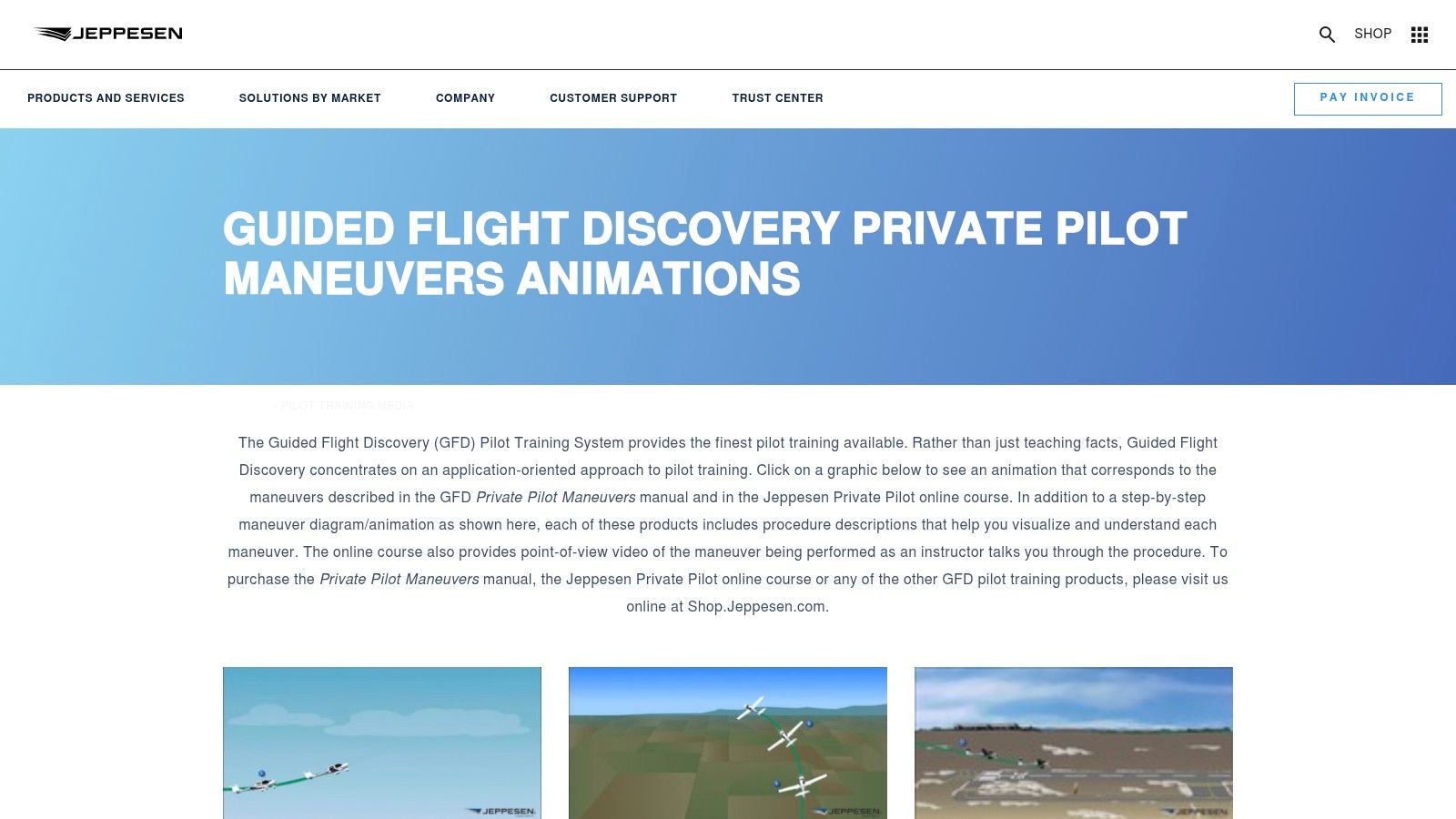
Jeppesen's Guided Flight Discovery: Private Pilot Manual is the best fit for students who learn visually and like a cleaner course flow. It pairs well with one-on-one instruction, and Jeppesen's training media are built around a consistent courseware style that supports syllabi, kits, and instructor resources (Jeppesen training media). That structure matters when your lessons are already being paced by a school syllabus.
Why Jeppesen works well in a school environment
The strength here is coherence. You get figures, explanations, and review questions in a layout that doesn't fight the way CFIs teach. That makes it easier to connect prelesson reading with the airplane session and the debrief afterward. Students in Part 61 and Part 141 environments often like it because it feels like a real curriculum rather than a loose textbook.
The cost is higher than the FAA handbooks, and the tone is more polished than practical. Some students want the official FAA language, and that's fair. Others want a book that feels less like a government reference and more like a teaching system, and Jeppesen is built for that.
If your school uses Jeppesen, this book earns its place quickly. If your school doesn't, it can still be valuable, but it works best when your instructor is willing to teach from the same structure.
5. Jeppesen Private Pilot Maneuvers Manual
The Jeppesen Private Pilot Maneuvers Manual is one of the best books for turning abstract maneuvers into something you can rehearse before you ever touch the airplane. It lays out each maneuver with an objective, procedure, and common errors, and it's built with color figures and compatibility with Jeppesen animations. That makes it especially good for chair-flying and prebriefing.
For students following a structured lesson flow, this is the book that keeps each maneuver organized. It works well for traffic patterns, slow flight, stalls, and ground reference maneuvers, and it fits naturally with the kind of recurring pattern work that gets drilled at schools using Jeppesen-style lesson plans. If you're training at a busy airport, that kind of repetition saves time because you're not trying to remember the order of every step while also managing radio calls and traffic.
A useful pairing here is a maneuver chapter in the manual plus a school-specific lesson brief. In a DuBois Aviation style environment, where ground reference maneuvers are taught in a local training flow, that pairing keeps the student's homework aligned with the airplane lesson. See the school's ground reference maneuvers training resource for an example of how a maneuver can be organized around real lesson objectives.
Best use case: read the maneuver page the night before, then chair-fly it in the morning using the same sequence your CFI uses in the airplane.
The manual is narrow, and that's the point. It's not your only book. It's the book that makes the airplane lesson feel familiar before you even start the engine.
6. Rod Machado's Private/Commercial Pilot Handbook
Rod Machado's handbook earns its reputation because it reads like a human being wrote it for a human being. It gives you plain-English explanations, illustrations, and memory aids across aerodynamics, weather, systems, and decision-making, which is exactly why many students use it as a companion to FAA handbooks rather than a replacement.
When a conversational book helps more than a formal one
Some students stall out on the FAA books because the tone feels heavy. Rod Machado solves that problem without dumbing anything down. He helps the reader connect the concept to the cockpit, which often makes the material stick on the second or third read. That matters when a student can recite a definition but can't explain what it means during a lesson review.
The book's informality is also its limitation. If you want official language, you still need the FAA material. If you want a friendly explanation that makes a tough subject feel less intimidating, this is a strong choice. It has a longstanding reputation among U.S. student pilots and CFIs for that reason.
A practical way to use it is to read Machado first, then verify the same topic in the PHAK or AFH. That two-book method gives you both comprehension and precision. It's one of the better combinations for self-study learners who don't want their ground work to feel like punishment.
7. ASA The Complete Private Pilot
ASA's The Complete Private Pilot, 14th Edition is a modern textbook with a student-first layout. It follows the FAA knowledge-exam structure while emphasizing practical flying and decision-making, and it includes chapter review questions, checklists, mnemonic aids, and downloadable syllabus resources. The product page shows it as the current 2025 edition, which matters because students need materials that match the present training environment rather than a dusty shelf copy (ASA product page).
A balanced middle ground for many students
This book sits in a useful middle zone. It's more approachable than the FAA handbooks, but it stays closer to formal training than a purely conversational text. That makes it a good fit for students who want one main textbook to anchor their study, especially if they're also using ASA test prep or an oral-exam guide.
The practical advantage is clear. Review questions and syllabus support turn it into a study book, not just a reading book. For a private student trying to keep up with lessons, that combination is often more valuable than extra narrative depth.
The drawback is visual style. Students who love dense diagrams and highly polished illustrations may still prefer Jeppesen. Students who want humor may prefer Rod Machado. ASA's strength is balance, and balance is exactly what many students need when they're trying to stay organized without overcomplicating the process.
8. The Pilot's Manual Ground School
The Pilot's Manual: Ground School, 7th Edition is a serious reference book, and it reads like one. It covers the private and commercial ground knowledge scope in a single volume, with clear diagrams and enough depth to stay useful long after initial training. The hardcover format and high production value make it a durable long-term reference rather than a quick throwaway workbook (ASA Pilot's Manual page).
Best for deep study and long-term retention
This is the book I'd recommend to a student who wants one strong reference that won't feel obsolete after the checkride. It fits well beside ASA test prep and oral-exam materials, and it works especially well for students in university or Part 141-style environments who expect a more formal ground-school backbone. For a practical example of how structured ground school can be built into a training program, see this ground school resource.
The trade-off is weight, both literal and mental. It is dense in places and not as quick to skim as lighter textbooks. That is not a flaw if you are serious about understanding the material, but it does make the book better for planned study sessions than for last-minute cramming.
A simple study pattern that works
- Monday and Tuesday: read one chapter section and write a short summary in your own words.
- Midweek: answer the review questions without looking back.
- Weekend: connect the chapter to whatever maneuver or lesson you flew that week.
That routine turns a deep reference into a usable training tool. If you like books that reward repeated reading, this is one of the strongest choices on the list.
9. ASA 2025–2026 Private Pilot Test Prep
If your goal is to pass the knowledge test efficiently, the ASA 2025–2026 Private Pilot Test Prep bundle belongs on the short list. It includes the book, Prepware software, and 24-month online access, plus explanations for correct and incorrect answers with FAA references and free updates when the question bank changes (ASA Test Prep product page). That makes it one of the most direct study tools available for exam preparation.
The quickest path to practice and feedback
This is not a ground-school textbook. It's a test-prep system. That distinction matters because students sometimes buy a prep book expecting it to explain everything from scratch, then get frustrated when it's clearly optimized for practice, tracking, and answer review. Used correctly, though, it's highly efficient.
The main advantage is feedback. You can identify weak areas, review the FAA-supported explanation, and then send those topics back into your main textbook or handbook. That loop is what helps students stop guessing and start studying with purpose. It also supports the endorsement process because the book is designed with the knowledge-test workflow in mind.
For students trying to self-study without paying for a full ground school, this kind of bundle is especially valuable. It doesn't replace the PHAK, AFH, or ACS, but it makes the knowledge-test stage much more manageable.
10. Say Again, Please, A Pilot's Guide to Radio Communications
Radio work is where many new pilots lose confidence, and Say Again, Please is one of the best books for fixing that problem. It focuses on ATC phraseology, sample transmissions by airspace and class, and realistic flight scenarios, which makes it especially useful for students training in busy towered airspace (ASA product page).
The book that makes radio work less mysterious
This is the supplemental book I'd hand to a student who can fly the airplane but freezes on the mic. It helps with workload management because it gives the student phrases they can rehearse before the flight. That matters in crowded environments, where the radio can feel like one more task competing for attention.
It also supports chair-flying well. You can run a mock departure, arrival, and pattern sequence while speaking the calls out loud. That kind of rehearsal is simple, but it builds confidence fast because the words stop feeling improvised.
The limitation is obvious. It's a communications guide, not a full private pilot textbook. Use it to complement your main study materials, not replace them. If your school sits at a busy airport, though, this book can make a real difference in how smoothly your early flights go.
Top 10 Private Pilot Training Books, Comparison
| Resource | Core Focus / Use | Key Features ✨ | Quality ★ / Highlights 🏆 | Value 💰 / Price | Target Audience 👥 |
|---|---|---|---|---|---|
| FAA Pilot's Handbook of Aeronautical Knowledge (paid link) (PHAK), FAA-H-8083-25C | Authoritative ground-school reference | ACS-aligned; broad theory & regs; searchable PDF ✨ | ★★★★★, Official reference 🏆 | 💰 Free (PDF); print/eBook available | 👥 Private students, CFIs, exam prep |
| FAA Airplane Flying Handbook (AFH), FAA-H-8083-3C | How-to flight maneuvers & techniques | Maneuver procedures; illustrated step-by-step ✨ | ★★★★★, Practical test alignment 🏆 | 💰 Free (PDF); print available | 👥 Student pilots, CFIs, checkride prep |
| FAA Airman Certification Standards, Private Pilot Airplane (ACS), FAA‑S‑ACS‑6C | Checkride rubric / evaluation standards | Task-by-task skills, knowledge & risk elements ✨ | ★★★★★, Defines what's tested 🏆 | 💰 Free (PDF) | 👥 Students, CFIs, DPEs |
| Jeppesen Guided Flight Discovery: Private Pilot Manual | Courseware-aligned private pilot textbook | High-quality visuals; integrated syllabus & media ✨ | ★★★★★, School-ready, instructor-friendly 🏆 | 💰 Higher (print/eBook) | 👥 Students in Jeppesen-based programs, CFIs |
| Jeppesen Private Pilot Maneuvers Manual (GFD) | Maneuver-focused pocket reference | Stepwise objectives, procedures, common errors ✨ | ★★★★★, Excellent for chair-flying 🏆 | 💰 Moderate (pocket format) | 👥 Pre/post-lesson students, CFIs |
| Rod Machado's Private/Commercial Pilot Handbook | Conversational, retention-focused ground book | Plain-English, humor, memory aids ✨ | ★★★★★, Highly engaging & readable 🏆 | 💰 Moderate | 👥 Students who prefer informal explanations |
| ASA The Complete Private Pilot (14th Ed., 2025) | Student-friendly textbook aligned to FAA exam | Review Qs, checklists, mnemonics, syllabi ✨ | ★★★★, Practical and updated | 💰 Affordable | 👥 Budget-conscious students, self-study |
| The Pilot's Manual: Ground School (7th Ed.), ASA | Comprehensive reference for private/commercial | Full-spectrum ground knowledge; durable production ✨ | ★★★★★, Deep reference; program-ready 🏆 | 💰 Pricier (hardcover) | 👥 University/Part 141 programs, long-term reference |
| ASA 2025–2026 Private Pilot Test Prep (Book + Prepware) | Knowledge exam practice & tracking | Book + Prepware; explanations; updates ✨ | ★★★★, Efficient path to first-time pass | 💰 Good value (bundle) | 👥 Exam-focused students |
| Say Again, Please: A Pilot's Guide to Radio Communications (7th Ed.), ASA | ATC phraseology & radio procedures | Sample transmissions by airspace; scenarios ✨ | ★★★★, Boosts radio confidence | 💰 Low–Moderate | 👥 Students training at busy towered airports |
Your Cockpit Library, A Foundation for Lifelong Learning
The best private pilot training books are the ones you read, understand, and bring into the airplane with you mentally. A good library doesn't need to be huge. It needs to be deliberate. For most students, that means starting with the PHAK, the Airplane Flying Handbook, and the ACS, then adding one main teaching text like Jeppesen, ASA, or Rod Machado depending on learning style.
That approach also works well inside a real training curriculum. In a Jeppesen-based program, for example, the manual, maneuvers book, and syllabus reinforce each other, so the student isn't bouncing between mismatched explanations. In a self-study path, the FAA books keep you aligned with standards while the prep book handles question practice and the radio guide fills in a weak spot that can otherwise slow down early progress. The goal is efficiency without shortcuts.
If you're training at a busy airport like KCNO, that structure matters even more. The better your ground prep, the less mental bandwidth you waste trying to decode basic concepts in the cockpit. That leaves more attention for aircraft control, traffic scanning, and radio discipline, which is where your instructor wants your head to be.
Students often ask which book to buy first. Start with the FAA foundation, then add one companion book that matches the way you learn. If you want a school that already teaches with structured materials, a place like DuBois Aviation can fit that need because its training model uses Jeppesen learning materials and personalized instruction.
If you're starting private pilot training in Southern California, DuBois Aviation can help you turn these books into a workable study plan instead of a pile of unread pages. Visit DuBois Aviation to explore private pilot training at KCNO, then bring your questions to a team that teaches with structured materials, one-on-one instruction, and a practical focus on getting you ready for the airplane.