
The best aviation books for a student pilot are the ones that answer the questions you will use in the cockpit. Start with the FAA’s Pilot’s Handbook of Aeronautical Knowledge for the underlying concepts and Airplane Flying Handbook for flight maneuvers. Keep the actual aircraft’s flight manual beside them. Buying a large stack of overlapping books is not necessary.
This is a practical reading list, not a claim that we have independently tested every commercial study course. Official FAA downloads are available without charge. If you prefer a printed handbook, the specific Amazon link below is an affiliate link. As an Amazon Associate, DuBois Aviation earns from qualifying purchases.
1. Pilot’s Handbook of Aeronautical Knowledge: start here
The PHAK explains aerodynamics, systems, instruments, weather, navigation, performance, airport operations, and decision-making. Use it to answer why something happens, rather than only memorizing a test answer. For example, read about load factor before steep turns and aircraft performance before a cross-country lesson.
Two practical options worth comparing
These are specific products pilots commonly compare for this type of flying. Confirm compatibility with your aircraft and instructor before ordering.
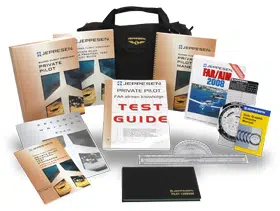
 Textbook used at DuBoisJeppesen Guided Flight Discovery Private Pilot TextbookCheck current availability on Amazon (paid link)
 2027 regulations and AIM referenceASA 2027 FAR/AIM - SoftcoverCheck current availability on Amazon (paid link)
Read the FAA’s current PHAK and check its updates. Compare the FAA revision identifier with any printed edition you buy; a cover year alone does not prove that all changes are included.
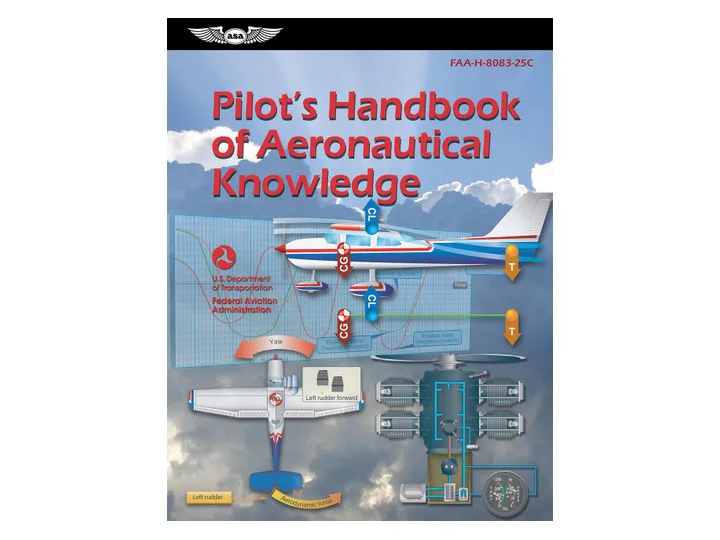
Pilot's Handbook of Aeronautical Knowledge (2026), FAA-H-8083-25C
An optional printed FAA reference for foundational aeronautical knowledge. This is separate from the Jeppesen textbook used by DuBois; the FAA also offers the handbook online for free.
Best for: Student pilots who prefer a physical reference for study and notes
View this exact product on Amazon (paid link)2. Airplane Flying Handbook: prepare for the next maneuver
The AFH is the companion for practical flying skills. Read the relevant chapter before a lesson on takeoffs, landings, slow flight, stalls, or ground-reference maneuvers. Bring questions about where the general explanation differs from the procedures for your airplane.
Open the current FAA Airplane Flying Handbook. Pair it with our steep-turn lesson or turns-around-a-point guide to connect reading with a visual explanation.
3. Aviation Weather Handbook: move beyond memorizing cloud names
A weather reference should help you explain a go/no-go decision, not just decode an abbreviation. Read about the hazards and processes relevant to a planned lesson, then discuss the actual briefing with your instructor. A handbook explains concepts; current weather products and a complete preflight briefing supply today’s conditions.
Find the current Aviation Weather Handbook in the FAA handbook library.
4. Your airplane’s POH or AFM: the aircraft-specific reference
The applicable pilot’s operating handbook or airplane flight manual supplies limitations, procedures, and performance information for the aircraft you actually fly. A generic model handbook found online may not match its serial number, equipment, supplements, or weight-and-balance records. Confirm the correct documents with your instructor or the school.
Before your next flight, locate the limitations section, normal checklist, emergency procedures, and the performance chart relevant to the lesson. Do not replace those procedures with a general training book.
5. Private Pilot ACS and current regulations: know the target
The Airman Certification Standards describe the knowledge, risk-management, and skill areas evaluated on the practical test. Use them as a progress checklist, not as your only textbook. When a question is about what is legally required, follow the cited regulation rather than an unsourced summary.
Get the current ACS from the FAA and look up current Title 14 regulations. A printed FAR/AIM can be convenient, but check amendments and effective dates before relying on it.
A simple reading routine that supports flying
- Before a lesson: ask which task is next, read its AFH explanation, and review the related PHAK concepts.
- During the briefing: compare the general guidance with your aircraft’s checklist and limitations.
- After the flight: write down one misunderstanding, one improvement, and the question to resolve before the next lesson.
- Before the checkride: work through the ACS with your instructor and explain answers using the underlying references.
Should I buy a test-preparation course too?
A course or question bank can organize study and reveal weak areas. Choose one compatible with your instructor’s syllabus, but do not treat a passing practice score as proof that you can explain weather, performance, or risk in a real scenario. Start with the required materials before purchasing optional extras.
Ask the DuBois Aviation team which materials match your training plan. See our private pilot course and flight-training options.