You've just enrolled in flight training, opened a private pilot study app, and found yourself staring at questions about weather, airspace, weight and balance, and regulations. The most reliable way to study for the private pilot written exam is to follow a four-stage, ACS-mapped process: learn the fundamentals, apply them through topic practice, simulate the timed test, then review every mistake. The goal isn't to memorize enough answers to reach the cutoff. It's to build a dependable margin above it.
Table of Contents
- Where Most Private Pilot Written Exam Prep Goes Wrong
- What the Private Pilot Written Exam Actually Is
- Mapping Your Study Plan to the FAA ACS
- A Four-Stage Study Workflow From Zero to Test Ready
- Building Your Study Resource Stack
- Habits That Move Scores From Passing to Comfortable
- Final Week, Test Day, and What Comes Next
Where Most Private Pilot Written Exam Prep Goes Wrong
A new student often begins with the same reasonable question: how should the studying start? The tempting answer is to open a practice-question bank and work through as many items as possible. That feels productive because every session produces a score, but a score alone doesn't show whether the student understands the subject or has merely recognized familiar wording.
Two practical options worth comparing
These are specific products pilots commonly compare for this type of flying. Confirm compatibility with your aircraft and instructor before ordering.
 Student headsetDavid Clark H10-13.4 Aviation HeadsetCheck current availability on Amazon (paid link)
 OrganizationASA Flight BagCheck current availability on Amazon (paid link)
The private pilot knowledge test is broad and application-oriented. A student may need to interpret a sectional chart, decide whether weather meets a requirement, understand how density altitude affects performance, or apply a regulation to a realistic flight situation. Memorizing isolated facts can help with light gun signals or aircraft documents, but it won't reliably solve questions that combine several ideas.
Students who begin with random quizzes often settle near the passing range because they're learning the answer pattern without learning the reasoning. That creates two problems. First, unfamiliar wording can expose the gap immediately. Second, the same weak knowledge tends to reappear during the oral portion of the practical test.
Practical rule: A missed question isn't finished when the correct answer is revealed. It's finished when the student can explain why that answer is correct and why the distractors are wrong.
A better plan uses the Private Pilot Airman Certification Standards, or ACS, as the map. Each study session should connect to a defined knowledge area, such as weather interpretation, airspace, navigation, performance, or risk management. Practice tests then become diagnostic tools rather than the entire curriculum.
Study time should also be allocated wisely. Weather, chart interpretation, performance calculations, and regulations usually demand more reasoning than simple memory topics. A student who gives every subject equal time may spend too long reviewing familiar material while avoiding the areas most likely to cause errors.
The practical target is not a last-minute pass. FAA 2025 data show that the Private Pilot Airplane knowledge test had 44,657 attempts, an 89.56% pass rate, and an 81.64% average score. The FAA test statistics summary supports a clear conclusion: effective preparation should aim well above the minimum, not merely at it.
What the Private Pilot Written Exam Actually Is
The private pilot airplane knowledge test is a computer-based, multiple-choice examination. It contains 60 questions, has a 150-minute time limit, and requires a 70% score, or 42 correct answers, to pass, as summarized in the FAA private pilot exam requirements.
The exam also uses the FAA Airman Knowledge Testing Supplement. That supplement provides the charts, figures, and reference material used for navigation, weather, and performance questions. Students should practice with the same style of charts and figures, rather than treating those pages as unfamiliar material on test day. The FAA testing supplements collection identifies the supplement as part of the computer testing system.
Private Pilot Written Exam at a Glance
| Item | Detail |
|---|---|
| Test format | Computer-based, multiple-choice exam |
| Number of questions | 60 |
| Passing score | 70%, or 42 correct answers |
| Time limit | 150 minutes |
| Reference material | FAA Airman Knowledge Testing Supplement |
| Eligibility | Required ground training or home-study preparation endorsement |
| Main framework | Private Pilot Airman Certification Standards |
The test is one part of a larger certification process. Knowledge, risk management, and practical skills are connected through the ACS, so a student shouldn't treat the written exam as an isolated hoop. A weak result in weather or performance can point to a training gap that matters during flight planning and the oral examination too.
Before taking the test, the applicant must present evidence of completed ground training or home study and readiness. FAA guidance connects this requirement to 14 CFR 61.35, 61.96(b)(3), 61.103(d)(2), and 61.105, as shown in the FAA testing matrix. The endorsement comes from an authorized instructor, or an eligible graduation certificate may apply when the training meets the applicable requirements.
The endorsement rules matter because students sometimes schedule the exam before confirming eligibility. FAA guidance also requires an instructor endorsement before the knowledge test and another before the practical test. The practical-test endorsement must document required training received within 2 calendar months before the month of application, while the knowledge-test endorsement confirms training and readiness under the applicable private-pilot rules, according to FAA Advisory Circular AC 61-65K.
Mapping Your Study Plan to the FAA ACS
The ACS should become the student's study index. Instead of asking, “Which quiz should be next?” the better question is, “Which ACS task can the student explain and apply today?” That change gives every session a destination and makes weak areas visible.
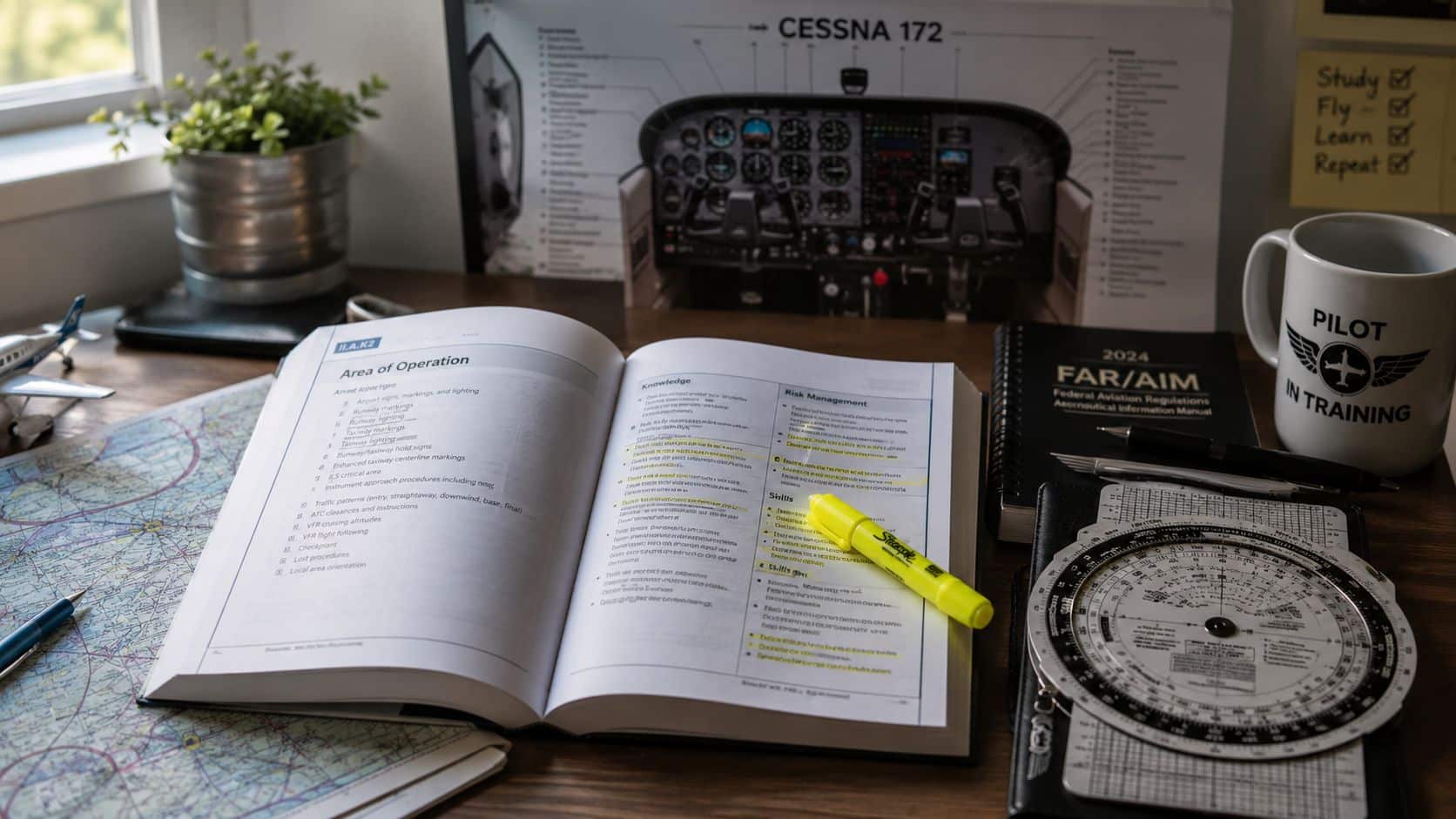
The private pilot ACS includes Areas of Operation covering preflight preparation, preflight procedures, airport and seaplane operations, takeoffs and landings, performance and ground reference maneuvers, navigation, slow flight and stalls, basic instrument maneuvers, emergency operations, night operations, high-altitude operations, and postflight procedures. The knowledge test doesn't ask the student to perform every maneuver in the chair, but the underlying knowledge supports those flight tasks.
A practical ACS allocation
- Preflight preparation: Give substantial attention to regulations, airworthiness, weather, cross-country planning, airspace, performance, and weight and balance. These subjects combine memorization with interpretation.
- Preflight procedures and airport operations: Learn signs, markings, traffic patterns, radio procedures, airport lighting, and operational risks. Use the student's training airport as a practical reference, while remembering that the test can use unfamiliar airport examples.
- Navigation: Practice sectional symbols, pilotage, dead reckoning, headings, groundspeed, fuel planning, and diversion decisions. Chart questions become easier when the student identifies the exact task before calculating.
- Performance and ground reference: Work through density altitude, takeoff and landing data, load factor, and maneuver effects. The arithmetic is usually manageable. Rushed setup and incorrect chart selection cause more trouble.
- Slow flight, stalls, and basic instrument maneuvers: Connect aerodynamic concepts to what changes in the airplane, including angle of attack, load factor, stability, instrument interpretation, and recovery priorities.
- Emergency, night, high-altitude, and postflight operations: Study the regulations, risks, equipment, decision-making, and operational limitations associated with each area.
Weather, aerodynamics, regulations, airspace, and chart reading deserve repeated application. They're high-impact subjects because questions often require interpretation rather than recognition.
How to turn an ACS task into a study session
- Read the task and elements. Identify the knowledge, risk-management, and skill expectations.
- Find the underlying concept. Use a ground-school lesson, FAA handbook, or instructor explanation.
- Work an example without answer choices. Calculate the performance result or interpret the weather product before looking at options.
- Complete targeted questions. Keep the questions tied to that ACS area.
- Record the remaining gap. Write the missed concept and the reference needed to correct it.
A structured flight and ground school program can help connect lessons to the ACS, but students still need to maintain their own error log. The written test rewards understanding that transfers from one scenario to another.
A Four-Stage Study Workflow From Zero to Test Ready
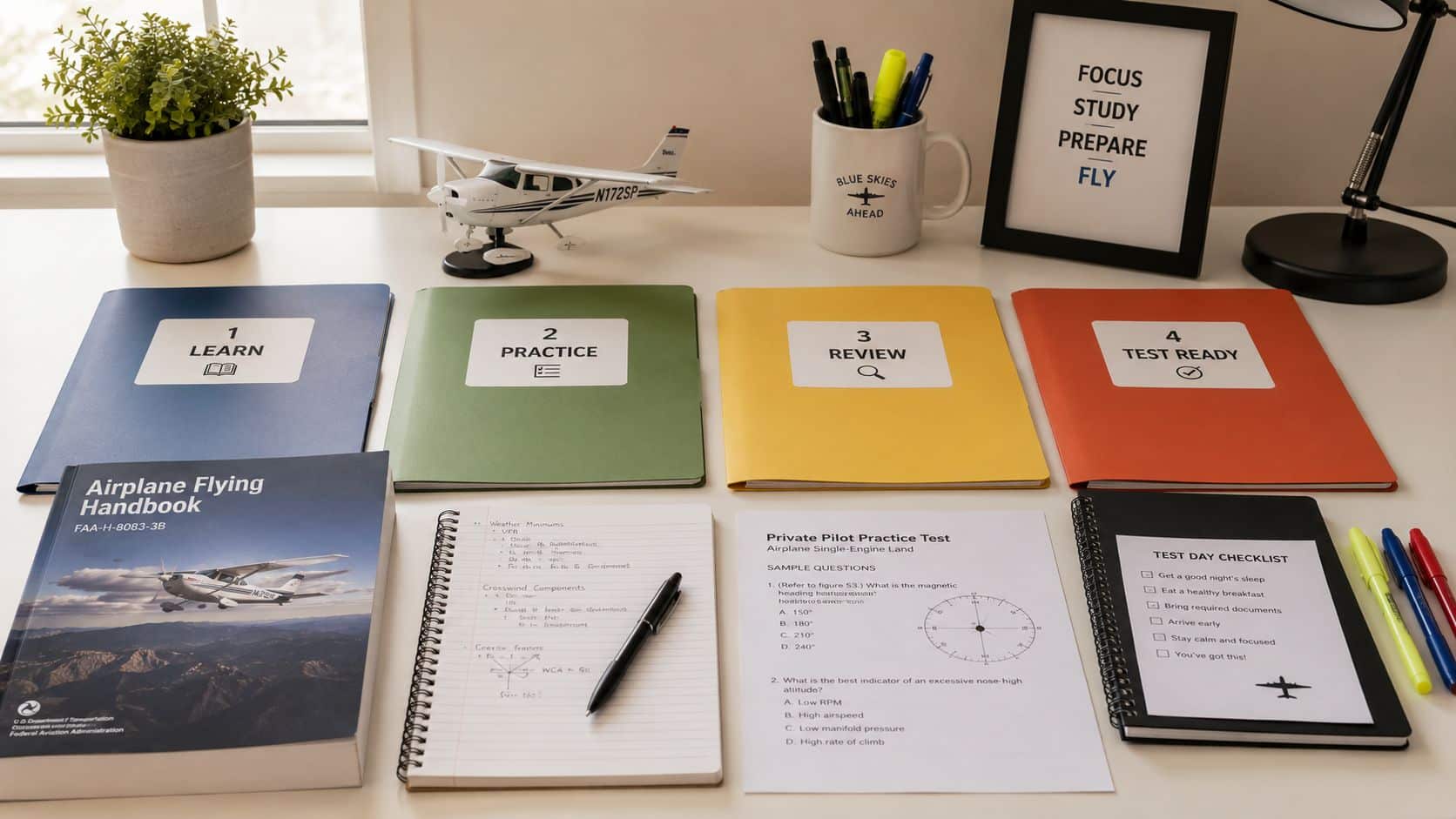
A four-stage sprint keeps preparation sequential. Students learn first, apply second, simulate third, and review last. Skipping the first stage usually creates fragile scores because practice questions become a substitute for instruction.
Stage one focuses on learning
During weeks 1 to 3, the student should complete ground-school lessons, reading, and videos before spending much time on question banks. A useful workload is 6 to 8 hours per week, provided in the verified study workflow for the exam. The exit criterion is coverage, not a practice score. The student should be able to describe the major ideas in plain language and identify which ACS area each lesson supports.
Stage two turns knowledge into application
During weeks 4 to 6, the student adds topic-specific question sets immediately after each lesson. The benchmark is 80% accuracy on the topics just studied, but the percentage only matters if every miss receives an explanation. A student who misses a density-altitude question should redo the setup, identify the chart or formula involved, and state what operational decision the result affects.
A weekly cadence can remain simple:
- Two study nights: Read or watch assigned material and make short notes.
- One practice block: Complete questions tied to the current ACS tasks.
- One review session: Rework misses and update the error log.
- Flashcard maintenance: Spend 30 minutes on V-speeds, light gun signals, sectional symbols, and other memory-heavy items.
Students who struggle with initiation or consistency may benefit from a daily structure for ADHD adults and then adapt the same principle to aviation study. Short, scheduled blocks are easier to protect than vague promises to study whenever time appears.
Stage three introduces realistic simulation
During weeks 7 and 8, move to full, timed, 60-question practice exams. Use the official time limit and the testing supplement style. Split the exam into three 30-minute blocks of 20 questions, a practical time-management method that reduces pressure when a chart or scenario takes longer than expected.
Track results by ACS area, not only by total score. A strong total can hide a recurring weakness in weather or performance.
Stage four targets the final gaps
In the final 7 to 10 days, focus on the weakest two or three areas. The benchmark is at least three full practice exams at 85% or higher before scheduling the actual test, following the recommended preparation workflow documented by the private pilot written exam checklist.
Building Your Study Resource Stack
No single resource does every job well. A structured course provides sequence, a reference book supplies depth, practice questions expose retrieval problems, and an instructor can explain why a student keeps making the same error.
The most effective stack usually contains one resource from each category:
| Resource | Typical Cost | Best Fit For |
|---|---|---|
| Structured ground school | $200 to $400 | Students who need a complete sequence and guided lessons |
| FAA reference textbook | Free PDF | Students who need regulatory and conceptual depth |
| Educational video course | Free | Students who learn well through visual explanations and can self-manage |
| Online question bank | $30 to $60 | Students who need repeated application and score tracking |
| CFI topic review | $50 to $80 per hour | Students with persistent gaps or confusing calculations |
The costs in this comparison are the planning ranges specified for these resource categories, not a guarantee of current pricing. Students should confirm current prices before purchasing.
A textbook such as the FAA's Pilot's Handbook of Aeronautical Knowledge can fill gaps that practice questions leave behind. It's especially useful when a student knows an answer but can't explain the aerodynamics, weather process, or regulatory reasoning behind it.
Free video instruction can clarify difficult concepts, but it requires discipline. Watching several lessons without pausing to predict an answer or work an example creates familiarity, not necessarily recall. A question bank helps only after the student has learned the subject well enough to interpret a new scenario.
A focused CFI session is often most valuable late in the process. The student arrives with an error log, identifies the recurring pattern, and asks for explanation rather than a general review. One or two targeted sessions can be more useful than repeatedly retaking broad exams.
For students training at Chino Airport, DuBois Aviation's private pilot training books guide can serve as a starting point when assembling a reference shelf. The same selection principle applies nationwide: choose resources that support the ACS, explain the reasoning, and fit the student's learning habits.
Habits That Move Scores From Passing to Comfortable
A practice score near the cutoff can create false confidence. The student may recognize familiar questions yet struggle when a chart changes, a weather report is presented differently, or two answers appear technically plausible. Comfortable performance comes from retrieval, explanation, and repeated work with realistic material.
Passive study usually looks busy. The student watches videos without pausing, skips the ACS, avoids weather and performance, and takes practice exams repeatedly without analyzing misses. Cramming a large number of quizzes the night before may produce temporary recognition while leaving the underlying weakness untouched.
Active study has a visible record. Each missed question should produce an entry that answers three points:
- What was missed: Copy the concept or describe the error in the student's own words.
- Why it was missed: Identify whether the problem was memory, interpretation, calculation, or rushing.
- How it will be fixed: Add the relevant ACS reference, reread the source, and complete a new example.
A 10-minute daily flashcard rotation works well for memory items such as V-speeds, light gun signals, and sectional symbols. The cards should be answered from memory before the explanation is checked. If a card is repeatedly missed, it belongs in the error log rather than being treated as a simple bad-luck item.
Weather requires a different habit. Students should practice reading current METARs and TAFs, identify the operational meaning of the reports, and explain what would change the go or no-go decision. Chart reading also improves through repetition. Reading the sectional around the home airport until symbols, airspace boundaries, frequencies, and elevations become familiar builds speed without turning the session into rote trivia.

The strongest review question isn't “What's the answer?” It's “What information in the question proves that answer is correct?”
The central shift is from consuming material to retrieving and explaining it. Multiple-choice questions reward the student who can recognize the governing principle, reject attractive distractors, and apply the rule to the scenario on the screen.
Final Week, Test Day, and What Comes Next
The final week should reduce uncertainty, not introduce an entirely new curriculum. The student's work should center on weak ACS areas, timed practice, documents, and a calm test-day routine.
Final-week checklist
- Confirm the eligibility paperwork: Verify the instructor endorsement, graduation documentation if applicable, and identification requirements.
- Confirm the appointment: Schedule the knowledge exam through the selected testing center and check its current arrival instructions.
- Run realistic simulations: Complete two full 60-question practice tests under timed conditions.
- Review the error log: Rework missed questions without relying on answer memorization.
- Prepare the supplement mindset: Expect charts, figures, and reference pages to be part of the question-solving process.
Students organizing a testing operation or managing preparation appointments may also find test prep center software useful as a general scheduling and administration resource. For an individual applicant, the priority remains simpler: confirm the appointment, bring the required documents, and arrive prepared to work carefully.
On test day, bring a valid photo ID and the required authorization or endorsement documentation. The exam allows 150 minutes, and optional breaks may be available under the testing center's procedures. A student shouldn't rush through familiar questions. Read the complete prompt, identify the task being tested, use the supplement when needed, and flag uncertain items for later review.
The passing threshold is 70%, or 42 correct answers out of 60, as established in the exam requirements cited earlier. The verified study guidance also identifies a 24-month validity period for a passing result and a 30-day retest cooling-off rule after a failure. Because testing-center procedures and fees can change, the applicant should confirm current retest requirements directly when scheduling.
Students can review FAA knowledge test locations before choosing a convenient appointment. The location matters less than arriving with valid documentation, a completed endorsement process, and enough preparation to maintain a buffer above the cutoff.
After the result is recorded
Save the Knowledge Test Report and brief the CFI on the result, including every ACS code associated with missed questions. Those codes should guide additional ground review before the practical test.
The written test should then give way to integrated preparation for the oral and flight portions of the checkride. The ACS remains the common reference. Regulations, weather, navigation, aircraft systems, performance, risk management, and maneuvers should be studied as connected operating decisions rather than separate trivia chapters.
Frequently asked questions
Does a student under 18 need an endorsement at a special time?
The student still needs the applicable instructor endorsement or qualifying training documentation before taking the knowledge test. The timing should be confirmed with the instructor and the testing center because eligibility depends on the applicable FAA rules and the student's training path.
What happens after a failed knowledge test?
The student should review the Knowledge Test Report, identify the missed ACS areas, and complete the required additional preparation before attempting a retest. The verified guidance specifies a 30-day waiting period after a failure, so that time should be used for targeted correction rather than repeated guessing.
When should the practical test be scheduled?
The practical test should be scheduled when the student is prepared for both the oral and flight portions, not just because the written exam has been passed. The CFI should use the Knowledge Test Report, ACS progress, aircraft proficiency, and endorsement timing to decide when the application is appropriate.
How should a student handle a barely passing score?
A barely passing score should be treated as a diagnostic result. The student should study every missed ACS code with the CFI and be ready to explain the underlying concepts during the oral examination.
What is the simplest study plan to follow?
Use the four stages in order: learn the fundamentals, apply them with targeted questions, simulate full timed exams, and review the weakest areas until practice performance is consistently strong. The student who can explain missed answers has a more durable foundation than the student who merely remembers a quiz key.
DuBois Aviation provides structured private-pilot ground training and flight instruction, including ACS-focused preparation for the FAA knowledge test and the later oral and practical checkride. Prospective students can review training options and contact DuBois Aviation to ask about course availability, scheduling, or a school visit at Chino Airport.