

A student sits down after work with a textbook, a question bank open on a phone, and a flight lesson booked for Saturday, unsure whether tonight should go to weather, airspace, or performance math. A Private Pilot Study Guide that works solves that problem by organizing every topic around the FAA Airman Certification Standards, linking aeronautical knowledge, risk management, and flight proficiency to the knowledge test, the oral exam, and each flight lesson. It isn't a flashcard list. It's a continuity system that shows what to study next, how to prove understanding, and how to restart cleanly after a break.
Table of Contents
- Why the Airman Certification Standards Drive Every Study Plan
- What the FAA Private Pilot Knowledge Test Covers
- Building a Realistic Two- to Three-Month Study Schedule
- Comparing Popular Private Pilot Study Materials
- Working Sample Questions the Way the FAA Tests Them
- What the Oral Exam Actually Feels Like on Checkride Day
- Linking Ground Study to Real Flight Lessons
- Putting It Together and Your Next Step
Why the Airman Certification Standards Drive Every Study Plan
Textbook chapters follow a teaching order. The checkride doesn't. An examiner follows the Airman Certification Standards, so a useful guide has to start there and work backward into daily study.
Two practical options worth comparing
These are specific products pilots commonly compare for this type of flying. Confirm compatibility with your aircraft and instructor before ordering.
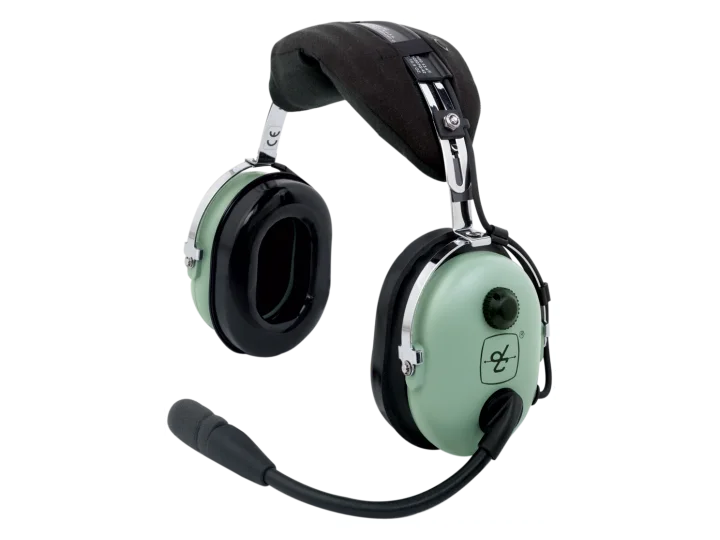 Student headsetDavid Clark H10-13.4 Aviation HeadsetCheck current availability on Amazon (paid link)
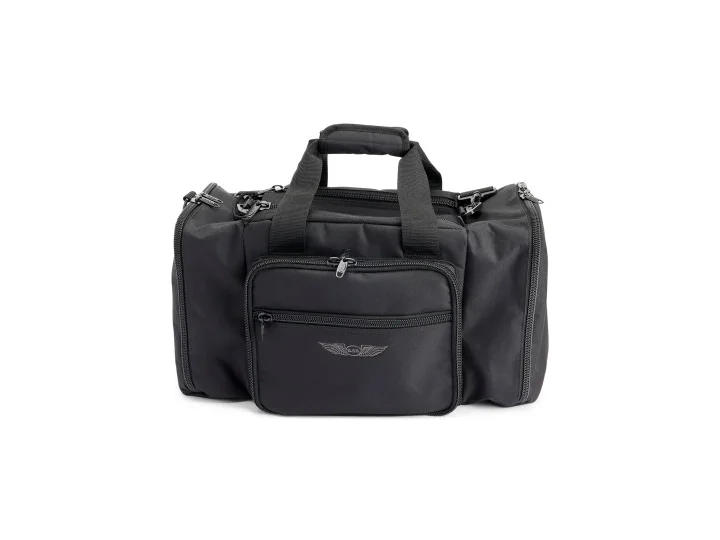 OrganizationASA Flight BagCheck current availability on Amazon (paid link)
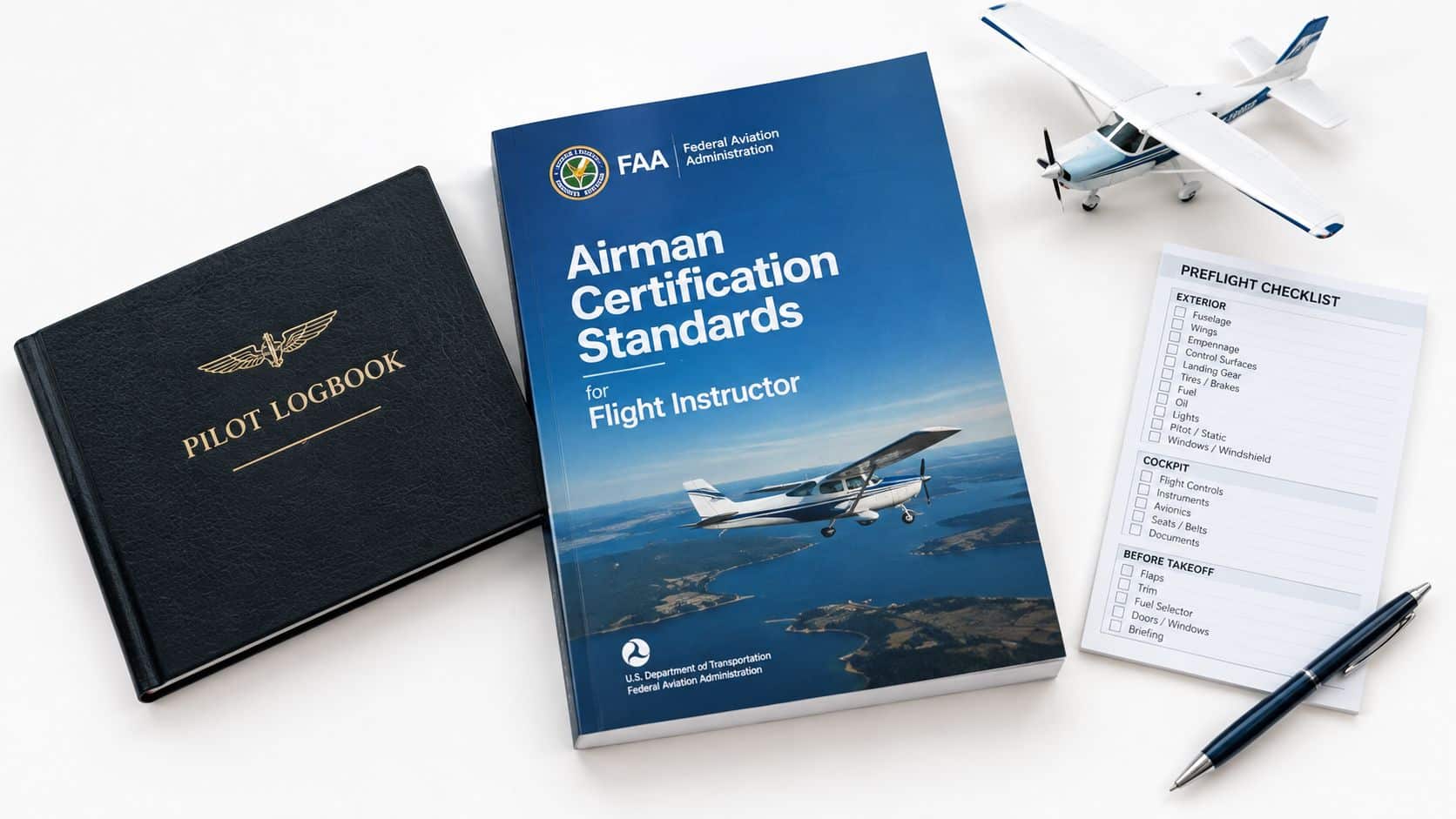
The Document That Sets the Standard
The current standard is FAA-S-ACS-6C, effective May 31, 2024, and it defines three connected areas of competence, aeronautical knowledge, risk management, and flight proficiency, according to the FAA Airman Certification Standards overview. That structure replaced a purely task-oriented approach with one that requires applicants to explain decisions, identify hazards, and demonstrate safe performance.
That distinction changes how studying works. Memorizing a definition of density altitude covers only the first area. The ACS also expects an applicant to recognize the hazard on a hot day, judge its effect on takeoff distance, choose a mitigation, and then fly the departure within tolerance. Readers who want the deeper logic can work through a guide to mastering the FAA Airman Certification Standards in flight training alongside the ACS itself.
Practical rule: If a study session can't be tied to an ACS task, it's probably trivia, not preparation.
What ACS Mapping Looks Like in Practice
Every topic in a well-built guide carries three prompts. What must the applicant know? What could go wrong, and how serious is it? What must the applicant do in the airplane? Weather study, for example, moves from reading a forecast to setting personal minimums to making a defensible go or no-go call before a cross-country flight.
Mapped this way, the rest of the work falls into place. A student learns to read an ACS task, inventory the test topics, build a realistic schedule, choose materials, work sample questions by reasoning rather than recognition, rehearse the oral exam, and connect each ground topic to a specific flight lesson.
What the FAA Private Pilot Knowledge Test Covers
The written test feels enormous until its topics are inventoried against the ACS. Once grouped, the subject areas are finite, and each one connects to an oral question and a flight task.
Test Format and Scale
The Private Pilot Airplane knowledge examination contains 60 questions, allows 2.5 hours, requires applicants to be at least 15 years old, and has a passing score of 70 percent, as detailed in the FAA Private Pilot Airplane ACS document. Applicants must pass that test before taking the practical test, so written preparation and flight preparation run on the same clock.
Demand for the test is substantial. FAA data recorded 46,132 tests and a 91.90 percent pass rate in the 2024 report, following 45,820 applicants with a 90.30 percent pass rate and an average score of 82.05 percent in 2023, per the FAA 2024 airman knowledge testing volume report. High pass rates don't mean the test is easy. They suggest structured preparation works.
Private Pilot Knowledge Test Topics Mapped to ACS Areas
| Subject Area | Example ACS Areas | Sample Study Task |
|---|---|---|
| Regulations | Pilot qualifications, operating rules | Explain currency and required documents for a planned flight |
| Airspace and ATC | Airspace classes, communication procedures | Identify entry requirements on a sectional chart excerpt |
| Weather and weather services | Weather information, hazard recognition | Brief a route and defend a go or no-go decision |
| Navigation | Pilotage, dead reckoning, navigation systems | Build a nav log and plan a diversion |
| Aircraft systems | Systems knowledge, malfunctions | Describe a system failure and the correct response |
| Performance and limitations | Performance planning, weight and balance | Compute takeoff distance and center of gravity |
| Aerodynamics | Principles of flight, stalls | Explain why load factor rises in a steep turn |
| Human factors | Aeromedical factors, decision-making | Apply a personal checklist before accepting a flight |
| Emergency procedures | Emergency operations | Recite and rehearse the engine failure flow |
Where the First Study Hours Should Go
Regulations, airspace, and weather repay early effort because they recur in nearly every lesson and every oral scenario. Performance and navigation follow, since both demand worked practice rather than reading. One change deserves attention now. Private pilot airplane and helicopter exams will receive embedded-image questions effective October 26, 2026, according to the FAA testing update announcing the change. Chart excerpts, weather graphics, and airport diagrams should therefore be part of study from the start, not a late add-on.
Building a Realistic Two- to Three-Month Study Schedule
A schedule built for an ideal week collapses by the third real one. A durable plan assumes work, school, weather cancellations, and aircraft availability will interfere, then builds slack into the calendar on purpose.
Anchor the Calendar to Flight Requirements
The regulatory floor gives the plan its grid. The framework requires at least 40 hours of logged flight time, including at least 20 hours with an authorized instructor and 10 hours of solo training, plus at least 3 hours each of cross-country, night, and instrument training, as summarized in the FAA guidance on hourly requirements for becoming a pilot. That 40-hour figure is a legal minimum, not a prediction, so the study calendar should target consistent ACS performance rather than a finish date.
Ground study pairs with each block. Cross-country preparation means nav logs, fuel computation, and diversion planning. Night preparation means lighting, visual illusions, and instrument reliance. Instrument preparation means attitude flying and scan discipline. Studying each topic just before flying it makes both stick.
A Weekly Rhythm That Survives a Missed Week
- Two short reading sessions: One ACS area per session, ending with three self-written oral questions.
- One application session: Weather graphics, chart work, or performance problems under a timer.
- One chair-flying session: Checklist flows and radio calls spoken aloud, start to finish.
- One weekly review quiz: Missed items logged by ACS code, not just by topic name.
Students who want help structuring those blocks can adapt general exam study planner strategies and templates to an ACS-based calendar, swapping generic subjects for ACS areas of operation. When a week is missed, the plan doesn't restart. The missed block moves, the review quiz still happens, and the next flight lesson gets a longer preflight briefing.
A one-hour session works when it has one target, one worked example, and one spoken explanation at the end.
Accelerated learners compress the same rhythm rather than skipping parts of it. Reading, application, chair-flying, and review still rotate, just daily instead of weekly, with mock oral questions added earlier because the checkride arrives sooner.
Comparing Popular Private Pilot Study Materials
Most students end up with a stack rather than a single source, one main text, one question bank, and something visual for hard topics. The goal isn't owning everything. It's covering three jobs, learning, practicing, and checking against the standard.
Comparing Popular Private Pilot Study Materials
| Resource | Format | Typical Cost Range | Best For |
|---|---|---|---|
| FAA handbooks and ACS downloads | Free PDF reference texts | Free | Source material behind every test question |
| Structured textbook systems | Print or digital book with workbook elements | Paid, one-time | Readers who learn by working chapter problems |
| Video ground school courses | Streamed lessons with quizzes | Paid, subscription or one-time | Visual learners and commuters studying in short blocks |
| Question bank applications | Timed practice exams with explanations | Paid, often recurring | Final-phase test rehearsal and weak-area tracking |
| Instructor-led ground school | Scheduled one-on-one or class sessions | Paid by session or course | Students who need accountability and direct feedback |
How to Choose Without Overspending
Free FAA material is the foundation, and it shouldn't be skipped because it's free. The handbooks explain the reasoning that question banks only sample. A paid course earns its cost when it adds structure, sequencing, and feedback that a self-reader won't build alone, not when it merely repeats handbook text on video.
DuBois Aviation offers one-on-one private pilot ground instruction using structured learning materials, which suits students who want an instructor to sequence topics against their flight lessons. Self-paced learners can start with handbooks and one question bank, then add help only where scores stall. A curated shortlist helps narrow the book decision, and a comparison of the best private pilot training books covers the main options in more depth.
The common mistake is buying the question bank first. Practice scores climb quickly through recognition, then collapse on oral questions that ask for reasoning. Materials should be bought in the order they're used, reference first, course second, question bank last, once there's knowledge worth testing.
Working Sample Questions the Way the FAA Tests Them
Flashcards reward recognition. The FAA increasingly rewards application, so sample questions only help when they're worked the slow way, with the reasoning spoken or written before the answer is checked.
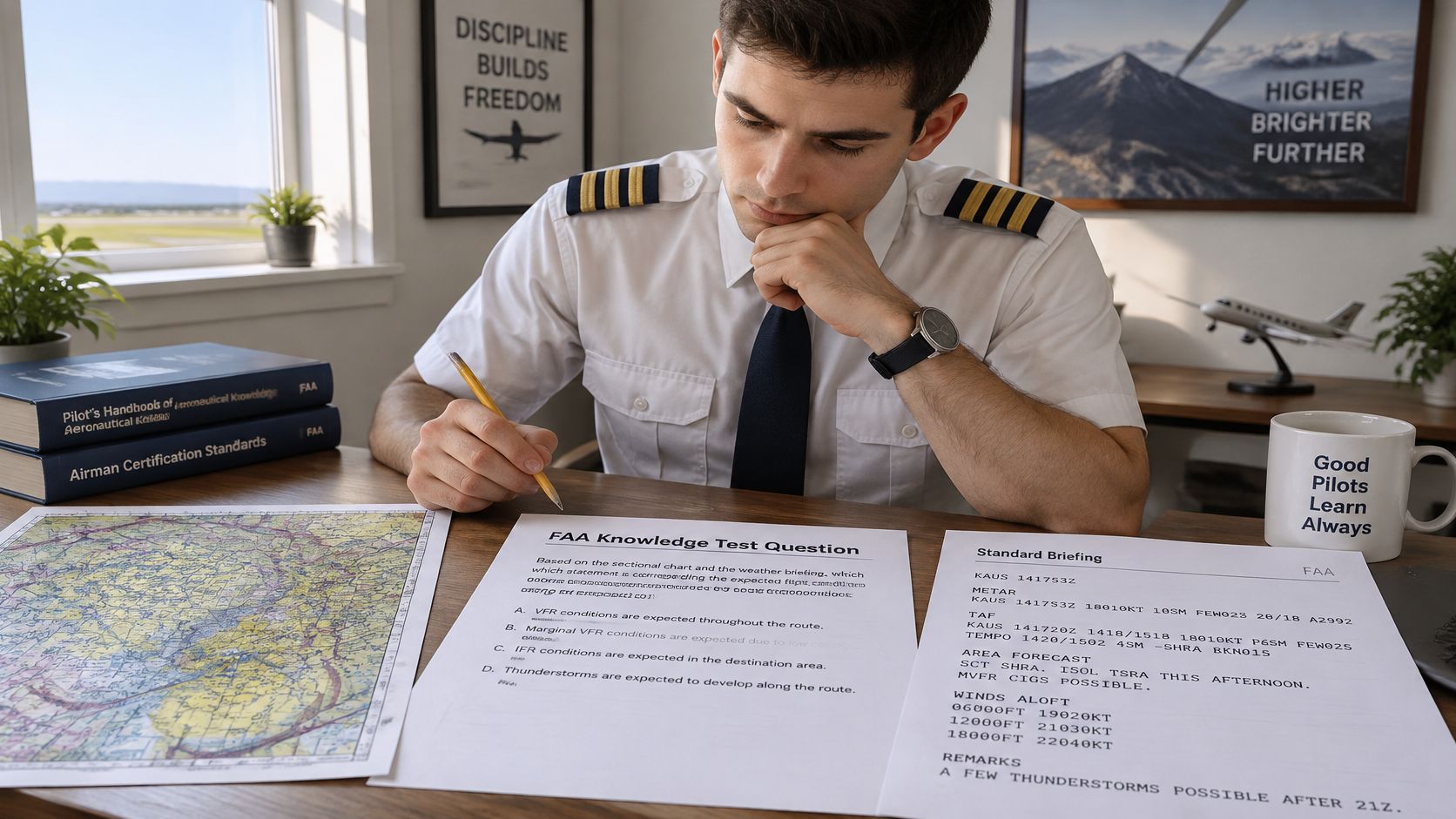
Three Questions Worked by Reasoning
Weather interpretation. A forecast shows visibility falling and temperature approaching dewpoint along a planned evening route. The strong answer isn't the one that defines fog. It's the one that recognizes a deteriorating trend, connects it to personal minimums, and delays or cancels. The ACS reference is weather knowledge paired with risk management, because the tested skill is the decision.
Airspace. A chart excerpt shows a route crossing controlled airspace near a towered airport. The reasoning chain runs in order, identify the airspace class from the chart symbols, recall its entry and equipment requirements, then state the radio call and timing. Distractors usually describe a neighboring class correctly, which is why reading the chart legend beats guessing from memory.
Aircraft performance. A question gives a heavy airplane, a short runway, and high temperature. The correct path starts with the performance chart, not intuition. Density altitude rises, takeoff distance grows, climb performance shrinks, and the safe answer may be reducing weight or waiting for cooler conditions. Each distractor typically gets one step right and the conclusion wrong.
The Habit That Transfers to Test Day
- Read the stem twice: The second read catches words like always, except, and required.
- Name the reference: Regulation, chart, or handbook concept behind the question.
- Eliminate before selecting: Cross out answers that violate a known rule.
- State the operational consequence: What changes in the airplane if this answer is right?
Timed drills with charts, weather graphics, and performance figures build exactly the visual skill the newer question format demands. A high practice score still isn't proof of readiness on its own. Proof is explaining, without notes, why the wrong answers are wrong.
What the Oral Exam Actually Feels Like on Checkride Day
The oral exam rarely feels like an interrogation. It feels like a long, structured conversation about one planned flight, with an examiner following threads wherever the applicant's answers lead.
How the Conversation Unfolds
A typical oral begins with credentials, endorsements, and eligibility, then moves to aircraft documents and maintenance status. From there it follows the flight the applicant planned, weight and balance, performance calculations, the weather briefing, airspace along the route, and the systems of the specific airplane sitting on the ramp. Scenario questions arrive throughout. A passenger feels ill. The destination weather drops. A vacuum pump fails. Each one tests whether knowledge turns into a decision.
Preparation for that format differs from written study, and a walkthrough of the oral exam for private pilot applicants outlines the sequence in detail. The key realization is that examiners aren't hunting for memorized paragraphs. They're checking whether the applicant can reason out loud, use references, and recognize the limits of personal knowledge.
Weak Areas Examiners Probe
- Density altitude math: Applicants who can define it but can't work its effect on a real departure.
- Personal minimums: Vague answers instead of written wind, ceiling, and visibility limits.
- Fuel planning cross-checks: Numbers accepted from an app without a manual sanity check.
- ATC expectations at towered airports: Hesitant readbacks and uncertainty about runway crossing clearances.
A Repeatable Answer Format
Strong answers follow a pattern. State the regulation or ACS reference, explain the reasoning in plain language, then tie it to the planned flight. An applicant who doesn't know an answer gains ground by saying so and opening the correct reference, because that behavior is itself risk management. Bluffing, by contrast, invites deeper questioning on exactly the wrong topic.
Examiner reality: A calm applicant who looks something up looks safer than a fast applicant who guesses.
Rehearsal is what produces that calm. Mock orals with an instructor, run against a real cross-country plan, expose weak threads weeks before an examiner finds them.
Linking Ground Study to Real Flight Lessons
Ground study that never reaches the cockpit fades fast. Each major topic has a flight lesson where it stops being theory, and scheduling study just ahead of that lesson is where a private pilot study guide earns its keep.
Pairing Topics With Flights
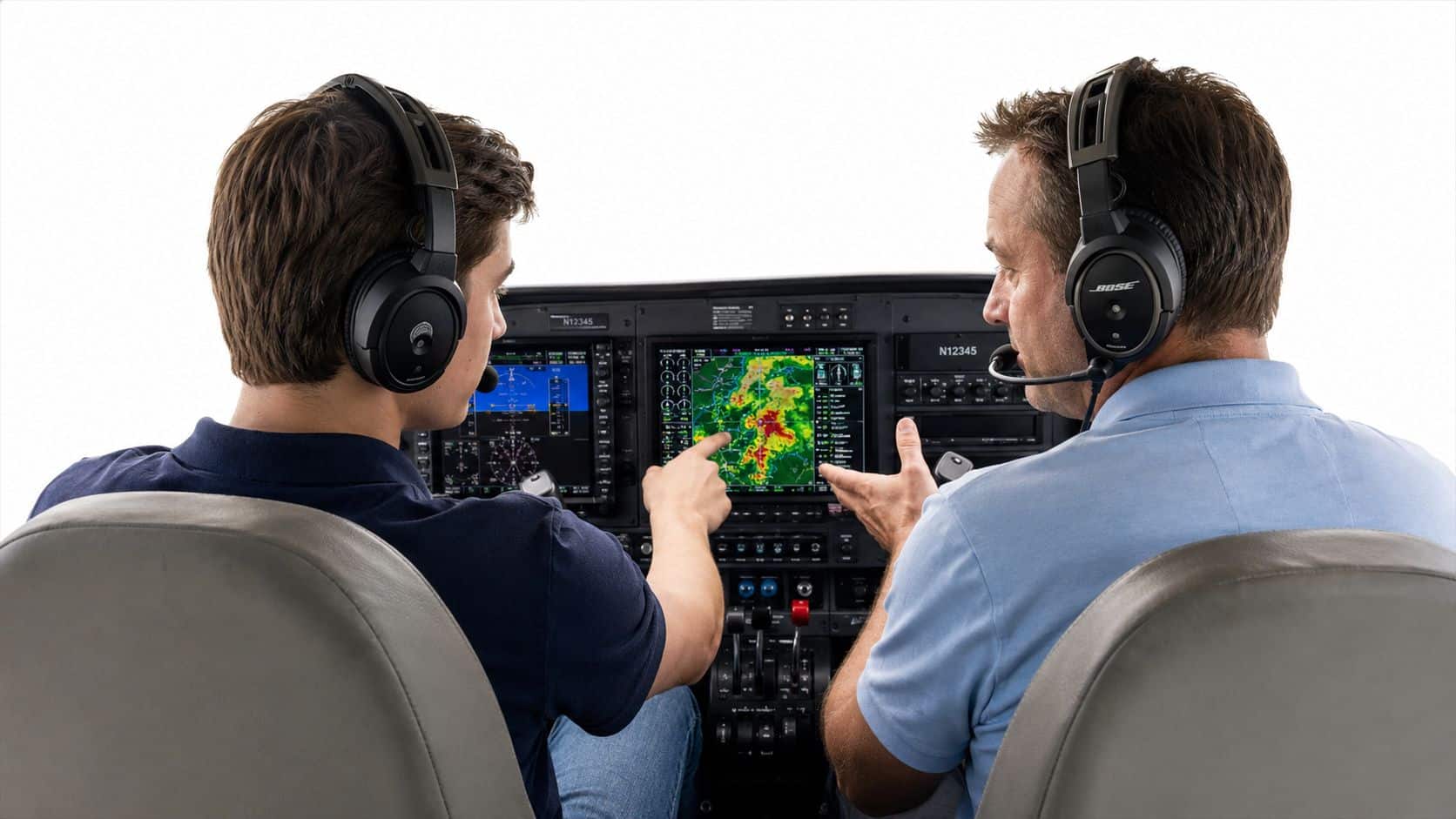
Weather theory pairs with briefing an actual route on an actual morning. Aircraft systems pair with the preflight walkaround, where each component studied the night before gets touched and checked. Regulations and airspace pair with radio work at a busy towered airport, where a clearance has to be heard, read back, and flown correctly in real time. Performance math pairs with the first hot day departure, when the numbers stop being abstract.
Restarting After a Break
Interruptions are common, and they're rarely about motivation alone. A 2025 survey of 215 pilots and aviation students found that nearly half lacked relatable mentorship or peer support, with financial uncertainty, instructor selection difficulties, burnout, and self-doubt also reported, according to the 2025 pilot training survey report. A structured restart treats the gap as a proficiency problem with a sequence, not a character flaw.
- Review personal minimums and emergency procedures on the ground before any flight is booked.
- Chair-fly and use simulator time to rebuild flows, checklists, and radio calls cheaply.
- Repeat weak knowledge areas in question-bank mode, sorted by ACS code.
- Fly progressively demanding lessons with an instructor rather than jumping to solo or checkride preparation.
- Confirm eligibility early, including medical status, before rebuilding a checkride timeline.
That last step matters more than students expect. A pilot generally must hold at least a third-class medical certificate under 14 CFR §61.23 when exercising private pilot privileges or taking a practical test, unless a specific regulatory alternative applies, per the current text of 14 CFR §61.23. Training at Chino Airport adds useful context throughout, since its towered environment, three runways, and instrument approaches turn airspace and communication study into daily practice.
Putting It Together and Your Next Step
Everything in a working study system reduces to three lines. Organize study around the ACS. Cover the major knowledge areas with worked practice, not just reading. Rehearse the oral exam before worrying about the flight portion.
The One-Page Framework
- Map it: Every study block tagged to an ACS area, with knowledge, risk, and skill prompts.
- Work it: Charts, weather products, and performance figures used under time pressure weekly.
- Say it: One topic explained aloud per session, in the answer format an examiner expects.
- Fly it: Each ground topic scheduled just before the lesson where it becomes real.
- Track it: Missed questions and weak maneuvers logged by ACS code in one running list.
Common Early Mistakes Worth Avoiding
Studying without practicing heads the list, because reading creates familiarity that feels like mastery until a timer or an examiner appears. Treating the knowledge test as the finish line runs second. It's a gate, not the destination, and the oral exam revisits every weak area the test report records. Skipping weather and performance math runs third, usually because both feel slow. They're also where real flights get decided.
Students returning from a break shouldn't rebuild everything at once. The restart sequence stays short, minimums and emergencies first, chair-flying second, weak knowledge areas third, then progressively harder flights. Two honest weeks of that sequence restores more proficiency than a single marathon weekend.
A private pilot certificate isn't earned in one heroic study session. It's earned in small, repeated reps, each one mapped to a standard, practiced in context, and checked against real performance in the airplane. Prospective students who aren't sure where they stand can ask about course availability, schedule a school tour, or request training information before committing to a start date. That conversation costs nothing and usually clarifies the first month of study better than another week of solo planning.
Prospective and current students can build an ACS-mapped study plan with structured ground instruction, one-on-one flight training, and simulator support at Chino Airport through DuBois Aviation. Visitors are welcome to ask about course availability, schedule a school tour, or request training information to map out a realistic first month of private pilot study.