
A modern pilot training program is no longer a small, informal route into aviation. FAA-recorded student pilot numbers rose from 128,501 in 2016 to 370,286 in 2025, while active pilots increased from about 584,000 to more than 887,000 over the same period (FAA-based pilot training data). The practical lesson is clear: students aren't entering a niche hobby market. They're entering a large, changing workforce pipeline where training quality, aircraft access, airspace exposure, and post-certificate opportunities matter as much as passing a checkride.
Table of Contents
- The Scale of Modern Pilot Training Programs
- Mapping the Complete Rating Pathway
- Comparing Part 61 and Part 141 Structures
- Timelines, Costs, and Simulation Technology
- Evaluating Flight School Facilities and Airspace
- Navigating Post-Training Bottlenecks and Careers
- Frequently Asked Questions About Pilot Training
- How many hours does a private pilot applicant need?
- Is a student pilot certificate the same as a pilot rating?
- Does a pilot need a medical certificate?
- How long does a flight review remain valid?
- Can WINGS or a proficiency check satisfy the flight review requirement?
- What should a student ask before enrolling?
The Scale of Modern Pilot Training Programs
The number of student pilots reached 370,286 in 2025, up from 128,501 in 2016 (FAA-based pilot training data). Active pilots also grew from about 584,000 to more than 887,000 during that period. For a prospective aviator, the implication is practical: training now feeds a broad aviation workforce, including airline operations, business aviation, helicopter services, instruction, rental flying, and related roles.
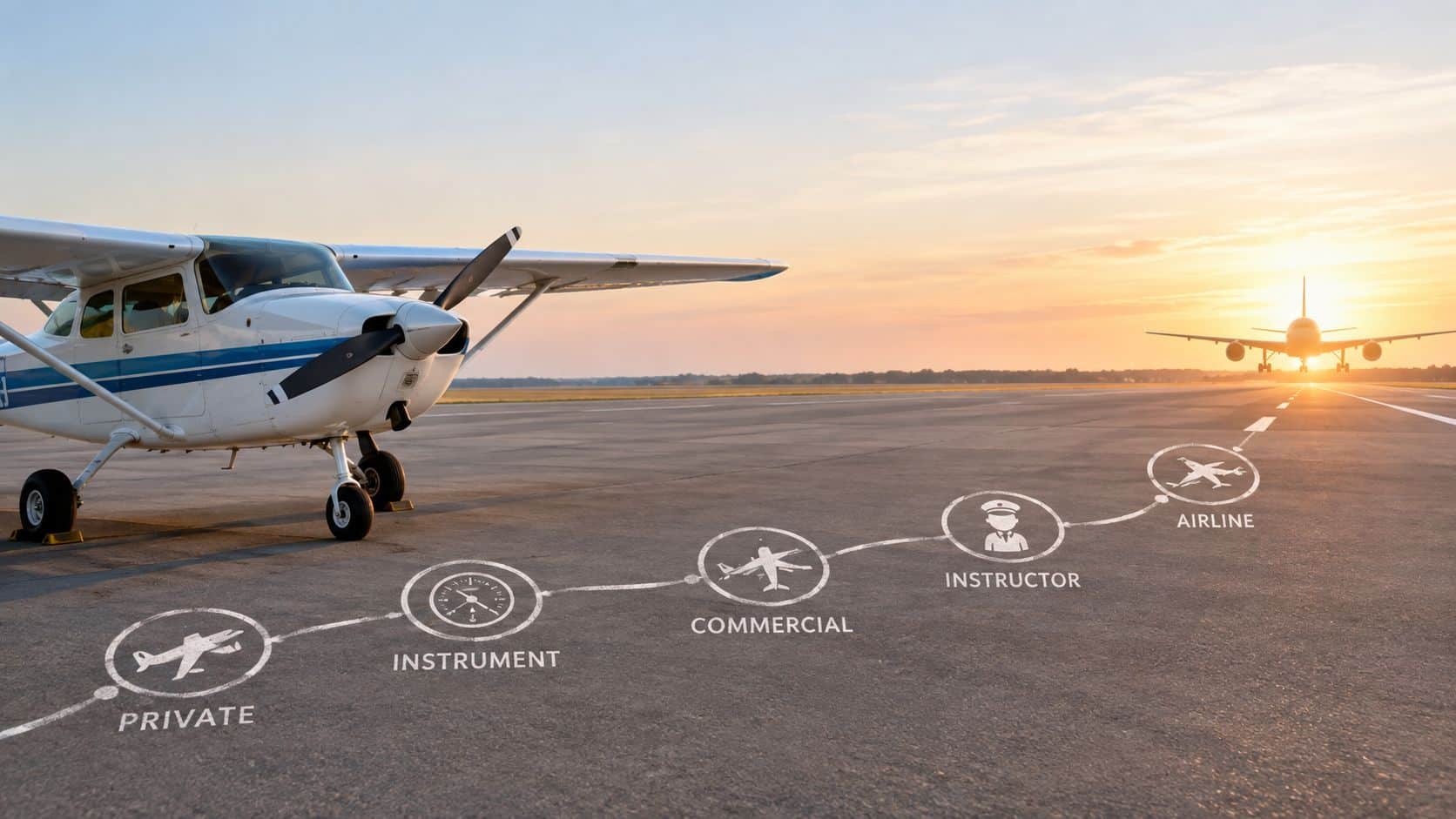
That growth changes how students should assess a flight school. A program must support more than aircraft rental and instructor scheduling. It should coordinate the progression through private, instrument, commercial, instructor, and multi-engine training while helping students manage finances, maintenance interruptions, examinations, and career decisions.
The yearly pattern still requires caution. The same FAA dataset records 69,503 new students in 2023, followed by 61,353 in 2024 and 58,761 in 2025. Training starts can rise or fall with labor demand, financing, regulatory pathways, aircraft availability, weather, and the capacity of schools to absorb new students.
What a complete program must provide
A serious program connects ground knowledge with repeated cockpit practice and realistic operational exposure. It also prepares students for the administrative work that follows each lesson, including logbook management, endorsements, medical planning, written examinations, checkride preparation, and the transition from certificate holder to employable pilot.
Evaluate the program across these areas:
- Instructional continuity: Students should know who tracks progress when an instructor becomes unavailable.
- Fleet access: Aircraft should be maintained, schedulable, and appropriate for each training stage.
- Progress tracking: Lessons should identify deficiencies and set the next measurable objective.
- Operational exposure: Students should handle radio communication, navigation, weather decisions, abnormal procedures, and increasingly complex airspace.
- Career planning: Career-track students need a candid explanation of hour-building, instructor work, hiring requirements, and possible employment gaps.
Simulator sessions can support this system when instructors connect them to cockpit lessons. They are useful for practicing procedures, instrument scans, workload management, and abnormal situations, but they do not replace judgment in live weather, busy airspace, or changing traffic conditions. A school's long-term value depends on how well it combines those environments and helps graduates become employable, not just checkride-ready.
Practical rule: Judge a school by how it manages the complete progression, including training quality and the opportunities that follow graduation.
The historical record reinforces the value of organized systems. During the wartime expansion of U.S. pilot education, 233,198 men entered primary training between July 1939 and August 1945, and 202,986, or 87 percent, advanced to basic training. Of those basic graduates, 193,440, or 95 percent, earned their wings (Smithsonian National Air and Space Museum). Civilian schools operate under different conditions, but the lesson remains relevant: standardized progression, reliable instruction, and enough capacity to place graduates into the next stage make large-scale training work.
Mapping the Complete Rating Pathway
A pilot training program succeeds when each rating prepares the student for the next operational demand, not merely the next checkride. The pathway usually begins with a discovery flight, then builds privileges through private, instrument, commercial, and instructor certificates. Each stage answers a different question: Can the student control the aircraft, operate with fewer visual cues, perform to a professional standard, and manage another pilot's workload?

Start with the private pilot certificate
A discovery flight lets a prospective student assess comfort, workload, and motivation before committing to a syllabus. The private pilot stage then develops aircraft control, navigation, radio communication, weather interpretation, emergency procedures, and aeronautical decision-making.
Under FAA Part 61, an airplane, helicopter, or gyroplane private pilot applicant must log at least 40 hours, including 20 hours of dual instruction, 10 hours of solo flight, 3 hours of cross-country training, 3 hours of night training, and 3 hours of instrument training (FAA private pilot hour requirements). The FAA also notes that most applicants need 60 to 75 hours, so the regulatory minimum is a floor, not a reliable completion forecast.
The certificate permits personal flying within its limitations. It does not authorize compensation for carrying passengers or property, and it does not demonstrate readiness for every operating environment. Students should finish this stage able to recognize personal limits, reject unsuitable weather, and continue learning without an instructor beside the controls.
Add the instrument rating
Instrument training teaches pilots to maintain control by reference to instruments, manage clearances, interpret procedures, and work accurately when outside visual cues diminish. It builds scan discipline, workload management, communication, and sound decisions in conditions that can expose weak habits quickly.
A useful syllabus includes realistic briefings and debriefings, rather than repeating approaches until the practical test. Students need to understand alternates, missed approaches, fuel planning, equipment limitations, and the difference between being legally equipped and operationally ready. Simulator sessions can reinforce procedures and abnormal situations, but live weather, traffic, and complex airspace still require aircraft experience.
Build commercial and instructor capability
The commercial certificate demonstrates a higher standard of aircraft control and judgment. It can support eligible compensated operations, but it does not qualify a graduate for every commercial activity. The intended operation, aircraft category and class, operating rules, and additional requirements must be assessed separately.
For many career-track pilots, the next practical step is the CFI certificate, followed by CFII and, where appropriate, MEI. Instruction provides structured flying, repeated maneuver demonstrations, and experience managing another pilot's workload. It also exposes weaknesses that may remain hidden during familiar personal missions. Instructor work is often the bridge between initial training and the experience required for later professional hiring, so students should evaluate whether a school can absorb graduates into productive hour-building roles.
Select specialized additions deliberately
Multi-engine training introduces asymmetric thrust, engine-out planning, systems management, and more demanding cockpit coordination. It suits students targeting multi-engine instruction or professional operations, provided the training produces genuine proficiency rather than a résumé credential.
Helicopter add-on training follows a different control philosophy and operating environment. Students must learn helicopter aerodynamics, hover work, autorotation procedures, confined-area considerations, and aircraft-specific limitations. A broader overview of pilot certificate and rating levels can help students place these additions within their intended pathway.
Comparing Part 61 and Part 141 Structures
Part 61 and Part 141 are regulatory frameworks, not ratings of instructional quality. Part 61 lets instructors adapt lessons to a student's pace, schedule, and learning needs. Part 141 requires an FAA-approved course with defined stages, records, and progression standards.
The better fit depends on availability, career goals, financing, and the student's ability to maintain a consistent schedule. A part-time student may need Part 61 flexibility, while a career student may benefit from Part 141 accountability and standardized documentation. The structure matters, but the school's ability to deliver effective instruction and support graduates matters just as much.
Decision matrix
| Feature | Part 61 | Part 141 |
|---|---|---|
| Course structure | Instructor can adapt the training sequence to the student | School follows an FAA-approved syllabus |
| Scheduling | Often suits irregular or part-time availability | Works best with regular attendance |
| Progress checks | Instructor evaluates readiness under applicable rules | Stage checks and documented milestones guide progression |
| Training minimums | Standard regulatory minimums apply | Some certificates and ratings may use approved reduced minimums |
| Personalization | High flexibility for individual learning needs | Less improvisation, with greater consistency between lessons |
| Administrative fit | Straightforward for independently funded students | May fit approved institutional or financing pathways |
| Best question to ask | Can the school keep training coherent around a changing schedule? | Can the student meet attendance and stage requirements? |
Part 61 still requires disciplined administration. The student should receive a coherent syllabus, accurate logbook entries, clear endorsements, and regular progress reviews. Those records also help instructors identify gaps before they affect later ratings or employment readiness.
Part 141 brings more structure, but an approved syllabus cannot compensate for weak instruction, limited aircraft access, poor maintenance, or inadequate student support. Ask how the school handles aircraft substitutions, instructor changes, missed stage checks, and periods when the fleet is unavailable. These operational details affect whether training converts into usable proficiency.
The practical choice: Choose the structure the student can follow consistently. A theoretically efficient course becomes inefficient when missed lessons, poor preparation, or limited aircraft access interrupt it repeatedly.
Students can compare the frameworks in this guide to Part 61 and Part 141 flight training. Before enrolling, ask who owns the training record, how stage failures are handled, whether credits transfer, and what happens if training pauses. Also ask how graduates build hours afterward. A program that prepares students for complex airspace, simulator-supported repetition, and instructor work may provide a stronger bridge into the next stage of the aviation pipeline than one focused only on checkride completion.
Timelines, Costs, and Simulation Technology
Training time and cost depend on more than aircraft rental. A workable budget accounts for aircraft and instructor time, ground instruction, written and practical tests, medical planning, supplies, equipment decisions, and repeated lessons when skills have not consolidated. Students should review a practical flight training cost framework and ask the school to separate fixed expenses from variable flight time.
Industry coverage tied to 2025 completion data reports median times of 24 weeks for private pilot, 15 weeks for instrument, 12 weeks for commercial, and 8 weeks for initial CFI training (2025 flight-training completion coverage). These figures are benchmarks, not promises. Student availability, weather, aircraft scheduling, instructor continuity, preparation, and learning pace can shift the schedule substantially.
Where simulation helps
Simulation earns its place when repetition matters more than aircraft handling. Instrument procedures, clearance interpretation, cockpit flows, navigation setup, radio work, and abnormal decision-making can be introduced and rehearsed in a controlled setting. That practice can preserve aircraft time for tasks that require real aerodynamic and operational feedback.
Market research cited in the same 2025 industry report estimates that simulators and simulation-based devices represented about 62.6 percent of global pilot-training market revenue in 2025. The figure describes market revenue. It does not establish how much simulator time an individual student should receive.
Aircraft training remains necessary for handling, visual references, wind, traffic, runway surfaces, engine sound, and the physical consequences of poor energy management. A blended plan assigns each environment the work it teaches best. Simulator sessions should connect directly to aircraft lessons, rather than becoming isolated hours that help a student pass a checkride without building usable judgment in busy airspace.
Measure performance, not just hours
Competency-based training evaluates whether a pilot can repeat the required skills, not merely accumulate time. ICAO-aligned frameworks address knowledge, procedures, flight-path management, communication, workload management, and decision-making. Training plans support that evaluation through syllabi, milestones, lesson plans, and documented assessment evidence (IATA competency assessment guidance).
Preparation is usually the most reliable cost-control measure. Students should review assigned material, understand limitations, and arrive with specific questions. A short ground or simulator session that prevents repeated aircraft lessons can improve efficiency. Skipping necessary aircraft practice only moves the expense to a later stage, often when the pilot is building hours or preparing for instructional work. The program should therefore measure post-training readiness, including communication, workload control, and performance in complex operating conditions, not just checkride completion.
Evaluating Flight School Facilities and Airspace
A flight school can advertise a strong syllabus and still deliver weak training if aircraft are unavailable, maintenance communication is unclear, or instructors lack time to debrief. Inspect the operating system behind the brochure. Ask about dispatch reliability, scheduling access, instructor coverage, simulator use, and the process for weather cancellations.
Examine the fleet and maintenance culture
Inspect the aircraft you will fly, not only the newest models on the ramp. The review should cover:
- Aircraft suitability: Confirm that the fleet supports your planned ratings and has avionics appropriate to each training stage.
- Maintenance visibility: Ask how pilots report discrepancies, who authorizes return to service, and how the school communicates cancellations.
- Scheduling resilience: Find out whether a grounded aircraft can be replaced without losing the training week.
- Instructor depth: Determine whether several qualified instructors can support the same course if availability changes.
- Simulator integration: Ask which lessons use the simulator and how instructors connect those sessions to aircraft procedures and performance.
A simulator earns its place when it prepares you for a specific aircraft lesson, radio task, or workload problem. Otherwise, it can become isolated time that helps with a checkride while leaving gaps in real operating judgment. The school should explain what happens before and after each simulator session.
Treat airspace as part of the curriculum
Simple airspace can make early flights manageable, but extended training there may delay exposure to radio work, traffic flow, and controlled-airspace procedures. A towered environment teaches students to listen before transmitting, read back clearances accurately, follow taxi instructions, maintain runway awareness, and continue flying while communicating.
At Chino Airport, KCNO has parallel runways 8L/26R and 8R/26L under or near Ontario Class C airspace, and county guidance warns pilots to use extra diligence because of nearby Ontario International Airport airspace (FAA Chino Airport guidance). That setting provides practice with runway selection, tower communication, controlled-airspace transitions, and traffic awareness.
Complex airspace should be introduced in stages. A private student might begin with the airport diagram and radio sequence, then progress through pattern operations, departures, arrivals, and transitions near more demanding airspace. The goal is usable judgment after training, not a difficult environment chosen for appearances.
A strong training environment adds workload gradually. It doesn't confuse a student with complexity before basic control and decision-making are stable.
DuBois Aviation operates at Chino Airport and offers airplane and helicopter instruction, an in-house simulator, aircraft rental, and training paths covering private, instrument, commercial, CFI, and multi-engine work. Evaluate the school directly, including aircraft condition, instructor availability, simulator coordination, and the actual scheduling process.
Navigating Post-Training Bottlenecks and Careers
A commercial certificate marks progress, not an employment offer. After the checkride, career-track pilots still need to build experience, maintain proficiency, find reliable flying or instructing work, and manage finances while qualifying for later roles. Long-term success depends on how well the training program connects graduates with those next steps.
The U.S. Air Force shows why production alone does not resolve a pilot shortage. Its newer pipeline uses 120 flying hours over 139 days during a civilian university stage, yet officials have described a shortfall of roughly 2,470 pilots. Retention and the capacity of operational squadrons to absorb trained pilots matter alongside training output (Air Force training pipeline coverage). Civilian students operate in a different system, but the principle is similar: graduating pilots and placing qualified pilots into sustainable jobs are separate tasks.
Hour-building requires a plan
Flight instruction is a common route for building experience. A certificate alone does not prepare a new CFI for every student or operating condition. Effective programs provide supervision, standardized lesson planning, regular feedback, and exposure to different learning styles. Ask how instructor applicants are assessed, who reviews their lessons, and what support they receive after starting work.
The gap between ratings deserves equal attention. Extended inactivity can weaken instrument scan, radio confidence, and procedural memory. Rental flying, structured proficiency flights, and deliberate study can preserve those skills, but the schedule and cost must fit the pilot's actual resources. A training plan that ignores those constraints can leave a graduate qualified on paper but underprepared for the next opportunity.
Look beyond the first job
Career planning should connect training completion with the conditions that follow it:
- Training completion: Whether the student can finish the planned certificates without avoidable interruptions.
- Instructional readiness: Whether the graduate can teach safely, consistently, and under supervision.
- Experience building: Whether aircraft access and scheduling permit regular flying.
- Professional presentation: Whether logbooks, records, references, and interview preparation are handled carefully.
- Employer absorption: Whether regional, charter, corporate, instructional, or other operators can place qualified pilots into available roles.
Regulatory pathways can change, so old roadmaps require verification. The Government Accountability Office urged the FAA in 2026 to establish public timelines for two pilot-training initiatives created by the 2024 reauthorization law. Students should confirm current requirements with the FAA and prospective employers before committing to a long training sequence.

Frequently Asked Questions About Pilot Training
How many hours does a private pilot applicant need?
Under FAA Part 61, the minimum is 40 total hours, including the required dual, solo, cross-country, night, and instrument components (FAA private pilot hour requirements). The legal minimum is a starting point, not a reliable completion forecast. Students should budget for the training time required to meet the standard consistently, including weather delays, aircraft availability, and additional practice before the checkride.
Is a student pilot certificate the same as a pilot rating?
No. A student pilot certificate permits training and limited solo operations under its conditions. It does not grant a private, instrument, commercial, or flight instructor certificate. A rating or certificate follows completion of the applicable experience, knowledge, practical, and administrative requirements.
Does a pilot need a medical certificate?
The answer depends on the operation and the privileges being exercised. Students should identify the applicable FAA medical standard before committing to an extended training plan and discuss concerns with an Aviation Medical Examiner. Medical eligibility and operating rules can change, so verify current requirements before starting a costly sequence of ratings.
How long does a flight review remain valid?
Except for specific exceptions, a pilot may not act as pilot in command unless a satisfactory flight review was completed within the preceding 24 calendar months. The authorized instructor records completion with a logbook endorsement (FAA Advisory Circular AC 61-98B). A flight review is recurring currency, not a permanent certificate milestone. It checks whether the pilot can continue exercising privileges safely.
Can WINGS or a proficiency check satisfy the flight review requirement?
Certain proficiency checks and a current phase of the WINGS program can satisfy the flight review requirement. Each completed WINGS phase extends the Flight Review Date by 24 calendar months from the month of completion (FAA WINGS guidance). Pilots must confirm eligibility and record the completion accurately. The program can also support continued proficiency between formal training events.
What should a student ask before enrolling?
Ask about aircraft access, instructor continuity, maintenance communication, syllabus structure, simulator use, stage or progress checks, cancellation policies, and opportunities after each certificate. Request a realistic estimate of variable flight time and a written description of lesson prerequisites. Also ask how the school exposes students to busy or complex airspace, because checkride preparation alone does not guarantee readiness for the operating environment that follows training.
DuBois Aviation provides airplane and helicopter instruction at Chino Airport, with options covering private, instrument, commercial, CFI, multi-engine, and additional helicopter training. Aircraft rental and simulator access support the program. Prospective students can visit DuBois Aviation to ask about course availability, schedule a school visit, or request a training plan matched to their goals.