
You're probably in one of two places right now. You're either excited to start flight training and worried the medical exam might trip you up, or you've heard just enough hangar talk to feel confused about what the FAA wants from a private pilot.
That anxiety is normal. Most student pilots don't struggle with the flying itself first. They stumble over paperwork, unfamiliar terminology, and fear of saying the wrong thing at the doctor's office. The good news is that the FAA Class 3 medical process is usually much less mysterious once you see it as a sequence of simple steps instead of one big pass-or-fail event.
If you're training locally, it helps to think of the medical the same way you'd think about a preflight inspection. You're not trying to prove perfection. You're checking whether you meet the standard required to operate safely.
Table of Contents
- Your First Step to the Skies The FAA Medical Certificate
- What Exactly Is a Class 3 Medical Certificate
- Decoding the FAA Class 3 Medical Requirements
- Your Step-by-Step Guide to the AME Exam Process
- Navigating Common Disqualifiers and Special Issuances
- Class 3 vs Other Options Class 1 Class 2 and BasicMed
- Practical Tips for Du Bois Students and Future Aircraft Owners
Your First Step to the Skies The FAA Medical Certificate
A new student often shows up ready to talk about headsets, logbooks, and first lessons, then pauses when the topic of the medical comes up. That pause usually means the same thing: “What if I can't get through this part?”
The FAA medical certificate is the first real gate in the process because it determines whether you can begin training in a way that counts toward your goal. A Third Class medical certificate is the mandatory prerequisite to begin flight training and log any flight hours, valid for 60 months (5 years) for pilots under age 40 and 24 months for pilots age 40 or older, a rule changed by the FAA from three to five years on July 24, 2008 according to Pilot Essentials on FAA medical exam common questions.
That makes the medical less like a side errand and more like your student pilot starter key. Without it, your training can feel tentative. With it, your schedule, lessons, and next milestones become much easier to plan.
If you're still sorting out what you need before day one, this checklist of student pilot license requirements helps place the medical in the larger training picture.
Practical rule: Get your medical early, before you invest too much time or money in training plans.
Students sometimes think the certificate is the FAA asking whether you're perfectly healthy. It isn't. It's the FAA asking whether you meet the operational standard for the type of flying you want to do. For a private pilot, that standard is the Class 3 medical.
What Exactly Is a Class 3 Medical Certificate
A Class 3 medical certificate is the FAA's health clearance for people flying as student, recreational, or private pilots. It's built for non-airline, non-commercial flying. If your goal is to train, fly with family, travel for personal reasons, or enjoy aviation on your own schedule, this is usually the certificate you're thinking about.
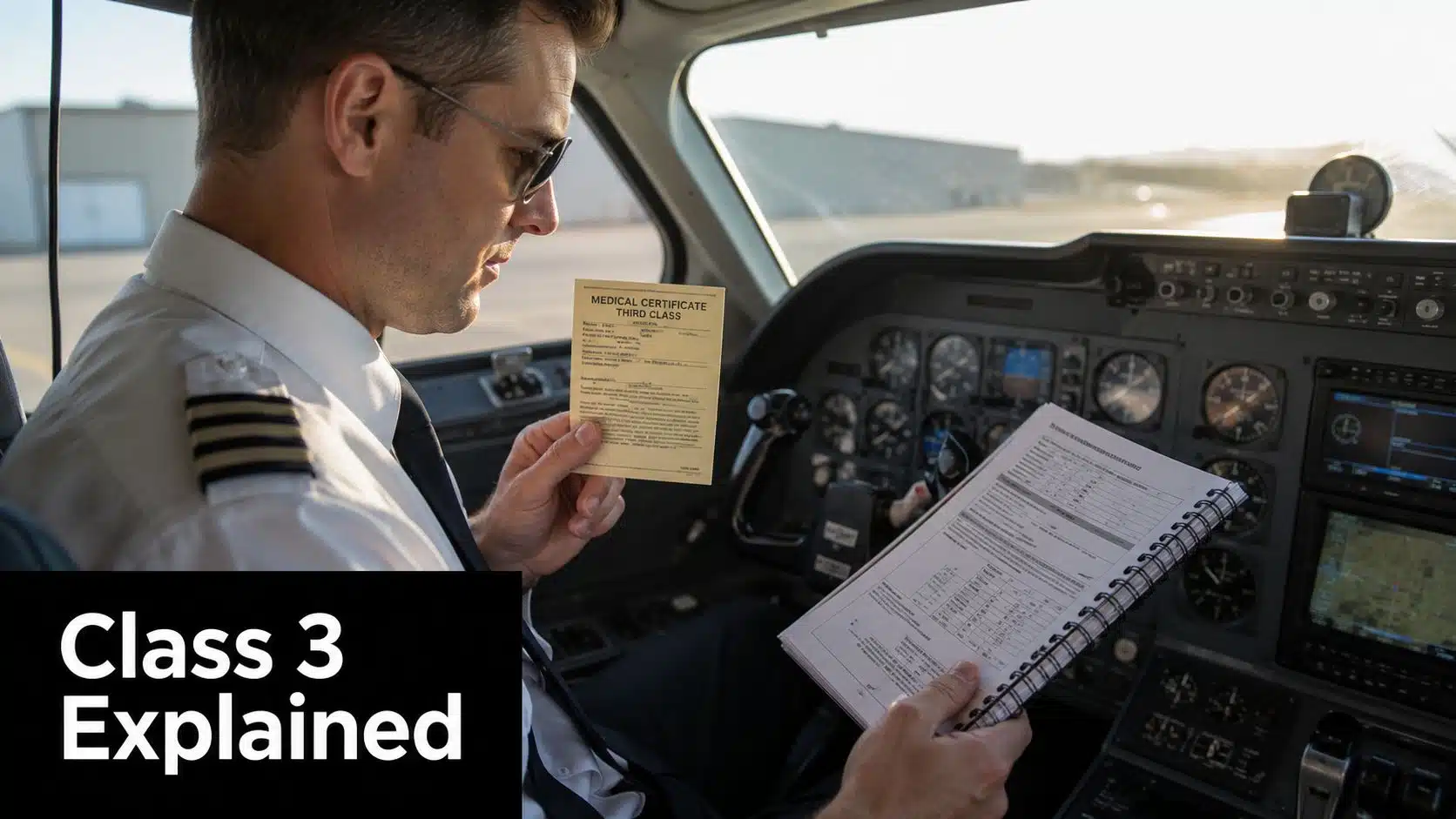
A good analogy is a driver's license vision screening, but much more aviation-specific. Your family doctor may focus on long-term wellness. An Aviation Medical Examiner focuses on whether any condition could interfere with safe flight duties, especially in a fast-changing environment where you need to interpret instruments, hear instructions, and make sound decisions.
It's not a routine annual physical
The AME isn't trying to create a full wellness plan. The AME is applying FAA standards. That means the exam feels more targeted than broad.
The questions usually center on things like:
- Medical history: Surgeries, medications, past diagnoses, and anything ongoing
- Functional ability: Can you see well enough, hear well enough, and perform safely
- Risk factors: Conditions that could suddenly impair you in flight
That's why people sometimes leave the office saying, “That was more specific than I expected, but less dramatic than I feared.”
Why private pilots need this specific certificate
A Class 3 medical matches the mission profile of private flying. You're not being evaluated under the same framework used for airline transport pilots, but you still need to show the FAA that you can operate safely.
The Class 3 medical is less about perfect health and more about reliable fitness for the cockpit.
That distinction matters. A student wearing glasses, for example, may still qualify. A student with a manageable condition may still qualify. The process is designed around practical flight safety, not an idealized picture of flawless health.
Decoding the FAA Class 3 Medical Requirements
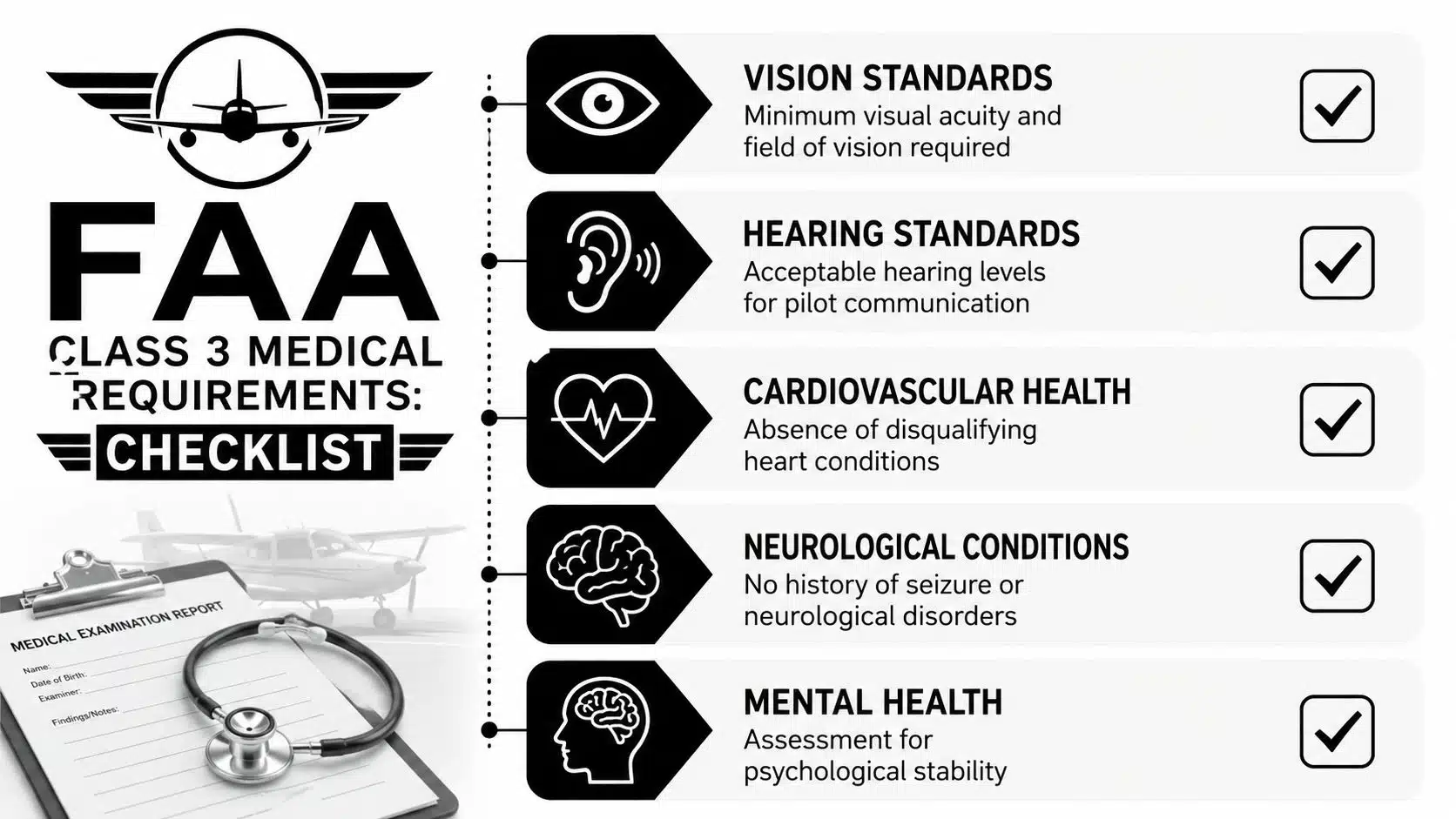
The easiest way to understand the FAA Class 3 medical requirements is to break them into the same categories an instructor would use in a briefing: what you need to see, what you need to perceive, and what parts of your health can raise concerns for the FAA.
Vision standards that matter in the cockpit
Vision is where many applicants get nervous, especially if they already wear glasses or contacts. The FAA standard is more practical than many people expect.
For FAA Third-Class Medical certification, the precise distant visual acuity threshold is 20/40 or better in each eye separately, with or without corrective lenses; if correction is required to meet this standard, the applicant is conditionally eligible only while wearing those lenses during flight operations. The regulation also explicitly mandates color vision discrimination of aviation signal red, green, and white according to the FAA Guide for Aviation Medical Examiners visual standards material.
That means:
- Glasses are not an automatic problem: If you meet the standard with correction, you may still qualify
- Each eye matters separately: This isn't just about your combined vision
- Color recognition matters operationally: Signal lights and cockpit indications aren't optional details in aviation
The visual demands are comparable to reading a sectional chart, spotting traffic, and recognizing airfield lighting within a single operational system. The FAA wants to know that your eyes can do the work the cockpit demands.
Hearing and general physical review
Hearing often worries applicants less, but it still matters because flying depends on communication. You need to receive instructions clearly, especially in a busy traffic pattern or around controlled airspace. The AME's review is based on whether you can function adequately for aviation tasks, not whether you have studio-grade hearing.
The broader physical review looks for conditions that can create sudden or serious risk. The AME may ask about your heart, neurological history, medications, mental health background, prior surgeries, and any diagnosis that required ongoing treatment.
A useful way to think about it is this: the FAA is less interested in whether a condition sounds intimidating, and more interested in whether it could impair judgment, consciousness, coordination, or perception during flight.
A simple mental checklist before your exam
- Bring your corrective lenses: If you use them for daily life, bring them
- Know your medications: Don't guess on names or doses
- Be ready to explain history clearly: A short, accurate explanation helps more than vague memory
- Avoid hiding information: Omissions usually create bigger problems than the condition itself
A straightforward explanation at the start can save weeks of confusion later.
Many students fear the standards because they picture them as hidden traps. In reality, the FAA Class 3 medical requirements are fairly understandable once you separate rumor from the actual benchmarks.
Your Step-by-Step Guide to the AME Exam Process
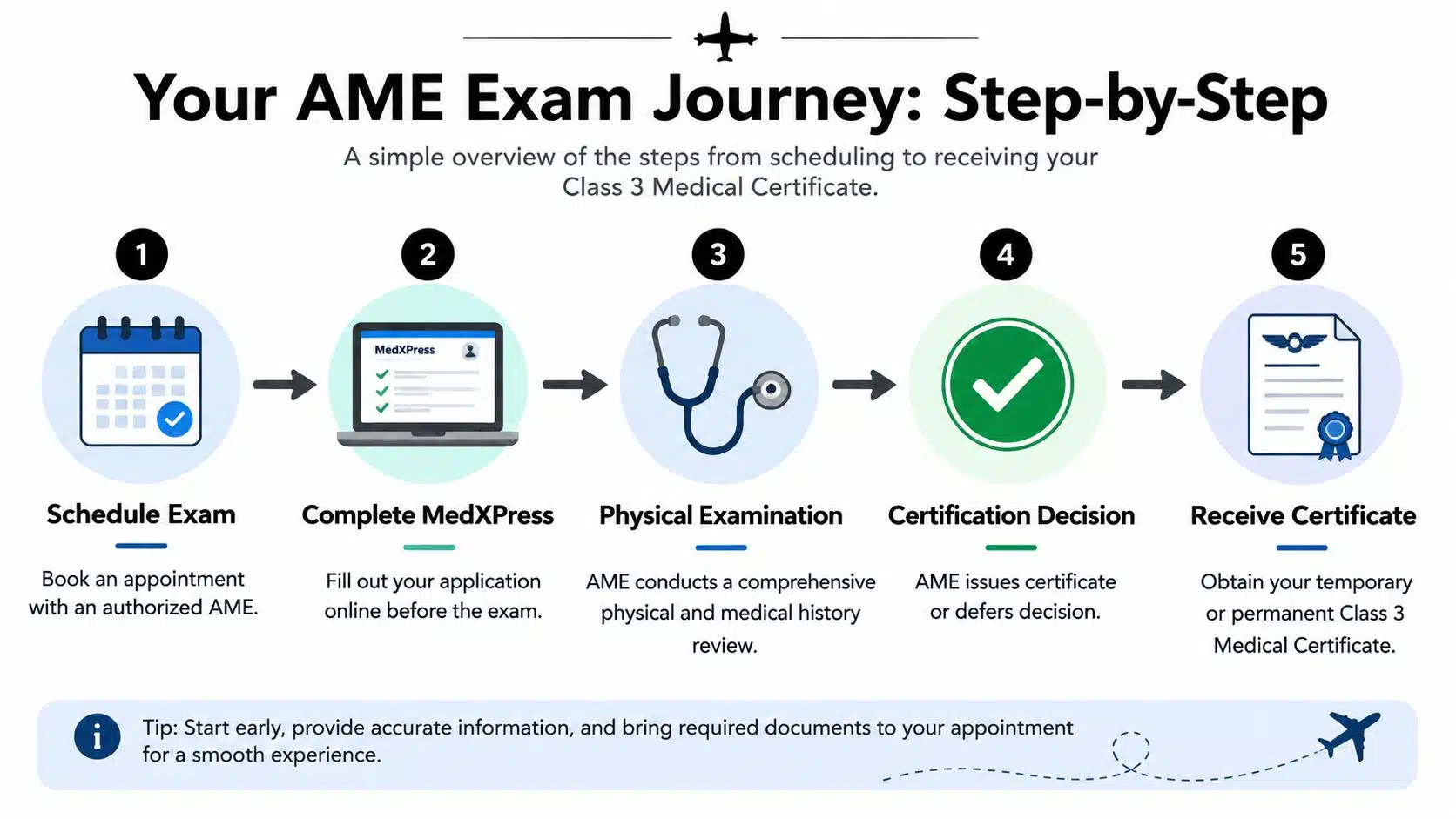
The process feels easier when you treat it like a normal training flow. There's paperwork first, then scheduling, then the actual appointment, then a result. Most frustration comes from rushing the early steps.
Start online before you ever see the doctor
You'll typically begin with MedXPress, the FAA's online application system, for entering your medical history, medications, and other required background details before the office visit.
Take your time here. Students get into trouble when they fill it out from memory while distracted. Pull together your medication list, prior diagnoses, and any records you may need first. If there's a question about terminology used during the review, this plain-language explanation of a review of systems explained can help you understand how clinicians think through symptoms and body systems.
A few practical habits help:
- Complete the form when you're not rushed
- Use exact medication names if you can
- List prior conditions accurately
- Double-check for missing history before you submit
What the office visit usually feels like
At the appointment, the AME reviews the form you already submitted and compares it with what you tell them in person. This is why consistency matters. You don't need to speak like a medical professional. You do need to be accurate.
Part of the exam includes vision testing. For Third Class certification, pilots must demonstrate near vision of 20/40 or better in each eye separately, with or without correction, measured at a distance of 16 inches (410 mm), and intermediate vision of 20/40 or better at 32 inches is not required for this class according to the FAA AME guide standards page.
That detail confuses people because they assume every distance test applies equally. For Class 3, near vision is explicitly part of the standard, while intermediate vision at that distance isn't required.
You can also expect discussion about your history and a basic physical review. If the AME sees no issue, they may issue the certificate. If more documentation is needed, the case may be deferred for FAA review. If a clearly disqualifying issue is present and unresolved, denial can happen.
Bring documents that answer questions before they become delays.
The best mindset is calm honesty. Don't try to sound healthier than you are. Don't dramatize small issues either. Treat the exam the way you'd brief an instructor before a flight. Clear, factual, complete.
Navigating Common Disqualifiers and Special Issuances
This is the part many applicants fear most. They hear the word “disqualifying” and assume it means the end of the road. Sometimes it does mean the path becomes harder. It doesn't always mean the path disappears.
Conditions that raise immediate FAA concern
Certain diagnoses trigger close scrutiny because they can affect consciousness, decision-making, circulation, or in-flight reliability. One of the clearest examples is cardiovascular disease.
Cardiovascular standards for a Third Class airman strictly prohibit any clinical diagnosis or history of myocardial infarction, angina pectoris, coronary heart disease requiring treatment, cardiac valve replacement, permanent cardiac pacemaker implantation, or heart replacement, with no established medical history of diabetes mellitus requiring insulin according to Ramos Law's guide to FAA medical standards and disqualifying conditions.
That list sounds severe because it is. The FAA treats these conditions seriously due to the potential for sudden impairment.
Other histories can also raise concern, especially if they suggest risk to alertness, stability, or control. Applicants usually get into the most trouble when they rely on guesswork, delay gathering records, or assume the AME can “just look past it.”
When a harder path is still a path
A deferral is not the same thing as a final dead end. In many cases, the issue becomes documentation, stability, and proof. The FAA may want specialist notes, treatment history, test results, or evidence that a condition is well managed.
That's where people hear terms like Special Issuance and Statement of Demonstrated Ability. In plain English, these are ways the FAA may allow an applicant to fly if the applicant can show that the underlying issue is understood, controlled, and compatible with safety.
A useful comparison is a maintenance discrepancy. Some issues ground the aircraft outright. Some require more inspection, paperwork, and signoff before the aircraft returns to service. Medical certification can work the same way.
Good habits if you know a condition may be questioned
- Talk with an AME before guessing: Early clarity beats late surprises
- Collect records before the appointment: Specialist reports are easier to gather when you're not under deadline
- Describe current status plainly: “Managed,” “stable,” and “under treatment” need supporting detail
- Stay patient: FAA review can feel slow, but incomplete submissions often slow it further
Students often want certainty before they begin. Medicine and regulation don't always offer that. What they do offer is a process, and many pilots move through that process successfully by being organized and honest.
Class 3 vs Other Options Class 1 Class 2 and BasicMed
A Class 3 medical fits a lot of pilots, but not every pilot. If your end goal is personal flying, it's usually the natural starting point. If you plan to move into paid flying, you'll eventually need to understand the broader scope of medical certifications, including higher classes and BasicMed.
A quick comparison
The one hard data point worth keeping in view here is the Class 3 timeline. The FAA Third-Class Medical Certificate is valid for 24 months for applicants aged 40 and over, while those under age 40 retain validity for 60 months (5 years) according to the AOPA guide to medical certification.
Here's the high-level view.
| Certification | Primary Use | Validity (Under 40) | Validity (40+) |
|---|---|---|---|
| Class 3 | Student, recreational, and private flying | 60 months | 24 months |
| Class 2 | Commercial flying | Depends on FAA rules and privileges exercised | Depends on FAA rules and privileges exercised |
| Class 1 | Airline transport careers | Depends on FAA rules and privileges exercised | Depends on FAA rules and privileges exercised |
| BasicMed | Alternative path for some pilots under specific limits | Not a Class 3 certificate | Not a Class 3 certificate |
If your long-term plan includes professional flying, it's smart to review the broader commercial pilot license requirements so your medical strategy matches your career path.
How to choose the right path
Most new pilots don't need to overcomplicate this. If you're learning to fly for personal use, a Class 3 medical is usually the correct lane.
If you already know you want to fly for compensation or move toward the airlines, don't assume a Class 3 answers every future question. It gets you started, but it may not be the final medical standard you'll need later.
Choose the certificate that matches the flying you plan to do next, not the label that sounds most impressive.
BasicMed also enters the conversation for some pilots, but it's better understood as an alternative framework for eligible operations rather than a replacement for every training or career situation.
Practical Tips for Du Bois Students and Future Aircraft Owners
Training at a busy airport adds realism early. That's excellent for skill-building, but it also means your preparation should be tidy. If your paperwork, scheduling, and records are in order, you'll feel that benefit right away.

Start training with fewer surprises
Before you schedule your first lessons, gather the items that usually create avoidable delays. Bring your identification, corrective lenses if you use them, medication list, and any medical records tied to a condition you know may need explanation.
It also helps to tell your instructor if you're waiting on the medical or if you expect a deferral. That doesn't make you a problem student. It makes you organized.
A short pre-training checklist:
- Set the appointment early: Don't wait until you're emotionally committed to a lesson calendar
- Keep copies of key records: You may need them again later
- Ask questions before the exam: Small misunderstandings grow fast in FAA paperwork
- Track your aircraft paperwork habits early: The discipline transfers to every part of flying, including your later review of aircraft maintenance records
How to buy an airplane the safe way
A lot of people searching for FAA Class 3 medical requirements are also thinking one step ahead. They want to know what flying can become. For some, that means renting for years. For others, it means ownership.
If you're looking at Articles about people looking to buy or sell airplanes and helicopters, the same rule applies that applies to medical certification: don't guess, verify.
How to Buy an airplane the safe way starts with process, not emotion:
- Get a true pre-buy inspection: Use a mechanic who works for you, not the seller
- Read the logbooks carefully: Missing entries, unclear maintenance history, or long periods of inactivity deserve close attention
- Confirm title and ownership details: Clean paperwork matters as much as shiny paint
- Match the aircraft to the mission: A trainer, cross-country machine, and helicopter each ask very different things from an owner
- Budget for the first surprises: New owners almost always find something that needs attention after purchase
The same applies if you're evaluating a helicopter. Rotorcraft buying decisions should be even more disciplined because maintenance history, component status, and mission fit are critical.
People often shop aircraft the way they shop cars. That's a mistake. An airplane or helicopter purchase should feel closer to due diligence on a business asset. You want independent eyes on the machine, complete records, and a realistic understanding of what ownership will demand from you.
Owning an aircraft can be one of the most rewarding parts of aviation. Safe ownership starts long before the first flight. It starts with careful review, expert inspection, and the patience to walk away from a deal that doesn't hold up.
If you're ready to begin training, earn your ratings, or map out the right path from medical certification to aircraft ownership, DuBois Aviation offers flight training, rentals, and guidance for pilots building real-world skills at Chino Airport.