
Before you can earn your wings and take to the skies as a licensed private pilot, you have to prove you’ve done your homework. That’s where the FAA Private Pilot Knowledge Exam comes in.
Think of it as the written driver's test for the sky. It’s a 60-question, multiple-choice exam designed to confirm you have the essential aeronautical knowledge to fly safely. Passing it is a major milestone and your ticket to moving on to the final stages of your flight training.
Two practical options worth comparing
These are specific products pilots commonly compare for this type of flying. Confirm compatibility with your aircraft and instructor before ordering.
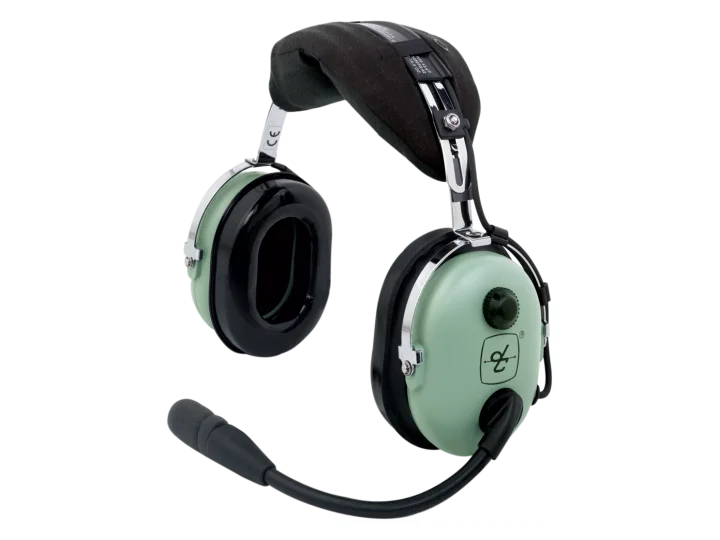 Student headsetDavid Clark H10-13.4 Aviation HeadsetCheck current availability on Amazon (paid link)
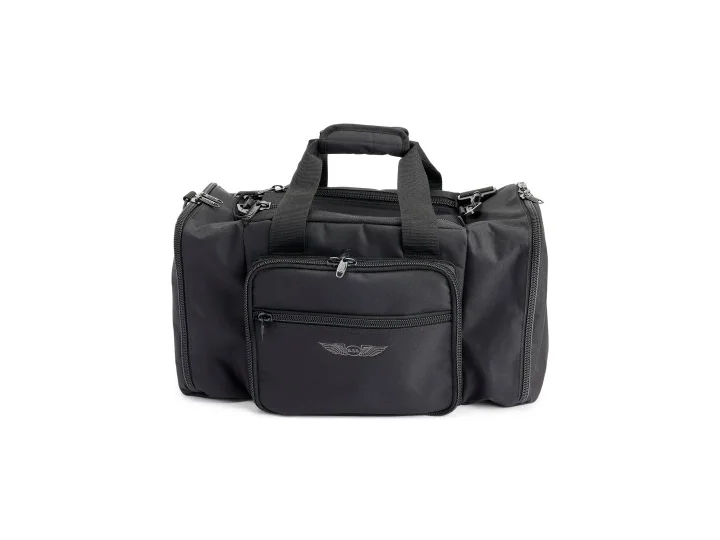 OrganizationASA Flight BagCheck current availability on Amazon (paid link)
What Is The FAA Private Pilot Knowledge Exam?
At its core, the Knowledge Exam is the FAA’s way of ensuring you’ve mastered the theory behind flying before you’re in command of an aircraft. It’s not about memorizing obscure facts; it’s about demonstrating that you can apply your knowledge to make sound, safe decisions.
This test covers the bedrock of aviation knowledge—the stuff you'll rely on for every single flight. We're talking about everything from aerodynamics and aircraft systems to interpreting weather reports and navigating federal aviation regulations. It’s the final exam for your ground school, and it validates that you're ready for the responsibility of being a pilot.
Who Can Take The Exam?
The eligibility rules are pretty straightforward. While you have to be 17 to get your private pilot license, you can tackle the written exam much earlier—at just 15 years old. This is a great way for eager student pilots to get a significant head start.
The single most important requirement, however, is an endorsement from your Certified Flight Instructor (CFI). This isn't a rubber stamp. It's your instructor’s official declaration that you've completed the required ground training and they are confident you have what it takes to pass. Here at DuBois Aviation, our CFIs work closely with you to build that confidence and knowledge base.
Understanding The Exam Format And Scoring
So, what can you expect on test day? The exam is administered at a certified FAA testing center. You’ll have 2.5 hours (150 minutes) to answer 60 multiple-choice questions. That gives you about two and a half minutes per question, so you need to manage your time well and have the material down cold.
To pass, you need a score of 70% or higher. A word of advice from experienced pilots: don't just aim for a 70. Every question you get wrong is a topic the Designated Pilot Examiner (DPE) can, and likely will, question you about during your oral exam for the practical test. A higher score means a smoother checkride later on.
The private pilot license is a popular starting point for many aviators. FAA data showed a slight dip in test-takers in early 2025 after a 2024 high of over 46,000, but the numbers are still incredibly strong. This reflects a healthy pipeline of new pilots, many of whom are on a fast track to commercial careers. You can dig into the numbers yourself in the FAA's latest airman knowledge test statistics.
Now that you know what the exam involves, your next step is figuring out the full journey. You can map out your entire path in our guide on how to become a private pilot.
Key Topics Covered on the Pilot Exam
The FAA Private Pilot Knowledge Exam isn't some arbitrary academic hurdle. It’s a carefully designed test meant to build your foundation as a safe, competent pilot. Instead of a random collection of facts, think of it as a guided tour through the nine core knowledge areas you’ll rely on for every single flight.
When you start to see how these subjects connect to the real world of flying, studying stops being a chore and becomes true preparation. While the FAA mixes up the exact number of questions from each category on any given test, they do give us a reliable blueprint of what to expect. This lets you focus your energy where it matters most.
Regulations and Airspace
The Federal Aviation Regulations (FARs) are, simply put, the rules of the sky. This part of the FAA Private Pilot Knowledge Exam makes sure you know your privileges and limitations as a private pilot. It’s the stuff that keeps everyone safe: rules for carrying passengers, how to stay "current," and the basic dos and don'ts of flying. It’s no different than learning traffic laws before getting your driver's license.
Just as important is understanding the invisible highways in the sky: airspace. You’ll need to prove you can look at a chart and instantly identify different classes of airspace—from the complex, busy Class B around major airports to the wide-open Class G in rural areas. More than that, you have to know the specific rules for entering and operating in each one. Getting this right is fundamental to navigating the system legally and safely.
Aircraft Performance and Flight Instruments
This is where the book smarts meet the cockpit. The aircraft performance questions are all about practical, real-world calculations. They’ll test your ability to read performance charts and answer critical questions like, "Can this plane clear a 50-foot obstacle on a hot, humid day with this much runway?"
Flight instrument questions confirm you can understand what the airplane is telling you. When you're training in a DuBois Aviation Piper Cherokee, you’ll become intimately familiar with the "six-pack" of primary flight instruments. The exam verifies that you know what each gauge—from your altimeter to your airspeed indicator—means, especially when you can’t see the horizon outside.
It's easy to fall into the trap of just memorizing what each instrument does. The real skill the exam is testing is your ability to cross-reference multiple instruments to build a complete mental picture of the aircraft's attitude and performance. This is the bedrock of instrument flying and a lifesaver in unexpected weather.
Aerodynamics and Weight and Balance
Aerodynamics answers the most basic question: how does this thing actually fly? You'll need a solid grasp of the four forces—lift, weight, throughst, and drag—and how they constantly battle for control of the airplane. This isn't just dry physics; it’s the key to understanding why an aircraft stalls and, more importantly, how you recover.
Weight and balance is all about making sure the aircraft isn't just flyable, but stable. Think of it as a perfectly balanced seesaw. You’ll learn how to do the math to calculate the aircraft's center of gravity (CG) and ensure it’s within the safe limits set by the manufacturer. An improperly loaded aircraft can become dangerously unstable, making this a non-negotiable, life-or-death skill.
Practical Applications for Your Pilot Exam
The rest of the exam is designed to tie all these concepts together into the practical art of flying a plane from one place to another.
- Weather and Meteorology: This is about more than just knowing clouds. You'll learn to decode official aviation weather reports (METARs) and forecasts (TAFs), read complex weather charts, and make the all-important go/no-go decision.
- Navigation: Here, you’ll prove you can use sectional charts to plot a course, calculate your time and fuel burn, and use navigation aids like VORs and GPS to find your way.
- Human Factors: This critical section covers the ways your own body and mind can become a risk. You’ll learn to recognize the subtle dangers of fatigue, stress, and hypoxia and how to mitigate them.
- Communication: Flying involves talking. You'll be tested on the standard, precise radio calls used to communicate with Air Traffic Control (ATC) and other pilots—a skill you'll put into practice every day flying out of a towered airport like Chino (KCNO).
Creating Your Personal Study Plan
Let’s be honest, no one passes the FAA Private Pilot Knowledge Exam by cramming the night before. This isn't a college final. Real success comes from a smart, consistent study plan that actually fits into your life.
The goal here is sustainability, not burnout. Whether you’re on a 30-day sprint or a more relaxed 90-day marathon, a well-structured schedule is your best friend. A good approach is to mix up your methods. Maybe you tackle specific chapters from a guide like the Jeppesen materials on weekdays and then dedicate your weekends to full-length, cumulative practice tests.
Designing Your Study Timeline
The best plans are always the ones you can actually stick with. A 90-day timeline is perfect for student pilots who are also juggling a job or other classes. It gives you the breathing room to really absorb the concepts without feeling rushed.
On the other hand, a 30-day plan is an intense, focused bootcamp. It demands an almost full-time commitment but can be incredibly effective if you work well under pressure and want to get the test out of the way quickly.
Regardless of your timeline, how you study matters just as much as when. It's worth checking out these science-backed tips for better grades, as the principles apply perfectly to flight training.
This visual shows how the core exam topics build on one another, starting with the fundamentals and moving toward more complex applications.
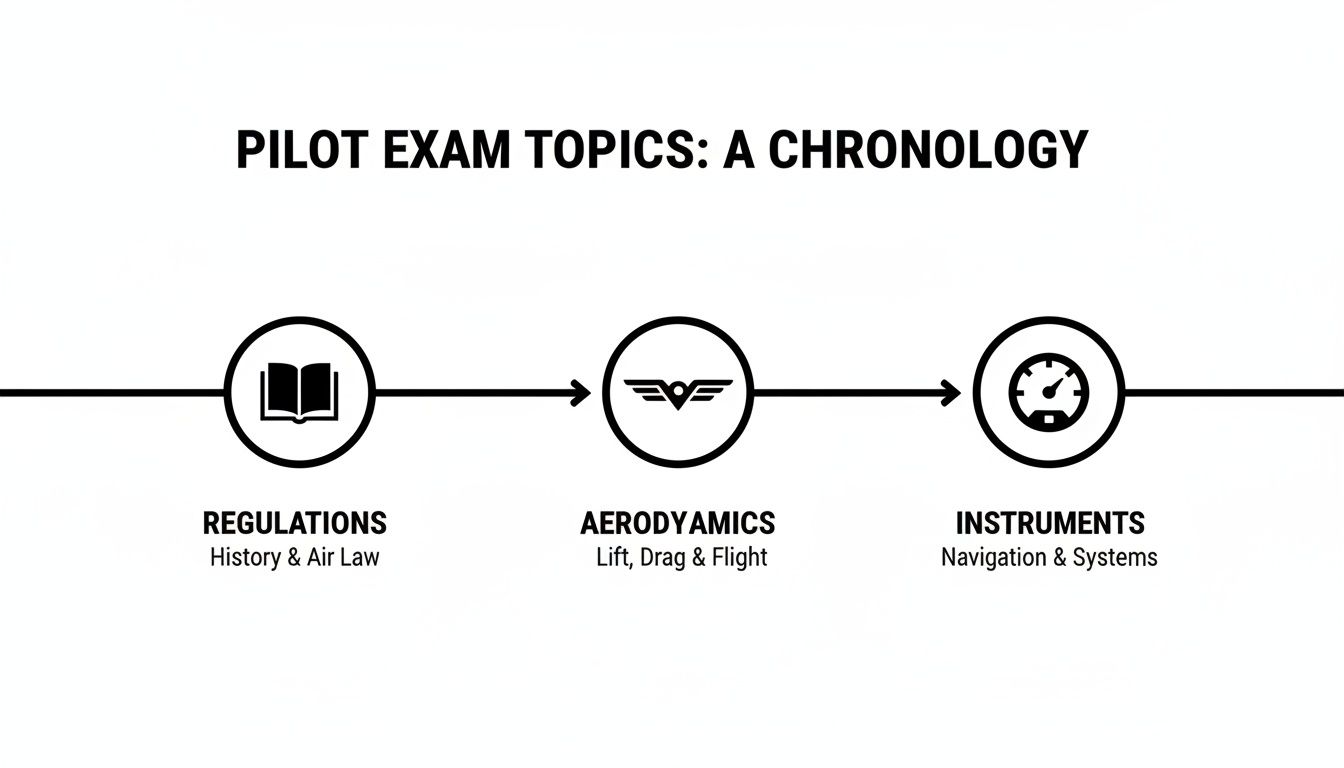
You can see how a solid grasp of regulations and aerodynamics lays the groundwork for understanding flight instruments and putting it all together in the cockpit. The key is to blend different resources. Your study sessions should be a mix of reading the Pilot's Handbook of Aeronautical Knowledge, watching video lessons, and working through interactive quizzes.
This integrated approach is exactly what we build into our DuBois Aviation ground school program, making sure you see the material from multiple angles.
Breaking Through Knowledge Plateaus
Every single student pilot hits a wall at some point. It's that frustrating moment when your practice scores flatline and you feel like you just aren't making progress. This is completely normal.
A study plateau isn’t a sign of failure. It’s your brain’s way of telling you it's consolidating a ton of complex new information. The secret to pushing through is to shake things up.
If you hit one of these plateaus, try one of these proven tactics:
- Attack Your Weak Spots: After a practice exam, don't just glance at the score. Dig into every question you missed. Spend dedicated time on those specific topics—like airspace or weather charts—until they finally click.
- Become the Teacher: Grab a friend, family member, or even your dog, and try to explain a difficult concept out loud. If you can teach someone else how to calculate weight and balance, you've officially mastered it.
- Change Your Scenery: Sometimes, the problem is just mental fatigue. If you’ve been stuck at your desk for hours, pack up and head to a library or coffee shop. A simple change of environment can do wonders for your focus.
The Power of Practice Tests
Think of practice exams as your flight simulator for the written test. They are without a doubt the most powerful tool in your study arsenal. They don't just tell you what you know; they train you for the real thing.
Taking full, timed practice tests builds the mental stamina and time management skills you’ll need on exam day. It gets you comfortable with the pressure, the question formats, and the pacing required to finish all 60 questions in 2.5 hours.
This strategy is proven to work. In 2026, student pilots achieved a 92% first-time pass rate on over 46,000 Private Pilot Airplane exams. These impressive results reflect how far modern training methods and computerized testing—which first launched way back in 1999—have come.
How a Flight School Prepares You for Success
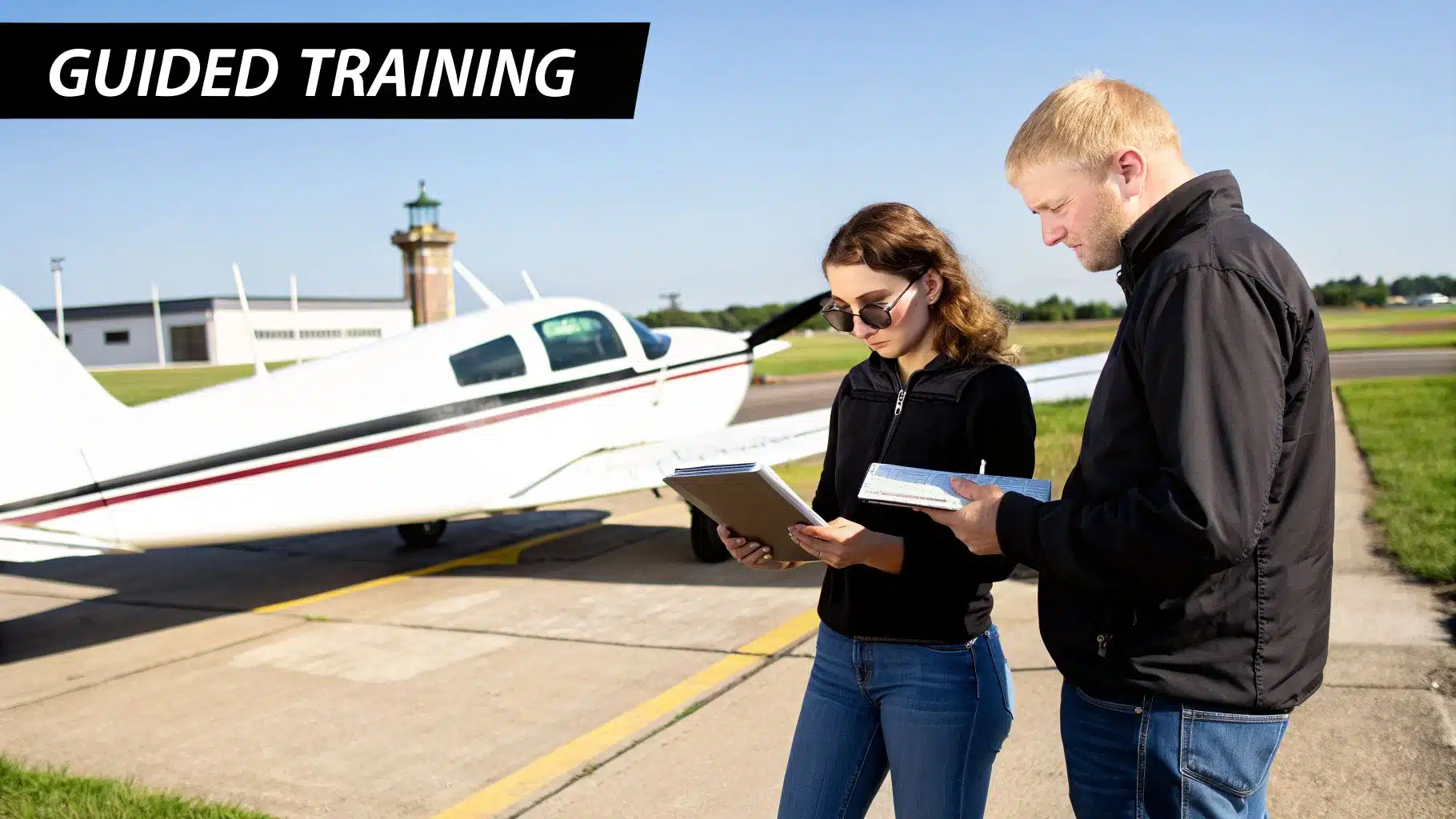
While you'll definitely hit the books on your own to prep for the FAA Private Pilot Knowledge Exam, the right flight school turns that solo effort into a guided mission. It provides the framework, expert guidance, and real-world context you need to connect what you're reading with what you're doing in the cockpit. A great school isn't just a place to log hours—it’s your partner in this journey.
At DuBois Aviation, we take that partnership seriously. It all starts with one-on-one ground instruction. Our Certified Flight Instructors (CFIs) aren't just there to lecture; they're mentors. After you knock out a practice test, they’ll sit down with you to go over every question, identify exactly where you’re struggling, and build a plan to shore up those weak spots.
From Theory to Reality The DuBois Aviation Method
There’s a world of difference between looking at airspace on a sectional chart and actually navigating it. Our students train at Chino (KCNO), a busy, towered Class D airport, which gives them a huge leg up. Every single flight involves putting the exact airspace rules and radio communications you read about into practice.
This daily immersion makes abstract concepts click. You won’t just memorize the procedure for entering Class D airspace; you’ll live it every time you fly. That kind of hands-on experience builds a deep, practical understanding that no book or video can ever truly replicate.
Mastering Skills Safely on the Ground
Real confidence in the air starts with solid preparation on the ground. That’s why our in-house simulator is a cornerstone of our training. It's the perfect, no-pressure environment to drill instrument procedures and work through emergency scenarios until they become muscle memory.
A flight simulator isn't a video game; it's a powerful training tool that allows you to pause, analyze, and repeat complex maneuvers until they become second nature. Mastering instrument approaches in the simulator ensures you are prepared and confident when you encounter them in the aircraft.
This mix of personalized ground school and advanced tools pays off. The results speak for themselves. In 2026, the national first-time pass rate on the private pilot exam hit an impressive 92%, with an average score of 83%. This trend underscores how a structured training environment helps students excel. You can see how scores compare across the country by exploring the latest analysis of FAA written test data.
Ultimately, a flight school does more than just teach you to fly. It provides the crucial instructor endorsement you need to even take the exam, offers steady support, and gives you the real-world experience to become a truly capable and confident pilot.
How to Buy Your First Airplane the Safe Way
For so many of us, passing the FAA private pilot knowledge exam isn't the finish line—it’s the starting gun. The real dream? Owning your own airplane. But let’s be honest, buying your first plane or helicopter is a massive step, and going in without a solid game plan is the fastest way to turn that dream into a financial headache.
The biggest mistake I see new buyers make is jumping straight into the classifieds. Before you even think about looking at listings, you need to get crystal clear on your mission.
Define Your Aircraft Mission
What are you actually going to do with this aircraft? Answering that question honestly is the single most important thing you can do. It keeps you from buying way too much airplane for your needs, or worse, one that can't do what you hoped.
Are you picturing yourself taking a friend on a classic "hundred-dollar hamburger" run in a simple, fun flyer like a Cessna 150? Or do you need something with more legs and seats to take the family on cross-country adventures? Get real about what your typical flight will look like.
Think through these questions to start building a profile:
- What’s a typical trip? Short hops around the local area or multi-state journeys?
- Who is coming with you? Will it just be you, you and a copilot, or the whole family?
- What’s the real budget? Factor in not just the purchase price, but insurance, hangar or tie-down fees, fuel, and the inevitable annual inspection costs.
Once you have that mission profile in hand, you can start zeroing in on specific makes and models. This disciplined approach is your best defense against getting sidetracked by a beautiful plane that just doesn't fit your life.
The Non-Negotiable Pre-Buy Inspection
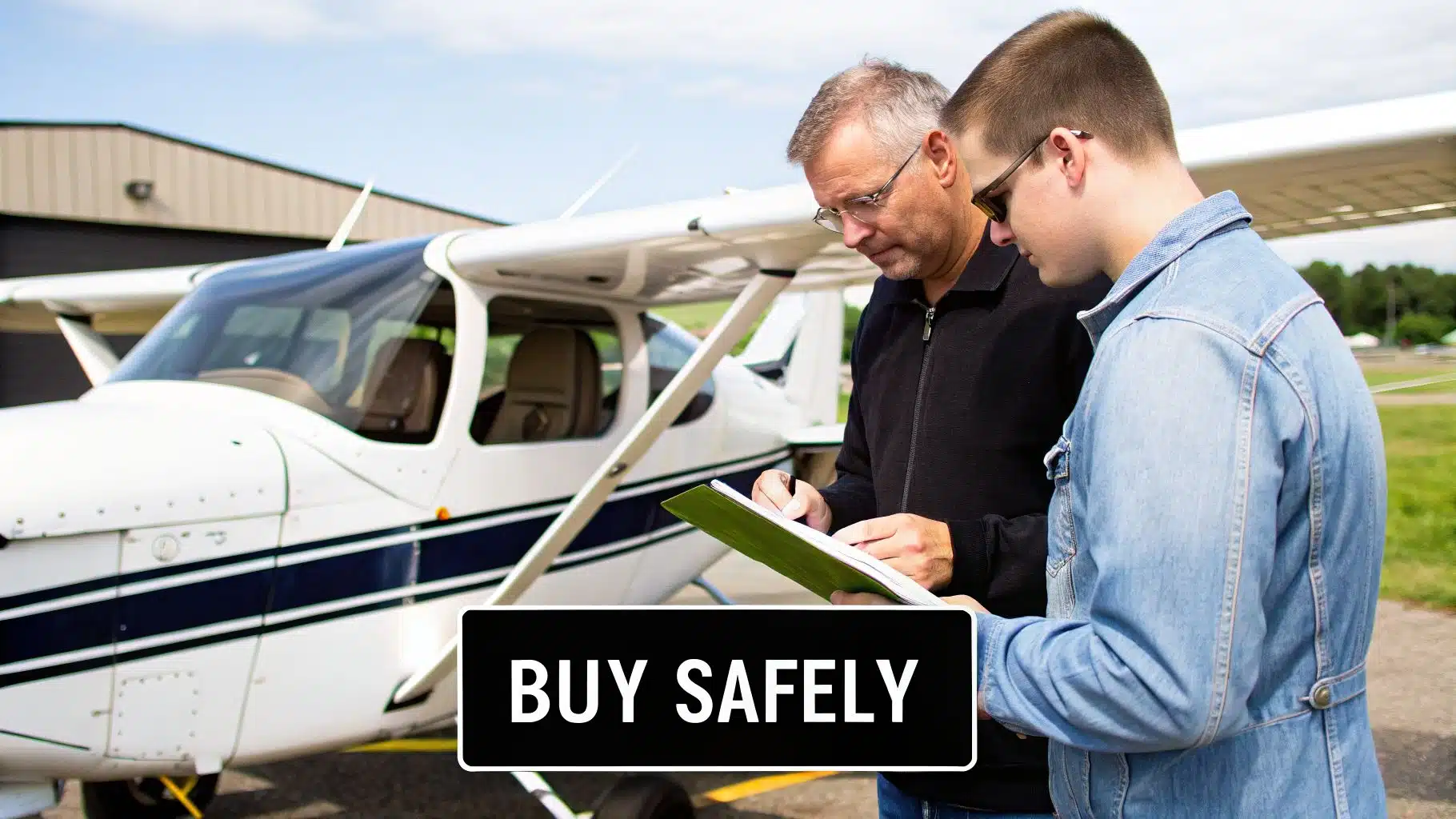
I’m going to say this as plainly as I can: no matter how perfect an aircraft looks or how much you trust the seller, a thorough pre-buy inspection is absolutely non-negotiable. This isn't a quick walkaround. It's a deep, invasive examination of the aircraft's health by an independent Airframe & Powerplant (A&P) mechanic you trust—preferably one who specializes in that exact make and model.
Think of a pre-buy inspection as a comprehensive medical physical for the airplane. It's your only real defense against buying a "hangar queen" that's hiding thousands of dollars in problems. Skipping it is, without a doubt, the most common and costly mistake a first-time buyer can make.
During the pre-buy, a good mechanic will comb through the logbooks, check for compliance with all Airworthiness Directives (ADs), run a compression test on the engine, and hunt for any hint of corrosion or hidden damage. The few hundred or thousand dollars you spend here could easily save you tens of thousands later.
Decoding Logbooks and Verifying Health
An aircraft's logbooks are its biography. Learning to read them is a skill you need to develop. You're looking for a complete, detailed history with no strange gaps or missing pages. Major damage history or sloppy, inconsistent entries are huge red flags.
Beyond the paper trail, the engine is the heart of the airplane—and its most expensive single component. Pay close attention to the Time Since Major Overhaul (TSMOH). A low-time engine overhauled by a well-known, reputable shop is worth its weight in gold.
Finally, think about the logistics of ownership. A partnership can slash the cost of entry, but you'll need a rock-solid legal agreement. Start getting insurance quotes early, too; you might be surprised how much rates can differ based on the aircraft and your own flight time. A smart, well-planned purchase is what ensures your dream of ownership actually gets off the ground.
Your Next Steps After Passing the Exam
First off, congratulations! Passing the FAA private pilot knowledge exam is a huge milestone, and you should be proud. All those hours spent studying regulations, weather charts, and aerodynamics have officially paid off.
So, what now? That passing score report isn't just a piece of paper; it's your ticket to the most exciting part of your training. Think of it as the official starting pistol for the final leg of your journey.
The 24-Month Clock Is Ticking
Your successful test report is valid for exactly 24 calendar months. This isn't an arbitrary deadline. It’s the FAA's way of ensuring your hard-earned knowledge is still fresh when you take your final practical test, better known as the checkride.
This two-year window is plenty of time to complete your flight training, master the required maneuvers, and ace your oral and practical exams to finally get that pilot’s license in your hands.
What Awaits You With Your License
With that brand-new pilot certificate, a world of freedom and adventure truly opens up. Imagine taking friends on a sightseeing flight over the city or renting one of our Piper Cherokees for a weekend trip. That’s the kind of freedom flying gives you, and you're so close to it.
Your Private Pilot License is also the essential first step for any other aviation goal you might have. It's the foundation you'll build on for an Instrument Rating or a Commercial License if you're dreaming of a career in the cockpit. To see the full roadmap, check out our guide on how to get a pilot's license.
From Knowledge to Skill
The written exam proved you know the material. Now it’s time to prove you can fly. The upcoming flight lessons are where you'll translate that textbook knowledge into real-world skill and pilot-in-command confidence.
Passing the written exam shows you can be a student of aviation. The next phase is about becoming a pilot. This is where you learn to feel the aircraft, make real-time decisions, and earn the confidence that only comes from experience in the air.
The most exciting part of your journey is still ahead. There’s no better way to celebrate this achievement than by getting back in the cockpit. Book a flight with DuBois Aviation, feel the controls in your hands, and take the next real step on your incredible journey.
Frequently Asked Questions
Even with the best study plan, it's natural to have a few questions about the FAA private pilot knowledge exam. Let's clear up some of the most common ones we hear from students here at DuBois Aviation.
What Happens If I Fail the FAA Knowledge Exam?
First off, don't panic. It happens, and it’s not the end of your dream to fly—it's just a small bump in the road. If you don't score the required 70% to pass, the process is straightforward.
You'll get a test report showing the specific areas you struggled with. You’ll then sit down with a certified instructor to review those topics. Once your instructor feels you have a solid grasp of the material, they'll give you a new endorsement, and you can schedule a retake. Think of it as a chance to reinforce what you know and go into your checkride even stronger.
Do I Need to Pass the Exam Before I Start Flying?
Absolutely not. In fact, we find that most students benefit from learning on the ground and in the air at the same time. The hands-on experience from your flight lessons makes the book knowledge "click."
For instance, trying to memorize airspace rules from a chart can feel abstract. But once you've actually flown through that airspace with an instructor, the concepts suddenly make perfect, practical sense. We usually advise students to take the written exam right around the time they're getting ready for their first solo flight, since passing it is a requirement before you can fly alone.
How Long Is My Knowledge Test Result Valid For?
Once you pass, your test report is good for 24 calendar months. That gives you a two-year window to complete your practical test (the checkride). If you don't finish your checkride within that timeframe, your knowledge test results expire. You’ll just have to pass the exam again before you can earn your pilot certificate.
What Should I Bring to the Testing Center?
Keep it simple. On test day, all you need is a valid government-issued photo ID (like a driver's license) and the signed testing endorsement from your instructor. The testing center handles the rest.
You won't be allowed to bring any personal items into the testing room. They will provide scrap paper, a pencil, and an approved flight computer (like an E6B) and plotter for you to use during the exam.
Ready to move from the study guide to the pilot's seat? At DuBois Aviation, we're here to provide the one-on-one ground school, expert flight instruction, and real-world training you need to become a safe, confident pilot. Learn more about how we can help you get started at https://duboisaviation.com.