A lot of future pilots sit in the same place before they ever touch a yoke. They look up when a piston airplane passes overhead, wonder what it would feel like to turn final themselves, and assume flying small plane is either too complicated, too expensive, or too far out of reach.
That’s usually not the primary problem. The underlying problem is that aviation gets presented in fragments. One article talks about a discovery flight. Another talks about ratings. Another talks about buying an airplane. Almost none of them connect the full journey in a way that helps you decide what to do next.
The path is more practical than many believe. You start by confirming that you like being in a light aircraft. Then you build skills in a structured way. After that, you decide whether flying stays a serious hobby, becomes a career track, or turns into ownership. The details matter, especially where you train, what aircraft you use, and how early you learn to operate in a real airport environment.
From Dream to Discovery Flight Your First Step Into the Blue
Many do not need a long speech about why flying is interesting. They already know. What they need is a first step that replaces guessing with experience.
A discovery flight does exactly that. You show up, meet an instructor, walk around the aircraft, and start learning before the engine even turns. You’ll usually get a basic preflight briefing, hear how the controls work, and learn what to expect during taxi, takeoff, and the first few turns in the air.

That first flight matters because it answers the questions people rarely say out loud. Do you like the feel of a small aircraft? Does the radio work excite you or overwhelm you? Can you picture yourself coming back next week?
What the first flight tells you
A good intro lesson isn’t a sightseeing ride dressed up as training. It gives you a realistic sample of the process.
You’ll learn things like:
- How the cockpit feels: Small training airplanes are simple, compact, and busy. That’s part of the appeal.
- What control inputs do: Even a gentle turn teaches more than hours of online videos.
- How much aviation is procedural: Checklists, communication, and sequencing start immediately.
- Whether the environment fits you: Some people fall in love with towered-airport structure on day one. Others need a lesson or two to settle in.
Small airplanes are not a niche toy. There are approximately 350,000 small airplanes worldwide, with more than half, around 175,000, based in the U.S., and small airplanes can use over 9,200 airports in the U.S. and Europe, compared with about 500 airports globally for large transport airplanes, according to the FAA’s small airplane overview.
Flying usually becomes real for a student on the taxi out, not at takeoff. That’s when they realize they’re participating, not watching.
If you’re at the point where curiosity has turned into action, an introductory flight lesson is the cleanest way to test the idea without committing to a full training schedule.
Your Private Pilot License Roadmap
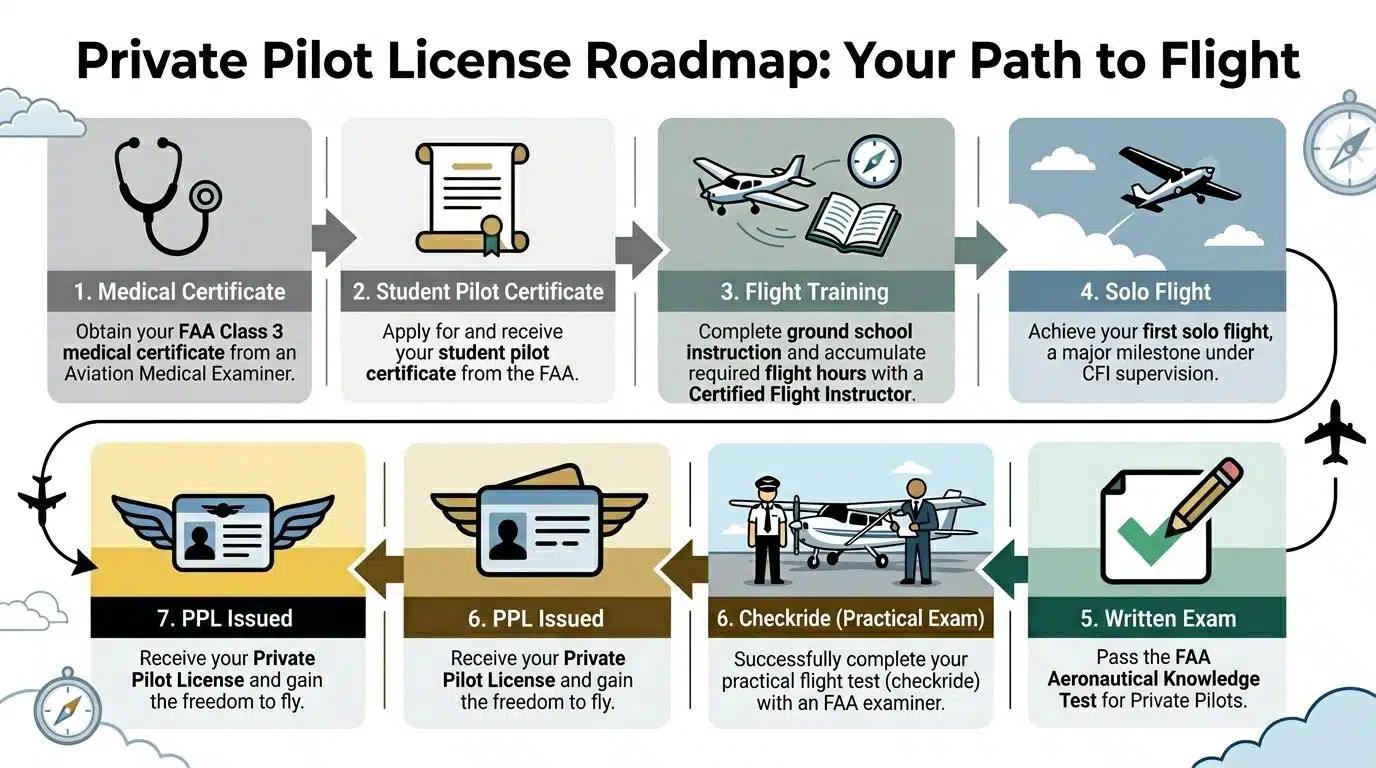
The private pilot license is where flying small plane stops being a dream and becomes a discipline. The people who progress well usually treat it like skill building, not entertainment. They show up prepared, study between lessons, and train often enough to keep each lesson connected to the last one.
Start with paperwork and structure
Before the memorable milestones come the administrative ones. You’ll need a student pilot certificate and an FAA medical that matches your training goals.
Then you begin two tracks at the same time:
- Ground knowledge
- Flight training
That’s how strong programs work. You don’t wait to “finish the book” before flying, and you don’t fly aimlessly without understanding what the airplane is doing.
If you’ve ever built internal training at work, the same principle applies in aviation. A good instructor doesn’t just pile on information. They develop a training curriculum that sequences skills, checks retention, and makes each lesson support the next one.
What you learn in the airplane
Private training starts with fundamentals. Taxi. Normal takeoffs. Climbs. Descents. Level turns. Then the lessons get more demanding.
You’ll work through:
- Slow flight: This teaches control feel near the lower end of the airplane’s operating envelope.
- Stalls: Not because anyone wants to stall in normal flight, but because pilots need to recognize and recover correctly.
- Steep turns: These expose sloppy coordination fast.
- Ground reference maneuvers: Wind correction becomes real when the airplane has to track a shape over the ground.
- Takeoffs and landings: The skill that looks simple from outside and takes the longest to refine.
A Piper Cherokee and a Cessna 150 both teach the same fundamentals, but they don’t teach them in the same way. Different sight pictures, control feel, and landing habits sharpen a student’s adaptability. That matters later when you rent, transition to more capable aircraft, or start looking at ownership.
Why towered-airport training changes your habits
Students who train only in quiet, non-towered environments can become good pilots. But students who learn early in a towered Class D airport pick up habits that carry forward well.
Flying into a towered airport like Chino requires mastering a five-step radio communication protocol, and for closed traffic, pilots need to coordinate with both ground and tower while clearly stating their intent to remain in the pattern. AOPA notes that mastering that sequencing directly supports progression and readiness for later transitions into more complex airspace in its article on towered airport traffic pattern operations.
The first solo
The first solo gets all the attention, and it should. It’s a real threshold. But students often misunderstand what it means.
A first solo does not mean you’ve mastered the airplane. It means your instructor has watched you enough times to trust your judgment, your checklists, your pattern work, and your ability to handle ordinary deviations safely.
Practical rule: If your preflight, taxi discipline, and radio work are inconsistent, your solo is not “almost here.” Solo comes after consistency, not after enthusiasm.
The strongest solo candidates tend to do a few things well:
- They brief each flight clearly: They know the lesson objective before engine start.
- They use checklists instead of memory theater: Confidence is not checklist replacement.
- They correct early: Good students don’t wait for a landing to become unsalvageable.
- They listen ahead of the airplane: They hear what the tower is likely to say before the call comes.
Written exam and practical test
At some point, your knowledge test needs to get done. Don’t let it drag. Students who postpone the written too long usually create unnecessary pressure near the end of training.
The checkride is different. It’s not one dramatic flight where an examiner tries to surprise you. It’s a structured evaluation of whether you operate safely, think clearly, and stay inside the standards while managing normal cockpit workload.
A simple roadmap helps:
| Stage | What matters most |
|---|---|
| Early lessons | Cockpit familiarity and discipline |
| Mid-training | Consistent maneuvers and pattern work |
| Pre-solo | Judgment, radio work, stable landings |
| Cross-country phase | Planning, navigation, and adaptability |
| Checkride prep | Accuracy, calmness, and decision making |
Cross-country time is where the license starts to feel useful. You plan a route, check weather, brief alternates, compute performance, and leave the local area with purpose. That’s also where students realize aviation rewards preparation every single time.
If you want a realistic sense of pacing, prerequisites, and how the training sequence fits together, this breakdown on how long to get private pilot license is worth reading before you book your first block of lessons.
Beyond Your First License Advanced Ratings and Career Pathways
A private license gives you access. Advanced ratings give you reach.
That reach can mean safer personal travel, more capable cross-country flying, or the start of a professional path. The right next step depends on what kind of pilot you want to become.
Instrument rating changes how you think
The instrument rating is not just “flying in clouds.” It’s a full upgrade in discipline.
You learn to trust instruments over sensation, manage approach setups, brief with precision, and stay organized when workload rises. Even pilots who mostly fly in visual conditions become sharper after instrument training because it forces better scan habits and better cockpit management.
Students are often surprised by how much instrument work improves basic flying. Altitude control tightens. Heading control tightens. Radio work becomes more deliberate. You stop improvising and start operating.
Commercial training requires precision
Commercial training doesn’t mean you’ll automatically fly for an airline. It means the FAA expects a higher standard of aircraft control, planning, and professionalism.
This phase is where many pilots start building serious time. Flights become less about “can I do it” and more about “can I do it accurately, repeatedly, and cleanly.”
For cross-country flights in small planes like Piper Cherokees, which have 4 to 6 hour ranges, pilots need to calculate fuel burn carefully, including 10 to 12 gallons per hour at cruise, and plan for 30 to 45 minutes of reserve fuel. Backroad Planet’s discussion of what most travelers do not understand about flying small planes is useful on this point, especially because instrument approaches and delays can stretch a flight in ways new pilots don’t always anticipate.
That planning mindset carries directly into commercial work. If your fuel thinking is casual, your commercial standards aren’t ready.
Multi-engine and helicopter pathways
Some pilots want more complexity. Multi-engine training gives you that, along with a much higher respect for systems, asymmetric throughst, and procedure discipline.
A twin like a Piper Apache is not just a faster single with one more engine. It requires sharper feet, better anticipation, and a stronger understanding of performance penalties when things go wrong.
Helicopter training attracts a different kind of student. Some come in with fixed-wing goals and want to branch out. Others start there because rotary-wing flying is what drew them to aviation in the first place. The learning curve is different, especially in hover work, but the same rule applies. Small improvements in consistency compound quickly.
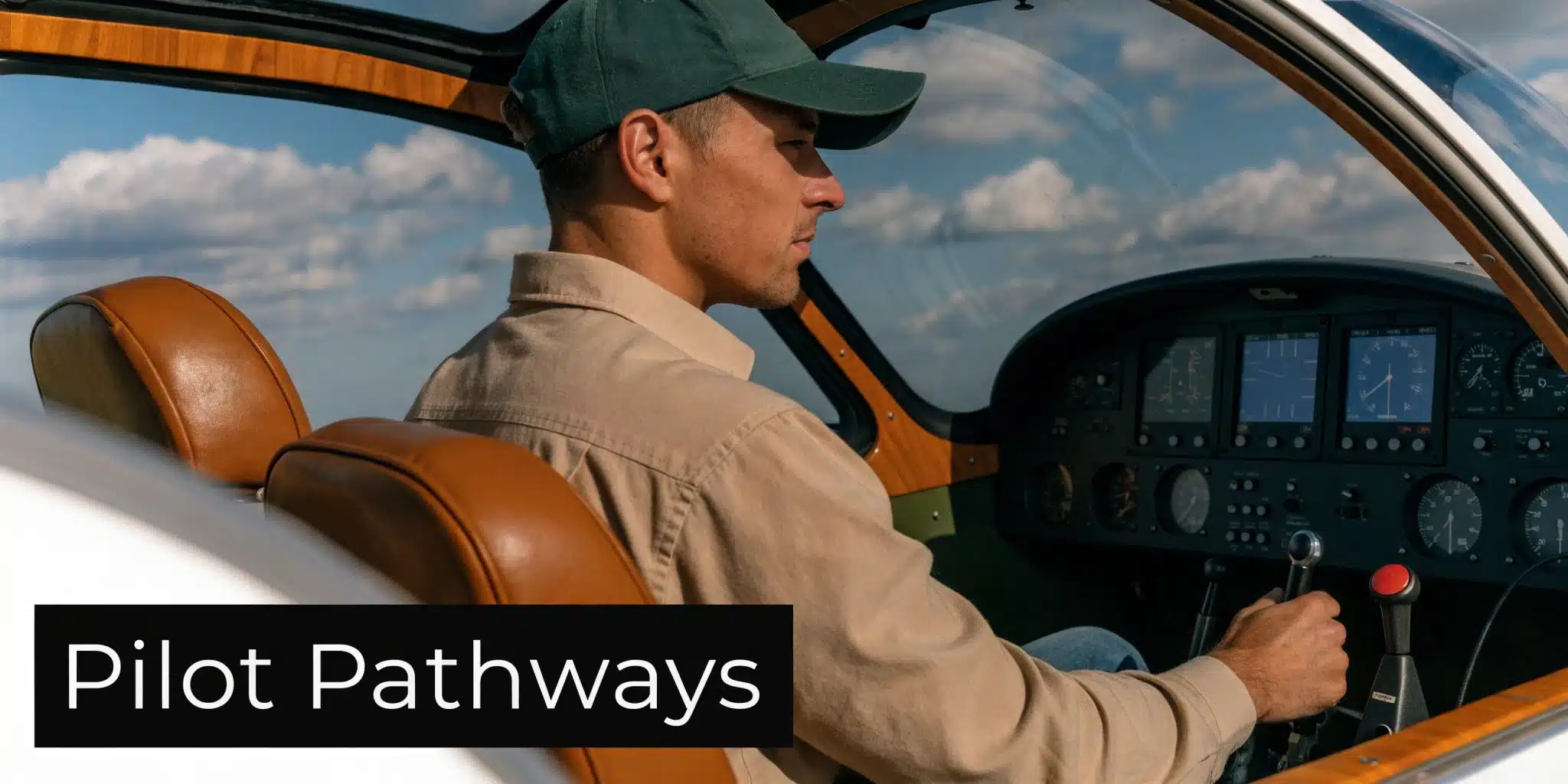
A cockpit view helps show what that progression feels like in practice.
Matching the rating to the goal
Not every pilot needs every rating. A simple way to think about it is this:
- Instrument rating: Better for pilots who want reliability, weather capability, and stronger procedures
- Commercial license: Necessary if flying will become compensated work
- Multi-engine rating: Valuable if your goals include more complex aircraft or specific career tracks
- Helicopter training: Best for pilots who want rotary-wing skills for personal or professional reasons
The wrong sequence usually comes from impatience. The right sequence comes from mission, money, and how often you’ll fly.
The pilots who progress well don’t chase ratings for status. They choose them because each one solves a real operational need.
The Ultimate Freedom Buying Your First Airplane or Helicopter
Ownership is where the romance of aviation collides with maintenance logs, mission discipline, and hard choices. That’s healthy. If you want to buy an airplane the safe way, emotion needs to stay in the back seat.
The first question is not, “What airplane do I like?” It’s, “What mission am I buying for?” A local time-building airplane, a family traveler, and a helicopter for specialized use are very different purchases.

Define the mission before the search
Most bad aircraft purchases start with a mismatch between mission and machine.
Ask yourself:
- How many people will I really carry
- Will I mostly fly local, regional, or cross-country
- Do I need simple and affordable, or do I think I need speed
- Can I handle tail-end ownership costs after the purchase closes
- Am I buying for personal travel, instruction, time-building, or business use
If your real mission is short local flights and skill building, a simple single-engine airplane often beats a more complicated aircraft that sits because it costs too much to operate.
How to buy an airplane the safe way
A safe purchase process is slower than an excited buyer wants and faster than a careless one deserves.
Use this sequence:
Set the mission in writing
If you can’t describe the airplane’s job in a few plain sentences, you’re not ready to shop.Screen the logs before traveling
Missing, disorganized, or suspicious records are reason enough to pause.Use a true pre-buy inspection
Not a casual look. Not a favor from a friend. A real inspection by someone who understands that make and model.Separate seller claims from verifiable facts
“Always hangared,” “runs great,” and “needs nothing” are not logbook entries.Budget for the first year accurately
New owners often focus on the purchase price and underweight immediate catch-up maintenance.
Buy the airplane you can operate consistently, not the one that impresses people on the ramp.
Used versus newer aircraft
A used airplane can be a smart buy. It can also become an expensive education if deferred maintenance is hiding behind fresh paint or a clean interior.
A newer aircraft may reduce some uncertainty, but it doesn’t remove the need for inspection discipline. Ownership is never just acquisition. It’s support, maintenance planning, and recurrent training.
A simple comparison helps:
| Question | Lean simpler used aircraft | Lean newer or more equipped aircraft |
|---|---|---|
| Main goal | Affordable access and time | Capability and convenience |
| Risk | Hidden maintenance history | Higher financial exposure |
| Best buyer mindset | Patient and detail-oriented | Well-capitalized and mission-specific |
Buying a helicopter requires even tighter discipline
Helicopter buyers need to be even more conservative. Maintenance history, component status, and operational mission matter a lot. A buyer who is solid on fixed-wing purchases can still get surprised in rotorcraft if they assume the process translates directly.
The smart move is to involve people who know the category you’re buying. That includes instructors, mechanics, and operators with actual time in that model.
If you’re still narrowing the kind of aircraft that fits your use, this comparison of the Piper Cherokee vs Cessna 172 is a helpful place to start. It gets you thinking in terms of mission and handling rather than image.
Partnership ownership also deserves serious consideration. Sharing costs and scheduling can work well if the agreement is clear, expectations are written down, and all partners treat maintenance decisions conservatively.
Decoding the Investment Costs and Timelines for Flight Training
People ask two questions early. How long will this take, and what will it cost? The direct answer is that both depend less on raw motivation and more on consistency.
Flight training gets expensive when momentum breaks. If you fly infrequently, each lesson starts with review. That review is useful, but it isn’t free. If you train steadily, your money buys forward progress more often.
Where the money goes
Even when a student talks about “paying for a license,” the spending is spread across several buckets:
- Aircraft rental: You’re paying for access to the airplane itself.
- Instructor time: Briefing, debriefing, and dual instruction are where many breakthroughs happen.
- Ground school materials: Good materials save time in the airplane.
- Exam and evaluator costs: Written testing and the practical exam are separate events.
- Supplies and headset: Small items add up, but they support easier training.
The biggest mistake is budgeting only for flight time and forgetting the rest. The second biggest mistake is treating training like a casual hobby while expecting efficient completion.
Time is a training tool
Pilots often compare “accelerated” and “flexible” training as if one is serious and the other is not. That misses the point. The right schedule is the one you can sustain.
A full-time student can move fast because recency stays high. A working adult can also succeed on a part-time plan if lessons are protected on the calendar and study happens between flights. Here, scheduling matters more than marketing language. You need a rhythm that lets you retain procedures, radio phrasing, and sight pictures from lesson to lesson.
The trade-off most students discover late
Training faster can reduce wasted review time, but only if your preparation keeps up. Training more slowly can fit life better, but only if long gaps don’t become the norm.
Here’s a simple way to approach it:
| Training pace | Main advantage | Main risk |
|---|---|---|
| Frequent lessons | Better continuity | Burnout if study doesn’t keep pace |
| Moderate weekly plan | Sustainable for many adults | Progress can stall after interruptions |
| Irregular schedule | Flexible short term | Relearning becomes expensive |
One option some students use is DuBois Aviation, which offers one-on-one instruction, an in-house simulator, and seven-day scheduling at KCNO. That kind of setup can help if your main obstacle is fitting aviation around a work or school schedule rather than finding motivation.
The cheapest lesson is usually the one you’re prepared for. The most expensive one is the repeat.
Timelines also shift with weather, aircraft availability, instructor continuity, and how quickly you finish the written exam. Students who take ownership of the ground side almost always move more efficiently than students who wait to be spoon-fed every concept.
Choosing Your Co-Pilot Why Your Flight School Matters
A flight school shapes more than your schedule. It shapes your habits.
The wrong school can still get you to a certificate, but it may leave you weak in radio work, weather judgment, aircraft familiarity, or self-briefing. The right school builds a pilot who can keep learning after the temporary certificate is printed.
What to evaluate before you commit
Most students look first at price or proximity. Both matter. Neither should decide the whole choice.
Look harder at these factors:
- Instructor depth: You want instructors who can teach your current rating and your next one.
- Fleet variety: Different aircraft expose you to different handling and planning demands.
- Maintenance culture: A clean airplane means little if paperwork and standards are sloppy.
- Airport environment: A busy towered field teaches sequencing, patience, and radio discipline.
- Scheduling reliability: If booking is chaotic, progress usually is too.
A school that can take you from private to instrument to commercial creates continuity. That continuity matters because instructors can connect your current weakness to your next training goal.
Weather judgment is part of the school’s culture
The legal minimums are not the same as good training conditions. That distinction separates schools that produce thoughtful pilots from schools that launch because the rule book permits it.
For Class D airspace like Chino, the minimum VFR weather is 3 statute miles visibility with specified cloud clearances, but the FAA also emphasizes that structures and terrain in traffic pattern areas become the greatest hazard when weather is near those legal minimums. That point is explained well in this review of Class D weather minimums and risk management.
That matters because students often assume legality equals comfort margin. It doesn’t.
Signs the training environment is doing its job
You can often tell within a few visits whether a school is building real pilots.
Good signs include:
- Students brief before flights instead of wandering to the airplane
- Instructors ask “why” questions, not just “did you memorize this”
- Aircraft dispatch feels organized
- People talk openly about go/no-go decisions
- Radio discipline and checklist use are visible on the ramp
Poor signs are usually obvious too. Lessons start late for vague reasons. Debriefs are rushed. The airplane changes every time because scheduling is unstable. Students know maneuvers by name but not by purpose.
A school’s culture shows up in the details. You can hear it on the radio and see it in the preflight.
Why the environment at KCNO matters
Training at a towered Class D field with multiple runways and instrument approaches gives students a more realistic operating picture from the beginning. You learn to wait your turn, copy instructions accurately, taxi with intent, and stay ahead of the airplane.
That doesn’t make the training easy. It makes it useful.
For pilots who want to continue into instrument, commercial, multi-engine, helicopter training, rentals, or guided flying later on, the school needs to support a longer relationship with aviation, not just a quick certificate. That’s what aspiring pilots should be looking for when they compare options.
Frequently Asked Questions About Learning to Fly
Do I need to know a lot about airplanes before I start
No. You need curiosity, coachability, and the willingness to study. Aviation knowledge builds step by step. What matters early is that you show up ready to learn and accept correction.
Is flying small plane harder than people expect
Some parts are easier than people expect. Some are harder. The controls make sense quickly. Judgment takes longer.
Landing, radio work, and weather decision-making usually require more repetition than beginners assume. That’s normal.
Can I wear glasses and still become a pilot
Many pilots do. The practical question isn’t whether you wear glasses. It’s whether you can meet the medical standards that apply to the kind of flying you want to do.
An Aviation Medical Examiner handles that part. If you have concerns, sort them out early rather than after investing heavily in training.
Should I train in airplanes, helicopters, or both
Start with your goal. If you want fixed-wing travel, ratings, rentals, or a path that may lead toward commercial airplane work, begin there. If rotary-wing flying is what interests you most, train in helicopters.
Trying both can be useful, but splitting focus too early sometimes slows progress.
When should I think about buying instead of renting
Usually after you’ve flown enough to understand your mission. New students often imagine ownership before they know what kind of flying they’ll really do.
Rent first if you need experience. Buy when the mission, budget, and usage pattern are clear.
Has training in small aircraft become safer and more practical over time
Yes. Modern general aviation is the product of more than a century of development. The Wright Brothers’ first powered flight on December 17, 1903 covered 120 feet in 12 seconds, and today’s training aircraft reflect major safety and performance improvements, as described in this overview of aviation history month facts.
What makes a student progress faster
Three things usually matter most:
- Frequency: Lessons close together improve retention.
- Preparation: Reading and chair-flying reduce wasted aircraft time.
- Debriefs: Students improve fastest when they accept what still needs work.
If you keep those three in place, the whole process becomes simpler.
If you’re ready to turn interest into action, DuBois Aviation is one place to start with discovery flights, airplane and helicopter training, rentals, and a path that can continue well beyond your first certificate.