
You’ve got your Commercial Pilot Certificate. The temporary certificate is still crisp, your logbook finally looks substantial, and people start asking the same question: “So what’s next?”
That question sounds simple. It rarely feels simple when you’re the one answering it.
Most commercial pilots hit the same crossroads. You can keep renting and piecing together hours one flight at a time. You can chase odd ferry opportunities. You can look at banner tow, survey, pipeline, or sightseeing work. Or you can choose the path that teaches you more than any other early-career job in aviation: becoming an instructor.
Two practical options worth comparing
These are specific products pilots commonly compare for this type of flying. Confirm compatibility with your aircraft and instructor before ordering.
 Premium ANR headsetLightspeed Zulu 4 ANR Aviation Headset - Dual GA PlugCheck current availability on Amazon (paid link)
 Premium headsetBose A30 Bluetooth Aviation Headset - Dual PlugCheck current availability on Amazon (paid link)
There’s a second thought that often shows up around the same time. If you’re serious about flying a lot, should you buy an airplane or helicopter instead of renting? Sometimes the answer is yes. Sometimes it’s absolutely not. The smart move depends on your mission, your budget, and whether ownership helps your training rather than distracting from it.
I’ve watched a lot of promising commercial pilots stand in this exact spot. The ones who progress well usually do two things. First, they stop thinking of the flight instructor training program as just another rating. They treat it like a professional reset, where they learn to teach, brief, analyze mistakes, and fly with discipline from the right seat. Second, they get more strategic about the machines they fly, rent, buy, or eventually sell.
That combination matters. If you understand instruction, you become a sharper pilot. If you understand aircraft ownership, you make better financial and safety decisions. Put those together, and your next few years in aviation become much easier to plan.
The Commercial Pilot Crossroads What Comes Next
A new commercial pilot at a busy airport usually looks confident on the ramp and uncertain in private.
One pilot I mentored had done everything right. He’d earned the ratings, flown hard, studied seriously, and started sending out applications for time-building jobs. What he found was familiar. Some operators wanted more experience. Some wanted specialized experience. Some wanted availability that didn’t fit his current life.
That’s when the substantive conversation started.
Why instructing changes your trajectory
Teaching is the move that gives many commercial pilots three things at once:
- Flight time: You keep flying regularly instead of waiting for rare opportunities.
- Income: You begin getting paid for aviation work, even if the early stage is modest.
- Skill growth: You stop hiding behind “good enough” understanding because students expose every weak spot.
When you teach steep turns, stalls, landings, and navigation to someone else, you don’t get to bluff. If your explanation is fuzzy, your student feels it right away. If your procedures are sloppy, they’ll copy them.
That’s why instructing is more than a bridge job. It can be the period that turns a commercial pilot into a professional aviator.
Where ownership enters the picture
At the same time, some pilots start thinking about buying. Maybe they’re tired of schedule conflicts. Maybe they want a machine available for personal trips, time building, or advanced training. Maybe they see ownership as part of a longer-term business plan.
That can be a smart move. It can also become an expensive distraction if you buy the wrong aircraft, skip due diligence, or underestimate maintenance realities.
A pilot who can explain lift, drag, weather, and risk clearly is easier to trust. The same is true of a pilot who can read an aircraft logbook before signing a purchase agreement.
The strongest career moves often look connected in hindsight. Instructor training builds judgment. Good judgment helps you buy well, sell well, and avoid bad shortcuts.
Understanding the Flight Instructor Path
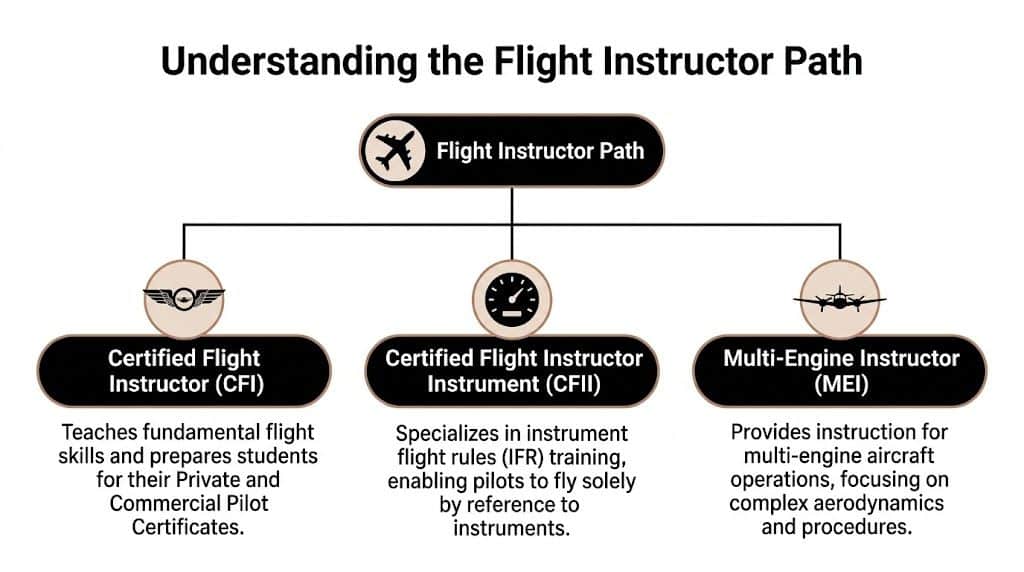
Most pilots say “CFI” as if it’s one thing. In practice, the instructor path has layers, and each one expands what you can teach.
The three core instructor ratings
| Rating | What you teach | Why it matters |
|---|---|---|
| CFI | Primary and commercial flight skills | This is the foundation. You teach core stick-and-rudder work, airspace, procedures, landings, and basic judgment. |
| CFII | Instrument flying | You teach pilots how to operate by reference to instruments, manage approaches, and think ahead in the system. |
| MEI | Multi-engine operations | You teach in twin-engine aircraft, where systems knowledge and asymmetric flight issues become more demanding. |
A plain-language way to think about it is this:
CFI teaches a person how to fly well.
CFII teaches a person how to fly precisely when outside visual references disappear.
MEI teaches a person how to handle more complexity, more performance, and more consequence.
Why so many commercial pilots start here
For many professional pilots, the instructor route is the most practical way to keep building experience toward airline minimums. It’s steady, relevant flying. More important, it builds habits that transfer well to later jobs: checklist discipline, clear communication, and situational awareness.
There’s also a real industry need. Just 18% of the U.S. pilot population holds CFI certificates, and a study drawing on collegiate aviation data noted retention and cost challenges, with over 43% of instructors leaving within one year in surveyed programs, which helps explain why schools keep needing new instructors (ERAU research summary and underlying data).
That shortage affects students directly. Fewer instructors means slower progress, harder scheduling, and bottlenecks in training pipelines.
The path isn’t only about ratings
A good instructor candidate also learns how pilot training levels fit together. If you want a quick reference for where CFI sits in the broader progression from private through advanced certificates, this overview of pilot license levels is useful.
Practical rule: Don’t chase CFII or MEI to avoid mastering the base CFI. If you can’t teach turns around a point, slow flight, or traffic pattern judgment clearly, the advanced ratings won’t fix that.
The best instructors I know didn’t rush through the first step. They built a teaching foundation first, then added instrument and multi-engine instruction as natural extensions.
Your CFI Training Curriculum and Prerequisites
The FAA doesn’t hand out instructor certificates because you’re a good pilot. It expects proof that you can teach safely and accurately.
What you need before training gets serious
At the entry point, the checklist is straightforward and mandatory.
- Commercial certificate: You need a Commercial Pilot Certificate.
- Instrument rating: You need instrument privileges before qualifying for the airplane instructor path.
- Flight time: Under 14 CFR §61.183, you need at least 250 total flight hours under Part 61 requirements. The same source notes that insufficient total time is correlated with a 40% higher checkride failure rate because candidates haven’t fully mastered advanced commercial maneuvers (CFI Bootcamp summary of requirements).
- Medical: You need a valid medical that supports your planned instructional activity.
That list looks simple on paper. Where people get tripped up is assuming the prerequisites are the hard part. They aren’t. The hard part is turning piloting knowledge into teachable knowledge.
What ground training actually covers
The initial flight instructor training program usually has two academic pillars.
Fundamentals of Instructing
FOI is where many commercial pilots get impatient. That’s a mistake.
This subject area covers how people learn, how they forget, why stress changes performance, how to critique, and how to structure a lesson so the student leaves better than they arrived. It sounds less exciting than takeoffs and chandelles. It’s not less important.
A pilot may know how to recover from a stall. An instructor has to know how to explain the cues before the stall, spot the student’s delayed response, and coach recovery without turning the lesson into a startle event.
Technical subject areas
The second pillar is the flying and regulatory material you’ll teach. Under FAA Part 141 minimums for initial CFI training, approved programs require 40 hours of ground training and 25 hours of flight training for the initial certificate, covering FOI, technical subject areas, instructional responsibilities, and required maneuver work (Regal Air Part 141 CFI summary).
For pilots who want a sense of how structured training is built, it helps to study how schools develop training curriculum. The language is broader than aviation, but the logic applies well to lesson sequencing, standards, and evaluation.
What flight training feels like from the right seat
In the airplane, your job changes. You’re not polishing your own maneuvers for style points. You’re learning to demonstrate, narrate, observe, and intervene.
That includes:
- Right-seat proficiency: Landings and maneuvers often feel strangely familiar and slightly wrong at first.
- Spin awareness and recovery: You need both technical understanding and calm presentation.
- Scenario teaching: You explain not just what to do, but why, when, and what can go wrong.
A structured school environment can help candidates keep all of that organized. For pilots comparing formats, this overview of Part 141 flight school training gives a useful reference point.
A short visual overview can help before you start building your own lesson binders:
Mastering the CFI Checkride and Oral Exam
The initial instructor practical test has a reputation for a reason. First-time pass rates for the initial CFI practical test average around 50% nationally, according to TakeFlightOC’s discussion of instructor training outcomes and common preparation gaps (TakeFlightOC on CFI pass rates and training weaknesses).
That number scares people. It should also focus them.
Why the checkride feels so different
Most checkrides test whether you can perform to standard. The CFI checkride tests whether you can teach to standard.
The examiner isn’t looking for a pilot who can fly a lazy eight or explain weather theory from memory. The examiner wants to see whether you can present a topic in order, explain common errors, connect the lesson to safety, and adjust when the “student” doesn’t understand right away.
That changes the whole game.
A weak CFI candidate usually sounds like this:
- They recite definitions but can’t teach from first principles.
- They know the maneuver but haven’t thought through common student errors.
- They talk too much in the airplane and don’t prioritize safety.
- Their lesson plans look downloaded rather than understood.
The oral exam rewards structure
The oral often feels long because it isn’t a trivia contest. It’s a teaching demonstration across many subjects.
A good way to prepare is to build your own lesson plan binder with a repeatable pattern. For each lesson, include:
- Objective
- Equipment or references
- Key teaching points
- Common mistakes
- Risk management concerns
- Completion standards
That format won’t magically pass the oral for you. It does force clarity.
Build lesson plans you can teach from under stress, not lesson plans that look pretty in a binder.
The flight portion is still a teaching test
In the airplane, candidates often overfocus on precision and underfocus on instruction. The examiner cares about both, but the right-seat teaching role is what makes this checkride unique.
You need to demonstrate and narrate. You also need to know when to stop narrating and fly.
If the examiner simulates a weak student, your correction should sound calm and specific. “Lower the nose slightly to reduce the angle of attack” helps. “Don’t do that” doesn’t.
The pilots who pass usually prepare the same way they’ll eventually teach. They brief clearly, they organize material well, and they practice out loud instead of only reading.
A Pilot's Guide to Buying an Airplane Safely
Aircraft ownership can support training, travel, time building, or business use. It can also create maintenance surprises, paperwork headaches, and bad financial pressure if you buy for the wrong reasons.
The safe way to buy starts with discipline, not enthusiasm.

Start with mission, not make and model
Pilots often shop backward. They fall in love with a type, then invent a mission to justify it.
Do the reverse.
Ask yourself:
- Training mission: Will this aircraft support instrument work, commercial prep, or regular local flying?
- Travel mission: Do you need useful load, cabin space, range, or speed?
- Ownership style: Will you fly enough to justify fixed costs, or would rental still make more sense?
- Helicopter versus airplane: Are you buying for utility, training continuity, recreation, or a business purpose?
If your real mission is economical local flying and occasional short cross-countries, buying a more complex aircraft “for the future” can backfire. Complexity raises training demands, maintenance exposure, and insurance friction.
Build a realistic ownership budget
The purchase price is only the opening move.
You also need to think through hangar or tie-down, insurance, inspections, routine maintenance, unscheduled maintenance, database subscriptions if applicable, and downtime. Don’t force a budget that leaves no room for surprises. Airplanes and helicopters don’t care what your spreadsheet hoped would happen.
A good rule is to leave emotional room as well as financial room. If one unexpected repair would make you afraid to fly the aircraft, the purchase may be too aggressive for your current stage.
The pre-buy inspection is where smart buyers separate themselves
Never skip a proper pre-purchase inspection.
And don’t let the seller choose the mechanic for you.
What a pre-buy should answer
A trusted A&P should help you determine:
| Area | What you’re looking for |
|---|---|
| Airframe | Signs of corrosion, damage history, poor repairs, or deferred issues |
| Engine | Overall condition, maintenance patterns, leaks, and signs that a bigger expense may be ahead |
| Avionics and systems | What works, what doesn’t, and what would need immediate attention |
| Documentation | Whether the logs support the physical condition and legal status of the aircraft |
The point isn’t to find a perfect aircraft. The point is to find one whose condition matches the story being told.
Read the logbooks like a future owner
Logbooks tell you how the aircraft has been treated.
Look for consistency. Look for gaps. Look for recurring squawks. Look for evidence that required work was tracked and completed properly. If the logs are disorganized, incomplete, or oddly vague, slow down.
If you can’t explain the maintenance story of the aircraft to another pilot in plain language, you’re not ready to buy it.
You also want to confirm title status, registration details, and whether any financing or ownership complications could affect the transfer. Use a reputable escrow and title process when the transaction calls for it. Clean paperwork protects both sides.
Know when not to buy
Walking away is part of buying safely.
Walk if the seller pressures you to move before inspection. Walk if the logs don’t line up. Walk if the airplane keeps getting described with adjectives instead of records. Walk if you’re trying to solve a career problem with an ownership decision that doesn’t make operational sense.
A well-bought aircraft can be a useful tool. A badly bought one can turn flying into constant damage control.
How to Sell Your Aircraft for Maximum Value
Selling an aircraft well is less about hype and more about reducing buyer doubt.
Most buyers are cautious for good reason. They know surprises are expensive. Your job as the seller is to make the aircraft easy to evaluate, easy to trust, and easy to close.
Presentation starts with records
Before you write an ad, organize the paperwork.
A serious buyer wants a clean picture of the aircraft’s history. That means complete logbooks, clear maintenance entries, documentation of major work, and a straightforward explanation of any known blemishes or recent issues. If you’ve converted records into digital form for sharing, make them easy to access.
Disorganized records make buyers assume there are deeper problems even when the aircraft itself is sound.
Fix the obvious friction points
You don’t need to restore the aircraft to museum condition. You do need to remove avoidable objections.
Focus first on items that make the aircraft look neglected rather than used. Interior presentation, exterior cleanliness, expired minor items, and small unresolved discrepancies can drag down buyer confidence. Deferred maintenance that seems minor to you often feels like a warning sign to the next owner.
A detailed aircraft also photographs better, shows better, and signals care.
Price like an adult, not a dreamer
Many sellers damage their own outcome by choosing a price emotionally.
Use accepted market references such as VREF or Bluebook to inform your asking range, then adjust based on equipment, maintenance status, cosmetic condition, and the strength of your records. The goal isn’t to prove what the aircraft means to you. The goal is to place it where qualified buyers will engage.
If you overprice early, the listing can sit. Once buyers see stale time on market, they start assuming something is wrong.
A practical pricing mindset
- Price from comparables: Use current market listings carefully, but don’t treat every asking price as a true value signal.
- Account for records quality: Strong logs and a clean maintenance story can support confidence.
- Be honest about upgrades: Not every panel change or cosmetic improvement returns dollar for dollar.
- Stay negotiable without sounding desperate: Confidence helps. Rigidity doesn’t.
Market the aircraft like a professional transaction
A good listing needs clear photos, plain language, and no mystery.
Buyers want to know the aircraft’s identity, equipment, maintenance status, mission fit, and anything unusual. Avoid fluffy language. “Always hangared” and “well cared for” don’t mean much without supporting records and a clean visual presentation.
When inquiries arrive, respond quickly and clearly. Have a standard package ready that includes photos, equipment details, and documentation you’re comfortable sharing early in the process.
Buyers don’t pay more because a seller sounds enthusiastic. They pay when the aircraft looks trustworthy and the transaction feels manageable.
Close the sale carefully
Use a purchase agreement that states expectations clearly. Decide how deposits, inspections, acceptance, and closing will work before emotions rise. For higher-value transactions, escrow and title support are usually worth using.
Most sale problems don’t come from bad intentions. They come from assumptions. Spell out the process, document everything, and keep the tone professional.
That’s how you protect value and keep the handoff smooth.
Training at DuBois Aviation Your Partner in Success

You finish a commercial flight, shut down, and realize the next phase is different. Flying well is no longer enough. You now have to explain, demonstrate, correct, and stay ahead of another pilot’s mistakes without losing the bigger picture. That shift is what good CFI training is built to teach.
The training environment matters because it shapes your habits. A pilot who learns to instruct only in simple conditions can still pass a checkride, but may feel behind when a student freezes on the radios, drifts off altitude, or misses a checklist item in busy traffic. At Chino Airport, students train in a towered Class D setting with multiple runways and instrument traffic. That gives you regular practice staying organized while the workload rises.
If you are comparing schools, this overview of a Chino Airport flight school helps you understand the local operating environment.
Structure matters too, especially during initial CFI training. You are not just reviewing commercial maneuvers. You are building lesson plans, learning how to teach FOI material, shifting to the right seat, and practicing clear demonstration standards. A school with an organized syllabus and regular progress checks usually makes that workload easier to manage because each lesson has a place, and each weakness gets addressed before it spreads into the next phase.
That is the primary value of a program. It keeps your training from turning into a pile of disconnected tasks.
At DuBois Aviation, that structure is supported by a varied fleet that includes Piper Cherokees, a Cessna 150, a Mooney M20B, a Piper Apache, and Robinson and Enstrom helicopters. Jeppesen materials, an in-house simulator, and one-on-one instruction from CFI, CFII, and MEI staff at KCNO give you more than one way to practice the same teaching problem until it clicks.
That variety helps in a second way. An instructor who has seen different aircraft systems, cockpit layouts, and performance profiles usually develops better judgment. The same judgment helps when you start thinking beyond instructing alone. Many ambitious pilots use the CFI certificate to build time and income while also learning enough about aircraft condition, records, and mission fit to make smarter ownership decisions later. If buying your first airplane is on your radar, training around multiple aircraft types gives you a more practical eye for what you are paying for.
Scheduling discipline also matters more than many pilots expect. A good class booking system can help keep lessons, study blocks, and progress reviews consistent, which is often the difference between steady improvement and having to relearn material after long gaps.
Choose a school the way you would choose an airplane for a serious mission. Look at the operating environment, the training flow, the fleet, the instructors, and how well the program supports the pilot you plan to become next.
Frequently Asked Questions for Aspiring Instructors and Owners
Is Part 61 or Part 141 better for a flight instructor training program
Neither is automatically better for everyone.
Part 141 is usually a better fit for pilots who want a defined syllabus, stage checks, and an organized progression. Part 61 can work well for self-directed pilots who need flexibility and already know how to keep themselves on a tight study and flight rhythm.
If you tend to perform better when someone has already built the sequence, Part 141 often feels cleaner. If your work schedule changes constantly, Part 61 may be easier to live with.
How long will CFI training take me
The honest answer is that it depends on your schedule, preparation, instructor availability, and how ready you are to teach rather than just fly.
Pilots who arrive with strong commercial-level proficiency, current knowledge, and disciplined study habits move much faster than pilots who are relearning old material while trying to build lesson plans at the same time. Consistency beats intensity. Three well-prepared training touchpoints a week usually outperform random bursts of effort.
What should I expect to spend
Use caution here. Costs vary widely by aircraft, instructor time, local rates, and how much retraining you need.
What matters most is your efficiency. A pilot who shows up prepared with completed lesson plans, current knowledge test results, and strong right-seat chair flying usually spends less than a pilot who “figures it out as they go.” Budget for both flight and ground. Underbudgeting ground time is one of the most common planning mistakes.
Should I buy an older aircraft to build time
Sometimes. But only if the aircraft matches your mission and you’ve got the cash discipline to support ownership properly.
An older airplane can make sense when the logs are solid, the inspection story is clean, and your use case is consistent. It makes less sense when you’re buying because you’re frustrated with scheduling or because someone online made ownership sound automatically cheaper than renting.
Partnerships can also work well. A carefully chosen co-ownership arrangement can reduce downtime and fixed-cost pressure, but only if expectations are written clearly.
How do I stay current after I become a CFI
Flight instructor certificates require renewal or continued qualification attention over time. Many instructors use a Flight Instructor Refresher Course, often called a FIRC, as part of staying current and sharpening knowledge.
That’s also a good time to improve your teaching systems. If you expect to manage a steady student load, even simple admin tools matter. A well-organized class booking system can help instructors or training businesses reduce scheduling friction and keep lessons from getting lost in text threads and calendar confusion.
What separates a passable instructor from a great one
A passable instructor knows the material. A great one knows the student.
Current training content often covers the technical side well but gives too little weight to adult learning psychology. That gap matters because flight students bring stress, self-doubt, overconfidence, work fatigue, and different learning styles into the cockpit. The source material behind this point argues that instructors who understand motivation and anxiety management produce better student outcomes and better retention (FlightInsight discussion of adult learning gaps in instructor training).
That doesn’t mean becoming a therapist. It means noticing when a student is overloaded, changing your pace, and giving feedback that improves performance instead of just increasing tension.
The student who struggles isn’t always underprepared. Sometimes they’re simply over-saturated, embarrassed, or trying too hard to impress you.
If you remember that, you’ll teach better from day one.
If you’re ready to turn your commercial certificate into a teaching credential and build a smarter plan for flying, ownership, and long-term career growth, contact DuBois Aviation. A focused conversation about your ratings, timeline, and aircraft goals can save you a lot of wasted motion.