
You’re probably looking at your calendar, your IACRA login, and a pile of unfinished instructor admin and thinking the same thing most CFIs think at renewal time: the certificate in your wallet may no longer show an expiration date, but your ability to keep teaching still runs on a deadline.
That distinction matters more than ever. A cfi refresh course isn’t just paperwork insurance. Done correctly, it’s where you clean up bad habits, update endorsements, sharpen your teaching language, and make sure the way you instruct in the airplane still matches the way the FAA expects instructors to think on the ground.
At a busy airport, that matters even more. In a place like Chino, where you’re managing tower communications, sequencing, pattern discipline, and students at different levels of readiness, a stale instructor usually shows up long before a lapsed privilege does. The good instructors I trust don’t treat renewal as a box to check. They use it as a forced pause to recalibrate.
Your CFI Certificate Is Not Expiring But Your Privileges Are
You finish a lesson at KCNO, taxi clear, and your student asks for two things before next week. A pre-solo endorsement review and a check on whether your own instructor privileges are still current. That is not a theoretical problem at a busy Class D field. It is the kind of question that shows up between pattern traffic, fuel orders, and the next briefing.
Since December 1, 2024, the FAA no longer prints an expiration date on the flight instructor certificate itself. Your authority to instruct still runs on a 24 calendar month recency cycle under 14 CFR 61.197. The FAA lays out the current instructor renewal and recent experience rule in the Electronic Code of Federal Regulations for 14 CFR § 61.197. The practical problem is simple. Instructors see a certificate with no expiration date and assume the pressure is off. It is not.
A cfi refresh course still matters because instructional drift happens long before an instructor notices it. At airports like Chino, drift shows up in small places first. A rushed endorsement. A soft-field brief taught from habit instead of current standards. A radio briefing that would be adequate at a quiet non-towered airport but falls apart when a primary student is trying to sort out tower sequencing, parallel traffic, and runway changes.
For instance, I still see experienced instructors teach soft-field takeoffs with dated wording and overgeneralized control inputs that do not line up cleanly with the current ACS and modern manufacturer guidance. The student may pass the lesson. The technique may even work on a calm day. Then the same student gets behind the airplane at KCNO, adds radio workload, and reveals that the lesson was never as precise as the instructor thought.
Why the FAA built the FIRC this way
The FIRC exists to correct that kind of drift before it becomes your normal standard. The weak points are predictable.
- Regulatory accuracy. Endorsement wording, eligibility details, and recent FAA interpretation changes fade fast if you teach from memory.
- Instructional judgment. The brief that works for a confident commercial applicant often misses the mark with a hesitant private student.
- Risk management habits. Students copy the risk tolerance they see, especially in weather calls, runway selection, and go around decisions.
- Language discipline. If your briefing language is vague, your student's cockpit execution usually is too.
At a place like DuBois Aviation, that matters beyond the classroom. You can work through the FIRC, then walk out to a live training environment where the gap between "legal" and "proficient" is easy to spot. Busy pattern work, tower expectations, transient traffic, and mixed-experience students expose stale instruction quickly.
Current is not the same as sharp.
A good renewal cycle should also line up with the rest of your recurrent planning. If you are reviewing instructor recency, it makes sense to review your biennial flight review requirements and any other currency items that affect how you teach from either seat.
The instructors who get the most out of a FIRC are usually not the ones in trouble. They are the ones who know that proficiency slips in quiet increments. At a busy Southern California Class D airport, those increments show up fast.
Navigating FAA Renewal Timelines and Options
The calendar is where most instructors get trapped. Not because the rules are impossible, but because they’re easy to postpone until the timing gets tight.
Under the current structure, instructors must satisfy recency within 24 calendar months, and if they miss that window, a 3-calendar-month non-instructional grace period applies for reinstatement. During that grace period, you cannot instruct. Miss that window too, and you face complete loss of instructor privileges, as explained in this breakdown of the CFI recency and reinstatement timeline.
What the timeline means in practice
The legal issue is straightforward. The operational issue is where people get hurt.
If you teach full-time, a lapse interrupts students, schedules, and payroll. If you teach part-time, a lapse can catch you even faster because your instructing may be irregular enough that the deadline doesn’t stay front-of-mind. For returning instructors, the safest move is to treat the calendar as an operational item, not an administrative one.
A good habit is to pair your instructor recency review with your broader recurrent planning, including things like your biennial flight review requirements, instrument currency, and any aircraft checkout issues you’ve been deferring.
The three practical renewal paths
Most instructors really have three workable choices. Each one has a place.
Complete a FIRC
This is the most predictable path. You can schedule it, finish it, document it, and avoid trying to assemble pass-rate records or proficiency program details at the last minute.Use the practical-test endorsement route
This works well for instructors with a steady student pipeline and disciplined recordkeeping. If your documentation is sloppy, this option becomes far less attractive.Use the FAA-sponsored proficiency activity route
This can be valid for the right instructor profile, but it depends on access, participation, and careful verification.
Don’t choose your renewal method based on what sounds easiest in month one. Choose the one you can still document cleanly in month twenty-three.
Why many instructors still choose the FIRC
The appeal of the cfi refresh course is reliability. It doesn’t depend on whether a student busts a practical test, whether your records are complete, or whether your flying schedule changed halfway through the cycle.
It’s also the cleanest choice for part-time instructors and for CFIs coming back after a period of lower activity. One of the biggest gaps in public guidance is practical advice for instructors who haven’t taught much recently. The regulations still apply, but the main issue is readiness. If you’ve been inactive, don’t just ask, “Can I renew?” Ask, “Am I prepared to teach safely on day one after renewal?”
That’s why many experienced instructors complete the course before the window gets tight, then use the remaining time to review teaching notes, standardize their paperwork, and get back in rhythm before taking on a full student load again.
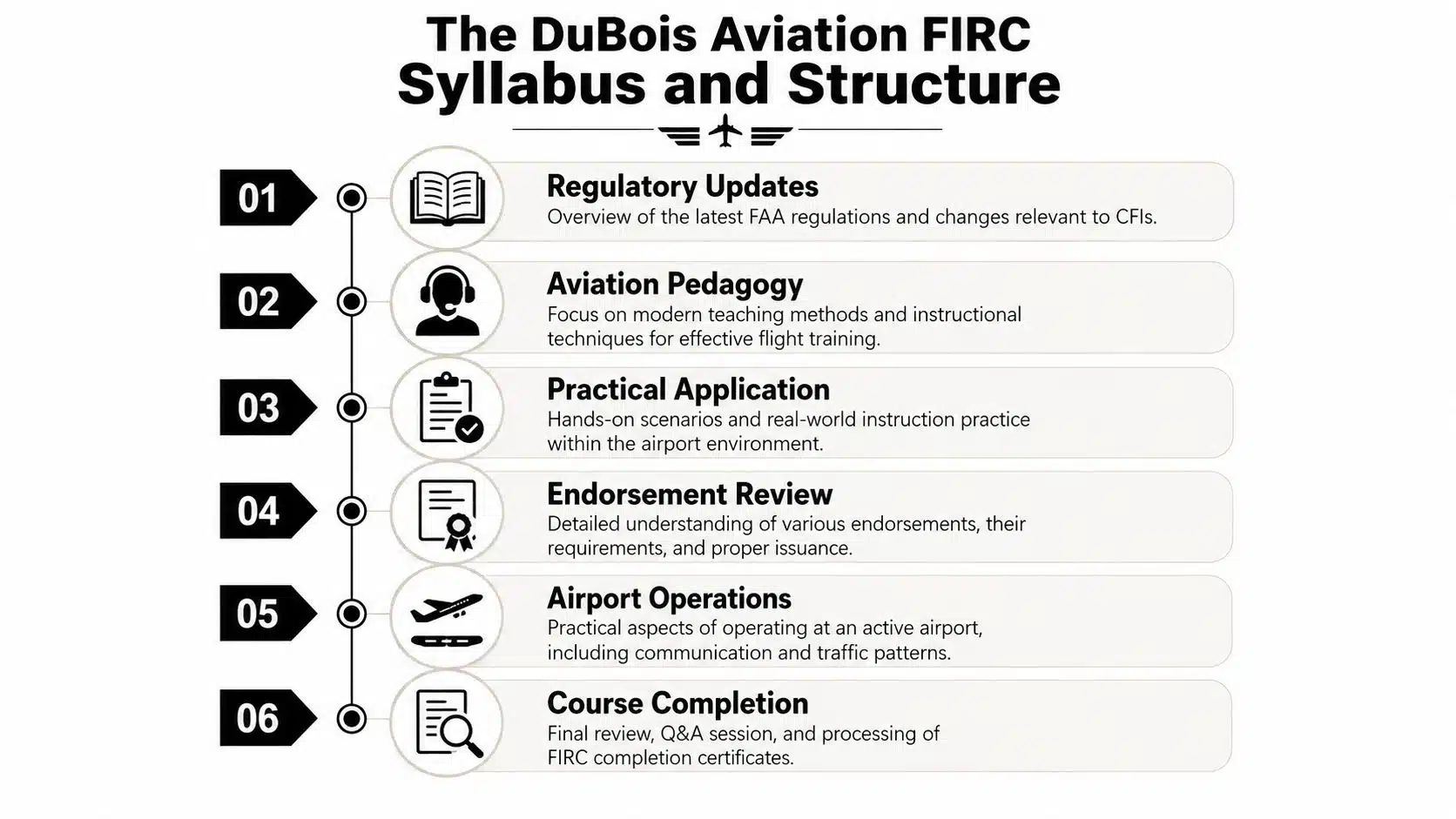
The DuBois Aviation FIRC Syllabus and Structure
Most online refresher courses do one thing well. They let you complete required ground content on your own schedule. That’s useful, especially if your time is fragmented.
But online-only renewal has an obvious limit. It can confirm that you answered questions correctly. It can’t show whether your in-person briefings are sharp, whether your pattern management matches what you teach, or whether your airport decision-making still holds up under workload.
FAA-approved FIRC programs require a minimum 16-hour training requirement, and a typical format includes 13 essential study units, elective choices, and a final exam with a 70% minimum passing score, with leading providers reporting 15-25 hours for self-paced completion, according to Sporty’s overview of FIRC course architecture.
What a hands-on structure adds
A useful cfi refresh course at an active airport should go beyond the minimum academic sequence. It should pressure-test how you teach in the environment where your students fly.
That means reviewing:
- Regulatory updates and endorsement language
- FOI application instead of FOI memorization
- Scenario-based teaching in towered airspace
- Ground-to-flight continuity
- Common instructor errors in preflight, taxi, pattern, and debrief
For instructors who want a formal training environment rather than a screen-based renewal, DuBois Aviation’s Part 141 flight school provides the kind of airport setting where those discussions stay practical instead of abstract.
Sample DuBois Aviation FIRC Timeline (2-Day Intensive)
| Day | Morning Session (4 hrs) | Afternoon Session (4 hrs) |
|---|---|---|
| Day 1 | Regulatory updates, certificate privileges, recent endorsement review, FOI refresh tied to common instructor scenarios | Airport operations in busy towered airspace, scenario-based teaching, risk management discussion, simulator-supported teaching flow |
| Day 2 | Aerodynamics review, instructional technique refinement, logbook and documentation review, common checkride preparation issues | Final review, Q&A, completion processing, practical discussion of lesson delivery in airplane and simulator settings |
This kind of schedule works because it respects how instructors learn. You review the rule set, then you immediately attach it to teaching behavior. You talk through endorsements, then you evaluate whether your current briefings support those endorsements. You review airport operations, then you compare your own pattern and radio habits against what you expect from your students.
The strongest recurrent training always answers one question: would I be comfortable defending this instruction to a DPE, a chief instructor, and myself?
What works and what doesn’t
What works:
- Ground sessions built around current teaching decisions
- Real examples from towered airport operations
- Time to review paperwork before submission
- Simulator use to rehearse high-workload scenarios
- Honest critique of briefing quality
What doesn’t:
- Treating the final exam as the goal
- Racing through modules with no note-taking
- Assuming your old endorsement templates are still sufficient
- Waiting until the last possible week
- Confusing completion with true readiness to resume teaching
A cfi refresh course should leave you with better language, cleaner records, and tighter standards. If it only leaves you with a completion certificate, you probably underused it.
How to Prepare for Your FIRC at DuBois Aviation
Show up to recurrent training the same way you show up to a flight review. Organized, current, and ready to work. Instructors waste a lot of training value hunting for documents, trying to remember renewal dates, or discovering halfway through the day that their notes and records don’t line up.
Bring the documents you’ll actually need
Before you arrive, assemble a clean renewal folder. Paper or digital is fine. What matters is that everything is easy to verify.
- Pilot and instructor certificates. Bring current copies and make sure the information matches your records.
- Government-issued photo ID. Keep it immediately accessible.
- Medical certificate if applicable. If your current operations require it, don’t assume you’ll remember the details from memory.
- Logbook or digital logbook access. You may need to verify prior activity or review instructional entries.
- IACRA readiness. If you haven’t logged in recently, verify your access before training day.
Review the subjects that usually expose rust
You don’t need to cram. You do need to arrive warmed up.
Spend some time on the areas instructors tend to teach from habit instead of from current standards:
- Endorsements and eligibility
- FOI concepts as applied to difficult students
- Common ACS teaching weak spots
- Practical test readiness judgment
- Risk management in busy airspace
If there’s a maneuver you can demonstrate well but don’t always teach well, put it on your list. The problem is rarely the flying. It’s usually the explanation, sequencing, or correction strategy.
Here’s a useful warm-up before you arrive:
Pack like an instructor, not just a pilot
Bring the tools that let you teach cleanly.
- Headset. Use the one you know well.
- Kneeboard or note system. You’ll want a place to capture wording changes, endorsement reminders, and teaching adjustments.
- EFB or iPad with current charts. If you’re working in the LA Basin, stale chart data is an unnecessary self-own.
- Charging cables and battery backup. Don’t build a training day around a dying tablet.
- Your usual lesson materials. If you rely on a binder, whiteboard flow, or digital lesson outlines, bring them.
Preparation standard: Bring the exact tools you use when teaching. Recurrent training is the right place to fix your system, not pretend you use a different one.
Arriving prepared does two things. It protects your time, and it makes the course honest. The more your real teaching setup is on the table, the easier it is to improve it.
After the FIRC Buying and Selling Aircraft
A week after finishing recurrent training, an instructor often gets a text like this: “I found a Cherokee for a good price. Can you look at it before I send a deposit?” That is not a side conversation. It is part of the job now.
The FIRC should sharpen your judgment, and students notice. After a course that refreshes airworthiness, documentation, endorsements, and risk-based decision-making, you are in a better position to help a buyer slow down, ask better questions, and avoid turning excitement into a maintenance project.

Why this belongs in post-FIRC instructor work
At a place like KCNO, instructors see ownership decisions up close. Students train around working airplanes, shop projects, and owners who use their aircraft. If you complete recurrent training at DuBois and spend time in the local environment, you can carry that perspective into buyer advising. The Chino airport flight training environment gives you a useful reality check on what reliable ownership looks like versus what only looks good in an online listing.
Your role is not to act as a broker, attorney, or mechanic. Your role is to help the buyer think like an operator. That distinction matters.
How a refreshed CFI adds value during a purchase
Good aircraft advice starts with the mission, but the conversation has to get specific fast. A student shopping for a Saturday lunch airplane needs something different from a buyer who wants hard IFR capability, regular passenger carriage, or a platform that can support future commercial training. Instructors who just finished a FIRC are usually better at spotting where the mission statement is fuzzy or unrealistic.
Use a process like this:
Pin down the actual use case
Ask how the airplane will be flown in the first year, not in the buyer’s fantasy version of year five. Local proficiency flights, instrument cross-countries, primary training, mountain trips, and family travel each point toward different airframes and equipment choices.Screen the airplane as a teaching platform and an operating machine
Useful load, avionics stability, parts support, recurring maintenance items, insurance friction, and cockpit layout all matter more than shiny paint. A buyer may be impressed by cosmetic upgrades. You should be asking whether the airplane dispatches consistently and fits the mission.Treat the pre-buy like a decision gate
A real pre-buy inspection needs an independent mechanic who knows the type. If the seller pushes back on that, pay attention. A fresh annual can still miss the exact issues that matter to a buyer, especially corrosion, damage history, poorly documented alterations, or deferred maintenance that has become normal to the current owner.Read logs for patterns, not just signatures
The logbooks tell you how the airplane has been cared for. Look for long gaps, repetitive squawks, vague write-ups, major repairs, and paperwork that does not line up cleanly. One ugly entry is not always fatal. A pattern usually is.Keep the buyer inside their lane
Instructors can help frame questions and identify concerns. Mechanics evaluate airworthiness. Title companies and attorneys handle ownership and closing issues. That separation protects everyone.
One sentence I use a lot is simple: “Good enough for a demo flight is not the same as good enough to own.”
Buying advice changes with the buyer
A private pilot buying their first airplane usually needs protection from optimism. A commercial applicant buying a time-building machine needs protection from false economy. An instrument student often overbuys panel and underestimates maintenance. A helicopter buyer can make the same mistake, only with higher operating costs and fewer good options nearby for support.
That is where current instructor judgment matters. You are not just helping them choose an aircraft. You are helping them avoid a bad training platform, a poor ownership fit, or a transaction that creates months of distraction from actual flying.
The best post-FIRC outcome is not just renewed privileges. It is sharper judgment that shows up in conversations like this, where a student needs an instructor who can say, with reasons, “Pass on this one,” or “Buy it, but only if the inspection answers these three questions first.”
KCNO Fly-In FAQs for Your FIRC
Flying into a new towered airport for recurrent training shouldn’t be the hardest part of the day. Still, instructors who are perfectly comfortable at their home field can get task-saturated when they arrive at a busy Class D with unfamiliar local flow.

What should you do before departure
Start with current planning. Review the Chart Supplement, NOTAMs, weather, and any runway or taxiway issues before you launch. If you haven’t been into Chino before, spend extra time understanding the airport layout and expected taxi workload after landing.
If you want a sense of the local training environment before arrival, review Chino Airport flight training information so you know what kind of traffic mix and instructional activity to expect around KCNO.
What kind of arrival mindset works best
Arrive early in your head. Don’t wait until the descent to start sorting out radios, airport geometry, or where you plan to park.
Use a conservative flow:
- Brief the arrival while still outside the busy area
- Set frequencies and backups before workload climbs
- Have a taxi plan before touchdown if possible
- Listen for local pace and phraseology instead of barging in
- If anything gets muddy, slow down and ask
The airport isn’t the place to prove how efficient you are. It’s the place to prove how disciplined you are.
What about IFR, VFR, and helicopter arrivals
For fixed-wing pilots, the smart move is simple. Expect a towered environment with active training traffic and stay ahead of your sequencing. If you’re IFR, think through the transition from approach to ground before the handoff comes. If you’re VFR, be especially careful not to let visual familiarity breed sloppy radio work.
Helicopter pilots should brief their arrival with the same care they’d use for any mixed-use airport. Know where you expect to integrate, where fixed-wing pattern traffic is likely concentrated, and what the ground movement plan will be after landing. If you’re flying an unfamiliar helicopter into a busy field, reduce variables where you can.
Ask for progressive taxi if you need it. Good judgment on the ground looks better than confident confusion.
Where do visiting pilots usually stumble
Usually in three places:
- Radio compression. Talking too fast because the frequency sounds busy.
- Taxi assumptions. Moving before the airport picture is clear.
- Transition mentality. Treating the arrival as routine when the local flow is not yet familiar.
The easiest fix is to arrive with margin. Give yourself extra time, extra fuel comfort, and extra attention for the arrival and shutdown phase. If your cfi refresh course starts with you already behind the airplane, you’ve made the day harder than it needs to be.
If you want recurrent training in a real towered-airport environment, plus access to airplane, helicopter, and simulator resources at KCNO, DuBois Aviation is one option to consider. Review the training fit, confirm your documents and timing, and come in with a plan to leave sharper than you arrived.