You're turning base to final at Chino. The checklist is done, the runway is in sight, tower is busy, and your brain is already half on the landing. Then you spot another aircraft that looks a little too close for comfort. It isn't obviously ahead of you. It isn't obviously behind you. For a second, your mind asks the question every student pilot eventually faces.
Who has the right of way?
That moment matters because right of way rules aren't trivia for the oral exam. They're the shared language that keeps pilots predictable when workloads climb and closure rates get uncomfortable. If you fly out of a place like KCNO, where you may be sequencing with fixed-wing traffic, helicopters, parallel runways, and rapid radio calls, you need more than a memorized line from the FARs. You need a working picture of how the rule applies when the airplane is moving, the radio is alive, and somebody else may be making a mistake.
A good checkride answer is useful. A good cockpit habit is better. The goal is to know the rule, recognize the situation early, and choose the safest action before the situation becomes dramatic.
Table of Contents
- The Unwritten Rule of the Sky
- See and Avoid The Cornerstone of Aviation Safety
- The Right of Way Hierarchy Who Always Goes First
- Rules for Converging Overtaking and Head-On Scenarios
- Right of Way in the Airport Environment
- Common Mistakes and Pro Pilot Mentality
- Buying Your First Aircraft the Safe Way
The Unwritten Rule of the Sky
A student on final into Chino often thinks the hard part is the landing. Sometimes it is. But just as often, the main challenge is managing uncertainty while staying smooth and predictable.
You might be on approach to one of KCNO's parallel runways, watching another airplane that seems to be drifting into your mental bubble. Maybe tower has already called the traffic. Maybe you never picked it up until late. Maybe you saw it and then lost it against the background. In those moments, pilots don't need vague advice. They need a simple chain of thought.
First, keep flying your airplane. Second, identify the conflict. Third, don't assume the other pilot sees you.
That's the unwritten rule of the sky. Right of way is useful, but collision avoidance is the primary job. A pilot who insists on legal priority while letting spacing collapse has missed the point.
Practical rule: Treat right of way as a tool for predictability, not permission to continue blindly.
Student pilots also get tangled up because the words sound more absolute than what is experienced in practice. “Aircraft on final has priority” sounds clean in a classroom. It feels less clean when traffic is turning inside you, tower is sequencing three airplanes, and a helicopter is moving through the pattern in a way that doesn't match your mental picture.
At a busy airport, the safest pilots are the ones who expect ambiguity early. They don't freeze when traffic doesn't fit the textbook diagram. They widen out, slow down, ask tower to repeat the call, or go around before pride traps them in a bad setup.
That habit starts with one idea. Right of way rules help everyone act predictably, but they never relieve you of the duty to avoid a collision.
See and Avoid The Cornerstone of Aviation Safety
The rule behind the rules
Before you sort out who yields, you have to start with see and avoid. That's the bedrock. It applies whether you're in the practice area, entering the pattern, taxiing near an active runway, or working with ATC at a Class D airport.
A lot of students learn the specific rules first because they're easy to memorize. Yield to the right. Overtake on the right. Turn right in a head-on. Those matter, but they make sense only after you understand the larger duty. The pilot in command must keep scanning, keep evaluating, and keep making choices that preserve separation.
That's also where pilots sometimes confuse the FAA materials. The regulation tells you what your obligation is. The guidance material helps you carry it out in practice. One gives the legal standard. The other helps you fly it well.
If your scan is lazy, the right answer may arrive too late to help you.
What this means in the cockpit
In practical terms, see and avoid is active. It isn't just looking outside every now and then. It's a deliberate habit.
- Clear in segments: Don't sweep your eyes once and call it good. Move your scan across sectors and pause long enough to detect motion.
- Cross-check the radio picture: If tower says traffic is a mile east of the field, your eyes should search where that call makes sense, not wander randomly.
- Use the airplane wisely: A small bank, a slight S-turn in taxi, or a different head position can uncover traffic hidden by a wing strut, post, or door frame.
- Rebuild the picture often: At a place like Chino, the picture changes fast. A traffic call that was accurate a minute ago may be stale now.
Situational awareness is what makes that possible. A strong scan works better when you already know where conflicts are likely to appear, especially in the pattern and around parallel runway operations. A student who wants to sharpen that skill should spend time on situational awareness in aviation.
See and avoid isn't a backup plan. It's the primary plan.
One more point matters for the checkride and for real flying. Right of way rules exist because two good pilots can still end up in situations where paths converge and someone must yield. But if you wait until the legal rule is your only remaining tool, you're already behind the airplane.
That's why experienced instructors keep asking the same questions. Where's the traffic now? What's your out? If they don't do what you expect, what will you do next?
The Right of Way Hierarchy Who Always Goes First
The one rule that overrides everything
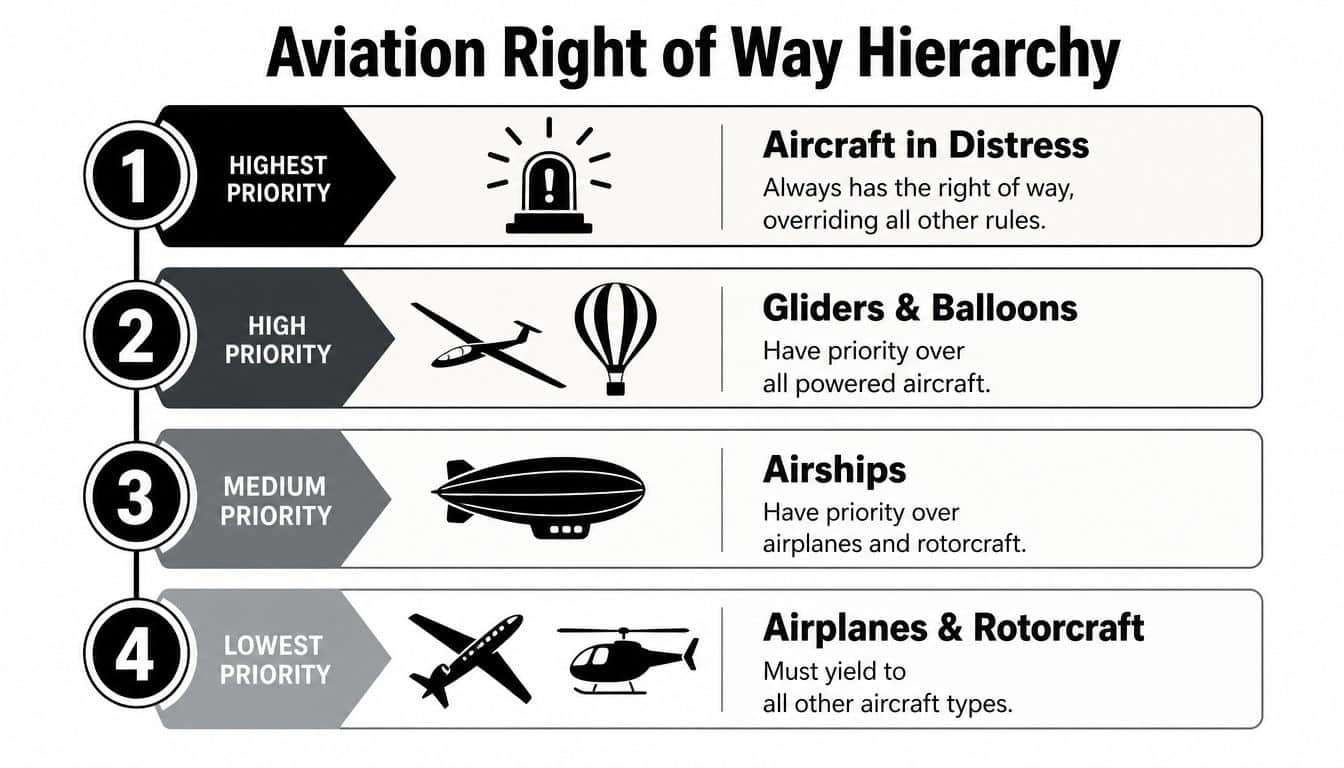
There is one right of way rule you should treat as absolute. An aircraft in distress has priority over everything else. According to 14 CFR § 91.113(c) and FAA guidance summarized here, an aircraft in distress has absolute priority over all other air traffic, with zero exceptions. If a pilot declares an emergency, that aircraft legally supersedes the normal hierarchy, whether another aircraft is on final, landing, or converging nearby.
That has direct consequences in the airport environment. If you hear that a distressed aircraft is coming in, your job isn't to debate who was first. Your job is to clear the space, comply with ATC if towered, and remove yourself as a factor.
A student pilot sometimes hears “right of way” and thinks in terms of fairness. Distress priority has nothing to do with fairness. It has everything to do with preserving life and giving the pilot with the fewest options the clearest path.
Who gets priority in normal operations
Once you set distress aside, the hierarchy follows maneuverability. The less able an aircraft is to easily change speed, direction, or altitude, the more protection the rules give it.
The broad order recognized under ICAO and mirrored by the FAA puts balloons at the top, then gliders, then airships, with powered airplanes and rotorcraft below them. That structure exists because not all aircraft can solve a conflict the same way.
Here's a cockpit-friendly way to understand this:
- Balloons: They're largely carried by the air mass and don't maneuver like an airplane in the pattern.
- Gliders: A glider pilot can't add power and go around. Energy management limits the choices.
- Airships: They're powered, but they don't maneuver like a light airplane or helicopter.
- Airplanes and rotorcraft: These usually have more flexibility to adjust speed, spacing, or path.
Some instructors teach a memory aid for the hierarchy so students can recall it under pressure. That's fine, as long as you don't reduce the rule to a chant. What matters is understanding the reason behind it. The rules favor the aircraft with fewer practical escape options.
A few quick examples make this stick:
- You're in a Cessna and see a glider converging in a way that creates doubt. Don't wait for a perfect geometric analysis. Give the glider room.
- You're in a helicopter repositioning near fixed-wing traffic. Don't assume your ability to hover makes the situation simpler for everyone else. Predictability still matters.
- You hear emergency traffic in the pattern. Everything else moves down the priority ladder instantly.
The hierarchy isn't about status. It's about who can least afford to maneuver late.
Students also ask where towing or refueling aircraft fit. In normal instruction, the key takeaway is still the same: if another aircraft has operational limits that reduce its flexibility, build your plan around that reality and don't force a close decision.
At the checkride level, the examiner usually wants two things. First, can you state the hierarchy correctly enough to stay safe? Second, do you understand why it exists? If your answer sounds like memorized law but your judgment says “I'll hold my course and make them figure it out,” the answer isn't good enough.
Rules for Converging Overtaking and Head-On Scenarios
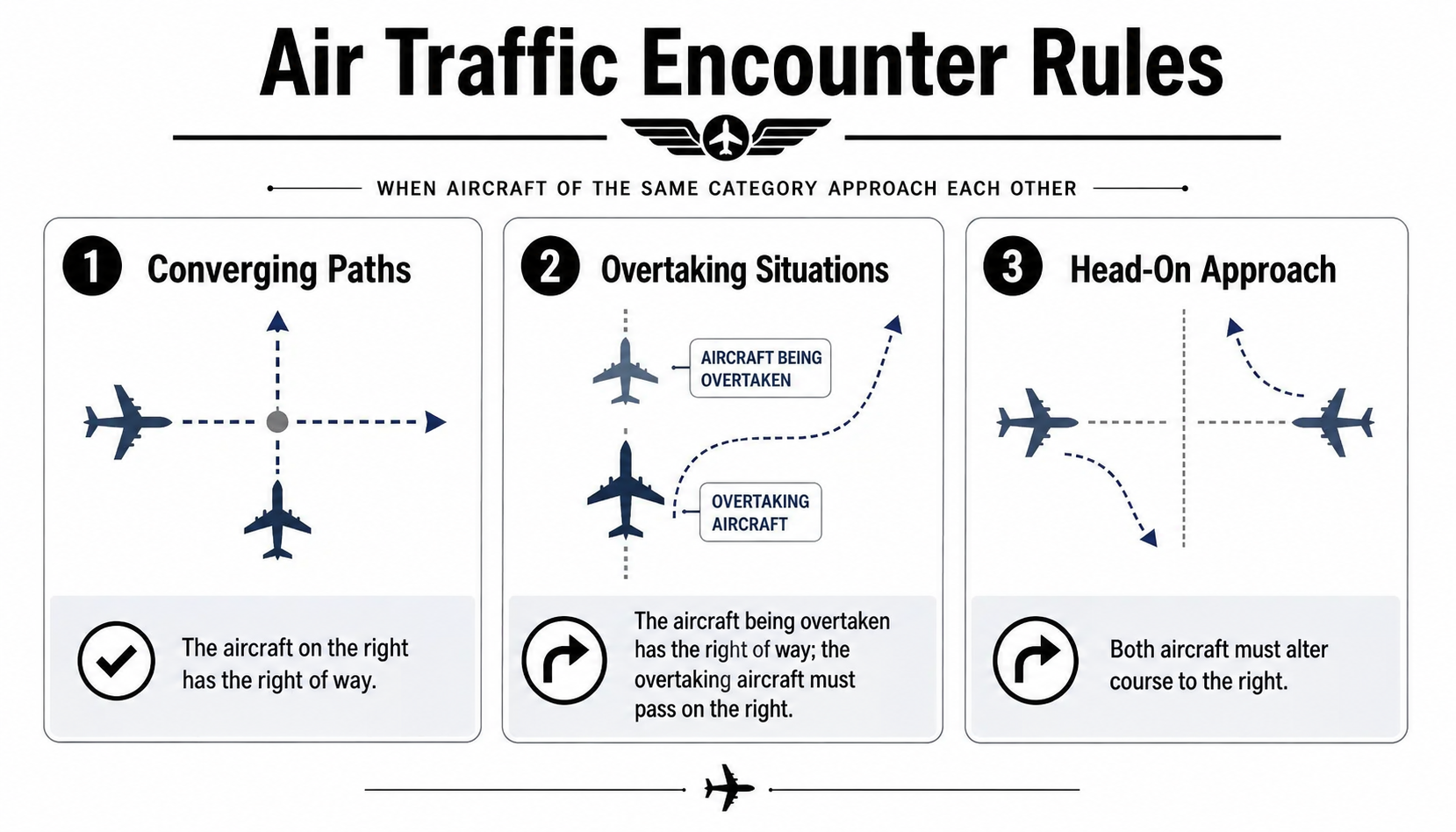
Once two aircraft are in the same broad category, the hierarchy doesn't solve the problem by itself. Now you're using the classic encounter rules. These are the ones every pilot should be able to recall instantly.
Converging traffic
Under ICAO and FAA rules, when two aircraft of the same category converge at about the same altitude, the aircraft on the left yields to the aircraft on the right. That's the core rule under 14 CFR 91.113.
This sounds simple on paper and slippery in the air because closure rates can distort your perception. A target that seems off your nose may in fact be moving into a collision path. A good habit is to ask a blunt question: is the other aircraft staying fixed in my windshield? If it is, the risk may be greater than it first appears.
At Chino, a student might feel this most clearly when traffic is sequencing from different legs of the pattern or when parallel runway activity makes visual geometry busy. If you identify aircraft to your right and the paths are converging, don't make a tiny correction and hope that counts. Make a clear, early adjustment that passes behind and well clear.
A smart yielding action usually has three qualities:
- It's early enough to be seen
- It's obvious enough to be understood
- It avoids crossing ahead of the other aircraft
Overtaking traffic
The overtaking rule is another place where students sometimes reverse the answer. The aircraft being overtaken keeps the right of way. The overtaking aircraft must alter course to the right and pass well clear.
That matters because the faster pilot often feels more “in control” of the situation. But speed creates responsibility, not privilege.
If you're overtaking another airplane in cruise or in the pattern, don't crowd from above, drift past with casual spacing, or assume your ADS-B picture tells the whole story. Move to the right, maintain generous separation, and avoid making the other pilot guess what you're doing.
A practical pattern example helps. Suppose you're on downwind in a quicker airplane and you catch slower traffic ahead. Don't tighten in, compress spacing, and then try to salvage it with a rushed base turn. Extend, slow if appropriate, advise ATC if towered, or go around if the sequence is no longer stable.
If you're the faster aircraft, you own the burden of staying clear.
Head-on traffic
A head-on encounter has the easiest memory item and the highest stress potential. Both aircraft turn right.
There's no left-right debate because neither aircraft has the special privilege to continue straight. If another aircraft appears on a reciprocal or nearly reciprocal path, both crews should alter course right.
What trips students up is hesitation. They start mentally classifying whether it is head-on or merely converging. If the picture is developing fast, don't get trapped by semantics. If right solves the conflict safely and early, use it.
Here's a clean mental model for all three encounters:
| Encounter | Who yields | Best practical action |
|---|---|---|
| Converging | Aircraft on the left | Alter course to pass behind and remain well clear |
| Overtaking | Overtaking aircraft | Move right and pass well clear |
| Head-on | Both aircraft | Turn right promptly |
The checkride answer should be crisp. The cockpit answer should be even better. Recognize the encounter, decide early, and maneuver in a way the other pilot can read instantly.
Right of Way in the Airport Environment
The airport is where student pilots often discover that right of way rules are easier to recite than to apply. Everything gets compressed. Distances shrink, frequencies get busier, and one instruction from tower can change your picture immediately.
How this feels at Chino
At a non-towered airport, you build the picture from position reports and visual scanning. At a towered field like Chino, you still scan outside, but now you're also fitting your actions into sequencing instructions. If tower says, “Number two, follow the Cherokee,” your right of way thinking doesn't disappear. It merges with compliance, spacing, and visual contact.
KCNO adds a layer of realism because parallel runway operations can make traffic identification harder for newer pilots. On one side of the field, you may be following traffic to 26R while another airplane is arriving or departing on 26L. If you fixate on the wrong aircraft, you can create your own conflict even while technically following instructions.
A few airport-specific habits help:
- Read back traffic instructions clearly: If tower assigns you to follow traffic, make sure you know which traffic.
- Don't taxi with assumptions: An aircraft landing or on short final has operational priority over ground traffic. If there's doubt, stop and clarify.
- Use the go-around early: If spacing collapses, the cleanest answer is often the simplest one.
- Keep your eyes outside after every transmission: Radio contact doesn't replace visual responsibility.
Students also ask whether ATC instructions cancel right of way rules. They don't turn unsafe operations into safe ones. But in a towered environment, ATC sequencing is part of how order is maintained, so you need to comply promptly unless you can't do so safely. If you can't, say so.
For pilots training in this environment, the local radio rhythm, runway layout, and pattern complexity are part of the learning curve at Chino Airport flight training.
Essential Right of Way Radio Phraseology
You don't need polished airline cadence. You need clear, timely words that reduce ambiguity.
| Situation | What You Say |
|---|---|
| You have traffic in sight | “Traffic in sight.” |
| You don't have the traffic | “Negative contact.” |
| You need more time or spacing | “Unable. Request extended downwind.” |
| You're not comfortable continuing the approach | “Going around.” |
| You're uncertain which aircraft to follow | “Confirm the traffic to follow.” |
| You need to stop clear of conflict on the ground | “Holding short.” |
A realistic KCNO example might sound like this in sequence: tower calls traffic, you reply “negative contact,” tower gives a better description, you acquire the airplane, then say “traffic in sight.” If the spacing still doesn't work, “going around” is a strong pilot decision, not an admission of failure.
Clear radio phraseology buys time because it helps everyone build the same picture.
On the ground, keep one more rule in mind. Taxi conflicts often start because two pilots each assume the other will stop. If the geometry is tightening near a runway exit or an intersection, slow down early and make your intentions obvious. Predictability matters just as much on taxiways as it does in the pattern.
Common Mistakes and Pro Pilot Mentality
The trap of being technically right
The most common student mistake isn't forgetting the rule. It's treating the rule like armor.
Aviation has a lot in common with driving in one important sense. Legal priority is not the same as physical safety. The right of way can be relative, and people still make errors. A driver with the legal advantage still has a duty to avoid the crash if possible. The same mindset belongs in the cockpit.
That's why the principle “When in Doubt, Bail Out” matters so much. As explained in this discussion of uncontrolled intersection safety and the NHTSA principle of defensive action, “Even if you have the right-of-way, if for any reason you feel uncomfortable or that your safety is threatened, let the other traffic go ahead. Your safety always comes first.”
Student pilots usually fall into a few predictable traps:
- Assuming “they see me” means they'll act correctly: They may not see you at all, or they may misidentify you.
- Following the moving map instead of the outside picture: GPS helps, but it won't look out the window for you.
- Treating an ATC instruction as a guarantee: Controllers help sequence traffic, but you're still responsible for avoiding collisions.
- Forcing a landing from an unstable setup: A rushed turn, tight spacing, or uncertain traffic call is often solved by going around.
How safe pilots think
Professional pilot mentality is simple to say and hard to live consistently. Right of way is something you give, not something you take.
That sentence changes your behavior. Instead of asking, “Can I legally continue?” you ask, “What action makes this safer and clearer for everyone?” Sometimes that means yielding even when you don't have to. Sometimes it means asking for another pattern, extending downwind, or declining an instruction that doesn't look safe from your seat.
Here's the test I like for students preparing for a checkride:
- Would your action be obvious from the other cockpit?
- Would you still choose it if the other pilot were inexperienced?
- Would you be proud of the decision after landing?
The best pilots don't win right of way arguments. They prevent right of way emergencies.
That mindset doesn't make you timid. It makes you disciplined. Confident pilots don't bully a situation into working. They preserve options until the picture is clear.
Buying Your First Aircraft the Safe Way
Owning an airplane or helicopter is exciting because it changes how you think about travel, proficiency, and freedom. It also changes your exposure to risk. A purchase decision can lock you into maintenance surprises, training gaps, or an aircraft that doesn't fit your mission.
Why flight rules matter during a pre-buy flight
A lot of buyers focus on paint, avionics, and speed claims. Those matter, but the safest buying process starts earlier. Watch how the aircraft is operated during a demonstration or evaluation flight.
Does the pilot brief clearly? Do they maintain spacing in the pattern? Do they use disciplined radio calls? Are they calm in a busy environment, or are they normalizing rushed decisions around traffic? If the airplane is being shown in a crowded pattern and the handling pilot treats right of way casually, that's not just a pilot issue. It may also tell you something about the ownership culture around the aircraft.
That applies to helicopters too. Hover work, pattern work, and airport transitions should look controlled and conservative. You're not just buying machinery. You're inheriting a maintenance history, an operating history, and often a training history.
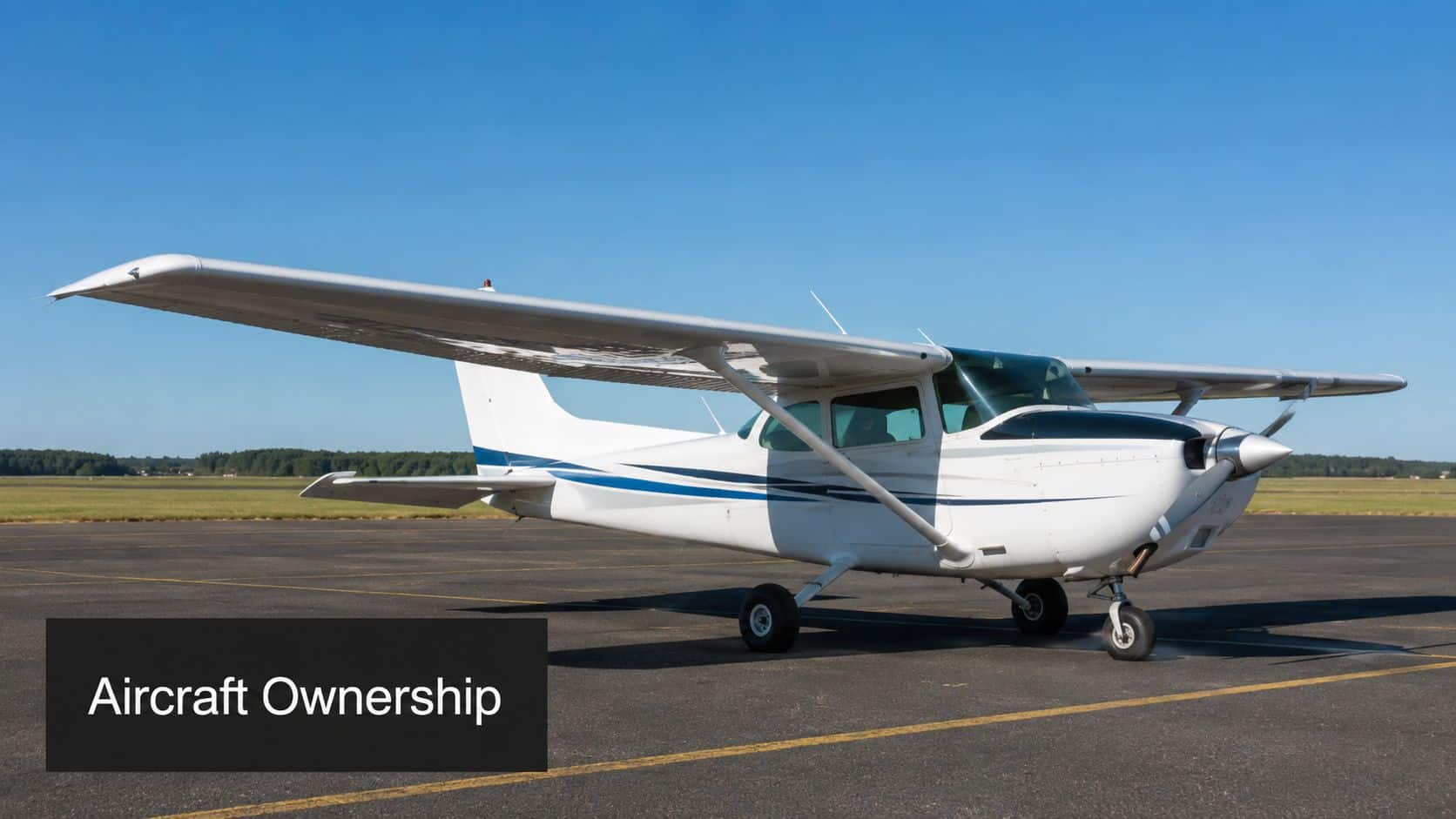
How to buy an airplane or helicopter safely
If you're one of the many pilots looking to buy or sell airplanes and helicopters, keep the process boring on purpose. Boring is safe.
- Start with mission fit: Decide what you need. Local proficiency flights, instrument travel, time-building, family trips, or helicopter training all point to different aircraft.
- Get a real pre-buy inspection: Use a trusted A&P mechanic who is working for you, not for the seller. A pre-buy should be detailed enough to uncover major concerns before money changes hands.
- Review the logbooks carefully: Logs tell the aircraft's story. You're looking for completeness, consistency, and signs that the airplane has been maintained thoughtfully.
- Evaluate the demonstration flight like a pilot, not a shopper: Note engine starts, system operation, handling, radios, and how the aircraft fits into normal airport operations.
- Plan the transition: Even a familiar make and model may require structured checkout training, insurance sign-off, or ferry support.
If you're choosing your first airplane, a practical starting point is learning what makes a trainer or personal aircraft forgiving, supportable, and appropriate for your experience level. A helpful place to begin is this guide to the best beginner aircraft.
Selling deserves the same seriousness. Sellers should organize logs, disclose known issues openly, and avoid rushing buyers through inspections or flights. Good transactions are transparent on both sides.
The safest way to buy an airplane isn't the fastest way. It's the methodical way. That same judgment you use in traffic. Slow down, verify the picture, and don't let excitement push you through uncertainty.
If you want help building safer habits in the cockpit, preparing for a checkride, or getting guidance as you move toward aircraft ownership, DuBois Aviation offers flight training and practical experience in the actual environment of Chino Airport.