

You’ve got your commercial certificate, a logbook that still looks thin, and one question that matters more than anything else right now. How do you build flight hours fast without wasting money or developing sloppy habits?
That’s the point where a lot of pilots get bad advice. Some are told to just rent and fly circles. Some are pushed toward buying an airplane before they understand ownership risk. Others hear that instructing is the only path, even if they haven’t looked at alternatives like safety piloting, jump flying, or rotorcraft work.
Building hours quickly is straightforward. It hinges on structure, access, and discipline. You need a plan for the hours that move your career forward, a way to fly consistently, and enough judgment to avoid chasing “cheap” time that turns into expensive dead ends.
A busy airport environment helps because it forces you to work like a professional from the start. Towered operations, varied traffic, instrument procedures, and real scheduling pressure all build useful habits. But the airport alone won’t do it. You still need to be deliberate about every hour you log.
The 1500-Hour Mountain Charting Your Course to the Cockpit
The airline path feels long because the number is big. 1,500 hours gets all the attention, but the primary issue isn’t only total time. It’s whether your logbook shows the right mix of experience when you get there.
To qualify for an Airline Transport Pilot certificate in the United States, you need 1,500 total flight hours, including 500 hours of cross-country time, 100 hours of night flying, 75 hours of instrument time, and 250 hours as Pilot-in-Command, according to this ATP requirements summary.
Think in categories, not just totals
Pilots get in trouble when they chase Hobbs time without tracking what kind of time they’re building. An hour that helps your cross-country total, sharpens instrument scan, and adds PIC time is worth far more than an hour of aimless local flying.
That’s how you should read the ATP rules. They aren’t paperwork trivia. They’re a map for the kind of flying that develops judgment.
Practical rule: If a flight doesn’t help a requirement, sharpen a weak area, or prepare you for paid flying, question why you’re doing it.
Your logbook should tell a story
A good time-building plan creates a progression. Early on, you’re cleaning up fundamentals and becoming consistent. After that, you start stacking useful categories together. A cross-country can also be PIC. A night flight can also include instrument work if it’s planned correctly and logged correctly. A teaching flight can deepen your own systems knowledge while adding time.
That’s the difference between random flying and professional development. One burns money. The other builds a résumé.
Build Your Foundation with Strategic Flight Planning
It is 6:15 a.m. at KCNO. Marine layer is sitting off to the west, one trainer just went down for maintenance, and the pilot who builds time fastest still gets a useful flight in because the plan was built for real conditions, not a perfect day.
That is the difference between logging hours and making progress. At a busy school, the pilots who move quickest are rarely the ones trying to fly the most random hours. They stack goals, protect continuity, and stop wasting aircraft time on flights that do not move a rating, a requirement, or a weak skill forward.
Build a schedule that can take a hit
A good plan survives weather, maintenance, instructor availability, and your own work schedule. If it falls apart after one cancellation, it was never much of a plan.
Set recurring flight days instead of booking one lesson at a time. Keep a backup mission ready for each slot. If the cross-country gets scrubbed, switch to a simulator block, night planning session, ground review, or a shorter local flight that still serves a purpose. Match the aircraft to the job. A simple trainer is usually the right tool for building consistency, and paying more for extra complexity only makes sense when the mission calls for it.
If you are still working toward an added rating or instructor certificate, consistency with one instructor matters too. Different teaching styles can be useful over time, but constant switching slows you down in the short term.
Stop treating training and time building as separate jobs
That split costs pilots money.
A cross-country can build PIC time while sharpening fuel planning, reroute decisions, radios, and cockpit management. A night flight can work on landing judgment and route discipline. An instrument lesson can be planned to clean up flows and workload control before those habits get exposed under pressure later.
The point is simple. Every flight should do more than one job, but not so many that the lesson turns into a mess.
A useful flight has a clear reason for leaving the ground and a clear standard for success before takeoff.
Use the simulator where it saves the most money
Sim time does not replace real flying. It does replace a lot of expensive repetition that does not need a spinning propeller.
Holds, approach briefings, flows, checklist discipline, instrument scan, emergency sequencing, and cockpit organization are all better learned through repetition before you burn fuel. Then use the aircraft for what the simulator cannot give you well enough. Sight picture, weather judgment, actual radio pace, turbulence, landings, and the physical feel of staying ahead of the airplane.
This matters even more at a school with steady traffic and busy airspace. At DuBois in Chino, I would rather see a pilot show up having already practiced the sequence in the sim than spend paid airplane time fumbling through basic flow order.
Give each flight one primary goal and one secondary goal
That keeps the lesson focused and still lets you get more value out of the hour.
| Flight type | Primary goal | Secondary goal |
|---|---|---|
| Local VFR sortie | Aircraft control and precision | Radio discipline in busy airspace |
| Cross-country | PIC decision-making | Navigation and fuel planning |
| Instrument session | Procedure execution | Cockpit flow and workload management |
| Night flight | Visual adaptation and landing judgment | Route familiarity and lighting awareness |
Pilots get off track when they try to squeeze five priorities into one flight. Pick the main job. Add one supporting job. If both get done well, the flight was efficient.
Protect continuity, or pay for rework
Skill fade shows up fast, especially in instrument work, landings, and cockpit flow. Miss enough time and the next lesson becomes a catch-up flight.
A few habits keep that from happening:
- Chair-fly before each lesson: Rehearse callouts, profiles, and flows at home.
- Write short post-flight notes: Record what slipped, what improved, and what to fix next time.
- Keep your logbook current: Catch category errors while the flight is still fresh.
- Brief the mission clearly: Know the route, standards, and likely decision points before startup.
Pilots who want a structured path into instructing can review DuBois Aviation's CFI training path and instructor requirements. That matters if your goal is airline progression, but even before you start teaching, the bigger lesson is the same. Good planning gets you to the next milestone faster, and it does it without wasting money or cutting corners on safety.
The Gold Standard Become a Certified Flight Instructor
If your goal is the airlines, becoming a CFI is still the most dependable way to build time quickly. Not because it’s glamorous. Not because every pilot loves teaching. Because it solves the two biggest problems at once. It gives you access to frequent flying, and it lets somebody else pay for a large share of the hours.
Why instructing works so well
A busy instructor doesn’t have to invent reasons to fly. Students create demand. Private students need pattern work, cross-countries, and checkride prep. Instrument students need procedures and approaches. Commercial students need precision and polish. That variety builds your own competence fast.
Full-time CFIs at busy flight schools can log 80+ hours per month, and that pace can put a pilot at the ATP minimum in 18 to 36 months, according to USAviation Academy’s discussion of post-license time building. The same source notes that the path to a 250-hour Commercial Pilot License can take 4 to 6 months, compared with more than a year for pilots relying on solo renting.
That gap matters. Renting on your own often feels flexible, but it usually turns into long breaks, weak structure, and repeated spending on flights that don’t move you forward efficiently.
What the CFI path actually demands
Instructing is not a shortcut around competence. If you want to teach well, you need to know your material cold and fly from the right seat with confidence.
The practical workload usually includes:
- Ground preparation: You need strong command of fundamentals, regulations, lesson structure, and evaluation standards.
- Right-seat adaptation: This trips up plenty of otherwise solid commercial pilots.
- Communication: Explaining a maneuver clearly is a separate skill from performing it.
- Professional consistency: Students notice every checklist habit, radio habit, and judgment call you make.
A lot of pilots discover that they don’t really understand a maneuver until they have to teach it to someone who’s struggling with it.
Adding CFII and MEI changes the game
Once you’re instructing, added instructor ratings can make your schedule much more productive. Instrument students often fly with a different rhythm than private students, and multi-engine instruction opens another category of work.
That matters for two reasons. First, more qualifications can create a steadier stream of lessons. Second, the flying becomes broader and more relevant to the next stage of your career.
If you’re considering that route, this guide to becoming a flight instructor lays out the training path in practical terms.
Here’s a useful explainer before we go further:
What instructing gives you that self-funded flying does not
This is the part low-time pilots often miss. Instructing doesn’t just build hours. It builds judgment under repetition.
You see weak landings, shaky radio work, poor checklist discipline, unstable approaches, and preventable decision errors. Then you learn to catch them early. That habit transfers directly to professional flying.
The instructor who has calmly managed dozens of small student problems is usually building better command judgment than the pilot who only flies alone on nice days.
The trade-offs are real
CFI time isn’t effortless. You’ll deal with no-shows, weather disruptions, fatigue, and long duty days. Some flying will feel repetitive. Some students will test your patience. You also need to resist a common trap, logging lots of hours while your own standards slide.
That’s why the best instructors treat every lesson as if another instructor were watching from the back seat. Clean briefings. Clean demos. Clean paperwork. Clean decisions.
If you can do that, the CFI path remains the benchmark. It’s still the most practical answer for most pilots asking how to build flight hours fast.
Explore Alternative Paths and Cost-Saving Tactics
Not every pilot should instruct full time, and not every pilot can. Some need a second path. Some want to mix methods. That’s smart, as long as you understand what each option gives you.
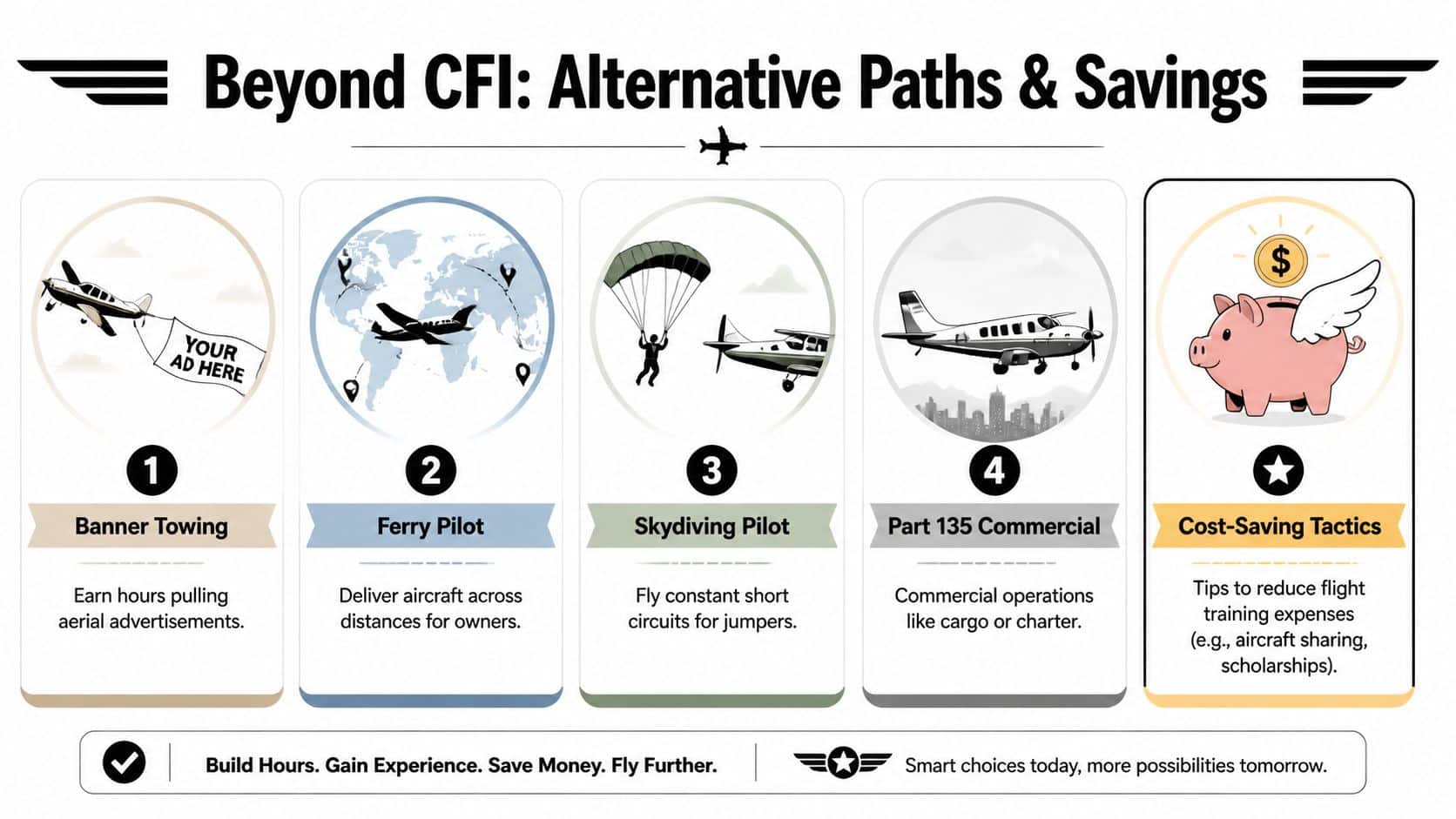
What works beyond the instructor route
The strongest alternatives usually fall into two categories. Paid flying jobs that create high utilization, and cost-sharing tactics that make self-funded flying less painful.
Skydiving operations are one of the fastest examples. Busy jump flying can produce 8 to 10 hours per day during active periods, according to this commercial pilot hour-building overview. Repeated climbs, descents, and landings sharpen aircraft handling quickly, though the flying can become operationally narrow.
Aerial survey, pipeline patrol, banner towing, and other niche work can also build time with real responsibility. The trade-off is that those jobs aren’t always easy to enter at low time, and some are seasonal or geographically limited.
The safety pilot method is one of the best deals in aviation
For pilots working on instrument proficiency and trying to save money, safety piloting is hard to beat when it’s done correctly. Under FAR 91.109, pairing with another qualified pilot can cut rental cost by 50%, and dedicated pilots using cost-sharing strategies like this can build 500 hours in 6 to 9 months, according to this review of time-building strategies.
That matters because instrument time is often expensive to build alone. Sharing the flight while alternating roles keeps both pilots engaged and can make otherwise unaffordable flying realistic.
If you’re trying to reduce training cost while keeping structure, this overview of lower-cost aviation school options is worth comparing against pure solo renting.
Compare the trade-offs honestly
Here’s the no-nonsense version:
| Path | Speed | Cost profile | Experience quality | Main downside |
|---|---|---|---|---|
| CFI | High when demand is steady | Lower personal outlay because you’re paid to fly | Broad teaching and operational exposure | Instructor workload and fatigue |
| Skydiving pilot | Very high in peak operations | Usually better than self-funded renting | Strong aircraft handling and repetition | Narrow mission profile |
| Aerial survey or patrol | Moderate to high | Paid time if hired | Precision and operational discipline | Entry opportunities vary |
| Safety pilot flying | Moderate, but efficient | Shared rental lowers cost substantially | Strong for instrument work and cockpit discipline | Requires a reliable partner and strict compliance |
| Solo rental hour building | Usually slower | Highest direct personal cost | Flexible, but quality depends on planning | Easy to waste money on low-value flights |
What does not work well
A few habits look productive and usually aren’t:
- Random local flights: They add time, but often not the kind you need most.
- Expensive aircraft for simple missions: If the goal is PIC time, use an aircraft appropriate to that mission.
- Unstructured partnerships: If you and your safety pilot don’t brief logging, roles, and weather standards in advance, you create confusion fast.
- Seasonal work without a backup plan: Jump flying is great until weather, maintenance, or seasonality dries up the schedule.
If a time-building method sounds fast but depends on luck, unclear logging, or constant exceptions, it’s not a system. It’s a gamble.
The Ownership Question Safely Buying a Plane for Time Building
Buying an airplane for time building sounds logical. You control the schedule, you know the aircraft, and you can fly whenever you want. That freedom is real. So are the costs and the traps.

The financial reality is tougher than most low-time pilots expect. A pilot aiming for 300 hours a year might face $15,000 to $25,000 in annual operating costs for a purchased Cessna 150 on top of the purchase price, and potential depreciation or resale risk can still leave the owner behind financially compared with renting at a school with block-rate discounts, according to AOPA’s discussion of time-building economics.
Why ownership appeals to pilots
The case for buying is straightforward:
- Schedule freedom: No fighting for weekend availability.
- Aircraft familiarity: You learn one machine in detail.
- Long flights become easier to plan: You’re not squeezing around a rental calendar.
- Partnership options exist: Some owners offset cost by sharing use.
Those are real advantages. For a pilot with cash, mechanical discipline, and a clear exit plan, ownership can work.
Why ownership goes wrong
The mistake is treating purchase price as the whole story. It never is.
Operating costs, maintenance surprises, insurance, storage, downtime, paperwork, and resale timing all matter. So does the simple fact that a broken airplane builds zero hours while still costing money.
A time-building airplane is only useful when it’s available, legal, and economically sane to keep flying. Low-time buyers often underestimate how much mental bandwidth ownership consumes. That matters if your actual goal is airline progression, not becoming an amateur fleet manager.
How to buy an airplane the safe way
If you’re serious about buying, approach it like a transaction, not a dream.
Get a real pre-buy inspection
Use an independent mechanic who knows the type. Don’t rely on the seller’s verbal confidence.Verify records carefully
Missing logbooks, unclear maintenance history, or sloppily documented repairs should slow you down immediately.Confirm title and paperwork
Liens, registration issues, and incomplete ownership records can turn a “good deal” into a legal headache.Buy for mission, not ego
A simple trainer often makes more sense for hour building than a faster, more expensive aircraft you can’t afford to operate consistently.Plan the sale before the purchase
If you don’t know who will want the airplane later and what condition they’ll expect, you’re not ready to buy.
How to sell an airplane safely
Selling deserves the same discipline. Clean records matter. Deferred maintenance hurts. So does unrealistic pricing. Buyers don’t pay premium money for an aircraft with confusing paperwork or a vague maintenance story.
The same basic rule applies to helicopters, and the stakes can be even higher because aircraft complexity, operating cost, and buyer pool can shift fast. If you’re buying or selling to build time, think like a risk manager first.
A good ownership decision starts with a clean inspection, clean records, and a realistic exit. Without those, renting is usually the safer move.
For many pilots, especially those with reliable rental access, ownership doesn’t accelerate the path as much as it seems. It just changes where the money goes.
The Rotorcraft Route Building Helicopter Flight Hours
Helicopter time building follows a different rhythm. Fixed-wing pilots often overlook it, but rotorcraft pilots can build time quickly if they line up the right kind of work.
In markets like Southern California, helicopter demand has surged 18%, with some sectors such as fire survey showing 22% operational growth. That environment can allow helicopter CFIs and tour pilots to log 80 to 120 hours per month, often more than the 60 to 80 hours typical for fixed-wing CFIs, creating a quick path toward the 500-hour minimum for Part 135 charter roles, according to this helicopter time-building analysis.
How the helicopter path usually develops
A common rotorcraft progression starts with instruction, then expands into tours, utility support, or other commercial work. The pilot who can teach, handle local sightseeing routes, and operate cleanly in busy airspace becomes useful fast.
That’s one reason the rotorcraft route can be attractive. The flying often combines passenger interaction, precision control, and operational tempo in a way that builds confidence quickly.
What rotorcraft pilots need to watch
Helicopter time is not just airplane time with different controls. Fatigue management matters. Smooth control inputs matter. Local area knowledge matters. Passenger briefing and operational discipline matter.
A rotorcraft pilot trying to build hours fast should focus on three things:
- Consistency in aircraft type: Early on, too much bouncing around can slow proficiency.
- Mission suitability: Discovery flights, local tours, and instruction all build different habits.
- Accurate logging: Rotorcraft pilots still need a clean, defensible record of what was flown and why it counts.
Why this path is often ignored
A lot of career content is written by airplane people for airplane people. That leaves helicopter trainees with thin guidance even though the path can be very practical in the right region.
For pilots interested in that route, helicopter pilot training at DuBois Aviation shows the kind of aircraft and training environment that support this progression. More important than the school name is the setup itself. You want aircraft availability, instructors who understand commercial pathways, and missions that build useful operational experience.
The rotorcraft route isn’t easier. It’s just different. For the right pilot in the right market, it can also be faster than people assume.
Frequently Asked Questions About Building Flight Time
Two commercial pilots can spend the same month flying and end up in very different positions. One adds hours that satisfy hiring minimums, sharpens weak areas, and keeps costs under control. The other stays busy, spends more, and still has gaps in the logbook that slow the next step.
That is the core point of the common questions below. The answers matter less as slogans and more as filters for decisions you make every week.
The fastest legal way to build time is usually the path that gives you repeat access to an aircraft, a reason to fly, and hours that still mean something to the next employer. At a busy school, that often comes from instructing, but the useful nuance is this: speed only helps if the time is loggable, defensible, and building judgment at the same time. Fast, sloppy hour building creates cleanup work later.
Renting versus buying usually comes down to cash flow, scheduling, and mechanical risk tolerance. Pilots who rent often pay more per hour but protect themselves from surprise maintenance bills and downtime. Pilots who buy sometimes lower the hourly cost on paper, then lose momentum waiting on parts, annuals, or a squawk they did not budget for. The better question is not "which is cheaper?" It is "which option keeps me flying consistently for the next six to twelve months?"
Not all flight time pulls equal weight. Cross-country PIC, instrument work done to a good standard, and time that reflects real planning and real decisions tend to carry more value than local laps with no clear purpose. Chief pilots and interviewers can tell when a logbook total was built with a plan and when it was assembled any way possible.
Safety pilot time can be smart if the pair treats it like a professional operation. Brief who is acting as PIC, confirm what can be logged, decide how the flight will be run, and keep the objective narrow. It saves money when it is organized. It wastes money when two low-time pilots launch with vague plans and come back with questionable entries.
Adding CFII or MEI makes sense when there is a near-term use for the rating. At a school with regular instrument students, CFII can pay for itself quickly because it opens more teaching days and keeps your schedule steadier. MEI is different. It is valuable, but only if there is enough twin demand in your market to justify the training cost.
The easiest way to stop wasting money is to audit your own flying the way a chief instructor would. Ask three questions after every week. What did I log? What did it qualify me for? What did it improve? If you cannot answer all three, the plan needs work.
One mistake shows up over and over. Low-time commercial pilots chase hours before they define the target. Airline track, corporate, aerial survey, utility, and rotorcraft work each reward a different mix of experience. Pilots who build time efficiently usually pick the target early, then match aircraft, ratings, and flying opportunities to that lane instead of trying to do everything at once.
If you are training at a place like DuBois at KCNO, use the environment for what it is good at. Busy airspace, steady aircraft movement, instructor access, and both airplane and helicopter operations give you more than raw time. They give you repetitions in communication, planning, and pace. That is the kind of experience that holds up in an interview and in the cockpit.


