
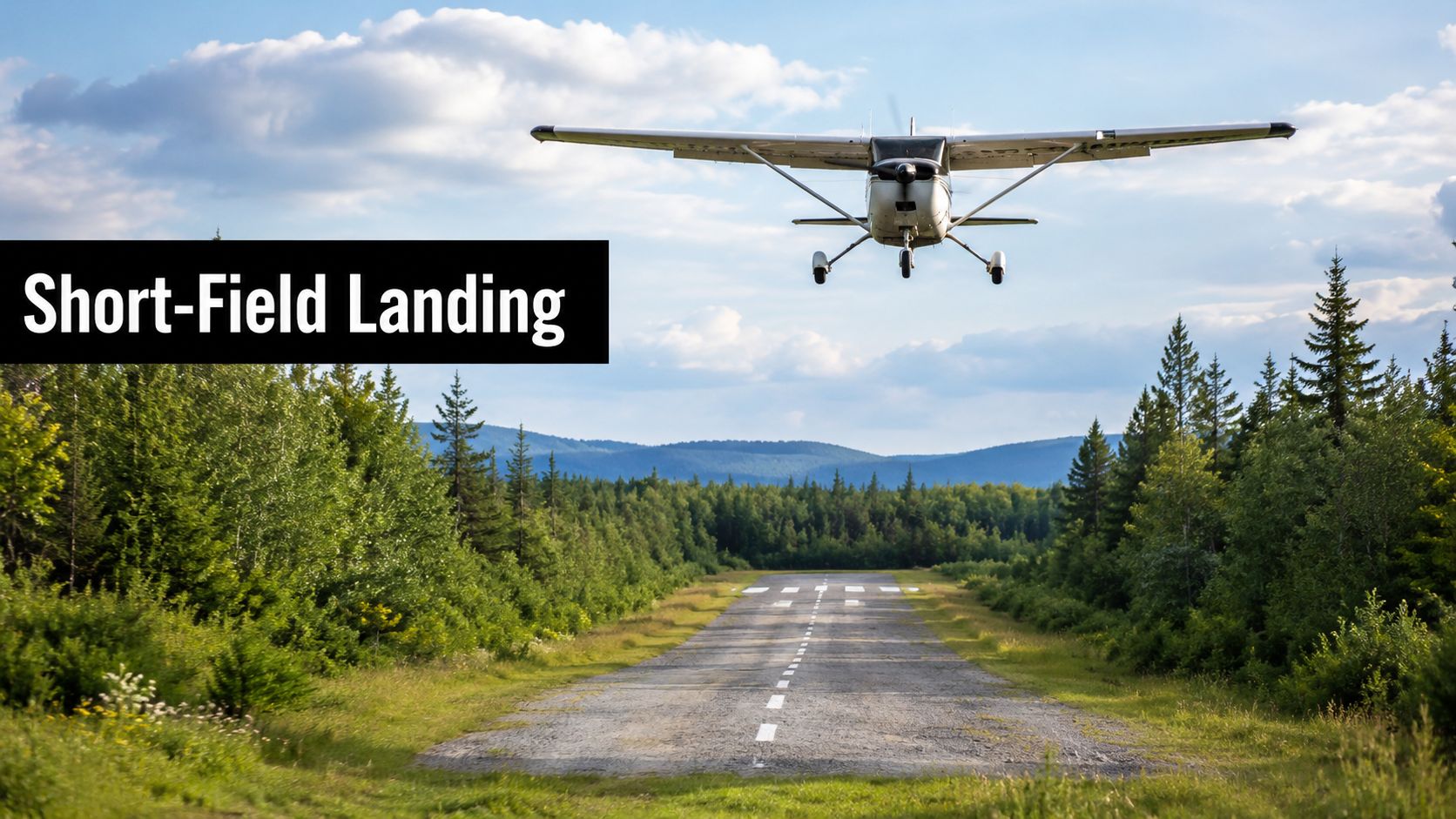
You're turning final at a field that looks comfortable from pattern altitude and suddenly feels small on short final. The threshold is coming at you faster than you expected. There's a fence off the end, maybe trees on one side, and the airplane still has more energy than you want. That's when short field landing technique stops being a checkride item and becomes real piloting.
At a busy training airport like Chino, students learn quickly that precision matters long before they ever visit a remote strip. Fast traffic behind you, radio calls in your ear, and the temptation to salvage a bad approach all expose the same truth. A short-field landing only works when the airplane is configured early, stabilized properly, and flown with discipline all the way through rollout.
Why Mastering Short Field Landings Matters
A pilot who can land short on command usually flies every other landing better too. That's because this maneuver forces you to manage the two things that drive most landing quality: energy and timing. If either one drifts, runway disappears.
Short field work also opens doors. A lot of interesting destinations don't offer a wide, forgiving runway with room for float, indecision, or sloppy airspeed. If you want access to smaller airports, mountain strips, grass runways, or confined fields, you need a repeatable method instead of hope. Good judgment starts with honest planning, including a proper look at landing distance calculation methods.
Precision beats bravado
Students sometimes think this is about “putting it down hard” or dragging it in as slowly as possible. It's neither. The skill is arriving over your chosen point with the right configuration, the right airspeed, and enough control margin to finish the flare without float.
At KCNO, where the environment stays busy and distractions are real, that discipline pays off everywhere. If you can hold a stabilized final while talking to tower, spacing with other traffic, and resisting the urge to chase every needle movement, your normal landings improve too.
Practical rule: A short-field landing is won before the flare. If final is unstable, the runway is already shrinking.
The habit that carries over
This maneuver builds habits that transfer directly to crosswind landings, power-off accuracy work, soft-field technique, and instrument flying. You get better at trimming for target speed, spotting trend changes early, and making an immediate go-around decision without ego.
That last point matters. A pilot who insists on “making it work” on a short runway often creates the exact problem they were trying to avoid. A pilot who goes around early protects both the airplane and the runway available.
Planning Your Approach Before You Leave the Ground
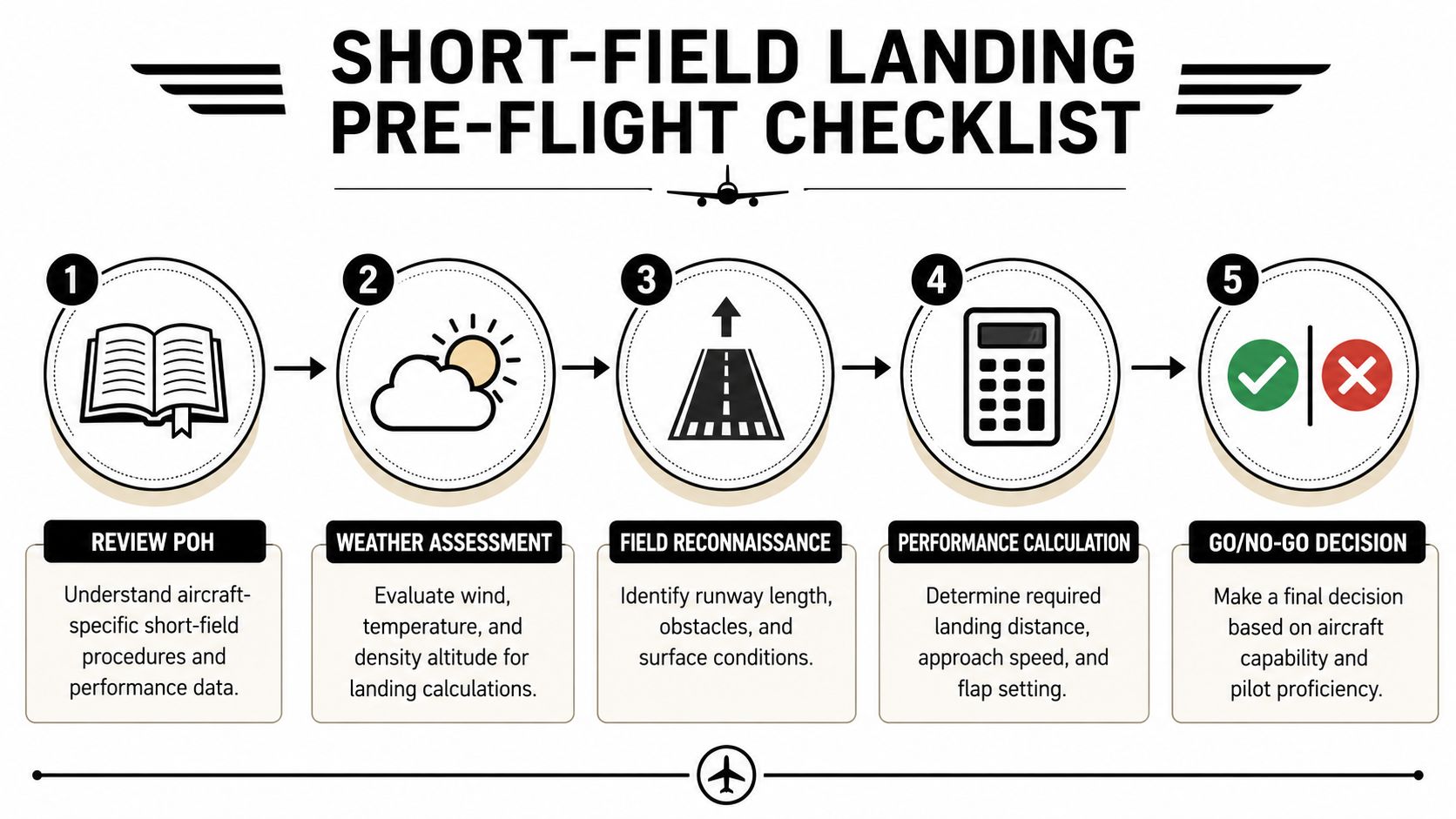
Short-field landings start on the ground, not on base leg. If you're figuring out flap setting, runway condition, and expected stopping distance while turning final, you're late. By the time the wheels leave the pavement at departure, you should already have a clear idea of what kind of landing the destination demands.
The first place to look is the POH. It tells you what the airplane was tested to do, in a specific configuration, under specific conditions. It does not promise that performance on a hot afternoon, with extra weight, a less-than-perfect touchdown, or a rough runway.
Build the landing before you fly it
Use the POH, weather, and airport data together. Don't read each item in isolation. A short runway with no wind can be more demanding than a longer runway with a healthy headwind, and an apparently simple paved strip can become a poor choice when density altitude climbs and your airplane is heavy.
A disciplined preflight review usually includes:
- Aircraft configuration. Confirm the published short-field flap setting, approach configuration, and landing data in the POH.
- Weather and wind. Look at temperature, pressure altitude, and the expected wind on arrival. Tailwind on a short runway changes the entire decision.
- Runway environment. Check length, obstacles, slope, surface, and whether there's room for an overrun if things don't go perfectly.
- Personal proficiency. Be honest about whether you've done this recently in that airplane, not just whether the book says it's possible.
For a useful refresher on reading and applying the numbers correctly, review aircraft performance charts for training flights.
Don't confuse legal with smart
One of the biggest mistakes newer pilots make is treating published performance like guaranteed real-world outcome. The chart may show the airplane can stop within a certain distance under test conditions. That doesn't mean you will if you float, touch down long, hesitate on braking, or arrive even a little fast.
That's why I tell students to make two decisions before departure. First, can the airplane do it on paper? Second, can you do it today, in these conditions, with margin? If either answer feels shaky, choose another airport or get more dual before trying to prove a point.
The runway doesn't care whether your plan was almost good enough.
A practical mental rehearsal
Before descent, rehearse the landing in plain language. Know the touchdown point you want. Know where the go-around line is in your head. Know what “unstable” will mean for that approach.
A simple self-brief works well:
- Identify the point where you want the mains to touch.
- Visualize the obstacle picture and the glide path you need.
- Commit to the configuration you'll use on final.
- Set a go-around trigger if speed, alignment, or sink rate gets away from you.
- Plan the rollout so braking and directional control aren't an afterthought.
That kind of briefing keeps you from improvising under pressure. Good short field landing technique rarely looks dramatic from the cockpit. It looks calm, quiet, and decided.
Flying a Precise and Stabilized Approach
The short-field approach lives or dies on consistency. Students often focus on the touchdown point and ignore the path getting there. That's backward. If the path is wrong, the touchdown point becomes luck.
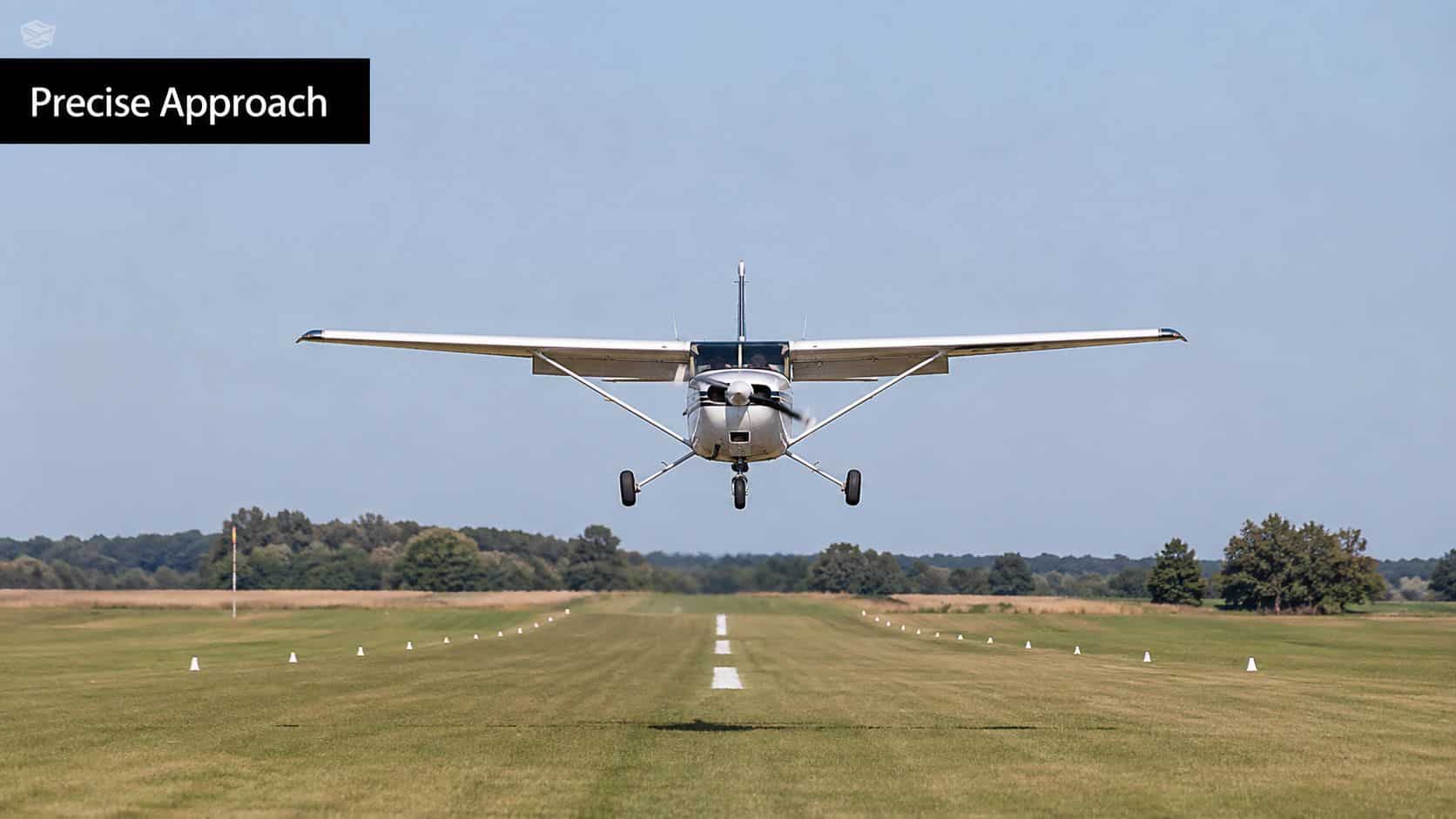
A strong short-field approach starts by being fully configured and stable early, not by diving for the runway late. A verified training reference notes that a critical step is precise airspeed control at 1.3 Vso using full flaps, with a stabilized approach established at least ½ mile before the threshold and by 400 feet AGL. The same guidance also notes that pilots should aim about 100 feet ahead of the intended touchdown point to account for float, using runway markings as a reference where centerline stripes are 120 feet and gaps are 80 feet, creating a 200-foot visual window, then touch down firmly on the mains at the minimum controllable airspeed just above stall speed (short-field landing methodology reference).
Separate the aiming point from the touchdown point
Often, many students finally gain a clear understanding of the maneuver. Your aiming point is where the airplane would hit if you never flared. Your touchdown point is where the wheels meet the runway after the roundout and flare. They are not the same thing.
If you aim at your touchdown spot, you'll usually land long. The airplane still has to transition from descent to landing attitude, and that takes distance. On a long runway, that float just looks untidy. On a short runway, it costs runway you may need.
A simple runway example helps. If you want the mains down on a specific set of markings, pick an aiming point ahead of it and watch whether that point stays fixed in the windshield. If it moves up, you're getting low. If it slides down, you're getting high. Students at towered airports learn this quickly because they don't have time to guess.
Control path with power and speed with pitch
That statement gets repeated in training, but it only becomes useful when you apply it gently. On a short-field final, abrupt changes are usually bad changes. Large throttle movements create sink or float. Big pitch changes ruin your speed control.
Use small corrections. Trim matters here more than students think. If the airplane is properly trimmed in landing configuration, it stops fighting you and starts giving honest feedback. You can feel the trend sooner and fix it with less input.
Watch for these signs that the approach is no longer worth salvaging:
- Airspeed won't settle at target without constant chasing.
- Power is moving too much because you're correcting late.
- The aiming point wanders around the windshield.
- Alignment degrades as you try to fix everything at once.
If any of that continues low on final, go around.
What it should look like from the cockpit
A good short-field final doesn't feel rushed. It feels locked in. Full flaps are already set. The descent angle is steady. You're not guessing whether you'll make the spot. You know.
That's also why longer finals help in training. They give you time to stabilize, trim, and verify that the runway picture stays consistent instead of changing every few seconds.
For a cockpit view that helps students connect the visual sight picture to the control inputs, this demo is worth studying:
Real-world trainer differences
In a Cessna 150, students often carry extra speed because the airplane feels honest and forgiving. That extra speed usually turns into float. In a Piper Cherokee, the picture can encourage a flatter arrival if the pilot waits too long to reduce energy. In a Mooney M20B, the lesson gets sharper. A cleaner, faster airplane punishes lazy stabilization because excess speed takes longer to disappear.
That's why the same short field landing technique can't be flown by vibe alone. The principle stays constant. The sight picture, sink response, and energy bleed are aircraft-specific.
Touchdown Technique and Decisive Go-Arounds
A short-field landing isn't judged by how pretty the touchdown sounds. It's judged by whether the airplane lands on the spot, stays on the mains, and decelerates efficiently without drama.
That's why the “greaser” mindset causes trouble here. If you keep trying to hold the airplane off for a silky touchdown, you often burn runway in float. For a short-field landing, a firm, controlled touchdown on the main wheels is usually the correct result.
What good touchdown timing feels like
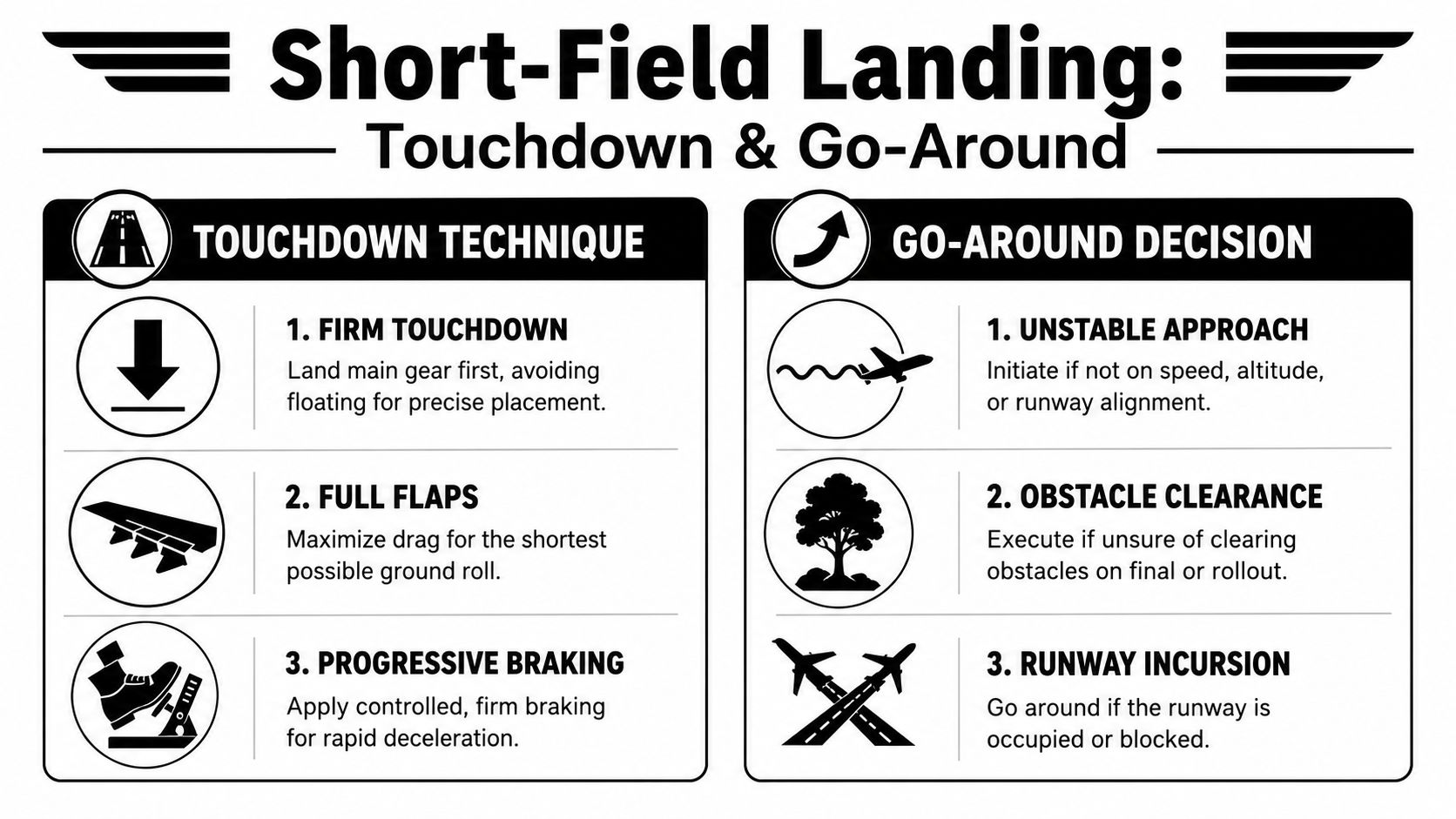
As the flare begins, start taking out the last bit of power smoothly. Don't chop it unless the airplane's energy state clearly calls for it. A verified training source points out that abrupt throttle reduction can make the airplane “flop” onto the runway instead of easing down, which leads to bounce or overshoot. The same guidance emphasizes gradually closing the throttle during the flare, then using aerodynamic braking with back pressure to improve braking effectiveness, while applying wheel brakes gently at first and increasing pressure as speed falls to avoid lock-up and tire sliding (short-field touchdown and braking guidance).
Aerodynamic braking needs timing
Students hear “hold the yoke back” all the time, but the timing is what matters. The goal isn't to yank the nose up dramatically. The goal is to keep weight where it helps, increase aerodynamic drag, and let the brakes do their job once the airplane is ready to accept them.
That sequence is more coordinated than forceful:
- Touch mains first and let the airplane settle, not skip.
- Increase back pressure progressively so drag builds while the airplane stays planted.
- Begin braking smoothly instead of stabbing at the pedals.
- Add brake pressure as speed decays and the chance of a skid drops.
A lot of weak rollouts come from doing one part right and the next part late. The airplane touches down near the spot, then the pilot relaxes. On a short runway, the rollout is part of the maneuver, not the cleanup.
Cockpit reminder: If the airplane is bouncing, floating, or refusing to settle where planned, stop trying to rescue it. Add power and go around.
Know your go-around triggers in advance
The best go-around decision happens early enough that it feels boring. Waiting until the airplane is half-flared, drifting, fast, and long is how pilots turn a manageable problem into a poor landing.
Here are objective reasons to discontinue the approach:
| Situation | What it means |
|---|---|
| Airspeed unstable | You won't get a predictable flare or touchdown point |
| Aiming point not steady | Glide path control is gone |
| Excess float developing | You're spending runway instead of saving it |
| Bounce after touchdown | The landing sequence is no longer controlled |
| Runway conflict or uncertainty | The safe option is to leave and try again |
One habit I push hard is verbal commitment. If you're not stabilized by the point you briefed, say “going around” out loud and do it. Speaking the decision helps break the tendency to keep negotiating with a bad approach.
What doesn't work
Some techniques fail almost every time on short runways:
- Dragging it in with random power changes. That creates an unstable descent and poor timing in the flare.
- Chopping power too early. The airplane sinks and arrives ugly.
- Forcing the nose down after touchdown. That reduces aerodynamic braking and can make braking less effective.
- Jamming brakes immediately. Locked or sliding tires don't help you stop.
The pilots who become accurate in this maneuver aren't aggressive. They're orderly. Their landing sequence has structure, and they abandon the plan the moment the airplane stops matching it.
Aircraft-Specific Speeds and Simulator Drills
One reason students struggle with short-field work is that they want one memorized number to solve every approach. That's not how good pilots land. The book number is your starting point. The actual target depends on the airplane, its weight, and what the wind is doing.
A useful training perspective notes that an underserved part of this topic is dynamic adjustment of approach speed based on actual aircraft weight and wind conditions, rather than treating the 1.2 to 1.3 Vso idea as fixed law. That same discussion argues that tailoring speed closer to minimum controllable airspeed for the actual airplane and the actual weather reduces float and improves accuracy (dynamic short-field speed discussion).
Common trainers compared
Below is the structure I teach students to use. The exact speed must come from the POH for the aircraft, at the weight and configuration you're flying.
| Aircraft | Configuration | Target Approach Speed (1.3 Vso) |
|---|---|---|
| Piper Cherokee | Full landing configuration per POH | Use POH-derived 1.3 Vso target |
| Cessna 150 | Full landing configuration per POH | Use POH-derived 1.3 Vso target |
| Mooney M20B | Full landing configuration per POH | Use POH-derived 1.3 Vso target |
The comparison matters because each airplane carries and sheds energy differently. A Cherokee often lets students settle into a stable picture if they trim carefully. A Cessna 150 rewards precision but exposes extra speed quickly because float becomes obvious. A Mooney M20B teaches respect for planning because being a little fast tends to stay with you longer.
Adjusting without guessing
Judgment, rather than rote recitation, becomes paramount. If the airplane is lighter than max gross, the POH speed may need thoughtful adjustment based on approved procedures and instructor guidance. If the wind is gusty, adding speed blindly can create more float than safety. If conditions are calm and the airplane is light, carrying excess speed often solves nothing.
I like students to think in terms of necessary energy, not comfort speed. You need enough to control the flare and no more.
For pilots who want a structured way to measure whether practice is improving decision-making and consistency, the ideas in these frameworks for training impact are useful. The value isn't corporate jargon. It's that measurable practice beats repeating the same weak habit.
Simulator drills that actually help
A simulator won't replace runway sight picture, but it can sharpen decision timing and workflow. A good session in a Redbird flight simulator for landing practice should focus on repetition with purpose, not sightseeing.
Try drills like these:
- Stabilized final repetition. Fly repeated finals where the only goal is configuration, trim, and target speed discipline.
- Go-around decision practice. Deliberately create unstable approaches and execute the go-around at the pre-briefed trigger.
- Cross-condition comparison. Practice the same runway in calm wind, gusts, and different loading scenarios to see how speed choices affect float.
- Touchdown coordination. Rehearse the transition from flare to aerodynamic braking so your hands and feet stay ordered.
The sim is especially good for teaching restraint. Students can see how often they make large corrections when small ones would have worked better.
From Proficient Renter to Safe Aircraft Owner
Once pilots build confidence with techniques like short-field work, ownership starts to look less distant. That's when people begin shopping for airplanes and helicopters, and that's also when mistakes get expensive. If you're thinking about how to buy an airplane the safe way, the first rule is simple. Don't fall in love with paint, avionics, or a polished sales pitch before you understand the airplane's paper and mechanical condition.

AOPA's used aircraft buying guidance notes that a proper pre-purchase inspection must include at least a differential compression check on each cylinder, plus a thorough review of FAA Form 337 and Airworthiness Directive compliance in the logbooks (AOPA used aircraft buying guidance). That's not paperwork trivia. It's where hidden problems often show up.
What buyers and sellers should pay attention to
If you're buying, use an inspection shop that has no connection to the seller. If you're selling, organized and complete logs help serious buyers trust what they're looking at. Missing records, long gaps in operation, and vague repair history all create friction.
A practical community recommendation is to pay for about 6 hours of digging through the records during the pre-buy process so someone can identify missing years, long periods of disuse, or signs of major repair, and to keep the inspecting shop totally unaffiliated with the seller (pilot discussion on pre-buy logbook review). That advice applies whether you're looking at an airplane or a helicopter. The machine may be beautiful on the ramp and still be a poor purchase.
People looking to buy or sell airplanes and helicopters usually focus first on price and appearance. Experienced owners focus first on inspection quality, record integrity, and whether the aircraft has been maintained in a way that supports safe flying after the sale.
If you want to sharpen your short field landing technique, build confidence in busy airspace, or get guidance as you move from renter to aircraft owner, DuBois Aviation offers airplane and helicopter training, rentals, and simulator sessions at Chino Airport with experienced instructors who teach for real-world proficiency.