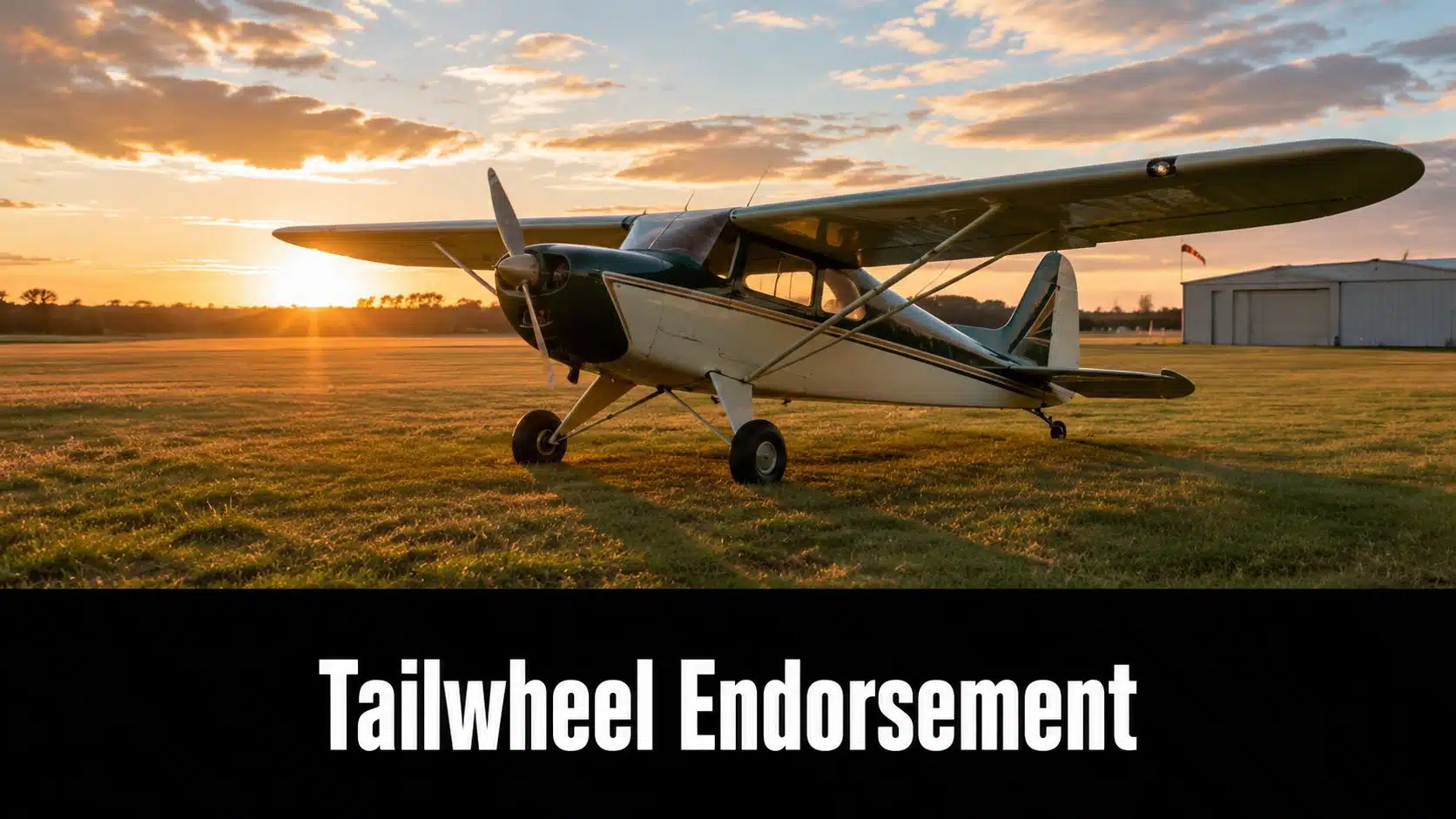
You're probably in one of two places right now. You've flown tricycle-gear airplanes long enough to know you want sharper hands and feet, or you've started looking at Cubs, Citabrias, Champs, Huskys, or even a helicopter and realized the next step in your flying life may involve more than just another rating.
That's where the tailwheel endorsement becomes more than a line in a logbook. It becomes a filter for judgment. It teaches you whether you're really flying the airplane all the way through rollout, whether you understand energy instead of just memorizing speeds, and whether your feet are actually participating in the landing. For a lot of pilots, it's the training that reconnects flying with airmanship.
It also opens a practical door. Many pilots who earn a tailwheel endorsement eventually start shopping for an airplane, and some start comparing airplanes with helicopters as mission tools for recreation, training, or personal travel. The smart path is the same in both cases. Train first, learn what kind of flying you enjoy, then buy carefully.
Why You Should Earn a Tailwheel Endorsement
A tailwheel airplane has a way of making you honest. It doesn't let you land a little crooked, get lazy with rudder, or mentally clock out once the mains touch. That's why so many pilots come out of tailwheel training better in every airplane they fly, not just conventional gear.
The appeal starts with the airplanes themselves. Classic fabric-and-tube machines, bush-capable aircraft, nimble aerobatic trainers, and a long list of older utility airplanes live in the tailwheel world. Flying them is fun. More important, learning to fly them well builds habits that transfer directly to crosswind work, short and soft field discipline, and directional control.
It sharpens the part of flying that matters most
Most pilots can hold altitude and heading in cruise. Distinguishing skill emerges close to the ground, when the airplane is slowing down, the controls are changing feel, and small mistakes start stacking up.
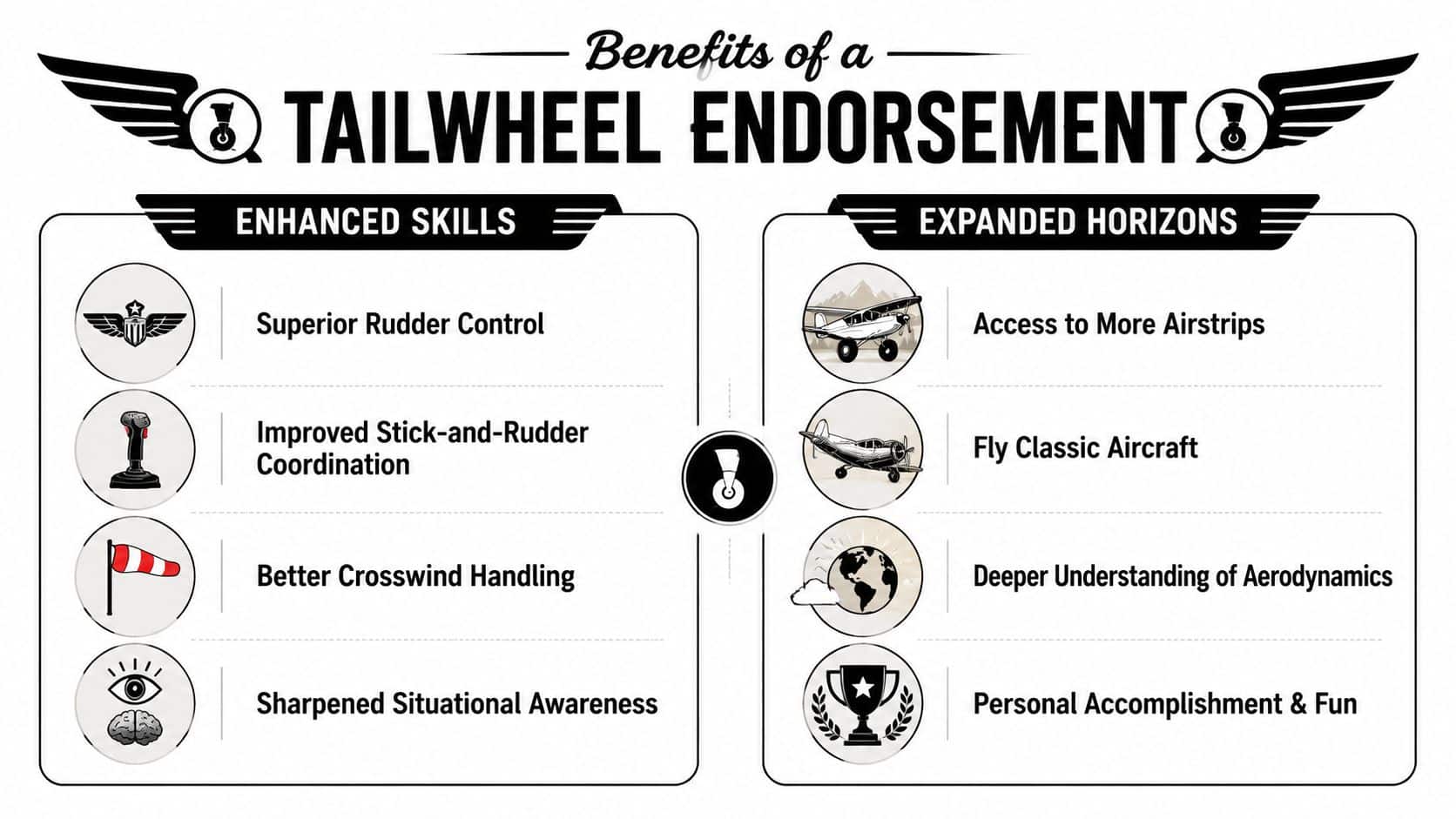
Tailwheel training improves:
- Rudder discipline. You stop thinking of rudder as occasional correction and start using it continuously.
- Sight picture judgment. You learn to feel what “straight” and “aligned” look like, not what you hope they look like.
- Crosswind confidence. You get quicker at recognizing drift, yaw, and whether the airplane is still under control.
- Rollout focus. You learn that the landing isn't over until the airplane is parked or clear of the runway.
Practical rule: If tailwheel training feels busy, that's not a flaw in the airplane. It's the airplane showing you where your attention needs to be.
There's also a pride factor here, and I mean that in the healthy sense. A tailwheel endorsement is a visible sign that you cared enough to improve your airmanship instead of settling for minimum comfort.
The safety case is real
The numbers matter because they explain why this training exists. A study summarized by General Aviation News reports that tailwheel airplanes account for 12% of all general aviation accidents, and 58% of nose-over or nose-down accidents specifically involve tailwheel airplanes, which is why specialized training for ground handling matters so much (General Aviation News coverage of the de Voogt and Louteiro study).
That shouldn't scare you away from tailwheel flying. It should push you toward doing it properly.
Here's the trade-off in plain language:
| What attracts pilots | What the airplane demands |
|---|---|
| Classic handling and fun | Precise directional control |
| Access to unique aircraft | Better crosswind technique |
| Stronger stick-and-rudder skills | More disciplined landings |
| Potential insurance benefits after training | Ongoing currency and humility |
Pilots who approach tailwheel flying with respect tend to come out of it more capable. Pilots who treat it like a novelty usually struggle.
Mastering the Tailwheel Training Syllabus
The regulation gives a checklist. Good instruction gives you a mental model.
A proper tailwheel syllabus teaches normal and crosswind takeoffs and landings, wheel landings where appropriate, and go-arounds. But the reason students struggle usually isn't because they forgot a step. It's because they haven't connected the airplane's behavior to the control input that fixes it.
Why the airplane feels different
In a tailwheel airplane, the center of gravity and gear geometry make ground handling less forgiving than in a tricycle-gear trainer. The airplane wants active management. During takeoff and landing, yaw shows up quickly, and if you wait to react, you're already behind it.
Three aerodynamic ideas matter every lesson:
- P-factor pulls when power and angle of attack combine.
- Torque reminds you that power changes don't happen in a vacuum.
- Spiraling slipstream changes how the vertical tail gets hit by propwash.
Students don't need a lecture full of buzzwords. They need to connect those effects to a simple cockpit truth: your feet can't be passive.
The two landings every student must understand
The full-stall three-point landing and the wheel landing are not competing religions. They're tools. A good pilot learns both and knows why one fits a condition better than the other.
A three-point landing rewards patience and good alignment. If the attitude, energy, and centerline control are right, the airplane settles with little drama. But if a pilot forces it on or lets yaw develop, the landing degrades fast.
A wheel landing is different. You arrive with intent, place the mains on, and manage the airplane while keeping the tail from dropping too early. Done well, it can be excellent in certain wind and runway conditions. Done poorly, it turns into bounce management.
The hard part isn't choosing three-point or wheel. The hard part is arriving over the runway with the airplane already stable enough that either choice works.
What usually separates fast learners from slow learners
It's rarely raw talent. It's attention and timing.
The pilots who progress quickly tend to do a few things well:
- They look far enough ahead during takeoff and rollout.
- They make small rudder corrections early instead of large corrections late.
- They accept go-arounds without ego.
- They keep flying after touchdown instead of relaxing.
A specific technical error deserves emphasis. A PilotWorkshops discussion of tailwheel operations notes a critical pitfall with propeller blast management: pilots must hold the elevator fully aft before adding run-up power so prop blast doesn't raise the tail prematurely and drive the propeller into the ground.
That's a perfect example of the “why” behind tailwheel instruction. A student may memorize where the stick goes. A pilot understands what the propeller blast is trying to do and gets ahead of it.
What works in training, and what doesn't
Some habits help almost immediately:
- Chair-fly the feet. Rehearse takeoff and landing footwork before engine start.
- Use stop-and-goes instead of rushing touch-and-goes. Reset the brain each lap.
- Debrief the rollout, not just the touchdown. Most preventable trouble starts after the wheels are on.
- Ask for wind limits that match your current skill. Confidence should be earned, not borrowed.
What doesn't work:
- Trying to “muscle” the airplane straight.
- Staring too close over the nose.
- Treating the endorsement as a box to check.
- Flying only in calm conditions, then assuming you're finished.
Good tailwheel training creates active feet, disciplined eyes, and a calm decision-making loop. That's the actual syllabus.
Estimating Your Time and Financial Investment
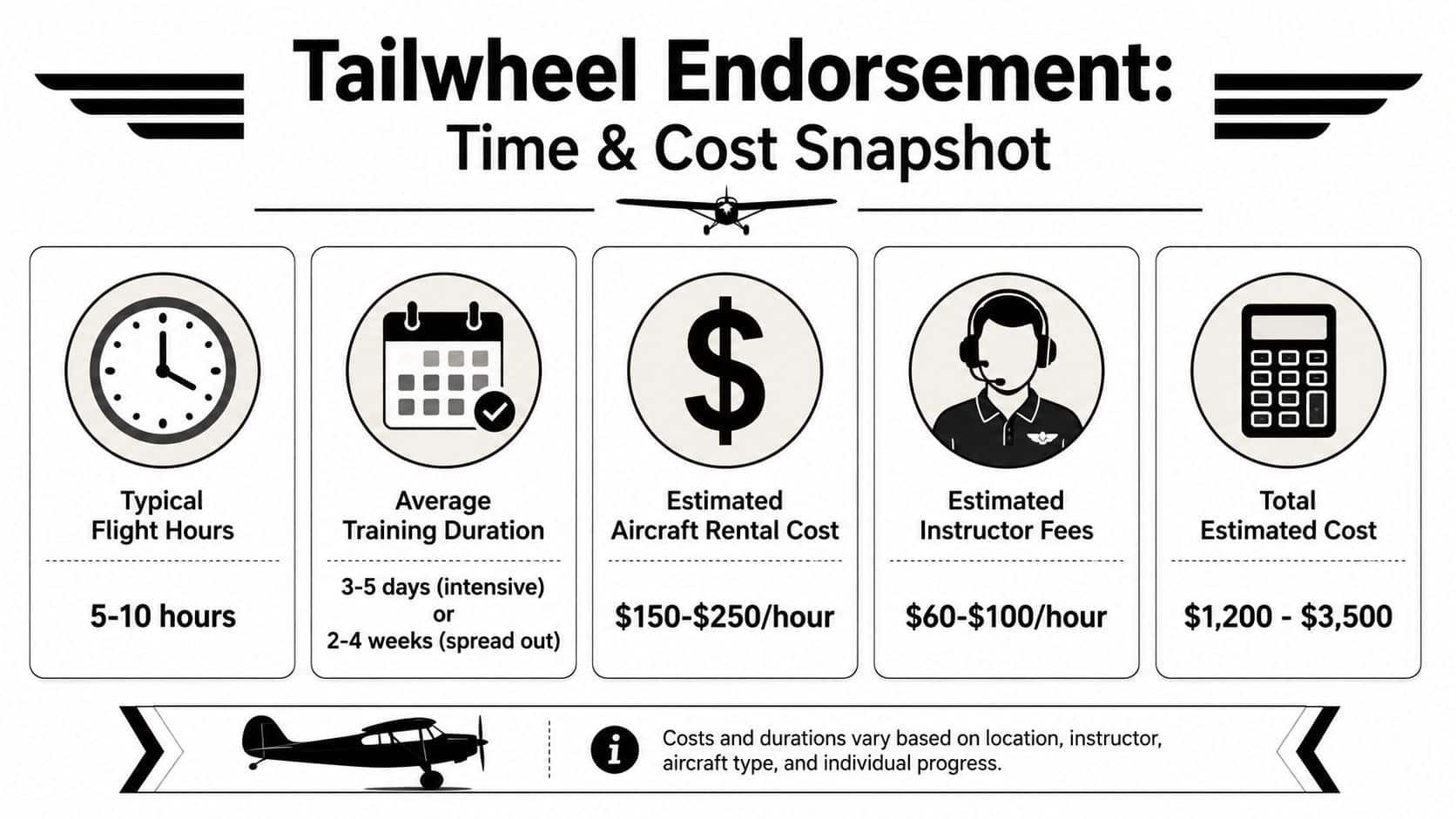
Most pilots ask two questions first. How long will this take, and what will it cost? The honest answer is that tailwheel training is proficiency-based under 14 CFR 61.31(i), so the FAA doesn't impose a minimum hour requirement. You earn the endorsement when you can perform to standard, not when you hit an arbitrary number.
The practical range is still useful. According to AOPA's explanation of ratings and endorsements, there's no minimum number of flight hours legally required for a tailwheel endorsement. In practice, many pilots need enough time to become comfortable with normal and crosswind takeoffs and landings, wheel landings where appropriate, and go-arounds.
What a realistic budget looks like
A commonly cited training benchmark is 8 to 10 hours of dual for many pilots to reach proficiency, with total training costs often falling in the $1,000 to $2,300 range. Intensive 3-day courses can run about $2,325 to $2,750 (tailwheel training cost discussion).
Those numbers move for reasons that make sense:
| Cost driver | What it changes |
|---|---|
| Your recent currency | Less time shaking off rust |
| Crosswind experience | Faster progress in the pattern |
| Aircraft type | Rental and handling differences |
| Training format | Intensive courses versus spread-out lessons |
| Instructor style | Efficient correction versus repeated re-learning |
If you're already budgeting for broader training, a breakdown of flight school costs in Chino can help you frame where a tailwheel block fits within your larger aviation plan.
Time is not the same as readiness
A pilot with solid coordination may move through the endorsement quickly. Another pilot may need more time even with plenty of total hours. That's normal. The endorsement doesn't reward accumulated logbook volume. It rewards control, consistency, and judgment.
This video gives a useful visual sense of what tailwheel operations demand in actual practice.
Budget for enough lessons that you don't feel pressured to “pass” on a specific day. Pressure creates rushed decisions, and rushed decisions show up first in the flare and rollout.
The best mindset is simple. Plan for a realistic block of training money, show up current, and let proficiency decide the finish line.
Finding the Right Tailwheel Instructor and School
Your instructor matters more in tailwheel than many pilots realize. A sharp tailwheel CFI doesn't just save you time. They shape the habits that keep you out of trouble later, when the runway is narrow, the crosswind is honest, and there's no one in the right seat.
One of the biggest gaps in this area is ground instruction. The rule requires logged flight training for the endorsement, but it does not explicitly require the same formal ground training structure that complex and high-performance endorsements do. AOPA's You Can Fly discussion highlights that gap and the risk that students may miss essential theory on slipstream dynamics and energy management if an instructor doesn't teach it deliberately (AOPA You Can Fly question on endorsement ground training).
What to look for in a serious tailwheel CFI
You want someone who teaches causes, not just corrections.
A strong instructor will usually do these things:
- Explains energy early. Not just “hold it off,” but why the airplane reacts the way it does when speed decays.
- Uses conditions as a teaching tool. Not reckless winds, but real-world variation instead of calm-air-only training.
- Debriefs specifically. “You drifted left at touchdown because your right rudder arrived late” is useful. “Work on landings” isn't.
- Knows when to pause. Some students need one more lap. Others need to stop, reset, and talk.
The wrong fit usually sounds different. They rush through ground discussion, focus on the signed endorsement more than the process, or can fly the airplane beautifully without being able to explain what they're doing.
Questions worth asking before you book
Don't be shy about interviewing the instructor.
Ask things like:
- How do you teach the difference between a three-point and a wheel landing?
- How much time do you spend on ground discussion before flying?
- How do you approach crosswind progression?
- What do students usually struggle with in rollout?
- Do you tailor the pace, or is the course mostly fixed?
A school with a broad instructor bench can also help if you want to compare teaching styles or need a schedule that supports consistent flying. Reviewing a team page like the DuBois Aviation instructors and staff roster is one practical way to see the range of instructor backgrounds available at a training operation.
A great tailwheel instructor makes the airplane feel understandable, not mysterious.
That's what you're paying for. Not just access to an airplane, but access to judgment.
From Endorsement to Ownership How to Buy an Airplane
A lot of pilots get their tailwheel endorsement and then start shopping. Sometimes it's a first airplane. Sometimes it's a move into a classic airplane, a utility taildragger, or even a helicopter for a different mission. The mistake is buying first and learning the mission later.
The safer path is to define how you will fly, then buy around that reality. Weekend fun, backcountry aspirations, local proficiency flights, family travel, helicopter training, or time-building all point toward different aircraft choices. The endorsement helps you discover what kind of owner you're likely to be.
The safest first moves
Before you contact a seller, have your money and paperwork framework ready. A widely shared buying guide in the flying community recommends having funds secured and a proposed purchase agreement drafted before reaching out to sellers. It also recommends a careful logbook review costing about $250 to $300 before commissioning the bigger pre-buy process, and prioritizing aircraft where at least one big-ticket item such as Engine, Paint, or Avionics is already done, since each of those can cost $25,000 or more (aircraft buying checklist discussed by pilots).
That advice is practical because ownership decisions are often lost before the airplane is ever flown. Missing logs, years of inactivity, old damage history, and deferred major expenses can turn a “deal” into a long grounding period.
A buying checklist that keeps you out of trouble
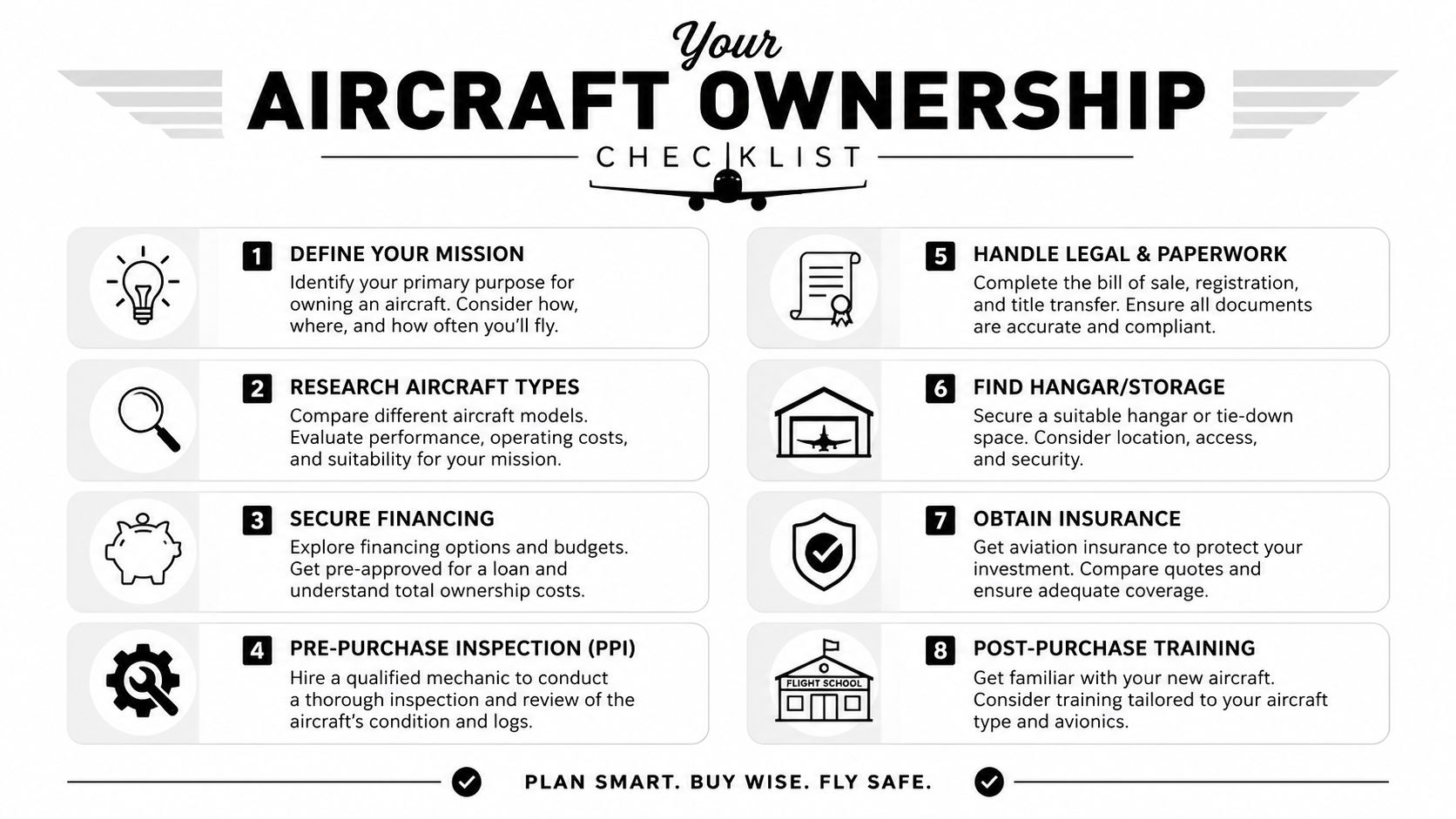
Here's the sequence I'd use for an airplane or helicopter purchase:
- Define the mission first. Don't shop by paint color or panel photos. Shop by runway needs, passenger needs, useful load, and the kind of flying you will do.
- Keep the budget conservative. A video discussion on aircraft budgeting recommends avoiding aircraft priced above 50% of your total affordable budget and setting a 20% to 30% buffer below your maximum so you don't end up skimping on maintenance.
- Review logs before emotions take over. You're looking for gaps, long idle periods, major repairs, and evidence of consistent care.
- Use an independent pre-buy shop. The inspection needs to come from someone unaffiliated with the seller.
What buyers often underestimate
The purchase price is only the opening number. Insurance, transition training, storage, deferred maintenance, and downtime all arrive quickly. That's why buying an aircraft with one major expensive item already complete can be smarter than buying the cheapest airframe on the market.
A structured marketplace can help you compare options and think in terms of mission instead of impulse. If you're browsing with that mindset, the DuBois Aviation aircraft sales page is a useful place to start looking at available aircraft categories.
For helicopters, the principle is the same even though the operating picture differs. Buy around supportability, training access, maintenance realities, and your intended mission. If you can't clearly explain why the aircraft fits your mission, you're not ready to own it yet.
Logbook Entries and Regulatory Need-to-Knows
The endorsement itself is simple. The training behind it is not.
Under 14 CFR 61.31(i), the tailwheel endorsement is based on demonstrated proficiency. Your instructor must see consistent performance in the required areas and then make the proper logbook entry. The exact wording your CFI uses should match current FAA guidance and accepted endorsement language, so the best practice is to use the FAA's current endorsement format directly from the instructor's reference materials rather than relying on memory or an internet paraphrase.
The misconception that causes legal trouble
One issue deserves a blunt answer. Some pilots still think an instructor can teach in a tailwheel airplane without personally holding the endorsement, especially if that instructor already has advanced ratings or old “grandfathered” assumptions in mind.
That's wrong. FAA legal interpretations have made clear that the person performing the flight must have the tailwheel endorsement. That means a CFII teaching in a tailwheel aircraft without the endorsement is in violation. A recent discussion summarizing that point notes that this misconception remains common and creates unnecessary liability for instructors who assume their other privileges cover it (FAA interpretation discussion on tailwheel instructor responsibility).
What belongs in your logbook mindset
The endorsement is not the finish line. It's permission to keep learning in an airplane that rewards precision and punishes complacency.
Keep these points in mind:
- Carry the right endorsement. Student, owner, or instructor, the person flying must be legal.
- Stay current, not just endorsed. Tailwheel skill fades when your feet get quiet.
- Respect rollout every time. Most tailwheel embarrassment starts after touchdown.
- Treat transition training seriously after purchase. Endorsement proficiency in one model doesn't automatically equal comfort in another.
A pilot who earns a tailwheel endorsement properly usually becomes more measured, more coordinated, and more honest about personal limits. That's a strong outcome whether you stop at the endorsement, buy a classic airplane, or use the experience to guide a future airplane or helicopter purchase.
If you want training that emphasizes safety, proficiency, and practical airmanship, DuBois Aviation is a strong place to continue your flying journey, whether you're working toward your next certificate, sharpening your skills, or exploring the path from training to aircraft ownership.