You've probably had this moment already. You finish a clean flight in a piston airplane or helicopter, walk past a turbine machine on the ramp, and stop for a second. The panel looks more serious. The checklist looks longer. The airplane or helicopter looks like it belongs to a pilot with sharper habits, better systems discipline, and a bigger margin for error only if they've earned it.
That mix of ambition and hesitation is normal.
Turbine transition training sits right in that gap. It's the bridge between being comfortable in what you know and becoming competent in an aircraft that punishes casual thinking faster. The training matters for safety, but it also matters for career timing, insurance conversations, and for some pilots, the next serious move after training: buying and operating a turbine aircraft of their own.
The View from the Right Seat
A solid piston pilot usually doesn't struggle with the basic idea of flying a turbine aircraft. The challenge is that turbine flying changes what demands your attention. In a piston machine, many pilots spend a lot of mental energy on engine handling cues they've built over time. In a turbine aircraft, you need to think farther ahead, manage systems earlier, and stay ahead of the aircraft when things are still calm.
I've watched that transition go well when the pilot arrives humble, prepared, and ready to slow down their thought process before they speed up the aircraft. I've also seen capable pilots make it harder on themselves by treating turbine transition training like a box to check for a logbook line.
The pilots who do best usually aren't the boldest. They're the ones who brief carefully, ask precise questions, and don't rush the setup.
The appeal is obvious. Turbine aircraft bring more capability, more useful mission profiles, and a more professional operating environment. For career pilots, they can open doors. For owner-operators, they can turn a long travel day into a workable schedule and expand what the aircraft can do for family, business, or utility flying.
What changes when you move up
A turbine aircraft often compresses your decision time. Energy management becomes less forgiving. Normal procedures matter more because they shape how well you'll handle abnormal ones. Small lapses that were survivable in a forgiving trainer can become expensive, or dangerous, in a higher-performance platform.
That's why good turbine transition training doesn't start with speed. It starts with discipline.
What this step is really for
The point isn't to make you look turbine-qualified on paper. The point is to make you predictable in the cockpit. Predictable pilots run stable checklists, brief clearly, catch errors early, and don't let workload stack up.
That's the essential threshold. Once you understand that, the training becomes much more useful and much less mysterious.
Preparing for Your Transition Prerequisites and Mindset
You can spot the pilot who arrived ready for turbine transition in the first hour. The cockpit stays organized. Briefs are short and clear. They are ahead of the aircraft before the start sequence, not chasing it after liftoff. The pilot who struggles usually has the same problem. Too much spare capacity is already being spent on basics that should have been settled before training started.
A turbine course teaches turbine procedures. It does not repair weak IFR habits, poor checklist discipline, or inconsistent aircraft control.
The practical prerequisites
Start with an honest standard, not a legal minimum. You may be allowed to begin training before your skills are sufficiently ready, but that does not mean you will get good value from the course. Employers, instructors, and insurers care less about whether you can spell the systems and more about whether you can operate a higher-performance aircraft without creating extra risk for everyone involved.
Four areas matter before day one.
- Instrument discipline: A turbine aircraft punishes sloppiness in scan, briefing, and setup. Pilots who are still burning mental bandwidth on radios or approach organization should fix that first. If your IFR foundation needs work, instrument rating training for pilots building real IFR proficiency is often a better investment before turbine transition.
- Procedural consistency: Flows, callouts, checklist verification, and stabilized approaches should already be normal habits. If those only appear on checkrides, turbine training will expose it fast.
- Coachability: Good candidates show up ready to change how they operate. That matters even for experienced pilots. Time in type is useful. Stubbornness is expensive.
- Mission clarity: Training for a job interview, an insurance checkout, and owner-operation are different targets. Pick one before you start, because it changes how you study and what standard you should hold yourself to.
Owner-pilots need to be stricter here than they think. If you plan to buy and operate your own turbine aircraft, you are not preparing to pass a course. You are preparing to make dispatch decisions, manage maintenance risk, and say no to bad flights without another pilot in the other seat to catch you.
The mindset shift that matters
The big adjustment is not raw speed. It is task management.
Piston pilots often get away with fixing one problem at a time. Turbine flying asks for a wider scan. You are tracking power, temperature, fuel, electrical status, automation, limitations, and procedure flow while still flying accurately and staying ahead of the next decision. That is why pilots with average hands and strong discipline often outperform naturally talented stick-and-rudder pilots who run an untidy cockpit.
A repeatable cockpit routine matters more than memory. If your normal operation depends on trying to remember the next step instead of using a consistent flow backed by the checklist, your workload will spike at the worst time.
Good preparation also means studying in a way that sticks. Pilots who review systems once and hope it stays put usually waste flight time. Pilots who quiz themselves, chair-fly procedures, and apply effective learning strategies tend to show up ready to use the aircraft instead of just react to it.
What to do before day one
Keep the prep simple and specific.
- Study the target aircraft's limitations, terminology, and normal procedures. Do not try to memorize every system detail. Learn the items that drive cockpit decisions.
- Clean up your IFR workflow. Radio setup, briefing format, and approach organization should be boring by the time training starts.
- Practice flows and callouts out loud. A pilot who sounds organized usually is organized.
- Show up current and rested. Transition training is a poor place to recover from six months of rust.
- Define the actual end state. Completion is not the same as readiness. If the goal is ownership, set your standard around safe solo operation, not course graduation.
That last point gets missed all the time. A course can sign you off. It cannot make you conservative, disciplined, or prepared to own the consequences of turbine decisions. Those habits need to be in place before you ever turn the starter.
The Core Curriculum Ground School and Flight Syllabus
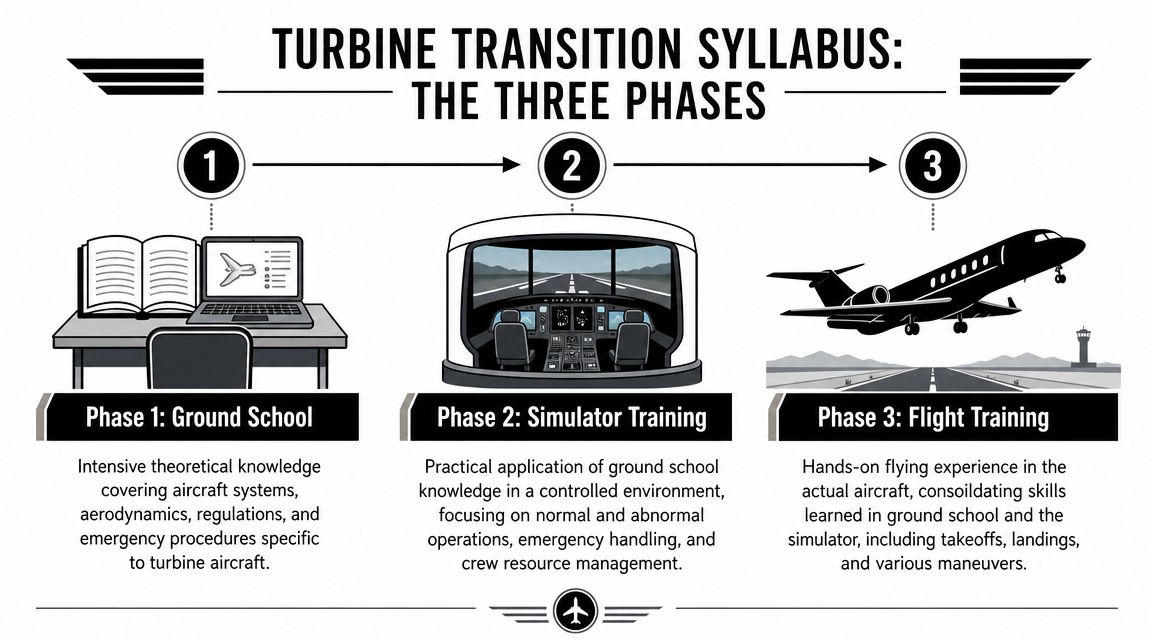
Most pilots do better once they can see the structure. A technically solid turbine transition syllabus usually follows three phases: ground school on turbine theory and aircraft systems, hands-on demonstration and practice, and then a formal evaluation. One listed program describes 5 to 10 hours of flight time plus around 12 hours of ground instruction in that transition format in its turbine transition course outline.
Ground school first, for good reason
The pilots who waste flight time are usually the ones who try to learn systems in the air. That's backward. Flight time is where you confirm decisions under workload, not where you first hear the vocabulary.
A useful ground syllabus should cover:
- Turbine engine theory: spool-up characteristics, power response, temperature awareness, and operating logic
- Terminology and limitations: if you can't speak the language cleanly, you probably don't understand the operating boundaries
- Aircraft-specific systems: fuel, electrical, hydraulics if applicable, environmental systems, and any automation you'll use
- Normal and emergency procedures: especially items that must be recognized early instead of reacted to late
If you want to apply effective learning strategies before the course, focus on transfer. Don't just memorize definitions. Practice connecting each system limitation to a cockpit decision you'll make.
Flight training is where habits get exposed
In the aircraft, the work usually centers on preflight discipline, normal operations, limitations, emergency procedures, and demonstrating competent handling. Through these activities, instructors find out whether your cockpit behavior is repeatable or accidental.
A lot of pilots expect the difficult part to be “flying the turbine.” Usually the harder part is sequencing everything on time while keeping the aircraft stabilized.
If you're still catching up to checklists on downwind or on final, the airplane is already ahead of you.
What changes by aircraft class
A turboprop syllabus and a light jet syllabus won't look identical, even when the training logic is similar. The differences usually show up in speed management, systems depth, automation use, and how quickly the aircraft can amplify a weak setup.
Sample Turbine Transition Syllabus Comparison
| Training Element | Turboprop Example (e.g., King Air 200) | Light Jet Example (e.g., Citation CJ3) |
|---|---|---|
| Ground focus | Powerplant logic, fuel and electrical systems, propeller-related procedures, performance planning | Jet engine operating concepts, pressurization, higher-speed systems management, automation discipline |
| Normal procedures | Engine start sequence, taxi technique, power setting awareness, stable approach planning | FMS or avionics workflow, faster climb and descent planning, stabilized profiles at higher speeds |
| Abnormal training emphasis | Engine indications, system malfunctions, checklist discipline, asymmetric considerations if applicable | Pressurization issues, automation surprises, higher workload during reroutes and approach changes |
| Takeoff and landing work | Torque and configuration awareness, speed control, runway and energy planning | V-speed discipline, profile management, earlier configuration decisions, precise descent planning |
| Crew mindset | Strong single-pilot organization, callout structure, systems prioritization | Even stronger workload control, automation management, and error trapping before tasks pile up |
| Evaluation standard | Safe, repeatable operation with limitations knowledge and procedural consistency | Same core standard, but with less tolerance for poor setup because events happen faster |
That table isn't a promise of exactly what your course will include. It's a realistic preview of how the emphasis shifts as aircraft performance rises.
Don't neglect simulator and procedural practice
Even when your course is aircraft-centered, procedural rehearsal matters. Chair-flying, mock callouts, emergency checklist practice, and cockpit flows save expensive airborne time. For pilots moving toward advanced airplanes, some multi-engine training environments also help build the workload discipline and systems awareness that carry forward into turbine operations.
What works is repetition with purpose. What doesn't work is trying to impress the instructor by going fast before you can go clean.
The Bottom Line Estimating Costs and Timeline
A pilot shows up for turbine transition with decent stick-and-rudder skills, weak systems prep, and a packed work calendar. The quoted price may look manageable. The final bill rarely is.
The course fee is only one part of the cost. Total spend depends on how much aircraft time you burn sorting out basics that should have been handled before day one, how the provider structures ground and procedural sessions, and whether your insurance carrier expects more training after the course is over. That last part matters if the goal is not just a signoff, but getting into turbine ownership without stepping into a bad insurance or operating decision.
What those numbers mean
An hourly rate never tells the whole story. It tells you how expensive inefficiency becomes once the prop stops being part of the equation.
Every repeated brief, every lesson spent fixing instrument scan problems, and every missed flow that turns into a cockpit reset adds cost fast. In turbine aircraft, wasted time is expensive in a way piston pilots feel immediately.
Timeline works the same way. A short, focused course can work well for a prepared pilot who studies at night, shows up rested, and keeps momentum. Stretch that same course across a crowded schedule, and you often pay twice. Once in dollars, once in retention.
Sample Turbine Transition Cost Estimate (Single-Pilot Type Rating)
| Item | Estimated Cost Range |
|---|---|
| Aircraft instruction time | Varies by aircraft, provider, and pilot preparation |
| Ground instruction | Varies with course depth and aircraft systems complexity |
| Simulator or procedural training | Varies by provider and training device availability |
| Instructor fees | Varies by instructor experience and program structure |
| Travel and lodging | Depends on training location and length of stay |
| Insurance-driven additional training | May be required after initial training, depending on carrier expectations |
| Checkride or evaluation-related costs | Depends on the specific training path and any formal rating involved |
That table stays broad on purpose. Schools package training differently, owner-flown aircraft create their own variables, and the cheapest quote can become the most expensive path if it takes extra sessions to reach a safe standard.
Budget for the program, not the brochure number.
Full-time versus stretched-out training
A concentrated schedule usually gives better value. Systems stay fresh, callouts stay consistent, and the instructor can spend time advancing the training instead of rebuilding yesterday's lesson.
Part-time training can still work. It just demands more discipline from the pilot. Off days need to include study, chair-flying, checklist review, and honest self-assessment. If they do not, the next flight starts behind schedule.
For owner-pilots planning to buy soon after training, full-time immersion has another advantage. It gives a clearer picture of how much mental bandwidth the airplane requires when the weather changes, maintenance interrupts your plan, or the panel setup is not exactly what you trained in.
Costs pilots forget to plan for
The misses are usually predictable:
- Travel friction: airfare, hotel, rental car, meals, and time away from work or family
- Insurance follow-ons: extra dual, recurrent training, or a make-and-model checkout after initial completion
- Preparation gaps: paying turbine rates to fix instrument rust, checklist discipline, or unstable approach habits
- Ownership transition costs: initial operating expenses, mentor pilot time, and differences training if the aircraft you buy is not identical to the one used in training
- Financing reality: if cost is the limiting factor, build the plan early. Review pilot training financing and budgeting options before you commit
Cheap training that leaves a pilot uncertain in the airplane is not a bargain. It is a deferred expense, and sometimes a safety problem waiting for the first solo trip home.
Choosing Your Training Partner
You finish a clean training flight, then the instructor says, "Good. Now show me how you'll make the same trip next month with your spouse on board, a maintenance discrepancy in the log, and an insurer who wants mentor time in type." That question tells you more about a training provider than the brochure ever will.
A good turbine program does more than get you through the checkout. It prepares you for real operation after the training event, especially if your end goal is buying and flying your own aircraft.
Ask better questions before you book
Start with the instructor, not the airplane. A pilot with real turbine time, line experience, and time teaching transitions usually spots the habits that will matter later in weather, under schedule pressure, or during a rushed reroute.
Ask direct questions:
- Who teaches the course: Find out whether you'll train with a career instructor, a contract pilot, or whoever is available that week.
- How the syllabus is sequenced: Strong programs can explain what gets taught in the classroom, what gets rehearsed on the ground or in a simulator, and what is saved for the aircraft.
- How extra training is handled: You want a clear standard for additional sessions, not a vague promise to "work with you."
- How abnormal and decision-making scenarios are taught: Checklist memory matters, but judgment under workload matters more.
- What support exists after the initial course: Recurrent training, insurance-required mentoring, and make-and-model follow-up should already be part of the conversation.
Public course descriptions rarely answer those questions well.
Recurrent support matters more than the initial checkout
Pilots often shop for a school as if the finish line is the signoff. In turbine flying, that is only the start of the accountability.
Universal Helicopters makes this point clearly in its overview of turbine conversion and recurrent training. Proficiency fades, insurers may ask for additional training, and some policies call for a make-and-model PIC endorsement even when the FAA does not. That changes the buying decision. If you expect to own an aircraft soon, choose a provider that can still support you after the ink dries on the checkout.
I have seen capable pilots struggle because they trained with a provider who could teach the initial event but had no plan for the first 25 to 50 hours of real operation. That gap shows up fast.
What a useful training environment looks like
The environment matters because it shapes habits. Busy airspace, disciplined radio work, simulator access, and instructors who are used to advanced students all help. DuBois Aviation is one example of that kind of setting. It operates from a towered Class D airport and offers airplane, helicopter, simulator, and advanced-rating training.
That does not mean every pilot needs the same school. It means the school should match the kind of flying you are preparing to do. An owner-pilot planning business travel in a turbine single has different needs than a pilot adding turbine time for a future job interview.
Red flags to watch for
Be careful if you hear any of the following:
- Sales-heavy answers: Convenience is nice. Standards matter more.
- No clear recurrent path: That becomes a problem the first time insurance asks for more than the initial training.
- Loose syllabus answers: Good instructors adapt. Good programs still have structure.
- No owner-focused discussion: If you plan to buy, the provider should talk about mentor time, operating discipline, maintenance coordination, and how to manage the first trips after delivery.
The best training partner teaches the aircraft, the operation, and the next step after training. That last part is what keeps a checkout from becoming an expensive false start.
Beyond the Training Buying Your First Turbine Aircraft
A lot of pilots pursue turbine transition training because ownership is sitting just over the horizon. That's a different kind of decision from renting or flying for someone else. Once you buy, every weak assumption has a price tag.
The safe way to buy an airplane or helicopter is slower than most buyers want and cheaper than a rushed mistake.
Start with the mission, not the machine
Buy for the job the aircraft will do. Family travel, business legs, utility work, training value, insurance viability, maintenance support, and runway environment all matter more than the emotional pull of a specific make and model.
If the aircraft doesn't match your real mission, you'll either overspend on capability you don't use or operate too close to the edge of what the machine can comfortably do.
Build a serious acquisition team
Don't try to buy a turbine aircraft by yourself unless you have deep experience in that exact part of the market. Use a reputable broker, involve a mechanic or service center with make-and-model knowledge, and get a logbook review before you become emotionally committed.
A proper pre-buy inspection is not a casual once-over. It needs to look closely at maintenance history, recurring discrepancies, engine condition, avionics status, component times, and signs that the aircraft was technically airworthy but operationally neglected.
Buying the wrong turbine aircraft can erase the value of your training fast.
Think like an operator, not just a buyer
After closing, the actual work begins. Insurance requirements, recurrent training, hangar planning, maintenance scheduling, fuel budgeting, and pilot standardization all become your problem. If you'll fly the aircraft personally, set a recurrent plan before the first trip, not after the first scare.
For some owners, professional management support makes sense. For others, a disciplined personal operating structure is enough. Either way, ownership works best when your training, insurance plan, maintenance support, and mission profile all align.
The smartest owner-pilots I know don't buy because they've earned the privilege. They buy because they've built the system to operate safely after the purchase.
If you're building toward turbine flying, aircraft ownership, or a stronger foundation in advanced operations, DuBois Aviation is a practical place to start. Their airplane, helicopter, simulator, instrument, and multi-engine training resources can help you close skill gaps before you invest in turbine transition training, which usually makes the later step safer and more efficient.