
Crew Resource Management isn't just a textbook term; it's a fundamental shift in how pilots operate. At its core, CRM is a safety philosophy designed to manage the single biggest threat in aviation: human error. The stark reality is that human factors contribute to an astonishing 70-80% of aviation accidents. CRM gives us the tools to directly address that risk.
Unpacking Crew Resource Management
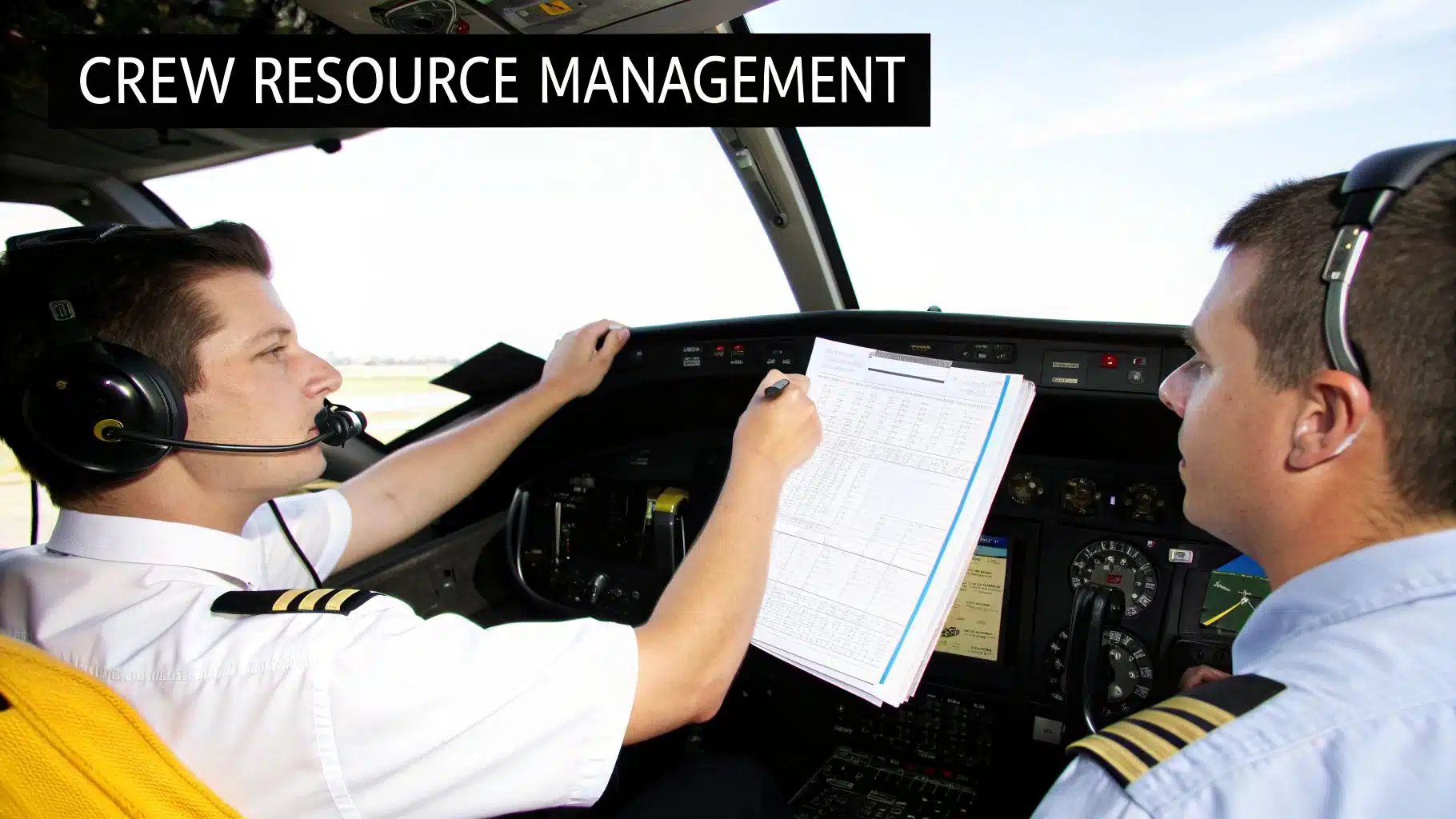
Think of it like a surgical team in a high-stakes operation. The surgeon might be the lead, but the anesthesiologist, nurses, and techs are all actively communicating, cross-checking each other's work, and sharing a single, unified goal—a successful outcome for the patient. That's the essence of Crew Resource Management. It's about turning a group of skilled individuals into a truly cohesive team.
But it wasn't always this way. Aviation's history is steeped in the "captain-is-king" culture, where a captain's authority was absolute and rarely questioned. This rigid hierarchy, we learned through hard lessons, was a danger in itself. CRM was born from the need to move away from individual heroics and toward collective problem-solving.
The Pillars of Crew Resource Management
CRM teaches us to manage all available resources to ensure a safe flight. This goes far beyond just the people in the cockpit. We break these down into a few key pillars.
| Pillar | Core Function |
|---|---|
| Communication | Creating a cockpit where information flows freely, questions are encouraged, and concerns are voiced clearly and respectfully. |
| Situational Awareness | Maintaining a constant, accurate understanding of the aircraft's status, the environment, and any potential threats. |
| Problem Solving & Decision Making | Using a structured, analytical approach to handle both routine and unexpected challenges during flight. |
| Teamwork & Leadership | Fostering a culture of mutual respect and support, where every crew member is empowered to contribute to the flight's safety. |
| Stress & Workload Management | Recognizing the signs of high stress or task saturation and using strategies to manage them before they compromise safety. |
These pillars work together, creating a robust framework that prepares pilots to handle anything that comes their way. It encourages co-pilots to speak up and trains captains to listen, creating an environment of mutual vigilance. A big part of this is also managing flight-related stress; you can dive deeper into how to overcome the fear of flying in our detailed guide.
Beyond The Cockpit
Interestingly, the principles of CRM are so effective they can be applied well beyond flight operations. Consider the process of buying or selling an airplane—a high-stakes endeavor filled with complex information and significant financial risk. Applying a CRM mindset here is a game-changer.
Instead of a flight crew, you assemble a "transaction crew." This team might include your A&P mechanic, an avionics specialist, a trusted Certified Flight Instructor (CFI), and an aviation attorney.
By treating your aircraft purchase like a mission-critical flight, you bring the same discipline. Clear communication ensures everyone knows their role, systematic checklists prevent you from missing critical due diligence steps, and threat management helps you spot risks like hidden airframe damage or incomplete logbooks. This approach protects your investment and makes sure the entire process is done the safe way.
The Story of CRM From Tragedy to Triumph
Most pilots know that modern aviation safety is built on lessons learned the hard way. The story of Crew Resource Management is a perfect example. Its origins weren't drafted in a quiet boardroom; they were forged in the smoke and wreckage of one of aviation's worst days.
To truly understand what crew resource management is, you have to know this history. It's a philosophy born from tragedy, designed to make sure it never happens again.
For decades, the cockpit was a place of absolute authority. The captain was king, and their decisions were final—even when junior crew members felt a pit in their stomach. This rigid hierarchy, often called the "captain-is-king" mentality, created an environment where a first officer or flight engineer might hesitate to speak up, even with critical information. The entire system rested on the assumption that one person was infallible, a dangerous vulnerability that was about to be tragically exposed.
The Disaster That Sparked a Safety Revolution
The moment that changed everything was March 27, 1977. CRM traces its roots directly to the Tenerife airport disaster, where two fully loaded Boeing 747s collided on a foggy runway. The accident claimed 583 lives and remains the deadliest in aviation history.
The investigation uncovered a horrifying truth: this wasn't a mechanical failure. It was a complete breakdown in human factors—miscommunication, flawed assumptions, and poor decision-making under pressure. You can learn more about the event that catalyzed the development of CRM by reviewing its history.
In the aftermath, the industry was forced to confront a disturbing pattern. When investigators looked at other accidents, they found that a huge percentage stemmed from failures in teamwork, communication, and leadership, not from the planes themselves. The story of CRM shows just how vital clear protocols are in high-stakes situations, a lesson that applies far beyond aviation, like in mastering emergency response communication for commercial teams. Tenerife made it painfully clear that a new way of operating was desperately needed.
From Cockpit Management to Crew Philosophy
The industry’s response was immediate. In 1979, NASA held a major workshop to dig into the growing evidence on human factors. Researchers and pilots pored over flight recorder data and accident reports, confirming the undeniable link between poor crew coordination and disaster.
It was at this workshop that the term "Cockpit Resource Management" was officially born. The initial focus was squarely on the pilots, with the goal of breaking down that rigid hierarchy and improving communication and decision-making on the flight deck.
United Airlines became an early champion, launching the first formal CRM training program in the early 1980s. They proved that these "soft skills" weren't just personality traits—they could be taught, practiced, and mastered. The training used simulators to put crews into tough, high-stress scenarios, forcing them to communicate and work together to solve complex problems.
But the concept kept growing. It became obvious that safety wasn't just the pilots' job. The name was broadened from "Cockpit" to "Crew" Resource Management, officially bringing flight attendants, mechanics, and dispatchers into the fold. This change recognized a simple truth: every person involved in a flight is a vital safety resource.
By the 1990s, the FAA made CRM training mandatory for all major airlines. The impact was immediate and dramatic. As a new culture of teamwork and open communication spread, accident rates fell sharply. What began as a response to a single, horrific tragedy had transformed into a global standard for aviation safety, saving countless lives along the way.
Mastering the Core Principles of Modern CRM
While knowing the history of Crew Resource Management tells you why we have it, mastering its core principles is what keeps you safe in the air. These aren't just abstract ideas from a textbook. They are the practical, hands-on skills you’ll rely on every single day, whether you're flying a Piper Cherokee solo or are part of a multi-pilot crew.
Think of CRM as the mental toolkit you carry alongside your flight bag. A mechanic wouldn't use a wrench to hammer a nail, and a pilot shouldn't rely on raw flying skill alone to manage the complexities of the flight environment. CRM gives you the right mental tool for each challenge, helping you shift from just flying the airplane to actively managing the entire operation.
As you can see below, CRM wasn't just a good idea someone had. It was forged in the aftermath of tragedy, born from a direct, structured response to a catastrophic human-factors failure.
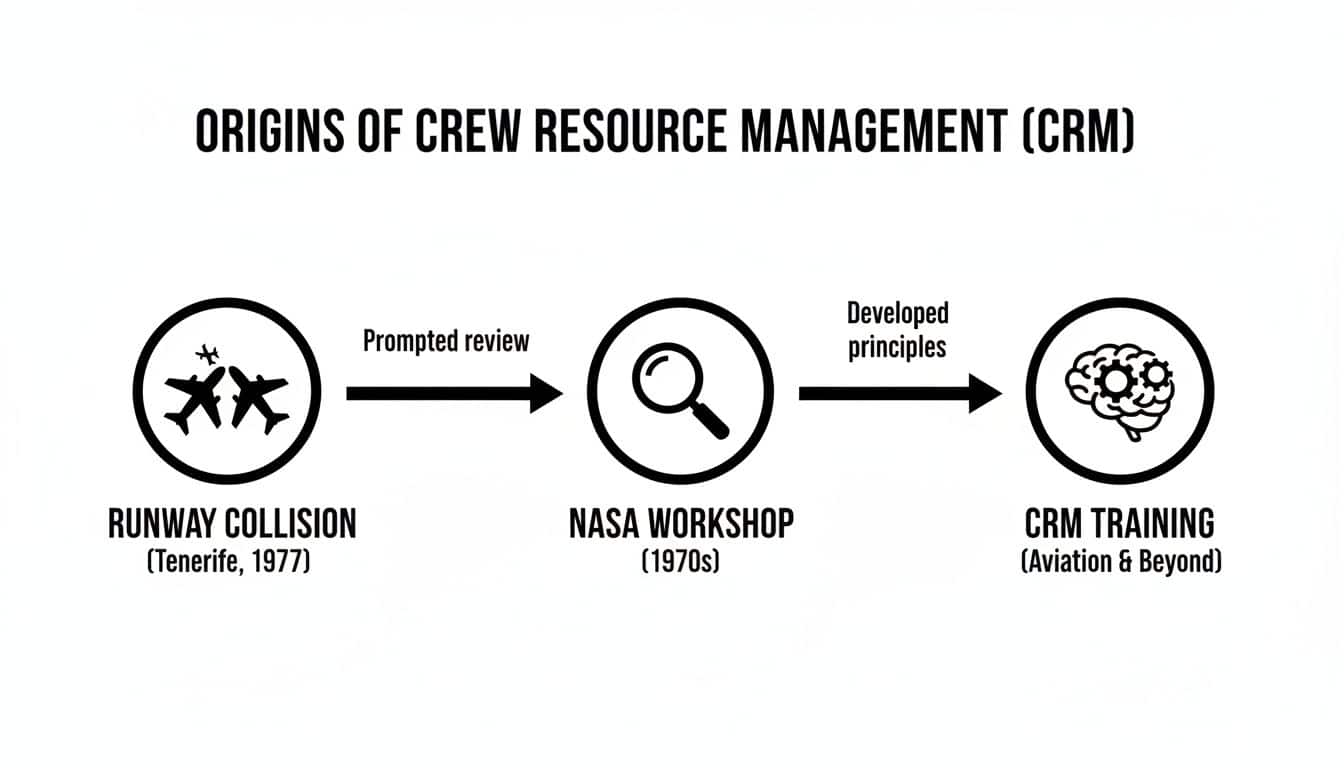
This proactive, structured approach to safety is what separates modern aviation from its past.
Building Situational Awareness
At its heart, situational awareness is the absolute bedrock of CRM. It's about knowing what's going on around you at all times. But it's more than just a snapshot; it’s a continuous, three-step mental process of understanding your aircraft, your environment, and what might happen next.
Let's put you in the cockpit on an approach into our busy home base at Chino (KCNO).
- Perception: You see several aircraft on your traffic display and hear their callsigns on the frequency. This is the raw data.
- Comprehension: You mentally connect the dots, figuring out who is where, at what altitude, and what they're likely doing in relation to your own flight path.
- Projection: You anticipate a potential conflict with an aircraft turning onto final ahead of you. You're already thinking a step ahead, planning your next radio call or a potential speed adjustment.
A breakdown in any one of these stages is how a pilot gets "behind the aircraft," and it's a leading cause of incidents. Maintaining this mental model is your primary job.
Communication and Teamwork
If situational awareness is the bedrock, then communication is the mortar holding it all together. This isn't just about talking—it's about creating a shared understanding. That means using standard, unambiguous phraseology, actively listening to confirm you've understood, and building an environment where everyone feels they can and should speak up.
In the cockpit, teamwork means everyone knows their role, tasks are clearly assigned, and the entire crew is united by a single goal: a safe flight. This works only when a First Officer feels comfortable questioning a Captain’s action without fear. A crew that works as a true team is one of the most powerful defenses against human error.
The data backs this up. A Purdue University study on unstabilized approaches—a major cause of landing accidents—found that 81% involved rushed approaches and a staggering 72% showed poor crew coordination. An NTSB analysis also pointed to inadequate monitoring by the flight crew as a factor in 63% of these events.
Decision Making and Workload Management
Every flight is a series of decisions, from small course adjustments to handling an emergency. CRM gives pilots proven frameworks, like the DECIDE model (Detect, Estimate, Choose, Identify, Do, Evaluate), to work through problems logically instead of just reacting. This structure is your best friend when the pressure is on.
At the same time, you have to manage your own capacity. Task saturation is a pilot's enemy. A critical CRM skill is recognizing when you're becoming overloaded and then taking immediate steps to get back ahead of the curve. This could mean:
- Delaying non-essential tasks ("Aviate, Navigate, Communicate").
- Delegating duties to a co-pilot or even asking ATC to "stand by."
- Using the autopilot strategically to reduce your manual workload.
Ultimately, mastering these principles is about developing strong internal alignment and leadership clarity, even when you're the only one in the cockpit. By learning to manage your own cognitive resources, you stay in control of the aircraft and the situation, no matter how challenging it gets.
Applying CRM When You Are the Entire Crew
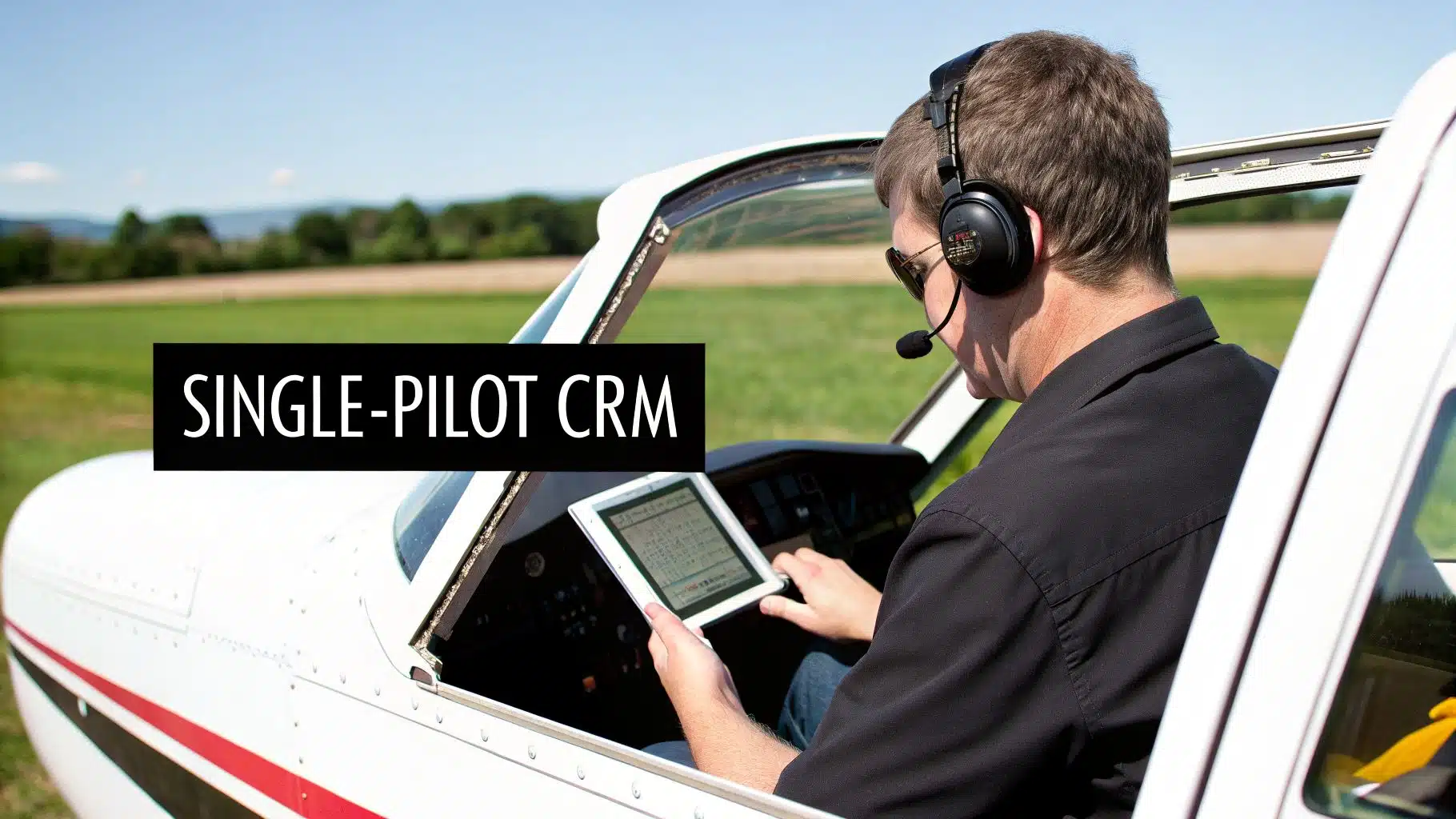
It’s easy to hear “Crew Resource Management” and picture two airline pilots in a complex jet. But what happens when the entire crew is just… you? The principles don’t vanish; they just adapt. This is the world of Single-Pilot Resource Management (SRM), and it’s about reframing the core ideas of CRM for the realities of flying solo.
SRM is the art of managing every available resource from the single seat of a general aviation aircraft. It's a mindset that shifts you from being just a "stick and rudder" pilot to a true flight manager. Instead of briefing a first officer, you learn to treat your instruments, checklists, and external support systems as your virtual crew.
This way of thinking is critical, right from your very first solo flight. A pilot who gets comfortable with SRM isn't just safer—they're more proficient, more confident, and a better Pilot in Command (PIC). The key is realizing that even when you're alone in the cockpit, you're never without resources.
Your Virtual Crew Members
At its heart, SRM is about identifying your "crew" and putting them to work, just as a captain would delegate tasks. Your crew members might not be human, but they are absolutely vital for keeping your workload manageable and your flight safe, especially when things get busy.
Think of your resources as specialists, each with a critical job:
- Your GPS and Autopilot: These are your navigation and workload-shedding experts. Let them handle the precise routing or hold an altitude. That frees up your mental bandwidth to monitor systems, talk on the radio, and keep your head outside the cockpit.
- Air Traffic Control (ATC): Think of ATC as an extension of your team. They’re your eyes and ears beyond the windscreen, providing traffic alerts, weather updates, and routing guidance. They're an invaluable source of real-time information.
- Checklists and SOPs: These are your most disciplined and reliable "First Officers." They never forget a step and ensure you follow methodical, proven procedures every single time. A solid guide on how to perform pre-flight checks for a Cessna 172 shows how this foundational SRM habit sets the tone for a safe flight before you even start the engine.
When you consciously treat these tools as active participants in your flight, you build a powerful system that supports your decisions and guards against common single-pilot errors.
SRM in Real-World Scenarios
Let's put this into a real-world context. Imagine you're on an instrument approach into Chino (KCNO) and the weather is deteriorating, getting worse than what was forecast. Your workload is climbing fast. A pilot without an SRM mindset might get task-saturated, trying to juggle everything at once and quickly falling behind the aircraft.
An SRM-trained pilot, on the other hand, actively manages the situation. They engage the autopilot to fly the approach (your workload expert), talk themselves through the approach plate out loud (simulating a crew brief), and proactively communicate their intentions and status to ATC (your external team member). They aren't just flying the plane; they are managing the flight.
This is the essence of what crew resource management is for the single pilot. It's about using threat and error management to see problems coming—like that unexpected weather—and using your resources to handle them before they grow into something more serious. It's a skill that separates a reactive pilot from a truly proactive one.
Using a CRM Mindset to Buy or Sell an Aircraft
Buying an airplane or helicopter is one of the most complex and high-stakes missions you’ll ever undertake as a pilot. It’s far more than just a transaction; it’s a project loaded with potential threats that can cost you thousands if not managed properly. The good news is that the skills you learn in the cockpit for managing flight safety are perfectly suited for this challenge.
Applying a Crew Resource Management mindset is the single best way to protect your investment and ensure you end up with a safe, reliable aircraft. You wouldn't fly a complex aircraft solo without the right support, so why would you navigate a six-figure purchase alone?
Assembling Your Aircraft Transaction Crew
The first step is to stop thinking of yourself as a lone buyer and start acting like the Pilot in Command of an acquisition mission. Your job is to assemble and manage your own specialized "transaction crew." Instead of a first officer or flight engineer, your team is made up of ground-based experts.
A poorly coordinated team is just as dangerous during a purchase as it is at 10,000 feet. It’s on you to brief them, define their roles, and ensure everyone is working toward the same objective.
Your essential crew members should include:
- Your A&P Mechanic: This is your technical expert, your eyes and hands on the aircraft. Their mission is to conduct a meticulous pre-purchase inspection to uncover any hidden airframe, engine, or systems issues before they become your problem.
- Your Avionics Technician: With today's glass panels and integrated systems, this role is non-negotiable. They verify that the GPS, autopilot, and other electronics are functional, legal, and not on the verge of a budget-busting failure.
- Your CFI or Mentor Pilot: A trusted instructor acts as your standards pilot. They bring an operational perspective, helping you decide if the plane is a good fit for your skills and typical missions. They’ll also fly the aircraft to feel out its handling and verify its performance numbers.
- Your Aviation Attorney or Title Company: This specialist handles the critical paperwork. They'll run a title search, check for liens, and draft a solid purchase agreement that protects you from legal and financial turbulence down the road.
Think of your first meeting with this team as a pre-flight briefing. You state the mission: to buy a safe, airworthy aircraft at a fair price, with no surprises. Everyone needs to understand their specific duties and how they'll report back to you.
Applying CRM Principles to the Purchase
With your crew in place, you can start applying the same CRM principles that keep you safe in the air. This is where you turn abstract concepts into practical, money-saving actions.
It boils down to a focused, disciplined process.
Get the Full Picture with Situational Awareness
This is all about intelligence gathering. You and your crew need to comb through every piece of data available—the aircraft’s logbooks, FAA records, and any damage history reports. Gaps in the logs or a fuzzy story about a past repair are major red flags that demand a closer look. You need to know the plane's full history, not just what the seller wants you to see.
Actively Hunt for Threats and Errors
Your team’s primary function is Threat and Error Management. Their job is to find the threats before they become expensive errors on your part.
A threat could be the aircraft's history of being based in a corrosive, salty environment. Your A&P's job is to manage that threat by specifically hunting for corrosion. An older, unsupported GPS unit is another threat; your avionics tech manages it by flagging the potential cost and timeline for a necessary upgrade.
Make Communication and Teamwork Your Priority
Just like in the cockpit, you need to maintain an open and constant flow of information. Your mechanic should give you a plain-language report of their findings, your CFI should debrief you on the test flight's quirks, and your attorney must explain any legal risks in the title report.
This creates a shared mental model, where every decision you make as the PIC is backed by complete and accurate information from your entire crew.
By using this structured, team-based approach, you transform a stressful purchase into a well-managed acquisition. This CRM-driven process drastically reduces risk, prevents ugly surprises, and ultimately gives you the confidence that you’ve made a sound investment.
How We Build CRM Skills from Your First Flight
Crew Resource Management isn't some advanced subject we save for the end of your training. At DuBois Aviation, we see it as the bedrock of professional flying, and we start building those skills the moment you step onto the ramp here at Chino Airport (KCNO).
From your very first lesson, you’ll discover that every flight is a team effort. Our Certified Flight Instructors (CFIs) are mentors, not just teachers. They show you how to manage the aircraft, not just operate it. We treat every session like a real-world mission, making the principles of what is crew resource management a natural part of how you learn to fly.
A Structure for Real-World Flying
We don't just lecture you on CRM; we live it. By weaving these practices into every single flight, the habits become second nature. You'll build the critical thinking skills that separate a good pilot from a great one.
It all starts with a simple, powerful rhythm:
- The Pre-Flight Briefing: This is far more than a quick chat. It’s a structured meeting where you and your CFI define the mission. We'll talk through the objectives, identify potential threats like tricky weather or busy airspace, and clarify who is responsible for what.
- The Post-Flight Debrief: After every shutdown, we sit down to talk it all through. What went right? What could we do better next time? This honest, no-fault conversation is the heart of CRM, creating a culture where feedback is just a tool for getting better.
This brief-fly-debrief cycle is exactly what airline crews do before and after every single flight. It's a fundamental habit that sharpens teamwork and hones decision-making. It's so vital, in fact, that it remains a key part of staying proficient, something we always reinforce during a biennial flight review.
Training That Mirrors the Real World
Learning to fly at a busy, towered airport like KCNO gives you a huge head start. You’re immediately immersed in a dynamic environment where sharp communication and situational awareness are non-negotiable.
You won't be practicing radio calls in a quiet corner of the sky. You'll be managing them for real, navigating around a mix of jets and piston aircraft, and talking to air traffic control from day one. That kind of daily exposure builds the resilience and confidence airlines are looking for.
To round out your experience, we use our advanced simulators to drill emergency procedures in a completely safe setting. This is where we can really put you to the test, pushing your decision-making, workload management, and teamwork skills with complex scenarios that are impossible to replicate safely in the air.
This blend of real-world flying and high-fidelity simulation closes the gap between being a student and becoming a professional. We've designed our training to build the specific CRM competencies that will make you stand out to airline recruiters. We’re not just preparing you to pass a checkride; we’re preparing you for a lifetime of safe, professional flying.
Common Questions About Crew Resource Management
It's one thing to learn the definition of Crew Resource Management, but it's another to see how it works in the real world. Here are a few of the most common questions we get from pilots about CRM and what it means for them.
Is CRM Only for the Airlines?
That’s a common misconception. While CRM got its start in the airline world, the core ideas are crucial for every single pilot. That's why the concept was adapted into Single-Pilot Resource Management (SRM).
Even when you're flying solo, you're never truly alone. Think of it this way: you are the captain of a team of "virtual crew members."
- Your checklists are your disciplined first officer, making sure nothing gets missed.
- Your GPS and autopilot act as a relief pilot, helping manage the workload on long flights.
- Air Traffic Control is your eye in the sky, providing essential intel on traffic and changing weather.
From your very first lesson, we teach you to think like a flight manager, not just someone who moves the controls. This SRM mindset is the foundation for the sharp decision-making and situational awareness that will keep you safe for your entire flying career.
How Can This Help Me Buy an Airplane?
Buying an airplane is a high-stakes decision, maybe one of the biggest you'll make. Applying CRM principles to the process is the smartest way to manage the complexity and protect your investment.
Instead of trying to do it all yourself, you assemble and lead a "transaction crew." This team might include your trusted A&P mechanic, an avionics technician, your CFI, and even an aviation attorney. You’re the pilot-in-command of the purchase.
Using clear communication and a methodical approach—just like a pre-flight checklist—you ensure every detail gets a thorough review. This framework helps you spot threats like hidden airframe damage or incomplete logbooks, allowing you to make a sound, informed decision. It's about buying an airplane the safe way.
Does CRM Actually Prevent Accidents?
Without a doubt. The evidence is overwhelming. An astonishing 70-80% of aviation accidents are traced back to human factors, not a mechanical failure. These incidents almost always involve a breakdown in communication, a bad judgment call, or a lack of teamwork.
The widespread adoption of CRM is one of the single biggest reasons for the dramatic drop in accident rates over the last few decades. It works because it empowers every person involved—whether it's a full airline crew or a single pilot—to use all available resources, speak up, and manage threats before they escalate. It turns the fallible human element into a robust safety system.
Ready to build the professional habits that airlines look for? At DuBois Aviation, we weave CRM and SRM into every single flight, right from day one. To learn more about our training programs, explore our website and see how we prepare pilots for success.