

For any student pilot dreaming of a career in the airlines or as a professional helicopter pilot, the Biennial Flight Review (BFR) is a foundational part of your journey. Required every 24 calendar months to legally act as pilot in command, it’s more than a regulatory hurdle—it’s your first taste of the recurrent training that defines a professional pilot's career.
This isn't a pass/fail test like your initial checkride. Instead, think of it as a collaborative coaching session with a qualified instructor, designed to keep your skills sharp as you build your career.
Understanding the Biennial Flight Review

For anyone aiming for a career as a professional helicopter or airline pilot, the BFR is your first taste of the recurrent training culture that defines the industry. It’s less of a hurdle and more of a professional tune-up—a dedicated time to polish your skills, get up to speed on new regulations, and shake off any bad habits before they stick.
The FAA requires this review to ensure every active pilot maintains a high standard of safety and proficiency. The core of the BFR consists of at least one hour of ground instruction and one hour of flight time with a certified instructor, covering current operating rules and practical flight maneuvers. You can find a good overview of the FAA's flight review standards on Wikipedia for more background.
Purpose Beyond the Logbook
At its heart, the BFR is all about managing risk. Flying is a perishable skill, and for students building time towards an airline transport pilot (ATP) certificate, maintaining proficiency is non-negotiable. The review acts as a scheduled reset, reinforcing everything from emergency procedures to nuanced aircraft handling under the guidance of an experienced instructor. It's a structured way to make sure your knowledge of airspace, regulations, and procedures is solid.
The Biennial Flight Review isn't about re-taking your checkride. It's a personalized proficiency assessment designed to make you a safer, more confident pilot by addressing your specific operational needs and habits.
Key Requirements At a Glance
The rules for the BFR are laid out in Federal Aviation Regulation (FAR) 61.56. While a good instructor will tailor the session to your specific flying goals, such as preparing for helicopter operations or airline-style flying, there are a few non-negotiable minimums.
Here’s a quick summary of the core components to help you prepare.
BFR Requirements At a Glance
| Component | Requirement Detail |
|---|---|
| Frequency | Must be completed every 24 calendar months. |
| Ground Instruction | Minimum of one hour covering Part 91 operating rules. |
| Flight Instruction | Minimum of one hour covering maneuvers and procedures. |
| Instructor | Must be conducted by an authorized flight instructor (CFI). |
Meeting these requirements ensures your logbook endorsement is valid and, more importantly, that you've taken a proactive step toward maintaining the high standards expected of a career pilot.
What to Expect During Your Flight Review
So, your flight review is coming up. For a student pilot, this can feel like another test, but it’s best to think of it as a professional tune-up. A good BFR is a collaborative session with a CFI to make you a sharper, safer pilot, ready for the next step in your career. It’s broken into two simple parts: a sit-down on the ground and some time in the air, with both parts focused on the kind of flying you are training for.
The whole thing kicks off with at least one hour of ground instruction. A good instructor won't just quiz you on random regulations. Instead, they'll shape the discussion around your career goals and the biennial flight review requirements. For a helicopter student aiming for an offshore job, you might get deep into rotorcraft-specific rules and performance. An aspiring airline pilot might focus on instrument procedures and crew resource management concepts.
The Ground Instruction Phase
Think of the ground portion as a "pre-flight" for your knowledge. It’s a chance for a flight student to solidify their understanding before the engine ever starts. Your instructor’s goal is to make sure you're up to speed on current rules and procedures relevant to your career path.
You’ll probably touch on topics tailored to your training:
- Rules of the Air: A solid review of FAR Part 91 is pretty standard. This usually covers airspace, right-of-way rules, and any recent changes.
- Aircraft Systems: If you’re a helicopter student, this is a great time to talk through mast bumping or retreating blade stall. A fixed-wing pilot on an airline track might go over the systems of a complex or multi-engine aircraft.
- Mission Planning: Expect to walk through a cross-country scenario, from interpreting weather to managing flight risks, just as a professional pilot would.
This isn’t an interrogation. It’s a professional conversation designed to refresh your memory and get you thinking like a career pilot in command.
The Flight Instruction Phase
Once you’ve covered the groundwork, you’ll head out to the aircraft for at least one hour of flight instruction. This is where you shift from talking about flying to actually doing it. The maneuvers aren't meant to feel like a checkride. It's simply a chance to show you’ve maintained proficiency.
A flight review isn't about perfection; it’s about proficiency. The instructor is there to observe, coach, and help you polish the skills essential for a career as a safe pilot in command.
An aspiring airline pilot might practice steep turns, stalls, and some basic instrument work. A helicopter student, on the other hand, will focus on things like autorotations, hovering, and maybe some confined area operations. It’s also the perfect opportunity to run through emergency procedures—like a simulated engine failure—in a controlled, safe environment.
At the end of the day, it's not about a pass/fail grade. It’s all about getting that logbook endorsement and walking away a more confident, career-focused pilot.
Why Your BFR Is More Than Just a Requirement
It’s easy for a student pilot to think of the Biennial Flight Review (BFR) as just another box to check. But for anyone with their sights set on a professional career, that’s a huge missed opportunity. This isn't just about staying legal; it's your first real taste of the professional safety mindset that every airline and helicopter operator is built on.
Let's be honest: flying is a perishable skill. Without regular practice and a sharp eye watching over you, proficiency fades, and bad habits can creep in. The BFR is designed specifically to stop that from happening. It’s a chance to get back to basics, shake off any rust, and sharpen your decision-making with a seasoned instructor by your side.
This isn't just a hunch—the numbers back it up. Pilot error consistently shows up as a leading factor in 70% to 80% of general aviation accidents. Considering that GA makes up about 90% of all civil aviation incidents, preventing skill decay is a serious business. You can get a much deeper look into these trends in the aviation industry's latest safety analysis.
From Proficiency to a Safer Career
When you treat your BFR with the seriousness it deserves, you're building the foundation for the kind of rigorous, safety-first culture you'll find at the airlines or in commercial helicopter operations. Think of it as a scheduled tune-up for your skills. It keeps you sharp and ready, which is exactly why commercial operators put their pilots through demanding recurrent training year after year.
This simple graphic says it all, showing just how much of an impact biennial flight review requirements have on keeping you at the top of your game.
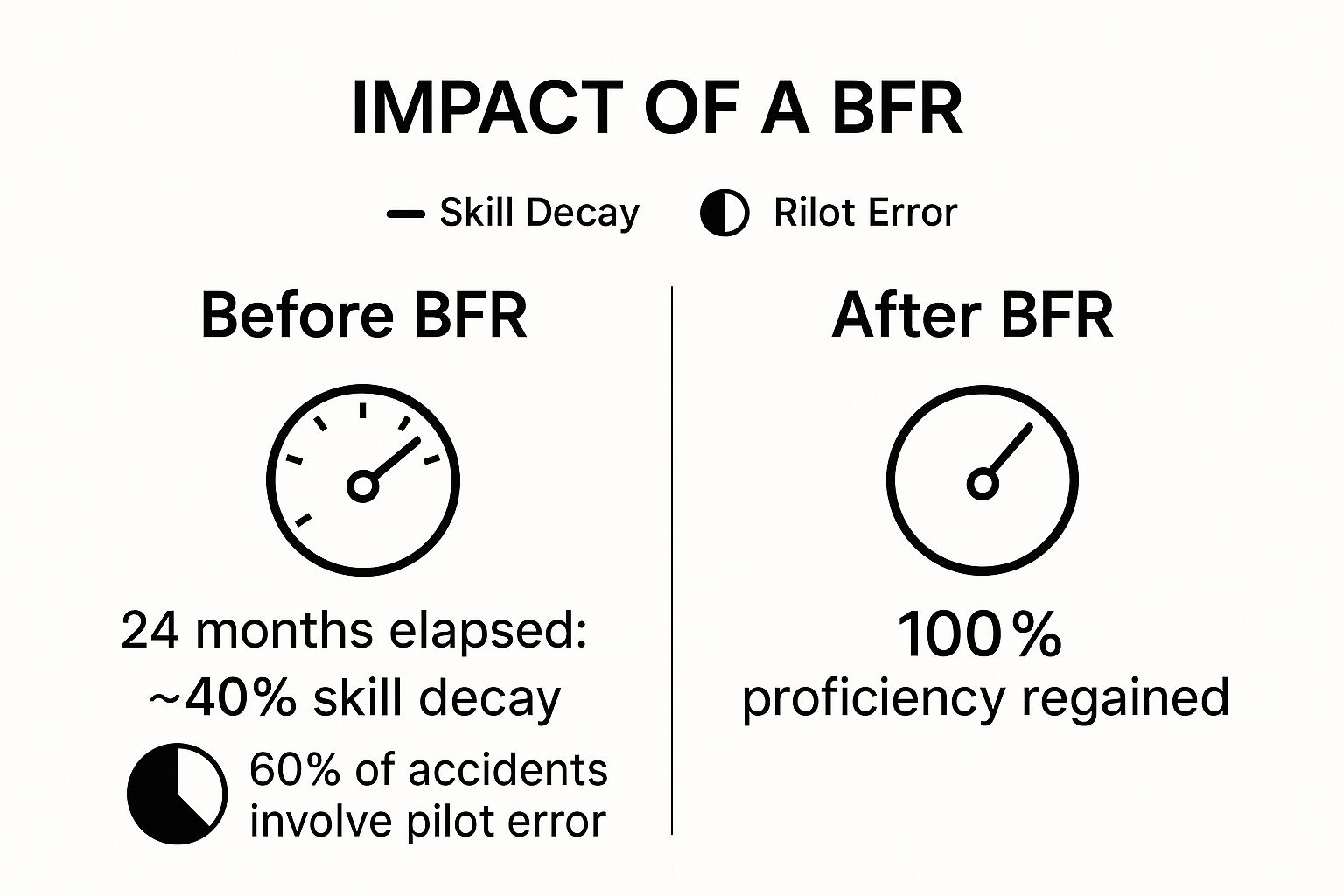
The takeaway here is pretty clear. The BFR isn't a chore; it's one of the most effective tools you have to reverse skill decay and lock in the safe habits you'll need for a long, successful career in the cockpit.
How Other Training Can Meet Your BFR Requirement
If you're a flight student on the path to an airline career, you're pretty much always in training. The good news is the FAA recognizes this, and a lot of that training can actually take the place of your standard flight review. After all, earning a whole new certificate or rating is a much deeper dive into your skills than a typical BFR.
Think about it this way: successfully passing a practical test—what we all call a checkride—for any pilot certificate or rating instantly resets your 24-calendar-month BFR clock. It doesn't matter if you just earned your private pilot license, added an instrument rating, or got your commercial helicopter add-on. The second that Designated Pilot Examiner (DPE) signs your temporary certificate, you're good to go for another two years.
Checkrides and the FAA WINGS Program
This is a huge plus for any student pilot working their way up the ladder. As you move through your flight training, each successful checkride keeps you current, letting you focus on the next big step without worrying about a separate flight review.
Another great option is the FAA WINGS Pilot Proficiency Program. This is a free, FAA-sponsored program designed to keep pilots sharp through ongoing training. It works by having you complete specific ground and flight training modules with an instructor. Once you complete a "phase" of WINGS, it counts as your flight review.
The FAA WINGS Program is all about shifting your mindset. Instead of seeing proficiency as a single event every two years, it encourages a continuous cycle of learning and skill refinement—the very definition of a professional pilot.
Comparing Your BFR Options
For student pilots on a professional track, it's all about smart planning. A checkride is an automatic BFR reset, but the WINGS program offers a fantastic way to stay proficient and engaged, especially between ratings. Let's break down how these options stack up against a traditional BFR.
Comparing BFR and Its Alternatives
| Method | Description | Best For |
|---|---|---|
| Traditional BFR | The standard 1 hour of ground and 1 hour of flight review with a CFI. | Pilots who aren't currently training for a new certificate or rating. |
| New Certificate/Rating | Passing any FAA practical test (checkride) for a new pilot certificate or rating. | Student pilots and career aviators actively pursuing new qualifications. |
| FAA WINGS Program | Completing an entire phase of the FAA's structured proficiency program. | Pilots who want a proactive, ongoing approach to skill development. |
Each path leads to the same outcome: satisfying FAR 61.56. The best choice really just depends on where you are in your aviation journey.
BFR Insights for Helicopter Pilots
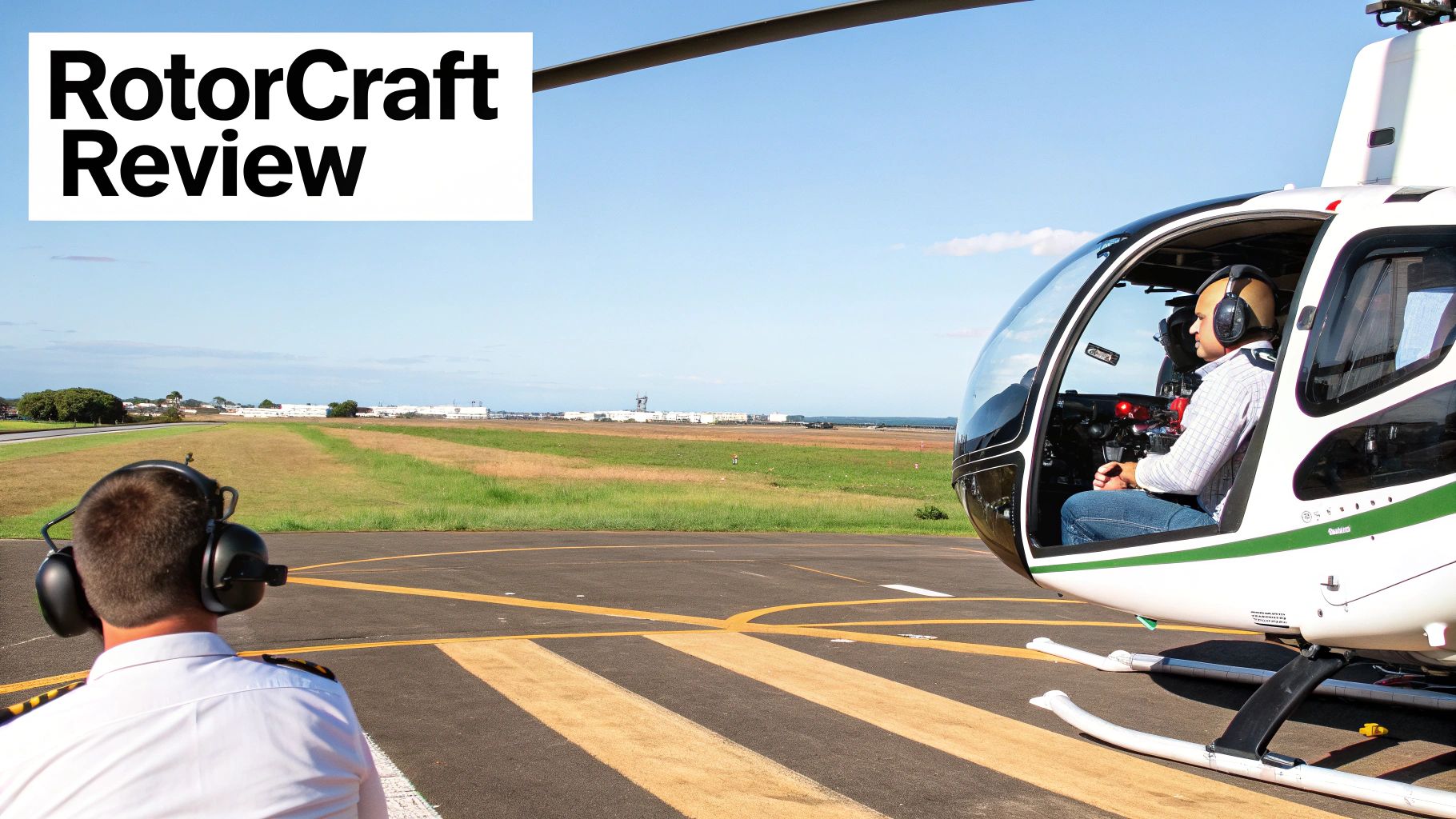
A helicopter flight review is a whole different ballgame compared to its fixed-wing counterpart. For any student building a career in rotorcraft, this isn't just a box to check—it's a specialized training event designed to sharpen the unique skills needed for vertical flight.
While the fundamental biennial flight review requirements under FAR 61.56 are the same for everyone, the actual content couldn't be more different. During the ground portion, you’ll dive deep into helicopter-specific systems, performance charts, and the regulations that govern rotorcraft. Forget standard fixed-wing aerodynamics; you'll be focused on critical concepts like retreating blade stall and the dreaded vortex ring state. This is all about making sure your head-knowledge is as solid as your hands-on skills.
Mastering Rotorcraft Maneuvers
Once you're in the air, the review hones in on the maneuvers that are the bread and butter of safe helicopter operations. Think of it as a chance to polish your skills under the watchful eye of an experienced instructor, in a controlled and supportive environment.
You can almost always expect to cover these key flight elements:
- Autorotations: You'll practice both straight-in and 180-degree autorotations, usually finishing with a power recovery.
- Hovering Operations: The instructor will want to see precise control while you hover both in and out of ground effect.
- Confined Area Landings: This is your chance to show you can execute safe approaches and departures in tight, challenging spaces.
The idea of a recurrent flight review is common worldwide, though the exact rules change from country to country. In the U.S., FAR 61.56 requires this check every two years to maintain proficiency, but it’s structured as a training event, not a rigid pass/fail test. For a look at how this fits into global standards, you can see how these requirements fit into the world air transport framework.
Choosing an instructor with deep, real-world helicopter experience is absolutely critical. A dedicated helicopter CFI can introduce realistic scenarios and provide targeted feedback that a fixed-wing instructor might miss, turning a routine requirement into a career-building experience.
At the end of the day, a well-run helicopter BFR does more than keep you current; it reinforces the specialized skills you’ll depend on every single time you fly. Our detailed helicopter training programs are built from the ground up to instill this kind of proficiency from your very first lesson.
Common BFR Questions Answered
It’s completely normal for a flight student to have questions about the biennial flight review. This is true whether you’re a new private pilot or building time for a career in helicopters or at an airline. Let’s clear up some of the usual points of confusion so you can walk into your next BFR feeling prepared and confident.
One of the biggest anxieties I hear from student pilots is, "What if I mess up?" It's important to remember that a BFR isn't a pass-or-fail test like your initial checkride. If your instructor sees an area that needs a little more polish, they simply won't sign your logbook yet. Instead, you'll just do a bit more training together until you both agree you’re proficient and safe to act as pilot in command.
How Do I Find the Right Instructor?
This is a big one for students. Finding a good instructor is key, especially if you're pursuing a specialized career in helicopters. Don't just book the first CFI with an open slot. You want to find someone with significant, real-world experience in the type of aircraft and operations you're training for.
The right instructor will also want to know your career goals—are you sharpening up your skills for an airline interview or trying to get more comfortable with advanced rotorcraft maneuvers? A great BFR is a tailored learning experience, not just a box to check. Ask for recommendations from other students and pilots, and definitely have a quick chat with a potential CFI before committing.
The goal of a BFR is proficiency, not perfection. Think of it as a collaborative effort with your instructor to find weak spots and strengthen them. This commitment to continuous learning is what separates career pilots from hobbyists.
What Should I Study Beforehand?
A little homework goes a long way toward making your BFR a smooth and valuable experience. A couple of weeks before your flight, set aside some time to get back in the books and, if possible, the cockpit.
- Dust off FAR Part 91: This is the bedrock of the ground portion. Really hit the big items like airspace rules, VFR weather minimums, and right-of-way procedures.
- Know Your POH: You should be able to talk about your aircraft's systems, limitations, and emergency procedures without hesitation.
- Practice the Maneuvers: If you can, fly with an instructor and run through the things you know will be on the review. For fixed-wing pilots on an airline track, that's stalls and steep turns; for helicopter students, it’s things like autorotations and confined area landings.
Coming in prepared shows your instructor you take your training seriously and makes the whole day more productive. For more answers to common flight training questions, head over to our detailed FAQ page.
At DuBois Aviation, our entire focus is on creating proficient, career-ready pilots. Whether you're coming up on your first BFR or adding a new rating, our experienced instructors are here to guide you. Learn more about our flight training programs.
What 14 CFR 61.56 actually requires
To act as pilot in command, a pilot generally must have completed a flight review within the preceding 24 calendar months unless an applicable alternative in the regulation has been satisfied. A standard flight review includes at least one hour of flight training and one hour of ground training.
- The minimum times are not an automatic signoff; the instructor must determine that the review was completed satisfactorily.
- The ground portion includes the current general operating and flight rules of Part 91.
- The flight portion reviews maneuvers and procedures needed for safe exercise of certificate privileges.
- A satisfactory endorsement is required in the pilot’s logbook.
Use the current text of 14 CFR 61.56 when determining compliance, and plan additional training when proficiency requires more than the regulatory minimum.
Current FAA guidance
A flight review is proficiency training, not just a calendar requirement
Under 14 CFR 61.56, most pilots must complete a flight review within the preceding 24 calendar months to act as pilot in command. The regulation establishes minimum ground and flight training, but the instructor should tailor the review to the pilot, aircraft, experience, and type of flying.
The FAA's current AC 61-98E also explains flight-review and instrument-proficiency-check considerations. Completing an eligible phase of the FAA WINGS program can satisfy the flight-review requirement under the applicable rule.
Source: FAA AC 61-98E. Reviewed August 17, 2026.


