
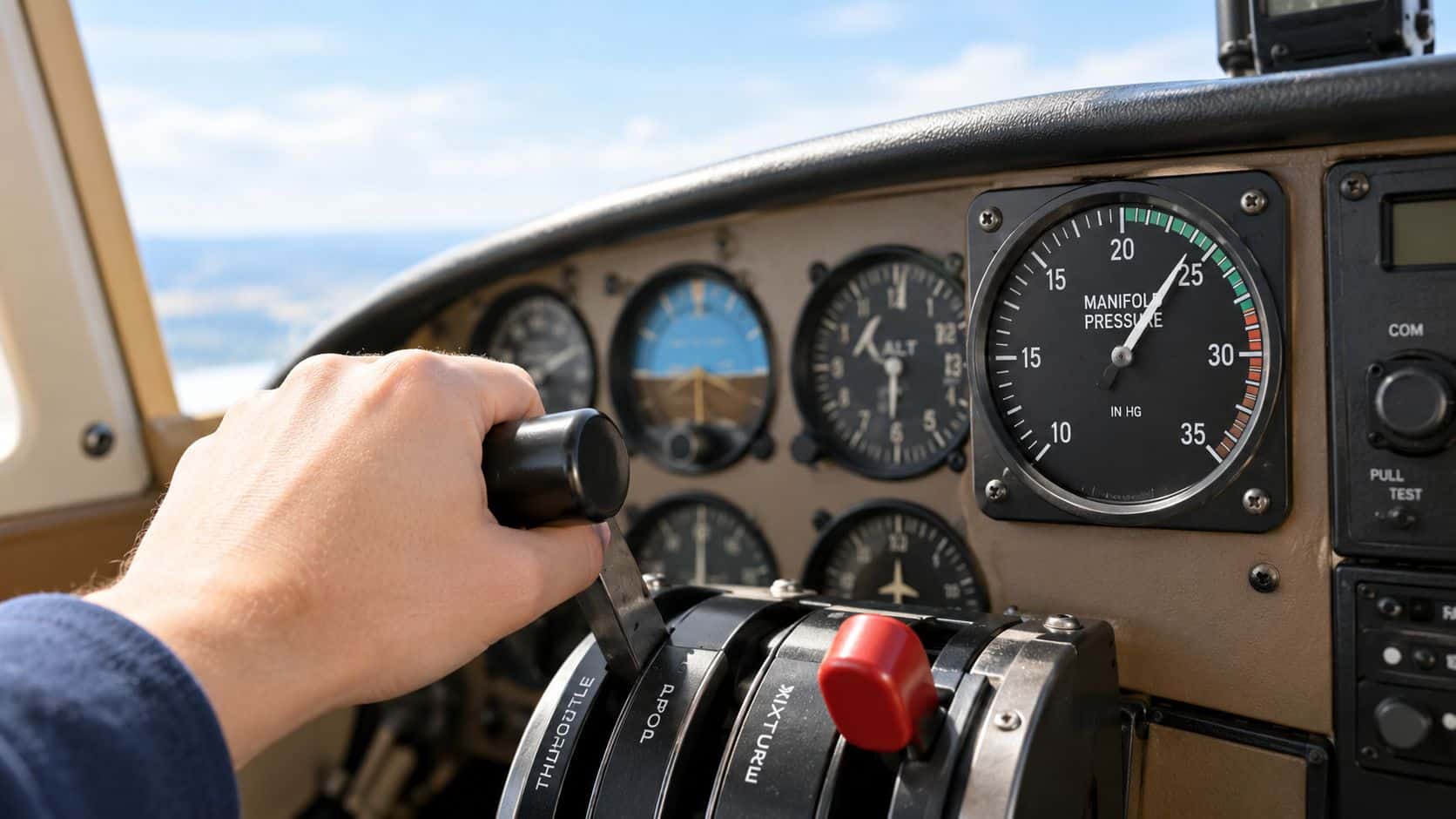
A student pilot sitting through the first engine run-up may see a manifold pressure gauge and wonder why another power instrument is needed. Manifold pressure is the absolute pressure inside the engine's intake manifold, measured in inches of mercury, or inHg. In a normally aspirated engine, the reading generally stays below outside air pressure while the engine runs. The throttle changes manifold pressure directly, while propeller RPM and mixture complete the power-setting picture.
Table of Contents
- What Manifold Pressure Actually Means
- How the Manifold Pressure Gauge Works
- Manifold Pressure, Throttle, and RPM Together
- Naturally Aspirated Versus Turbocharged Engines
- Reading Power Settings in the Cockpit
- Common Mistakes and Training Habits That Build Confidence
- Pilot Questions About Manifold Pressure
- What does manifold pressure really measure?
- Why can a turbocharged engine show pressure above local ambient pressure?
- When should a pilot lean the mixture?
- How do MP and RPM combine during a checkride power setting?
- What might an unexpected MP drop in cruise indicate?
- Does manifold pressure appear on FAA knowledge testing?
What Manifold Pressure Actually Means
During a preflight briefing, a CFI can point to the manifold pressure gauge and offer one useful mental image. The throttle butterfly acts like a sliding door in the induction system. When the door closes, the engine has more difficulty drawing air through the opening, so pressure in the intake manifold falls. When the door opens, pressure rises because the engine can breathe more freely.
Two practical options worth comparing
These are specific products pilots commonly compare for this type of flying. Confirm compatibility with your aircraft and instructor before ordering.
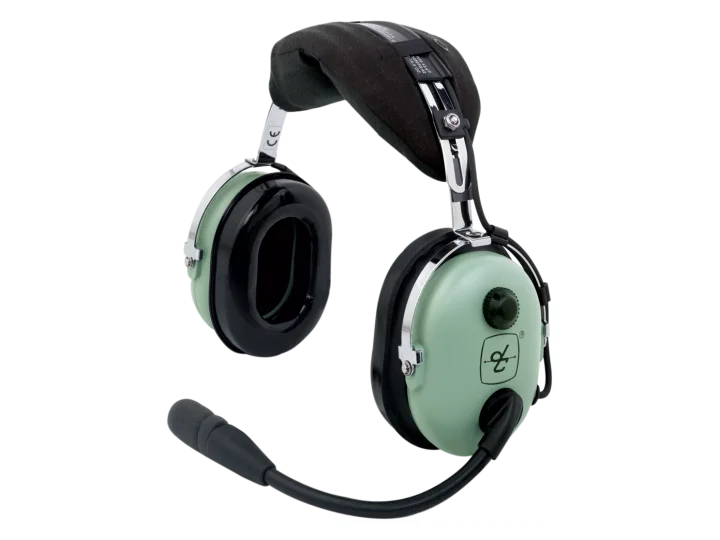 Student headsetDavid Clark H10-13.4 Aviation HeadsetCheck current availability on Amazon (paid link)
 OrganizationASA Flight BagCheck current availability on Amazon (paid link)
The gauge reports the pressure after the throttle valve, inside the intake manifold. It isn't measuring throttle position, fuel flow, or engine power by itself. It measures the air pressure available to the cylinders before the intake valves admit the charge.

Absolute pressure instead of vacuum
The word absolute causes much of the confusion. A manifold pressure gauge is referenced to a vacuum, not directly to the pressure outside the airplane. That means a parked airplane with its engine off can show a reading close to local barometric pressure. Once the engine starts, the nearly closed throttle at idle creates a restriction, and the reading falls below ambient pressure.
AOPA describes manifold pressure as the intake pressure shown in inHg. In a normally aspirated airplane, the reading is lowest at idle and, at a given throttle setting, decreases with altitude by about 1 inHg per 1,000 feet (AOPA's explanation of manifold pressure).
The gauge therefore gives a student a direct cockpit clue about engine loading:
- Low MP: The throttle is restricting airflow, or the engine is operating where ambient pressure is lower.
- Higher MP: The throttle is allowing more intake pressure, increasing the air available to the cylinders.
- Above ambient MP: The induction system is using forced induction, such as a turbocharger or supercharger.
The first cockpit lesson
A Cessna or Piper with a fixed-pitch propeller may not use manifold pressure as the primary power-setting instrument. In a constant-speed-propeller airplane, however, MP becomes especially important because the pilot can set intake pressure and propeller speed separately.
A pilot checking pressure altitude should keep the same distinction in mind. Altitude changes the outside pressure available to a normally aspirated engine, while the throttle controls the pressure that remains in the intake manifold.
Practical rule: Manifold pressure tells the pilot how much intake pressure the engine is receiving. It doesn't tell the whole power story until RPM, mixture, altitude, and aircraft limitations are considered.
How the Manifold Pressure Gauge Works
Parked on the ramp with the engine stopped, the manifold pressure gauge should sit near the outside air pressure. The engine is not creating intake flow, so the gauge is showing an absolute pressure reading, not a measurement of how far pressure is below atmospheric pressure.
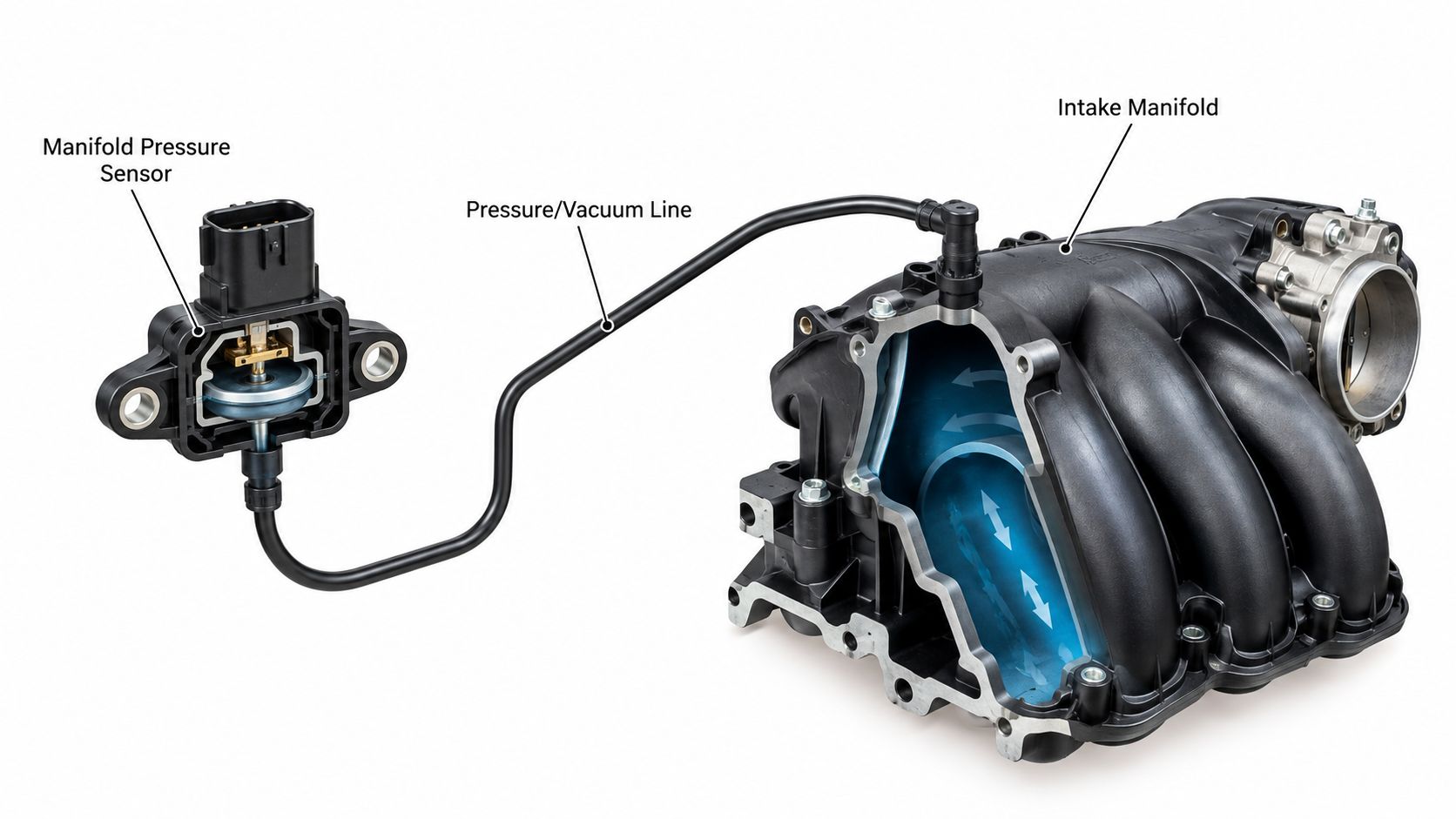
A small line runs from the intake manifold to a pressure-sensing element behind the instrument. That element responds to pressure changes, and a mechanical linkage moves the needle across a scale calibrated in inches of mercury, or inHg.
A traditional gauge may use a flexible capsule and a calibrated spring. Higher pressure changes the capsule's shape against the spring. Lower pressure lets it move in the opposite direction. The linkage turns that small movement into the needle position visible in the cockpit.
What the needle shows before and after start
Before start, the gauge reflects local ambient pressure, within the limits of instrument accuracy and current atmospheric conditions. After start, the throttle plate is nearly closed at idle. Each intake stroke draws air through that restriction, lowering the pressure in the manifold downstream of the throttle.
The idle reading commonly falls around 12 to 15 inHg (manifold pressure and powerplant guidance). The engine is still producing power. The lower number shows that the cylinders are receiving an intake charge at substantially reduced pressure.
At the run-up area, move the throttle gradually and watch the MP needle. It should respond as the intake restriction changes. The tachometer may react at a different rate because the engine and propeller have inertia. In a constant-speed propeller system, governor action also affects how quickly RPM settles at the selected value.
Why inHg appears on the face
Inches of mercury provide a familiar pressure scale for piston-aircraft engine instruments. The unit also appears in barometric references, so the pilot can relate intake pressure to the pressure outside the airplane.
Some gauges include colored arcs or markings for normal ranges, caution areas, and maximum limits. Those markings apply to that specific engine and installation. Use the aircraft flight manual, pilot operating handbook, or other approved operating information instead of carrying limits from one airplane into another.
The gauge can also reveal that a situation deserves attention. If the reading is lower than expected at a familiar throttle setting, compare it with RPM, engine sound, and other indications. Induction restriction, carburetor icing, or an engine problem could be involved. MP points toward a possible issue, but it does not identify the cause by itself.
Manifold Pressure, Throttle, and RPM Together
At the run-up area, a constant-speed propeller airplane gives you two separate power controls. The throttle changes manifold pressure by changing the amount of air entering the intake manifold. The propeller control changes RPM by changing blade pitch, while the governor adjusts blade angle to hold the selected propeller speed.
The MP gauge shows absolute pressure, not a percentage of engine power. The tachometer shows how quickly the engine and propeller are turning. These readings describe different parts of the same system. A higher MP generally gives the cylinders more air mass for combustion, while higher RPM means the engine completes more operating cycles in a given period. Mixture, ignition timing, temperature, density altitude, and propeller efficiency also affect the power produced.
A common cruise pairing on many constant-speed installations is 23 inHg and 2,300 RPM (constant-speed propeller power-setting example). In the cockpit, that means setting intake pressure with the throttle and propeller speed with the propeller control. It is an example, not a universal setting. Use the aircraft's approved cruise power chart.
Why the controls respond differently
Move the throttle, and MP can change almost immediately because the throttle changes the restriction in the induction path. Move the propeller control, and blade angle changes first. The governor then works to establish the selected RPM, so the tachometer may settle at a different rate.
The order of adjustment also matters. In many constant-speed-propeller airplanes, reduce MP first and then RPM during a power reduction. During a power increase, set RPM first and then MP. Follow the aircraft manufacturer's procedure because the correct sequence protects the engine from unsuitable mechanical or thermal loads.
Watch both instruments together. You are reading the engine as a system, not chasing one number.
A training reference table
The values below are illustrative examples only, not approved settings. The aircraft POH or AFM controls every takeoff, climb, and cruise selection.
| Phase | Manifold Pressure, example only | Propeller RPM, example only | Approximate power |
|---|---|---|---|
| Takeoff | 24 to 25 inHg | 2,500 RPM | 75% power |
| Climb | 23 inHg | 2,400 RPM | High or reduced climb power |
| Cruise | 23 inHg | 2,300 RPM | Charted cruise power |
A pilot might see these kinds of pairings in training, but the exact numbers vary with the engine, propeller, aircraft weight, altitude, and operating limitations. A setting that is appropriate in one airplane may be wrong in another.
A fixed-pitch trainer teaches the same relationship more clearly. The throttle changes engine power, and the tachometer shows the resulting RPM. Because the pilot cannot select propeller speed independently, the MP gauge may be absent or less important during normal operation.
Naturally Aspirated Versus Turbocharged Engines
A normally aspirated engine depends on outside air pressure to fill its intake manifold. As the airplane climbs, ambient pressure decreases. Even with the throttle fully open, the engine eventually cannot maintain the same MP it showed near the airport.
AOPA describes an approximate loss of 1 inHg per 1,000 feet at a given throttle setting in a normally aspirated airplane (AOPA's manifold pressure gauge guidance). The lower intake pressure reduces the air mass available for combustion and therefore reduces available power.
A turbocharged engine takes a different path. The turbocharger compresses intake air so the engine can maintain a higher manifold pressure as ambient pressure falls. That doesn't make every high-altitude power setting automatic. The pilot still has to monitor MP, RPM, temperature indications, and the aircraft's published limits.
Critical altitude and boost control
The FAA Airplane Flying Handbook describes altitude turbocharging, or normalizing, as maintaining maximum allowable sea-level manifold pressure, normally 29 to 30 inHg, up to an aircraft-specific critical altitude (FAA Airplane Flying Handbook, Chapter 12). Above that critical altitude, MP declines as altitude increases.
Critical altitude isn't a promise that the airplane will maintain the same power everywhere. It identifies the point at which the turbocharger can no longer sustain the specified manifold pressure under the system's conditions. A wastegate and its controller regulate exhaust flow to the turbocharger, limiting or managing boost according to the installation.
A turbocharged Piper or Cessna can therefore show a manifold pressure that would be impossible for a normally aspirated engine at the same altitude. Some turbocharged applications have requirements ranging from 31.0 to 45.0 inHg, as described in an NTSB technical document referenced by the FAA handbook material. Those figures apply to specific applications, not to every turbocharged airplane.
Comparing the readings
| Altitude (ft) | Naturally Aspirated MP (in. Hg) | Turbocharged MP (in. Hg, below critical altitude) |
|---|---|---|
| Sea-level operating area | Near local ambient pressure at full throttle, subject to induction losses | May be set near the approved sea-level value |
| Climbing altitude | Falls as ambient pressure decreases | Can remain near the approved target while the system has available boost |
| Above critical altitude | Continues to reflect lower ambient pressure | Begins to decline as the system reaches its limit |
A student moving into a high-performance aircraft must treat the MP gauge as a limit instrument, not merely a request for more power. Excessive MP at a given RPM can overstress cylinders and increase mechanical loads. Any sign of over-boost, an unexpected rise, or an unstable reading requires the published procedure and immediate coordination with the instructor.
Reading Power Settings in the Cockpit
A pilot setting power begins with the airplane's approved chart, not with a memorized number from another aircraft. An MP gauge reports absolute intake pressure, so the reading must be interpreted with the engine, altitude, temperature, induction system, propeller, and aircraft limitations in mind. The same needle position can represent a different operating condition in another airplane.
On the ramp, a normally aspirated engine with the throttle closed will show very little manifold pressure. As the throttle opens, intake pressure rises toward the surrounding air pressure. During takeoff, the pilot uses the approved throttle position, propeller setting, mixture procedure, and engine limits rather than chasing a familiar number from a different cockpit. The approved aircraft performance charts show how those power combinations relate to the airplane's expected performance.
In a constant-speed-propeller airplane, a climb briefing may sound like this: establish the target attitude and airspeed, set the throttle to the published climb MP, set the propeller to the approved climb RPM, and manage the mixture according to the POH and current conditions. The CFI then checks MP, RPM, temperatures, airspeed, and climb performance against the expected picture.
A fixed-pitch Cessna 172-style trainer may not have separate MP and propeller controls. Its pilot works with the throttle, tachometer, airspeed, attitude, and engine indications together. The gauge concept still helps because throttle position, altitude, airflow, and mixture affect the pressure inside the intake manifold.
A climb example
Suppose the aircraft documentation calls for full available throttle and an approved climb RPM. The pilot can make the transition in a deliberate sequence:
- Establish attitude and airspeed. Pitch and configuration determine whether the airplane is climbing as planned.
- Set the throttle as published. In a normally aspirated engine, available MP generally decreases as altitude increases.
- Set the propeller control to the charted RPM. The governor changes blade angle to maintain that speed.
- Set the mixture using the approved procedure. Technique depends on engine, power setting, temperature, and manufacturer guidance.
- Cross-check the result. MP, RPM, temperatures, airspeed, and climb performance should agree with the expected picture.
If the gauge shows an unusual value, verify throttle position, altitude, configuration, and other engine indications. Follow the aircraft-specific checklist rather than forcing the needle to a preferred number.
A cruise example
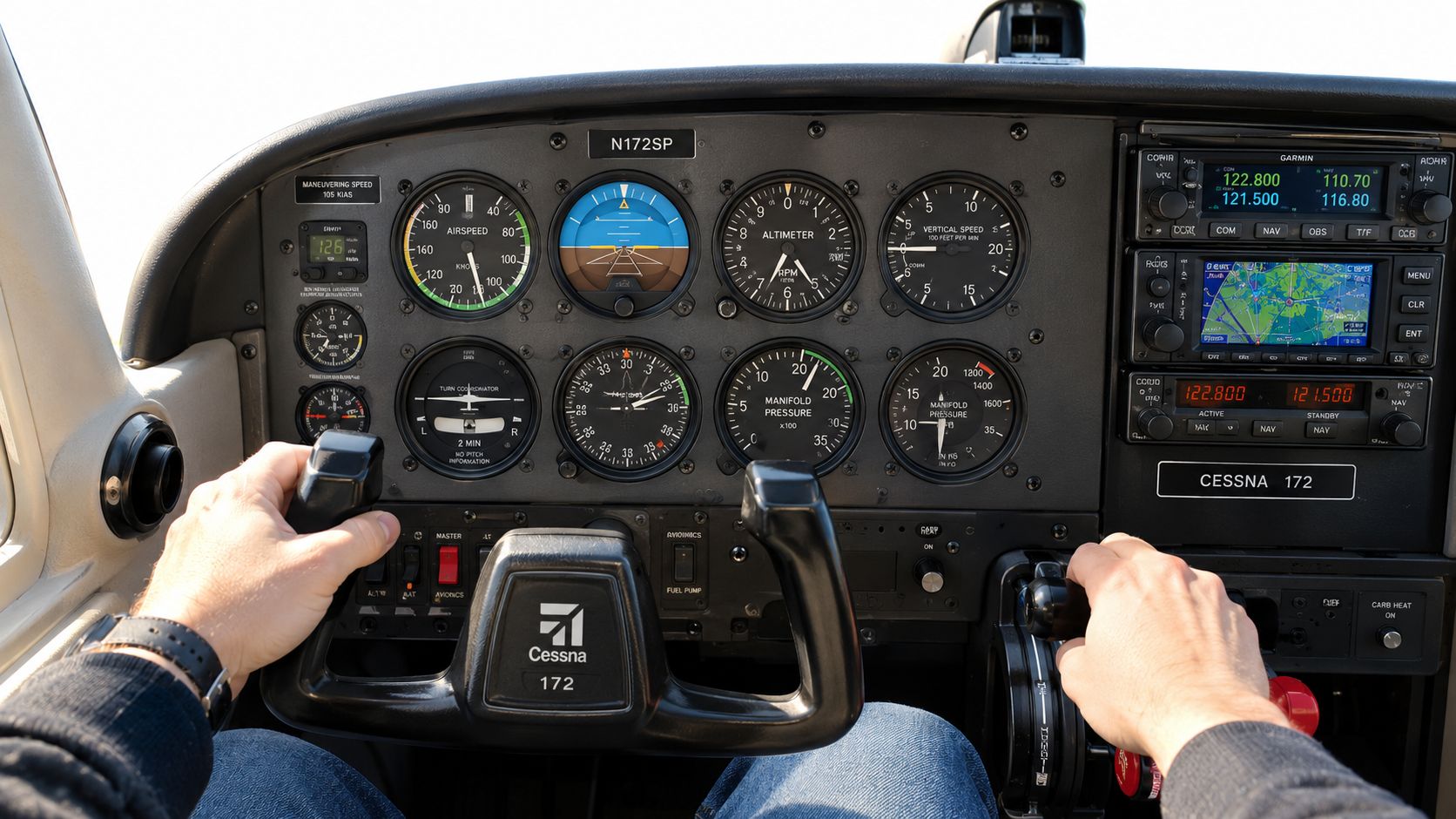
For cruise, select the airplane's intended power from the chart. In a constant-speed-propeller airplane, the pilot commonly sets the published RPM, adjusts the throttle to the charted MP, and then follows the approved leaning procedure. Some aircraft specify peak EGT, an economy setting, or another method. The POH and engine guidance determine the correct technique.
A charted cruise setting might read 22 inHg and 2,200 RPM on one installation, while another might use 24 inHg and 2,400 RPM. The format matters more than memorizing the numbers. A power-setting reference can clarify how MP and RPM are paired (power combination example).
Use a simple cockpit callout. Place a fingertip on the throttle quadrant, make the adjustment smoothly, and state the intended MP and RPM to the CFI. That gives the instructor time to catch a mistaken lever, an incorrect chart, or an unsuitable combination before cruise is established.
Common Mistakes and Training Habits That Build Confidence
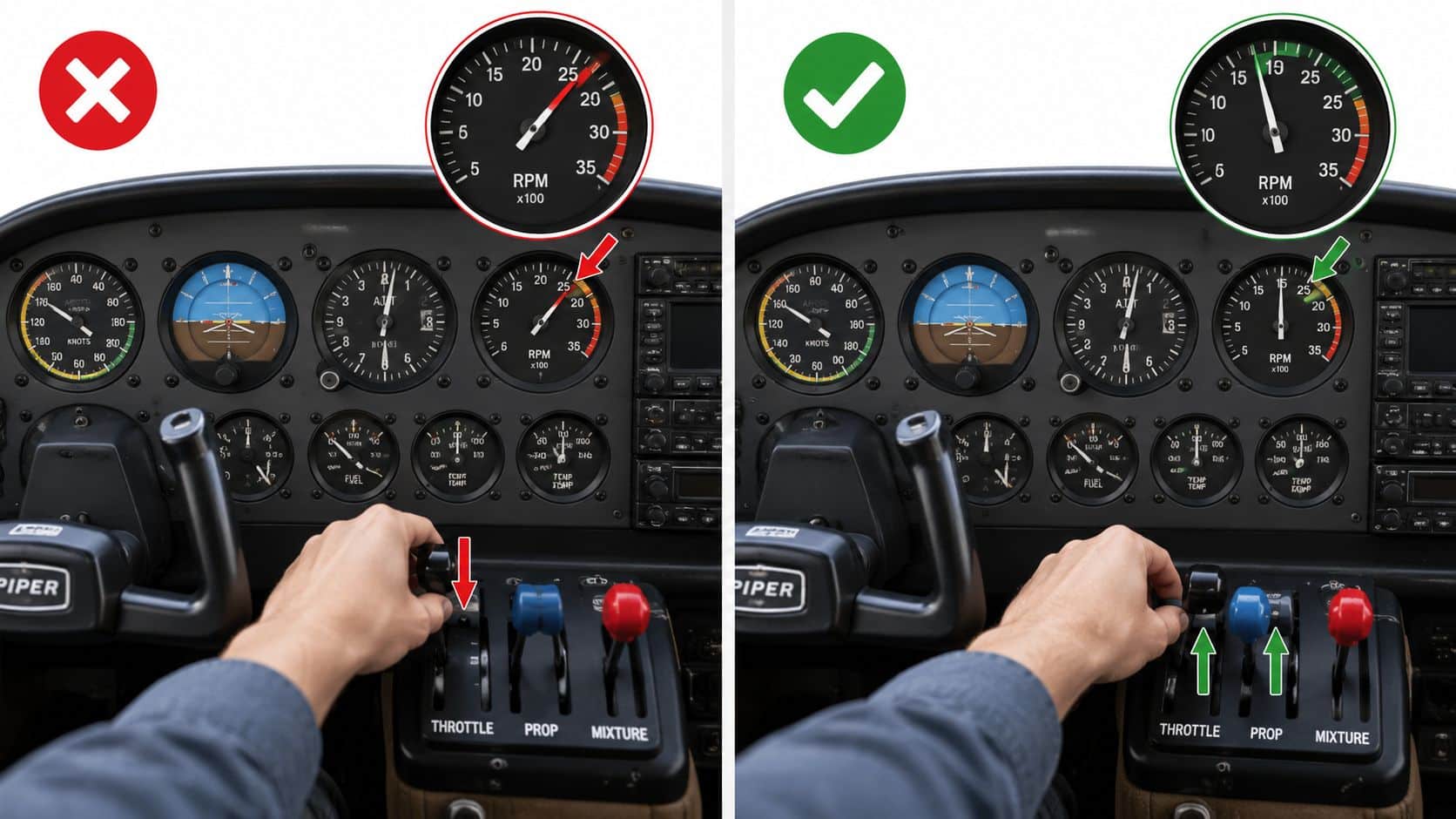
After solo, a pilot may leave a Cessna or Piper trainer's practice area and feel comfortable moving the controls, yet still hesitate when the MP and RPM indications do not match expectations. Start with the meaning of each instrument. Manifold pressure shows absolute intake pressure, while RPM shows engine and propeller speed. They describe different parts of the power setting.
In an airplane with a constant-speed propeller, the two controls work as a pair. A throttle change alters the pressure available to the cylinders. A propeller-control change alters RPM. Moving one control without considering the other can create an overspeed, underspeed, or combination outside the approved range. The POH, AFM, checklist, and CFI determine the correct sequence and amount of each adjustment.
Errors that deserve deliberate practice
- Confusing pressure with fuel flow: MP indicates intake pressure, not the amount of fuel entering the engine. Mixture and fuel delivery determine whether the air-fuel charge suits the selected power.
- Treating MP as total engine power: RPM, mixture, temperature, altitude, and propeller efficiency also affect the engine's output. A pressure reading alone cannot describe the airplane's complete performance.
- Leaning by habit: Use the approved procedure for the engine and power setting. High-power leaning requires care, and cruise mixture technique should come from the POH, AFM, or engine guidance.
- Reading the wrong scale: Confirm the instrument label and units before interpreting the needle. Inches of mercury describe pressure. They do not describe engine displacement or a generic “engine inch.”
- Ignoring a changing indication: A rise or drop that does not match a known throttle, altitude, or configuration change deserves attention.
Practice the callout before a transition. State the intended throttle movement, target MP where applicable, target RPM, and mixture action. Then check the actual indications and aircraft response. A pilot can use this side-by-side cockpit control example to rehearse identifying the correct lever and setting (A side-by-side comparison of a plane cockpit showing correct and incorrect throttle control settings.)
Using the gauge during abnormal situations
During a partial-power problem, MP may help confirm that the engine is still producing intake pressure. The indication cannot prove that the engine is reliable. Airspeed, landing-area selection, checklist use, and emergency communication still guide the response.
For a precautionary landing, a stable partial-power indication may help the pilot manage the approach while preserving options. An unexpected MP loss in cruise, especially with roughness, an RPM change, temperature change, or fuel-system symptoms, calls for the applicable checklist and a systems-focused response.
Instrument habit: Ask whether MP agrees with RPM, throttle position, altitude, mixture, and aircraft performance. One acceptable-looking number is never the whole diagnosis.
Pilot Questions About Manifold Pressure
What does manifold pressure really measure?
Manifold pressure, or MP, is the absolute pressure inside the intake manifold, between the throttle and intake valves. The gauge displays this pressure in inHg. In a parked, normally aspirated airplane, the reading is usually below local atmospheric pressure because the engine is drawing air through the intake system. The number shows the pressure available to the cylinders, not total engine power by itself.
Why can a turbocharged engine show pressure above local ambient pressure?
A turbocharger compresses intake air before it reaches the manifold. The gauge can therefore show pressure above outside atmospheric pressure, provided the setting remains within approved limits. A normally aspirated engine generally cannot produce that above-ambient intake pressure in ordinary operation.
When should a pilot lean the mixture?
Use the aircraft's POH or AFM, engine guidance, power setting, altitude, and CFI instruction. A mixture setting suitable for cruise may be inappropriate during a high-power operation. Follow the published procedure instead of relying on memory or a single gauge indication.
How do MP and RPM combine during a checkride power setting?
Treat them as a matched pair. If the approved setting calls for a particular MP and RPM, identify both before moving a control. Adjust the throttle and propeller control in the prescribed sequence, then confirm the tachometer, MP gauge, engine smoothness, and aircraft performance. A correct-looking MP with the wrong RPM is not the intended power setting.
What might an unexpected MP drop in cruise indicate?
First consider a throttle or altitude change. If neither explains it, possible causes include an induction restriction, carburetor icing, turbocharger or controller behavior, or an engine problem. Compare MP with RPM, smoothness, temperatures, fuel status, and aircraft performance. Use the applicable checklist, especially if the drop occurs with roughness or another indication.
Does manifold pressure appear on FAA knowledge testing?
The related concepts can appear in piston-engine systems and power-management questions. Study absolute pressure, normally aspirated and forced-induction engines, and how MP and RPM work together. Use current FAA references and instruction from a qualified CFI.
DuBois Aviation offers airplane and helicopter instruction, aircraft rental, simulator-supported training, and private, instrument, commercial, and multi-engine programs at Chino Airport. Visit DuBois Aviation for training availability or information about manifold pressure and checkride preparation.