
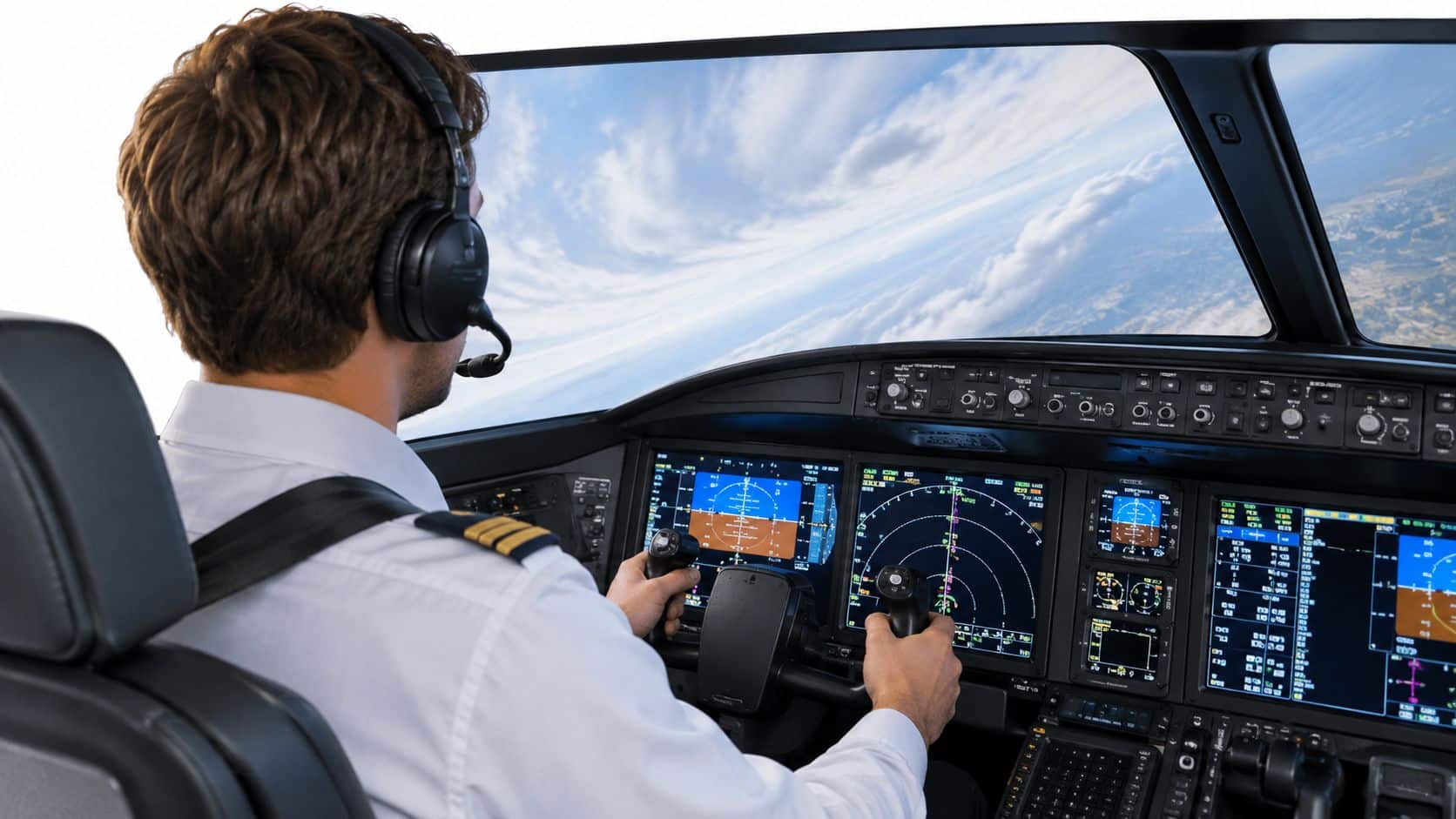
Spatial disorientation appears in 7.4% of fatal general-aviation accidents, and the risk is strongly associated with pilots who have fewer than 500 flight hours. Effective spatial disorientation training must prove more than recognition. It must show that a pilot can establish control by reference to instruments when the body, the outside view, and workload all become misleading.
The problem isn't a lack of intelligence or commitment. Spatial disorientation is a sensory mismatch. The eyes, inner ear, and body can send convincing but conflicting information about the aircraft's attitude. A pilot who understands that conflict, practices the correct response, and demonstrates it under increasing workload is better prepared for the moment visual references become unreliable.
Table of Contents
- Why Spatial Disorientation Remains a Leading Cause of Fatal Accidents
- Understanding the Illusions That Deceive Pilots
- How Effective Spatial Disorientation Training Works
- Fixed-Base Simulators Versus Virtual Reality Training
- Recommended Training Syllabus and Safety Considerations
- How DuBois Aviation Implements Local Training
- Key Takeaways for Safe Instrument Flight
Why Spatial Disorientation Remains a Leading Cause of Fatal Accidents
The FAA reviewed 26,535 general-aviation accidents from 2003 through 2021 and identified 367 fatal accidents involving spatial disorientation. Those accidents produced 741 fatalities, including 384 pilots and 346 passengers, and had a 94% fatality rate among the identified spatial-disorientation accidents (FAA research report).
Those figures change how pilots should view the subject. Spatial disorientation isn't only a student-pilot problem, and it isn't limited to a total loss of visibility. The FAA found a strong association with pilots who had fewer than 500 flight hours, but experience alone doesn't remove the underlying sensory conflict. The same report shows why every pilot carrying passengers needs a reliable response.
The risk is not limited to beginners
Earlier FAA analysis of National Transportation Safety Board records identified 1,022 spatial-disorientation-related accidents from 1976 through 1992, resulting in 2,355 fatalities. More than 70% were associated with instrument meteorological conditions, and approximately half occurred at night (FAA historical analysis).
The historical record also showed that the proportion of involved pilots holding an instrument rating roughly doubled when comparing the earlier and later periods reviewed. An instrument rating improves a pilot's ability to interpret instruments, but it doesn't make the inner ear reliable or prevent visual illusions.
Practical rule: An instrument rating is a tool for managing disorientation, not immunity from it.
Spatial disorientation begins when the pilot's sensory picture stops matching the aircraft's actual attitude. Outside references may suggest level flight while the attitude indicator shows a bank. The body may report a turn that the instruments don't confirm. Without a practiced instrument response, a pilot can follow the wrong source of information while believing the correction is sensible.
Understanding the Illusions That Deceive Pilots
The inner ear detects angular movement through fluid-filled semicircular canals. That system works well for ordinary movement on the ground, but it isn't an attitude instrument. A gradual bank can develop below the threshold at which the canals signal a noticeable change, allowing the aircraft to drift while the pilot feels level.
The FAA Pilot's Handbook of Aeronautical Knowledge identifies the leans as the most common in-flight spatial-disorientation illusion. Semicircular-canal stimulation at approximately 2 degrees per second or less can remain below the detection threshold. When the pilot abruptly levels the wings, the inner ear may create the false impression that the aircraft is banking in the opposite direction (FAA Pilot's Handbook).
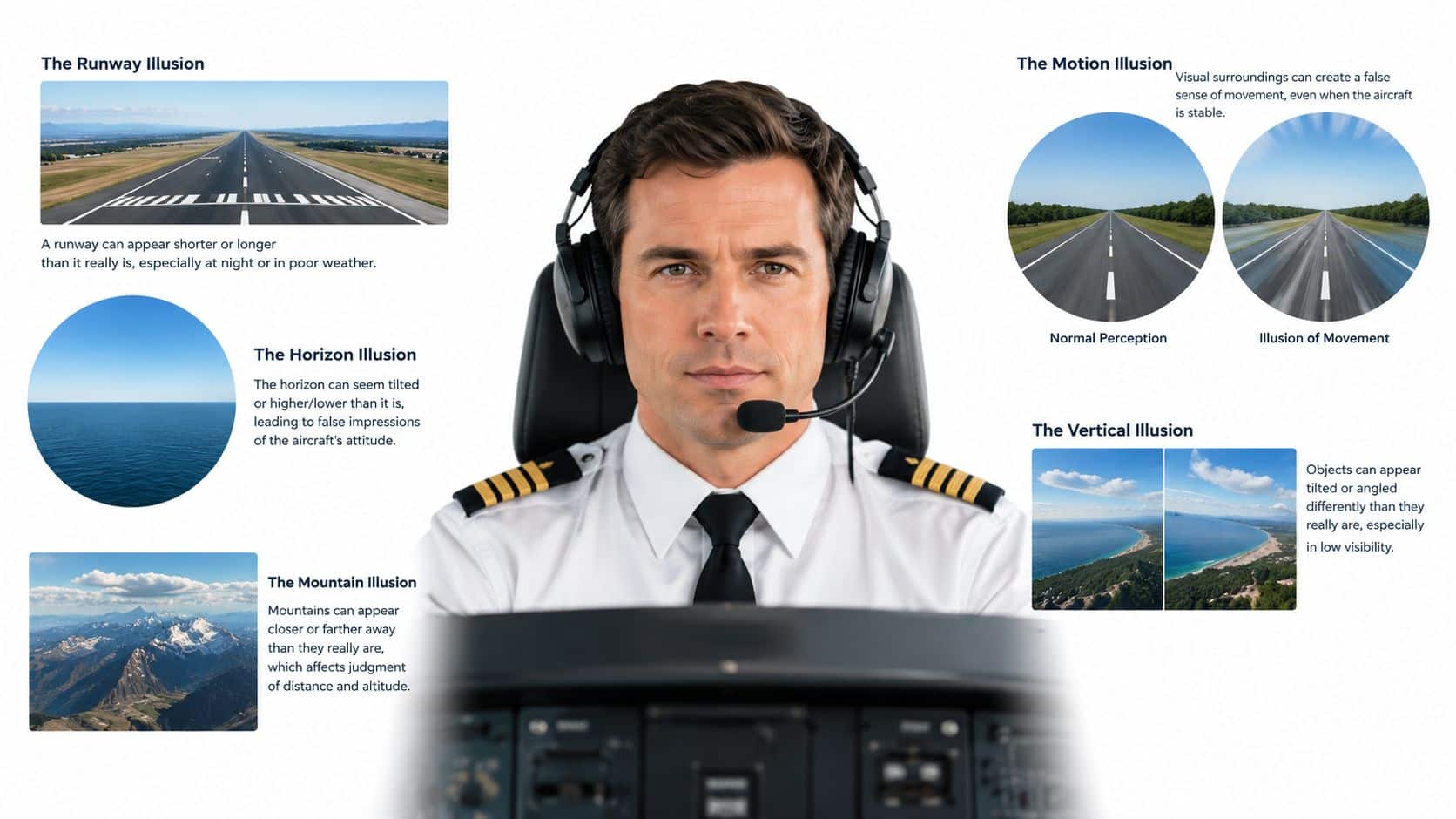
Common illusions and their traps
Several illusions deserve a plain-language explanation:
- The leans: A gradual bank goes unnoticed, then leveling the aircraft feels like banking the other way. The pilot may re-enter the original bank to “correct” a false sensation.
- The graveyard spiral: A prolonged turn can become difficult to perceive. As the aircraft loses altitude, the pilot may increase back pressure instead of recognizing the bank, tightening the turn and increasing the descent.
- The Coriolis illusion: An abrupt head movement during a turn can stimulate the semicircular canals in a way that creates a powerful sensation of tumbling or movement in another direction.
- Somatogravic illusions: Acceleration can feel like a pitch-up, while deceleration can feel like a pitch-down. Pilots learning related vestibular effects can review the somatogravic illusion in more detail.
Visual illusions create a different problem. A dark night, limited horizon, sloping terrain, unusual runway width, or sparse ground lighting can make the aircraft appear higher or lower than it is. The eyes aren't deliberately misleading the pilot. They are interpreting incomplete information with the references available.
The practical lesson is simple: bodily sensations and visual impressions are useful only when they agree with reliable aircraft instruments. When they conflict, the instruments take priority.
How Effective Spatial Disorientation Training Works
Exposure to an illusion can be memorable, but memory isn't the same as performance. Research indicates that current training improves recognition of environments where disorientation is likely, while showing little or no demonstrated effect on the perceptual response itself or on the explicit recovery action once disorientation begins (review of spatial-orientation training).
That limitation matters during a real emergency. A pilot may recognize, “This feels wrong,” yet still delay the instrument scan, chase a bodily sensation, or allow airspeed and altitude to deteriorate while handling radios and checklists.
Three layers that reinforce one response
A useful syllabus connects three training environments:
- Ground instruction: The pilot learns how visual, vestibular, and proprioceptive inputs disagree. The briefing covers the leans, prolonged turns, head movement during turns, reduced external references, and the difference between recognizing an illusion and recovering from it.
- Simulator exposure: The pilot experiences carefully controlled conflicts without the risk of an uncontrolled aircraft. The instructor can pause, repeat, and add workload while observing the scan, attitude control, power changes, and communication.
- Supervised aircraft practice: The pilot transfers the same discipline to flight. The instructor establishes appropriate conditions, confirms the aircraft is configured for safe training, and requires instrument-based control rather than sensation-based correction.
The FAA identifies devices such as a Barany chair, Vertigon, GYRO, and virtual-reality spatial-disorientation systems as ways to experience how convincing false sensations can feel. These demonstrations support awareness, but they shouldn't be treated as complete recovery training.
What the instructor should measure
Attendance and confidence don't prove mastery. A stronger evaluation records observable behavior:
- How quickly the pilot identifies that an outside reference is unreliable.
- Whether the pilot establishes attitude and power without chasing sensations.
- The altitude and bank deviation during unusual-attitude recovery.
- The number of unnecessary control reversals.
- Whether the pilot verbalizes the aircraft's attitude and trend.
- Whether the pilot uses the prescribed recovery sequence while managing communication and navigation.
A convincing sensation is not the test. A consistent instrument-based recovery is the test.
The instructor can increase difficulty by adding radio calls, navigation changes, checklist tasks, or simulated equipment failures. The objective isn't to make pilots immune to illusions. It is to make the correct response faster and more dependable when perception becomes untrustworthy.
Fixed-Base Simulators Versus Virtual Reality Training
Effective spatial disorientation training does not require every device to move. Each environment exposes a different weakness, so instructors should choose the device according to the illusion and behavior they need to train, not its appearance.
A fixed-base simulator works well for visual illusions, instrument workload, and repeatable control tasks. It can reproduce a dark approach, misleading runway perspective, limited outside references, unusual attitudes, and distractions while the instructor watches the pilot's control inputs. Because the scenario can be paused and repeated, the instructor can test whether the pilot recognizes unreliable visual information and transfers attention to the instruments.
A virtual-reality system adds immersion and a strong sense of visual presence. That can help pilots understand how convincing a false picture may appear, but immersion alone does not prove operational skill. Comfort, briefing quality, and transfer to the aircraft still require deliberate evaluation.
A 2026 simulator study found that trainee pilots generally flew a shallower final approach at night in black-hole conditions. Night and overall flight experience did not eliminate the error, while the study found that fixed, low-cost simulators could reproduce the illusion effectively (2026 simulator study).
Match the device to the training objective
| Training objective | Useful training environment | What the pilot should demonstrate |
|---|---|---|
| Recognize misleading runway or terrain perspective | Fixed-base simulator or VR | A stable instrument-guided approach using planned references |
| Practice unusual-attitude recovery | Approved simulator or aircraft with an instructor | Immediate attitude-and-power control |
| Experience vestibular sensations | Carefully controlled ground device | Recognition without using sensation as an attitude reference |
| Manage reduced-visibility workload | Fixed-base simulator followed by aircraft practice | A disciplined scan while handling radios, navigation, or checklists |
| Build operational judgment | Briefing, simulator, and supervised flight | Conservative decisions before visual references degrade |
VR may improve knowledge and self-efficacy, but motion sickness can limit training time. A study of 215 participants reported a large knowledge effect and an average post-training nausea score of 34.91 on the 0-200 Simulator Sickness Questionnaire scale, a mild but measurable effect (immersive training research). Instructors should screen for comfort and treat that result as a study outcome, not a prediction for every pilot.
The same principle applies when evaluating immersive instruction in other fields. The discussion of assessing XR medical simulation accuracy shows why simulation quality must be judged by accuracy and transfer, not visual impact alone.
For pilots training around Chino, a simulator training center can provide repeatable instrument scenarios before the instructor introduces the same control discipline in an aircraft. The useful test is simple: can the pilot identify unreliable information, maintain the intended attitude, and apply the correct response under workload?
Recommended Training Syllabus and Safety Considerations
A sound syllabus progresses from understanding to control, then from control to judgment. The sequence should prevent a student from experiencing a dramatic sensation without knowing what action follows.
A practical progression
Begin with the briefing. The instructor explains sensory mismatch, instrument priority, common illusions, and the conditions that increase risk. The pilot rehearses a short verbal response, such as identifying the unreliable reference, naming the aircraft attitude, and committing to the instruments.
Move to the simulator. Initial scenarios should use manageable workload. The pilot practices a standard instrument scan, maintains attitude and airspeed, and recovers from gradual bank entries or reduced visual references. Later sessions can add radio work, navigation changes, checklist tasks, and simulated equipment problems.
Transfer the behavior to flight. In-flight demonstrations require a serviceable aircraft, functional dual controls, clear transfer-of-control language, conservative weather, and an instructor who can stop the exercise immediately. The instructor should never create an unnecessary emergency to make a lesson memorable.
The NTSB research summarized in FAA excerpts found that 281 of 367 fatal general-aviation spatial-disorientation accidents occurred in instrument meteorological conditions, and 44% involved a pilot entering IMC while intending to operate under VFR (FAA and NTSB research excerpts). That finding supports conservative weather decisions, current instrument proficiency, and a clear response to inadvertent IMC.
Applying the lesson near Chino
Chino Airport's towered Class D environment offers realistic radio and traffic-management demands, but those demands must be introduced deliberately. A student shouldn't be overloaded with complex tasks before basic attitude control is stable.
Useful preparation includes:
- Weather decisions: Set conservative limits before departure and define when the flight will turn back, divert, or remain on the ground.
- Workload control: Add one distraction at a time rather than combining every possible task at once.
- Transfer language: Use explicit phrases for who has control, who is monitoring, and what action follows.
- Recovery practice: Review unusual attitude recovery before any supervised demonstration.
- Debriefing: Compare the pilot's perceived attitude with the aircraft's recorded or observed attitude, then assign a specific improvement for the next session.
The instructor's job is to create a controlled mismatch, not an uncontrolled surprise. Every demonstration should have a defined entry condition, recovery method, stopping point, and post-flight discussion.
How DuBois Aviation Implements Local Training
DuBois Aviation can integrate spatial disorientation training into private-pilot, instrument, commercial, multi-engine, CFI, CFII, MEI, helicopter, and rental-pilot preparation through a simulator-to-aircraft sequence. Initial work can focus on attitude-instrument flying and scan discipline, followed by supervised aircraft practice in which the pilot applies the same priorities without relying on bodily sensations.
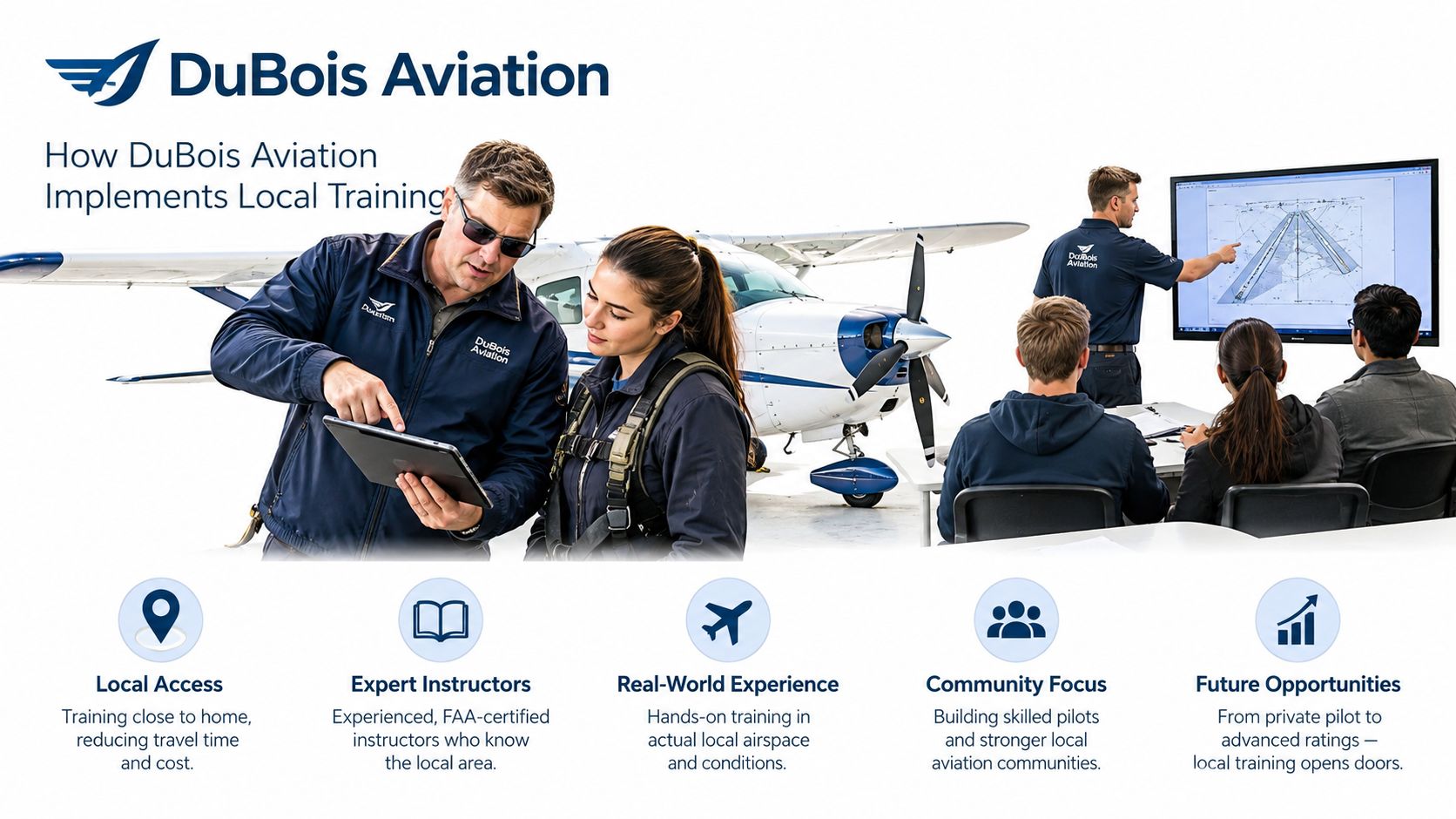
The local setting adds useful operational context. Training at Chino Airport exposes students to tower communications, changing traffic demands, multiple runways, and instrument approaches, while Southern California weather can require careful decisions about visibility and external references. Those conditions should be used for judgment and workload training, not as an excuse to introduce unnecessary risk.
The fleet supports different training needs, including Piper Cherokees, a Cessna 150, a Mooney M20B, a Piper Apache, and Robinson and Enstrom helicopters. The appropriate aircraft and lesson depend on the pilot's certificate, rating, experience, and training objective.
FAA guidance recommends ground exposure through devices such as a Barany chair, Vertigon, GYRO, or Virtual Reality Spatial Disorientation Demonstrator so pilots can recognize how persuasive false sensations can feel before encountering them in flight (FAA spatial-disorientation guidance). A responsible local program pairs that awareness with measurable instrument-control behavior.
For renters and career-track pilots, the same framework remains useful after certification. A recurrent lesson can test scan discipline, inadvertent IMC decision-making, workload management, and recovery consistency without waiting for a real emergency to expose a weakness.
Key Takeaways for Safe Instrument Flight
Spatial disorientation training works when it changes what the pilot does. The pilot doesn't need to feel calm, certain, or physically oriented before taking action. The pilot needs to recognize that perception may be unreliable and establish control from instruments.
A useful post-training check asks whether the pilot can:
- Identify the conflict: State that outside references or bodily sensations no longer provide dependable attitude information.
- Control the aircraft: Set the prescribed attitude and power without abrupt control reversals.
- Use the scan: Cross-check attitude, airspeed, altitude, heading, and trend rather than fixating on one indication.
- Communicate clearly: Tell the instructor or other qualified pilot what is happening and transfer control when appropriate.
- Manage the emergency: Reduce nonessential tasks, use available automation only when properly understood, and communicate with air traffic control as workload permits.
A pilot who performs those actions in a quiet simulator may still need practice when radios, navigation, weather, and passengers compete for attention. Instructors should therefore repeat the exercise with graduated workload and document whether recovery remains consistent.
The right mindset is not, “The illusion won't happen.” The better mindset is, “If perception becomes unreliable, the instruments and procedure will take over.” That competency deserves reinforcement throughout a pilot's career, whether the pilot is working toward a private certificate, an instrument rating, a commercial certificate, a CFI or CFII rating, a helicopter add-on, or regular aircraft rental.
DuBois Aviation offers airplane and helicopter instruction, simulator-supported instrument training, aircraft rental, and career-track programs at Chino Airport. Pilots can visit DuBois Aviation to ask about course availability, schedule a school tour, or request a training plan built around measurable spatial disorientation recovery skills.