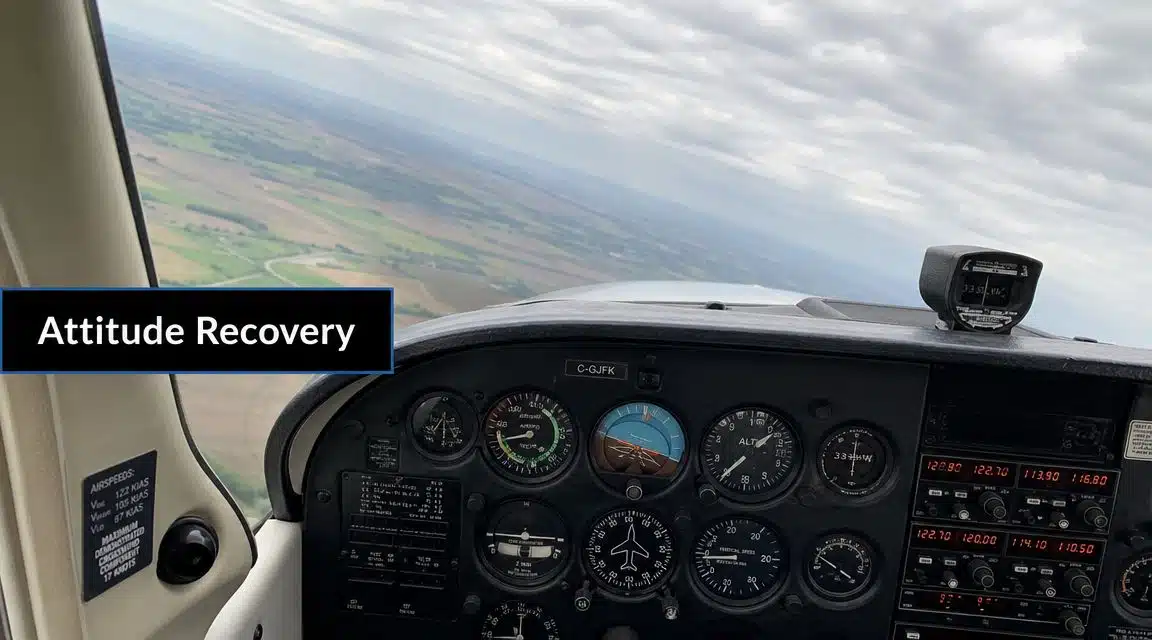
You're usually not thinking about unusual attitude recovery on a calm day in cruise. You're thinking about radios, weather, a checklist item you want to stay ahead of, or whether the autopilot is doing exactly what you expect. Then the airplane starts doing something you didn't command. Your inner ear says one thing. The panel says another. The nose feels high, or maybe it only feels high because your body is lying to you. That's how a routine flight starts drifting toward a very bad place.
At our school, we treat this as a core piloting skill, not a checkride trick. A pilot who can recognize an upset, trust the right instruments, and make disciplined control inputs has a margin that an untrained pilot doesn't. That matters for the student in early instrument work, the rusty private pilot coming back for recurrent training, and the owner who just bought an airplane and wants to operate it safely instead of just legally.
Why Every Pilot Must Master Upset Recovery
A pilot in visual conditions can still get caught. A pilot in instrument conditions can get trapped faster. It often starts small. A distraction during a climb. A scan breakdown under the hood. Turbulence, a trim issue, or an automation surprise. The airplane drifts away from where it should be, and the pilot reacts to the feeling instead of the evidence.
That's why unusual attitude recovery deserves respect. It sits right at the intersection of aerodynamics, workload management, and human factors.
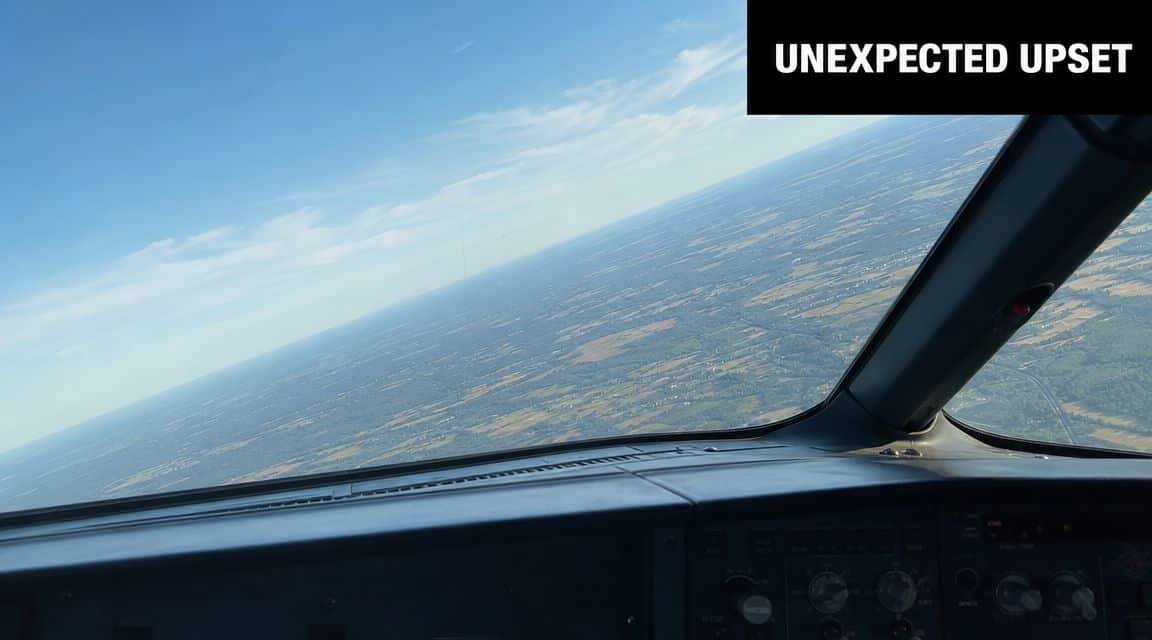
This is a safety skill, not an aerobatic skill
A lot of pilots hear “upset recovery” and think of aggressive maneuvering. That's the wrong frame. Formal recovery training grew because loss of control in flight kept showing up as one of aviation's most serious accident categories. Aviation Performance Solutions notes that LOC-I accounts for over 41% of all airline fatalities and ties that directly to the rise of formalized recovery training in modern doctrine, including the four-step Push, Roll, Power, Stabilize sequence in major training systems (Aviation Performance Solutions on unusual attitude recovery).
The key point is simple. Recovery is about regaining controlled flight before the airplane reaches a stall, an overspeed, or a structural loading problem. It's an energy problem first. Attitude matters because it drives energy, but chasing the picture alone doesn't solve the underlying problem.
Practical rule: If you wait to “figure it out” while the airplane keeps diverging, you're already behind. Recognize, unload or protect as required, roll appropriately, manage power, then stabilize.
Why pilots struggle in the moment
What works in a briefing room can fall apart under pressure because the first impulse is often wrong. In a nose-high upset, many pilots hesitate to lower the nose because the ground feels precious. In a nose-low upset, many pull before they level the wings because altitude loss feels urgent. Both reactions are understandable. Neither is reliably safe.
We teach recovery as a practiced response because that's what holds up when the workload spikes. The goal isn't to turn pilots into robots. The goal is to give them a procedure sturdy enough to survive stress.
Three realities shape that training:
- Your body can mislead you. Spatial disorientation doesn't announce itself politely.
- The airplane keeps accumulating energy or losing it while you hesitate. Delay narrows your options.
- Small errors compound fast. A rough pull, a bank left in during recovery, or a power mistake can turn a recoverable upset into a damaged airplane.
That's why unusual attitude recovery belongs in primary training, instrument training, recurrent training, and transition training for anyone buying into a new airplane or stepping into higher performance.
Recognizing the Upset and Taking Immediate Action
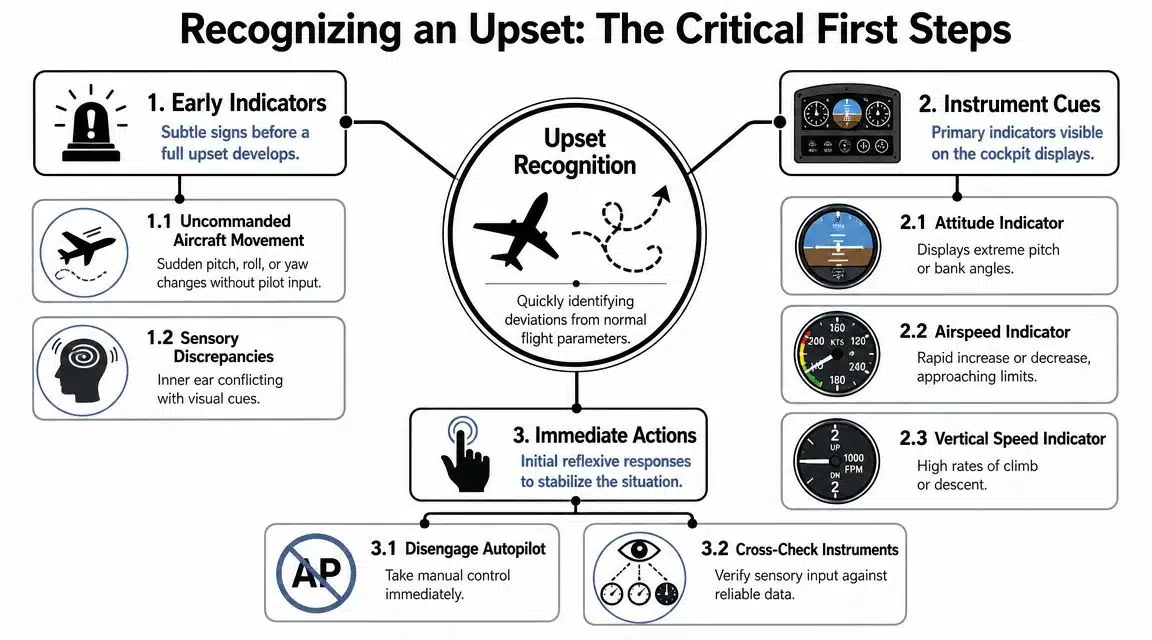
Recognition is where the whole maneuver is won or lost. If the diagnosis is late or wrong, the recovery will be late or wrong too. In actual flying, especially in IMC, you don't get a pause button. You need a fast, reliable way to identify what the airplane is doing.
What qualifies as unusual
There are formal thresholds for when an attitude has crossed into upset territory. SKYbrary defines an unusual attitude as typically involving a nose-up pitch greater than 25 degrees, a nose-down pitch greater than 10 degrees, or a bank angle greater than 45 degrees (SKYbrary guidance on recovery from unusual aircraft attitudes).
Those numbers matter in training because they give us a concrete trigger. You don't wait for the airplane to become spectacularly out of control. Once the aircraft is beyond normal flight parameters and still diverging, you act.
Read the panel in clusters, not in isolation
The attitude indicator is the headline instrument, but it should never act alone in your mind. We train pilots to confirm what they see by cross-checking airspeed, VSI, and altimeter. Those supporting instruments tell you whether the trend matches the picture.
A nose-high upset usually presents as a high pitch indication with decreasing airspeed and a climb trend. A nose-low upset usually shows a low pitch indication with increasing airspeed and a descent trend. The bank picture matters too, but the trend instruments help prevent you from making a control input based on a misread or a rushed glance.
Here's the mental flow we want:
- See the divergence. The aircraft is no longer where you intended it to be.
- Confirm attitude. Start with the attitude indicator.
- Cross-check trend. Airspeed, VSI, altimeter.
- Classify the upset. Nose-high or nose-low.
- Take control inputs in the right order.
A short video is useful here because seeing panel indications and timing helps lock the sequence in.
What immediate action looks like
The first seconds matter more than perfect wording or textbook neatness. We teach pilots to do a few things immediately and consistently.
- Disengage what needs to be disengaged. If automation is contributing confusion, get manual control established.
- Trust the instruments, not the seat of your pants. Vestibular illusions are persuasive and often wrong.
- Identify the trend before you move the controls. Rising airspeed and a plunging VSI tell a different story than decaying airspeed and a climb.
- Stop the upset from getting worse. The airplane doesn't care that you're still thinking about it.
Look for trend first. A stopped decay in airspeed, a stopped increase, and a reversed VSI tell you recovery is beginning before the airplane looks pretty again.
A practical recognition standard
Pilots often ask what “good recognition” feels like. It feels fast, calm, and slightly boring. There's no drama in it. You notice the flight path diverging, you verify the instrument story, and you classify the upset without wrestling with your senses.
What doesn't work is fixating on one instrument or reacting to a single cue. If you stare only at altitude, you'll tend to pull too soon. If you stare only at bank, you may miss a dangerous speed trend. A proper scan prevents both.
For the student pilot, this starts under the hood with controlled setups. For the rated pilot, recurrent work matters because scan discipline fades when it isn't used. That's especially true for owners stepping into a newly purchased aircraft with different panel flow, trim feel, or power response.
The Correct Recovery Procedures for Any Situation
Once the upset is identified, the recovery has to follow the airplane's needs, not the pilot's fear. We teach this at DuBois Aviation as an energy and lift-vector problem first. If you understand what the wing is doing, the sequence makes sense and holds up when the picture is ugly.
A nose-high upset and a nose-low upset can both cost altitude. They do not demand the same first control input.
Nose-high recovery
A nose-high upset usually means airspeed is bleeding off, angle of attack is increasing, and the wing is getting closer to quitting on you. The pilot who tries to save altitude with back pressure often turns a recoverable situation into a stall or spin entry.
The priority is to reduce angle of attack and get the airplane flying cleanly again. Add power as appropriate for the aircraft, lower the nose enough to break the high-AOA condition, then bring the wings back toward level with coordinated control. After the wing is flying normally again, return to the desired flight path and trim the airplane.
That order matters. Power helps, but power alone does not fix an overworked wing. Pitch relief does. If you want a stronger grasp of why that matters, review our explanation of angle of attack.
In training, we make pilots prove they can accept temporary altitude loss here. That is the trade-off. Give up a little altitude now, or risk giving up the airplane.
Nose-low recovery
A nose-low upset is usually an energy problem in the other direction. Airspeed builds fast, the descent steepens, and many pilots pull before they have dealt with bank. That is how you drive the load factor up and make the recovery rougher than it needs to be.
The priority is to stop the airplane from tightening the problem. Reduce power as needed to control the speed increase, level the wings, then raise the nose smoothly to arrest the descent. As the airplane comes back toward a normal attitude, set the power you need and re-trim.
Leveling the wings first is not just a memory item. It puts the lift vector back where it can help you recover instead of forcing the airplane through a loaded, banked pullout. In our simulator and in-air drills, pilots experience the difference between a disciplined recovery and a panicked one.
In a nose-low, banked upset, the clean recovery is wing first, then pitch. That keeps the structure and the wing out of an unnecessary fight.
Quick-reference comparison
| Condition | Step 1 Power | Step 2 Bank/Pitch | Step 3 Power Adjust | Rationale |
|---|---|---|---|---|
| Nose-high upset | Add power as appropriate | Lower the nose to reduce angle of attack, then level the wings | Adjust as needed once returning toward stabilized flight | Restores wing effectiveness before a stall develops |
| Nose-low upset | Reduce power as needed | Level the wings first, then smoothly raise the nose | Reintroduce appropriate power as the airplane stabilizes | Limits speed growth and avoids excessive loading during pullout |
Why energy management beats memorization
Memorized steps help on a checkride. Understanding helps when the upset is unplanned, partial-panel, at night, in turbulence, or in an unfamiliar aircraft.
A nose-high airplane usually needs angle of attack reduced before anything else matters. A nose-low airplane usually needs the lift vector realigned and the speed increase checked before a smooth pitch recovery. The control feel will differ between a trainer, a complex single, and a twin. The aerodynamic logic stays the same.
That is why our upset training does not stop at reciting procedures. We use simulator scenarios to force quick recognition without outside visual cues, then repeat the same logic in the aircraft so pilots can connect instrument indications, control pressure, trim state, and energy trend. That is how the procedure becomes usable under stress, not just repeatable in the briefing room.
Common Mistakes and How to Avoid Them
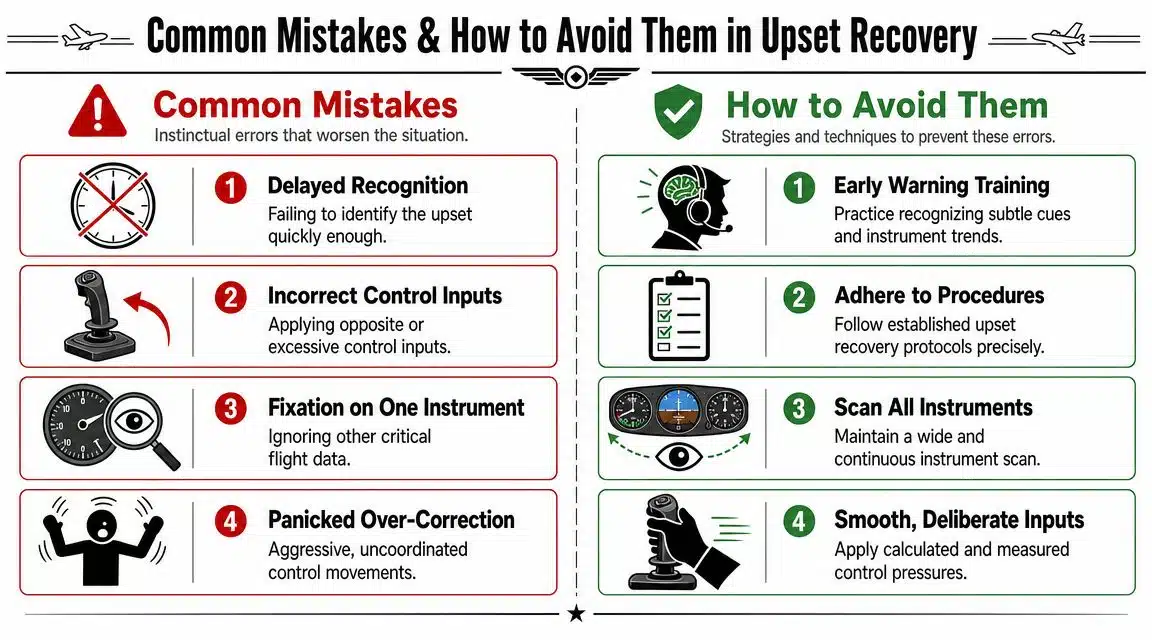
Most bad recoveries don't come from ignorance alone. They come from instinct. The pilot sees an alarming picture and does what feels urgent instead of what improves the airplane's condition. That gap between instinct and discipline is where training earns its keep.
The urge to save altitude immediately
This is one of the most common traps. Pilots hate seeing altitude unwind, so they pull. In some cases that pull comes while the wings are still banked. In others it comes so abruptly that it creates more load than the airplane or the situation can tolerate.
FAA and safety references warn against overcorrecting with abrupt control inputs, especially above maneuvering speed, and they also warn against chasing altitude instead of focusing on energy management, using trend reversals in airspeed, VSI, and altimeter as the right markers for the recovery's success (Fly8MA discussion of unusual attitude recovery).
The correction is not “ignore altitude forever.” The correction is to stop treating altitude as the first variable to rescue at any cost.
The scan collapses to one instrument
Another frequent mistake is fixation. A pilot stares at the altimeter. Or the airspeed indicator. Or the attitude indicator alone. That single-instrument focus creates blind spots at exactly the wrong time.
Use a broad but disciplined scan instead:
- Start with attitude. That gives you the basic picture.
- Check airspeed trend. It tells you whether energy is bleeding off or building dangerously.
- Confirm with VSI and altimeter. They show whether the airplane is still diverging.
- Keep bank in the picture. A bank left in during recovery changes everything.
A narrow scan makes the upset feel simpler than it is. That's dangerous.
Abrupt control movements
The phrase “smooth and coordinated” can sound soft until you've seen what rough control work does. Rapid, aggressive movement can overshoot the correction, increase structural stress, and create a second upset immediately after the first. This gets worse when the pilot is startled or embarrassed and wants to “fix it now.”
We coach the opposite response. Get decisive, but stay measured. The controls don't need panic. They need order.
Smooth doesn't mean slow. It means controlled, proportional, and in sequence.
Letting pride block recurrent practice
Licensed pilots sometimes avoid unusual attitude work because they think it's basic stuff they should already have down. That mindset creates rusty instrument scans, stale habit patterns, and overconfidence in airplanes they haven't flown enough.
What works better is treating unusual attitude recovery like any other perishable skill. If your recent flying has been easy VFR, your instrument cross-check and upset timing probably aren't where you think they are. Recurrent training fixes that before the weather, workload, or a bad surprise exposes it.
Prevention and Proactive Training at DuBois Aviation
The best recovery is the one you never need. That isn't a slogan. It's how real pilots manage risk. Most upsets begin earlier than people think, with a weak scan, poor task management, a rushed weather decision, or an automation assumption that goes unverified.
We build prevention around habits, not lectures. A pilot who manages workload early usually stays ahead of the airplane. A pilot who knows the aircraft's performance and trim behavior usually catches deviations before they become dramatic. A pilot who's current on instruments usually recognizes the panel story before the body starts inventing one.
How we train the prevention side
At DuBois Aviation, we don't wait for a student to reach a checkride maneuver before introducing the thinking behind upset prevention. We work it into day-to-day flying.
That includes:
- Simulator sessions with deliberate disorientation setups. The simulator lets us create scan failures, distractions, and attitude changes safely, then repeat them until the response becomes orderly.
- In-aircraft drills with tight instructor oversight. The airplane adds real control feel, real trim response, and real workload that no desktop lesson can fully replace.
- High-workload operations at a towered airport. Training at KCNO means radios, traffic awareness, runway changes, and pace. Those are exactly the conditions where poor prioritization can start an upset chain.
The simulator is where many pilots first understand that unusual attitude recovery begins before the controls move. It begins with recognition. It begins with scan. It begins with not letting confusion linger.
Why this matters for airplane buyers and owners
Pilots shopping for an airplane often focus on useful load, speed, avionics, and insurance requirements. Those are all important. But safe ownership starts with a harder question. Are you ready to manage the airplane when it stops looking like the brochure and starts behaving like a machine with momentum, trim forces, and workload?
A safe purchase process includes more than a prebuy. It includes honest training planning. If you're moving into a faster single, a retractable, a complex airplane, or a type with a different panel and handling profile, unusual attitude recovery and instrument proficiency should be part of the transition plan. Owners who skip that step often end up behind the airplane in the first demanding weather day or the first distraction-heavy trip.
That's one reason we put serious value on advanced proficiency work, including instrument flying training. Instrument discipline sharpens the same scan, trend awareness, and workload control that keep small deviations from turning into larger problems.
What works better than trying to “be careful”
“Be careful” isn't a method. Structured training is. We've found that prevention improves when pilots practice three things together:
- Task prioritization under pressure
- Instrument cross-check during distraction
- Prompt correction of minor deviations before they grow
Those habits pay off whether you're a student pilot, an instrument candidate, a commercial trainee, or a pilot who just bought an airplane and wants to operate it with judgment rather than hope.
Integrating Recovery Skills into Your Flying Career
Unusual attitude recovery isn't a box to check and forget. It's a professional habit. The pilot who stays current in this area usually flies better in every other area too, because the same skills support safer instrument work, better automation management, and calmer decision-making when the cockpit gets busy.
That's why we treat it as a recurring discipline. You recognize the upset. You confirm it with a proper instrument cross-check. You recover in the correct aerodynamic order. Then you practice it again later, because skill fades when it isn't used.
The standard worth carrying forward
A good pilot doesn't need to be dramatic in an upset. A good pilot needs to be reliable. That reliability comes from disciplined scan habits, respect for energy management, and willingness to train beyond the minimum.
It also connects directly to cockpit teamwork. Even in single-pilot flying, strong habits borrowed from crew resource management improve outcomes. Use available resources. Verify what the airplane is telling you. Don't let ego or hurry crowd out procedure.
The pilots who handle upsets best are rarely the ones with the most swagger. They're the ones who kept the fundamentals polished.
If your unusual attitude recovery practice is stale, fix that before the next trip, the next layer, or the next transition into a different aircraft does it for you.
If you want to sharpen your unusual attitude recovery skills, build safer instrument habits, or plan transition training before buying an airplane, DuBois Aviation can help with one-on-one instruction, simulator work, and aircraft-specific proficiency training at Chino Airport.