
You’re probably here because the idea won’t leave you alone.
You’ve looked up at a helicopter crossing the California coast, lifting over traffic, tracing a canyon, or working a fire line in the distance, and thought, I want to learn how to do that. Then the practical questions hit. How hard is it? How long does it take? What does helicopter training california look like when you move past the dream and into real lessons, real costs, and real decisions?
That uncertainty is normal. Most prospective students don’t need more hype. They need a calm, accurate explanation from someone who’s watched beginners start with zero experience and work their way to a checkride.
From Golden State Dream to Cockpit Reality
California has a way of making helicopter flight feel close enough to touch. One day you’re watching a helicopter move along the shoreline. Another day you see one crossing dry inland terrain, or hear rotor noise near a hospital, utility corridor, or fire operation. The appeal is obvious. Helicopters go places airplanes can’t, and the flying feels direct, precise, and alive.
What many people don’t realize is that the path from curiosity to certificate is structured. You don’t need to “figure it out” on your own. You start with a medical and a school. You learn basic aerodynamics, regulations, weather, and helicopter systems. You build skill in hovering, takeoffs, landings, emergency procedures, navigation, and radio work. Then you move through written tests, practical standards, and a final checkride.
California is a strong place to do that because the training environment is rich. Students can encounter coastal conditions, mountain terrain, desert air, and complex urban airspace in one state. Some schools train under Part 61, which gives more flexibility. Others train under Part 141, which follows a more formal syllabus. Both can work well when the instruction is solid and the student shows up prepared.
Flying a helicopter starts as an emotional decision. Finishing training is a discipline decision.
If you’re worried that the process sounds too technical, that’s where good instruction matters. A competent instructor doesn’t dump jargon on you. They break each lesson into tasks you can understand, practice, and improve.
By the time you finish reading, you should have a clear picture of the certifications, the money, the timeline, the school-shopping questions, and one topic most guides skip entirely: what it means to buy a helicopter safely after training if ownership is part of your long-term plan.
Your Flight Plan The Helicopter Pilot Certification Path
A helicopter certificate path works more like a ladder than a single finish line. You start by learning to control the machine. Then you prove you can do it consistently, under more conditions, and with more responsibility.
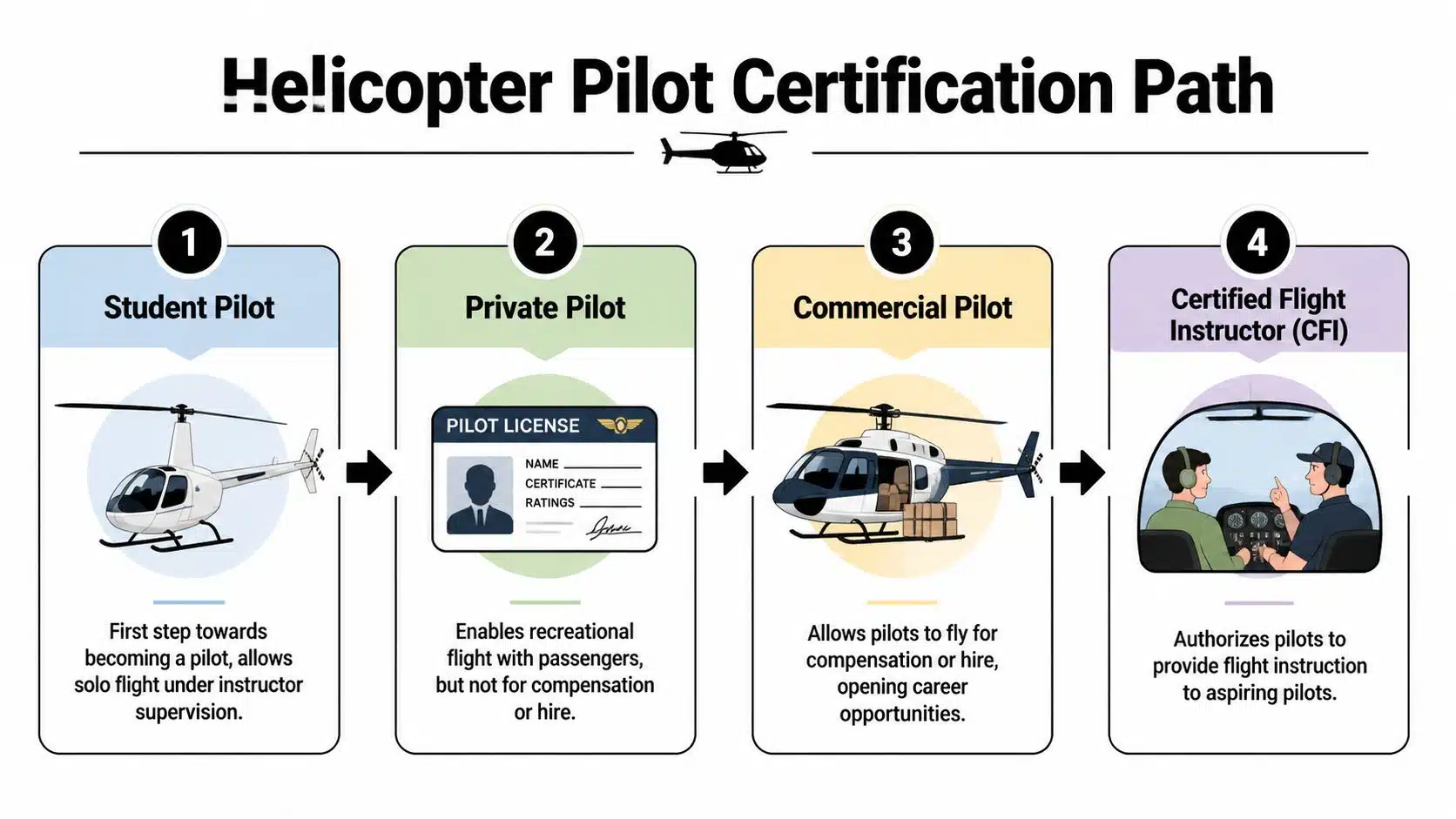
That structure helps because early confusion is normal. New students often hear terms like student pilot, private, instrument, commercial, Part 61, and Part 141 and assume they are choosing one path instead of moving through a sequence. In practice, each stage builds on the one before it.
Student pilot to private pilot
Your first phase is simple in concept and demanding in practice. You begin as a student pilot, usually flying with an instructor while learning preflight habits, checklist discipline, hovering, takeoffs, landings, traffic patterns, radio calls, and emergency procedures. Hovering alone can surprise people. It feels less like steering a car and more like balancing on a large exercise ball while trying to stay relaxed.
For the Private Pilot Certificate, Rotorcraft-Helicopter, the FAA minimum is 40 hours of flight time. The exact mix can vary by school and training approach, but the private level includes dual instruction, solo experience, cross-country work, night flying, and some instrument reference training. Ground study matters just as much here. If you want a structured option to build that knowledge between flights, a formal helicopter and fixed-wing ground school program can help you connect regulations, weather, aerodynamics, and systems before you are trying to apply them in the cockpit.
A private certificate lets you fly for personal reasons and carry passengers. It does not let you fly for compensation or hire.
That line matters more than many students expect.
Some people begin training because they want weekend freedom, family trips, or the satisfaction of mastering a difficult skill. Later, they decide they want to instruct, tour, or work toward utility flying. Private training still fits that plan because it gives you the base layer. If owning a helicopter is part of your long-term goal, private training is also where you start learning what kind of aircraft matches your future mission, budget, and skill level.
The instrument rating and why it changes your flying
An Instrument Rating often sounds abstract until you experience it. Instead of relying mainly on the horizon and outside visual cues, you learn to control and position the helicopter by reading the panel accurately and following procedures with precision.
Students sometimes assume this rating is only for future airline-style flying. In helicopters, it has a broader value. It improves scan discipline, smooth control inputs, situational awareness, and decision-making when the outside picture is limited or distracting. It also teaches humility. The helicopter does not care whether you feel confident. It responds to what you do.
Instrument training can be mentally tiring at first. That is normal. You are building a new way of processing information, much like learning to read music after playing by ear. The payoff is that your overall flying usually becomes calmer and more exact.
Commercial pilot and the move toward professional standards
The Commercial Pilot Certificate, Rotorcraft-Helicopter is the point where the FAA allows you to fly for compensation or hire, assuming you also meet the requirements of the job itself. The minimum experience rises to 150 total flight hours.
The bigger change is not just the number. It is the standard.
Commercial training asks for tighter maneuvers, better consistency, stronger judgment, and cleaner technique under pressure. A private pilot can be safe and competent. A commercial pilot must also be reliable in a way that another person can trust with money, schedules, passengers, or operational demands.
This is also a good time to start thinking one step past the certificate. If your eventual plan includes buying a helicopter, commercial-level training gives you a much sharper eye for ownership realities. You begin to notice how aircraft differences affect operating cost, payload, maintenance access, insurance, and mission fit. That perspective can save you from earning a certificate in one aircraft and purchasing another that does not suit the kind of flying you intend to do.
Certified flight instructor for time-building and teaching
Many helicopter career paths continue with the Certified Flight Instructor certificate. Instructors teach student pilots, reinforce their own fundamentals, and often build the flight time needed for later jobs.
Even if instruction is not your final destination, it is one of the most common bridges between training and professional employment. Teaching also exposes weak spots in your own understanding. If you can explain a hovering correction clearly, demonstrate it, and catch a student’s error before it grows, you understand the skill at a deeper level.
Part 61 and Part 141 without the jargon
Students often worry about choosing between Part 61 and Part 141 as if one is correct and the other is a compromise. The better question is which structure fits the way you learn and live.
- Part 61 usually offers more schedule flexibility and more room to tailor the pace.
- Part 141 follows an FAA-approved syllabus with a more formal progression and documentation.
- Both can produce excellent pilots when the instruction is disciplined and the student trains consistently.
If your work schedule changes week to week, Part 61 may fit better. If you do well with a defined sequence and classroom-style accountability, Part 141 may feel clearer. Ask how the school teaches, how often students typically fly, how stage checks are handled, and what happens when a student needs extra help. Those answers matter more than a label.
Requirements at a glance
| Certificate / Rating | FAA Minimum Flight Hours | Typical Total Hours | Primary Privileges |
|---|---|---|---|
| Private Pilot Rotorcraft Helicopter | 40 | Most students need more than the minimum for proficiency | Personal helicopter flight, passenger carriage, no compensation or hire |
| Instrument Rating | 40 instrument hours, plus other experience requirements | Varies by prior experience and proficiency | Helicopter flight under instrument procedures and improved weather and systems proficiency |
| Commercial Pilot Rotorcraft Helicopter | 150 total | Often completed beyond minimums as skill develops | Fly for compensation or hire |
| Certified Flight Instructor | Not specified here | Varies qualitatively | Teach helicopter students if you earn the instructor certificate |
One practical tip before you move from one certificate to the next. Build your budget the same way you build hours, in planned increments. If the cost of training feels hard to visualize, you can discover sinking funds and use that approach to separate checkride fees, headset purchases, written test costs, and recurring flight blocks into predictable buckets.
The certification path is demanding, but it is not mysterious. You train. You practice. You get corrected. You improve. By the time you reach the checkride, the goal is not to impress the examiner. The goal is to show that safe habits have become normal for you.
Budgeting Your Ascent Realistic Costs and Timelines
A lot of future helicopter students reach the same moment. They can picture the first lesson clearly. They can hear the rotor, see the runway, and feel the excitement. Then they ask what the whole path costs, how long it takes, and whether the plan still works if they someday want to own a helicopter instead of only renting one.
That is the right question to ask early.
Helicopter training is rarely expensive because of one dramatic bill. It is expensive the way a long cross-country flight uses fuel. A little at a time, steadily, over a route that rewards planning. If you only budget for the first few lessons, the training can stall right when your skills need repetition and momentum.
Published price ranges vary widely by school, aircraft, and training pace, but the practical takeaway is simple. Reaching commercial helicopter certification is usually a major financial project, not a casual hobby expense. Students who understand that from day one tend to make calmer, better decisions.
Why one student finishes faster and spends less than another
Skill matters. So does rhythm.
A student who flies two or three times a week usually retains more from each lesson than a student who flies once, then waits three weeks. In helicopter training, long gaps can be expensive because part of the next lesson gets used to rebuild what faded since the last one. It is a little like learning a musical instrument. Regular practice turns separate lessons into progress. Irregular practice turns them into review.
Several factors shape the final cost:
- Aircraft type: Hourly rates depend heavily on the helicopter used for training.
- Lesson frequency: Consistent flying usually reduces repeat instruction.
- Home study: Students who arrive prepared often make better use of paid flight time.
- Checkride timing: Testing before you are fully ready can lead to extra training and another examiner fee.
- Life interruptions: Work trips, weather delays, and family demands can stretch the timeline.
The important part is not finding a perfect estimate. It is understanding why your estimate can change.
Build the budget in phases, not one giant number
Many students get discouraged because they look at the total before they look at the sequence. A better method is to break training into stages and fund each one on purpose. Private pilot. Instrument, if you plan to add it. Commercial. Instructor ratings if you are pursuing a career path.
That phased approach also helps if your long-term goal includes ownership. Buying a helicopter after training is not something to figure out later with a shrug. It affects how you think about cash reserves, insurance, hangar or tie-down costs, maintenance, and what kind of aircraft experience will serve you well. A student who expects to buy a simple piston helicopter for personal flying may make different financial decisions than a student planning to build hours toward an employer-operated turbine job.
If you need a practical way to organize that money, one smart household budgeting method is to discover sinking funds and set aside training dollars gradually for known aviation expenses. That works well for flight training because many costs are predictable even when the exact date is not. Written test fees, headset purchases, medical exams, examiner fees, and blocks of flight time all fit naturally into separate buckets.
Timelines follow consistency more than raw talent
Students often ask for a calendar answer. Three months? Nine months? Two years?
The honest answer depends less on enthusiasm than on availability. A highly motivated student with a chaotic schedule may progress more slowly than an average student who protects two or three training slots every week. Helicopter flying is physical, mental, and procedural. Repetition turns all three into habits.
Ask a school to help you map a training rhythm you can realistically maintain. Not your ideal week. Your real week.
That same realism matters if you hope to own an aircraft after training. The pilot who rushes to finish with no financial margin may earn the certificate, then discover that ownership remains out of reach because the training budget consumed every reserve. The wiser approach is to train with the next step in mind. Finish your ratings, keep some liquidity, and learn enough about operating costs to decide whether buying, renting, or joining a partnership makes the most sense.
The goal is not the cheapest path on paper. The goal is a training plan you can sustain all the way to the checkride, with a clear view of what comes after.
Why California is a World-Class Helicopter Classroom
You lift from a Southern California airport on a clear morning, work a few radio calls in busy traffic, track inland where the air gets hotter and thinner, then spend the afternoon judging wind near rising terrain. That is not a special adventure flight. In California, it can be a normal training day.
That range is what makes the state such a strong place to learn. A student does not spend month after month seeing only one kind of weather, one kind of airport, and one kind of decision. The environment keeps asking new questions, and good training teaches you how to answer them calmly.
Terrain that teaches judgment
California gives instructors a large teaching map. Desert flying shows why power margins matter when temperatures climb. Mountain areas teach respect for wind flow, escape routes, and the difference between a landing area that looks acceptable from far away and one that is usable. Near the coast, marine layers and changing visibility can turn a simple plan into an exercise in restraint and timing.
Those lessons build the kind of judgment that a future helicopter owner will also need. A pilot who may one day buy an aircraft should learn early that performance is never abstract. It affects where you can go, how much fuel you can carry, what margin you keep, and whether a trip still makes sense after conditions change. Training in varied terrain helps connect cockpit skill to future ownership decisions.
Airspace that builds confidence
California also gives students regular exposure to busy airspace. At a towered airport such as Chino, a new pilot learns that radio work is part of aircraft control, not a separate academic subject to worry about later. You listen, sort priorities, respond clearly, and keep flying the machine.
That can feel like learning to drive in city traffic instead of an empty parking lot. It raises the workload, but it also builds habits that transfer well. Students who train in active airspace often become more comfortable with planning ahead, staying organized, and keeping their attention outside the cockpit while still handling instructions correctly.
Quiet airports still have value. They can be excellent places to practice fundamentals. California’s advantage is that many students can experience both simplicity and complexity during the same training journey.
California teaches more than aircraft control. It teaches adjustment.
The flying culture is practical, not abstract
The state also puts students close to real helicopter work. You see aircraft supporting public safety, utility operations, charter, instruction, and specialized missions. Even if you are years away from that kind of flying, it helps to train in a place where helicopter operations are visible and discussed in concrete terms.
That matters because career goals and ownership goals often overlap more than new students expect. Someone who plans to instruct, fly tours, or build time commercially may later compare the cost of renting against joining a partnership or buying an older piston helicopter. A training environment connected to real-world operations gives those later decisions more context. You start to understand not only how to pass a checkride, but also how helicopters are used, maintained, and paid for.
California does not make training easy. It makes it broad, realistic, and demanding in ways that prepare you for what comes after the certificate.
Choosing Your Flight School A California Checklist
A flight school is not just a place that rents you a helicopter and assigns an instructor. It shapes your habits, pace, confidence, and safety culture. That’s why choosing one deserves more than a quick price comparison.
Many schools talk about certificates. Fewer talk clearly about total investment, job prospects, or why their fleet and airport environment matter. That transparency gap is specifically noted in Specialized Heli’s discussion of helicopter training decision factors.
Start with questions about honesty
When you call or visit a school, listen for direct answers. You want a school that will explain not only the path in front of you, but also the common reasons students spend more time and money than expected.
Ask things like:
- What does your training estimate include? Look for clarity on aircraft, instructor time, ground instruction, and likely extra expenses.
- How do you handle students who need more repetition? A good answer sounds practical, not defensive.
- What does a normal training week look like here? You’re trying to learn whether the school can support steady momentum.
- How do students prepare outside the aircraft? Schools that value briefing and study usually waste less flight time.
Evaluate the instructor fit, not just the school brand
Students often choose based on website polish, then discover the actual experience depends on one instructor. Your fit with that instructor matters a lot.
Look for:
Teaching style that matches your learning style
Some instructors are concise and technical. Others are more conversational. Neither is automatically better.Availability and consistency
A strong instructor who’s rarely available can slow your progress.Willingness to explain the “why”
You don’t want someone who only says “do this.” You want someone who can connect the maneuver to aerodynamics, safety, and judgment.Calm cockpit presence
Helicopter students make mistakes. A useful instructor corrects them without making the cockpit feel chaotic.
Inspect the fleet and the maintenance mindset
The aircraft type affects training feel, scheduling flexibility, and long-term goals. In California helicopter training, students often compare Robinson models with Enstrom helicopters. That’s a fair question. The school should be willing to explain where each aircraft fits in the curriculum and what kind of experience you’ll gain from it.
A useful school tour includes more than a glance at the ramp. Ask about maintenance scheduling, aircraft downtime, and backup plans when one helicopter is unavailable. You’re not asking for a sales pitch. You’re checking whether the operation seems orderly and safety-minded.
A clean lobby doesn’t tell you much. A school’s attitude toward scheduling, maintenance, and honest answers tells you a lot.
Consider the airport environment
Some students do better starting at a quieter field. Others benefit from working in towered airspace right away. Neither choice is universal, but the school should be able to explain the training value of its location.
A busy airport can teach radio skills, sequencing, and airspace awareness from the start. A quieter airport can reduce early workload. The right fit depends on your goals, confidence level, and how the school manages progression.
Watch how the school treats your career questions
If you’re career-focused, ask about the full pathway, not just the first certificate. Ask what students typically do after commercial training. Ask whether the school can discuss realistic next steps without exaggeration.
That matters even more for veterans or students trying to compare helicopter and fixed-wing routes. A school that can talk openly about return on investment, fleet differences, and training environment is usually showing respect for your decision process, not just trying to close a sale.
School Spotlight Why DuBois Aviation at Chino (KCNO) Excels
The easiest way to judge a school is to test it against the checklist above. That makes the abstract questions practical.
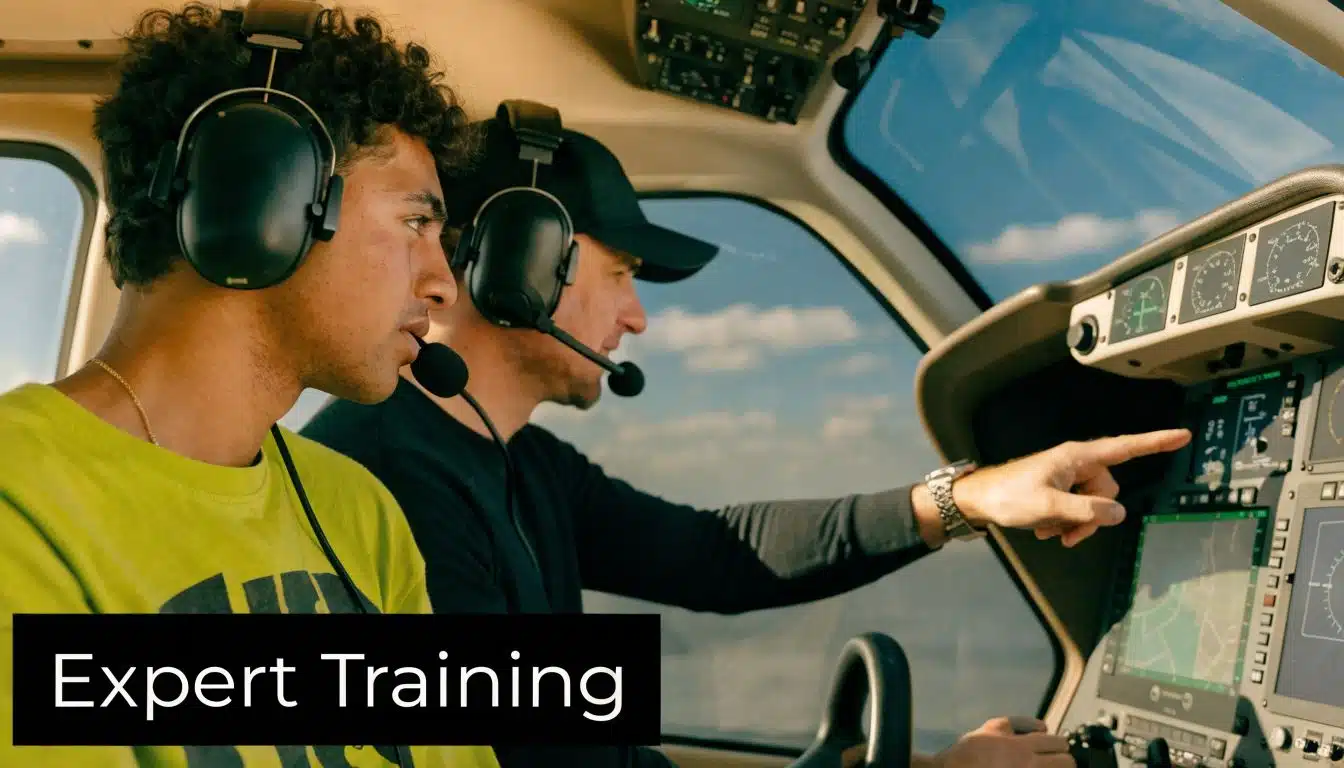
One California example is DuBois Aviation, based at Chino Airport. The factual details that stand out are straightforward: helicopter and airplane training, one-on-one instruction, Robinson and Enstrom helicopter availability, simulator support, Jeppesen learning materials, and operations at a busy Class D airport with three runways and multiple instrument approaches.
Why the airport matters
Chino (KCNO) is not a stripped-down training environment. It’s a working towered airport. Students training there gain early exposure to radio communication, runway assignments, traffic sequencing, and real-world situational awareness.
That experience can reduce the shock some pilots feel when they leave a very quiet field and suddenly have to operate in busier airspace. If your long-term goal includes professional flying, it’s useful to train where communication and planning are part of normal life, not a late add-on.
Another practical advantage is variety. According to the verified training profile, trainees at Chino can build experience around a Class D towered facility with multiple instrument approaches, using fleets that include Robinson and Enstrom helicopters, plus simulator support and 1-on-1 CFI instruction with Jeppesen materials.
Why aircraft choice matters
A school that offers both Robinson and Enstrom helicopter experience gives students more context than a single-aircraft environment. You learn not just how to pass a lesson, but how different aircraft can shape your feel for handling, procedures, and mission fit.
That doesn’t mean one type is automatically “better” for every student. It means the school can have a more useful conversation with you about training goals. If you’re planning recreational flying, one path may make sense. If you’re thinking about broader exposure, another may.
A short look inside the training environment helps make that more concrete:
Why the instructional format matters
One-on-one instruction changes the pace of learning. In helicopter training, that can be a big deal because the aircraft is sensitive, lesson time is valuable, and students progress at different rates. A personalized format lets the instructor adjust quickly when a student needs more work on hovering, radio confidence, or emergency procedure flow.
The other factor is scheduling and continuity. A school that supports regular training and keeps the plan visible tends to serve students better than one that treats each lesson like an isolated event.
If you’re comparing schools around Southern California, this is the kind of case study to keep in mind. Don’t just ask who offers helicopter certificates. Ask where you’ll train, in what aircraft, under what level of structure, and with how much individual attention.
Beyond the Checkride Buying Your First Helicopter
Some pilots finish training and realize they don’t just want to rent. They want to own. That can make sense for personal use, business travel, specialized operations, or access and convenience. It can also become expensive fast if you buy carelessly.
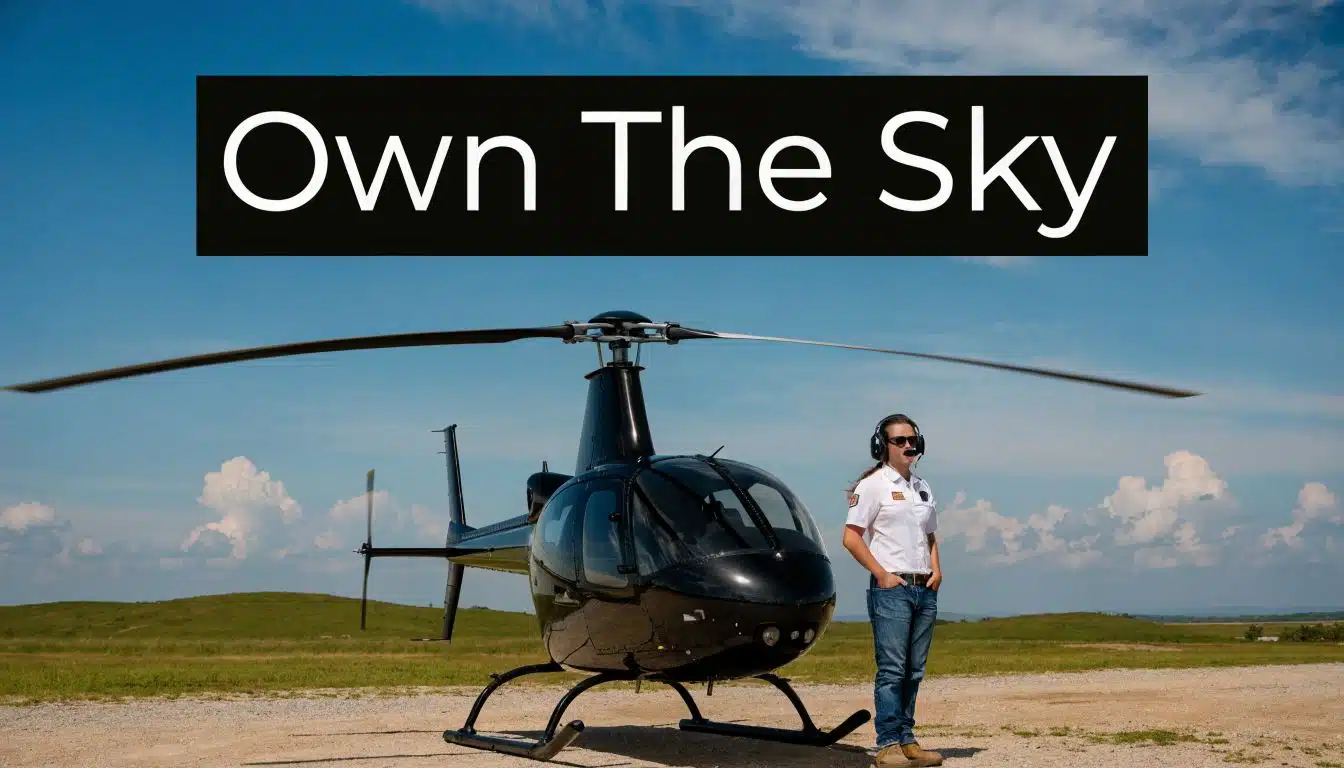
The safe way to buy an airplane or helicopter starts with due diligence. Never rely on a seller’s confidence, a clean paint job, or a quick demo flight. You need an independent pre-buy inspection by a mechanic or maintenance professional who knows that aircraft type well.
What to check before you buy
- Maintenance logs: Review them carefully. Missing records are more than a paperwork annoyance. They represent a risk.
- Time-limited components: Helicopters can carry expensive replacement obligations tied to component life. If you don’t understand those, the purchase price can fool you.
- Damage and repair history: Ask direct questions and verify the answers against the records.
- Mission fit: Don’t buy for fantasy use. Buy for the flying you will do.
- Insurance and operating support: Make sure your post-purchase plan is realistic, including where the helicopter will be maintained and who will help with recurrent training.
A sales page can help you understand the market and available inventory, but it shouldn’t replace your inspection process. If you’re exploring ownership options, aircraft sales through DuBois Aviation is one example of where buyers can start browsing while still doing the independent checks that protect them.
Buy the records as much as the aircraft. In rotorcraft ownership, paperwork often reveals costs the paint never will.
Ownership can be rewarding. It just needs the same mindset that good training requires: slow down, verify everything, and don’t let excitement outrun judgment.
Your Journey Starts Now
If helicopter flying has been sitting in the back of your mind for a while, the next step doesn’t need to be dramatic. It just needs to be real.
The path is manageable when you break it into parts. Learn the certificate sequence. Build a budget that respects reality. Choose a school that answers direct questions. Train in an environment that will make you sharper, not just comfortable. If ownership is part of your future, start learning how to evaluate aircraft safely long before you sign anything.
California gives you a strong setting for this work. The state can challenge your flying in useful ways, and that’s exactly what many students need. Not more mystery. Better preparation.
A discovery flight is often the right first move. You’ll feel the controls, hear the radio, watch how an instructor teaches, and get a much clearer sense of whether this is just an interest or the start of something bigger.
If you’re ready to take that first practical step, DuBois Aviation offers airplane and helicopter training at Chino Airport, along with discovery flights that let you experience the cockpit before committing to a full training plan.