

Most student pilots think the checkride is a coin toss. It isn’t. The latest FAA data shows that the first-time private pilot pass rate was 74.5% in 2023, down from 78% in 2021, with the longer trend from 2014 through 2021 staying in a fairly tight range of 73.9% to 78% according to FAA pass rate data summarized here. That should calm you down for two reasons.
First, most applicants do pass. Second, the students who don’t usually don’t fail because of some mystery standard. They miss predictable items. Weak oral prep. Sloppy planning. A maneuver that falls apart under pressure. Poor judgment when the examiner changes the scenario.
If you’re anxious, that’s normal. I’ve sat across from plenty of applicants who were more afraid of the unknown than the actual test. The cure is understanding what the private pilot checkride pass rate really means, what causes disapprovals, and how to prepare in a way that makes the practical test feel familiar instead of intimidating.
Two practical options worth comparing
These are specific products pilots commonly compare for this type of flying. Confirm compatibility with your aircraft and instructor before ordering.
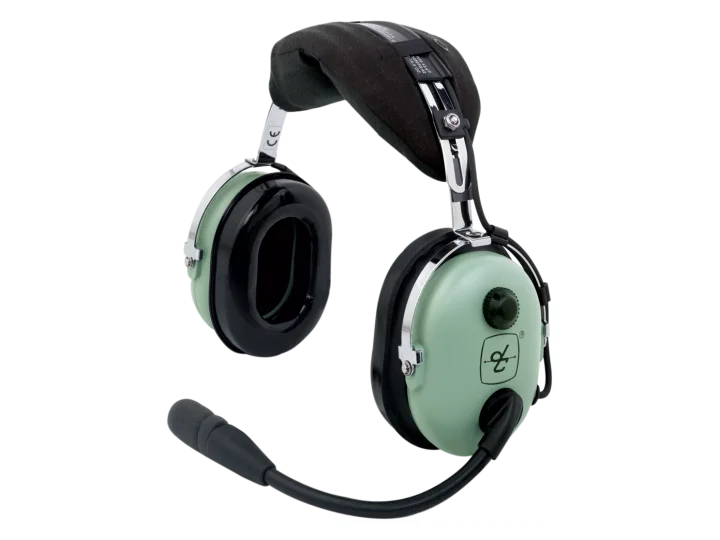 Student headsetDavid Clark H10-13.4 Aviation HeadsetCheck current availability on Amazon (paid link)
 OrganizationASA Flight BagCheck current availability on Amazon (paid link)
Understanding the Private Pilot Checkride Pass Rate in 2026
74.5%. That was the FAA private pilot first-time pass rate in 2023, down from 78% in 2021, based on this summary of FAA practical test data. For an anxious student, that number can feel either comforting or ominous. The better way to read it is more practical: roughly three out of four applicants passed on the first try, and the one who did not usually missed something identifiable, trainable, and preventable.
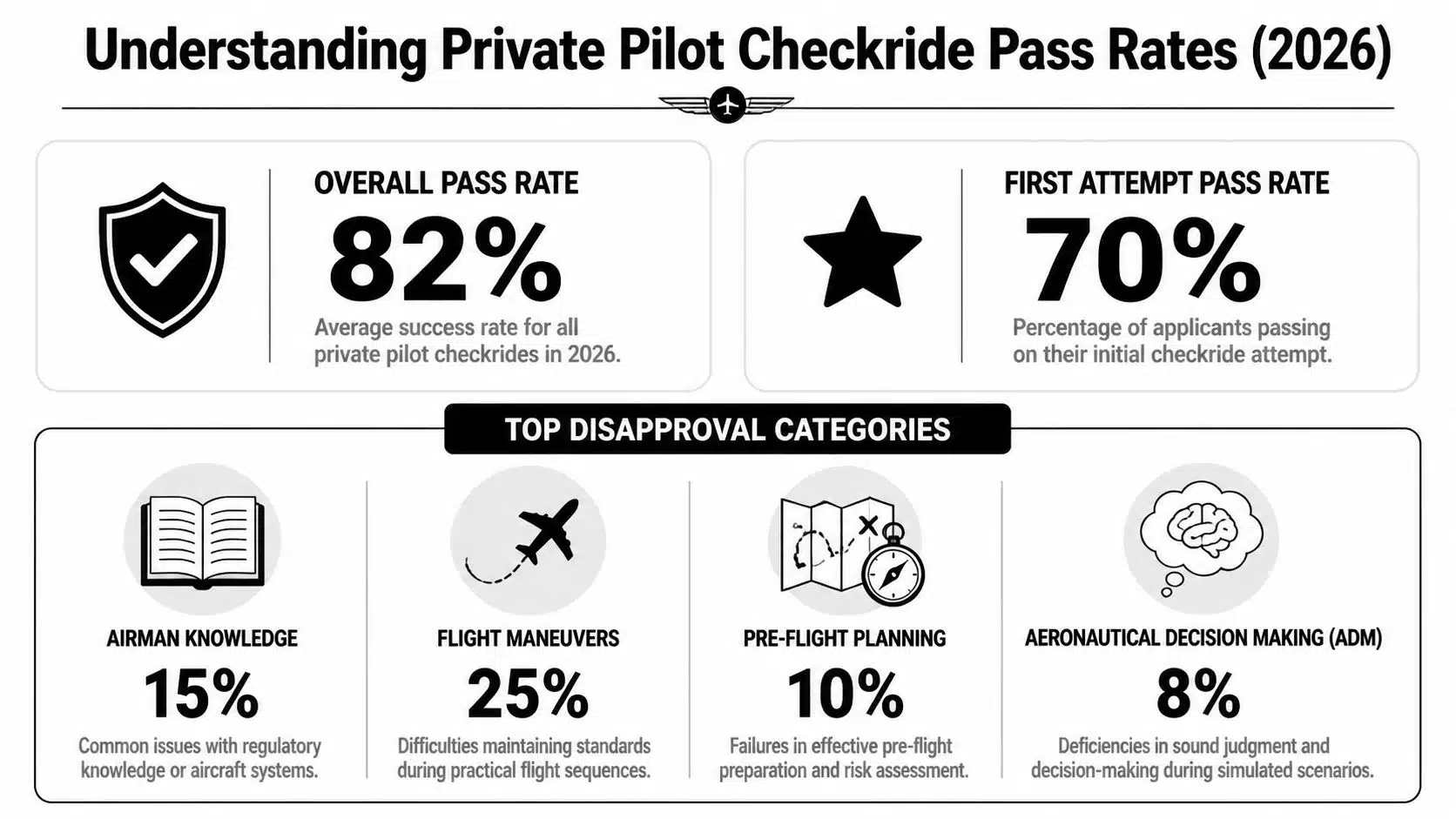
That context matters because students often hear one number and turn it into a personal forecast. It is not. A pass rate is a trend line across thousands of applicants, not a prediction about your checkride. Your result depends much more on whether your preparation matches the Airman Certification Standards, especially in the areas where applicants commonly come apart under pressure.
Here is the part many students miss. The rate dipped from a recent high, but the longer pattern had been fairly steady for years. From 2014 through 2021, first-time pass rates stayed within a relatively narrow band of 73.9% to 78%, as noted in the same FAA data summary. That looks less like a sudden spike in examiner harshness and more like a system under strain: more applicants, uneven readiness, and more training gaps showing up on test day.
What the pass rate actually measures
The checkride pass rate tracks first-attempt results. It does not measure eventual success after a retest, and it does not separate a polished applicant from one who showed up tired, poorly organized, or weak on scenario questions.
A checkride works a lot like a final stage check with higher stakes. Two applicants may have the same total time, similar written scores, and identical endorsements. One can still pass comfortably while the other earns a disapproval because the ACS is not grading hours. It is grading whether knowledge, flight skill, and judgment show up together, on demand, in a real scenario.
That distinction matters if you are trying to estimate your own odds.
Use the pass rate as a benchmark for the system, not as a verdict on your readiness.
Why the recent numbers changed
A common point of confusion for students is how disapprovals can rise even as total certifications increase. In the same FAA data summary, private pilot disapprovals requiring retests increased by 46.78% from 2022 to 2023, while total private pilot certifications issued increased by 30.9%, or 7,545 additional certificates over the same period.
That combination does not prove that training suddenly got worse across the board. It usually means testing volume increased sharply, and when more applicants enter the pipeline, both passes and disapprovals rise in raw numbers. The better question is why some of those added applicants were not equally ready.
The 2026 conversation becomes more useful than a simple percentage. The issue is not just pass rate movement. The issue is where applicants are breaking against ACS standards. Instructors and examiners keep seeing the same pressure points: scenario-based oral questions, inconsistent risk management, missed details in cross-country planning, and maneuvers that degrade when workload rises. Those are not random failures. They are patterns, and patterns can be trained out.
| Period | What the trend suggests |
|---|---|
| 2014 to 2021 | First-time results stayed fairly stable |
| 2021 to 2023 | The pass rate slipped from a recent high |
| 2022 to 2023 | More checkrides produced more passes and more disapprovals |
If you are still building your training plan, it helps to place the checkride in the full certificate process instead of treating it like a separate event. This guide on how to get your pilot’s license step by step gives that bigger picture. The checkride is the point where the examiner verifies that your day-to-day training habits hold up when the script changes.
Why Student Pilots Fail Their Checkride
Most checkride failures aren’t surprises to the instructor, the examiner, or even the applicant if everyone is being honest. They usually trace back to three areas in the ACS mindset. Knowledge, skill, and judgment.

Oral exam weaknesses
A lot of students say, “I’m more worried about the oral than the flight.” That’s often because the oral exposes shallow understanding fast.
The examiner isn’t looking for trivia mastery. They want to know whether you understand the airplane, the regulations that apply to your flight, the weather you’re launching into, and the risks you’re accepting. Trouble starts when a student memorizes flashcards but can’t apply the information to a scenario.
Common examples include:
- Airspace confusion when the chart question changes from simple identification to required equipment and cloud clearance.
- Weather interpretation problems when the student can read a report but can’t explain whether the flight is still a good idea.
- Systems gaps when the applicant knows the checklist but can’t explain what would make the airplane unairworthy.
That kind of weakness often shows up long before checkride day.
Maneuvers that unravel under pressure
The flight portion usually doesn’t fail because a student is terrible at flying. It fails because a maneuver that was “usually fine” in training becomes inconsistent under stress.
Short-field landing judgment gets rushed. Steep turns drift. Slow flight turns into altitude chasing. Ground reference maneuvers become wind corrections done too late instead of smoothly. It’s often not one dramatic mistake. It’s a pattern that tells the examiner the standards aren’t yet reliable.
Students rarely fail because the examiner expected perfection. They fail because the examiner saw that the result depended too much on luck.
A strong instructor tries to remove “pretty good” from the student’s vocabulary before signoff.
Aeronautical decision making problems
This is the category many applicants underestimate. The examiner is evaluating whether you think like a pilot in command, not like a student who waits to be rescued.
If weather is marginal, do you have a plan or are you hoping it improves? If a runway change comes at a busy moment, do you manage the workload or get behind the airplane? If something doesn’t look right in the run-up, do you stop and sort it out?
This is also why nerves matter. Anxiety can narrow attention and make a smart student act small. If fear is part of your preparation problem, this article on overcoming fear of flying can help you separate normal stress from the kind of tension that disrupts performance.
The hidden failure point
Sometimes the primary issue isn’t knowledge or stick-and-rudder skill. It’s readiness discipline.
A student who shows up with messy paperwork, weak flight planning, and an aircraft binder they’ve barely reviewed is often sending a bigger signal. They’re treating the checkride like a finish line instead of a professional evaluation. That attitude leaks into every part of the day.
Here’s the short version:
- If your oral prep is passive, you’ll struggle with scenario questions.
- If your maneuvers are inconsistent, stress will expose it.
- If your decision making is reactive, the examiner will see it.
- If your preparation is disorganized, that usually reflects your cockpit habits too.
Your Bulletproof Plan to Pass the Checkride
Passing the checkride starts well before the examiner shakes your hand. It starts when your preparation becomes structured instead of hopeful.
Build your oral around scenarios, not definitions
A lot of students study the wrong way. They read the handbook, highlight half of it, and feel productive. That’s not the same as being ready.
Instead, take each major checkride topic and turn it into a scenario. Don’t ask, “What is Class D?” Ask, “I’m arriving at a Class D airport with changing weather and a radio issue. What do I need to think about?” Don’t ask, “What documents are required?” Ask, “We found a maintenance discrepancy this morning. Can we still legally depart?”
Try this study pattern:
- Read one ACS task
- Say the answer out loud without notes
- Have your instructor change one variable
- Answer again as a pilot in command
That method exposes weak understanding quickly.
Make maneuver practice boring
That sounds odd, but it’s the goal. You want steep turns, stalls, landings, and emergency procedures to feel routine enough that your brain still has capacity left on checkride day.
Students often improve fastest when they stop treating maneuvers as isolated stunts and start flying them as transitions in a normal sequence. Set up, brief, clear, execute, recover, and move on. Same cadence every time.
A simulator can help with that flow, especially for cockpit management, radio work, checklist usage, and emergency sequences. Some schools, including DuBois Aviation, use an in-house simulator and Jeppesen-based training materials as part of private pilot preparation. That doesn’t replace airplane time. It gives you a lower-pressure place to rehearse procedures and tighten weak spots before you burn fuel.
Use mock checkrides the right way
Not every mock checkride helps. Some are too soft. Some are just your instructor asking questions you’ve heard twenty times.
A useful mock checkride should include:
- A real document check so missing endorsements or expired items don’t surprise you later
- An oral with follow-up questions instead of simple recitation
- A full flight profile with the possibility of changed plans, not a canned sequence
- A debrief that names the exact weak points you must fix before signoff
Checkride habit: If you can’t explain why you made a choice, you’re not ready to defend it to an examiner.
After the mock, don’t just note “work on landings.” Get specific. Was it directional control? Flare timing? Airspeed discipline on final? Vague corrections create vague results.
A short walk-through like this can also help you visualize the day and reduce uncertainty:
Schedule like a pilot, not like a gambler
Students sometimes choose a checkride date based on impatience. Bad move.
A smarter approach is to schedule when three things line up:
| Readiness factor | What to look for |
|---|---|
| Knowledge | You can answer scenario questions without guessing |
| Flight consistency | Your weak maneuver is no longer your weak maneuver |
| Personal condition | You’re rested, current, and not forcing the date for outside reasons |
If you’ve been away from flying, don’t assume a quick brush-up is enough. If weather has disrupted recent lessons, rebuild the rhythm. If your last few flights have been uneven, postpone and fix the issue. The checkride rewards honest readiness.
Pack a simple checkride system
The night before, avoid heroic cramming. Instead, organize.
Use a folder or kneeboard setup that includes your certificate and medical, photo ID, knowledge test report, logbook, endorsements, aircraft documents, nav log, weather briefing notes, performance work, and weight-and-balance materials. If your airplane uses a tablet for charts, verify the device is charged and current.
That sounds basic, but calm pilots usually have simple systems. Rattled pilots usually have loose papers.
The Chino Airport Advantage for Checkride Readiness
Where you train shapes how checkride stress feels. Students who train only in quiet environments sometimes get a shock when workload rises. Students who train every week in a busier environment tend to see less novelty on test day.
At Chino, that matters. KCNO is a towered Class D airport, and regular exposure to that environment builds habits that transfer directly into the practical test. You’re not hearing controlled-airport phraseology for the first time when the examiner is sitting next to you. You’re not trying to decode a fast instruction while also figuring out taxi flow, runway assignment, and spacing.
Why busier airspace can help
A student at a towered field learns to divide attention early. Taxi instructions matter. Readbacks matter. Pattern awareness matters. Runway changes happen. Other aircraft are part of the picture, not an interruption to it.
That experience helps with several common pressure points:
- Radio confidence improves because communication becomes routine.
- Workload management improves because students learn to aviate while handling instructions.
- Situational awareness improves because traffic flow is part of every lesson.
The result isn’t that the checkride becomes easy. It becomes more familiar.
Why the airport layout matters
Chino’s multiple runways and instrument procedures also create useful training variety. Different runway assignments, traffic flows, and approach setups force the student to think, adjust, and stay ahead. That’s good training for a practical test where the examiner may change the plan midstream.
The best checkride preparation doesn’t remove complexity. It teaches you to stay organized inside it.
For students comparing training environments, this overview of a Chino Airport flight school gives a practical sense of what that setting looks like day to day. A busy airport won’t pass the test for you, but it can reduce the surprise factor that hurts many applicants.
After the Pass What About Buying an Airplane
Passing the checkride often creates a new kind of pressure. Once the certificate is in your hand, it is easy to feel like the next smart move is to buy an airplane right away.

For many new private pilots, that decision can wait. The better question is whether ownership supports the kind of flying that helped you pass and will keep improving your judgment after the checkride. A fresh certificate means you met the ACS standard on one day with an examiner. It does not mean you have already seen enough weather, cross-country variation, maintenance realities, and real-world go or no-go decisions to choose the right aircraft with confidence.
If ownership is one of your goals, treat it the same way you treated checkride prep. Start with the mission. Write down the flying you expect to do in the first year, who will usually be in the airplane, whether you plan to add instrument training, and what operating costs you can handle without stress. That approach keeps the airplane aligned with your next training phase instead of turning it into an expensive distraction.
A practical next step is to rent longer, fly different missions, and ask your instructor where your habits are still developing. The pilot who just passed but still struggles to stay ahead of the airplane on cross-countries may need more experience before ownership makes sense. The pilot who has a clear mission, stable budget, and trusted mechanic may be ready to examine the option seriously.
Aircraft ownership can be a good next chapter. It should support your growth as pilot in command, not compete with it.
Earning Your Wings With Confidence
The private pilot checkride feels huge because it is huge. You’re proving that you can act as pilot in command, not just complete lessons. But the outcome isn’t random, and it isn’t reserved for naturally fearless people.
Students pass when they prepare in a deliberate way. They understand what the pass rate means without obsessing over it. They identify weak areas before the examiner does. They use mock checkrides, scenario-based oral prep, and consistent flight practice to remove surprises from the day.
If you’re nervous, that doesn’t mean you’re not ready. It usually means you care. Use that energy well. Tighten the weak spots, organize the paperwork, and walk into the checkride knowing exactly what standards you’re there to meet.
If you’re ready to start training or want help building a smarter path to your checkride, contact DuBois Aviation. Their team can help you schedule a discovery flight, map out private pilot training, and continue the conversation all the way from first lesson to aircraft ownership decisions later on.