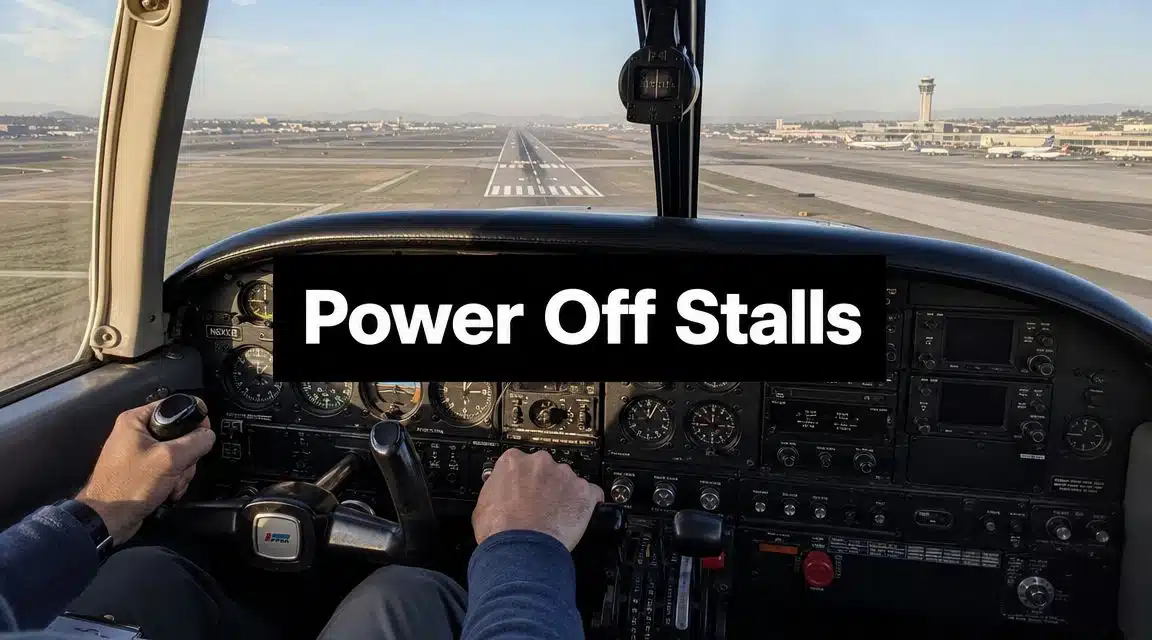
You're on downwind at Chino in a Piper Cherokee. Tower is moving traffic, another airplane is reporting midfield, and you pull the power back because you're a little high. The airplane slows, the controls start to feel soft, and now you're doing three jobs at once: flying the wing, managing the pattern, and staying ahead of the radio.
That's why power off stalls matter.
In training, this maneuver can look simple. At a busy towered airport, it never is. You're not just proving that you can make the horn sound and recover. You're building the habit that keeps a low-speed approach from turning into a loss-of-control event when workload goes up, spacing gets tight, or you overshoot the centerline and get tempted to fix it with the wrong control.
Why Power Off Stalls Are Your Most Important Maneuver
A lot of students first think of power off stalls as a checkride task. That mindset is too small. A power off stall is an approach-to-landing stall, and the whole point is to rehearse what the airplane feels like when you're slow, configured to land, and close to the ground.
At Chino, that matters every day. You might be turning final for 26L with parallel runway traffic in sight, listening for a tower instruction, and adjusting descent because the spacing changed. In that moment, the wing doesn't care that you're busy. If you let angle of attack build while trying to salvage the approach, the airplane will tell you. The yoke gets mushy. Control response fades. If you keep pulling, the stall arrives anyway.
The accident record is blunt. The NTSB found that over 70% of all stall accidents, 571 of 786, happened in or around the traffic pattern, which is the exact phase of flight power off stalls are meant to simulate, according to the NTSB stall and loss-of-control briefing.
Practical rule: If your stall training doesn't connect directly to base, final, and go-around decisions, you're missing the point of the maneuver.
What this maneuver teaches that normal landings don't
Normal pattern work helps, but it doesn't force you all the way to the edge of the wing's performance. Power off stalls do. In a Cherokee, that means learning the exact progression from stable approach energy to the point where the airplane can't keep flying at that angle of attack.
Three habits come out of good stall work:
- Recognize deteriorating control feel early: Don't wait for the break to admit the airplane is getting behind you.
- Stop trying to stretch the glide: Pulling to “save” the landing is how students trap themselves.
- Recover without drama: Calm control inputs beat abrupt ones every time.
What works in real flying
Good pilots don't use power off stall training to become comfortable with stalls. They use it to become uncomfortable with the setup that creates them. If the approach is unstable, the answer is usually simple: go around.
That's the survival skill behind the maneuver. Not bravado. Judgment.
The Pre-Maneuver Setup and Safety Briefing
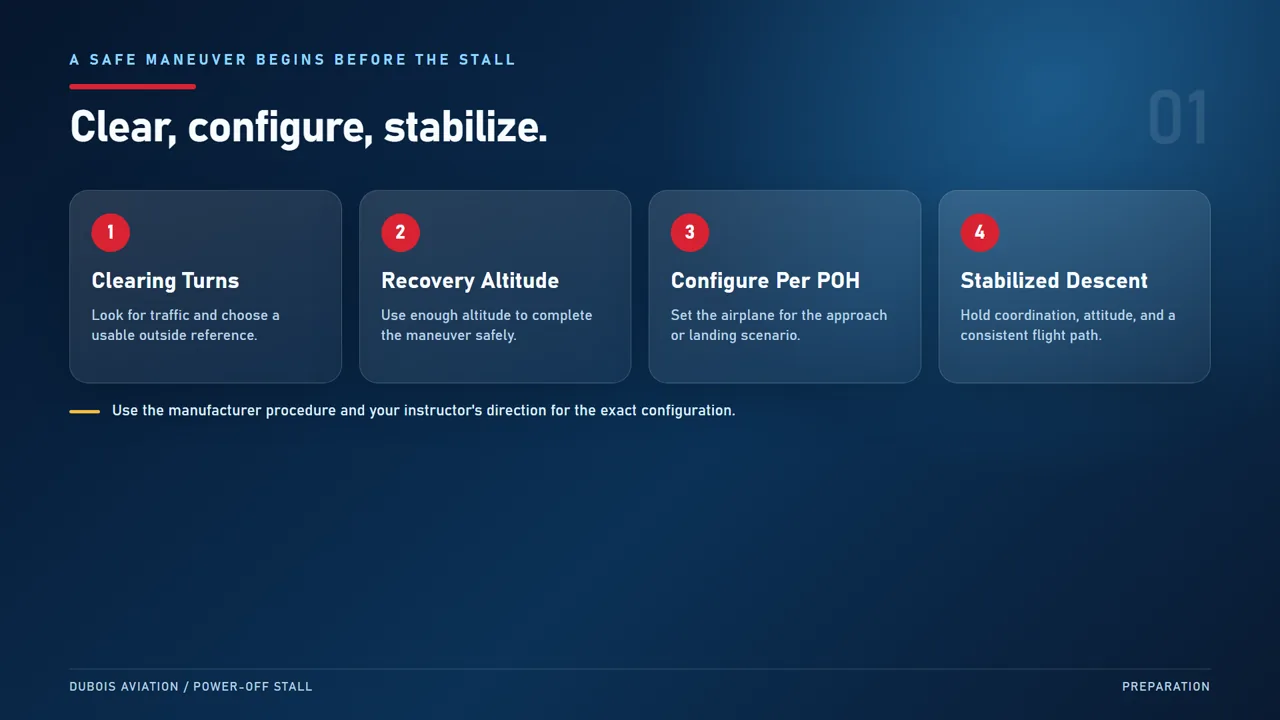
A clean power off stall starts long before the nose comes up. In a busy training area near KCNO, setup is where a lot of safety margin is either created or wasted.
Pick the right place and protect your altitude
Don't practice this maneuver in a spot where you're dividing attention between terrain, traffic, and a cramped airspace corner. Find a practice area with room to work, good visibility, and an easy outsized margin from other aircraft. Around a field like Chino, that means being deliberate about where you go and what frequencies you're monitoring.
Altitude is a strict requirement. Modern FAA-aligned training standards stress recovery completion no lower than 1,500 feet AGL for single-engine airplanes, with emphasis on realistic setup and coordinated energy management, as described in this FAA-aligned training discussion on power off stall recovery.
If you start too low, everything tightens up. Your scan gets worse. Your recovery gets rushed. Students start flying the fear instead of the airplane.
Use a real briefing, not a rushed checklist
Before entry, brief the maneuver like you mean it. In a Cherokee, that usually includes the practice area, minimum recovery altitude, clearing turns, expected configuration, and who has the controls if something doesn't look right.
A practical pre-maneuver flow looks like this:
- Area selection: Confirm you're clear of the pattern, known traffic flows, and obvious conflict areas.
- Altitude check: Verify you have enough room to complete the stall and the recovery without chasing the ground.
- Clearing turns: Do them properly. Two 90-degree turns are common because they force a real scan instead of a lazy glance.
- Configuration plan: Decide what flap setting and landing configuration you're simulating.
- Systems check: Engine instruments in the green, fuel where it should be, and no open aircraft discrepancies affecting the maneuver.
- Passenger brief: If someone is with you, tell them what to expect before you start pitching.
In high-workload airspace, the best stall setup is the one that feels slightly over-prepared.
A Cherokee-specific setup mindset
In the Piper Cherokee, students often get casual because the airplane feels stable and honest. That's exactly why you need discipline. Stable airplanes can lull pilots into late recognition.
Use a familiar flow such as C-GUMPS if that's how you've been taught, but don't recite it like a script. Confirm each item with your hands and eyes. Then set up the airplane like you're on a real landing approach, not like you're checking a box.
What works is consistency. What doesn't is improvising every entry.
How to Enter and Recognize the Impending Stall
The entry should be smooth enough that the airplane tells you a coherent story. If you rush it, you mask the cues you're supposed to learn from.
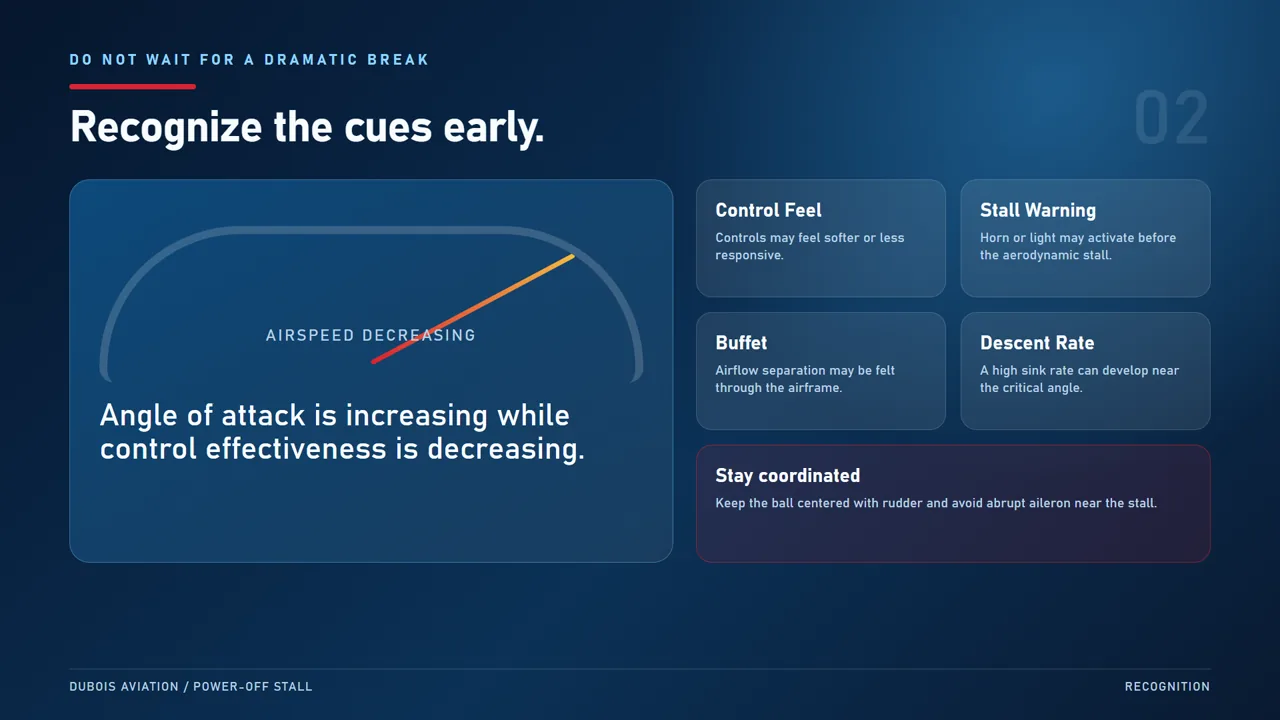
In a typical training setup, you establish a safe altitude, clear the area, configure for a landing approach, and bring the power back toward idle. Then you increase back pressure to hold altitude as airspeed decays. The mistake students make is trying to force a dramatic nose-high picture. In a Cherokee, the better approach is to stay coordinated and let the wing arrive at the stall naturally.
What the airplane feels like before the break
The first cue usually isn't loud. It's a change in feel.
The controls stop feeling crisp. Pitch response gets soggy. You may need more and more elevator to hold the attitude you want. If you're coordinated, the airplane often gives you a clear progression from slowing flight to an obvious loss of authority.
The FAA Airplane Flying Handbook notes that in a power-off, 1G stall, key cues may include full-up elevator against the stops and a high descent rate, while the warning buffet is often less pronounced than in a power-on stall, according to the FAA Airplane Flying Handbook chapter on stalls.
That last point matters. Students who expect a dramatic buffet sometimes miss what's happening in a power off stall because the feedback can be subtler.
The scan that keeps you honest
During the entry, don't fixate on one instrument. Look outside first, then use the panel to support what you already feel. At a busy field, this habit translates directly to the pattern because you'll never have the luxury of staring at the airspeed indicator for long.
Use this mental sequence:
- Outside attitude: Is the nose where it should be?
- Coordination: Are you balanced, or are you feeding a skid?
- Control feel: Are the surfaces still effective?
- Stall cues: Horn, buffet, sink, and the need for more elevator.
If you need a refresher on why this happens, the core concept is angle of attack, not a magic airspeed number. Airspeed influences when you arrive there. Angle of attack causes the stall.
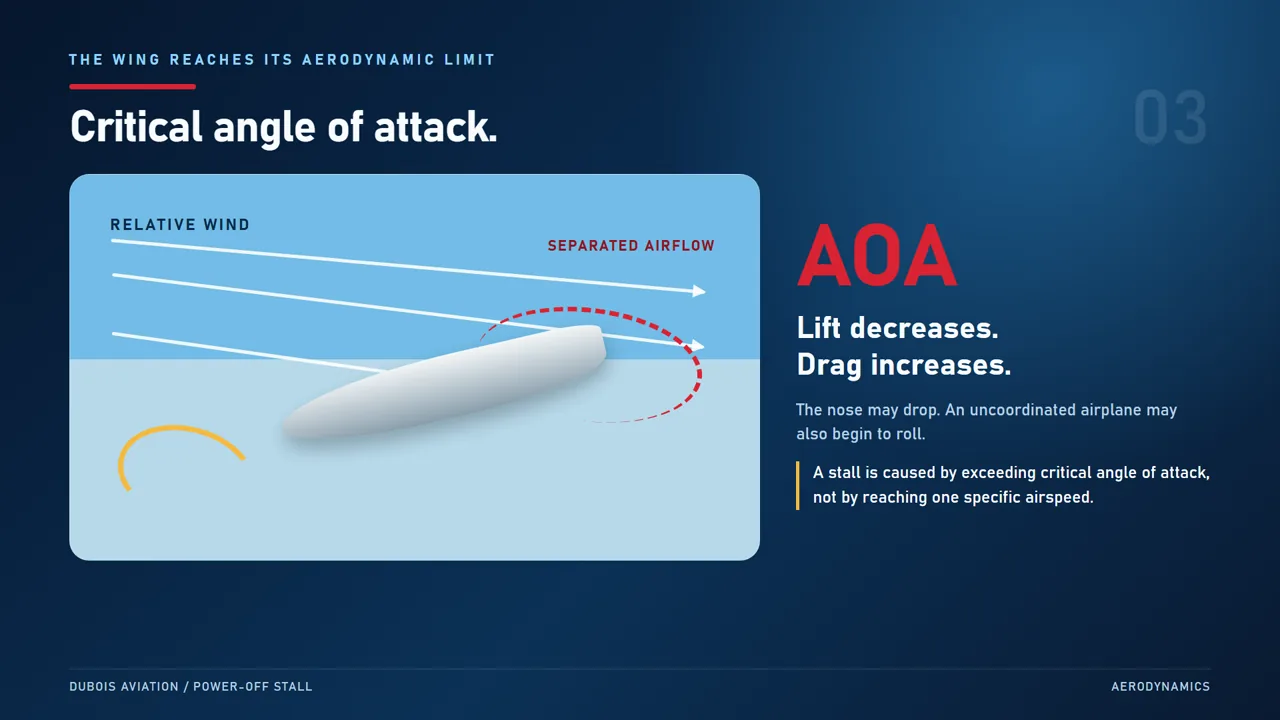
The best stall recognition happens before the break, not after it.
What students often miss at towered airports
Students who train around active Class D airspace sometimes carry pattern habits into the practice area. They rush checklists, talk too much, or split attention because they're expecting another call. For this maneuver, quiet the cockpit. Finish the setup first. Then fly the entry with deliberate pacing.
A clean entry teaches more than a rushed one ever will.
The Recovery Sequence Your Examiner Wants to See
Recovery is where the checkride standard and real-world safety line up perfectly. The examiner wants to see control, judgment, and sequence. The wing wants the same thing.
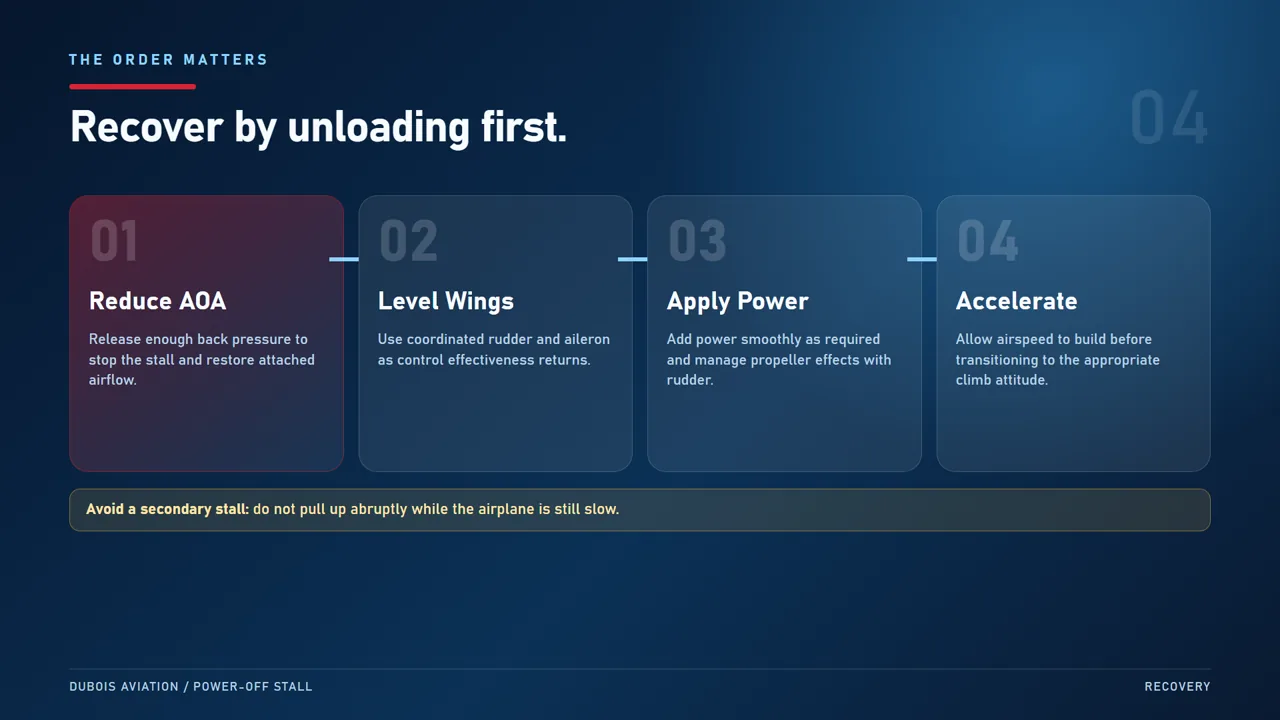
The core recovery is simple, but students often scramble it under pressure. They add power before they unload enough. They pitch up too early. They retract flaps all at once because they're in a hurry to clean up the airplane. That's how you create a weak recovery or a secondary stall.
The order matters
A standard power-off stall recovery involves reducing the angle of attack first, then adding full power, and retracting flaps in stages only after a positive rate of climb is established to avoid a secondary stall, as outlined in this power-off stall recovery procedure guide.
That first action is the one students resist. They don't want to lower the nose because they're already worried about altitude. But if the wing is stalled, pulling harder won't save altitude. It only prolongs the stall.
The sequence I want to see in a Cherokee
In practical terms, the recovery should look like this:
- Unload the wing: Relax enough back pressure to reduce angle of attack and break the stall.
- Add full power promptly: Smoothly, but without delay.
- Keep it coordinated: Use rudder to manage yaw and keep the airplane tracking properly.
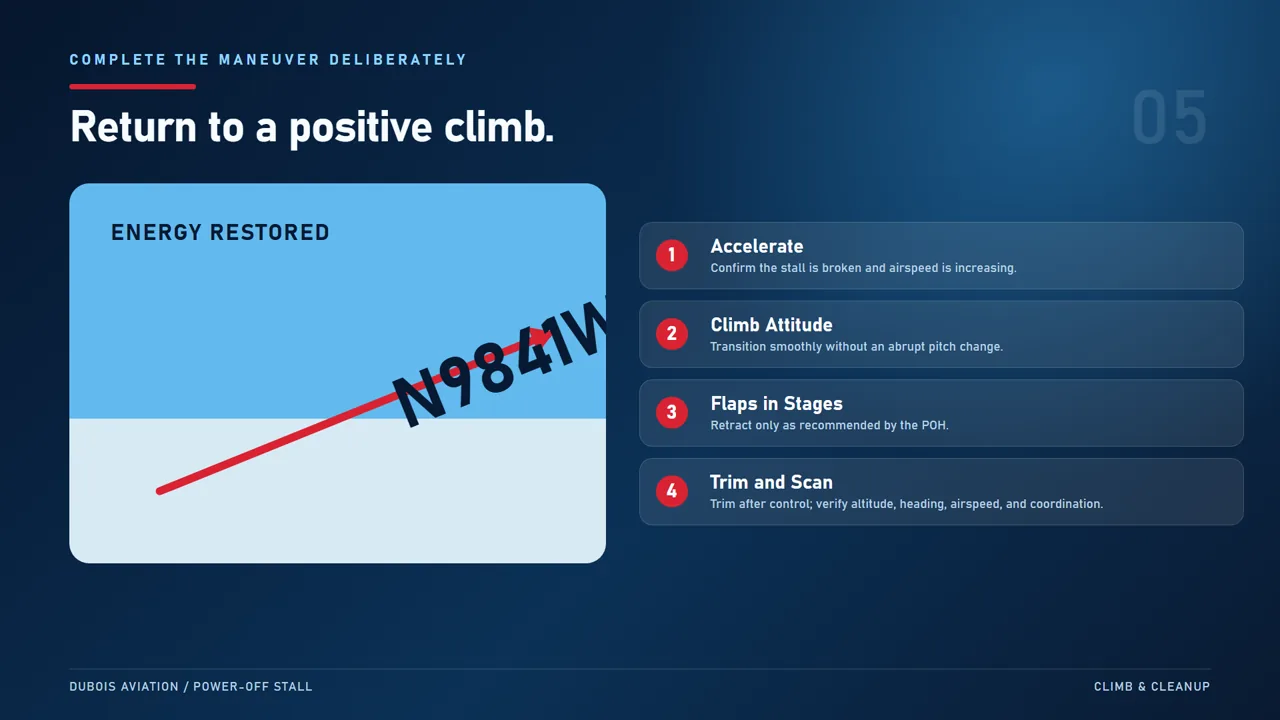
- Stop the sink, then climb: Don't yank. Let the airplane accelerate.
- Clean up in stages: Retract flaps incrementally after you have a positive rate and the aircraft is ready for it.
Here's a good visual reference for the flow in motion.
What examiners notice immediately
Examiners aren't just watching for recovery. They're watching how you recover.
A strong checkride performance usually includes these traits:
| What they want to see | What hurts you |
|---|---|
| Prompt reduction in angle of attack | Hesitating because you don't want to lose altitude |
| Coordinated rudder use | Chasing heading with sloppy feet |
| Stable energy management | Pitching up before airspeed returns |
| Clean flap sequencing | Dumping flaps and sinking again |
Checkride standard in plain English: recover decisively, keep the airplane coordinated, and don't trade one stall for another.
The best recoveries are boring. No abrupt pitch change. No overcorrection. Just a stalled wing returning to normal flight because the pilot handled the sequence in the right order.
Common Errors and Handling Stall Variations
Most power off stall mistakes come from one problem: the pilot is trying to make the airplane do what they want instead of responding to what the wing is doing.
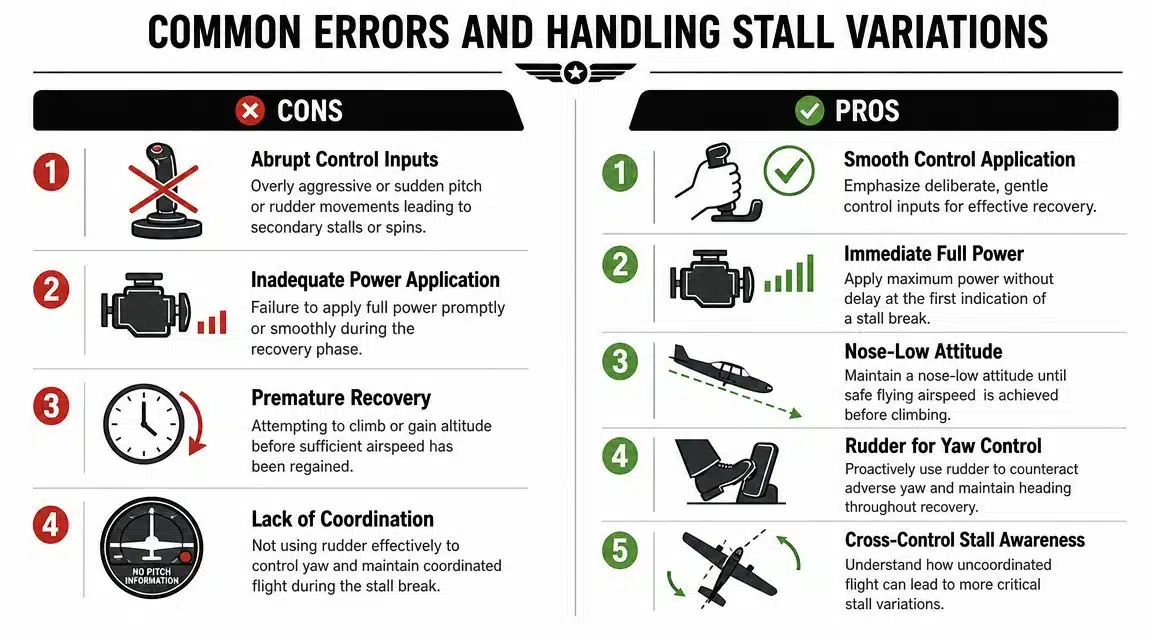
AOPA flight training guidance notes that a common practical test error is recovering from an incipient stall instead of a full stall, and that real-world stalls often happen in distracted, turning situations, which makes coordination the main benchmark for proficiency, according to this AOPA power-off stall technique article.
The mistakes that show up all the time
Some errors are easy to spot because they repeat from student to student.
- Recovering too soon: The horn chirps, the student gets nervous, and they start recovering before the stall fully develops when the task calls for a developed stall.
- Using aileron to pick up a dropping wing: Near the stall, that can make the situation worse. Yaw control belongs mostly to your feet here.
- Pulling after power comes in: Students feel the engine accelerate and immediately try to climb before the airplane is ready.
- Letting coordination slide: A skid in a turning, low-speed situation is where this maneuver stops being academic.
How to correct them in training
The fix usually isn't more aggression. It's more patience and better sequence.
If the wing drops, lead with rudder to stop the yaw and keep the airplane coordinated. Don't make a big, panicked correction. If you're recovering too soon, commit to the maneuver you were asked to perform and learn the full cue set. If you're climbing prematurely, hold the nose where it needs to be until the airplane regains flying energy.
A useful training companion here is understanding maneuvering speed, especially when students confuse structural caution with stall technique. They're related parts of aircraft control, but they aren't the same lesson.
In real flying, stalls rarely happen when the pilot is calm, wings level, and expecting them. They happen when attention is split and coordination slips.
The variation that matters most
The most relevant variation isn't exotic. It's the turning stall, especially the kind that resembles an overshooting base-to-final correction.
At a busy airport, this can happen fast. A pilot sees they're wide, adds bottom rudder to hurry the turn, and keeps back pressure in because they don't want to descend. That combination is exactly why realistic stall practice has to include coordination discipline, not just pitch-and-power memory.
If your power off stall work only looks good straight ahead in smooth air, it's incomplete.
Beyond the Checkride How to Buy an Airplane the Safe Way
Once pilots start feeling consistent in the airplane, ownership usually enters the conversation. For some, that means a first trainer. For others, it means stepping out of rental scheduling and into an aircraft that's always configured the same way and available when they need it.
Buying safely starts with mission, not paint.
Start with the flying you'll actually do
A lot of poor airplane purchases come from buying an identity instead of a mission. Be honest about how you'll fly. Local proficiency flights, weekend trips, instrument training, family travel, mountain flying, and time-building all point to different airplanes.
If you're deciding between common trainers, a side-by-side comparison like this Piper Cherokee vs Cessna 172 guide can help frame useful trade-offs such as cabin feel, handling, and loading habits.
Ask yourself:
- How many people will you carry?
- What runway and airport environment will you use most?
- Will you rent it out, train in it, or keep it strictly personal?
- Do you want simple fixed-gear ownership or more complexity?
Budget for the airplane and the life around it
The purchase price is only the opening number. Insurance, tie-down or hangar, annual inspections, oil, unscheduled maintenance, avionics surprises, and fuel will decide whether ownership feels sustainable or stressful.
That's why buyers should build a full operating picture before shopping seriously. If the airplane only works financially when nothing breaks, the plan is too tight.
A safe buying process usually includes:
- A mission-based shortlist instead of shopping every listing that looks attractive.
- Logbook review before emotions get involved.
- A title and registration check so there are no ownership surprises.
- An independent pre-buy inspection by a mechanic who works for you, not the seller.
- A transition training plan for type-specific systems, landing habits, and emergency procedures.
Don't skip the pre-buy
This is the step buyers most want to rush, especially when inventory feels scarce or the seller sounds trustworthy. Don't.
A pre-buy isn't just looking for corrosion or compression concerns. It's also about finding hidden cost, deferred maintenance patterns, poor repairs, missing documentation, and equipment that technically works but will immediately need attention. On older training airplanes, that list can be longer than new buyers expect.
For pilots who want structured flight training, rental access, or multi-engine instruction while they evaluate ownership, DuBois Aviation operates at KCNO with airplane and helicopter training, aircraft rental, and a fleet that includes multiple Piper Cherokees. That kind of access can help pilots sharpen preferences before committing to a purchase.
The safe way to buy an airplane is the same way you recover from a stall. Slow down, identify the actual problem, and act in the right order.
Conclusion From Cockpit Proficiency to Aircraft Ownership
A good power off stall isn't about making the horn sound. It's about recognizing a bad energy state early, staying coordinated, and recovering without adding a second mistake. That discipline carries straight into pattern work at busy airports like Chino, where radio calls, traffic, and spacing can push students into rushed decisions.
The key lesson stays the same. Reduce angle of attack first. If a pilot remembers that under pressure, a lot of bad outcomes become avoidable.
That same mindset shows up again when pilots move toward ownership. Safe aircraft buying has less to do with excitement and more to do with sequence, judgment, and not forcing an outcome. Define the mission, inspect carefully, and train for the airplane you purchase.
The pilots who progress well usually aren't the flashy ones. They're the ones who build repeatable habits. They brief carefully, set up the maneuver correctly, recognize the stall accurately, and recover with coordination instead of panic. Those habits make better checkride applicants, better renters, and better future owners.
If you can fly a Cherokee through a clean power off stall recovery while managing workload the right way, you're building more than a maneuver. You're building command judgment.
If you want help sharpening stall technique, preparing for a checkride, or figuring out your next step from rental flying to ownership, DuBois Aviation offers training and aircraft access at Chino Airport in a busy real-world environment that matches how pilots fly.