
If you ask most new pilots what keeps an airplane in the air, they’ll probably say "speed." It's an understandable assumption, but it’s not the whole story. There’s a single, more fundamental concept that truly governs flight, and mastering it is the key to becoming a confident, safe aviator.
That concept is the angle of attack (AoA).
The Single Most Important Concept in Aviation
Forget about your pitch attitude or airspeed for just a moment. Think about sticking your hand out the window of a moving car. If you hold it perfectly flat, the air flows right over and under it. But as you start to tilt the leading edge of your hand up into the wind, you feel a powerful upward force. That's lift.
That simple feeling is the angle of attack in action. It’s not about the angle of your hand compared to the road, but its angle relative to the oncoming air.
In an aircraft, it's exactly the same principle. We define angle of attack as the angle formed between the wing's chord line (an imaginary line from its leading edge to its trailing edge) and the relative wind (the air flowing toward the wing). This relationship is the bedrock of aerodynamics, and it's something we drill down on from day one at DuBois Aviation, whether you're in a Cessna 150 or a more complex aircraft.
This isn’t some new-fangled idea. The Wright Brothers recognized its importance way back in 1908 when they patented a device to measure their wing's performance. They knew that understanding how the wing meets the wind was absolutely vital. You can read more on how this insight shaped early aviation over at Plane & Pilot Magazine.
What Angle of Attack Is and What It Is Not
One of the biggest hurdles for student pilots is separating AoA from other ideas that seem similar, like pitch attitude. Confusing them is easy to do, but it can lead to dangerous situations. That’s why we make sure this foundation is rock-solid.
Let’s clear things up with a simple breakdown.
Angle of Attack at a Glance
The table below defines the core components of AoA and, just as importantly, clarifies what they are not. Getting this right is crucial.
| Component | Definition | What It Is NOT |
|---|---|---|
| Angle of Attack | The angle between the wing's chord line and the oncoming relative wind. This is a direct measure of aerodynamic performance. | It is not the aircraft's pitch attitude (the angle of the nose relative to the horizon). You can have a high AoA with a low pitch, or vice-versa. |
| Chord Line | An imaginary straight line connecting the leading edge to the trailing edge of the airfoil (the wing). | It is not the physical bottom surface of the wing. The chord line is a geometric reference, not a physical part. |
| Relative Wind | The direction of airflow with respect to the wing. It's created by the aircraft's motion through the air. | It is not the surface wind you feel on the ground. Relative wind is always parallel and directly opposite the aircraft's flight path. |
Here's the takeaway that every pilot must burn into their memory: An aircraft stalls at its critical angle of attack, regardless of its airspeed, weight, or attitude. This is why truly understanding AoA is far more important than just memorizing a few stall speeds from a chart. It gives you a direct, real-time understanding of your wing's performance and is the ultimate key to stall prevention.
How AoA Creates Lift and Triggers Stalls
So, how exactly does AoA create the lift that keeps us flying? It’s a beautifully simple, yet powerful relationship. Think of it as a constant conversation between your wing and the air it's slicing through. At a low angle of attack, the wing is only asking for a little bit of lift, and the air flows smoothly over and under it without much fuss.
When you, the pilot, gently pull back on the controls, you're increasing that angle. You’re essentially asking the wing to work harder and generate more lift. As you do this, the air flowing over the top of the wing has to travel a longer, more curved path than the air underneath. This forces the air on top to speed up. According to Bernoulli’s principle, that faster-moving air creates lower pressure. The higher pressure below the wing then pushes up, and voilà—you get more lift. For a while, this works perfectly.
But every wing has its breaking point.
The Point of No Return
There comes a moment when you ask for too much. This is the critical angle of attack. At this specific angle, the air flowing over the top surface can no longer hug the wing's curve. It gets turbulent, breaks away, and separates from the wing. Imagine a race car trying to take a corner too fast—it loses grip and skids right off the track.
That flow separation causes a sudden, dramatic loss of lift. The wing is no longer flying; it's in an aerodynamic stall.
A stall isn't the engine quitting. It has nothing to do with the airplane stopping in mid-air. It’s a purely aerodynamic event that happens anytime the wing exceeds its critical angle of attack—at any airspeed, in any attitude.
This diagram clearly shows the core relationship between the wing, the oncoming relative wind, and the angle of attack that's formed between them.
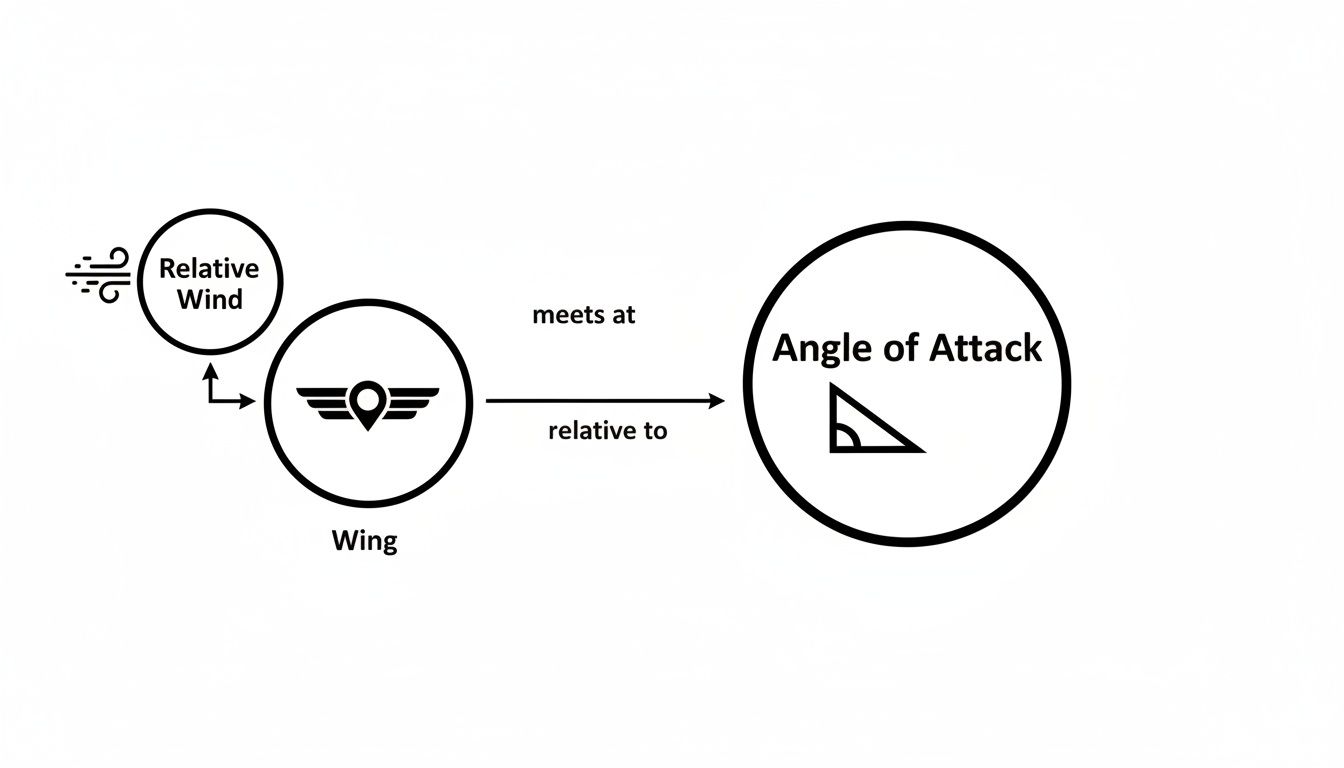
As you can see, the angle of attack is all about how the wing meets the air, not how the plane is pointed relative to the ground. That’s a crucial distinction.
Understanding the Stall Boundary
Every aircraft has a specific critical angle of attack, usually somewhere between 15 and 20 degrees. This isn't a variable number; it's a fixed aerodynamic limit for that particular wing design. It doesn’t change with your aircraft's weight, how steeply you're banking, or how many Gs you're pulling.
Flying safely means always respecting this boundary. When you cross it, the results are immediate and non-negotiable:
- Lift Collapses: The very force holding you in the sky deteriorates rapidly.
- Drag Skyrockets: That messy, turbulent airflow creates a huge amount of drag, slowing the plane down even more.
- Control Diminishes: With chaotic air flowing over your ailerons and elevator, your ability to control the aircraft is severely compromised.
Recognizing the signs of an impending stall and knowing how to recover is one of the most important skills we teach at DuBois Aviation. The recovery is always the same: reduce the angle of attack. You do this by smoothly pushing the controls forward, which lets the airflow reattach to the wing. It's often counterintuitive—especially for students—because it means pointing the nose down, but it's the only way to get the wing flying again.
The Connection for Airplane Buyers and Sellers
This isn't just theory for student pilots; it has real-world meaning for anyone buying or selling an airplane. As a buyer, you should carefully evaluate an aircraft's stall characteristics during a pre-purchase flight. How does it feel in slow flight? Does it give you plenty of warning—like a physical buffet or a stall horn—before it lets go? A plane with forgiving, predictable stall behavior is a much safer and more pleasant aircraft to own.
If you're a seller, demonstrating these docile flight characteristics can be a huge selling point. What's more, an aircraft equipped with an Angle of Attack indicator is often seen as a major safety upgrade. A savvy buyer knows this instrument gives a direct, honest reading of the stall margin. Adding one can significantly boost an aircraft's value and appeal, showing that you understand that knowing your angle of attack isn't just about flying—it's about making smarter ownership decisions.
Why Pitch Attitude and Airspeed Can Be Deceiving
One of the most dangerous traps for a new pilot is mixing up pitch attitude and angle of attack. It’s an easy mistake to make. Pointing the nose up feels like you're climbing and creating lift, right? But getting this wrong isn't just an academic error—understanding the difference is a life-saving skill.
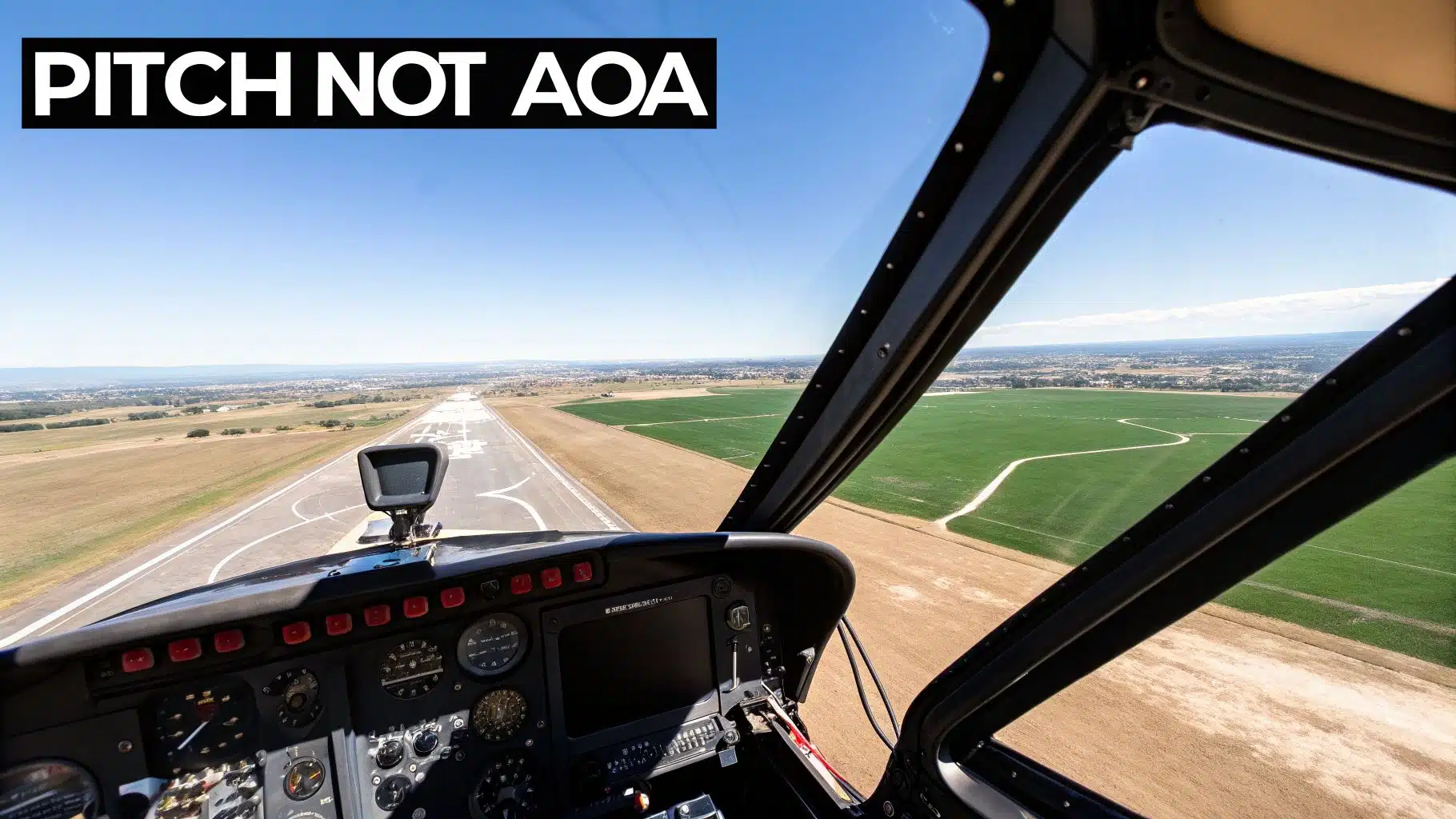
Pitch attitude is just where the airplane's nose is pointed relative to the horizon. That’s it. Angle of attack, however, is the angle between the wing and the wind that's hitting it—the relative wind. These two things are often completely independent.
When Pitch Doesn't Equal AoA
Let's walk through a few real-world scenarios where just looking at the nose will lead you astray. This is where you really see why knowing your true angle of attack is so critical.
High Pitch, Low AoA: Picture this: you’re in a powerful climb, engine roaring at full throttle. The nose is pointed high at the sky, but you're moving fast. Because of that high airspeed and forward momentum, the relative wind is hitting the wing at a shallow angle. In this case, a high pitch attitude doesn't mean you're anywhere near a stall.
Low Pitch, High AoA: Now, let's put you in a tight, steep turn. To hold your altitude, you have to pull back on the yoke. Your nose might be level with the horizon, or even pointed slightly below it. But that back pressure and increased G-load have cranked up your wing's angle of attack dramatically. You could easily stall the airplane here, even with a "normal" looking pitch attitude.
Here’s the single most important takeaway: an aircraft can stall at any attitude and at any airspeed. A nose-down attitude is no guarantee against a stall, just as a nose-high attitude doesn't automatically mean you are in one.
The Problem with Relying on Airspeed
Just as misleading as pitch is your airspeed indicator (ASI). Sure, every aircraft has a published stall speed (Vs), but that number is calculated under very specific, sterile conditions: straight-and-level flight, maximum gross weight, and a 1 G load. The moment you deviate from that perfect scenario, the number becomes irrelevant.
Relying only on your ASI to avoid a stall is a flawed and dangerous strategy. An aircraft's actual stalling speed isn't a fixed number; it climbs significantly when the wings have to work harder.
Factors That Increase Stalling Speed:
- Increased G-Loading: In a 60-degree bank, your aircraft experiences 2 Gs of force. This doubles the load on the wings, and your stall speed jumps by about 40%.
- Increased Weight: A heavier airplane needs to generate more lift, which requires a higher angle of attack for any given airspeed. The stall will happen sooner, at a higher speed.
- Center of Gravity Changes: An aft (tail-heavy) center of gravity can reduce stability and make stall recovery much more difficult.
Your airspeed indicator can't see any of this. It only knows how fast you're moving through the air, giving you zero direct information about how much lift your wing has left in the bank. While your panel instruments are essential, learning what they aren't telling you is just as important. A deep understanding of these systems is a must for advanced ratings, like the one we cover in our guide to the instrument rating course.
Ultimately, only the angle of attack gives you a direct, honest measure of how close you are to the critical stall point. AoA doesn't care about your weight, G-load, or bank angle. It's the true measure of your wing's performance.
Managing AoA Through Every Phase of Flight
Knowing the textbook definition of angle of attack is one thing. Actually feeling and managing it from the pilot's seat is where real skill is born. A great pilot isn't just aware of AoA; they are in a constant conversation with the wing, making tiny adjustments to keep it performing exactly as needed, from takeoff roll to the final touchdown.
This isn't just about stall avoidance—it's about precision and efficiency. Getting AoA right is how you coax every bit of performance out of your aircraft, whether you're lifting a Cessna 150 off a short field or finessing a complex approach. So, how does this look in the cockpit? Let's break down a standard flight.
Takeoff and Initial Climb
The moment your takeoff roll begins, you’re already managing AoA. As you thunder down the runway, you're building speed. At rotation speed (Vr), you bring the control yoke back. That one smooth pull pitches the nose up, instantly increasing the wing's angle of attack and commanding it to fly.
Once you’re off the ground, the mission changes. You're no longer just trying to get airborne; you’re targeting the AoA for the best climb. To achieve your best rate of climb (Vy), you'll adjust your pitch attitude to nail that specific airspeed. This puts the wing right at its L/D MAX angle—the sweet spot that gives you the most lift for the least amount of drag, letting you claw for altitude as efficiently as possible.
Cruise and Maneuvering
Reaching your cruise altitude, you gently lower the nose to accelerate and settle into level flight, which naturally reduces your angle of attack. The goal here is simple: efficiency. You trim the aircraft to hold a low AoA where the wing is generating just enough lift to offset weight. It's not working hard; it's just loafing along, sipping fuel.
But the moment you decide to turn, everything changes. As you bank the aircraft, a portion of your vertical lift is diverted sideways to pull the aircraft through the turn. To hold your altitude, you must create more total lift. How? By pulling back on the yoke.
This back pressure directly increases the angle of attack. It's a critical phase where a pilot can get caught out. A steep turn adds significant G-load, which means your wing has to work much harder, bringing your current AoA alarmingly closer to the critical angle—even at a perfectly normal cruise speed.
This is why we drill maneuvering flight at DuBois Aviation. You have to develop a feel for how much back pressure is just enough to get the job done without pushing the wing over the edge into an accelerated stall.
Approach and Landing
The final approach is where AoA management becomes most intense. The objective is a stabilized descent on a constant, predictable glide path at a safe speed. To do this, you are intentionally flying with a much higher angle of attack than you did in cruise, because you need the wing to generate enough lift at a much slower airspeed.
Here, you use power and pitch in a delicate dance. Power controls your rate of descent, while your pitch attitude controls your airspeed by adjusting the AoA. If you’re a little fast, you raise the nose slightly to increase AoA and add a bit of drag. Too slow? You lower the nose just a touch to decrease AoA and let gravity help you regain speed. It's a fundamental skill for every safe landing.
This constant adjustment of AoA is central to flying. The table below provides a quick-glance summary of how a pilot’s focus and actions shift throughout these key phases of flight.
AoA Management Across Different Flight Phases
| Phase of Flight | Typical AoA | Pilot Action & Goal | Common Risk |
|---|---|---|---|
| Takeoff Climb | High (near L/D MAX) | Pitch for best climb speed (Vy). Goal is maximum altitude gain. | Pitching up too aggressively, leading to a high AoA and potential low-altitude stall. |
| Cruise | Low | Reduce pitch and trim for level flight. Goal is fuel efficiency. | Inattention, allowing airspeed to decay without adjusting pitch, causing AoA to increase. |
| Turns | Increased | Apply back pressure to maintain altitude. Goal is coordinated flight. | Applying excessive back pressure in a steep bank, leading to an accelerated stall. |
| Landing | High | Use pitch to maintain approach speed. Goal is a stabilized descent. | Flying too slow, allowing AoA to become critically high on final approach. |
As you can see, from the start of your takeoff roll to the moment the wheels touch down, every input you make is part of a constant negotiation with your wing, spoken in the language of angle of attack.
Using AoA Indicators for Stall Awareness
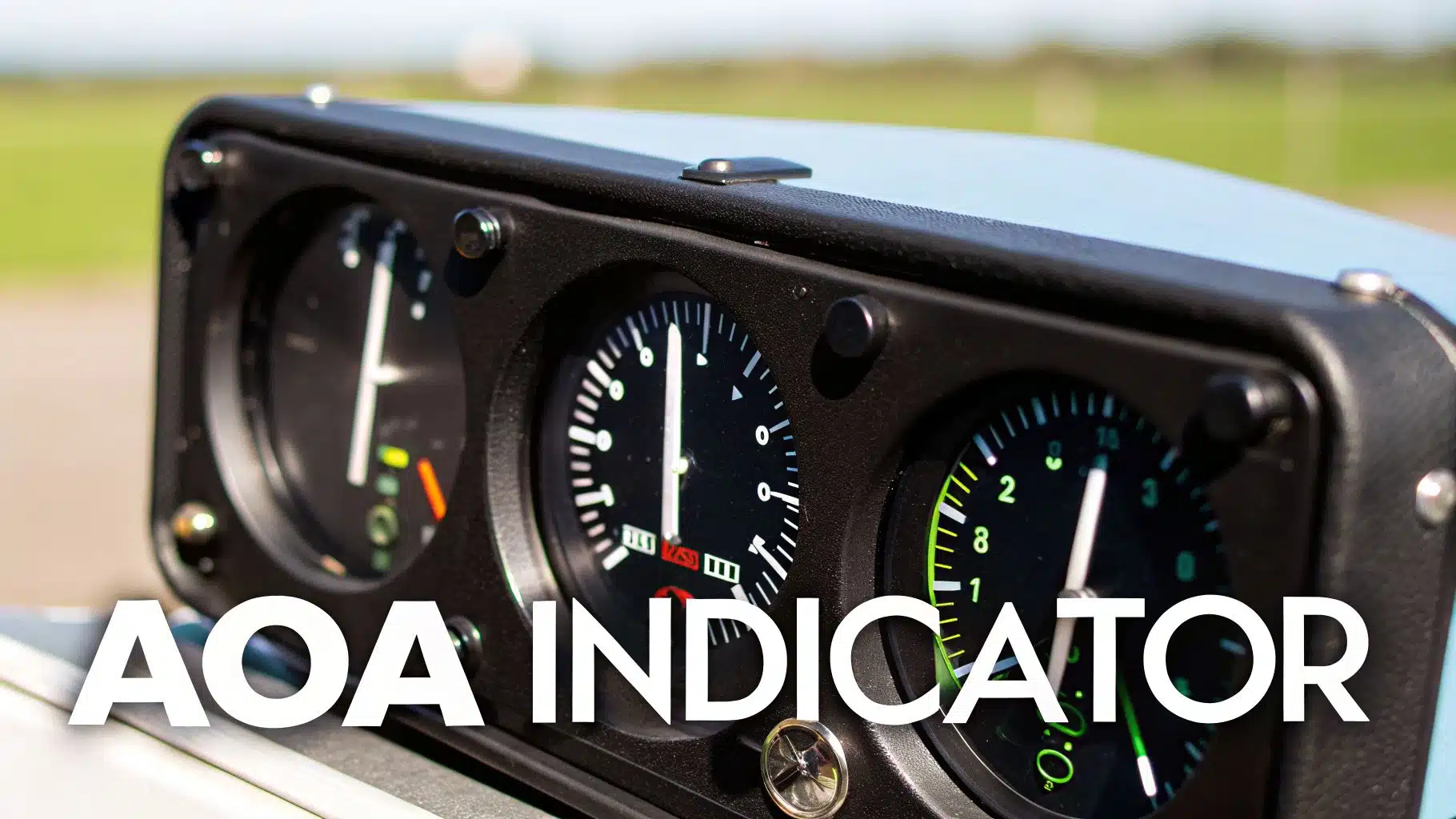
So far, we've been talking about the angle of attack as something you feel—an invisible force that a good pilot learns to anticipate. But what if you could actually see it? That’s exactly what an Angle of Attack Indicator (AoAI) does. It takes AoA from an abstract concept and puts a real, live number right on your instrument panel.
These gauges give you instant, direct feedback on your stall margin. Think about it: an airspeed indicator is just an indirect clue. You have to do mental gymnastics to correct for weight, G-loading, and density altitude. An AoA indicator, on the other hand, gives you the unvarnished truth about how hard your wing is working. It answers the most critical question: how much lift do I have left?
A Simple, Lifesaving Display
Most AoA indicators are designed for a quick glance, which is exactly what you need during busy moments like takeoff or landing. They typically use a simple, color-coded display that makes it incredibly easy to see your aerodynamic situation.
- Green: This is your happy place—a low angle of attack, typical for cruise flight. Your wing is flying efficiently with plenty of performance to spare.
- Yellow: You're now approaching the optimal lift AoA, often called "on-speed." This is the sweet spot you'll target for a perfect final approach.
- Red: Time to pay attention. Red means you're getting dangerously close to the critical angle of attack. This is your cue to immediately reduce back pressure and lower the nose to prevent a stall.
This simple visual cuts right through the noise. Instead of chasing a specific airspeed that changes with your aircraft's weight and configuration, you can just "fly the donut" or keep the needle in the green/yellow zone. You’ll know, with certainty, that your wing is right where it needs to be.
Proven Safety from Military to General Aviation
The value of AoA indicators isn't just theory; it's proven by decades of hard data. The technology has a long and storied history in military aviation, where pilots have been using it to nail carrier landings for generations. In fact, by 1958, U.S. Navy pilots who learned to trust their AoA indicator over airspeed saw carrier landing fatalities drop by an incredible 50% annually. You can read more about this history on the Cirrus Pilots & Owners Association site.
The FAA strongly recommends AoA indicators for general aviation, stating, "The use of an AOA system can provide a more reliable indication of an impending stall than an airspeed indicator alone."
This track record is exactly why the FAA and NTSB are now such strong advocates for bringing this technology into general aviation. Loss of Control in Flight (LOC-I) is still a leading cause of fatal accidents, and these events almost always begin with an unintentional stall. An AoA indicator gives you the direct, immediate awareness needed to break that accident chain.
Knowing your aircraft's systems is just as vital as the physical checks you perform on the ground, like those covered in our guide to pre-flight checks for the Cessna 172. Here at DuBois Aviation, we don't see this technology as a crutch. We see it as a powerful tool that reinforces the safety-first mindset every great pilot must have.
How to Buy an Airplane the Safe Way
If you're in the market for an airplane, your grasp of angle of attack suddenly becomes one of your most important buying tools. It’s about looking past the shiny paint and clean logbooks to understand the airplane’s true personality. How it behaves at the edge of its performance envelope is what truly defines your safety and enjoyment for years to come.
The pre-buy inspection and test flight are where you get to have that crucial conversation with the aircraft. This isn't just about ticking boxes; it's about feeling how the plane talks to you when its wing is working hard.
What to Look For During a Test Flight
With a qualified instructor or test pilot beside you, make a point to explore the slow side of the flight envelope. You need to get a feel for the aircraft’s manners when it’s near a stall.
- Slow Flight: As you slow down and increase the angle of attack, how do the controls feel? Do they get soft and mushy, or do they remain crisp and responsive? You want an airplane that still listens to your inputs.
- Approach to Stall: Pay close attention to the warnings. A good aircraft will give you plenty of notice before things get serious. You should feel a distinct buffet—a shudder through the airframe—and hear the stall horn long before the wing gives up.
- Stall Behavior: When the stall finally happens, is it a gentle mush or does it aggressively drop a wing? A predictable, docile stall is an incredible safety feature.
These flight characteristics are a direct window into the plane's aerodynamic design and its current health.
Think of it this way: An airplane with gentle, predictable stall characteristics is a more forgiving partner in the sky. That quality is arguably worth more than any fancy avionics or fresh paint job.
An aircraft that gives you plenty of warning before hitting its critical angle of attack provides a safety buffer you simply can't put a price on. If you're starting to look at what's available, browsing our current listings can give you a feel for different models. You can see what we have on our aircraft sales page.
And once you find the right plane, one of the smartest upgrades you can make is installing an AoA indicator. This single instrument gives you a direct, real-time picture of your stall margin, turning a complex aerodynamic concept into a simple, life-saving gauge. It's how you turn a good purchase into a truly safe investment.
Common Questions About Angle of Attack
Once you start getting a real feel for how an airplane flies, a few questions about Angle of Attack always seem to pop up. You'll hear them discussed during pre-flight briefings and in hangar talk with other pilots. Let's clear up some of the most common points of confusion, because understanding these details is what separates knowing the rules from true airmanship.
Does Weight Affect the Critical Angle of Attack?
Simply put, no. The critical angle of attack is a fixed value, determined purely by the aerodynamic design of the wing. It doesn't care how heavy the airplane is.
But, and this is a big but, weight absolutely changes when you'll reach that critical AoA. A heavier aircraft has to work harder and generate more lift to stay in the air. To do that, it must fly at a higher angle of attack for any given airspeed. This means a heavier plane operates closer to the edge and will stall at a higher indicated airspeed than a lighter one. It hits that fixed critical angle sooner.
Does a Specific AoA Always Mean a Specific Airspeed?
This is a classic trap for student pilots. The answer is a firm no. While a certain AoA might correspond to a certain airspeed in straight-and-level flight at a constant weight, that relationship goes right out the window the moment you start maneuvering.
Think about it: when you roll into a steep turn, the G-load on the airplane increases. To maintain altitude, you have to generate more lift, which means pulling back on the yoke and increasing your AoA. In that turn, you could be at the same high AoA you'd see on a slow final approach, but your airspeed will be significantly higher.
The real lightbulb moment for a pilot is realizing that while airspeed is constantly changing, the angle of attack for peak performance—whether it's for your best glide speed or a perfect stabilized approach—never does. This is why learning to "fly the wing" by AoA is far more direct than just chasing numbers on the airspeed indicator.
Getting this wrong isn't just an academic mistake; it can have devastating consequences. Loss of Control In-flight (LOC-I) is the single deadliest threat in aviation, and it's almost always caused by an excessive angle of attack. For general aviation, the numbers are stark: over 40% of all fatal GA accidents in the U.S. between 2001 and 2010 were LOC-I events. You can dig into the data yourself in the General Aviation Joint Steering Committee's analysis. That number alone shows that a deep, practical understanding of AoA isn't just about passing a checkride—it's a fundamental survival skill.
At DuBois Aviation, we’re firm believers that mastering aerodynamics is the foundation of a long and safe flying career. From your very first lesson to earning advanced ratings, our instructors are here to help you build the confidence and precision you need in the cockpit. If you’re ready to get started, check us out at https://duboisaviation.com to learn about our training programs and book a discovery flight.