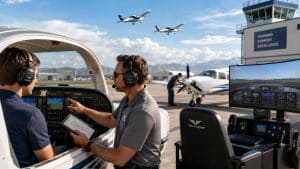
If you’ve ever looked up at a plane and felt a pull towards the sky, this guide is for you. Earning a pilot's license is a tangible goal, a journey that blends dedicated study with incredible hands-on experience. It’s about transforming that dream of flight into a real, hard-earned certificate.
Why 2026 Is The Year To Start Flying
For anyone considering flight training, 2026 is shaping up to be an incredible time to start. The dream of earning your wings has never been more relevant, thanks to a unique mix of high industry demand and clear, accessible training paths. The world of aviation is expanding, creating a bright future for new pilots.
Imagine your very first flight lesson. At a place like Chino (KCNO), you're not on some quiet, isolated airstrip. You’re immediately immersed in the real deal—a bustling, towered airport. From day one, you're learning to communicate with air traffic control, building the foundation of a serious skill set right from the start.
A Sky Full Of Opportunity
The demand for qualified pilots right now is surging. The global pilot training market, valued at USD 9.41 billion in 2024, is projected to explode to USD 31.38 billion by 2034. Why? Industry forecasts from sources like Capella University predict a need for 674,000 new pilots worldwide over the next two decades.
A huge chunk of that demand—123,000 pilots—is needed right here in North America. This isn't just a number for aspiring airline captains; it creates a vibrant ecosystem for all pilots. As professionals advance into airline roles, it opens up opportunities at every level, making the world of private and general aviation more dynamic than ever.
Your First Ticket: The Private Pilot License
Your journey begins with the Private Pilot License (PPL). Think of it as the foundational certificate that unlocks the freedom of flight.
With a PPL, you can:
- Fly single-engine airplanes in good weather, day or night.
- Act as the pilot-in-command (PIC).
- Take friends and family flying with you (though not for compensation).
- Use an airplane for personal travel, recreation, or to build hours for advanced ratings.
The PPL is your license to learn. It’s what gets you into the sky and serves as the essential stepping stone for any aviation goal, whether that’s flying for fun on weekends or aiming for a career in the cockpit.
Understanding The Commitment: Cost And Timeline
Let's talk about what it really takes. Earning your PPL requires a commitment of both time and money, especially in a busy aviation hub like Southern California.
To give you a clearer picture, here’s a quick breakdown of what to expect.
Private Pilot License At A Glance
| Requirement | FAA Minimum | National Average | Notes |
|---|---|---|---|
| Flight Hours | 40 Hours | 60-70 Hours | Varies based on consistency and individual learning pace. |
| Total Cost | N/A | $15,000 – $20,000 | Includes aircraft, instructor, exams, and materials. |
| Timeline | N/A | 6-12 Months | Based on flying 2-3 times per week. |
While the FAA sets the legal minimum at 40 flight hours, most students find they need closer to 60-70 hours to feel truly proficient and confident for their final checkride. Consistency is key here—flying frequently helps you retain what you learn and progress much faster.
Financially, a realistic budget is crucial. You should plan for an investment between $15,000 and $20,000. This covers everything: aircraft rental, instructor fees, ground school materials, exam costs, and your basic pilot supplies. You can get a more detailed look at what influences these numbers in our guide on how long it takes to get a private pilot license.
For those with dreams beyond weekend flying, the PPL is just the beginning. The skills you master here are the bedrock for building your instrument, commercial, and multi-engine ratings—the path that eventually turns a passion into a profession. But it all starts with mastering the fundamentals and earning that first set of wings.
Getting Your Pre-Flight Paperwork in Order
Before you can even think about touching the controls, there are a couple of essential pieces of paperwork you need to sort out. Think of it as your official entry ticket into the world of aviation. It might sound like a hassle, but it’s a straightforward process that lays the legal and medical groundwork for everything that follows.
First things first, let's talk about the basics. The Federal Aviation Administration (FAA) requires you to be at least 16 years old to get a Student Pilot Certificate and fly solo. You also have to be able to read, speak, write, and understand English—that one’s non-negotiable for safety and clear communication with Air Traffic Control.
With those boxes checked, your first real task is getting an FAA Medical Certificate. This isn't your average check-up. It's a specific exam performed by an FAA-certified Aviation Medical Examiner (AME) to make sure you're medically fit to fly an airplane.
Understanding the FAA Medical Certificate
The FAA has three different classes of medical certificates, and the one you need depends on your flying goals.
- Third-Class Medical: This is the one you need. It’s the standard for student, recreational, and private pilots. If you’re just starting your Private Pilot License (PPL) journey, this is your target.
- Second-Class Medical: This is for commercial pilots who fly for a living but not for an airline—think charter pilots, aerial photographers, or even flight instructors.
- First-Class Medical: The highest level, required for Airline Transport Pilots (ATP)—your future airline captains.
Here's a pro tip: if you have any inkling that you might want to fly for a living one day, go for the First-Class medical right from the start. It’s better to find out now if there are any medical hurdles than to invest years of training only to hit a wall later.
Finding an AME is easy using the FAA's online database. The exam itself will cover your vision, hearing, and general health, with a focus on anything that could pose a risk in the cockpit. The most important thing is to be completely honest on your application. Many conditions are perfectly acceptable, but failing to disclose something is a serious issue.
Your Official License to Learn
Once you have your medical certificate, the next piece of the puzzle is your Student Pilot Certificate. This is the document that officially gives you permission to fly an aircraft solo, as long as you're under the supervision of a flight instructor.
You’ll apply for this certificate online through the FAA’s Integrated Airman Certification and Rating Application (IACRA) portal. Don't worry, your flight instructor at Du Bois Aviation will walk you through the entire thing. They'll verify your ID and eligibility before hitting submit for you. It's a quick and painless digital process.
With your FAA Medical and Student Pilot Certificate in hand, you’ve officially got the green light. These are the keys that open the cockpit door and let you move from dreaming on the ground to actually flying in the sky.
Keeping track of all the paperwork might feel a bit overwhelming at first. For those who want to build good habits from the get-go, it can be helpful to learn about effective document organization by looking into resources like DOT compliance software for document management. While you won't need that kind of software as a student, the principles of good record-keeping will serve you well throughout your entire flying career.
With your paperwork sorted, you are officially ready to start logging hours and begin the real adventure.
Mastering Aeronautical Knowledge on the Ground
Every great pilot’s journey begins long before they ever take to the skies. While the real thrill is up in the air, your safety and skill are forged on the ground. This is what ground school is all about—it's the critical phase where you learn the "why" behind every single action you'll take in the cockpit.
This isn’t about cramming facts for a test. It’s about building a deep, intuitive understanding of the principles that make flight possible, from the physics of how a wing generates lift to the complex forces acting on the aircraft at all times. A well-structured program, like the Jeppesen syllabus we use at Du Bois Aviation, gives you a clear and logical path through this essential knowledge.
What Ground School Really Teaches You
Think of ground school as building your mental toolkit for flying. Each subject gives you a new tool you'll need to make safe, sharp decisions as a pilot-in-command. The curriculum is intentionally broad to prepare you for just about anything.
You’ll dive deep into key areas, including:
- Aerodynamics: You'll go way beyond the simple concept of "lift." We're talking about the four forces—lift, weight, throughst, and drag—and how you, the pilot, manipulate their delicate balance throughout every single phase of flight.
- Aircraft Systems: This is where you get to know your plane inside and out. From the engine and electrical system to the flight instruments staring back at you, you’ll learn what they do, how they work, and—most importantly—what to do when they don't.
- FAA Regulations: Flying isn't a free-for-all. You have to know the rules of the road… or, in this case, the sky. This covers everything from airspace classifications and right-of-way rules to the specific radio calls that keep everyone safe and organized.
- Weather Theory & Services: Bad weather is a pilot's worst enemy. You'll learn to become a practical meteorologist, capable of reading charts and forecasts to spot potential hazards like icing, thunderstorms, and wind shear before they become a problem.
- Navigation & Flight Planning: This is where it all comes together. You’ll learn to read aeronautical charts, plot a cross-country course, calculate fuel burn with precision, and manage an entire flight from a simple idea to a successful touchdown.
This is the knowledge that separates a true pilot from someone who can just move the controls. It's the difference between reacting to a situation and being five steps ahead of it.
Finding an Environment That Clicks With You
People learn in different ways, and thankfully, ground school isn't a one-size-fits-all deal. You've got options, and choosing the right one is a big first step. Many factors come into play, and you can explore them further in our guide on how to choose the right flight school for your needs.
Here are the most common paths students take:
- A Structured Classroom: The traditional route. You have a set schedule and an instructor leading a group of fellow aspiring pilots. This works wonders for people who like routine and enjoy bouncing ideas off their peers.
- One-on-One Instruction: Your personal Certified Flight Instructor (CFI) covers ground topics with you, often right before or after your flight lessons. It's incredibly personalized and perfect for getting your specific questions answered on the spot.
- Self-Paced Online Courses: For those with busy or unpredictable schedules, these are a game-changer. You can study from anywhere, anytime, using a mix of videos, reading, and quizzes to master the material.
Honestly, a lot of our students find a hybrid approach is the sweet spot. They’ll use an online course for the core learning and then use their one-on-one time with a CFI to iron out the concepts that are giving them trouble.
No matter how you tackle it, the goal is the same: gain the knowledge you need to pass the FAA Private Pilot Written Knowledge Test and, more importantly, to be a safe, confident, and competent pilot for the rest of your life.
Acing the FAA Written Knowledge Test
All your ground school study culminates in one big milestone: the FAA Written Knowledge Test. It’s a 60-question, multiple-choice exam, and you need to score a 70% or higher to pass. This is the FAA's way of verifying you've got the book smarts down before you move on to the final practical test.
The secret to passing isn't last-minute cramming; it’s consistent study and practice. Get your hands on some good practice exam software. These tools are designed to mimic the real test and give you detailed feedback on your answers, which is the best way to find and fix your weak spots.
Once your instructor is confident you're ready, they'll give you an official endorsement to take the test. You’ll schedule it at an FAA-approved testing center (they're located all over the country). Passing this exam is a huge confidence booster. It's proof that all your hard work on the ground has paid off, and it clears you for the next, most exciting phase of your training.
Taking the Controls: From Your First Flight to Flying Solo
This is where the books close and the real journey begins. That walk out to the airplane for your very first lesson is a feeling you won't forget—it’s the moment theory gives way to the incredible reality of flight.
The Ritual Before Flight
Before you even think about starting the engine, you’ll learn one of the most fundamental rituals in aviation: the pre-flight inspection. Your instructor will walk you around the aircraft, likely one of our trusty Piper Cherokees, showing you what to look for. You'll check fuel levels, wiggle the control surfaces, and inspect the tires. This isn't just about ticking boxes; it's about building a connection with the machine and understanding its health before you ask it to carry you into the sky.
Once you’re strapped in, the real magic starts. That first takeoff, with your hands on the controls as your instructor guides you, is a core memory in the making. Feeling the airplane accelerate down the runway and lift into the air is a sensation that hooks pilots for life.
Milestones in the Sky
Flight training isn't just a collection of random lessons. It’s a carefully structured process where each flight builds methodically on the last. You’ll start with the absolute basics.
You'll spend your initial hours mastering fundamental skills like:
- Straight-and-Level Flight: The surprisingly tricky art of just keeping the plane steady.
- Climbs, Turns, and Descents: Learning to guide the aircraft smoothly and precisely through the air.
- Slow Flight and Stalls: Getting a feel for the edge of the airplane's performance envelope, so you understand how it behaves at low airspeeds and learn to recover safely.
One of the biggest advantages of learning at Du Bois Aviation is our location at Chino (KCNO). It's a towered airport, which throws you right into the deep end with real-world radio communications and busy airspace. It might seem intimidating at first, but it makes you a much more capable and confident pilot in the long run.
You’ll know you’re getting it when you stop reacting to what the airplane is doing and start anticipating its next move. That’s the feeling of true proficiency, and it’s your green light for flying solo.
The ground knowledge you've been building is the foundation for every single one of these in-air skills. It's a constant cycle of study, practice, and testing your understanding.
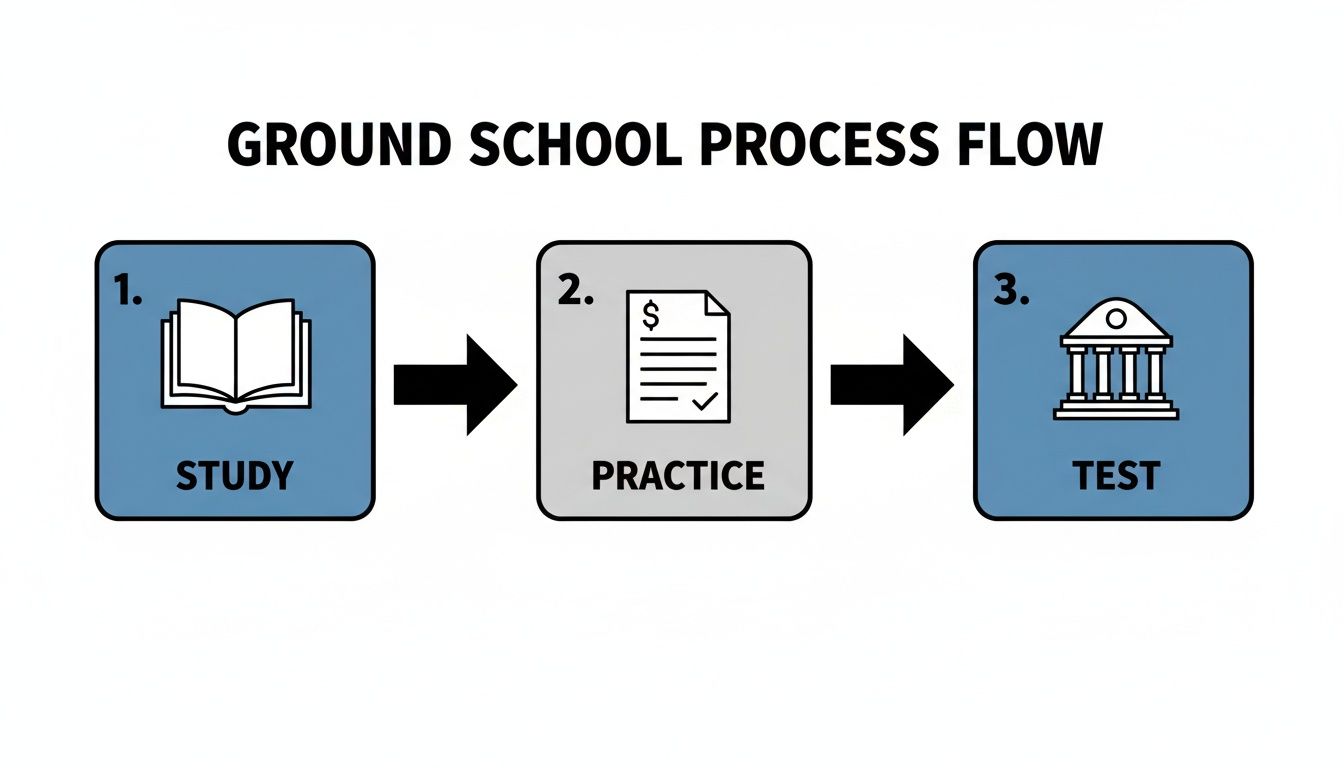
As the diagram shows, what you do in the cockpit is a direct result of the hard work you put in on the ground.
The Ultimate Milestone: Your First Solo
The day your instructor hops out, closes the door, and says, "She's all yours," is a day you'll replay in your head forever. That first solo is usually just three takeoffs and landings at your home airport, but it’s the ultimate vote of confidence. It's proof—to your instructor and, more importantly, to yourself—that you have what it takes to be a pilot.
Of course, the training doesn't stop there. After your first solo, you'll start expanding your horizons. You’ll fly solo "cross-country" flights to other airports to practice navigation, and you'll fly with your instructor at night to master the unique challenges of flying after dark. These aren't just boxes to check for the FAA; they are the experiences that forge a well-rounded aviator.
While the FAA sets the minimum at 40 hours, most people are realistically ready for their final exam, the checkride, somewhere between 60-70 hours. Remember, this isn't a race. Every hour you spend in the air is an investment in becoming a safe, confident pilot.
If you want a taste of what that first flight feels like, our introductory flying lessons are the perfect way to see if the pilot's life is for you.
Conquering The Checkride And Earning Your Wings
This is it—the final hurdle. The checkride is the culmination of every hour spent studying on the ground and practicing in the air. It’s totally normal to feel a bundle of nerves, but let’s reframe this. It's not so much a pass/fail test as it is a chance to confirm the skills your instructor already knows you have.
The exam is conducted by an FAA-Designated Pilot Examiner (DPE), an incredibly experienced aviator who acts on behalf of the Federal Aviation Administration. Think of them as a quality-control expert. Their job is simply to verify that you meet the high standards required to be a safe, competent pilot. It's your moment to shine.
The Oral Exam Unpacked
Before you even think about starting the engine, your checkride kicks off with a one-on-one oral exam. The DPE will sit down with you for a conversation designed to probe your practical knowledge and, more importantly, your decision-making process.
They'll typically give you a flight scenario to plan—like a cross-country trip—and then dive deep into the details. You can expect questions to pop up from just about any area of your training:
- Regulations: "What kind of airspace will we be flying through on this first leg, and what are the rules for it?"
- Aircraft Systems: "Talk me through the fuel system on this airplane. What would you do if you saw the fuel pressure gauge drop to zero?"
- Flight Planning: "Show me your weight and balance calculations. Why did you choose this altitude for the trip?"
The secret to the oral exam isn't just spitting out memorized facts. It's about explaining the why. The DPE needs to see that you truly think like a pilot-in-command, with safety and good judgment driving every decision.
The Practical Flight Test
Once you’ve successfully navigated the oral portion, it’s time to head out to the airplane for the practical test. This is where the rubber meets the runway, literally. You get to prove your hands-on flying skills.
Rest assured, the DPE won't ask you to perform some exotic maneuver you've never seen. Every single task comes directly from the official FAA's Airman Certification Standards (ACS)—the same playbook your instructor has been using since day one.
What to Expect in the Air
You'll be asked to demonstrate a variety of maneuvers, proving you can command the aircraft with precision and confidence.
- Takeoffs and Landings: Performing smooth, controlled takeoffs and consistent landings, including in a simulated crosswind.
- Emergency Procedures: Responding to a simulated engine failure by establishing a glide and navigating toward a safe landing spot.
- Maneuvers: Executing steep turns, slow flight, and stall recoveries with confidence and control.
- Navigation: Flying a leg of your cross-country plan using pilotage and dead reckoning.
Your DPE isn't searching for inhuman perfection; they're looking for safety, control, and consistency. If you botch a maneuver slightly, don't panic. Acknowledge it, explain what happened, and correct it safely. Showing good aeronautical decision-making when things don't go perfectly is a huge part of proving you're ready.
Passing the checkride is an incredible milestone. That moment the DPE turns to you, shakes your hand, and says, "Congratulations, you're a pilot," is a feeling you will carry with you for the rest of your life. It's the official start of your journey as an aviator.
How to Buy an Airplane the Safe Way
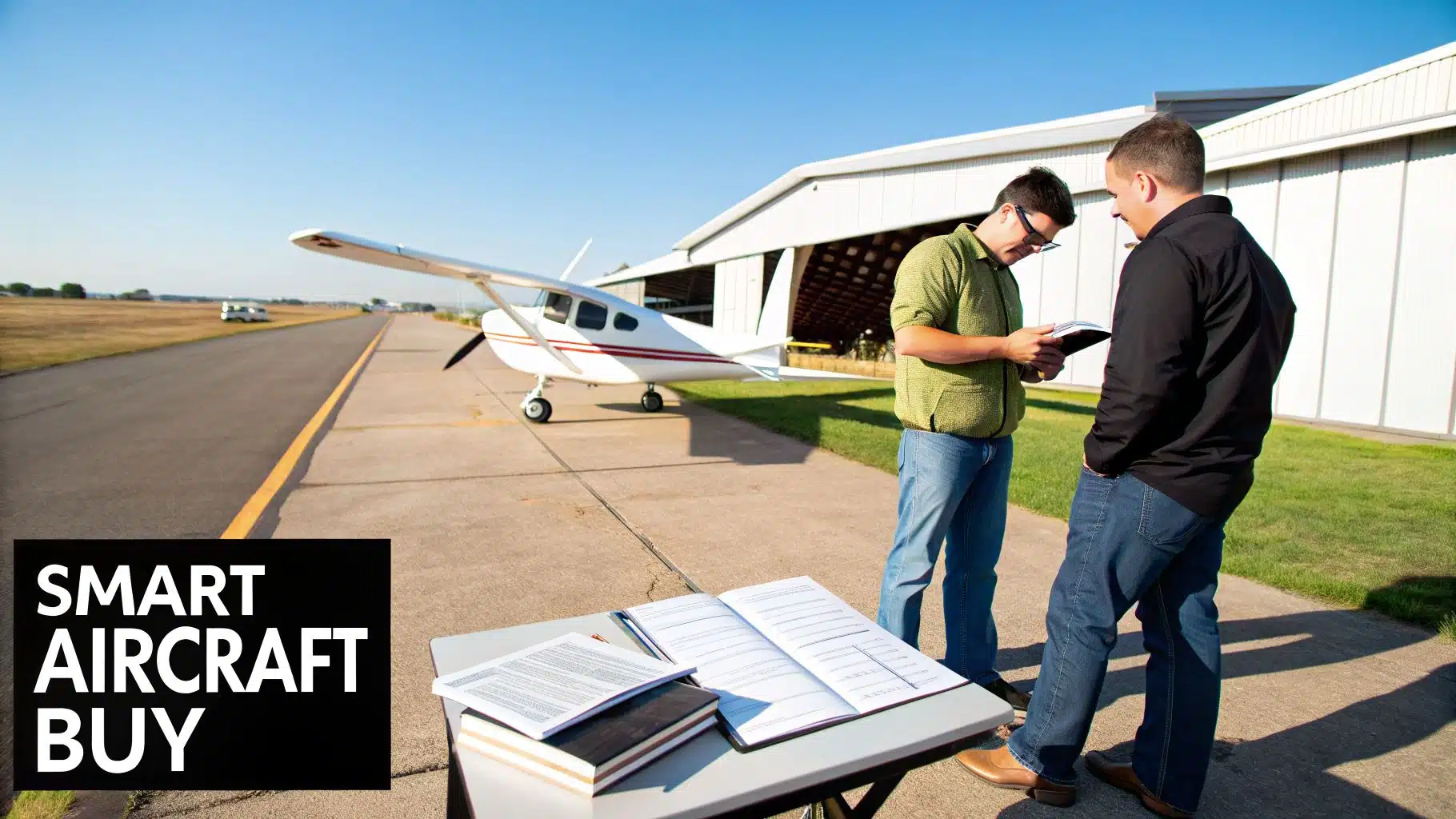
Once you have that pilot's license, the ultimate dream for many is aircraft ownership. Whether you're eyeing a classic Cessna for weekend trips or a versatile helicopter for unique missions, buying your own aircraft is a major step. It requires a different kind of training: diligence, research, and a healthy dose of caution.
Define Your Mission Before You Shop
The first and most critical question is: "What will I use it for?" Answering this honestly will save you from buying the wrong aircraft.
- Recreation: Are you just looking for a fun machine to take up on sunny days? A simple two-seater might be perfect.
- Travel: Do you plan on taking family or friends on cross-country trips? You'll need more seats, speed, and range.
- Business: Will the aircraft be used for work? Payload, speed, and operational costs become paramount.
The mission defines the aircraft. A Piper Cherokee is great for training and short hops, while a Cirrus SR22 is a cross-country machine, and a Robinson R44 helicopter offers unique point-to-point travel.
The Non-Negotiable Pre-Buy Inspection
If you remember one thing, make it this: get an independent pre-buy inspection. This is a deep dive into the aircraft's mechanical health and historical records, performed by an Airframe & Powerplant (A&P) mechanic that you hire and trust. Never use the seller's mechanic.
A thorough pre-buy includes:
- Logbook Forensics: A detailed review of all maintenance records to spot signs of major repairs, damage history, or compliance issues.
- Physical Inspection: Checking everything from engine compression to corrosion and control surface integrity.
- Legal Check: Ensuring there are no liens on the aircraft and the title is clean.
A cheap airplane can quickly become the most expensive one you'll ever own if you skip a meticulous pre-buy inspection. It's the single most important investment you'll make during the purchasing process.
Understanding the True Cost of Ownership
The purchase price is just the beginning. Ongoing expenses are a significant part of ownership and must be budgeted for.
- Fixed Costs: Hangar or tie-down fees, insurance, and annual inspections.
- Variable Costs: Fuel, oil, and routine maintenance.
- Reserves: A dedicated fund for major expenses like an engine overhaul.
While your Private Pilot License gets you in the air, you'll quickly discover that an Instrument Rating is what truly unlocks the potential of aircraft ownership, letting you fly safely through clouds and less-than-perfect weather. In fact, the professional side of aviation is booming, with the Commercial Pilot License (CPL) training segment expected to grab a 60% share of the market in 2025. You can discover more insights about these flight training market trends to see where the industry is heading.
Following a smart, disciplined process will help ensure your first airplane is a source of incredible adventures, not a constant financial headache.
Your Top Questions About Becoming A Pilot, Answered
If you're thinking about learning to fly, you've probably got a dozen questions running through your head. That's a good thing. Going in with a clear understanding of the process is the best way to set yourself up for success. Let's tackle some of the most common ones we hear from aspiring pilots.
How Long Does It Really Take To Get a Pilot's License?
The FAA's minimum is 40 flight hours, but let's be realistic—that's a baseline, not the norm. Most people find they need somewhere between 60 and 70 hours to feel truly confident and competent in the cockpit. The national average lands squarely in that range.
So, what does that mean for your calendar? If you can commit to flying two or three times a week, you could be a licensed pilot in as little as 3-6 months. Consistency is everything. If your schedule is more spread out, it can easily take a year or more, simply because you'll spend the first part of each lesson shaking off the rust instead of learning new skills.
What's The Biggest Pitfall for Student Pilots?
Hands down, the most common and costly mistake is inconsistent training. When you take long breaks between lessons, your progress stalls out.
Think of it like this: if you go weeks without flying, your next lesson isn't about moving forward; it's about re-learning what you forgot. That's a surefire way to stretch out your timeline and inflate your budget.
Committing to a regular flight schedule isn't just about finishing faster—it's the single most effective way to save a significant amount of money on your training.
Can I Fly if I Wear Glasses or Have a Medical Condition?
Absolutely. Needing glasses or contacts is extremely common among pilots and is rarely an issue, as long as your vision is correctable to the FAA standard. The same goes for many common health conditions.
The most important thing is to be completely open and honest with your Aviation Medical Examiner (AME). They are your best resource. If you have a condition that needs a closer look, they'll guide you through the process, which might involve getting a Special Issuance medical certificate to show you're safe to fly.
Is a Private Pilot License the Same as a Commercial License?
They're two different tools for two different jobs. Your Private Pilot License (PPL) is your ticket to the skies for personal enjoyment. You can take friends and family flying, explore new places, and fly for fun, but you can't be paid for it. It's the foundation for everything else in aviation.
A Commercial Pilot License (CPL) is the next step up, required if you want to fly for a living. It’s the professional-grade certificate that allows you to be hired as a pilot.
Ready to stop wondering and start flying? At Du Bois Aviation, our team has heard every question in the book, and we’re here to help you map out a plan that works for you. The best way to start is to get in the air. Visit us online at https://duboisaviation.com to book a discovery flight and see what it’s all about.