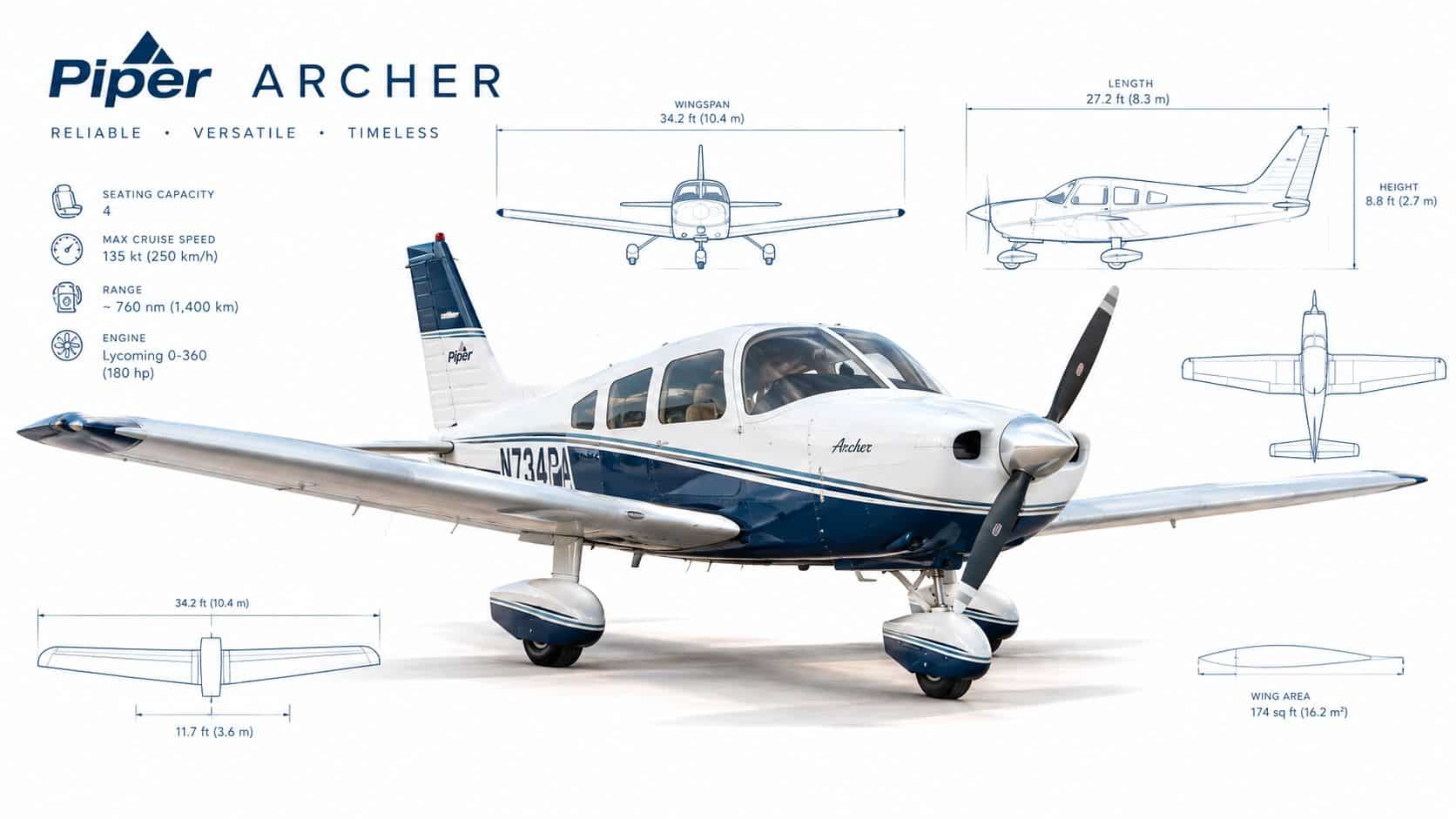
The Piper Archer is a four-seat, fixed-gear Piper with a 180-horsepower engine, a 2,550-pound maximum takeoff weight, and roughly 125 to 128 knots of normal cruise speed. Exact figures depend on the aircraft's model, equipment, loading, and current FAA-approved Pilot's Operating Handbook.
A student arriving for a rental checkout at Chino Airport usually wants one answer: can this Archer carry the planned people, baggage, and fuel, then depart with useful climb performance? The specification sheet helps establish the aircraft's character, but the cockpit answer comes from the specific airplane's weight-and-balance data, performance charts, engine installation, and operating limitations.
Table of Contents
- Why Piper Archer Specifications Require an Archival Switch
- Archer Background and Variant Lineage
- Powerplant and Engine Designations
- External Dimensions and Ramp Geometry
- Weights, Loading, and Fuel Capacity
- Performance Numbers and POH Verification
- Training, Operations, and Southern California Considerations
- Certification, Avionics, and Equipment Variations
- Quick-Reference Specification Card
- Common Pilot Mistakes with Archer Specs
- Piper Archer Specifications FAQ
- Can two adults, baggage, and full fuel fly a meaningful cross-country?
- Does an O-360-A4M Archer operate like an IO-360-B4A Archer?
- What changes between a six-pack Archer and a G1000-equipped Archer?
- Is the Archer suitable for private, instrument, and commercial training?
- What should a renter verify before accepting the aircraft?
Why Piper Archer Specifications Require an Archival Switch
Generic Piper Archer specifications are useful for orientation. They describe the familiar four-place, single-engine, all-metal, low-wing configuration and provide a reasonable starting point for discussing cruise, range, dimensions, and fuel. They aren't enough for dispatch.
The controlling reference is the aircraft-specific Airplane Flight Manual or Pilot's Operating Handbook, commonly called the AFM/POH. It normally lives in the cockpit or in the aircraft document system, together with approved supplements, equipment information, and current weight-and-balance material. The AFM/POH governs operating limitations, loading, performance calculations, and approved maneuvers for that particular airframe.
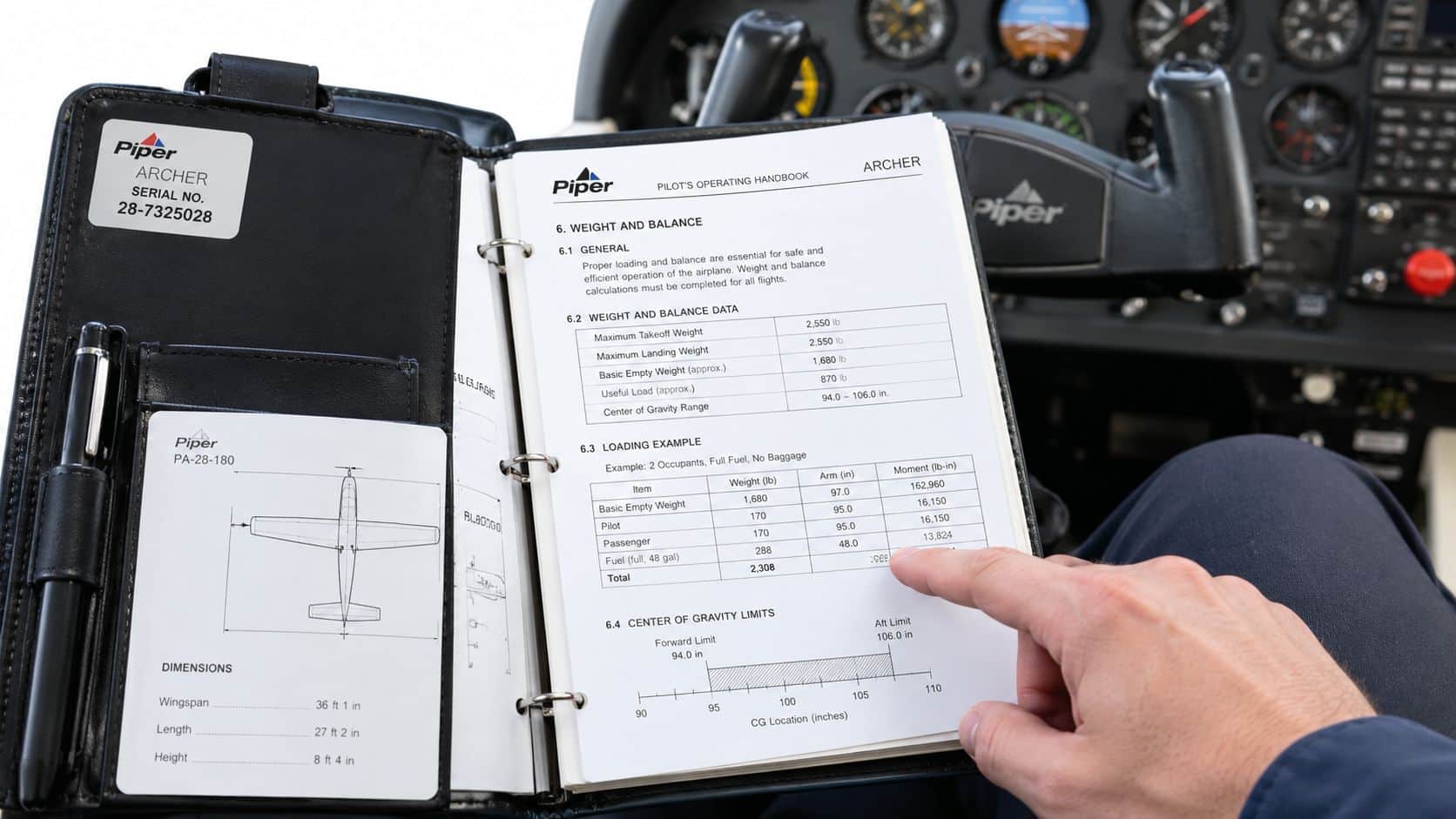
A practical POH-first process
Before a rental checkout, lesson, flight review, or instrument departure, the pilot should:
- Identify the airplane: Confirm registration, serial number, model designation, and engine.
- Check loading data: Use the latest empty weight, center-of-gravity limits, and equipment list.
- Find the performance charts: Select the correct takeoff, landing, climb, cruise, and fuel information.
- Review supplements: Verify avionics, autopilot, GPS, engine, propeller, and other installed equipment.
- Brief limitations: Confirm speeds, category restrictions, fuel requirements, and maneuver approvals.
At a busy towered airport such as Chino, this discipline matters because a flight may combine congested radio work, warm-weather density altitude, instrument procedures, and a fully occupied cabin. A brochure number won't tell the pilot whether today's load fits or whether the runway margin remains comfortable.
Practical rule: Use generic specifications to learn the airplane. Use the aircraft's approved documents to make the flight decision.
Archer Background and Variant Lineage
Walk onto a busy ramp at Chino and ask for an Archer, and the name alone still leaves work to do. Across the PA-28-181 line, pilots will encounter Cherokee Challenger, Archer II, and Archer III labels attached to airplanes that share the same basic role but can differ in the paperwork and installed equipment that matter on dispatch day.
Piper certified the airplane as the Cherokee Challenger on May 22, 1972. Sales started in September 1972 at an advertised price of $16,990, and Piper built 7,455 examples through 1975 before the Archer II replaced the original version. Those historical details, including the later 2013 FAA type-certificate approval for Garmin G1000 avionics in new Archer models, are documented in Piper's Archer development overview.
Cherokee Challenger, Archer II, and Archer III kept the same four-seat, fixed-tricycle-gear layout. Over time, the changes showed up in equipment, avionics, production details, and the approved documents a pilot has to use. That is the point students and renters miss when they treat every Archer number on the internet as interchangeable.
Variant names still matter in practical flying. An Archer II POH may not match an Archer III on supplements, equipment list, or performance presentation. An older analog-panel trainer can also carry a different empty weight, different installed options, and a different cockpit workflow than a later glass-panel airplane wearing the same family name.
For checkout flying, instrument work, or a simple local lesson, that lineage affects four things:
- Maintenance references, including engine, propeller, and installed-equipment data
- Weight and balance, especially after avionics or interior changes
- Performance charts, where the approved assumptions and configurations may differ
- Training decisions, particularly when moving between six-pack and glass cockpits
I treat Archer lineage as a dispatch item, not trivia. Before the flight, confirm the serial number, model designation, engine, avionics suite, and required supplements for that airplane. The long production run helps with familiarity and fleet availability, but it also means brochure-level Archer specs are only a starting point.
Powerplant and Engine Designations
You feel this section on a checkout ramp, not in a spec sheet. At a place like Chino, where departures happen in heat, with traffic pressure and little patience for guesswork, the engine line on the paperwork changes how you brief start, taxi, run-up, and climb.
The baseline Archer callout is the 180-horsepower Lycoming O-360-A4M, a four-cylinder, air-cooled, horizontally opposed piston engine. The PA-28-181 model designation is the family label most pilots know, but that label alone does not settle which engine is installed in the airplane in front of you. FAA aircraft registration data shows PA-28-181 examples with Lycoming reciprocating engines that include both O-360-A4M and IO-360-B4A installations.
That difference matters in daily flying. If the airplane has an O-360-A4M, use the procedures and limits for that installation. If it has an IO-360-B4A, use those. Sharing part of an engine family name does not make the fuel system, starting technique, fuel and oil references, or maintenance paperwork interchangeable.
I tell renters to separate brochure language from POH language. Brochure data gives you the broad Archer picture. The approved handbook for that serial number tells you what to do with mixture, priming, power settings, limitations, and performance assumptions. That becomes more than paperwork when the airplane is heavy, the afternoon is hot, or the lesson includes short-field work.
A quick verification flow works better than the usual paragraph-and-list routine:
First, confirm the installed engine in the aircraft records or registration.
Then open the POH engine section and read the operating limits and normal procedures for that engine.
After that, check supplements for modifications or alternate installations.
Last, review maintenance entries if there is any doubt about configuration.
The 180-horsepower class makes the Archer useful for training, instrument work, and routine cross-country flying, but climb and takeoff results still depend on loading, density altitude, engine condition, propeller condition, and pilot technique.
At DuBois Aviation, that is not an academic distinction. Before a training cross-country, identify the exact engine and brief from that airplane's documents, not from memory borrowed from another Archer.
External Dimensions and Ramp Geometry
Pull an Archer onto a busy ramp at Chino and the geometry matters before any checklist item does. Generic spec sheets are usually close enough to judge space, but if you want the finer points, the Archer III reference material lists a wingspan of about 35.5 feet, an overall length of 24.0 feet, a height of roughly 7.3 feet, and a wing area near 170 square feet. That same Archer III aircraft reference document also gives a tailplane span of 12 feet 10.5 inches, a wheelbase of 6 feet 7 inches, and a propeller diameter of 6 feet 4 inches.
Those are not abstract brochure dimensions. They drive whether you can swing the airplane clear of a fuel island, how much room you need to pivot into a tiedown row, and whether a hangar opening leaves comfortable wingtip margin or only a few feet to spare. At a crowded training airport, that difference shows up fast.
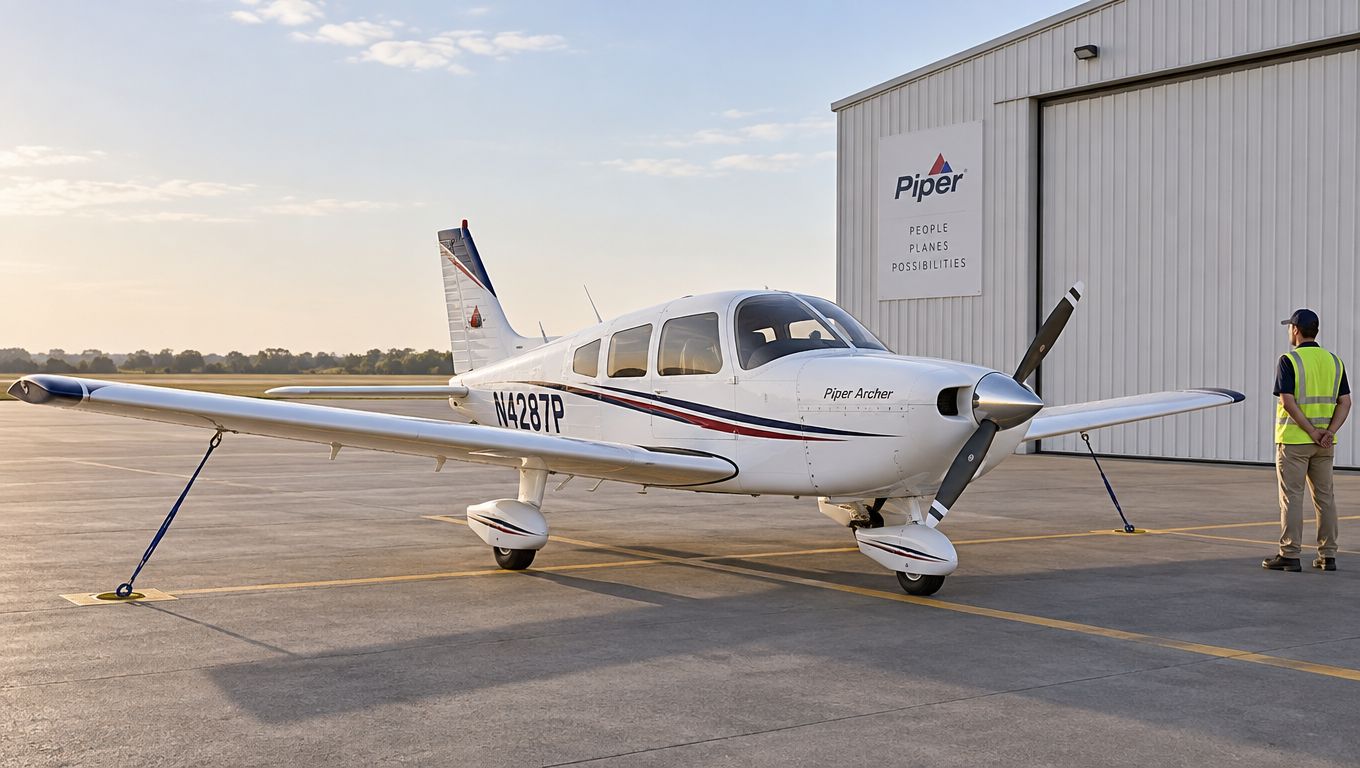
The fixed tricycle gear helps here. For a student or renter, ground handling stays straightforward because there is no retractable-gear task competing for attention during taxi, lineup, or after-landing flow. What still deserves respect is turning radius, brake use, and prop clearance around cones, tow bars, and service carts.
I treat the propeller diameter as a practical warning. On a tight apron, people focus on the wingtips and forget the arc at the nose. The Archer is forgiving, but it is still easy to create a clearance problem by hand-pulling the airplane with the nose angled toward equipment.
A quick ramp check works better than another generic spec list:
- Wingtip path: Confirm the full turning path, not just parked width.
- Tie-down points: Check the actual wing and tail attachment locations in use on that airplane.
- Control lock position: Verify what is installed before moving the aircraft.
- Parking and towing plan: Use a wing walker when neighboring aircraft or hangar posts leave little margin.
Dimension data stays fairly consistent across PA-28-181 examples. Ramp technique does not. That part is aircraft-specific, airport-specific, and worth briefing every time.
Weights, Loading, and Fuel Capacity
The Archer's maximum takeoff weight is approximately 2,550 pounds, and commonly cited reference data places useful load near 900 pounds with fuel capacity around 48 to 50 U.S. gallons. Those figures are starting points, not a substitute for the aircraft's current weight-and-balance records. The aircraft weight-and-balance information from DuBois Aviation should be treated as a planning resource, while the specific aircraft paperwork remains controlling.
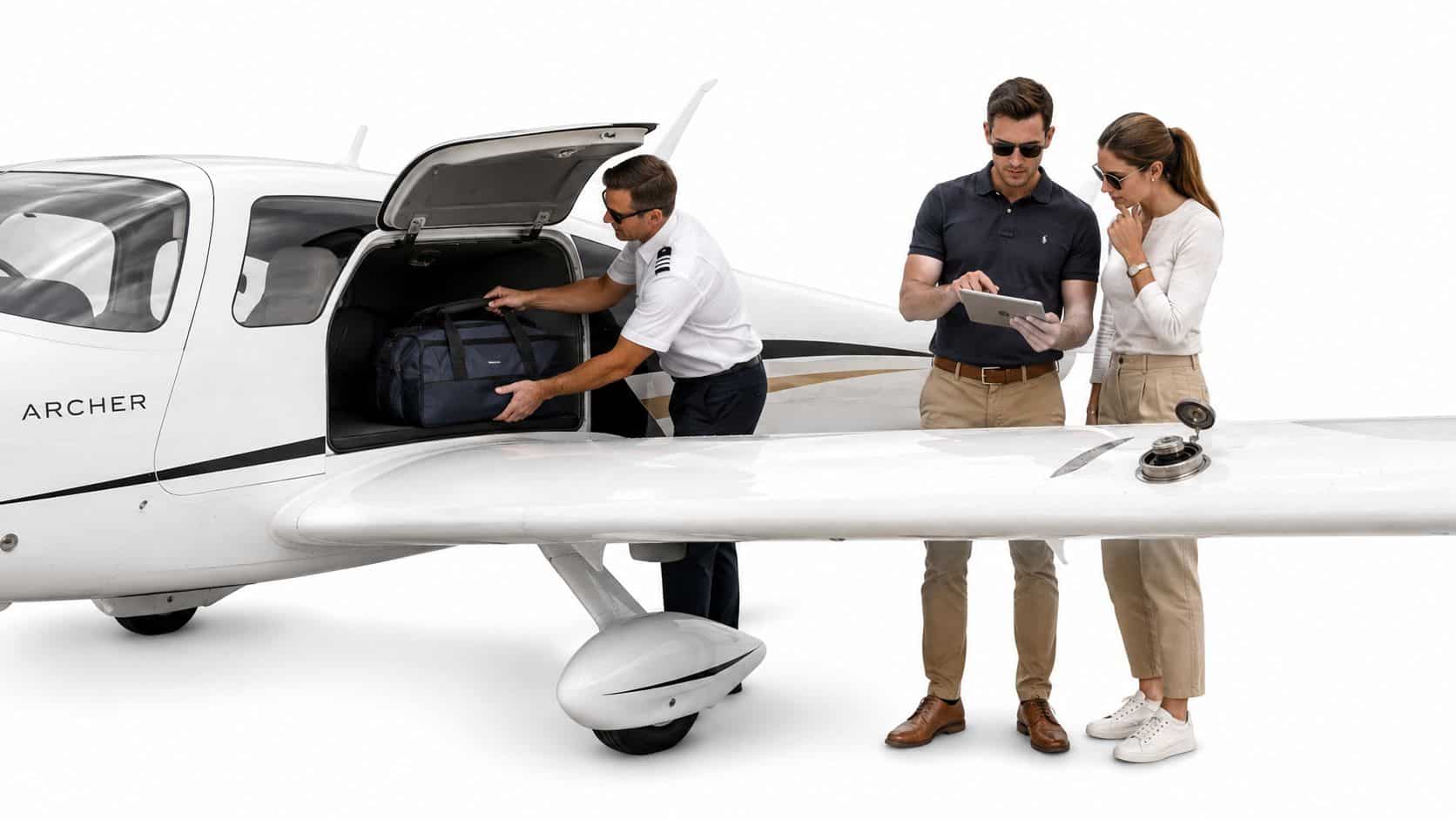
Fuel creates the first obvious trade-off. Full fuel represents roughly 300 pounds before accounting for unusable fuel and aircraft-specific fuel details. That leaves substantially less of the advertised useful load for occupants and baggage.
A representative loading decision
A practical loading calculation should proceed in this order:
| Item | Planning question |
|---|---|
| Aircraft empty weight | What does the current equipment-specific record show? |
| Fuel | How much fuel is required for the mission and reserves? |
| Occupants | What are the actual pilot and passenger weights? |
| Baggage | Does baggage remain within compartment and loading limits? |
| Center of gravity | Does the completed loading calculation stay within limits? |
Two adults, baggage, and full fuel may fit in some individual Archers, but the question can't be answered from the model name alone. The aircraft's actual empty weight, installed avionics, interior, fuel quantity, and occupant weights decide the result.
Why mission planning changes
For local training, a lighter load can preserve climb performance and provide more flexibility if the lesson needs repeated takeoffs and landings. Instrument and commercial flights may add equipment, charts, or another occupant while still requiring practical reserves. A rental cross-country can make a fuel stop preferable to loading the airplane beyond a comfortable margin.
The pilot must deduct legal and practical reserves from any advertised range or payload assumption. High density altitude, passengers, baggage, and equipment all affect the arithmetic. The current weight-and-balance revision and POH supplements should be checked before every flight, not just during the initial checkout.
Performance Numbers and POH Verification
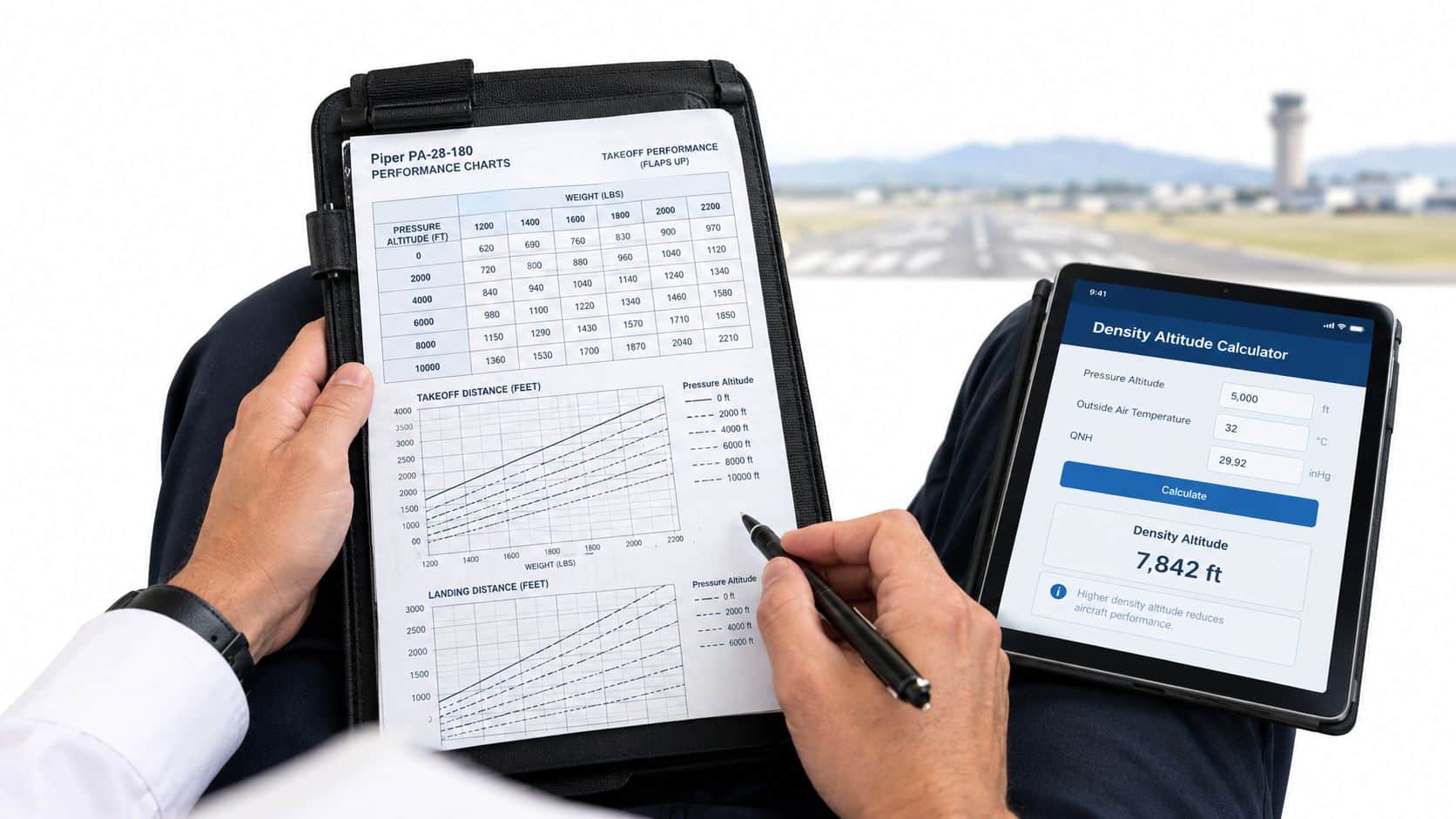
Pulling Archer performance numbers from a sales sheet or a generic spec card is how pilots get surprised on a hot afternoon. Archer figures vary by variant, year, installed equipment, and the conditions used to generate them, so numbers that look close on paper can lead to different runway and climb expectations in actual use. Typical references put normal cruise near 125 to 128 knots, maximum level speed around 133 knots, range at roughly 550 to 600 nautical miles, service ceiling around 13,200 to 14,100 feet, rate of climb near 660 to 700 feet per minute, landing-configuration stall speed near 49 knots, and takeoff ground roll from about 870 to 1,135 feet.
Those are planning references, not dispatch answers.
For a rental checkout or instrument lesson, the practical question is simpler. Which number came from the approved POH for this airplane, and which one came from a broad model summary? That distinction matters at a place like Chino, where summer temperature, traffic flow, and runway assignment can turn a small paper difference into a real operational one.
Reading the charts correctly
The POH separates takeoff, landing, climb, cruise, and range for a reason. Each chart assumes a specific setup, and if you miss one input, the answer can be off enough to matter. A clean calculation should:
- Start with actual weight, including fuel, occupants, and baggage.
- Use pressure altitude and temperature, not field elevation by itself.
- Apply runway and wind corrections, including slope and surface where the chart calls for them.
- Confirm the configuration, such as flap setting, power, and mixture assumptions.
- Check obstacle and climb margin, not just the published ground roll.
At Chino, density altitude is the trap. An Archer that looks comfortable under standard conditions can use more runway and deliver less climb than the headline figure suggests, especially when loaded for instruction with two people, bags, and enough fuel for delays or multiple approaches.
Cruise numbers need the same discipline. Normal cruise and maximum level speed are different values, and neither should be treated as what you will always see on a given day. Use the POH cruise tables, then compare your work with a neutral aircraft performance chart reference if you want a study aid.
Before departure, write down today's expected ground roll and climb rate from the POH charts. That written number is the standard to use.
Training, Operations, and Southern California Considerations
The Archer's fixed landing gear, four-seat cabin, and moderate cruise speed suit several training roles. The airplane provides a familiar platform for private pilot work, instrument procedures, commercial maneuvers, and cross-country practice without adding retractable-gear complexity to every lesson.
Chino Airport gives that training a realistic operational setting. Its Class D airspace, three runways, and multiple instrument approaches expose students to tower communications, runway selection, traffic sequencing, and instrument procedures early in their training. The same environment demands accurate planning because busy airport operations leave less room for an improvised loading or fuel decision.
Matching the airplane to the mission
A practical mission check looks like this:
- Private pilot training: The Archer's stable fixed-gear configuration supports pattern work, takeoffs, landings, and basic maneuver practice.
- Instrument training: Avionics, fuel reserves, workload, and approach planning become more important than nominal cruise speed.
- Commercial preparation: The pilot must confirm approved maneuver limitations, loading, and the aircraft's ability to support repeated training operations.
- Rental cross-country: Payload, winds, fuel stops, and density altitude should be settled before the aircraft leaves the ramp.
A pilot considering Piper Archer rental near Chino should ask which specific aircraft is available, what avionics it carries, and whether the planned mission fits that airplane's current documents.
Coastal-inland routing can bring changing temperatures, terrain, and airspace workload into one flight. Legal fuel reserves are a baseline, not a reason to plan to the last usable gallon. A practical buffer should account for routing changes, vectors, weather, delays, and the pilot's comfort level.
For a pilot pursuing private, instrument, commercial, or later multi-engine training, the Archer can build strong planning habits. A different fleet aircraft may be more appropriate when the mission requires additional payload, different avionics, retractable-gear experience, or multi-engine systems.
Certification, Avionics, and Equipment Variations
The Archer III certification basis is identified as CAR 3 and FAR Part 23, and certification documentation references an approved POH or FAA-approved AFM governing operating limitations, loading, and utility-category maneuvers. The EASA Archer III certification documentation is useful background, but the aircraft's own approved documents remain the practical authority.
FAA registration records identify PA-28-181 aircraft certificated in both Normal and Utility categories, with representative O-360-A4M and IO-360-B4A installations. Category approval doesn't mean every maneuver is automatically permitted. The pilot must verify the aircraft's limitations, approved weight range, maneuvering restrictions, and POH language before conducting commercial or instructor-training maneuvers.
Avionics change the cockpit workflow
Legacy Archer panels may use conventional six-pack instruments, while later aircraft can include integrated glass avionics. Piper's 2013 FAA type-certificate approval for Garmin G1000 avionics created a clear example of how the same basic airframe can require a different training workflow and additional supplements.
A glass-equipped Archer may reduce some navigation workload, but it doesn't eliminate the need to understand pitch, power, heading, altitude, airspeed, and failure procedures. It also introduces equipment-specific operating guidance, databases, electrical considerations, and training expectations. The pilot must use the installed system's approved supplements instead of assuming that a legacy checklist applies unchanged.
The pre-maneuver document check
Before calculating payload or planning training maneuvers, confirm:
- Aircraft identity: Registration and serial number.
- Engine model: O-360-A4M, IO-360-B4A, or the installation shown in the records.
- Equipment list: Avionics, autopilot, GPS, and other installed systems.
- Weight and balance: Current empty weight, arms, moments, and loading limits.
- Supplements: Applicable avionics, engine, propeller, and equipment documents.
An Archer with an IO-360 installation shouldn't be treated as operationally identical to an O-360-A4M example. Fuel, oil, performance, and maintenance references must follow the actual aircraft.
Quick-Reference Specification Card
The following card is useful for a rental checkout or checkride review, but every value remains a reference figure. The aircraft-specific POH, AFM, supplements, and weight-and-balance records control.
Piper Archer Quick-Reference Specifications
| Spec | Reference Value | POH Check |
|---|---|---|
| Normal cruise | 125 to 128 knots | Confirm power setting and configuration |
| Maximum level speed | About 133 knots | Confirm model-specific limitation or reference |
| Maximum takeoff weight | Approximately 2,550 lb | Confirm aircraft records |
| Useful load | About 900 lb, commonly cited | Use current weight-and-balance data |
| Fuel capacity | About 48 to 50 U.S. gallons | Confirm usable fuel |
| Range | Approximately 550 to 600 nm | Recalculate with reserves and wind |
| Service ceiling | About 13,200 to 14,100 ft | Confirm aircraft-specific figure |
| Stall speed, landing configuration | Near 49 knots | Confirm configuration and weight |
Before flight, verify:
- Model and serial number, not only the Archer name.
- Engine and avionics installation.
- Current loading and center of gravity.
- Takeoff, landing, and climb charts for today's conditions.
TX, LX, Archer II, and Archer III figures may differ. When a reference card and the aircraft documents disagree, the aircraft documents take precedence.
Common Pilot Mistakes with Archer Specs
The most persistent mistake is treating brochure range as dispatch range. A published range of 550 to 600 nautical miles is a reference figure, not a promise that the aircraft can carry the planned occupants, baggage, and fuel while preserving legal and practical reserves. The range must be recalculated for loading, winds, fuel quantity, and the aircraft's approved performance data.
Density altitude creates another quiet trap. A ground-roll figure near 870 feet or an Archer III reference of 1,135 feet doesn't describe every runway departure. Heat, pressure altitude, surface, slope, weight, wind, and obstacle requirements can turn a comfortable-looking number into an unsuitable plan.
Corrections that improve the preflight
- Replace model-level assumptions: Use the serial-number-specific POH and equipment list.
- Separate fuel from payload: Full fuel is roughly 300 pounds, so two adults and baggage may require a loading compromise.
- Identify the engine: O-360-A4M and IO-360-B4A aircraft require their own fuel, oil, performance, and maintenance references.
- Use real conditions: Calculate density altitude and climb expectations before departing Chino, especially during hot weather.
A short preflight review prevents several errors at once. The pilot confirms the airplane, calculates the load, checks runway performance, and sets a reserve policy before taxi. That process works better than memorizing a single attractive specification.
Piper Archer Specifications FAQ
Can two adults, baggage, and full fuel fly a meaningful cross-country?
Sometimes, but the answer depends on the individual aircraft. Full fuel represents roughly 300 pounds, leaving less of the advertised useful load for occupants and baggage. The pilot must use current empty weight, actual occupant weights, baggage, usable fuel, center-of-gravity limits, and reserve requirements before deciding.
Does an O-360-A4M Archer operate like an IO-360-B4A Archer?
Not automatically. The engine designation changes which fuel, oil, performance, operating, and maintenance references apply. The pilot should confirm the installed engine in the aircraft records and consult the appropriate POH sections and supplements.
What changes between a six-pack Archer and a G1000-equipped Archer?
The basic airframe may remain familiar, but cockpit procedures, avionics supplements, failure modes, checklists, and training expectations can differ. The 2013 G1000 type-certificate approval is a historical milestone, not permission to apply one aircraft's procedures to another.
Is the Archer suitable for private, instrument, and commercial training?
Its four-seat fixed-gear configuration can support private, instrument, and commercial training, subject to the aircraft's approved equipment, loading, category restrictions, and maneuver limitations. Multi-engine training requires an appropriately approved multi-engine aircraft, so the Archer should be viewed as a foundation for that progression rather than a substitute.
What should a renter verify before accepting the aircraft?
The renter should confirm the aircraft identity, engine model, avionics, current weight-and-balance data, POH revision, supplements, fuel status, and performance calculations. Those checks matter more than relying on a generic Archer specification table.
DuBois Aviation provides airplane and helicopter instruction, aircraft rental, and training pathways from private through instrument, commercial, and advanced instructor-focused programs at Chino Airport. Pilots can visit DuBois Aviation to ask about Archer availability, schedule a school visit, or request training information matched to the aircraft and rating they plan to pursue.