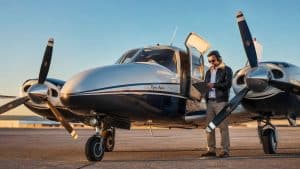
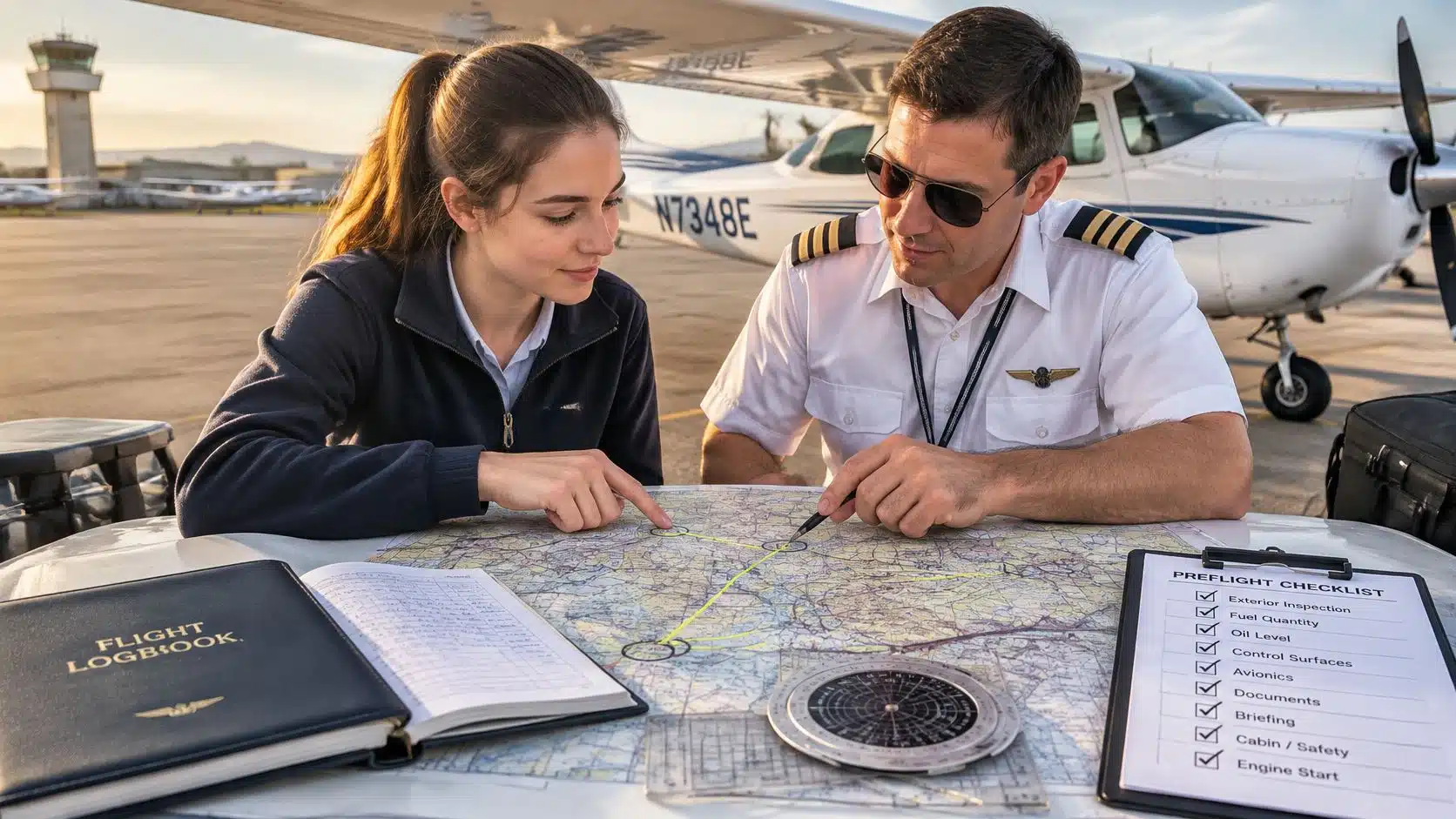
For a private pilot certificate with an airplane single-engine rating, the FAA minimums include 3 hours of cross country flight training and 5 hours of solo cross country time. A student must also complete one solo cross country flight of at least 150 nautical miles in total, with full-stop landings at three points and at least one leg more than 50 nautical miles in a straight line between takeoff and landing.
What makes a flight demanding is not always what makes it count as cross country time. A short trip through busy controlled airspace can require frequent radio work and careful attention, while a longer route between quiet airports may involve fewer immediate tasks. Distance determines whether a flight meets the relevant rule; it does not, by itself, show whether a student is ready to fly that route alone.
That distinction matters. The regulation sets a legal minimum, while an instructor assesses whether the student can manage the route, procedures and decisions without help. A flight can satisfy the distance requirement and still be a poor choice for a first solo cross country trip. Understanding both standards helps students prepare for the required experience without mistaking a qualifying flight for proof of readiness.
Two practical options worth comparing
These are specific products pilots commonly compare for this type of flying. Confirm compatibility with your aircraft and instructor before ordering.
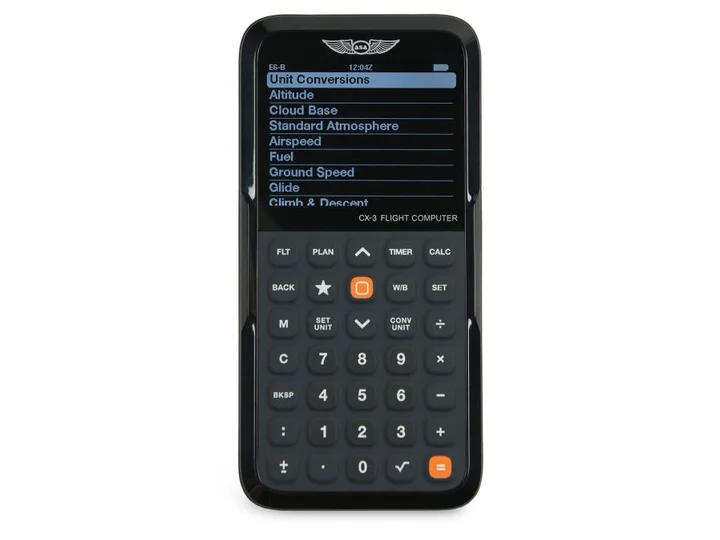 Flight planningASA CX-3 Flight ComputerCheck current availability on Amazon (paid link)
 Electronic flight bagApple iPad mini A17 Pro, Wi-Fi and Cellular, 128GBCheck current availability on Amazon (paid link)
Table of Contents
- Student Pilot Cross Country Requirements at a Glance
- What Counts as Cross Country Time
- Endorsements Required Before Solo Cross Country
- Repeated Local Flights and the 50 Mile Exception
- Legal Clearance Versus Readiness to Fly
- Plan Each Cross Country Flight and Avoid Common Errors
- Your Next Steps Toward a First Solo Cross Country
- Frequently Asked Questions About Cross Country Requirements
Student Pilot Cross Country Requirements at a Glance
Which numbers belong in the logbook, and which describe a student's readiness to fly? For a private pilot certificate with an airplane single-engine rating, 14 CFR Part 61 on the eCFR sets minimum aeronautical experience of 40 hours of total flight time, including 20 hours with an authorized instructor and 10 hours solo. The cross country requirements fit within those totals:
| Requirement | Minimum | What it shows |
|---|---|---|
| Total flight time | 40 hours | Includes 20 hours with an instructor and 10 solo |
| Cross country flight training | 3 hours | Navigation training with an authorized instructor |
| Solo cross country time | 5 hours | Navigation flown alone after the required endorsement |
| Required solo cross country flight | 150 nautical miles total | A solo flight covering a substantial route |
| Full-stop landings on the solo flight | 3 points | Landings at points along the route |
| Longest straight-line leg | More than 50 nautical miles | A leg measured directly between takeoff and landing points |
| Towered airport operations | 3 full-stop takeoffs and landings | Operations at an airport with an operating control tower |
| Student authorization threshold | More than 25 nautical miles from departure | A separate distance threshold for student pilot authorization |
Treat the numbers as minimums, not a target for readiness. The table sets out experience requirements; it does not establish that a student can handle every situation on a trip. For example, a logbook could show 40 hours total and 5 hours of solo cross country time, while a recent flight still reveals difficulty managing a route change. The entry may satisfy a minimum, but it cannot show by itself how well the student handles decisions in flight.
What the table can and cannot tell you
The logbook makes recorded experience visible. It does not capture every part of a student's performance, such as how reliably they respond when a runway changes or a destination closes. An instructor assesses those skills through training and observation, rather than by adding up hours alone.
Audit a logbook against the table
- Total time: Add dual and solo time, then confirm the 20-hour instructor and 10-hour solo minimums.
- Cross country training: Find at least 3 hours of cross country instruction with an authorized instructor.
- Solo cross country: Confirm 5 hours logged as pilot in command on solo cross country flights.
- The long flight: Check that the 150-nautical-mile entry records full-stop landings at three points and a leg longer than 50 nautical miles in a straight line.
- Tower work: Confirm three full-stop takeoffs and landings at an airport with an operating control tower.
Use the current eCFR text to check the applicable rule and its effective date before relying on these requirements. A logbook review is a useful arithmetic check: it can reveal missing hours or entries, but it cannot replace the flight instruction needed to develop skill.
What Counts as Cross Country Time
A flight between two airports isn't automatically cross country time. For certificate purposes, the flight has to include a landing more than 50 nautical miles in a straight line from the original departure point, and the pilot has to determine position and course by pilotage, dead reckoning, electronic navigation aids, radio aids, or another navigation system, as the private pilot aeronautical experience rule sets out.
The measurement is straight line from the departure airport to the landing point, not the total distance flown. That distinction trips up more students than any other part of the definition. A 35 nautical mile round robin that lands at a nearby field is useful training, but it doesn't count as certificate cross country time. A flight that lands 60 nautical miles straight line from the departure field qualifies, even when the route flown is longer or shorter than the straight line.
Then the definition shifts with the requirement you're trying to satisfy. FAA guidance on cross country definitions explains that the terms in 14 CFR 61.1(b)(3) apply differently to different certificates and ratings, so a flight that counts toward a private certificate may not count toward another requirement.
| Requirement | Landing needed | Distance test |
|---|---|---|
| Certificate cross country under 14 CFR 61.1(b)(3), such as private pilot | Yes, at a point other than the departure airport | More than 50 nm straight line from departure |
| Student solo cross country authorization under 14 CFR 61.93 | Not the controlling test; the distance threshold sets it | More than 25 nm from departure airport |
| Airline transport pilot experience under 14 CFR 61.159 | No | More than 50 nm straight line from point of departure |
Where the landing test disappears
The airline transport pilot experience rule is the clearest example of how far the definitions drift apart. Under 14 CFR 61.159, the controlling definition requires a straight-line distance of more than 50 nautical miles from the original point of departure but no landing at all. A pilot building time toward an ATP certificate can log a flight that wouldn't count toward a private certificate.
Build a separate logbook column for each requirement you're tracking, and check the cited section before relying on any of that time.
A logbook entry that says "local" tells a future examiner nothing. Record the landing point and the straight-line distance on every flight that might count.
For a fuller picture of how the hours stack up across the whole certificate, the private pilot hour requirements breakdown covers the totals beyond cross country.
Endorsements Required Before Solo Cross Country
A general solo endorsement does not authorize a solo cross country flight. Under 14 CFR 61.93, a student pilot must receive aircraft-specific training from an authorized instructor, demonstrate proficiency in the required cross country maneuvers and procedures, complete the applicable pre-solo requirements under 14 CFR 61.87, and comply with every limitation written into the instructor's endorsement.
The training behind that signature is broader than most students expect. It covers navigation, pilotage, dead reckoning, chart and navigation-system use, diversion procedures, communications, airspace avoidance, weather evaluation, fuel planning, and abnormal or emergency decisions. A generic endorsement stops being sufficient the moment the aircraft type, route, airport, or operating limits differ from what was signed.
The four-item check before any solo cross country
- The solo endorsement is in the logbook, signed and current.
- The cross country endorsement names the aircraft make and model, or category and class.
- The written limitations match the planned route, airports, and forecast conditions.
- The instructor reviewed the planned flight and dated the endorsement before departure.
Run that list before leaving the parking area, not after runup. Students who check it at the last minute tend to discover a missing make-and-model reference when the engine is already warm.
Before a student is cleared for solo, DuBois Aviation runs stage-check flights that review flying skills, procedures and decision-making. A stage check doesn't replace the required instructor training and endorsements, and it isn't a substitute for the specific authorization 14 CFR 61.93 demands.
Understanding where the endorsement fits in the wider paperwork helps too. The student pilot certificate requirements explain the certificate itself, the medical path, and the documentation a student needs before any of these privileges apply.
Repeated Local Flights and the 50 Mile Exception
Does every cross country trip require a brand-new endorsement? The honest answer is that it depends entirely on how the endorsement was written.
FAA student pilot guidance draws a clear line between the general solo endorsement and cross country authorization. A solo endorsement alone doesn't permit solo cross country operations, and the instructor must review the planned flight and endorse the logbook before the flight, as the FAA student pilot resource describes. There's also a narrower exception worth knowing: 14 CFR 61.93(b)(2) allows repeated, specifically identified solo cross country flights within 50 nautical miles of the departure point when the instructor has provided the required training and written the appropriate limitations.
That means two pieces of folk wisdom are both wrong. "Every trip always needs a new endorsement" isn't accurate. Neither is the assumption that one broad signature covers any destination a student picks.
Say a student at a busy towered field wants to fly a rotation of three named practice airports. One endorsement can list those airports, the specific aircraft, the weather minimums, and the airspace limits, and the student can fly that rotation repeatedly within those terms. Change the aircraft or add an airport and the paperwork has to change with it.
A practical rule: an endorsement covers the places and conditions written on the page. It doesn't cover the destination a student invents on a Saturday morning.
Distance isn't the whole story either. A flight under 50 nautical miles can still involve Class D communications, transitions through neighboring Class C or Class B airspace, special-use airspace, or an unfamiliar arrival procedure at the other end. Ask the instructor to write the limits in plain language, and read the current rule text before leaning on the exception.
Legal Clearance Versus Readiness to Fly
How can a flight meet the student-pilot rules and still be the wrong trip to fly solo? The answer lies in the difference between regulatory permission and a sound decision for the conditions and pilot. Under 14 CFR 61.93, a flight more than 25 nautical miles from the departure airport is treated as cross country for student pilot authorization purposes. Solo cross country privileges also require the specified training, pre-solo qualifications, demonstrated proficiency, and compliance with the instructor's written limitations, as set out in the published text of the student pilot regulation.
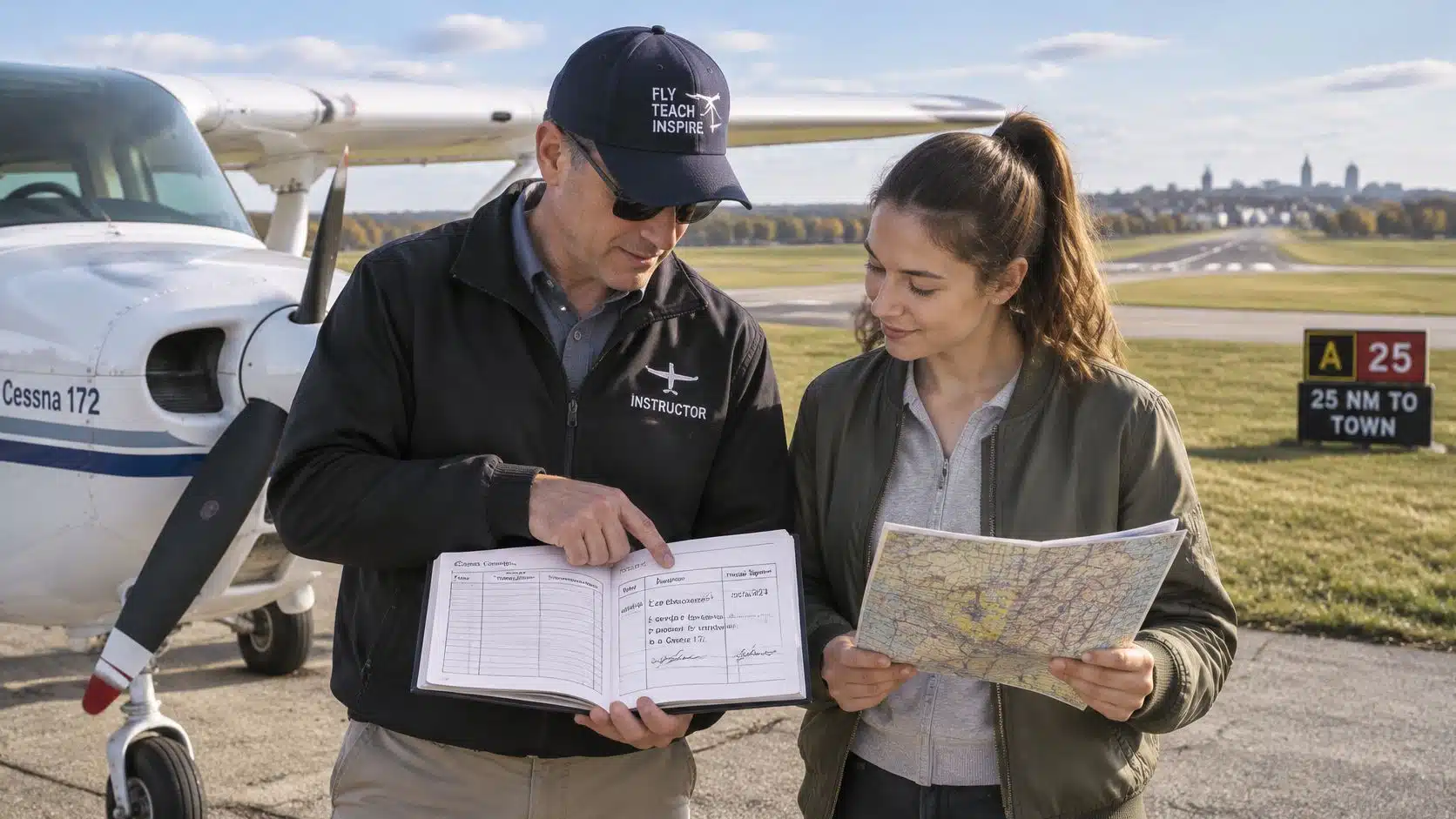
An instructor's safety judgment draws on the whole flight, not just its distance. A written go/no-go plan makes that judgment concrete: a student might set personal limits for weather ceilings and visibility, identify a usable alternate, and decide in advance what conditions would mean postponing the trip. Those limits help the student make a decision before pressure builds in the air.
What the instructor is actually weighing
The instructor considers the workload across radio handoffs, whether a viable diversion exists, and how weather compares with the student's stated limits. They also assess aircraft performance for the day's density altitude, backup navigation options if GPS or a ground-based aid fails, and procedures at an unfamiliar airport. Each factor can change how much attention the flight requires.
A student may satisfy every listed training requirement and still need more practice applying those skills together. The instructor can require another dual flight before endorsing the trip, because completing maneuvers is not the same as managing a full flight safely. A careful go/no-go decision is part of learning to fly, not a sign that the rules have changed.
Plan Each Cross Country Flight and Avoid Common Errors
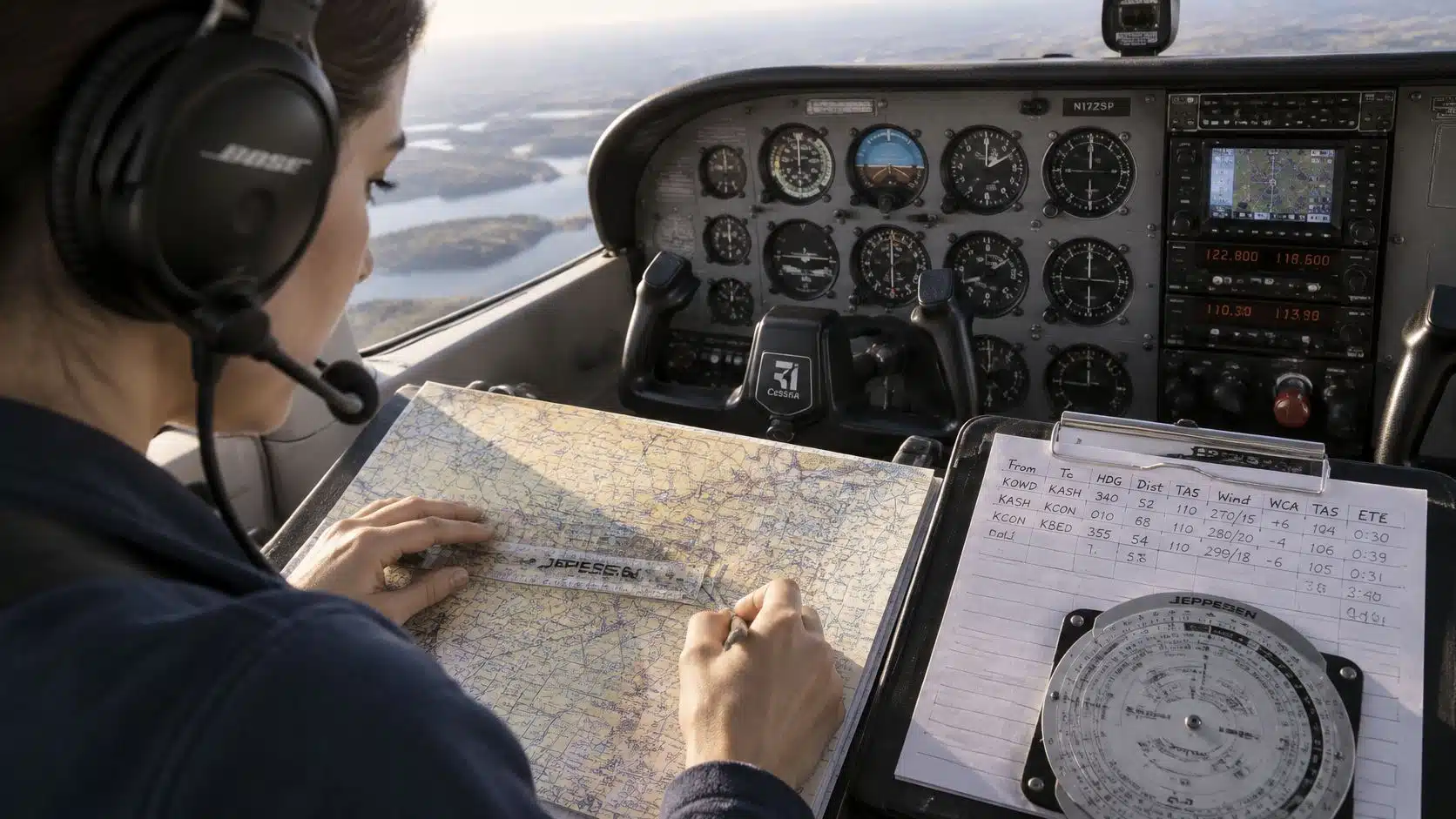
A cross country flight is planned on the ground and flown in the air. A sound plan links each decision to the next, from checking the route to setting limits for turning back. Strong aircraft handling cannot make up for a plan that leaves weather, fuel, or a diversion to chance.
Use this sequence for each trip. The same planning steps apply to a first solo cross country and later training flights, though the pilot's experience and the flight's conditions affect the margins.
- Measure the distance. Confirm the straight-line distance from departure airport to landing point meets the requirement for the cross country time you intend to log.
- Check the endorsement. Make sure its limits cover the aircraft, route, airports, and forecast for the planned flight.
- Review weather. Read the full briefing, including forecasts, TAFs, winds aloft, and density altitude. Check conditions along the route as well as at the destination.
- Check NOTAMs and temporary flight restrictions. Use official FAA sources on the day of the flight, so the plan reflects current restrictions.
- Plot checkpoints. Estimate time and fuel burn for each leg. Set them close enough together to notice early if you pass a checkpoint without identifying it.
- Choose a diversion airport. Decide in advance where you could land and where along the route you would make that choice.
- Review airspace. Note controlled airspace, special-use areas, and relevant tower frequencies for each airport on the route.
- Calculate fuel. Meet the reserve required by 14 CFR 91.151 and account for forecast winds rather than assuming they will be favorable.
- Brief the instructor and set go/no-go limits. Write down ceiling, visibility, and wind limits before starting the engine.
Common errors, their causes, and the fix
The clouds are lower than forecast, but the student continues. A written limit gives the pilot a clear decision point before pressure builds in the air. Set ceiling and visibility minimums during planning, and treat conditions below them as a reason not to depart or to turn back.
The arrival is late and the tower call feels rushed. A runway change or traffic delay can disrupt the schedule. Build buffer time into the plan, then rehearse the arrival call before takeoff so time pressure does not take over the radio work.
The climb is sluggish on a hot afternoon. Density altitude affects aircraft performance. Check the aircraft's performance figures using the actual temperature and field elevation, and confirm the runway length needed before departure.
Brief both the planned route and a diversion. Thinking through the alternate on the ground gives the pilot a clear next option if conditions change.
DuBois Aviation's cross country flight training takes place at Chino Airport, a towered Class D airport where students gain experience with controlled airspace and radio communication.
Your Next Steps Toward a First Solo Cross Country
What comes after endorsements are in the logbook? At DuBois Aviation, training follows a sequence: fly and study, solo the aircraft, learn to plan and fly across Southern California, then schedule a checkride after meeting the practical test standards. Each step builds on the skills and judgment developed earlier.
Legal clearance and readiness are different things. An endorsement authorizes a flight under the applicable rules; it does not mean every route is a good first solo trip. Before departure, make sure you understand the plan and can explain the choices you would make if conditions or circumstances change.
To see how cross country training fits into a broader path, students can review the school's courses, which include Guided Cross-Country Adventures, the Fast-Track Career Pilot Program, Aviation Camp, TSA FTSP Requirements, Helicopter Training, and Simulator. These offerings provide different ways to continue learning, while private pilot progress still depends on preparation, proficiency, weather, aircraft availability, and examiner scheduling.
Frequently Asked Questions About Cross Country Requirements
Does a cross country flight with an instructor count as solo cross country time?
Dual cross country flight training counts toward the required cross country training, but it is logged as dual time. Solo cross country time must be flown alone, with the required instructor endorsement.
How should I log a dual cross country flight?
Record the flight as dual instruction and include the route, airports, and flight time in your logbook. Your instructor can help ensure the entry distinguishes the training received from any solo cross country time.
Do I need a new endorsement when I switch aircraft?
An endorsement applies to the aircraft and operation it covers. If you switch to a different make and model, or a different category and class, ask your instructor whether you need another endorsement before departing.
What should I do if the weather changes after my endorsement is signed?
Pause and contact your instructor before taking off. An endorsement does not make unsuitable weather safe, and your instructor can help assess whether to delay, change the route, or cancel the flight.
Can a stage check replace instructor training or an endorsement?
No. At DuBois Aviation, stage-check flights review flying skills, procedures, and decision-making before a student is cleared for solo. Passing a stage check does not replace the required instructor training or endorsements.
Cross country requirements set the legal boundaries, while a sound go or no-go decision also depends on the student's preparation and conditions. DuBois Aviation provides one-on-one airplane and helicopter instruction at Chino Airport, with training progress shaped by proficiency, weather, aircraft availability, and preparation. A flight may meet a rule and still be a poor choice for a student's first trip away from the local area. Ask your instructor to assess readiness for the specific flight, not just whether the paperwork is in place.