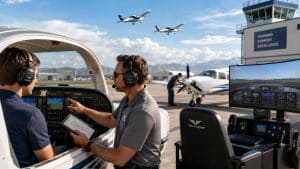
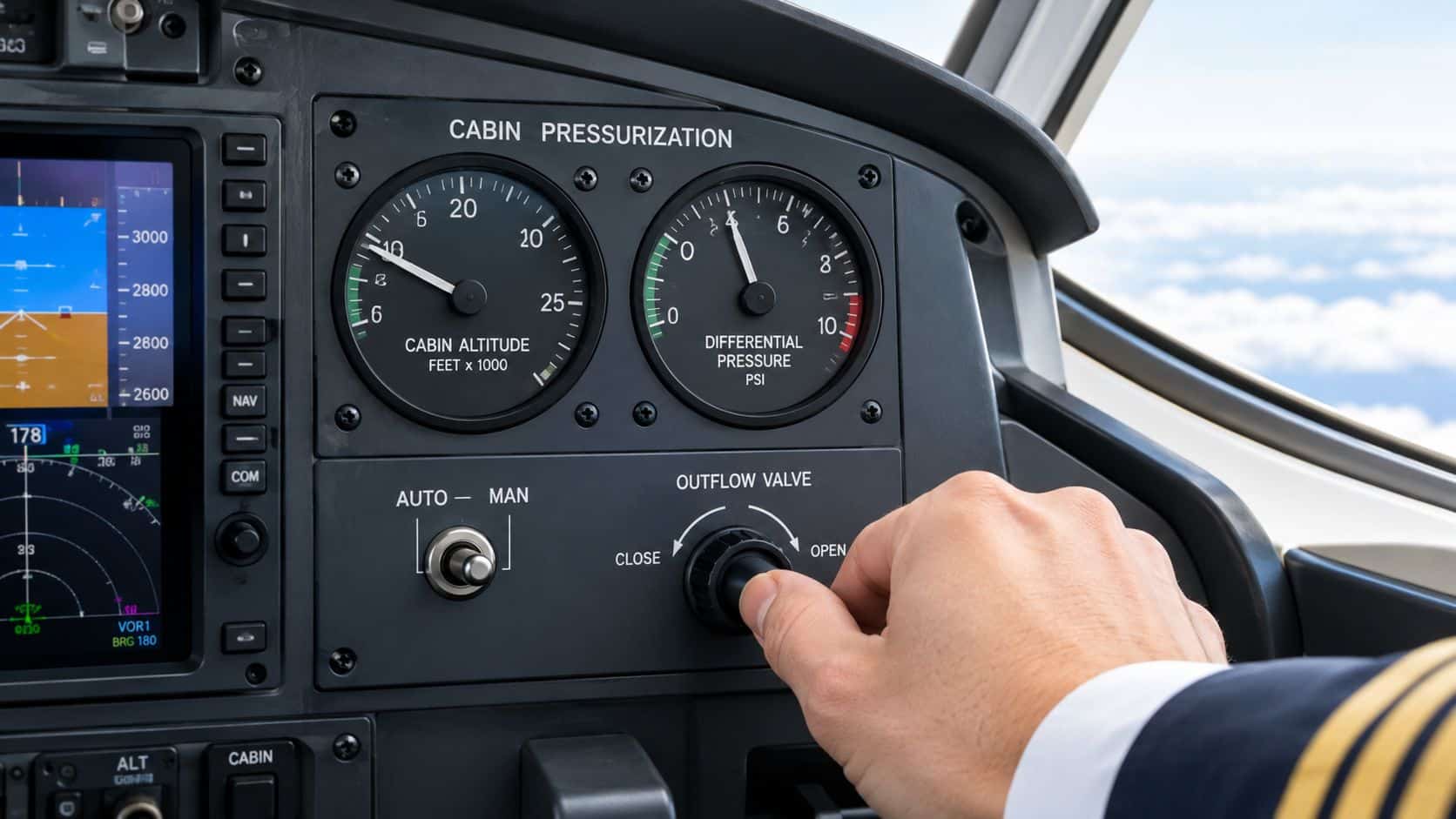
You're cruising high, the airplane is stable, and then the cabin altitude warning sounds. The pressurization system has stopped maintaining the cabin's planned pressure schedule, and the next decisions matter more than diagnosing the failed component. In simple terms, the system keeps the cabin at a lower pressure altitude than the airplane's actual altitude. Under U.S. transport-aircraft certification guidance, normal cabin pressure altitude is generally limited to 8,000 feet, even when the airplane is flying substantially higher (FAA Advisory Circular AC 25-20).
For a pilot, pressurization knowledge is therefore not just about comfort or panel terminology. It connects cabin altitude, hypoxia, oxygen equipment, structural limits, warning systems, emergency descent procedures, and human performance into one time-critical cockpit problem.
Table of Contents
- What a Pressurization System Does
- Cabin Altitude and Differential Pressure
- Key Components and How They Work Together
- Normal Operation Versus Slow Leak Versus Rapid Decompression
- Emergency Procedures for Loss of Pressurization
- Supplemental Oxygen Rules and Practical Application
- Common Failure Modes and Lessons From Real Incidents
- Practical Tips for Student Pilots and Renters
What a Pressurization System Does
At cruise, a warning horn sounds. The cabin-altitude indication begins to rise, an annunciator illuminates, or oxygen masks deploy. The airplane may still be at the same flight level, but the pressure altitude inside the cabin is increasing. That is the first cockpit distinction to make, because the response clock starts before a pilot identifies the failed part.
Airplane altitude describes the aircraft's position in the atmosphere. Cabin altitude describes the pressure inside the occupied cabin, expressed as the altitude where that pressure would normally occur outside. The airplane can be high above the ground while occupants experience pressure associated with a much lower altitude.
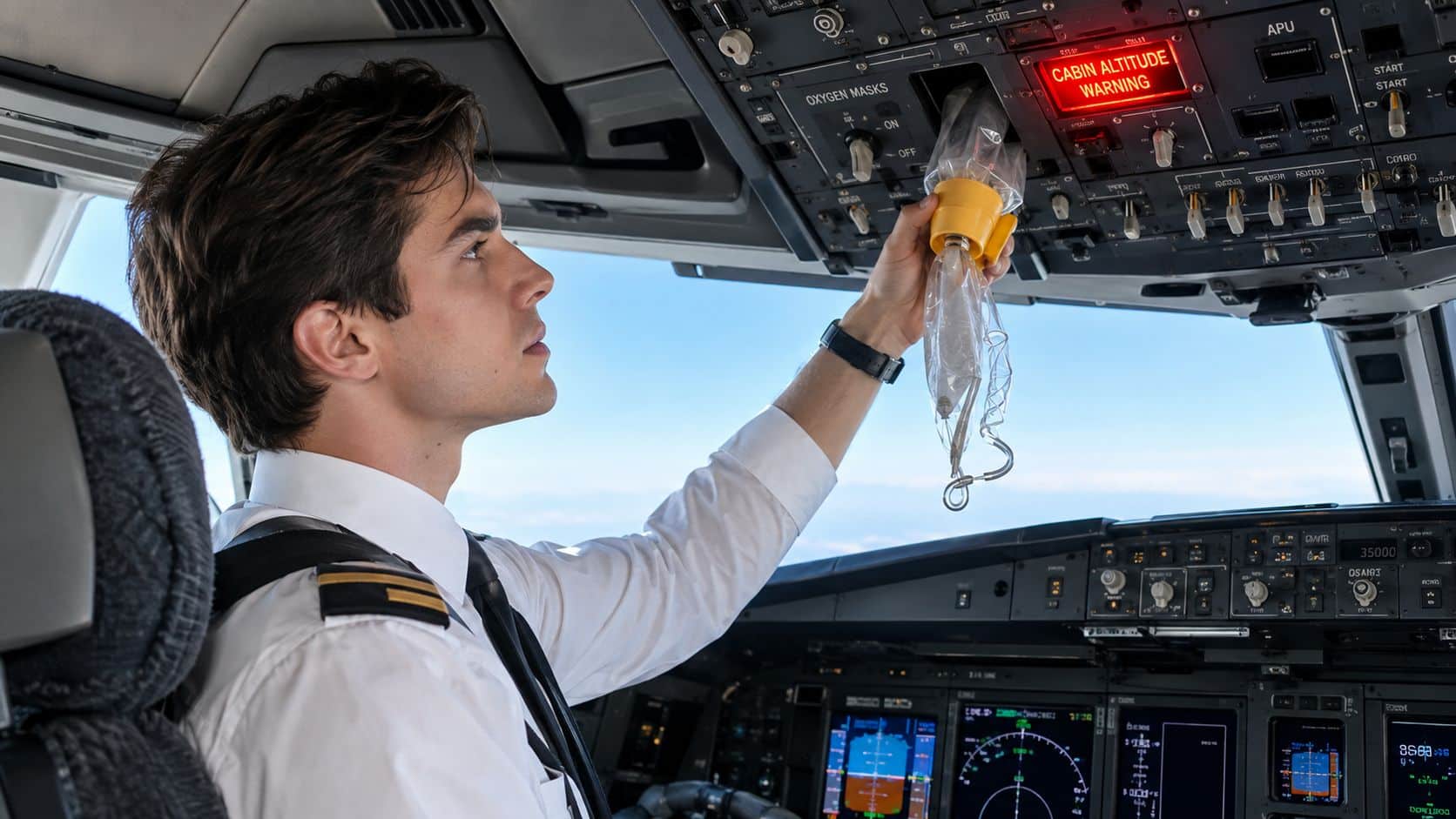
By maintaining higher cabin pressure, the system preserves more usable oxygen than the thin outside air would provide at cruise altitude. It also allows efficient high-altitude flight without requiring everyone onboard to breathe concentrated supplemental oxygen for the entire trip. Comfort is a benefit, but protecting human performance is the main purpose.
The cabin is a controlled pressure vessel
A pressurized fuselage holds a pressure difference between its interior and the surrounding atmosphere. Conditioned air enters through the environmental control system, while an outflow valve meters the air leaving. Sensors and controllers adjust that balance to follow a planned cabin-altitude schedule and limit how quickly cabin pressure changes.
The cabin is therefore not a sealed tube with air forced in at one fixed rate. It is a controlled vessel supported by valves, sensors, controllers, structural reinforcement, warnings, and emergency oxygen. On the panel, each indication represents part of that chain. Understanding the chain helps a pilot decide whether the airplane is maintaining pressure, losing it slowly, or requiring immediate oxygen use and descent.
Practical rule: A rising cabin altitude is an oxygen problem before it is a troubleshooting problem.
The same pressure-control idea appears outside aviation, but the audience and consequences differ. Explaining a pressure-control system clearly matters outside the cockpit too; the guide to how to advertise pressure washing services shows how technical services can be communicated to non-experts. In an aircraft, clear recognition must lead to immediate action.
A pressurized airplane still needs oxygen planning. A leak, controller malfunction, valve fault, or structural opening can remove the cabin's physiological margin. The pilot must recognize the warning, use oxygen before performance deteriorates, and descend toward a safer altitude while controlling terrain, traffic, and aircraft limitations.
Cabin Altitude and Differential Pressure
A useful analogy is a drive from sea level into the mountains. The vehicle's physical location changes as it climbs, but the occupants' experience depends on the pressure and environment inside the vehicle. In an aircraft, cabin altitude applies the same idea to pressure rather than road elevation.
At a high cruise altitude, the airplane may be surrounded by very thin air. The pressurization system makes the cabin pressure behave as though the cabin were at a lower altitude. That lower cabin altitude gives occupants more physiological margin, but it also creates structural stress because the pressure inside the fuselage exceeds the pressure outside.
Under U.S. transport-category certification rules, a pressurization system must normally maintain an occupied cabin pressure altitude no higher than 8,000 feet, corresponding to approximately 10.9 psia (FAA environmental control systems guidance). The exact schedule varies by aircraft, but the principle remains consistent.
Differential pressure is the structural tradeoff
Differential pressure is the difference between cabin pressure and outside atmospheric pressure. As the airplane climbs, outside pressure falls. If cabin pressure remains comparatively high, the differential increases and the fuselage, windows, doors, seals, and pressure bulkheads carry greater loads.
The airplane therefore can't maintain a sea-level cabin indefinitely. The design must balance:
- Physiological margin, which improves as cabin altitude stays lower.
- Structural loading, which increases as inside and outside pressure diverge.
- Rate of change, which affects passenger comfort and pilot workload.
- System limits, including the maximum allowable differential pressure.
A pressurization schedule shows how cabin altitude changes during climb, cruise, and descent. A student reading that schedule should identify when cabin altitude begins to rise, the planned cruise cabin altitude, and the point where differential pressure reaches its operating limit. Those values belong to the aircraft's approved documentation, not to a generic rule copied from another airplane.
For a pilot building foundational knowledge, a detailed explanation of pressure altitude helps separate altitude references that are often confused during instrument and high-altitude training. Cabin altitude isn't the same as indicated altitude, pressure altitude, or the airplane's flight level.
The practical cockpit question is simple: What does this indication tell the crew about the occupants and the structure? Cabin altitude speaks to oxygen and physiology. Differential pressure speaks to the fuselage and system limits. Rate of cabin-altitude change speaks to how quickly the situation is developing.
Key Components and How They Work Together
A generic pressurization panel usually presents a controller, cabin-altitude indication, cabin rate indication, differential-pressure indication, mode selections, and warning lights or annunciators. The exact layout varies, so pilots should learn the aircraft-specific manual and checklist rather than assume that every panel behaves alike.
The system's operating chain is easier to understand when followed in airflow order.
Air enters, air leaves, and the valve controls the result
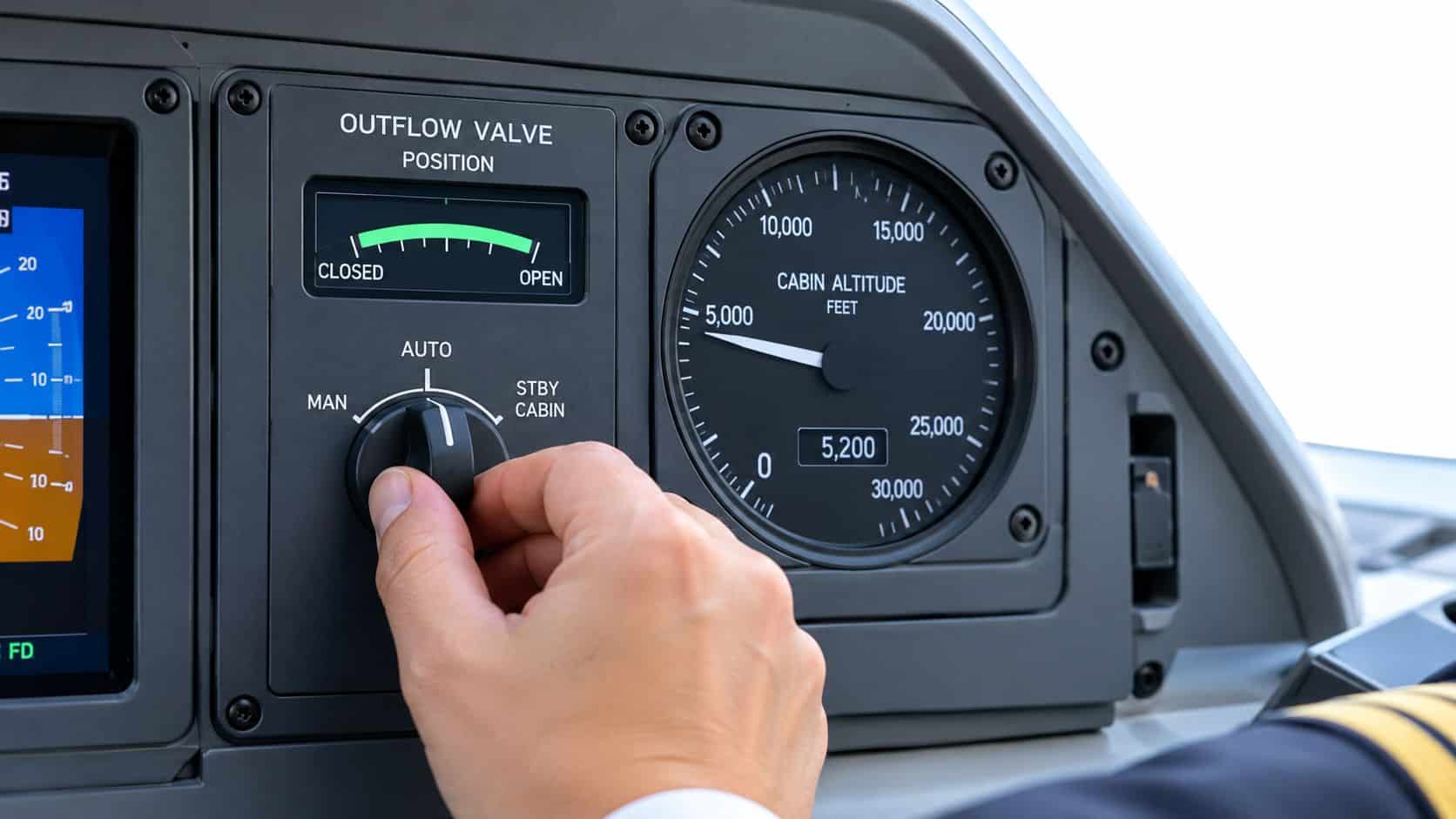
Conditioned air may come from engine bleed air or electrically driven compressors, depending on the aircraft. That air enters the fuselage through the environmental control system. The outflow valve meters discharge from the cabin, making it the principal controlled variable in many pressurization designs.
If the valve closes too much, cabin pressure can rise excessively and create an excessive differential. If it remains too open, cabin altitude can climb and occupants can lose their oxygen margin. The controller commands valve movement to maintain the selected schedule, but sensors and indications tell the crew whether the result matches the plan.
A pilot may see three related values:
- Cabin altitude, the pressure altitude the cabin is experiencing.
- Cabin rate, how quickly that cabin altitude is changing.
- Differential pressure, the pressure difference between inside and outside.
Those indications should be read together. A cabin altitude that is stable with a modest rate may be normal. A cabin altitude climbing despite a selected target suggests that the system isn't holding pressure. A high differential with an unexpectedly low cabin altitude may point toward a control or sensing issue that requires aircraft-specific action.
Automatic modes still require active monitoring
Automatic pressurization reduces workload, but it doesn't remove responsibility. Many aircraft provide more than one automatic controller or a manual backup mode. A controller may select the cabin schedule, while the crew monitors valve position, pressure, rate, and warnings.
The pilot should know what happens after a controller failure, which controls remain available, and whether manual operation requires a particular direction or technique. Functional checks matter because a valve-control or sensing fault can produce either inadequate pressure or excessive structural loading.
FAA certification guidance states that compliant pressurized aircraft have cabin-altitude warning systems that activate at 10,000 feet, while transport-category aircraft have automatic passenger oxygen-mask systems that activate before cabin altitude exceeds 15,000 feet (14 CFR Part 23). A visual inspection alone doesn't prove that the warning, controller, sensor, or valve will function correctly.
Normal Operation Versus Slow Leak Versus Rapid Decompression
The most useful distinction is the event's onset. Normal operation is stable and predictable. A slow leak develops over time. Rapid decompression changes the cabin environment so quickly that oxygen use and descent take priority over diagnosis.
FAA guidance defines decompression as the system's inability to maintain its designed pressure schedule. Decompression occurring in less than 0.5 seconds is generally considered explosive and potentially dangerous (FAA AC 61-107B).
Pressurization Events Compared
| Event | Onset | Cabin Indication | Pilot Response |
|---|---|---|---|
| Normal operation | Planned and gradual | Cabin altitude follows the schedule, rate remains controlled, and differential pressure stays within the aircraft's limits | Monitor the panel, verify automatic mode or approved manual operation, and follow the checklist |
| Slow leak | Progressive | Cabin altitude rises unexpectedly, the controller struggles to hold the target, or the warning eventually activates | Use oxygen as required by the aircraft procedure, identify the warning, coordinate with the other pilot, and prepare for descent |
| Rapid or explosive decompression | Sudden, potentially in less than 0.5 seconds | Abrupt pressure change, possible fog or loose items moving, loud airflow, immediate warning, and rapid cabin-altitude change | Don oxygen immediately, maintain aircraft control, initiate the emergency descent procedure, communicate, and troubleshoot only after the airplane and occupants are protected |
A slow leak can be more deceptive than a dramatic decompression because the crew may have time to rationalize an abnormal gauge or attempt a repair. The cabin-altitude trend is often more useful than one frozen indication. If the cabin is climbing and the system isn't arresting that climb, the situation deserves emergency treatment even before the cause is known.
For maintenance and troubleshooting teams, symptom-based compressor failure workflows demonstrate the value of starting with observable symptoms and working toward a fault. In flight, troubleshooting must remain subordinate to oxygen, aircraft control, and descent.
The event category matters less than the pilot's recognition speed. A slowly developing fault can become a rapid human-factors emergency once hypoxia begins to reduce judgment and coordination.
Emergency Procedures for Loss of Pressurization
A warning sounds during cruise. The cabin-altitude indication is rising, the cause is unclear, and the next minute will be busy. Treat the first 60 to 90 seconds as a cockpit decision problem, not a fault-finding exercise. Information may be incomplete, another occupant may need help, and the checklist still has to be found or read.
Use this priority sequence:
- Maintain aircraft control. Keep attitude, airspeed, altitude, and configuration within safe limits. Automation can assist, but the pilot remains responsible for the flight path.
- Use oxygen immediately. Put the mask on your face and confirm oxygen flow according to the aircraft procedure. A mask left beside you provides no protection.
- Initiate the emergency descent. Follow the approved aircraft procedure while accounting for airspeed, terrain, traffic, structural limits, and engine considerations.
- Communicate with ATC. Declare the emergency, state that a descent is required, and give concise information as workload allows.
- Troubleshoot after protection is established. Then check the pressurization panel, controller mode, outflow-valve indication, doors, and applicable checklist items.
FAA guidance says that after a pressurization failure above 10,000 feet, pilots should use supplemental oxygen immediately and descend to 10,000 feet or below when terrain permits (FAA hypoxia guidance). The aircraft flight manual and operating checklist govern the exact procedure for that airplane.
Why oxygen comes before diagnosis
At 25,000 feet, useful consciousness after a loss of pressurization may last only a few minutes. That estimate is not a guarantee. Workload, health, fitness, decompression rate, cabin altitude, mask fit, and oxygen flow can change the result.
A pilot who delays oxygen to inspect a valve risks losing the judgment needed to complete the descent. The immediate goal is to preserve cognitive function, control the airplane, and reach a safer cabin altitude. Identifying whether the controller or outflow valve failed can wait until those actions are underway.
Practice the sequence aloud during instrument, commercial, or multi-engine training: control, oxygen, descent, communication, then diagnosis. A memory flow supports checklist use, but it does not replace the aircraft-specific emergency procedure. Reviewing emergency descent procedures helps connect the maneuver to the pressurization event rather than treating it as an isolated performance exercise.
Supplemental Oxygen Rules and Practical Application
Oxygen rules become easier to apply when separated into three questions: Who must use oxygen? Who must receive it? What reserve must be available after a pressurization failure?
For a U.S.-registered civil aircraft under 14 CFR 91.211, required flight crew must use supplemental oxygen for any portion of a flight lasting more than 30 minutes at cabin pressure altitudes above 12,500 feet through 14,000 feet MSL. Above 14,000 feet MSL, required flight crew must use oxygen for the entire time at those altitudes. Above 15,000 feet MSL, supplemental oxygen must be provided to every occupant (FAA oxygen equipment guidance).
Oxygen Use Thresholds Under 14 CFR 91.211
| Cabin Pressure Altitude | Flight Crew Requirement | Passenger Requirement |
|---|---|---|
| Above 12,500 through 14,000 feet MSL, when the flight portion exceeds 30 minutes | Required flight crew must use supplemental oxygen | The regulation does not require oxygen for every occupant solely at this threshold |
| Above 14,000 feet MSL | Required flight crew must use oxygen for the entire time at those altitudes | The regulation does not yet require oxygen for every occupant solely at this threshold |
| Above 15,000 feet MSL | Required flight crew continues to use oxygen | Supplemental oxygen must be provided to every occupant |
These are regulatory minimums, not a signal to wait for symptoms. A pilot may need oxygen earlier because of workload, illness, fatigue, aircraft condition, or personal response to altitude. The aircraft flight manual, operating limitations, and approved equipment instructions also matter.
Pressurized-aircraft reserve requirements
Pressurized-aircraft operations above FL250 require an additional oxygen reserve of at least 10 minutes for each occupant if a pressure loss requires descent (FAA oxygen equipment guidance). This reserve supports the transition from normal pressurized flight to emergency descent.
Above FL350, one pilot at the controls must wear and use a secured, sealed oxygen mask that supplies oxygen continuously or automatically when cabin pressure altitude exceeds 14,000 feet. An exception allows two pilots operating at or below FL410 to use quick-donning masks that can be placed on the face with one hand from the ready position within five seconds, provided the masks supply oxygen and are properly secured and sealed.
Pilots comparing aviation oxygen equipment with medical-use equipment should consult a qualified aviation source and the aircraft documentation. A general guide for supplemental oxygen therapy may explain oxygen-concentration concepts, but it doesn't replace approved aircraft equipment guidance or the applicable regulation.
Common Failure Modes and Lessons From Real Incidents
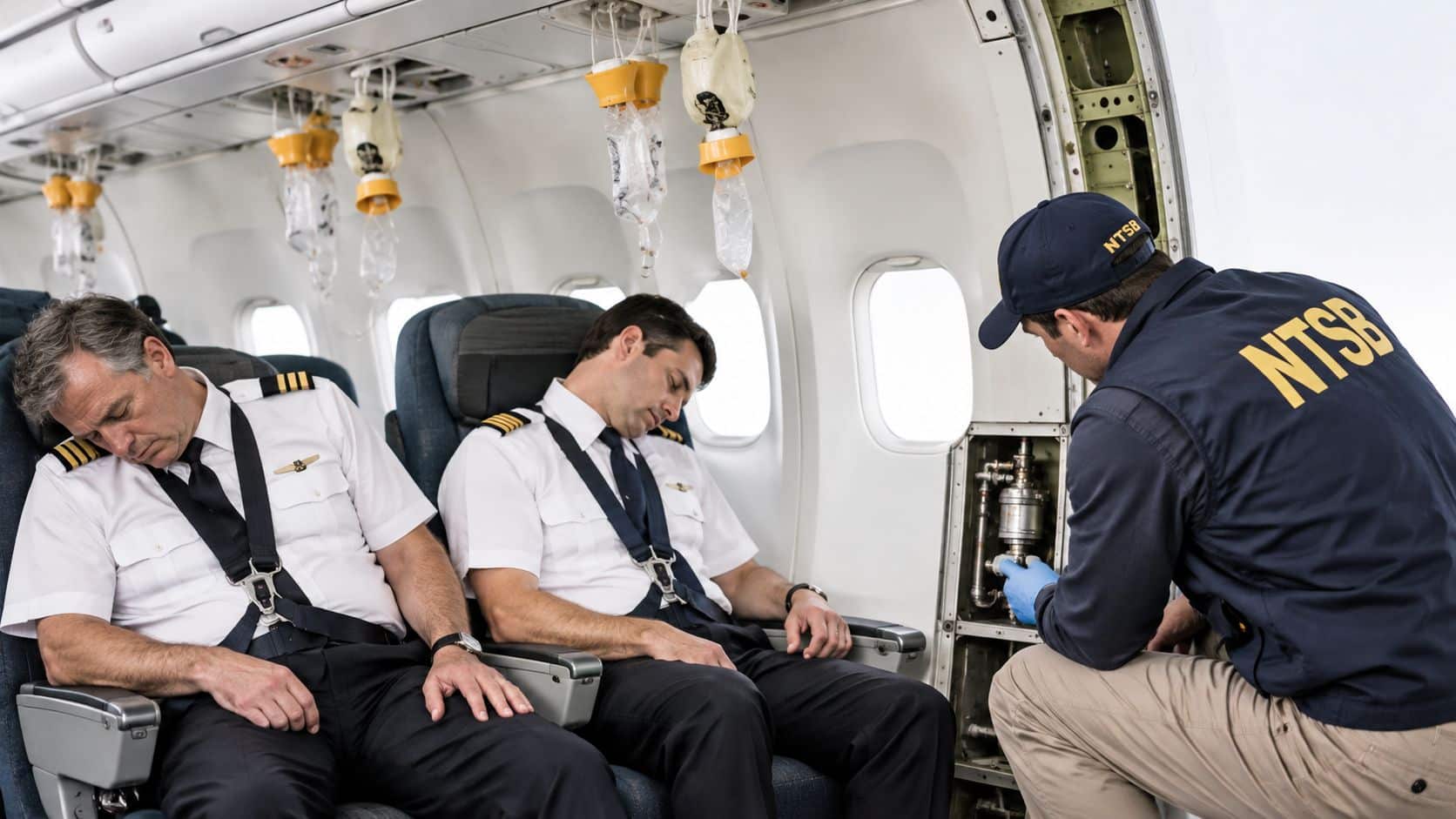
A pressurization emergency can start as a technical fault and become a time-critical cockpit decision. A controller may malfunction, a sensor may mislead the crew, an outflow valve may move incorrectly, or a door seal may leak. While the crew investigates, rising cabin altitude can reduce clear thinking and coordination. The first priority is to preserve both.
An NTSB investigation described pilots who became unconscious after delayed oxygen-mask use, improper outflow-valve control, and failure to follow a checklist. An NTSB investigator inspects the aircraft cabin as two pilots appear to be asleep in their seats.
The lesson applies beyond that specific sequence. A manageable malfunction can become incapacitating when the crew spends the available 60 to 90 seconds troubleshooting instead of securing oxygen, beginning the descent, and completing the applicable checklist. A pilot should treat the cabin-altitude warning as a command to act, not as an invitation to diagnose the system first.
The panel can mislead a distracted crew
A pilot might see cabin altitude and differential pressure disagree, a controller in an unexpected mode, or a valve indication that does not match the commanded response. These indications help with diagnosis after immediate protection is established. They should not delay oxygen use following a genuine cabin-altitude warning.
Common failure categories include:
- Outflow-valve faults: The valve may fail to open, fail to close, or respond incorrectly to the controller.
- Controller or sensor errors: The system may receive inaccurate pressure information or fail to command the planned cabin schedule.
- Door and seal problems: A leak may prevent the cabin from holding pressure even when the controller appears normal.
- Oxygen-system failures: A mask, regulator, supply line, or flow indication may not provide the expected protection.
- Warning-system faults: A missing or late warning can remove the crew's clearest cue, while a nuisance warning can encourage complacency.
Certification requirements limit occupant exposure to a cabin altitude above 40,000 feet after decompression under the applicable airworthiness standards, such as 14 CFR 25.841. That design protection does not replace crew action. The aircraft must support a safe descent and landing, while the pilots must use oxygen and execute the emergency procedure without delay.
Simulator practice should connect each indication to a decision. Rehearse mask-on communication, emergency-descent setup, ATC coordination, and checklist discipline. Knowing altitude thresholds matters, but practicing the sequence matters more when useful thinking time is shrinking.
Practical Tips for Student Pilots and Renters
A student or renter may not yet operate a high-altitude pressurized airplane, but the habits can be learned before the first transition flight. During the aircraft briefing, the pilot should ask where the oxygen masks are, how they deploy, how flow is confirmed, and which controls select automatic or manual pressurization.
A focused preflight review should include:
- Mask access: Confirm that each required crewmember can reach and secure the mask without searching.
- Regulator settings: Review the aircraft-specific oxygen controls and flow indications.
- Passenger briefing: Explain mask deployment and the priority of following the pilot's instructions.
- Emergency descent: Identify the approved procedure, terrain considerations, and communication plan.
- Panel function: Verify that warnings, indications, controller modes, and backup controls receive functional checks rather than only visual inspection.
- Aircraft documents: Review the flight manual, limitations, oxygen quantity, and required equipment before accepting the airplane.
A renter transitioning into a pressurized aircraft should ask the instructor to demonstrate a normal pressurization schedule, cabin-altitude warning, automatic mode, manual backup, outflow-valve indication, and oxygen-mask procedure. The pilot should also ask what a slow leak looks like before attempting a high-altitude flight.
The human-factors side deserves equal attention. DuBois Aviation's human factors training can help pilots connect system indications with workload, communication, checklist use, and decision-making. Pressurization experience also supports broader instrument, commercial, multi-engine, and career-track training because each program depends on disciplined aircraft and emergency management.
A pilot who can explain cabin altitude, differential pressure, outflow-valve control, oxygen thresholds, and emergency descent priorities is ready to ask better questions on the next training flight.
DuBois Aviation provides airplane and helicopter instruction, aircraft rental, simulator-supported training, and programs ranging from private and instrument certificates to commercial, multi-engine, instructor, and career-track pathways at Chino Airport. Visit DuBois Aviation to ask about course availability, schedule a school visit, or request training information that includes pressurization and emergency-procedure preparation.