
Choosing a flight school often starts with a simple question: “Can I book a lesson?” Before committing to a schedule or paying for a block of instruction, check the prerequisites for pilot training in sequence: age and paperwork, medical eligibility, basic readiness, and the requirements for the certificate or rating you want. Most are FAA rules, with a handful of practical habits that make lessons more productive. They're not a test of personality or a requirement to arrive already knowing how to fly.
Table of Contents
- What Pilot Training Really Asks of You Before You Start
- Age, Language, Citizenship, and the Paperwork to Gather
- The Medical Certificate Decision Tree Before You Pay for Lessons
- Baseline Knowledge and Skills You Can Build Before Day One
- How Prerequisites Change by Rating and Pathway
- Aircraft Rental Eligibility, Solo Currency, and Chino Airport Realities
- A Sequenced Pre-Training Checklist and Next Steps
What Pilot Training Really Asks of You Before You Start
A prospective student usually needs clarity on four things: who's eligible to begin, whether a medical certificate is part of the chosen path, what paperwork and study habits are needed, and which requirements apply to the target certificate or rating. Handling those in order can prevent avoidable delays. It also helps separate legal prerequisites from useful preparation.
The first bucket is eligibility. Age and English-language requirements depend on the certificate and aircraft category, while a Student Pilot Certificate is required before student solo flight. Next comes medical planning. For many airplane and helicopter students, medical qualification matters before solo, so a health question is better resolved early than after a training schedule is underway.
The third bucket is readiness. Students don't need to master charts or radio calls before their first lesson, but being prepared to study, listen, ask questions, and follow procedures helps. The final bucket is the specific pathway. Private, instrument, commercial, instructor, and helicopter training each bring their own experience and endorsement requirements.
Practical rule: Treat each prerequisite as a gate in the training sequence. Find out what applies, resolve it, and keep records together before the next stage.
That approach keeps training decisions grounded in the actual rules rather than assumptions. Readers seeking a broader perspective on aviation education can also explore About Edvdo's mission as a resource on learning and access.
Age, Language, Citizenship, and the Paperwork to Gather
Start with the eligibility basics. In the United States, an applicant for a Student Pilot Certificate must be at least 16 for powered aircraft, or 14 for gliders and balloons. An applicant for a private pilot certificate must generally be at least 17, with lower minimum ages for private glider and balloon privileges, as explained in the FAA's testing and certificate guidance. These are certificate rules, not a claim that a teenager can't begin learning earlier under the applicable supervision and school policies.
English proficiency is also a regulatory requirement. Student pilots must be able to read, speak, write, and understand English, subject to limited medical accommodations where the FAA can apply appropriate operating restrictions. Aviation English means being able to understand instructions and communicate clearly, not using a particular accent. If additional language practice would help, a resource such as online Duolingo prep for Moroccans may support general preparation, but it doesn't replace the FAA requirement or aviation-specific communication practice.
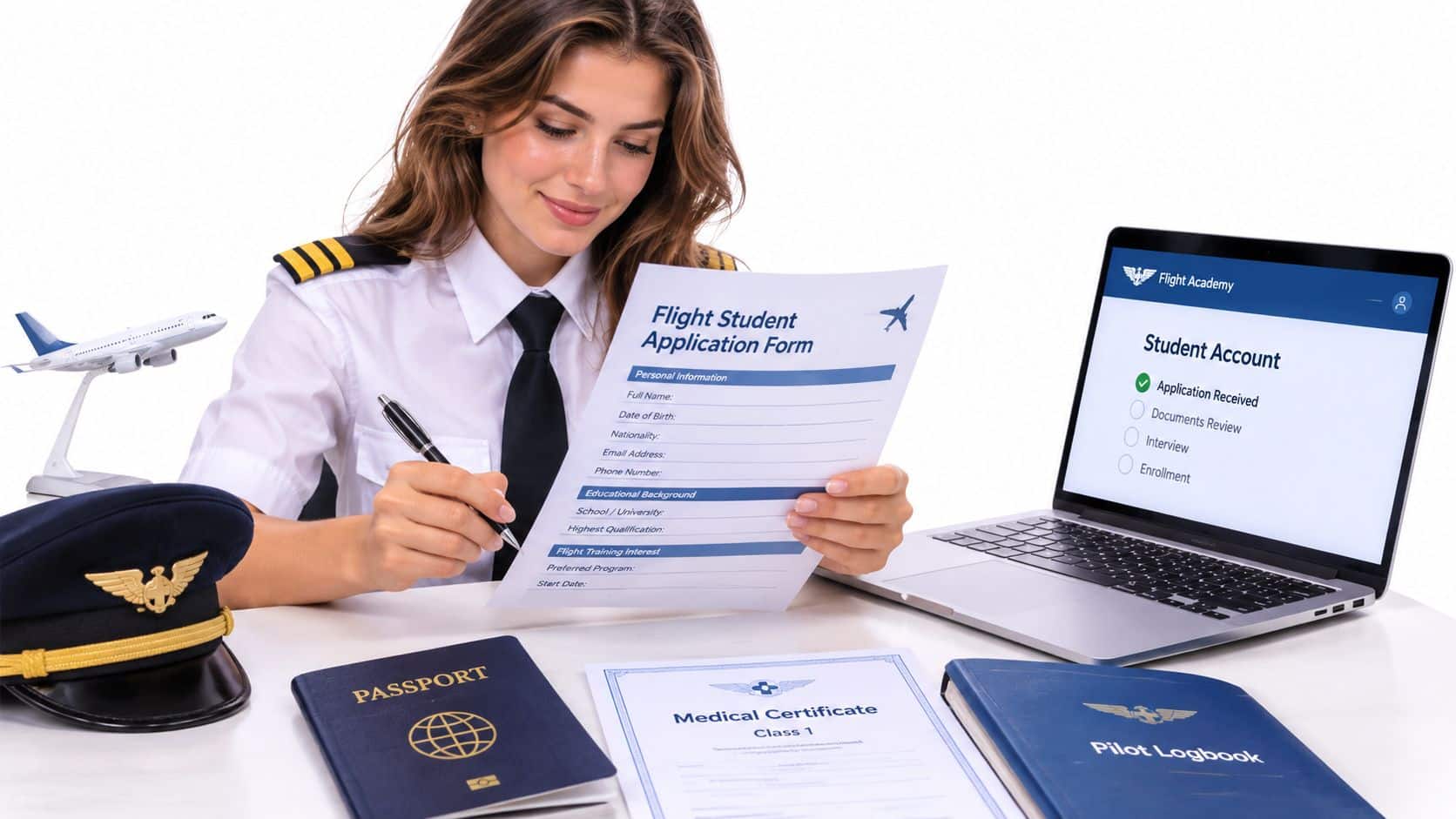
Gather the documents before scheduling
A school will typically ask to review government-issued identification and confirm eligibility documents relevant to the student's circumstances. The FAA Student Pilot Certificate application is handled through the appropriate FAA process, and an overview of Student Pilot Certificate requirements can help students understand the paperwork sequence. Ask the school which identification it needs on file and when the certificate must be issued for the planned training stage.
For international students, citizenship or immigration status can bring a separate security process. Non-U.S. citizens and non-U.S. nationals seeking U.S. flight training may be covered by TSA's Flight Training Security Program. The final rule took effect July 30, 2024; after vetting and a positive eligibility determination, an applicant receives a Certificate of Eligibility and may train during a five-year period while remaining eligible, subject to program rules and applicable fees, according to TSA's Flight Training Security Program guidance. Confirm applicability with the training provider before lessons begin, rather than waiting until after paying a deposit.
The Medical Certificate Decision Tree Before You Pay for Lessons
Medical certification is best treated as an early decision, not a form to leave until solo is approaching. For airplane and helicopter student pilots, an FAA medical certificate is generally required before solo, except for sport-pilot operations that meet defined conditions. For private-pilot privileges, a third-class medical is generally the relevant baseline; a higher class also satisfies that requirement. The FAA's student pilot guidance recommends obtaining medical certification early so potential issues are identified before substantial time or money goes into training.
A third-class medical standard includes distant vision of at least 20/40 in each eye, with or without correction, and conversational hearing in a quiet room at six feet. These standards don't mean every medical history has the same outcome. A condition or medication may require additional records or FAA review, which can affect timing.
Choose the next step based on your history
The FAA medical application is Form 8500-8, submitted through MedXPress. The FAA advises applicants to complete their Aviation Medical Examiner appointment within 60 days of submitting the application. For a practical explanation of the process and local considerations, consult this FAA medical certification guide for Southern California.
Use this decision path:
- No known medical concerns: Review the application process and arrange the AME appointment before committing to an intensive training schedule.
- A current condition, medication, or complicated history: Speak with an Aviation Medical Examiner before submitting an application or paying for a substantial block of lessons. Ask what records may be needed.
- A previous denial or deferral: Get case-specific guidance before enrolling. A deferral isn't the same as a final denial, but it can make the timeline less predictable.
- Considering sport-pilot privileges: A driver's license may substitute for an FAA medical certificate under defined conditions. Confirm the applicable limitations before choosing that route, since it isn't a general replacement for medical certification across pilot pathways.
A medical history doesn't automatically mean someone can't become a pilot. The prudent move is to resolve the certification question early and make the training start date match the likely approval path.
Baseline Knowledge and Skills You Can Build Before Day One
Students don't need to arrive with a pilot's knowledge. They do benefit from separating what can be previewed from what should be learned with an instructor. Before the first lesson, a student can become familiar with the purpose of sectional charts, common airspace symbols, basic weather products, and the rhythm of standard radio exchanges. Formal ground school and flight instruction should teach how to apply those topics safely and accurately.
Math preparation can stay practical. A student should be comfortable working with time, distance, fuel-planning concepts, and basic arithmetic. English fluency matters because a pilot must understand instructions, make clear radio calls, and ask for clarification when needed. These are skills that improve through practice, not reasons to postpone training indefinitely.
Physical readiness is also about function, not athleticism. A prospective student should be able to sit comfortably, see the instrument panel, hear radio calls in a noisy cockpit, and tolerate ordinary aircraft motion. If a specific concern could affect safe participation, discuss it with the instructor or medical examiner rather than guessing.
A useful pre-study checklist is modest:
- Review basic airspace concepts: Learn the difference between controlled and uncontrolled airspace at a high level.
- Look at chart examples: Practice locating airports and recognizing chart symbols without trying to plan a real flight alone.
- Listen for communication patterns: Focus on clear, concise phraseology and the importance of listening before transmitting.
- Read weather terminology: Become familiar with the kinds of reports and forecasts pilots discuss in training.
- Set a study routine: Reserve regular time for ground-school work and lesson preparation.
Free FAA learning materials and school-provided course materials can complement each other. Many Part 61 schools use Jeppesen-style learning materials; the instructor can identify which sections to preview and which concepts should wait for formal teaching. The aim isn't to self-teach a flight syllabus, it's to make the first dual lesson easier to follow.
How Prerequisites Change by Rating and Pathway
A private certificate is a starting point, not a universal template. An airplane private-pilot applicant must meet the applicable eligibility rules, pass the knowledge and practical tests, and complete the required experience. The FAA minimum is 40 logged flight hours, including at least 20 hours of instruction and 10 hours of solo training, with specified cross-country, night, and instrument experience under Part 61 requirements. Those are minimums, not a promise that every student will be checkride-ready at that point.
Instrument and commercial training add experience, knowledge, and practical-test prerequisites. Instructor certificates add preparation to teach and demonstrate maneuvers. Multi-engine training involves a different aircraft class and its own training and endorsement needs. Helicopter add-on training uses rotorcraft-specific requirements, so airplane hours and endorsements can't be assumed to satisfy every item. The Part 61 and Part 141 training comparison can help students understand that training structure also varies by program.
Compare the questions to resolve, not just the hour totals
| Pathway | Medical Class | Min Age | Min Hours | Key Endorsements |
|---|---|---|---|---|
| Private airplane | Generally third class before solo; higher class also satisfies the requirement | 17 for certificate | 40-hour FAA minimum | Solo, required training, and practical-test endorsements |
| Instrument | Confirm medical privileges for the intended operations | Depends on certificate held | Confirm current rating-specific rule | Instrument training and practical-test endorsements |
| Commercial | Confirm medical requirements for intended privileges | Depends on certificate held | Confirm current category and pathway requirements | Commercial training and practical-test endorsements |
| CFI, CFII, or MEI | Confirm medical needs for intended flying and employment | Depends on certificate held | No single shared hour figure shown here | Instructor- and rating-specific endorsements |
| Helicopter add-on | Medical and experience depend on the certificate and operation | Depends on certificate held | Confirm rotorcraft-specific requirements | Rotorcraft training and practical-test endorsements |
| Sport pilot | Driver's license may be used under defined conditions | Depends on certificate and aircraft category | Confirm pathway-specific rule | Sport-pilot training and applicable endorsements |
The table is a planning aid, not a substitute for checking the current regulation for the exact category, class, and rating. Before beginning each new phase, ask an instructor to identify the required experience, knowledge tests, endorsements, and practical-test prerequisites, then track them in the logbook as they're completed.
Aircraft Rental Eligibility, Solo Currency, and Chino Airport Realities
Earning a certificate doesn't automatically qualify a pilot to rent every aircraft. A rental checkout may include an instructor's review of aircraft systems, operating procedures, and the pilot's ability to handle that specific model. The school may also set insurance and currency expectations. Those are provider requirements, not FAA certificate minimums, so pilots should ask for the rental policy before planning a flight.
At Chino Airport (KCNO), the local environment makes communication and airspace knowledge part of everyday training. Chino is a towered Class D airport with three runways and multiple instrument approaches. A student should expect radio work, traffic sequencing, and controlled-airspace procedures to feature in lessons from early on. That differs from a non-towered field, where the communication pattern and traffic awareness tasks are different.
For students, the practical question is how to turn paperwork and preparation into consistent lessons. DuBois Aviation operates at KCNO and offers instruction, aircraft rental, an in-house simulator, online scheduling, and flexible seven-day scheduling. Before choosing a schedule, students can ask how lesson availability, aircraft assignment, and simulator use fit their training plan.
Renters should also distinguish certificate privileges from recency and proficiency. A pilot can hold the right certificate and still need practice or a checkout before using a particular aircraft. Ask what the school requires for the aircraft, the intended operation, and the pilot's recent experience, rather than assuming that a certificate alone settles rental eligibility.
A Sequenced Pre-Training Checklist and Next Steps
A useful preparation plan follows the order in which decisions affect training:
- Choose the target pathway. Decide whether the first goal is private airplane, sport pilot, helicopter, or another certificate, and ask which later ratings matter to the long-term plan.
- Confirm the security process if applicable. International students should clarify TSA Flight Training Security Program applicability with the provider before training begins.
- Resolve medical questions early. Arrange the AME process and gather any records requested for a condition, medication, deferral, or previous denial.
- Apply for the Student Pilot Certificate. Confirm the application steps and school identification requirements before planning solo milestones.
- Take a discovery flight. Use it to experience the aircraft and instruction environment. Ask whether the flight is introductory or can be logged under the school's procedures.
- Build a training plan with the school. Discuss lesson frequency, study time, the aircraft type, and the records needed for each stage.
Students can ask for a tour, available scheduling options, and a list of documents to bring. For a training plan that spans private, instrument, commercial, multi-engine, instructor, or helicopter goals, it's useful to name the intended certificate and ask what must be completed before each phase.
Common questions before enrollment
How long does the process take? It varies with medical review, paperwork, lesson availability, study consistency, weather, and the time needed to demonstrate proficiency. The FAA minimum flight-hour figure is a regulatory floor, not a completion schedule.
Does a discovery flight count as training? It depends on how the flight is conducted and documented. Ask the school whether it will be logged and what instruction it includes.
What background checks apply? Non-U.S. citizens and non-U.S. nationals may fall under TSA flight-training security requirements. Students should confirm their status and process with the training provider before lessons begin.
Can someone start if they're unsure about the medical? They can ask an AME about the appropriate next step before committing to substantial training. Early guidance is more useful than assuming a medical issue automatically rules out flying.
DuBois Aviation provides airplane and helicopter instruction, aircraft rental, simulator access, and training pathways from private through advanced ratings at Chino Airport. Visit DuBois Aviation to request training information, ask about course availability, or arrange a school tour and discuss the prerequisites for the pathway you're considering.


