

What if a student pays for weeks of lessons, then learns a medical issue, a missing document, or an age rule blocks solo flight? Pilot school requirements work in a set order, and people who meet the regulatory thresholds for their chosen certificate can start training. The thresholds change by level, so checking age, English, medical timing, and required hours before day one prevents wasted lessons.
Table of Contents
- Eligibility at a Glance for Every Certificate Level
- Age, English and Student Certificate Rules
- Medical Certificate Classes and When to Get One
- Documents and Preparation Before Your First Lesson
- Flight Hour Minimums From Private to Commercial
- Instructor Ratings Career Pilots Need to Meet
- How DuBois Aviation Admits New Students
- Requesting a Training Plan
Eligibility at a Glance for Every Certificate Level
Most applicants can begin flight training once they meet the threshold for the certificate they want. For an airplane student pilot certificate, 14 CFR Part 61 sets the minimum age at 16, with 14 allowed only for glider or balloon operations, and the applicant must read, speak, write, and understand English.
That's the starting point, not the whole path. Each later certificate adds a prerequisite certificate, a knowledge test, and a practical test. A reader who finds the right column first can avoid applying rules from the wrong stage.
Eligibility Rules by Certificate Level
| Requirement | Student pilot | Private pilot | Commercial pilot | Flight instructor |
|---|---|---|---|---|
| Minimum age | 16 for airplane (14 for glider or balloon) | 17 | 18 | 18 |
| English proficiency | Read, speak, write and understand English | Same standard | Same standard | Same standard |
| Prerequisite certificate | None before lessons; student certificate before solo | Student certificate | Private pilot certificate and required experience | Commercial or airline transport certificate with matching rating |
| Written knowledge test | Not required for student certificate | Required | Required | Required (instructor knowledge test) |
| Practical test | Not required | Required (checkride) | Required | Required (instructor practical test) |
The table separates legal eligibility from readiness. Meeting an age threshold doesn't grant solo privileges, and holding one certificate doesn't waive testing for the next. Each row has its own timing trap, especially the medical and the hour totals, which the following sections break down in order.
Consider two readers who look similar at booking. A 16-year-old aiming to fly recreationally needs the student column now and the private column next. A 19-year-old aiming for paid flying needs to read across to commercial and instructor, because early choices, especially which medical class to pursue, affect that longer path.
Teen applicants often compare flying rules with driving rules, since both involve staged privileges and age gates. Families researching that parallel can review Joshua's Law requirements for teen drivers for an example of how another licensing system sequences eligibility, then return to the FAA table for aviation.
Read the column for the certificate being sought, not the certificate eventually wanted. The next gate is the one that controls timing.
Age, English and Student Certificate Rules
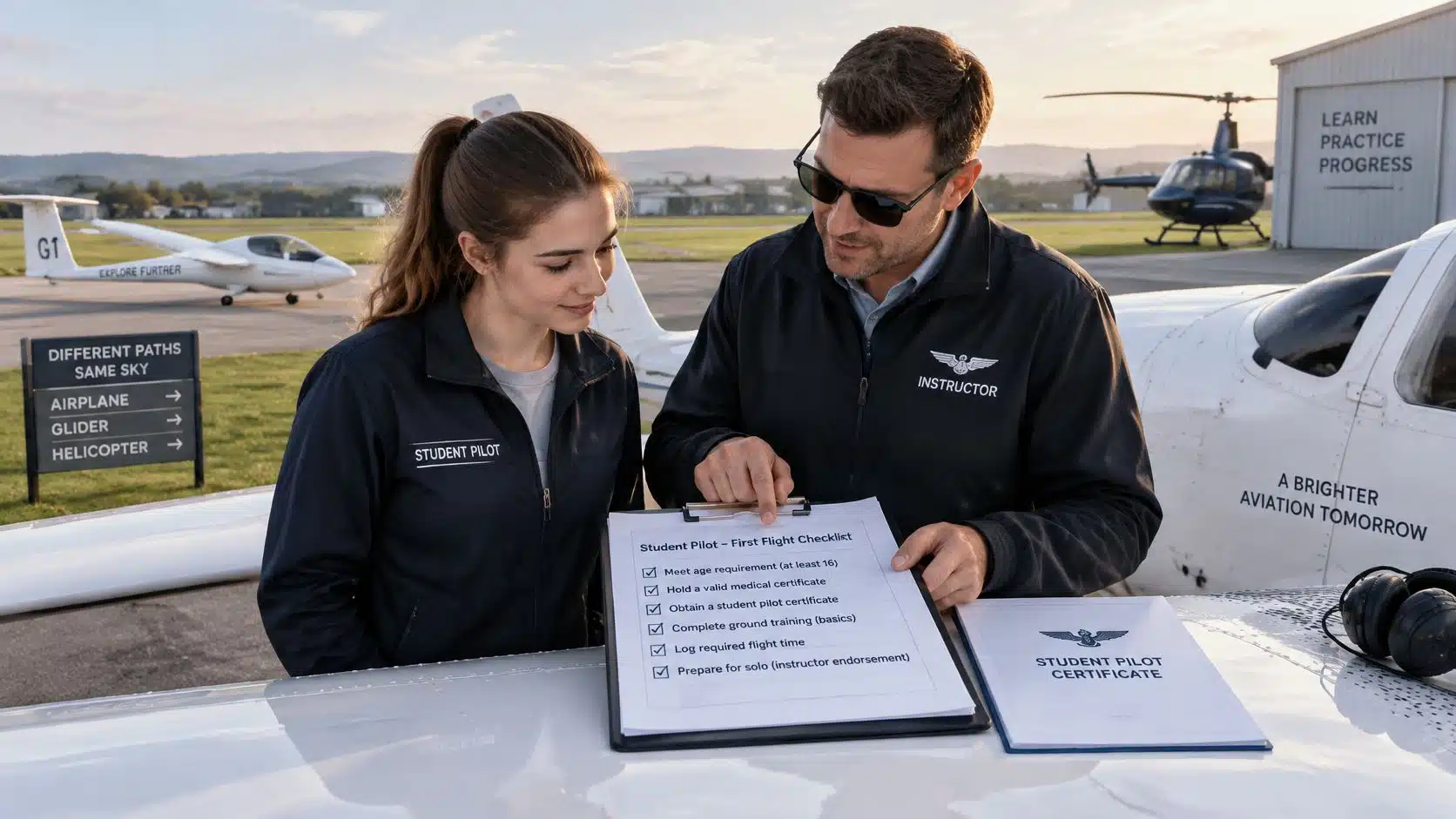
Age comes first because it is a hard gate. Under 14 CFR 61.83 on student pilot eligibility, students may begin flight lessons without a student certificate, but they must obtain one before soloing, and airplane student pilots generally must be at least 16 and able to read, speak, and understand English.
Helicopter applicants should confirm student eligibility against the same regulation before enrolling, since category and class details affect endorsements. Youth aviation camps and similar programs are separate from certification. They build interest, but they create neither a student certificate nor solo authority.
Why English Is a Regulation, Not a Preference
The applicant must be able to read, speak, write, and understand English, unless the FAA authorizes an appropriate limitation for a medical reason. Pilots use English for tower instructions, checklists, weather products, and emergency calls. Weak comprehension is a safety problem, so instructors assess it during the application rather than leaving it for later.
Applicants who want an early sense of whether language or other eligibility factors need work can check training eligibility with ELTica before scheduling, then confirm the aviation standard directly with an instructor.
Timing Lessons Around a Birthday
A 15-year-old in Chino who turns 16 in August can start ground lessons and dual flights now, building radio and traffic-pattern skills. The student certificate and any solo come after the birthday, and both still depend on instructor endorsements.
Students often treat the student certificate as solo permission. The document only establishes eligibility. The instructor must separately determine that the student is prepared and sign the required endorsements before any solo flight.
A clean sequence prevents confusion:
- Confirm birthdate: Match it against government ID.
- Confirm English ability: Discuss any concern with the instructor early.
- Apply through IACRA: Submit the student certificate application with accurate name details.
- Receive endorsements: Earn the instructor signoffs required before the first solo.
Readers who want the paperwork spelled out can review the student pilot certificate requirements before starting the application. Getting the order right means a birthday, a certificate, and readiness line up instead of colliding.
Medical Certificate Classes and When to Get One
Timing matters more than most new students expect. The FAA guidance on when a medical examination is required states that student pilots must obtain at least a third-class medical certificate from an Aviation Medical Examiner before soloing, and the FAA specifically recommends obtaining the medical early in training.
That recommendation carries financial weight. A student who flies for months and then learns a condition needs FAA review may pause while paperwork moves. Early evaluation turns that surprise into a planned step.
Medical Eligibility Is Not Readiness
A medical certificate answers one question: is this person medically fit to hold pilot privileges? The solo endorsement answers a different one: is this student prepared to fly alone right now? The first decision belongs to the Aviation Medical Examiner. The second belongs to the instructor who has watched the student fly.
Both gates must open before the first solo.
That separation protects the student in both directions. A passed medical is only eligibility, and the instructor still decides readiness for solo. In the same way, a student who flies well still needs the certificate issued before flying alone.
Medical Classes and What Each One Covers
| Medical class or option | Typical privileges | When it matters |
|---|---|---|
| First class | Airline transport operations | Airline career goal; evaluate early |
| Second class | Commercial privileges, including compensated instruction | Paid flying and flight instructing |
| Third class | Student, recreational and private privileges | Minimum required before first solo |
| BasicMed | Private privileges after a valid medical on record | Not a starting route for a new student; no flying for compensation or hire |
The FAA page on who must hold a medical certificate explains that a medical certificate is required when exercising student-pilot privileges and for private, commercial, and airline transport operations, subject to limited exceptions.
BasicMed deserves careful handling. New aviators need one FAA medical certificate to qualify for BasicMed, and BasicMed permits no flying for compensation or hire. It is not a starting route for a new student, and it does not serve a commercial or airline path.
A limited exception applies to certain sport-pilot operations, where an eligible pilot may use a valid U.S. driver's license instead of a medical certificate under the applicable rules. That exception leaves the standard airplane student path described here unchanged.
Two Cases Where Early Action Changes the Outcome
A 17-year-old with a past condition may need FAA review before a certificate is issued. Seeing an Aviation Medical Examiner before spending heavily on lessons reveals what documentation the FAA may want and how long review could take.
An adult candidate targeting an airline career faces a different question. A first-class evaluation early in training, even while flying at private level, tests eligibility against the eventual standard rather than the minimum for solo.
Both cases point the same direction: find out where you stand medically before the training investment grows. Students researching the starting level can review the details of a third-class FAA medical certificate, then confirm current standards with an Aviation Medical Examiner or the FAA, since medical and BasicMed rules can change.
Documents and Preparation Before Your First Lesson
Paperwork falls into two groups. Some items are required or regulatory, and a lesson or solo can't proceed without them. Others are recommended preparation that makes training smoother but aren't regulations.
Required and Regulatory Checklist
- Government photo ID: Bring valid identification matching the name on the student certificate application.
- Identity and status verification: Complete citizenship or status verification under current TSA flight training security rules, and confirm current requirements with TSA before enrolling.
- IACRA application: Submit the student certificate application through IACRA with accurate details.
- English ability evidence: Be ready for the instructor to judge reading, speaking, writing, and understanding during the application.
- Medical certificate: Carry it once issued by an Aviation Medical Examiner, before solo.
TSA security requirements for flight training apply to certain applicants, most notably non-U.S. citizens. Because those requirements can change, applicants should confirm them before enrolling rather than relying on an older checklist from another school.
Recommended Preparation Checklist
- Ground-study plan: Set up study time using the school's Jeppesen learning materials.
- Basic topic review: Preview aerodynamics, weather, airspace, and radio phraseology.
- Logbook: Start it from the first lesson so no entry needs reconstruction.
- Realistic hour estimate: Use the hour table in the next section, not the regulatory floor.
- Weather buffer: Leave room in the weekly schedule for cancelled days.
- Discovery flight: Test fit with the aircraft and instructor before committing.
Small lapses cost real slots. A student who brings an expired ID may lose a scheduled lesson while documents are sorted. A student who starts flying long before arranging the medical risks wasted hours if that medical is delayed.
Practical rule: Bring documents that match each other exactly. Name mismatches between ID and application create delays that have nothing to do with flying ability.
Flight Hour Minimums From Private to Commercial
Treat each published hour minimum as the legal floor, then plan your schedule and budget around the total above it. The FAA FAQ on hourly requirements for becoming a pilot sets the private pilot baseline at 40 flight hours for an airplane, helicopter, or gyroplane, including at least 20 hours of flight training with an authorized instructor and 10 hours of solo flight training. Inside that total, the same baseline requires at least 3 hours of cross-country flight, 3 hours of night flight, and 3 hours of instrument training, so private preparation covers more than basic aircraft handling from the start.
The structure works like a supervised driving rule: the law sets the minimum hours, but the examiner only cares whether the skills hold up under test conditions.
Flight Hour Minimums by Certificate
| Certificate | Minimum total hours | Required inside the minimum |
|---|---|---|
| Private pilot, airplane (Part 61) | 40 | 20 with an authorized instructor; 10 solo; 3 cross-country; 3 night; 3 instrument training |
| Private pilot, approved school (Part 141) | 35 | Same experience categories as Part 61, under the approved school's structure |
| Commercial pilot, single-engine airplane | 250 | 100 as pilot in command; 100 in powered aircraft; 50 cross-country; 20 hours commercial training including 10 instrument |
The U.S. Federal Aviation Administration pilot schools guidance confirms that approved Part 141 schools may reduce the private-pilot requirement from 40 hours to 35 hours. Whichever path you take, plan on 60–75 hours before your skills meet practical test standards.
That gap is what families should budget around. The practical test is performance-based rather than time-based, so weather cancellations, aircraft availability, stage-check remediation, and proficiency gaps all add hours. Reaching the floor without meeting tolerances does not produce a certificate.
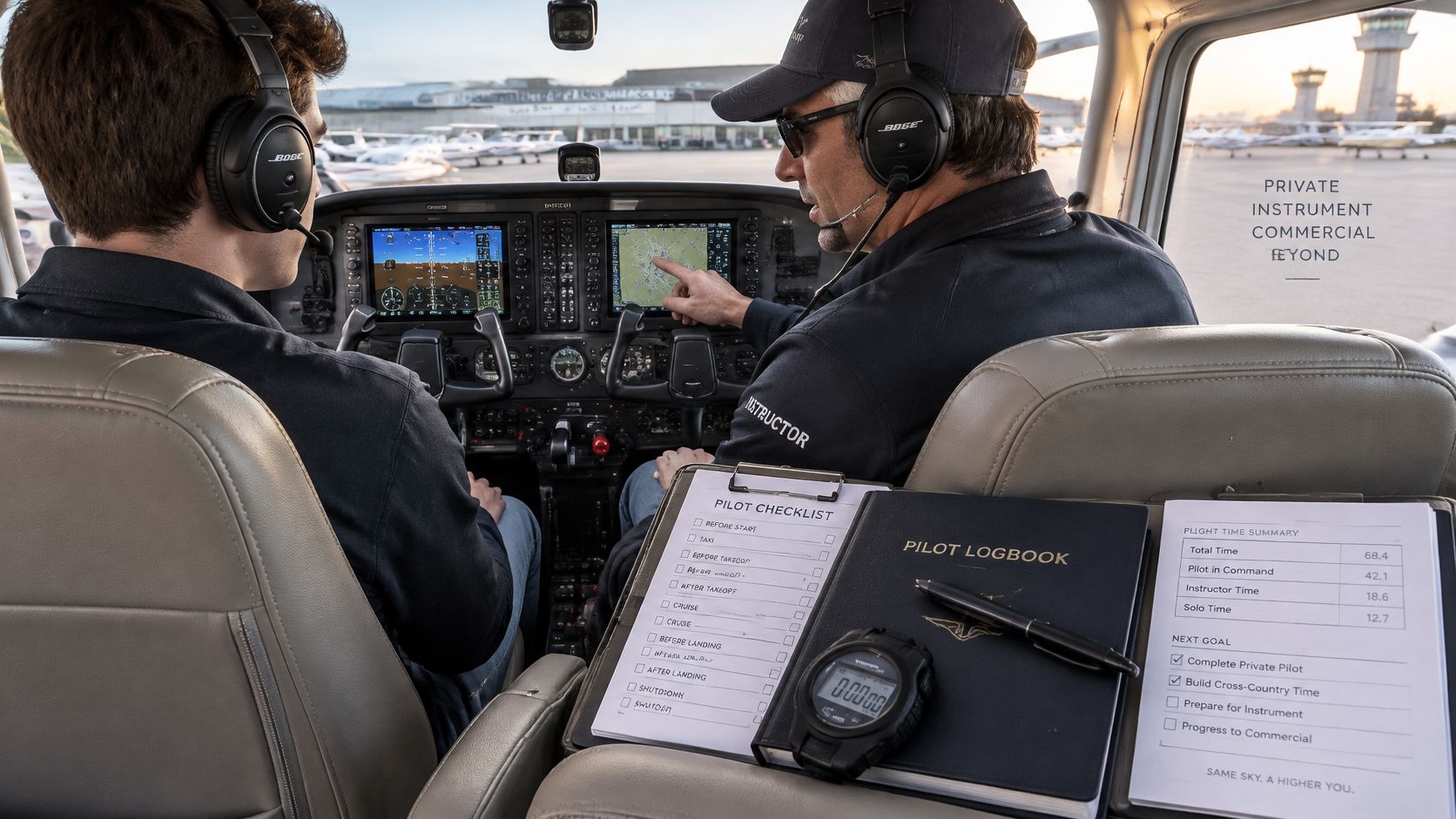
Two Chino students can start training in the same week and finish months apart. One flies twice a week and loses days to wind at a towered airport, while the other flies four times a week. The second student usually retains skills between lessons and reaches the practical test sooner, because lesson frequency protects proficiency even when both students face the identical minimum.
Commercial training works differently because hours must land in specific categories. The FAA FAQ on getting a commercial pilot certificate requires at least 250 total flight hours for a U.S. commercial pilot certificate. Under 14 CFR 61.129, the commercial program also includes a qualifying cross-country flight of at least 300 nautical miles with landings at three points, one segment at least 250 nautical miles from departure.
Those categories create scheduling pressure. Schools must slot cross-country, night, towered-airport, and aircraft-specific training early enough to avoid bottlenecks near the checkride. The 250-hour mark satisfies the regulation itself, while airlines set hiring standards above it.
Helicopter private certificates start from the same 40-hour regulatory baseline, with required experience specific to the category. Helicopter students should confirm those requirements with the school before planning hours or budget.
Instructor Ratings Career Pilots Need to Meet
Instructor eligibility starts with the underlying pilot certificate, not with teaching talent. Under 14 CFR 61.183 on flight instructor eligibility, an applicant must be at least 18, be able to read, speak, write, and understand English, and hold a commercial or airline transport pilot certificate with the appropriate aircraft category and class rating.
That foundation matters because instructor ratings attach to existing qualifications. A pilot can't teach in a category or class that the underlying certificate doesn't cover.
Instructor Rating Eligibility and Tests
| Rating | Additional eligibility | Tests to pass |
|---|---|---|
| Flight instructor, airplane single-engine | Age 18; English; commercial or airline transport certificate with matching category and class; authorized-instructor endorsement | Instructor knowledge test and FAA practical test |
| Instrument instructor (CFII) | Instrument rating or required privileges under 14 CFR 61.183 | Knowledge test and FAA practical test for the instrument instructor rating |
| Multiengine instructor (MEI) | Matching multiengine qualification and class | Knowledge test and FAA practical test for the multiengine instructor rating |
Every applicant must receive an authorized-instructor logbook endorsement for the fundamentals of instructing and pass the required knowledge test, unless an applicable exception applies, such as holding a qualifying existing flight-instructor or ground-instructor certificate or certain state teaching credentials.
Meeting eligibility doesn't itself confer privileges. The applicant must still pass the FAA practical test for each requested rating. Eligibility opens the door to testing, nothing more.
A workable planning sequence keeps dependencies in order:
- Commercial certificate first: Build the category and class foundation.
- Instrument rating next: Begin the path toward CFII.
- CFI after that: Add instructional knowledge and pass the practical test.
- CFII or MEI later: Match each added rating to its instrument or multiengine qualification.
Other instructor pathways follow a similar logic of staged qualification, and readers comparing structures can understand the ADI qualification requirements as an example from driver training. Aviation applicants should still plan from the FAA regulation, not from another industry's sequence.
Career pilots weighing the order of ratings can compare CFI versus CFII before committing to a sequence. Helicopter instructor requirements follow separate rules, so helicopter career candidates should confirm them before planning.
How DuBois Aviation Admits New Students
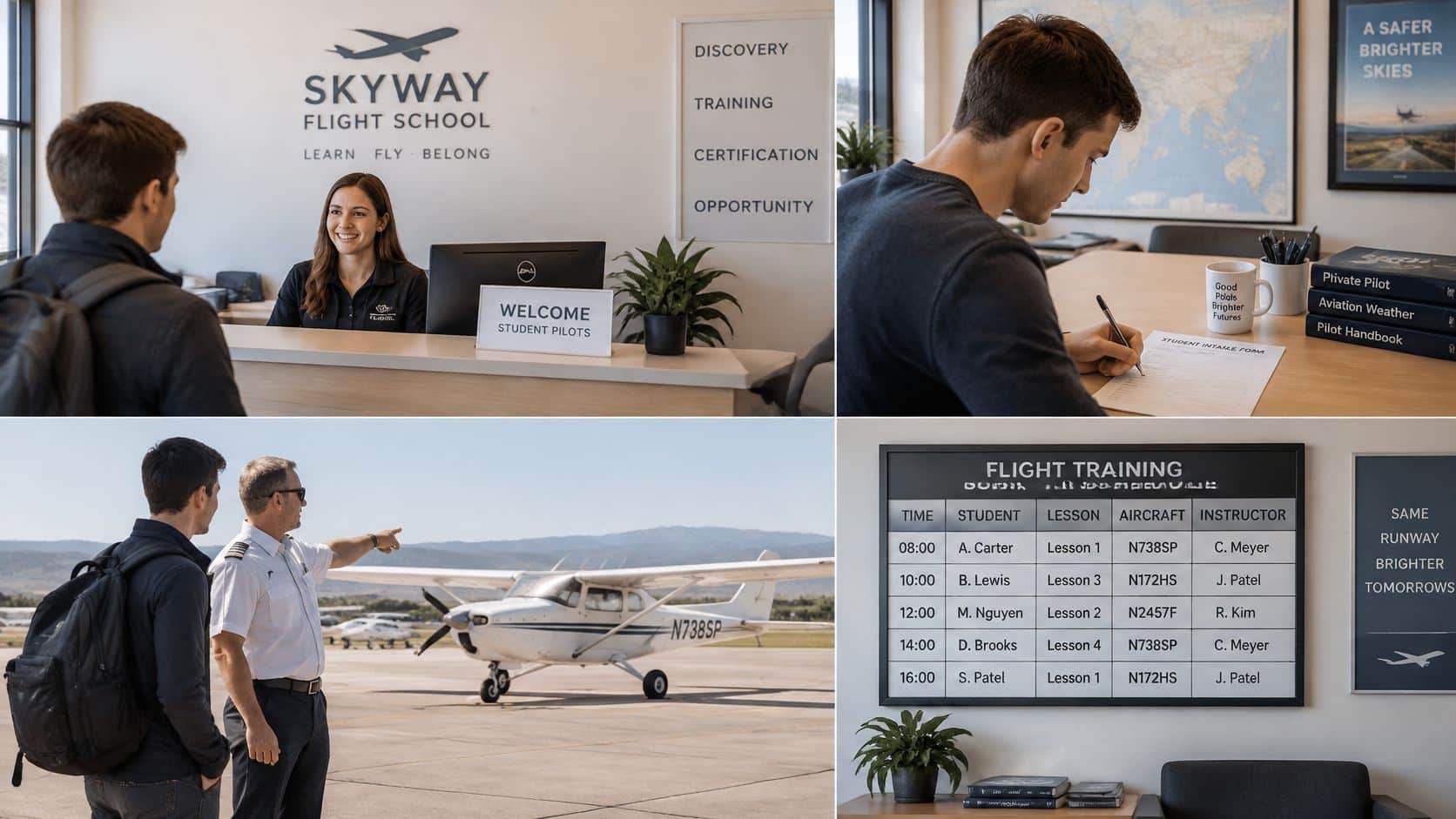
Admission works best as a sequence, with each step clearing the next. Skipping ahead, for example paying for a block of lessons before medical timing is settled, creates the delays earlier sections describe.
From First Contact to First Lesson
- Choose a certificate path: Private, instrument, commercial, multi-engine, flight instructor, and helicopter add-on training each carry different pilot school requirements, so the goal gets named first.
- Check the gates: Age, English ability, and medical timing get checked against eligibility rules before money goes into lessons.
- Book a discovery flight: A short introductory flight tests fit with the aircraft, the airport environment, and instruction style before enrollment.
- Gather documents: Required identification, IACRA details, and status verification get shared with the school before enrollment, while they're easy to correct.
- Enroll with a written plan: The student and instructor agree on a training plan with estimated hours and stages. Candidates with a fixed timeline can ask about accelerated flight training at this point.
- Match aircraft to goals: The current aircraft fleet page shows what's available, and availability changes, so aircraft choice gets confirmed rather than assumed.
- Schedule the first lesson: Course availability gets confirmed with the school, and the first booking goes on the calendar.
What Training at Chino Adds Early
Training at Chino Airport, a towered airport, introduces radio discipline and traffic-pattern awareness from early lessons. Students learn to copy clearances, watch for other traffic, and avoid runway incursions while basic handling skills are still forming.
That exposure reduces the transition burden later. A student who has only flown in quiet conditions often needs extra lessons when busier airspace first appears. Early towered-airport practice spreads that learning across the whole course instead.
A written training plan should name stages and estimated hours, not just a start date. Vague plans hide the bottlenecks that delay checkrides.
Policies, availability, and aircraft listings change. Applicants should confirm current details with DuBois Aviation before planning work schedules, travel, or a fixed completion date around them.
Requesting a Training Plan
Once eligibility, medical timing, and documents are checked, a training plan request can be specific instead of general. A useful request asks about course availability for a named certificate path, requests training information with an estimated hour range, or schedules a school tour in Chino.
Bringing the right information makes that first conversation productive:
- Birthdate and government photo ID
- English ability, plus any questions about the standard
- Medical status, or the planned date for seeing an Aviation Medical Examiner
- Certificate goal, such as private, instrument, commercial, multi-engine, or instructor
- Weekly availability, including flyable days and hours per week
With those five items, an instructor can identify which steps are already done and outline a realistic hour range for that schedule. The student can also ask about the next available start date and how weather or aircraft availability would affect lesson scheduling.
Specific questions get specific answers. A request that names the goal, the medical plan, and weekly availability leads to a plan built around real constraints, not regulatory minimums alone.
DuBois Aviation offers private, instrument, commercial, multi-engine, instructor, and helicopter training at Chino Airport, with discovery flights and aircraft rental for certificated pilots. Prospective students who have checked eligibility and medical timing can visit DuBois Aviation to ask about course availability, schedule a school tour, or request a training plan matched to their certificate goal.