

A third class FAA medical certificate lets a pilot exercise student, recreational and private pilot privileges, and it lasts through the end of the 60th calendar month after the exam month for pilots under 40 and the 24th calendar month for pilots 40 or older. Why do so many students treat that exam as paperwork to finish after they've already committed to training, when the date, age and outcome can shape the whole plan?
That's the gap that creates avoidable delays. A student who gets examined early knows whether solo flight, a multi-year schedule or a career pathway is realistic. A student who waits may have paid for ground school, blocked instructor time and built momentum before learning that records are missing or the FAA needs more review. The medical isn't just a form. It's a training-plan decision.
Table of Contents
- What the Third Class Medical Covers and How Long It Lasts
- Medical Standards Every Applicant Must Meet
- Conditions That Trigger Deferral, Denial or Special Issuance
- How to Get Examined by an AME, Step by Step
- BasicMed Versus a Third Class Medical
- Frequently Asked Questions About the Third-Class Medical
- Your Next Step Before Flight Training
What the Third Class Medical Covers and How Long It Lasts
A third class FAA medical certificate is the standard medical qualification for student, recreational and private pilot privileges, and it can also be required when a flight instructor acts as pilot in command or as a required flightcrew member under 14 CFR § 61.23. That same rule makes clear what it doesn't do. It doesn't authorize operations that require a second-class or first-class certificate.
Expiration depends on the operation and the pilot's age on the exam date, not the age when a later flight occurs. That's a regulation, not a school recommendation. A pilot who turns 40 during the validity period keeps the duration set at the exam.
The Calendar Clock
Think of the certificate like a food expiration date that starts at packaging rather than when the jar is opened. The clock starts with the exam month, and the certificate remains valid for the remainder of that month plus the applicable number of calendar months. It isn't calculated by counting an exact number of days.
Say a 32-year-old completes an exam in March 2026. Third-class privileges run through the end of March 2031, even if that pilot turns 40 in 2030. A 41-year-old examined in the same month has privileges through the end of March 2028.
Third-class validity by age on the exam date
| Age on exam date | Third-class validity for operations needing that class | Example exam in March 2026 |
|---|---|---|
| Under 40 | Through the end of the 60th calendar month after the exam month (about five years) | Through March 31, 2031 |
| 40 or older | Through the end of the 24th calendar month after the exam month (about two years) | Through March 31, 2028 |
| Operations requiring a second- or first-class certificate | Not authorized by a third-class certificate | Not applicable |
Why Timing Changes the Training Plan
A younger student can often complete private pilot training and continue flying for years on one certificate. An older student building a slower plan around work or family may need a renewal before a checkride if training stretches out. Neither outcome is a problem when it's known at the start.
Practical rule: Calculate the expiration month on the day the certificate is issued, then compare it with the expected solo and checkride dates.
Students reviewing private pilot license requirements should place that expiration month beside the training timeline before choosing a pace. The current eCFR text remains the authority to check for wording and effective dates, because regulations can be amended. A flight school can explain the planning implications, but it can't change the calendar rule.
Medical Standards Every Applicant Must Meet
Third-class eligibility rests on explicit thresholds, not a general impression that someone looks fit. Under 14 CFR Part 67, Subpart D, distant visual acuity must be at least 20/40 in each eye separately, with or without correction. When corrective lenses are needed to reach that standard, the pilot must wear them while exercising airman privileges.
Each eye is judged separately for a reason. A stronger eye can't hide a weaker one during the exam, and it shouldn't hide one in flight. Corrective lenses aren't a failure, they're a condition of meeting the standard when needed.
Vision in Practice
Consider a hypothetical student with 20/50 uncorrected vision in one eye who reaches 20/20 with glasses. That student would need the correction documented at the exam and must wear the glasses on every flight where privileges are exercised. Leaving them in a car or flight bag doesn't satisfy the requirement.
Hearing also deserves preparation, particularly when hearing loss, ear disease or balance symptoms are part of a medical history. Pilots who want a clearer picture before an exam can review what comprehensive hearing assessments evaluate and bring relevant records for the Aviation Medical Examiner, or AME, to consider. A separate assessment doesn't replace the FAA exam, but complete records make the AME conversation more useful.
Heart and Diabetes History
Part 67 specifically addresses several cardiovascular histories and diagnoses. They include myocardial infarction, angina pectoris, clinically significant coronary heart disease, cardiac-valve replacement and permanent pacemaker implantation. Specific wording matters because records, dates and follow-up testing often determine what happens next.
Diabetes requiring insulin or another hypoglycemic drug is also addressed in the general standards. Control, treatment history and documentation matter more than a short verbal summary. Applicants shouldn't guess how the FAA will view a condition when the AME needs records to make that judgment.
Core medical standards for a third-class certificate
| Standard | Threshold or rule | What to prepare |
|---|---|---|
| Distant vision | At least 20/40 in each eye separately, with or without correction | Current eyeglass or contact lens prescription |
| Corrective lenses | Must be worn while exercising privileges when needed to meet the standard | Note the correction at the exam and carry the lenses on every flight |
| Cardiovascular history | Myocardial infarction, angina pectoris, clinically significant coronary heart disease, cardiac-valve replacement and permanent pacemaker implantation are specifically addressed | Cardiologist records, test results and procedure dates |
| Diabetes treated with insulin or another hypoglycemic drug | Addressed by the general standards and reviewed based on control and treatment history | Current medication list, glucose records and a physician letter |
| Other conditions | Reviewed case by case under the general medical standards | Records from the treating physician and any specialist letters |
A simple screening sequence helps. First, confirm corrected and uncorrected vision records. Second, disclose cardiovascular and diabetes history accurately. Third, consult an AME before flight training when anything potentially disqualifying applies.
That last step is a recommendation, and it's a practical one. Incomplete disclosure or late review can delay solo authorization and disrupt a training schedule. Applicants should check exact thresholds in the current Part 67 text, since rules can be amended and the effective date of any change matters.
Conditions That Trigger Deferral, Denial or Special Issuance
A common assumption is that a medical condition either disqualifies a pilot or it doesn't. Real cases often sit between those extremes. Many conditions aren't automatically disqualifying, but they need records, specialist input or FAA review before a certificate can be issued.
The question for a student isn't just, "Is this allowed?" It's, "What evidence will the AME or FAA need, and how long could review take?" That difference affects solo timing, course enrollment and money already committed.
Histories That Commonly Need Records
- Heart attack or stent history: Cardiology reports, procedure dates, test results and current status letters help show stability and follow-up care.
- Seizures or loss of consciousness: Neurology records and explanations of cause matter. A history involving fainting may also benefit from background on wearable heart tracking for fainting episodes, although personal tracking doesn't replace specialist evaluation or FAA review.
- Mental health diagnoses and medications: Treatment records, medication history and current clinician input may be needed.
- Insulin-treated diabetes: Glucose records, medication details and evidence of control should be organized before the appointment.
- Sleep apnea needing treatment: Sleep study results and treatment compliance records are commonly useful.
- Cancer and its treatment: Oncology records, treatment dates and current status help the reviewer understand recovery.
- Sedating medications: The AME needs the drug name, dose, reason for use and timing.
- Vision changes after eye surgery: Surgical records and current visual acuity documentation help establish the outcome.
Bringing records isn't an admission that a condition is disqualifying. It's the fastest way to let the AME apply the standard to a complete file. Missing paperwork often creates delays that complete disclosure could have shortened.
Three Outcomes Pilots Confuse
A deferral means the FAA needs more information before deciding. A denial means it has declined to issue. A special issuance means a certificate is issued with conditions, monitoring or time limits.
An expired certificate isn't the same as a denied certificate. The FAA BasicMed checklist.pdf) states that the most recent FAA medical certificate, including a special-issuance certificate, must not have been denied, suspended, revoked or withdrawn for a pilot to qualify under BasicMed, which also requires an examination within the previous 48 months and a medical education course every 24 months.
Medical outcomes and the next action
| Situation | What it usually means | Next action |
|---|---|---|
| Certificate has expired | Expiration is not the same as denial; a current exam or BasicMed eligibility may be needed | Do not fly operations that need a valid medical until the status is clarified |
| Exam deferred | The FAA is reviewing submitted information before issuing | No solo or medical-dependent flights until issued; respond to FAA requests promptly |
| Certificate denied | Affects future issuance and may affect BasicMed eligibility | Request written reasons and consult a qualified AME before planning training |
| Special issuance | Certificate issued with conditions, monitoring or time limits | Follow the reporting and renewal conditions printed on the certificate |
| New medication started | May change eligibility or require additional records | Ask the AME before the next flight |
Planning Around Review Time
Consider a 42-year-old student examined in March whose third-class privileges run only through March two years later. If deferral review or a break in training pushes progress back, renewal planning should start early rather than in the expiration month. That's scheduling logic, not a regulatory requirement.
Don't guess whether a condition ends a flying goal. Ask an AME early, with records, before training depends on the answer.
Two mistakes recur. Students assume a condition disqualifies them without asking, or they leave records out and slow the review. An AME conversation before enrollment avoids both, and current FAA guidance should be checked because medical policy can change.
How to Get Examined by an AME, Step by Step
Submitting an online form doesn't qualify anyone to fly. An FAA-designated Aviation Medical Examiner must perform the exam. The FAA medical certification page describes FAA MedXPress as the required online system for entering applicant information from FAA Form 8500-8, and FAA guidance says the examination generally must be completed within 60 days after the application is submitted.
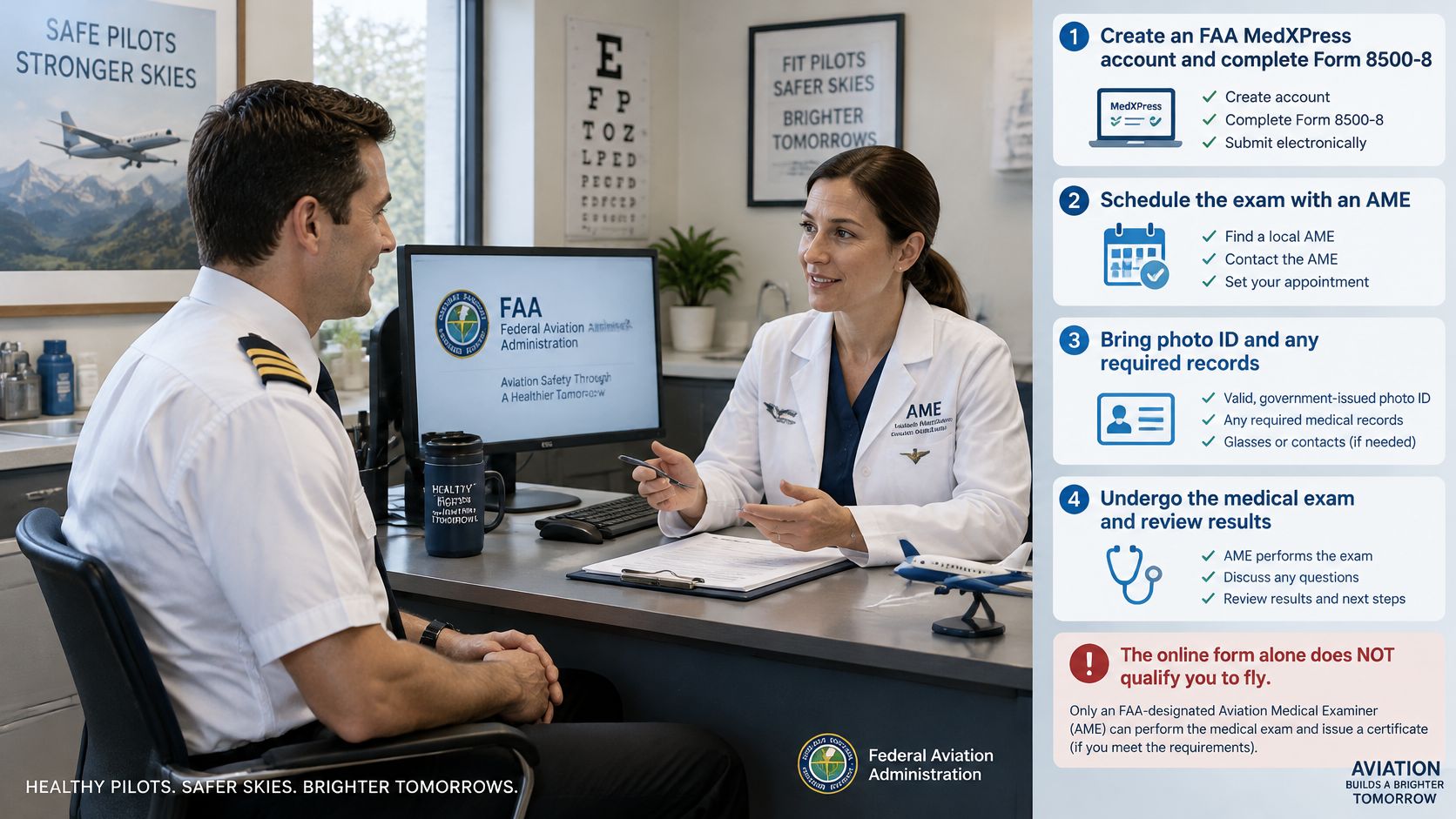
The Seven Steps
- Create the MedXPress account: Complete Form 8500-8 and enter medical history accurately and completely. Dates, medications and prior visits shouldn't be reconstructed from memory when records are available.
- Submit and save the confirmation number: The AME uses that number to retrieve the submitted information. Without it, the appointment can't proceed as intended.
- Book promptly: Arrange the AME appointment soon after submission because of that general 60-day completion window. Applicants with complicated histories should call the office before submitting and ask which records are expected.
- Gather records: Use the checklist below and bring copies rather than relying on a portal login during the appointment. Organized records reduce follow-up requests.
- Complete the exam: The AME checks items such as vision, hearing, blood pressure and urinalysis and reviews the history. The goal is to compare the actual file against FAA standards.
- Receive the outcome: If the case meets the standards, the certificate is issued through the medical certification process. If more review is required, issuance may be deferred while the FAA evaluates the information.
- Record the expiration: Keep a copy and calculate the final month with the age rule. A calendar reminder set well before expiration is a recommendation, not a regulation.
Appointment Checklist
- Government photo ID: Bring acceptable identification for the appointment.
- MedXPress confirmation number: Save it digitally and on paper.
- Vision correction: Bring current glasses or contact lenses and the prescription.
- Medication list: Include doses, reasons for use and prescribing clinicians.
- Medical records: Cover surgeries, diagnoses, hospitalizations and procedures.
- Specialist letters: Include current status statements when a condition needs context.
- Prior FAA letters: Bring any deferral, denial or special issuance correspondence.
- Exam fee: Confirm the amount and payment method with the AME office because fees vary.
Preparation should stay ordinary and honest. Arriving rested helps. Starting a new medication or drinking heavily before an exam can complicate the picture, and medication changes should never be made for an appointment unless a physician approves.
Before submitting: Read every answer as if an AME will ask for the record behind it.
That habit prevents the most common avoidable problem, which is an accurate condition reported with the wrong date, dose or treatment detail. Digital copies create a backup if the FAA requests more information later. Getting this done early is especially useful before advanced ratings or a career-track program, when a deferral could interrupt a much larger investment.
BasicMed Versus a Third Class Medical
BasicMed is an additional pathway, not a replacement that erases third-class certification. It may allow eligible pilots to fly certain covered operations without a current FAA medical certificate, but only when every condition is met. A pilot who doesn't satisfy those conditions still needs the required medical certificate for the operation.
The relevant operating scope is set by 14 CFR 61.113(i), including restrictions on aircraft, passenger capacity, speed, altitude and compensation. According to the FAA BasicMed form, a pilot must have held an FAA medical certificate after July 14, 2006, and the most recent certificate must not have been denied, suspended, revoked or withdrawn.
What Changes for Career Goals
Say a Southern California student plans private flying now but may pursue instrument training, commercial privileges, flight instruction or an airline pathway later. BasicMed may make some private operations legally possible, yet that isn't the same as being medically positioned for a career. Future privileges can require a specific medical class, and a later FAA history review can matter.
That distinction is often missed. BasicMed can reduce administrative burden for a strictly recreational pilot who qualifies. It can be a poor first strategy for a student who hasn't ruled out career flying.
Third-class medical compared with BasicMed
| Factor | Third-class medical | BasicMed |
|---|---|---|
| Exam requirement | Examination by an FAA-designated AME | Physician exam and completed checklist within the previous 48 months |
| Recurring requirement | Renewal by the age-based calendar rule | Medical education course every 24 months |
| Operating scope | Covers operations at the certificate's privilege level | Limited to eligible operations, including U.S. only and a maximum of 250 knots |
| Career pathway | Supports instrument, commercial, instructor and airline planning | Not a substitute for privileges that require a specific medical class |
| Prior medical history | Deferrals, denials and special issuances are handled through FAA review | Most recent FAA medical must not have been denied, suspended, revoked or withdrawn |
Students weighing license pathways, including the differences explained in sport pilot versus private pilot, should match the medical pathway to the privileges they may use. Renters need the same discipline for each proposed flight, aircraft and operating condition.
A clear decision rule helps, and it's a recommendation, not a regulation. If there's any chance of instrument, commercial, instructor or airline goals, get a third-class certificate early. If flying is strictly recreational, every BasicMed condition is met and the operation fits the limits, BasicMed may fit. Current FAA BasicMed guidance should be checked for effective dates and operating limits before relying on it.
Frequently Asked Questions About the Third-Class Medical
How Long Does a Third-Class Medical Last
For pilots under 40 on the exam date, it lasts through the end of the 60th calendar month after the exam month. For pilots 40 or older, it lasts through the end of the 24th calendar month. The age at the exam controls that certificate's duration.
Is a Medical Needed Before the First Lesson
A medical is needed before solo flight as a student pilot, but early dual lessons may follow a different timeline. Timing should be confirmed with the instructor and current FAA rules. Getting examined early still prevents a student from reaching solo readiness while a preventable medical delay remains unresolved.
Does MedXPress Submission Count as a Medical
No. MedXPress is the application step, not the qualification. An FAA-designated AME must still perform the examination and determine whether the certificate can be issued.
Can BasicMed Replace a Third-Class Medical
Only when the pilot meets every BasicMed condition and the operation falls within BasicMed limits. It doesn't cover career privileges that require a specific medical class. Eligibility and the proposed flight both have to fit.
Can a Flight Instructor Use a Third-Class Medical
Yes, a third-class certificate supports flight instructor operations when the instructor acts as pilot in command or as a required flightcrew member. That doesn't expand it into operations requiring a higher class. The operation being conducted determines the medical class required.
Your Next Step Before Flight Training
Get the third-class exam before committing to a multi-year training budget, especially when instrument, commercial, CFI or airline goals remain possible. That's the practical recommendation. It protects the schedule before aircraft, instructor time and checkride planning depend on an unresolved medical answer.
Three questions frame the decision. Does the exam date leave enough months of validity for the planned training? Could the medical history require deferral time that would stall solo? Do the goals need a third-class certificate, or does a BasicMed-eligible path fit?
DuBois Aviation doesn't make medical determinations, and neither does a flight instructor acting as an instructor. The FAA-designated AME does. Prospective students can review prerequisites for pilot training, then compare course timing with the medical timeline before enrollment.
A useful next step is specific but low pressure. Ask whether a course start date fits the expected medical timeline, request training information, or schedule a school tour at DuBois Aviation in Chino. A short conversation before the exam can prevent an expensive pause later.
Students planning private, instrument, commercial, multi-engine or instructor training can use the medical timeline to choose a sensible start date and avoid reaching solo with paperwork still unresolved. Visit DuBois Aviation to request training information, ask about course availability or schedule a school tour at Chino Airport.


