

A student pilot is two lessons from solo when the instructor asks for a medical certificate. A renter may discover that a driver's license doesn't cover the private-pilot privileges they plan to exercise. The 3rd class medical is the FAA medical certificate that usually clears those pilots to act as student, recreational, or private pilots. It's not a flight-skills test, but it is a certification gate, and the timing of that gate can affect solo training, checkride planning, aircraft rental, and future career decisions.
Table of Contents
- What a Third-Class Medical Is and Why Pilots Need One
- Eligibility, Standards, and How Long the Certificate Lasts
- How to Get Your Third-Class Medical Step by Step
- Special Issuance and Conditions That Trigger Deferral
- Third-Class Medical vs BasicMed and Choosing the Right Path
- Finding an AME and Timing the Exam Around Training
- Practical Tips, Common Mistakes, and Pilot FAQs
What a Third-Class Medical Is and Why Pilots Need One
A student pilot has finished several dual lessons, and the instructor is starting to discuss solo. That is the point at which an unresolved medical question can interrupt training. A third-class airman medical certificate is the baseline FAA medical certification for private and recreational pilot operations. An FAA-designated Aviation Medical Examiner, or AME, issues it after reviewing the application and completing the examination.
The certificate confirms that the applicant meets the medical standard required to exercise the applicable flying privileges, rather than assessing flight skills. It exists alongside the student pilot certificate and flight training record, so earning the certificate does not replace instruction, endorsements, or proficiency checks.
A student can usually take dual instruction with a flight instructor before holding a medical certificate. The required medical certification must be in place before the first solo, however. Waiting until the training schedule is already built can create an avoidable pause, especially if the AME defers the application and additional FAA review becomes necessary.
Practical rule: A discovery flight and early dual lessons can introduce someone to flying, but a student who wants to solo should resolve the medical question well before the instructor starts preparing the first-solo endorsement.
Which flying privileges it supports
The third-class certificate generally supports:
- Student pilot operations, including the medical requirement before solo.
- Recreational pilot privileges, when the pilot meets the applicable operating rules.
- Private pilot privileges, including personal flying and many rental operations.
The FAA's three standard medical classes correspond to different flying privileges. First class is associated with airline transport privileges, second class with commercial pilot privileges, and third class with private-pilot-level flying, as described in the FAA medical certificate class guidance.
A pilot planning instrument, commercial, multi-engine, or instructor training should include medical certification in the broader training plan. A third-class certificate may support private-pilot privileges, while a career-track aviator may need a different class or additional medical planning. Discussing that choice with an AME before committing substantial time and money can prevent an expensive change of course.
Why a driver's license isn't a substitute
A driver's license does not establish FAA medical eligibility for ordinary student solo or private-pilot operations. Alternative pathways exist for some pilots, with separate requirements and operating limits. New students should identify the medical path before solo preparation begins, then schedule the examination early enough to address any follow-up review.
Eligibility, Standards, and How Long the Certificate Lasts
The AME evaluates the applicant against FAA medical standards, not against a school's preferred profile. Corrective lenses are commonly compatible with certification, and a medical history doesn't automatically mean denial. The decisive issue is whether the applicant meets the standard through ordinary issuance or needs additional FAA review.
Standards the AME checks
The principal third-class checkpoints include vision, hearing, cardiovascular information, color perception, and the medical history supplied through the application. The FAA lists distant vision of 20/40 or better in each eye separately, with or without correction, for third-class applicants. The FAA standards page also states that intermediate vision isn't required for third-class applicants, while near-vision requirements still apply under the broader standard framework. See the FAA medical standards for vision and related requirements.
| Standard | Requirement |
|---|---|
| Distant vision | 20/40 or better in each eye separately, with or without correction |
| Intermediate vision | Not required for third-class applicants |
| Hearing | Hear a conversational voice at 6 feet with the back turned to the examiner, or meet an equivalent audiometric standard |
| Blood pressure | The current guideline maximum shown by the FAA is 155/95, although the standards themselves don't state a fixed blood-pressure number |
| Color vision | Adequate perception of colors necessary for safe aviation duties, including aviation charts and signal lights |
| Medical history | Conditions, medications, and prior events may require documentation, deferral, or special issuance |
The hearing standard is easy to overlook. The FAA describes the conversational-voice test at six feet, or an equivalent audiometric standard, as the applicable method for all medical classes. A failed screening doesn't automatically settle the application, but it can lead to additional evaluation.
Validity depends on age at examination
The FAA certificate is valid for the remainder of the month of issue plus the applicable calendar-month period. If the applicant is under 40 on the examination date, a third-class certificate is valid for 60 calendar months, effectively up to five years. If the applicant is 40 or older, it's valid for 24 calendar months, about two years, according to the FAA's medical certificate validity rules.
That age is measured on the examination date, not when training starts or when the certificate is printed. A student approaching 40 should schedule renewal planning around the actual date of examination and upcoming solo, instrument, or checkride milestones. A condition handled through special issuance can impose different conditions or follow-up requirements, so the standard validity window shouldn't be assumed in that situation.
Pilots preparing a renewal should also review the practical details in DuBois Aviation's private pilot license renewal guidance, especially when a certificate may lapse during an extended training schedule.
How to Get Your Third-Class Medical Step by Step
The process starts online and ends at the AME's office. The most effective preparation is administrative, not dramatic. Applicants who assemble accurate records before submitting the application give the AME a clearer basis for deciding whether the certificate can be issued immediately.
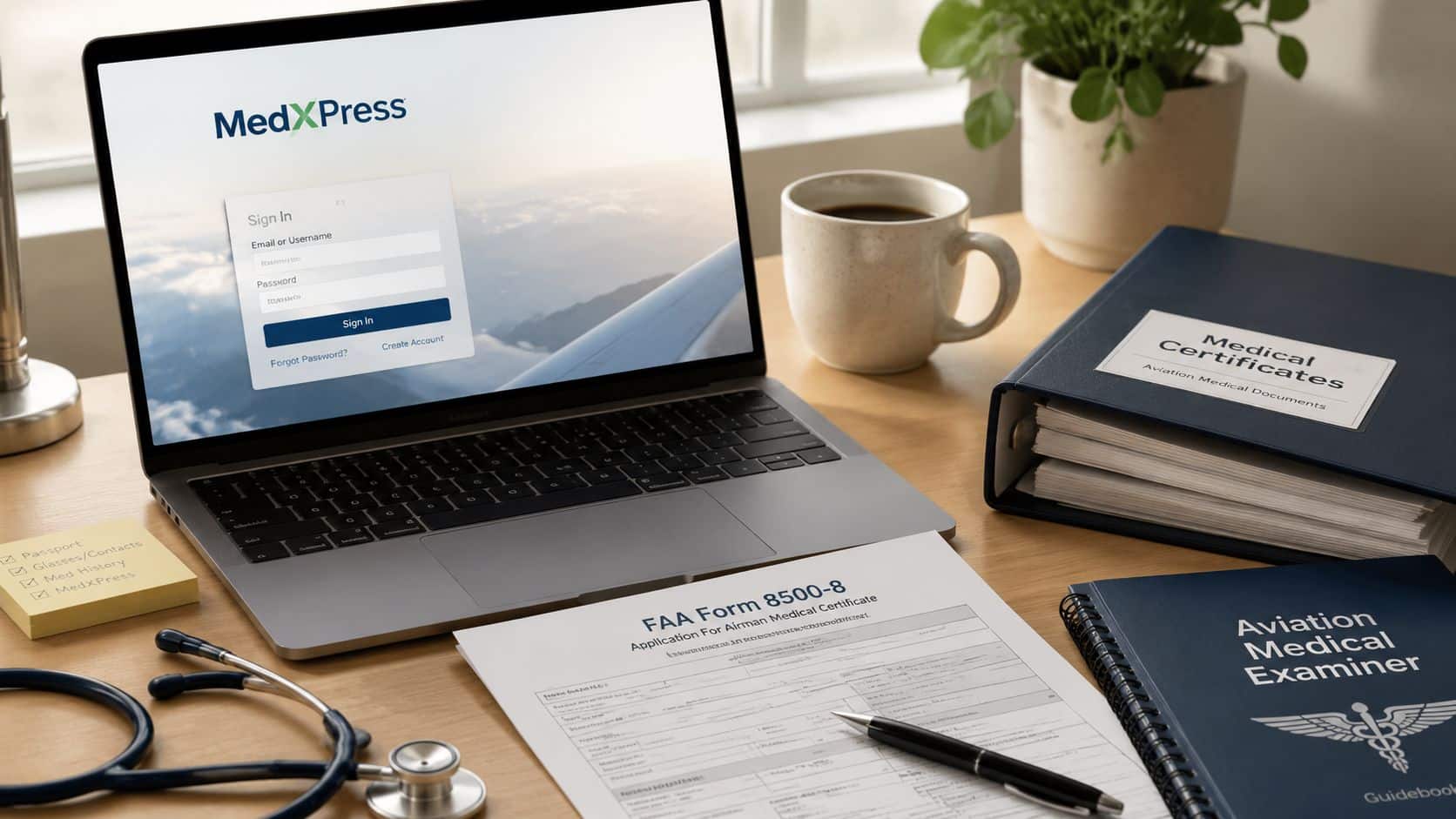
The MedXPress to AME workflow
Complete FAA Form 8500-8 in MedXPress. Submit the medical history electronically and save the confirmation number. The FAA says the applicant should complete the AME examination within 60 days of submitting the application, as explained in the FAA medical certification application process.
Stage the supporting documents. Bring government photo identification, relevant medical records, specialist letters, a current medication list with dosages, glasses or contact lenses, and the previous certificate when renewing. The goal isn't to overwhelm the examiner. It's to prevent a straightforward question from becoming an open-ended records request.
Schedule with an FAA-designated AME. Use the FAA's examiner locator and allow enough time for availability during busy periods. Applicants with a complicated history should seek guidance from an AME before submitting MedXPress, because the submitted application becomes part of the certification record.
Disclose the complete history. Medication changes, prior diagnoses, hospital visits, mental-health treatment, cardiovascular events, diabetes, neurologic symptoms, and substance-use history can affect the review. Incomplete disclosure can create a more serious certification problem than the underlying condition.
Complete the examination. The AME reviews the application and performs the required checks, which can include vision, hearing, blood pressure, urinalysis, and a general physical examination.
Receive an outcome. The AME may issue the certificate, request more information, or defer the application to FAA review. A deferred application isn't the same as a denial, but the applicant shouldn't assume the certificate is available until the FAA or AME has issued it.
A student pilot certificate is another part of the pre-solo paperwork, so applicants should review the student pilot certificate requirements while organizing the medical appointment.
Special Issuance and Conditions That Trigger Deferral
A deferral means the AME can't issue the certificate immediately under the information available. The case moves to FAA medical review, where the applicant may need to provide current treatment records, specialist reports, test results, and a clear explanation of present status. That process can be manageable, but missing documents and inconsistent timelines create unnecessary delays.
FAA-supported reporting shows that nearly 6.2% of issued medical certificates required special issuance in 2024, compared with nearly 5.9% in 2022. Those figures show that special issuance is a meaningful part of the certification system, not an unusual administrative accident. The FAA population report also found that 29.5% of medically certified airmen age 16 and older held third-class certificates in 2024, while the 2022 population studied included 34.1% with third-class certificates. These figures appear in the BTS and FAA medical certification report.
Conditions that commonly require more review
Deferral risk rises when the history involves conditions such as:
- Cardiovascular disease, including significant prior events or procedures.
- Diabetes treated with medication, depending on the medication and FAA pathway.
- Psychiatric diagnoses or treatment, particularly when records are incomplete.
- Sleep apnea, where treatment compliance and current status matter.
- Substance dependence or abuse history, which requires careful documentation and FAA review.
- Neurologic events, including unexplained loss of consciousness or control.
The practical response isn't to conceal the condition or submit a vague explanation. It's to obtain current records before the appointment. A useful packet identifies the diagnosis, treatment, medication, stability, follow-up, and any restrictions or lack of restrictions from the treating specialist.
Some stable conditions may fit a CACI, Conditions AMEs Can Issue, pathway. When the applicant brings the required documentation and meets the applicable worksheet criteria, the AME may be able to issue without sending the case through the full FAA review process. The FAA special issuance guidance summarized for pilots also makes the central point clear: certification may remain possible, but it can be conditional and require periodic follow-up.
Third-Class Medical vs BasicMed and Choosing the Right Path
BasicMed can be a practical alternative for an established recreational pilot, but it isn't a universal replacement for a third-class medical. The choice depends on the pilot's training objective, aircraft, operating environment, and medical history.
| Criteria | Third-Class Medical | BasicMed |
|---|---|---|
| Aircraft weight | Governed by the applicable aircraft and operating rules | Up to 6,000 pounds maximum certificated takeoff weight |
| Passenger capacity | Depends on the applicable pilot and aircraft privileges | Up to seven people including crew |
| Altitude | Depends on the operation and aircraft | Up to 18,000 feet MSL, or 25,000 feet in a pressurized aircraft |
| Compensation | May support privileges that require the relevant medical class | Not for compensation |
| Aircraft type | Supports the privileges associated with the certificate | Not for turbine operations |
| International operations | Depends on applicable authorization and country requirements | Not for international operations under the stated BasicMed limits |
| Currency | Medical validity follows FAA certificate rules | Recent flight review and other BasicMed requirements still apply |
The operational limits above are the relevant boundaries for this comparison, but pilots should verify the current rule set before relying on BasicMed for a particular aircraft or mission. A pilot also needs to satisfy the applicable BasicMed qualification and education requirements, rather than treating it as a simple substitute card.
The medical decision
A student pursuing private, instrument, commercial, multi-engine, or CFI training should generally keep a current FAA medical appropriate to the intended privileges. Commercial and instructor work can require medical privileges that BasicMed doesn't support, and an advanced training plan is easier to manage when the medical path matches the career goal.
For a recreational pilot, BasicMed may become more attractive when renewal has turned into a recurring documentation bottleneck, particularly after a new diagnosis or medication change. It still comes with aircraft, passenger, altitude, and operational restrictions.
The FAA-supported safety comparison needs careful interpretation. After adjustment, the BasicMed population had a 53% higher medically related mortality risk than the third-class group, according to the cited BTS and FAA research. That's a population-level benchmark, not an individual prediction, and it doesn't by itself decide whether BasicMed is appropriate. It does reinforce the need for honest medical self-assessment and conservative operating choices.
Finding an AME and Timing the Exam Around Training
The FAA's AME search tool is the starting point for finding a designated examiner. Proximity matters, but availability and experience with student applicants matter too. A student who may need medical documentation should look for an AME willing to discuss the history before the application is submitted, rather than selecting the first open appointment without asking about the process.
When students should schedule
The cleanest timing is before the first solo, with enough margin to handle a deferral or records request. That approach gives the instructor and student certainty before solo preparation begins.
A student who wants to manage scheduling around ground training can complete the written knowledge work first, then schedule the medical well before checkride preparation. The wrong timing is waiting until the certificate becomes an immediate prerequisite, because an AME appointment and FAA review may not fit inside a compressed training calendar.
What to bring
Bring the MedXPress confirmation number, photo identification, corrective lenses, hearing aids if used, and medical records for any relevant condition. A current medication list should include names, dosages, and the reason for use. Applicants renewing a certificate should bring the prior certificate and records of changes since the last examination.
Most AMEs set their own fees and payment policies, so applicants should ask when scheduling whether payment is due at the appointment and whether insurance applies. The exam itself is often brief, but the waiting time for an opening and any FAA review can be much longer.
A certificate that expires during training can stop the pilot from exercising privileges even if the flight school schedule remains open. Renewal planning should therefore be attached to real milestones, not just a calendar reminder. Pilots renting aircraft should also keep their broader pilot currency requirements current, since medical eligibility and flight currency are separate requirements.
Practical Tips, Common Mistakes, and Pilot FAQs
Medical planning works best when it's treated like a training prerequisite. Before submitting MedXPress, the applicant should reconcile every medication, diagnosis, specialist visit, prior restriction, and unresolved vision issue. A blood-pressure reading that looks unusual, a medication omitted from the application, or a prior waiver that was never formally closed can change an appointment from issuance to deferral.
Schedule before the first solo, then check the expiration date against the instrument and practical-test schedule. If the FAA denies an application, the pilot shouldn't submit another application casually. The denial letter and any special issuance letter should be reviewed carefully, because each may specify documentation, limitations, or follow-up conditions.
Frequently asked questions
Can a pilot use the certificate before it arrives by mail?
A pilot should have the certificate properly issued and carry or otherwise present the required documentation under the applicable FAA rules. The AME's verbal indication that the exam went well isn't the same as an issued certificate.
What happens after a third-class medical lapses?
The pilot can't exercise privileges that require a current medical until another qualifying pathway is in place. Training can continue in a limited instructional context, but solo, rental, and private-pilot operations must be checked against the applicable requirements.
Is a medical required before a discovery flight?
A prospective student can generally take an introductory dual flight without first holding a medical. The certificate becomes critical before student solo.
Can BasicMed replace the medical requirement for a CFI checkride?
BasicMed doesn't automatically satisfy every medical requirement connected to a commercial or instructor privilege. The applicant should confirm the required medical class and operating privileges with the instructor and current FAA rules before scheduling the checkride.
Training-plan checkpoint: The right medical decision is the one that supports the next intended privilege, not merely the easiest appointment available today.
DuBois Aviation helps students and current pilots plan private, instrument, commercial, multi-engine, and instructor training around their certification requirements, with airplane and helicopter instruction at Chino Airport. Visit DuBois Aviation to request training information, discuss course availability, or schedule a school visit before booking the AME appointment.