
Most advice on private pilot license renewal starts in the wrong place. It talks as if your certificate expired and you need to win it back from the FAA.
That framing creates unnecessary stress. For most pilots, the issue isn't replacing a lost privilege forever. It's sorting out medical eligibility, flight review status, and recent experience so you can safely act as Pilot in Command again. If you've been away from flying for a while, the bigger challenge usually isn't paperwork. It's confidence.
Pilots returning after a long break often assume they'll have to re-qualify from scratch. In practice, the path back is usually far more manageable than that. The key is to separate legal currency from actual proficiency, then build a realistic plan to recover both.
Two practical options worth comparing
These are specific products pilots commonly compare for this type of flying. Confirm compatibility with your aircraft and instructor before ordering.
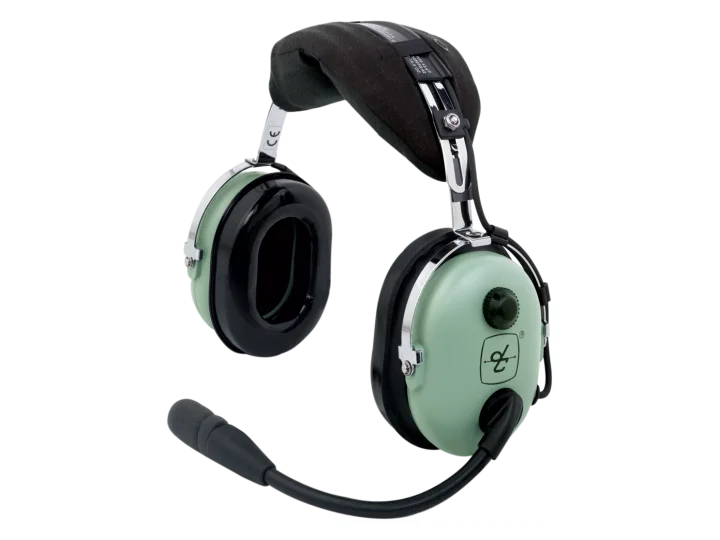 Student headsetDavid Clark H10-13.4 Aviation HeadsetCheck current availability on Amazon (paid link)
 OrganizationASA Flight BagCheck current availability on Amazon (paid link)
Your Pilot Certificate Never Expires But Your Privileges Do
The phrase private pilot license renewal is common, but it isn't technically accurate. Your private pilot certificate is permanent. What changes is whether you're currently allowed to use its privileges.
Under the FAA rules discussed in this guide on whether a private pilot license needs renewal, pilots often confuse a permanent certificate with the 24-month Flight Review requirement. That confusion matters because it makes rusty pilots feel like they've fallen off a cliff, when in reality many just need structured recurrent training and an endorsement. The same source notes that flight reviews for rusty pilots often take 3 to 5 hours of instruction, not just the minimum, before an instructor is comfortable signing them off.
The word renewal causes the wrong kind of fear
A pilot who hasn't flown in years usually doesn't need more pressure. They need a straight answer.
If your certificate is still valid, the question isn't, "Do I have to become a pilot again?" The better question is, "What do I need to do before I can safely and legally act as PIC?" That's a much smaller problem, and it's a solvable one.
A lot of frustration also comes from mixing up certificate privileges with operational limitations. If you need a quick refresher on those boundaries, review common private pilot license restrictions and make sure you're thinking in terms of what you can do today, not what your certificate once allowed.
Practical rule: Stop saying your license expired. Say your currency lapsed. That wording points you toward the fix.
Rust isn't failure
Pilots get rusty for ordinary reasons. Work changes. Family priorities shift. Medical issues come up. Airplanes get sold. Flying clubs close. None of that means you've lost the ability to come back.
What does matter is honesty. If your scan is weak, if radio work feels fast, or if landings haven't been part of your muscle memory in a long time, a minimum review probably won't be enough. That's normal.
The pilots who return well are usually the ones who accept two things early. First, being legal and being ready aren't the same. Second, extra dual isn't a setback. It's the shortest path to real confidence.
Decoding Your Aviation To-Do List Medical Review and Currency
Rusty pilots usually make the same mistake first. They lump medical, flight review, and recent experience into one fuzzy idea called "getting renewed." That mindset slows the comeback because each item has a different rule, a different timeline, and a different fix.
Treat them as three separate boxes. Medical eligibility. Flight review. Recent experience. Once you do that, the path back gets much clearer.
Medical comes first
If you are flying under a traditional FAA medical, the validity period changes based on your age and the class of medical you hold. The age-based timing is summarized in this FAA medical validity overview.
| Requirement | FAA 3rd Class Medical | BasicMed |
|---|---|---|
| Basic use case | Standard medical route for many private pilots | Alternative path for qualifying private pilots |
| Validity timing | Valid for a longer period if you are under 40, and a shorter period once you are 40 or older | Requires a physical exam every 4 years and a recurring online course, for pilots who qualify under the BasicMed rules described in this expired license renewal discussion |
| How you complete it | Examination with an Aviation Medical Examiner | BasicMed physical plus required online course |
| Key caution | Age changes your validity period | The timing and paperwork are different from the third-class path |
BasicMed deserves more attention than it gets. It works well for many returning private pilots, but only if they qualify and keep up with its separate requirements. I see pilots assume their old medical habits still apply, then realize too late that they have mixed up two different compliance paths.
Flight review is a separate requirement
Your medical only answers one question. Are you medically eligible to act as PIC. It does not satisfy the flight review requirement.
The FAA also requires a flight review within the preceding 24 calendar months before you act as PIC, unless you met that requirement through another qualifying event. A lot of pilots still call this a BFR, but the practical point is simple. If the review is out of date, your certificate is still valid and your PIC privileges are not.
That distinction matters because the phrase private pilot license renewal points people in the wrong direction. There is no single reset button. There is a checklist of separate legal requirements, and each one has to be current on its own.
Before you book time with an instructor, review the practical pilot currency requirements so you know exactly which box is stale.
A current medical and a current flight review still do not make you passenger-current.
Passenger currency is its own box
Carrying passengers has its own recent-experience rule. You need the required takeoffs and landings in the same category and class, and type if required, within the preceding 90 days. Night passenger carrying has a stricter standard, including full-stop landings at night.
This catches returning pilots all the time. A pilot may be legal to go fly solo after sorting out the medical and flight review, but still not legal to take a spouse, friend, or client along.
That gap between legal currency and real readiness matters too. A pilot can meet the passenger rule and still be rusty in crosswinds, radio work, or pattern judgment. Logging the minimum is not the same as being sharp. Good comeback plans account for both.
Your Step-by-Step Flight Review Action Plan
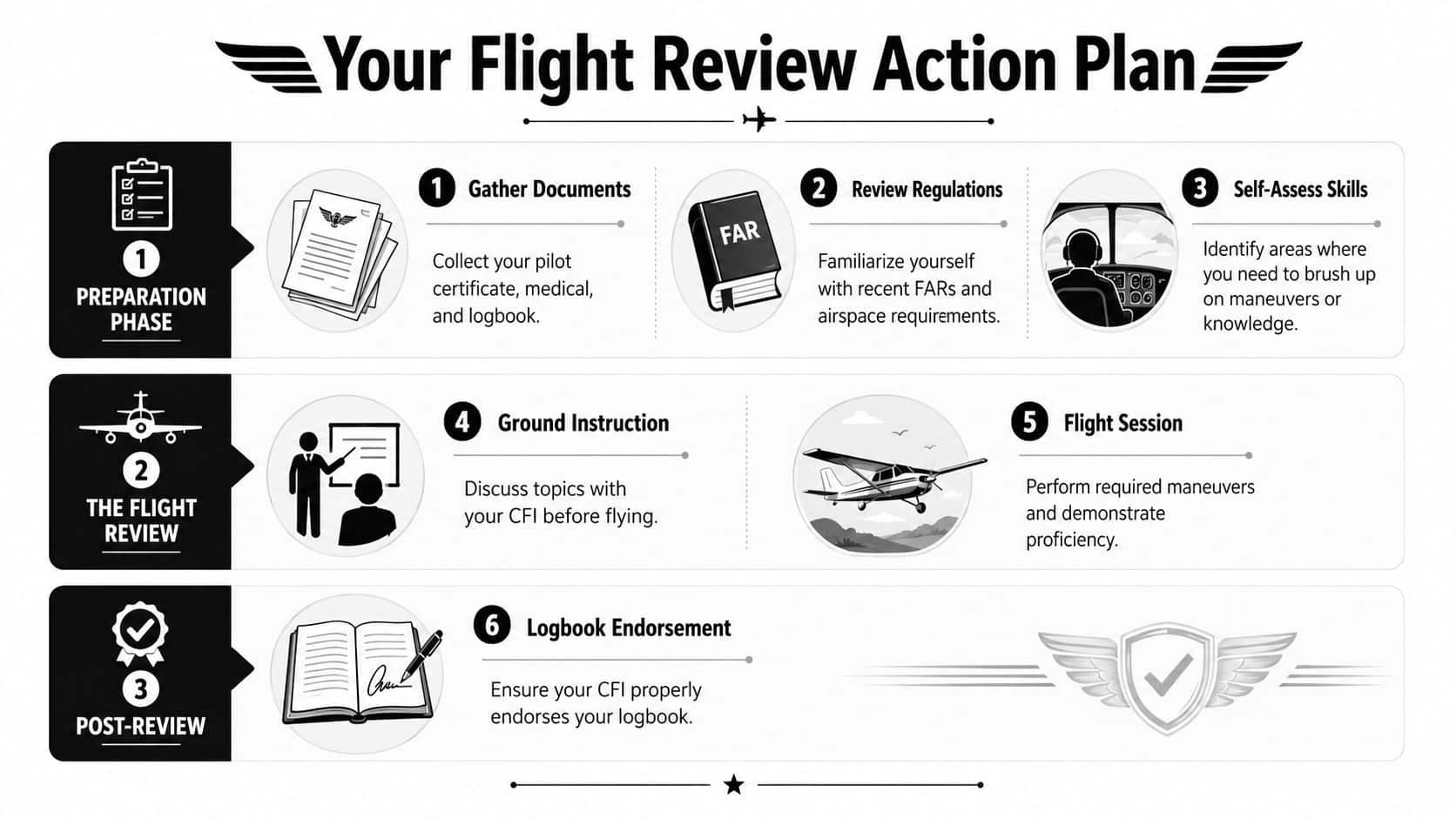
Stop treating the flight review like a renewal appointment. That mindset puts pilots in the wrong seat mentally before the engine even starts. A flight review is recurrent training, and for a rusty pilot it should be approached as a structured return-to-proficiency plan, not a box to check.
Start with a realistic self-assessment
The first job is paperwork. The second is honesty.
Bring your pilot certificate, photo ID, medical or BasicMed documentation, and logbook. An instructor cannot sort out your status if half the record is sitting in a desk drawer. Missing documents waste Hobbs time and usually add cost.
Then look hard at your own weak spots before the lesson. Be specific. Are you uneasy on radios at a busy Class D? Have crosswind landings gone stale? Do you remember the airspace rules well enough to apply them in real time, not just recognize the answer on a quiz? That self-brief saves time because it gives the instructor a place to start.
Pilots who have been away for a while often underestimate how much rust shows up in simple tasks. Checklist flow, taxi discipline, pattern spacing, trim use, and looking outside consistently are common examples. None of that is unusual.
Book the right instructor, not just the first available one
A rusty-pilot flight review goes better with a CFI who teaches a lot of recurrent training. There is a difference between an instructor who can coach a comeback and one who turns every review into a pass-fail event in disguise.
Ask these questions before you schedule:
- Do you work with returning pilots regularly?
- How do you split the ground and flight portions?
- What should I review before the appointment?
- If I need more than one lesson, how do you structure the follow-up?
- Can we do the review in the make and model I plan to fly?
That last question matters more than many pilots expect. If your goal is to get back into a Cherokee, doing the review in a different airplane may satisfy the regulation while doing less for your real-world readiness. Legal is not always useful.
It also helps to set expectations on cost before the first lesson. A bare-minimum plan is often a poor fit for a rusty pilot, so review realistic flight training costs for recurrent and proficiency work before you book.
Expect a training session that exposes rust
The FAA minimum for a flight review is one hour of ground instruction and one hour of flight training with an authorized instructor. That is the floor, not the target.
In practice, the ground portion should focus on the decisions and rules that affect the flying you will do. That usually means airspace, weather judgment, aircraft documents, preflight planning, operational rules, and the mistakes that tend to trap inactive pilots. A good instructor will ask scenario-based questions and listen to how you think through them.
The flight portion should fit your mission. For a local daytime pilot, the lesson may stay focused on aircraft control, pattern work, and local procedures. For a pilot planning cross-country trips or flying out of a busier airport, the review should include more radio work, airspace transitions, and decision-making under workload.
Common items include:
- Slow flight to rebuild coordination and feel
- Stall recognition and recovery
- Takeoffs and landings, where rust usually shows up first
- Go-arounds, because many rusty pilots delay them
- Emergency procedures such as engine-failure planning
- Pattern work and local airspace operations
If the instructor recommends another lesson before signing the endorsement, that usually reflects good judgment. I would rather see a pilot spend another hour fixing unstable approaches than leave with a fresh endorsement and old bad habits.
Leave with an endorsement and a comeback plan
Before you walk out, confirm the logbook endorsement is complete and accurate. Do not assume it got written correctly.
Then make a practical plan for the next few flights while the review is still fresh. If landings were the weak point, schedule another pattern session. If radios were the issue, fly with a CFI in the local system again before adding passengers. If everything was legally complete but workload was high, keep the next flight short, local, and simple.
That is the part many articles miss. A flight review can restore privileges, but it does not automatically restore sharpness. The smart move is to use the endorsement as the start of your return, not the end of it.
Avoiding Common Pitfalls and Hidden Costs
The most expensive mistake in private pilot license renewal usually isn't the airplane. It's magical thinking.
Pilots tell themselves they'll need just the minimum review, they'll knock it out in one shot, and they'll worry about passenger currency later. That plan falls apart fast when the first lesson reveals weak landings, rusty checklist flow, or a fuzzy grasp of airspace and procedures.
The deadline trap
The most common pitfall is missing the 24-calendar-month flight review deadline. Once that happens, your PIC privileges are invalid until you complete the review. That same training overview also notes that most pilots needed 60 to 80 hours for initial private training, while fewer than 5% finish in the FAA minimum range and Cessna cites 75 hours as a typical benchmark. It also notes that rusty pilot reviews often run 3 to 5 hours rather than the minimum, and that early completion starts a new 24-month period from the review date, with reminders set 2 to 4 weeks early helping pilots avoid lapses, as covered in this private pilot course breakdown.
That matters because it resets expectations. If most pilots didn't finish their original training at the bare minimum, it's not realistic to assume a long-inactive pilot will slide through recurrent training in the minimum time either.
Budget for proficiency, not just legality
Use a realistic planning mindset:
- Reserve extra training time: If you've been out of the cockpit for years, expect more than the minimum.
- Separate solo currency from passenger currency: Getting signed off doesn't automatically mean you can take passengers.
- Watch the calendar carefully: Early reviews reset your clock from the day of completion.
- Treat refresher flying as part of the cost: The review itself is only one part of getting fully ready.
If you want a better sense of what drives training expense, this overview of flight training cost factors helps frame the budgeting side.
Key takeaway: The cheapest plan on paper often becomes the most expensive plan in practice.
What doesn't work
Waiting until the month you're planning a trip. Booking with an instructor you've never spoken to. Showing up without your logbook. Assuming your medical, review, and passenger currency are all the same thing. All of that creates avoidable friction.
What works is simple. Start early, be candid about your rust level, and build enough time for a second session if the first one exposes gaps.
Get Current with DuBois Aviation at Chino Airport
The right training environment makes recurrent training smoother. That's especially true if you want more than a rubber-stamp flight review.

DuBois Aviation operates at Chino Airport (KCNO), a busy towered Class D field with three runways and multiple instrument approaches. For returning pilots, that's useful in the best way. You rebuild radio discipline, pattern awareness, and airspace habits in a setting that feels like real flying, not a sheltered bubble.
Why this environment helps rusty pilots
A lot of pilots coming back after time away don't need generic instruction. They need targeted repetition in the areas where rust shows first.
DuBois Aviation's setup supports that well:
- One-on-one instruction: CFIs can tailor the lesson pace instead of forcing everyone through the same script.
- In-house simulator access: A practical place to rehearse flows, procedures, and instrument references before the engine starts.
- Flexible seven-day scheduling: Helpful if you want to keep momentum and avoid stretching refresher training too far apart.
- Mixed fleet access: Training and rental options include multiple Piper Cherokees, a Cessna 150, a Mooney M20B, a Piper Apache, and helicopter options including Robinson and Enstrom aircraft.
That matters for both airplane and helicopter pilots. If you're getting current in fixed-wing, renting afterward, or adding recurrent work in a familiar platform, having access to a broad fleet helps keep training aligned with the way you'll fly in practice.
A closer look at the school gives some context for what it offers:
Good recurrent training should feel efficient, not rushed
DuBois Aviation uses Jeppesen learning materials and supports private, instrument, commercial, multi-engine, and helicopter training with experienced CFI, CFII, and MEI instructors. That mix is useful for certificated pilots who don't just want a signoff. They want a plan that fits whether they're returning to local day VFR flying, instrument work, aircraft rental, or transition training.
The school also rents aircraft to certificated pilots and supports ongoing flying through its Flyers Club community. That's an advantage after the review is done, because staying current is easier when booking, aircraft access, and follow-up training all live in one place.
If you're based near Chino or want a busier SoCal training environment, it's a strong place to rebuild both legal currency and cockpit confidence.
Beyond Currency How to Buy an Airplane Safely
Buying an aircraft too early is one of the more expensive mistakes a rusty pilot can make. Getting legal again does not mean you are ready to own well, insure well, or make a smart mission-based purchase.
A lot of pilots use "I got current" as the signal to start shopping. That is the wrong trigger. Shop after you have a few flights back in the system and a clear picture of how you plan to use the aircraft.
Start with the mission, not the listing
The market sells emotion. Ownership only works when the mission is honest.
Start with your real flying, not the airplane you always wanted ten years ago. A pilot doing solo daytime proficiency flights around the local area needs something very different from a pilot planning regular family trips, mountain flying, or IFR travel. The same goes for helicopters. Utility, training, sightseeing, and personal transportation each push you toward a different machine, budget, and maintenance profile.
Ask the questions that save money and regret:
- How many seats will you use most flights?
- How far do you usually fly?
- Do you need speed, payload, simplicity, short-field performance, or lower hourly cost?
- Will you fly enough to justify fixed costs, or does rental still make more sense?
- Can you insure the aircraft at a rate you will tolerate with your recent experience level?
That last point catches people off guard. The airplane that looks affordable on the listing can become a bad buy once insurance, hangar space, deferred maintenance, and transition training show up in real numbers.
The safest buying process is usually the least exciting
A safe purchase is slow, paper-heavy, and a little boring. That is a good sign.
Use a disciplined process:
- Set a real ownership budget. Include purchase price, tax, insurance, tie-down or hangar, annual inspection, maintenance reserves, subscriptions, and the first round of fixes after closing.
- Read the records, not the ad. Complete logbooks, consistent maintenance entries, equipment documentation, and damage history matter more than cosmetics.
- Get an independent pre-purchase inspection. Hire a mechanic or shop that works for you and knows the make and model.
- Check title and registration before money changes hands. Paperwork problems can delay the deal or create expensive cleanup later.
- Plan transition training before the airplane arrives. A new purchase raises workload. Good instruction lowers it.
Here is the trade-off. A cheaper airframe with weak records often costs more to sort out than a higher-priced airplane with clean logs and a history of steady care. Newer avionics do not erase poor maintenance. Fresh paint does not make corrosion disappear.
Buy the aircraft you can afford to fly, maintain, insure, and train in consistently.
That standard is stricter than "can I make the purchase price work." It should be.
Ownership also does not solve the gap between legal currency and real proficiency. A pilot can be current on paper and still be behind the airplane in an unfamiliar model. That is exactly why transition training matters, especially after time away from flying. The first goal is not pride of ownership. The first goal is safe, repeatable operation.
For many returning pilots, a good school is part of the buying process. It gives you a place to compare aircraft types, get an instructor's second opinion, and build a transition plan before you commit.
If you're ready to get legal, get proficient, or talk through the next step toward ownership, DuBois Aviation can help with airplane and helicopter instruction, simulator refreshers, aircraft rental, and recurrent training at Chino Airport.


