
You've probably got a dozen tabs open right now, one promising a free download, another showing a forum scan, and a third trying to sell a “complete” study guide. That's the normal starting point for a new student pilot who types private pilot license book PDF into a search bar and expects one file to solve everything.
The good news is that the right PDF stack does exist, but it's not one magic book. It's a sequence of FAA handbooks, the checkride standard, and, in many cases, a commercial manual that helps a lesson make sense faster. Once you know what belongs in the stack, you can stop guessing and start studying in the right order.
Table of Contents
- What a Private Pilot License Book PDF Really Means
- The Official FAA PDF Stack Every Student Should Know
- Comparing the Top Private Pilot Study Books
- Copyright, Piracy, and the Case for Official Sources
- How DuBois Aviation Uses PDFs in Real Flight Training
- Building a Study Plan That Gets You Test-Ready
- Download, Annotation, and Retention Tips That Stick
Two practical options worth comparing
These are specific products pilots commonly compare for this type of flying. Confirm compatibility with your aircraft and instructor before ordering.
 Student headsetDavid Clark H10-13.4 Aviation HeadsetCheck current availability on Amazon (paid link)
 OrganizationASA Flight BagCheck current availability on Amazon (paid link)
What a Private Pilot License Book PDF Really Means
The first confusion is simple. A student searches for private pilot license book PDF and expects one neat download, but the results usually mix FAA handbooks, commercial study guides, author-made notes, and old scans. The term is really a category, not a single title.
The PDF pile has three jobs
Some PDFs teach theory. Those cover aerodynamics, weather, regulations, systems, and decision-making. Others are built for procedures, which means they help you fly maneuvers, brief a lesson, or prepare for the checkride. That's why two PDFs often sit open at once, one on the desk for concepts, one on the iPad for the task you're working on.
Practical rule: If a PDF talks only about memorizing facts, it probably won't carry you through the whole training process. If it explains how the FAA expects you to perform a task, it belongs in your core stack.
That's also why a good study setup often includes a way to keep your files clean and searchable. If you're assembling your own digital binder, a basic workflow guide like Camelot Print & Copy Centers PDF creation can help you think about file quality, naming, and organization before you start annotating.
Read in layers, not at random
The smartest approach is layered. Start with the official FAA material, then add a commercial book only if it helps you understand what the FAA already says. If you read randomly, you'll spend too much time on the wrong chapter and too little on the material that shows up in the oral and practical test.
A clean mental model helps here:
- Theory first: Learn why the aircraft does what it does.
- Procedure second: Learn how the FAA wants the task flown.
- Application third: Use a school manual or instructor lesson to make it stick.
The rest of this guide follows that order. Official FAA PDFs come first, commercial books come second, and the final sections focus on copyright, study workflow, and what a real flight school does with the files.
The Official FAA PDF Stack Every Student Should Know
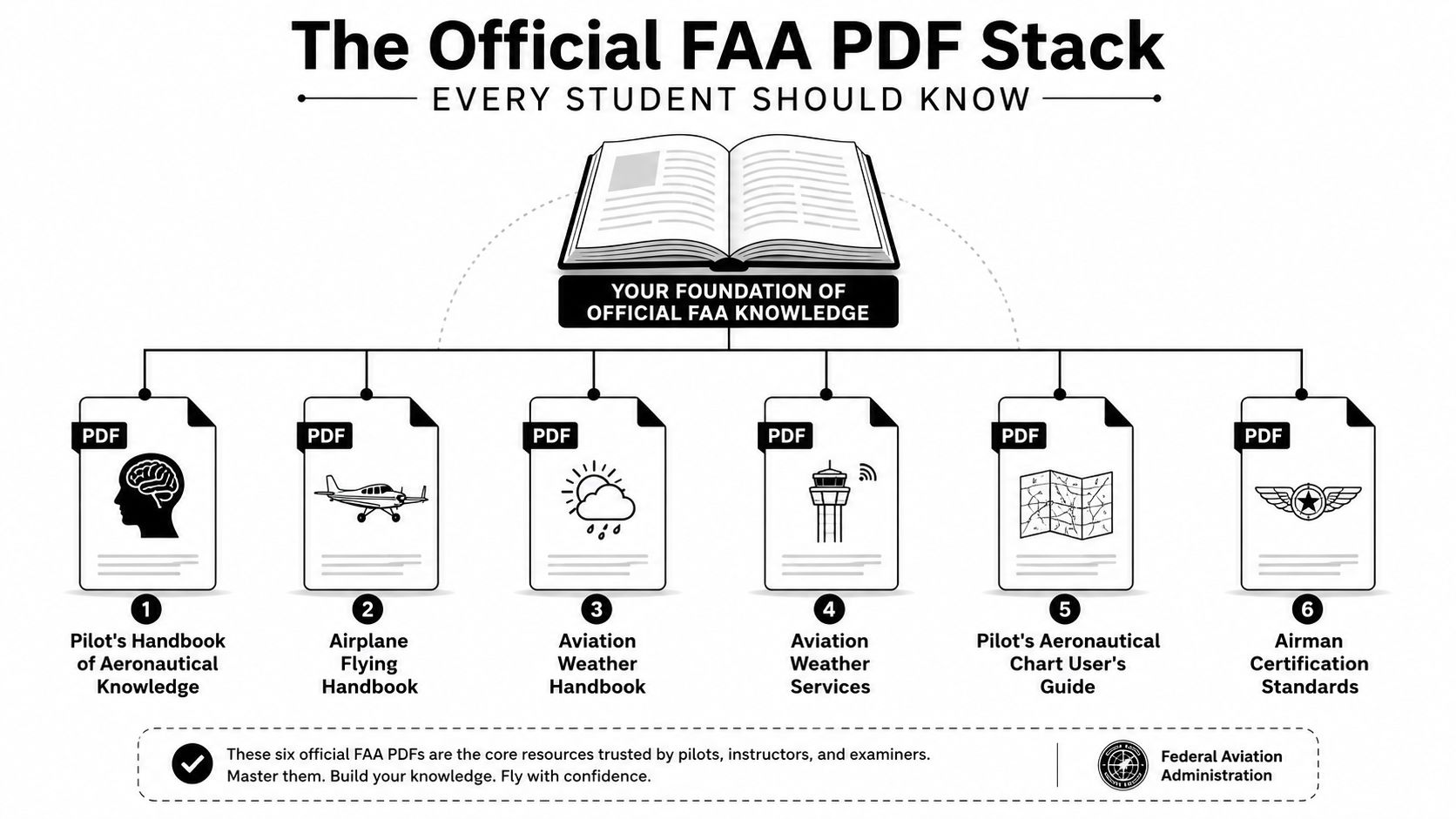
A new student usually starts with one question at the kitchen table or in the school lounge, which PDF should I read first? The answer is simpler than it looks. The FAA stack is the backbone of private-pilot study because it matches what the FAA tests and evaluates, so each file has a clear job instead of sitting in a folder as dead weight. The Pilot's Handbook of Aeronautical Knowledge is the foundation for theory, and the FAA includes it in the official handbook set that supports private-pilot ground knowledge. The Private Pilot Airplane knowledge test recorded 45,820 test attempts, a 90.30% pass rate, and an average score of 82.05% FAA handbook and testing context. That scale is why a student needs a disciplined PDF library, not a random pile of downloads.
The FAA documents and what each one owns
The easiest way to use the stack is to give each PDF a job, the same way a flight instructor assigns each lesson a purpose.
- Pilot's Handbook of Aeronautical Knowledge. This is the core theory book. It covers the broad subjects students usually meet first, including aerodynamics, systems, weather, airspace, and aeromedical factors.
- Airplane Flying Handbook. This is the procedure book. It moves from concepts to how maneuvers are flown and fits naturally with flight lessons and maneuver practice FAA Airplane Flying Handbook.
- Aviation Weather Handbook. This supports weather decision-making and helps connect forecasts, reports, and go or no-go judgment to real flight planning.
- Weight and Balance Handbook. This covers loading, balance, and performance basics, the practical side of making the airplane legal and safe before takeoff.
- Private Pilot Airplane Airman Certification Standards. This is the master checklist for the checkride. The FAA uses it to judge whether a student can demonstrate the required tasks to the acceptable level FAA Private Pilot Airplane ACS.
- Airman Knowledge Testing Supplement. This is the test-graphics book. It supports the written exam by showing the charts, figures, and reference material students must interpret.
A better reading order
Start with the PHAK so you get the big picture. Use the Airplane Flying Handbook when a lesson shifts from what a maneuver is to how it is flown. Bring in weather and weight-and-balance material as soon as your instructor starts talking about planning, because those subjects stop being abstract very quickly.
The ACS belongs on your desk from day one, not only at the end. It tells you what the examiner can ask about, and it also tells you what performance standard matters on each task area. The testing supplement belongs with your knowledge-test prep, because the written exam uses visuals and interpretation, not just definitions.
The FAA's own handbooks are free, official, and enough to build a serious baseline. That is the minimum PDF library every new private pilot should understand before buying anything else.
Comparing the Top Private Pilot Study Books
Once the FAA PDFs are in place, the next question is whether a commercial book is worth it. For many students, the answer is yes, but only for a specific reason. Commercial manuals don't replace the FAA stack, they help translate it into a smoother lesson flow.
What each option does best
The FAA handbooks are the most authoritative, but they aren't always the easiest first read. A commercial manual can give you structure, stories, or exam-focused summaries that help the material land faster. If you want a broader buying guide, DuBois Aviation keeps a useful roundup at best private pilot training books.
| Book | Format | Strength | Best For |
|---|---|---|---|
| Pilot's Handbook of Aeronautical Knowledge | Free FAA PDF | Core theory and official guidance | Students who want the authoritative baseline |
| Airplane Flying Handbook | Free FAA PDF | Procedures and maneuver explanations | Students preparing for flight lessons and the checkride |
| Jeppesen Private Pilot Manual | Commercial book and PDF forms | Structured curriculum and school-friendly progression | Students in a formal ground school |
| ASA Private Pilot Study Guide | Commercial study guide | Fast review and test prep style organization | Students who want a quicker reference |
| Rod Machado Private Pilot Handbook | Commercial handbook | Narrative explanations and friendly teaching style | Students who learn best from examples and stories |
| King Schools Private Pilot eBook | Digital study product | Visual, video-paired learning | Students who want a multimedia approach |
How to choose without overbuying
If you're self-studying and already understand lessons well, the FAA PDFs may be enough for the written test and a lot of the oral. If you get stuck on terminology, a commercial manual can save time by giving you a simpler explanation before you return to the FAA wording.
Jeppesen tends to fit structured school programs because the flow matches a syllabus. ASA works well when you want concise review. Rod Machado is usually the friendliest choice for students who need a concept explained in plain language. King Schools is strongest when a visual demonstration helps more than text.
Good rule of thumb: Buy one commercial guide for clarity, but keep the FAA PDFs as your final authority. If the two disagree, the FAA document wins.
Copyright, Piracy, and the Case for Official Sources
A lot of the search results for private pilot license book PDF point to unofficial uploads. That creates two problems right away. One is legal, because pirated scans can violate copyright. The other is practical, because an unofficial PDF may be outdated, missing pages, or built from an old edition with the wrong study cues.
What's safe to download
The FAA handbooks are free, official, and meant to be used. That's the easiest place to start because you're not risking a copyright problem just to study the material the FAA already publishes.
Manufacturer PDFs sit in a gray but familiar zone. Many aircraft makers provide pilot guides and reference material for personal use, but that doesn't give you the right to repost or redistribute them. A clean rule is simple, download official documents for your own study, and never assume a scan on a file-sharing site is legitimate just because it opens.
Why unofficial PDFs cause real study problems
A bad PDF can waste a week. Missing diagrams make chart work harder. Outdated answer keys can train the wrong habit. Broken bookmarks and unreadable scans turn a study session into a repair job.
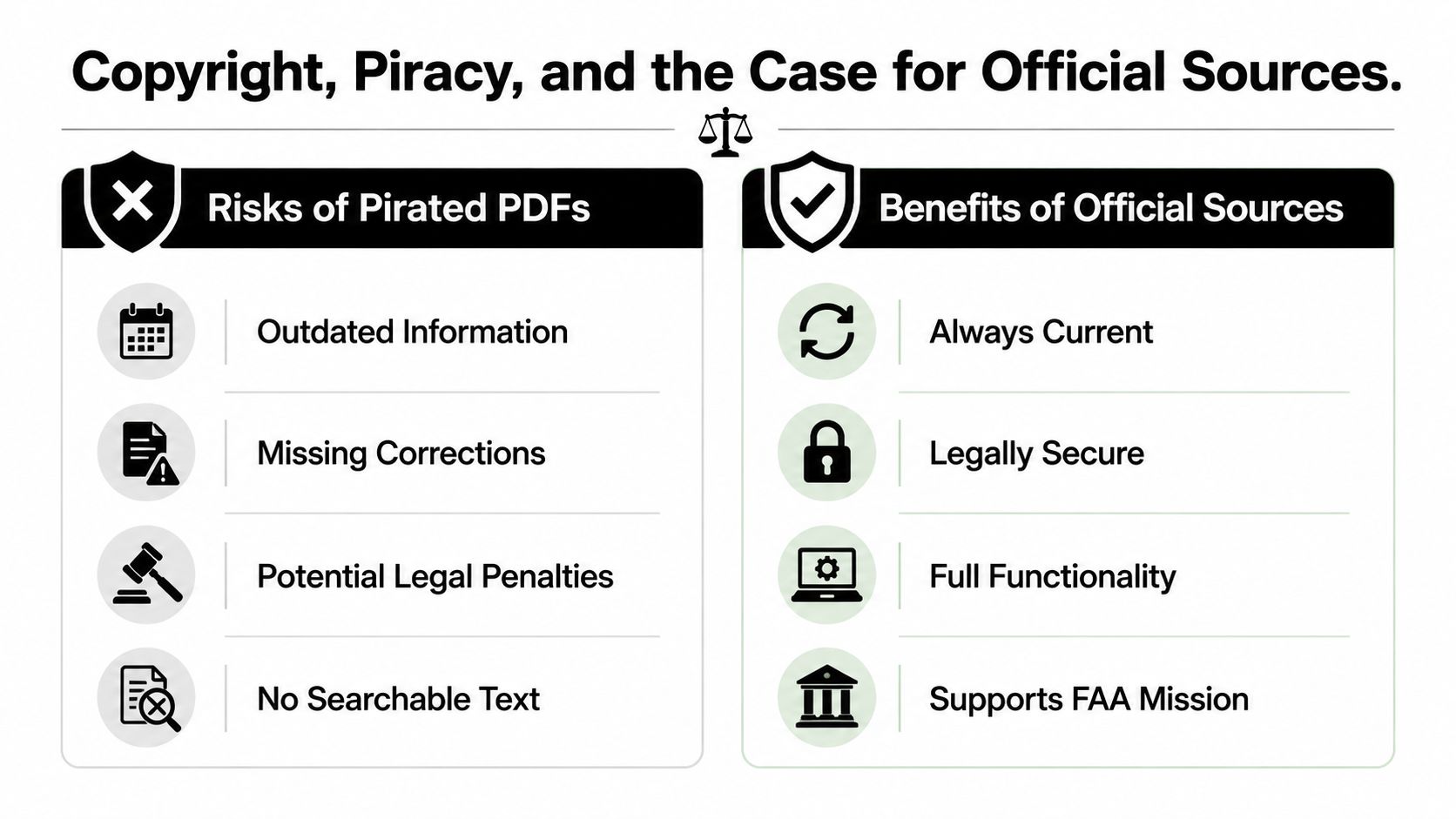
The FAA already publishes the materials most students need, so piracy rarely buys you anything useful. You're not saving money on the foundational documents, and you may be undermining the one thing you need: confidence that your source is current and complete.
If you do use a commercial manual, buy it from the publisher or a legitimate retailer. That keeps the edition clear, the pages intact, and the study notes aligned with the book your instructor expects you to use.
How DuBois Aviation Uses PDFs in Real Flight Training
A real flight school doesn't treat PDFs as the whole lesson. It uses them as the homework that feeds the lesson. At Chino Airport, the rhythm is straightforward, read the assigned chapter first, bring the matching FAA handbook sections for the rule or principle behind it, then practice the maneuver in the aircraft or simulator.
What the study flow looks like in practice
Students who work one-on-one with CFIs usually do better when the reading and flying stay tied together. A Jeppesen chapter gives the lesson structure, while the FAA PDF explains the underlying standard in official language. That combination keeps the student from memorizing procedures without understanding the “why.”
The airplane choice changes with the lesson. A student might practice basic handling in a Piper Cherokee or Cessna 150, then work with a Mooney M20B or Piper Apache as training advances. The in-house simulator helps with repetition before the student burns cockpit time on the same task.
Why the airport matters
Chino's Class D environment gives students the radio work and traffic awareness they need early. A towered airport with three runways and multiple instrument approaches forces clean phraseology, good listening, and smart sequencing. That's useful because the textbook PDFs don't teach you how busy real-time coordination feels.
The book can teach the rule. The airport teaches the workload.
That's the main limitation of any private pilot license book PDF. It can prepare you, organize you, and keep you from being surprised on the oral. It can't substitute for hearing traffic calls, managing spacing, or handling the pace of a live pattern.
For a student, the best use of PDFs is simple. Read before the lesson, fly the lesson, then go back to the specific pages that matched the errors or questions that came up in the cockpit.
Building a Study Plan That Gets You Test-Ready
A good study plan turns the FAA PDF stack into a sequence you can follow without guessing. A weak plan leaves you with open tabs, half-read chapters, and the feeling that every topic matters at once. The better approach is to match each subject to a flight lesson or simulator session, so the reading has a clear place in the airplane.
A practical 12-week sequence
Weeks 1 and 2 should stay with aerodynamics and aircraft systems, with the early PHAK chapters open beside your notes. That is the right point to learn lift, drag, controls, and basic components, because those ideas shape everything that follows.
Weeks 3 and 4 should move into weather, using the Aviation Weather Handbook together with instructor briefings. Weeks 5 and 6 should cover airspace, sectional charts, and the Airman Knowledge Testing Supplement, so you practice chart interpretation instead of only reading definitions. Weeks 7 and 8 should shift into the Airplane Flying Handbook for procedures and maneuvers.
By Weeks 9 and 10, you should be working mock questions and revisiting weak spots. Weeks 11 and 12 belong to the ACS overview and task list, because that is the master checklist for checkride prep and the clearest way to see what the examiner can reasonably expect you to know and do.
A simple schedule helps here, especially if work, family, or flight time changes from week to week. A planner that fits real life keeps the plan usable when a perfect calendar would fall apart after two sessions.
Pair each block with a flight activity
- Aerodynamics weeks: Use short simulator sessions to match theory with control response.
- Weather weeks: Review real forecasts with your instructor before a flight.
- Regulations and airspace weeks: Brief the route, the airport environment, and any special use airspace nearby.
- Procedures weeks: Practice the maneuvers in the airplane after reading the matching handbook section.
- ACS weeks: Review each task area as if you are answering the examiner, not a quiz app.
If you want the written exam prep to stay aligned with the rest of your study, keep the FAA private pilot knowledge exam guide close. That keeps the written test and the oral test working from the same material instead of treating them like separate subjects.
The point is steady repetition, not speed. A student who studies in smaller, regular blocks usually remembers more than a student who crams on weekends and hopes the material sticks.
Download, Annotation, and Retention Tips That Stick
You can have the right private pilot license book pdf files and still waste study time if the stack is hard to open, hard to mark, or hard to review. A clean workflow solves that problem. Treat the PDFs like a kneeboard setup, everything has a place, and every item should be ready before the lesson starts.
Set up the files before you need them
Start with one PPL Study folder and place every official FAA PDF there. Sort the files into subject folders such as theory, procedures, weather, and testing so you can find the right document without hunting through a long downloads list. If you are adding personal notes or scans, give each file a clear name that tells you what it contains. If you need a starting point for your PDF workflow, upload your first PDF to get organized.
A tablet-friendly PDF reader helps because you will annotate more when the tool feels easy to use. If you are choosing a device workflow, the iPad for pilots guide is a helpful companion for thinking about cockpit and ground-school use together. The same idea applies whether you use an iPad, another tablet, or a laptop. The reader should make highlighting, page jumps, and bookmarks quick to reach.
Annotate by task, not by chapter
Chapter titles are useful for orientation, but ACS task areas are better for study. They match the way the oral and practical test are put together, so your notes stay tied to what you will explain and do.
Use this pattern:
- Definitions in one color: Mark terms you need to explain out loud.
- Procedures in another color: Flag steps you will need to perform or brief.
- Personal notes in the margin: Write the shortcut, memory cue, or mistake you keep making.
Retention tip: The best notes are the ones you can turn into a five-minute review before a lesson, not a perfect summary you never reopen.
Use repetition to make the pages stick
A short weekly review of weak areas works better than waiting until the end of the month. Print only the pages you need if you learn better on paper, then mark the copy and keep the digital version clean. If you prefer digital review, sync your notes so the same highlights appear on every device you use.
Flashcards help too. Put the question on one side and the FAA wording, or your own plain-English version, on the other side. That turns passive reading into active recall, which is the difference between recognizing a page and remembering it under pressure.
If you want a simple finish line, keep it this way. Download the FAA stack, organize it into one folder, annotate by ACS task, review weak areas every week, and match each reading assignment to a flight lesson or simulator session.