

You've finished another ground lesson, your notebook is full of cross-country calculations and weather notes, and your instructor has started asking the question every student pilot hears sooner or later: “When are you taking the written?” That's usually the moment the administrative side of flying becomes real. You're not just studying anymore. You're picking a date, finding a seat, and putting your preparation on the calendar.
For Southern California students, especially those training around Chino Airport (KCNO), the challenge usually isn't whether FAA knowledge test locations exist. It's choosing the right one, booking it in the right sequence, and showing up with everything dialed in. A testing center that looks convenient on a map can have awkward hours, limited slots, or a check-in process that catches unprepared applicants off guard.
Table of Contents
- Your First Solo Milestone The FAA Knowledge Test
- Finding Your Ideal FAA Testing Center
- Navigating the Scheduling and Registration Process
- Preparing for Test Day Documents and Pro Tips
- After the Test Understanding Scores and Retakes
- Beyond the Knowledge Test Your Future in Aviation
Your First Solo Milestone The FAA Knowledge Test
The knowledge test feels a lot like a first solo in one respect. Your instructor has helped you get ready, but at some point you have to step forward and handle the process yourself. You choose the day, verify the documents, and sit down at a computer knowing the result is on you.
That can feel bigger than it needs to. The good news is that the system is more accessible than many students expect. PSI operates over 700 FAA-authorized knowledge testing centers across all 50 U.S. states and select territories, creating one of the most geographically accessible networks for airman certification exams in the world, according to Rotate Pilot's overview of FAA testing locations.
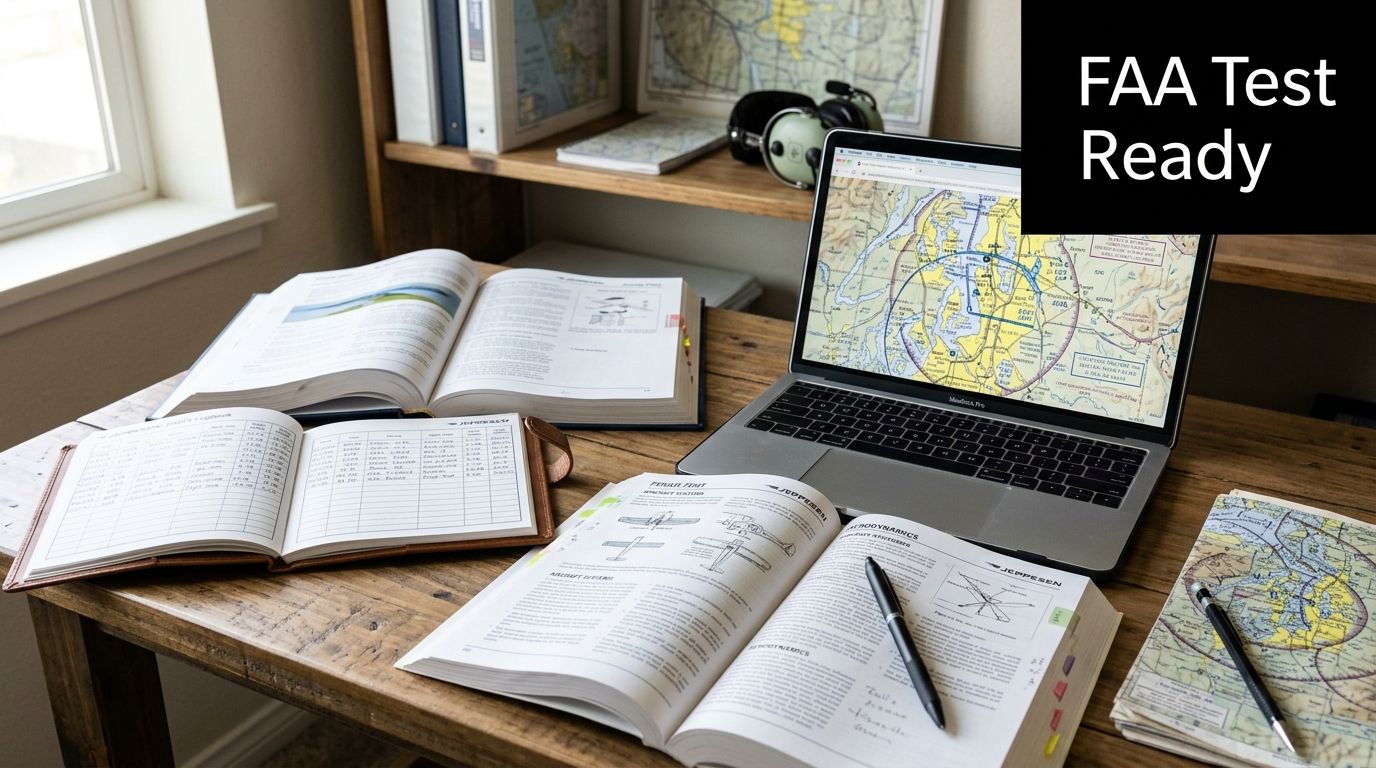
That matters because many student pilots still assume the exam happens at some dedicated FAA office. It usually doesn't. The FAA uses a distributed testing model through authorized centers, so the task isn't “find the FAA building.” The task is “find the right PSI seat at the right time.”
What the written test really represents
The written exam is more than a requirement to check off before the checkride. It's proof that your study habits are catching up with your flying. When a student can decode a METAR, work a weight-and-balance problem, and apply airspace rules under time pressure, that student is moving from memorization to pilot judgment.
For private pilot applicants, that usually means your Jeppesen material, your instructor's lesson flow, and your practice tests are finally coming together. If you want a focused refresher on the private pilot exam itself, this private pilot knowledge exam guide is a useful companion to the scheduling side.
Practical rule: Don't wait to feel “perfect” before you schedule. Pick a realistic date that gives your studying structure.
Why this system is better than it looks
A centralized government-only testing setup would sound simple, but it would create long drives and fewer choices. The current PSI network gives most applicants more flexibility. You can search by location, compare appointment options, and often find something that fits your work or flight schedule better than a single regional office ever could.
For a student around Chino, that flexibility is useful. KCNO training days often involve traffic, weather adjustments, and changing lesson times. A system with multiple center options gives you room to be strategic instead of boxed in.
Finding Your Ideal FAA Testing Center
A common mistake is booking the nearest pin on the map and assuming the job is done. That works sometimes. Other times it creates a rushed drive, a weekday conflict, or an appointment at a center that only opens on a narrow schedule.

The search itself is straightforward, but the decision takes some judgment. The official system can make locations look more standardized than they really are. As noted in the FAA knowledge exam FAQ discussion cited here, existing content fails to clarify that “FAA knowledge test locations” are not fixed FAA offices but rotating slots at third-party PSI centers with erratic, non-standardized hours, and only 2 of 9 search results disclose specific center closures or limited weekday windows.
Why the closest center isn't always the best one
If you're based near Chino Airport, you're already used to planning around Southern California traffic. A center that is geographically closer may still be the worse choice if its start times are awkward or if the building is hard to access.
When I advise students in the Inland Empire, I tell them to compare centers using a short decision filter:
| What to compare | Why it matters |
|---|---|
| Available dates | The best prep plan falls apart if the first open seat is too soon or too far out. |
| Time of day | Most students perform better when they test at the same time they usually study and fly. |
| Building logistics | Office parks, airport suites, and shared testing spaces can be easy to miss. |
| Drive stress | A shorter route with predictable traffic is often better than a slightly shorter distance with heavy congestion. |
A calm arrival helps more than students think. If the drive is chaotic, the first few questions often feel harder than they should.
What works for Chino area students
For KCNO-area pilots, search broadly at first. Don't lock yourself into one zip code radius on the first try. Search near Chino, then expand toward surrounding Inland Empire and eastern Los Angeles County options if the calendar looks thin.
A few tactics work well:
- Check multiple radii: Start local, then widen the search if you don't like the first set of slots.
- Look at several dates, not one: Students often miss a good appointment because they only search the exact day they had in mind.
- Test your drive mentally: If an appointment forces you onto the freeway at the wrong time, it may be a poor choice even if the center itself is good.
- Call if something looks odd: If a listing seems active but the available schedule is strange, it's worth confirming the center is operating when you need it.
For Southern California students, I usually prefer a center that is slightly farther away but easier to enter, park at, and find without last-minute confusion. On test day, simple is good. Familiar is better. Quiet is best.
Navigating the Scheduling and Registration Process
Students usually stumble here for one reason. They do the steps out of order. The system isn't complicated once you respect the sequence.
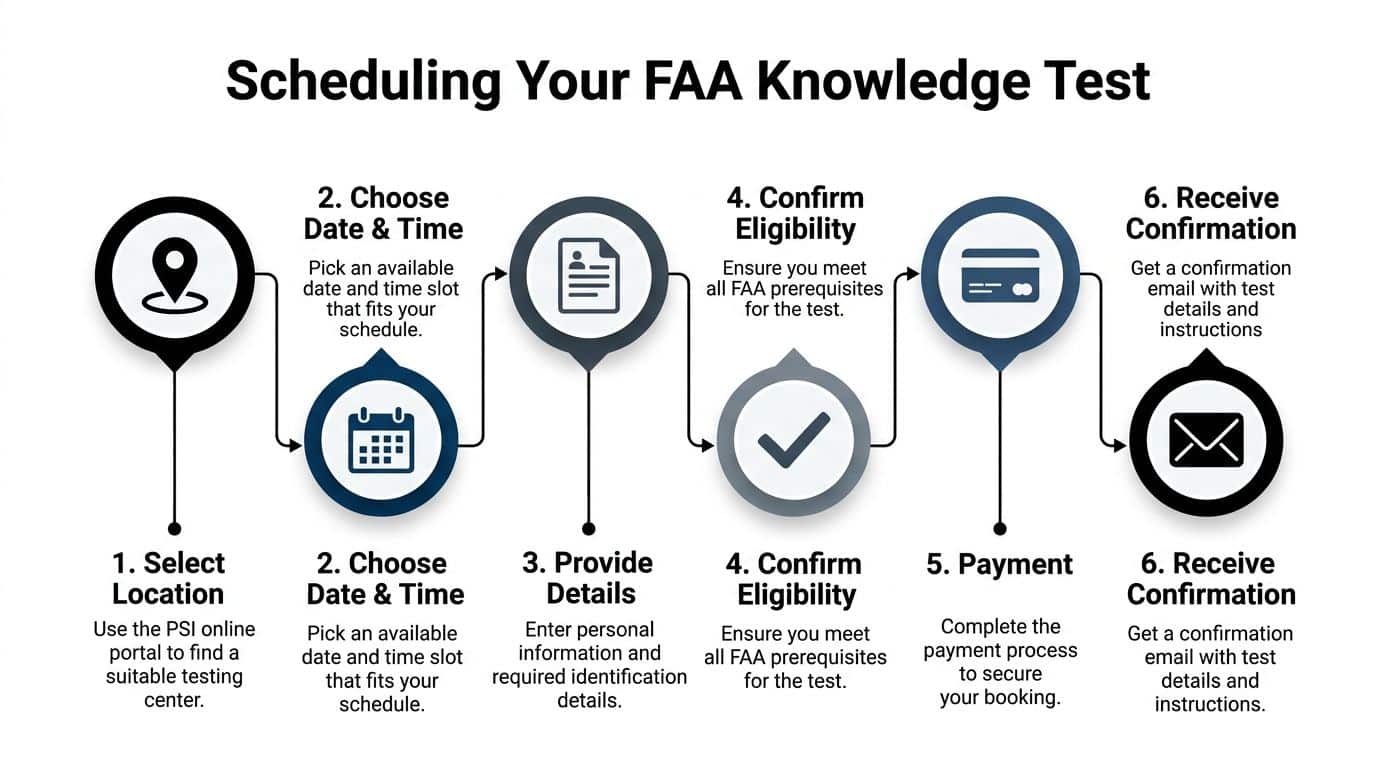
The order matters
The required flow is clear. The scheduling process requires applicants to first obtain an FAA Tracking Number (FTN) via the IACRA website, create a matching PSI account, and then select a specific date and time slot, with exam fees typically ranging from $160 to $175, as described in this FAA testing process document on GovInfo.
If your IACRA profile and PSI profile don't match cleanly, you can create avoidable check-in problems. Use the same legal name format on both. Don't improvise with nicknames, extra initials, or alternate email habits.
A clean booking routine
Here's the version that works consistently.
Create or verify your IACRA account
Make sure your profile is complete and your FTN is active before you even open the PSI portal.Build your PSI account to match
Use the same personal information you used in IACRA. Matching records save headaches later.Choose the correct exam
Don't rush this screen. Private pilot applicants should confirm they're selecting the proper airplane exam rather than clicking through on autopilot.Compare locations and times together
A decent center at the right time beats a perfect center at the wrong time.Pay and save the confirmation
Once you've booked, keep the confirmation where you can retrieve it quickly on test day.
For many students, the actual online process only takes a few minutes once everything is lined up. The delays usually happen before that, when someone realizes they never created the FTN or they used mismatched personal details.
A note for international applicants
International applicants need to be careful in the PSI ecosystem because general search paths can point them toward the wrong exam categories. The fix is simple. Double-check that you're specifically in the FAA Airman Knowledge Testing side of the system and that you've chosen the correct aviation exam.
Booking is easy when the setup is clean. Most “PSI problems” are really profile and exam-selection problems.
Preparing for Test Day Documents and Pro Tips
A lot of students think the hard part is over once the appointment is booked. It isn't. The booking gets you a seat. Preparation gets you a passing result.
The benchmark I like is simple. Don't schedule the official exam until your timed practice work is consistently above the pass line. Success rates for FAA knowledge tests are significantly higher when candidates achieve benchmark practice scores of ≥85% on timed exams before the actual test, as this creates a performance buffer against the psychological pressure of the two-hour, 60-question exam, according to Fly Compton's FAA knowledge exam preparation guide.
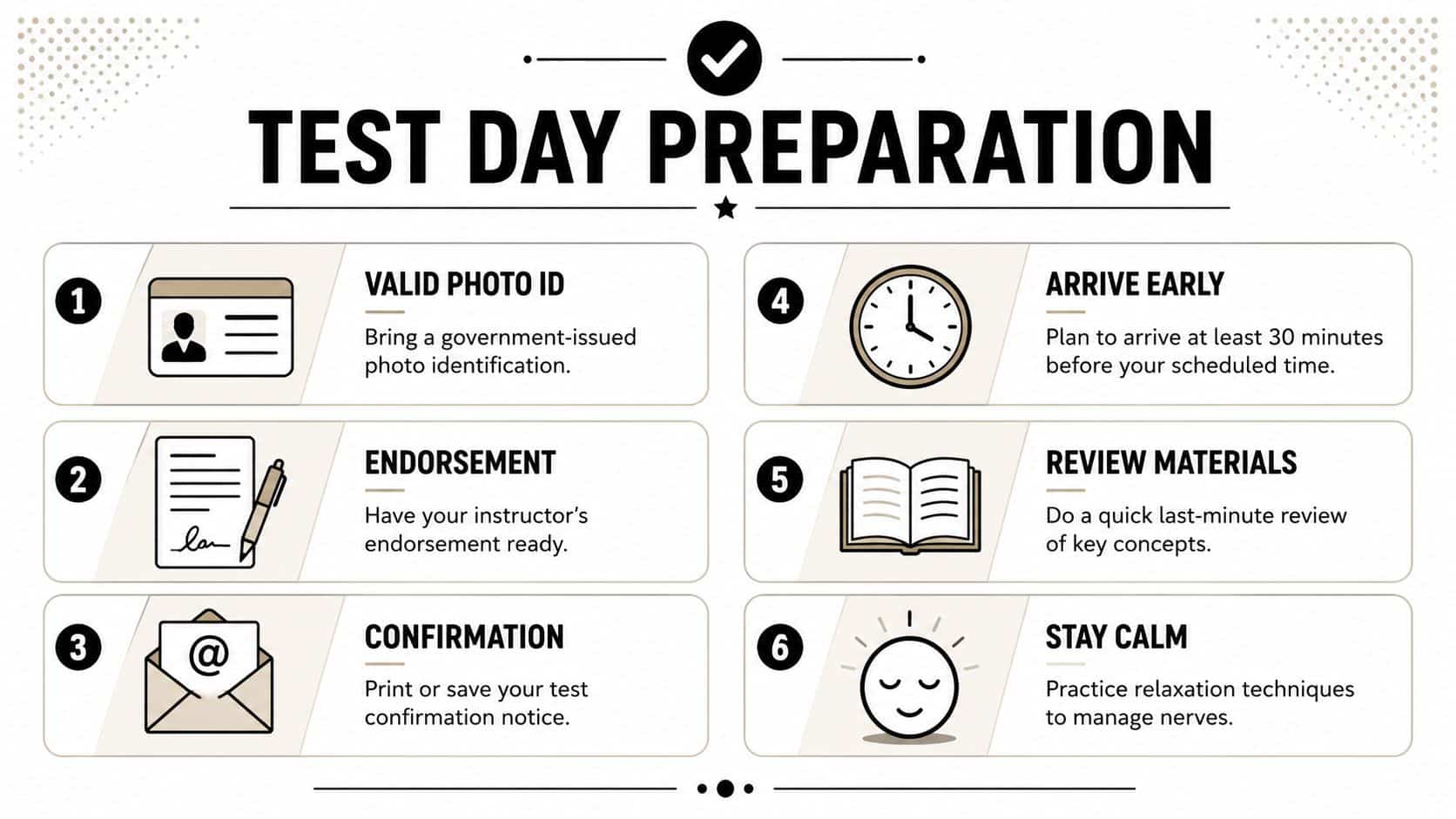
Your test day checklist
Bring the basics, but don't treat them casually.
- Government-issued photo ID: The name needs to match your registration details.
- Instructor endorsement: If you're taking the test through the standard training path, this is one of the most important documents in your stack.
- Booking confirmation: Printed or saved accessibly on your phone is fine if the center accepts it at check-in.
- A realistic arrival plan: Build in margin for parking, building access, and check-in delays.
- A clear head: Don't carry loose study materials into the lobby and then scramble to organize yourself at the desk.
A lot of students also benefit from reviewing their medical timeline and overall training readiness while they're preparing for this phase. If you're still sorting out the medical side, this Class 3 medical overview helps keep the bigger certification picture organized.
How to show up ready to pass
The final day shouldn't be a cram session. It should feel like a confirmation flight. You're not trying to learn the material in the parking lot. You're trying to arrive settled, alert, and ready.
A few habits consistently work better than last-minute grinding:
- Use timed practice, not casual review: If you only study in untimed mode, the actual exam can feel more rushed than it should.
- Review weak areas, not favorite topics: Most students waste the last day rereading the sections they already like.
- Keep the evening boring: Normal dinner, normal bedtime, normal morning.
- Arrive early enough to recover from small problems: Traffic, parking, and check-in friction are normal. Build around them.
If your study routine still feels messy, Cramberry's no-nonsense study guide is a good practical read because it focuses on effective review habits rather than motivational fluff.
Students rarely regret being overprepared. They often regret taking the test the first week they “maybe felt ready.”
After the Test Understanding Scores and Retakes
When you finish the exam, you won't be left guessing. You'll receive a score report right away, and that report tells you exactly where you stand.
If you pass
If you pass, save that result carefully. It becomes part of your practical test path, and your instructor will want it in your records. Treat it like a required aircraft document. Don't leave it folded at the bottom of a flight bag with old fuel receipts and weather printouts.
Passing also gives you a useful confidence boost. You've proven that your aeronautical knowledge is strong enough to move forward, and that usually sharpens the quality of the remaining training.
If you don't pass
If you miss the passing standard, don't turn one bad morning into a larger story about your ability. Read the score report closely. The missed subject areas matter more than the emotional sting.
Use the Learning Statement Codes on the report with your instructor. That's where the retake path gets efficient. Instead of restudying everything, you can target the specific areas that caused trouble, especially if the miss came from weak chart reading, airspace details, or performance questions.
The right move after an unsuccessful attempt is usually simple:
- Debrief the score report promptly
- Review the weak areas with structure
- Get the required authorization squared away before rebooking
- Retake only when your practice work shows you're ready
A retake isn't a reset of your entire training. It's a correction.
Beyond the Knowledge Test Your Future in Aviation
The written exam is a gate, not the destination. Once pilots clear it and move toward the checkride, their thinking often changes. They stop asking only, “How do I pass?” and start asking, “What kind of flying life do I want?”
For some, that means weekend rentals and local trips. For others, it grows into instrument training, commercial work, or eventually owning an aircraft. That's where disciplined habits learned during test prep become surprisingly useful. Good pilots and good aircraft buyers have one thing in common. They don't rush important decisions.
Owning an airplane starts with disciplined decision making
A first aircraft purchase usually begins with excitement and ends with paperwork, maintenance logs, and sober review. That's how it should be. Buying an airplane the safe way means slowing down long enough to verify what you're purchasing.
The practical approach looks like this:
- Start with mission, not paint: A clean-looking airplane that doesn't fit your real flying needs is still the wrong airplane.
- Insist on a pre-buy inspection: Use a mechanic who represents your interests, not the seller's convenience.
- Review logs carefully: Gaps, vague entries, and poorly documented work should change your level of caution.
- Confirm title and ownership details: Administrative mistakes can become expensive problems after closing.
- Budget for operating reality: Tie-down or hangar, insurance, fuel, oil, maintenance, and unexpected squawks all matter.
Students who've already learned to prepare methodically for a knowledge exam often do better here. They ask better questions, and they're less likely to confuse confidence with verification.
If your long-term goal is aircraft ownership, it helps to keep your pilot progression in view from the beginning. This private pilot license path is often the first real step toward that bigger goal.
Buying or selling helicopters takes a different mindset
Helicopters deserve even more caution. The mission profile, maintenance environment, and insurance picture can differ sharply from fixed-wing ownership. A buyer who would casually shop for a used trainer airplane often becomes much more selective when rotorcraft enter the conversation.
Selling matters too. Whether it's an airplane or a helicopter, the cleanest transactions usually come from organized records, realistic pricing, and honest disclosure. Buyers notice when an owner has treated the machine like an aircraft instead of a toy.
A pilot who gets through the written test properly is already building the right habits for all of this. Preparation, documentation, and judgment don't stop mattering after the exam. They matter more.
If you're training near Chino and want a flight school that can help you move from ground study to checkride prep with clear guidance, DuBois Aviation offers airplane and helicopter training, aircraft rental, and one-on-one instruction at KCNO. It's a strong place to keep your momentum going after the written and build toward the kind of flying you want to do.