
You're in the run-up area, running the checklist, and your instructor says, “Notice how the airplane sits a little nose-high on the ground? That ties into the wing's angle of incidence.” Ten minutes later, after takeoff, the same instructor says, “Lower the nose a touch. Your angle of attack is getting high.” If you're new to flight training, those two phrases can sound like they mean the same thing.
They don't. One is built into the airplane before you ever touch the controls. The other changes every time you pitch, climb, descend, slow down, or flare. That difference matters in a Piper Cherokee, a Cessna 150, a Mooney M20B, and even when you start thinking about helicopter rotor blades.
If you're the kind of learner who understands better after seeing a concept from a few angles, video can help. A practical companion to article-based study is ClipCreator.ai's video learning guide, especially if you like turning technical topics into visual review material for later chair-flying.
Table of Contents
- Understanding the Angles of Flight
- Angle of Incidence A Fixed Foundation
- Incidence vs Attack The Critical Distinction
- How Incidence Engineering Shapes Flight
- Incidence in Action At DuBois Aviation
- Buying an Airplane The Safe Way
- Angle of Incidence FAQs for Student Pilots
Understanding the Angles of Flight
A student on an early lesson usually meets both terms in one day. During preflight, you stand beside the wing and talk about how the airplane was built. In the air, you talk about what the wing is doing right now. That shift from design to flight condition is where the confusion starts.
Angle of incidence is about the airplane's geometry. Angle of attack is about the wing meeting the airflow in the moment. If you mix them up, a lot of aerodynamics sounds harder than it really is.
The first place students get tripped up
Say you're flying a normal takeoff in a trainer. The airplane leaves the runway, climbs steadily, and feels predictable. A student often assumes the wing must have “changed its incidence” when the nose came up.
It didn't. The airplane changed attitude, and the wing met the relative wind at a different angle. That's angle of attack, not incidence.
Practical rule: If you can change it with the yoke, cyclic, or pitch attitude, you're not talking about angle of incidence.
A useful way to think about it is this. Incidence belongs to the airframe. Attack belongs to the flight condition. One lives in the structure. One lives in the airflow.
Why pilots should care
This isn't just a written-exam term. It helps explain why one airplane rotates smoothly, why another cruises flatter, and why a trainer often gives you forgiving stall behavior. It also sharpens your stall awareness because you stop treating all “angles” as the same thing.
When students ask what is angle of incidence, I tell them to start with the simplest possible answer. It's the wing's built-in mounting angle relative to the fuselage. Then we separate that from the changing angle between the wing and the oncoming air.
Angle of Incidence A Fixed Foundation
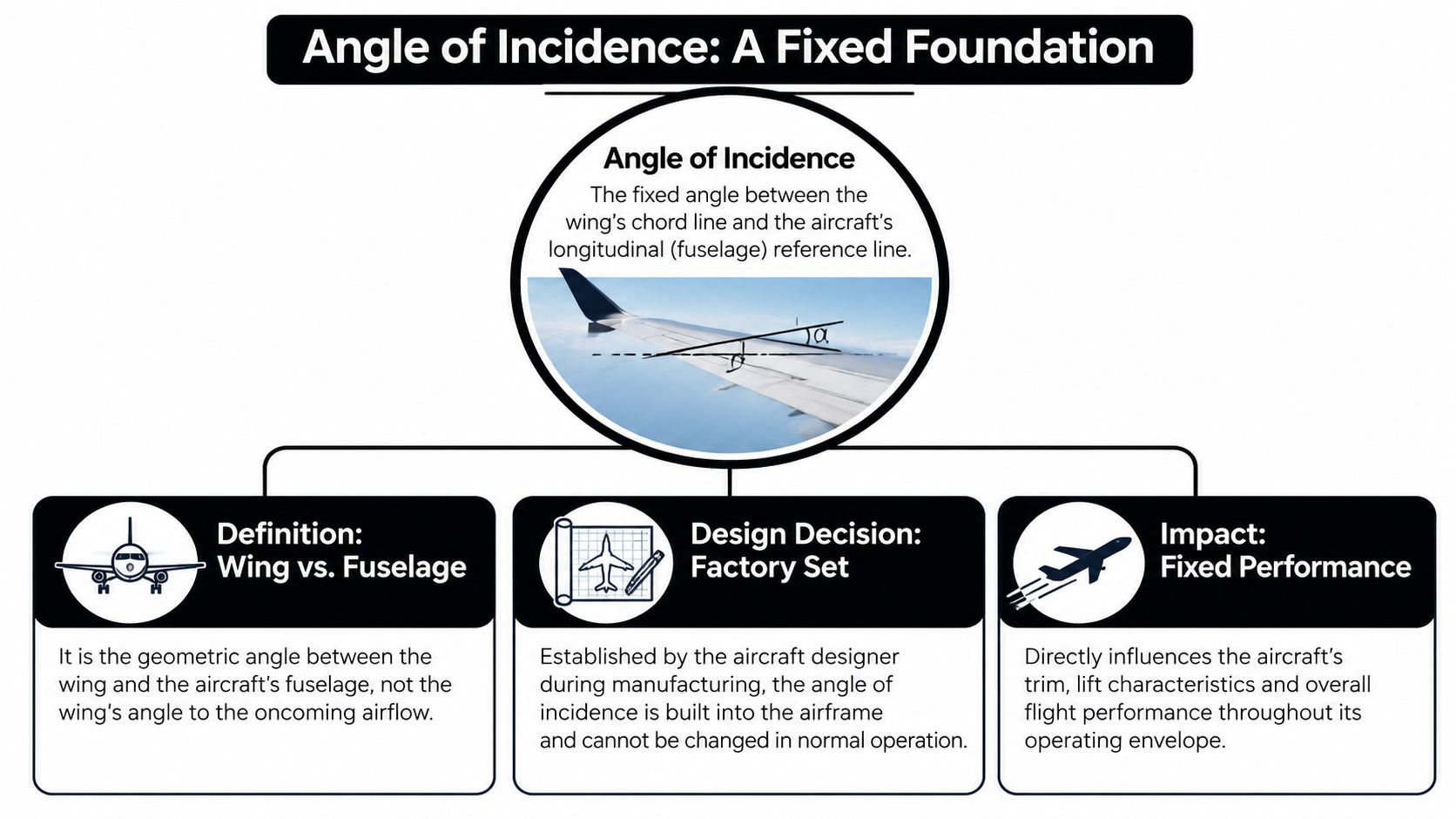
The clean definition is this. Angle of incidence is the angle between the wing's chord line and the aircraft's longitudinal axis. The chord line is the imaginary straight line from the wing's leading edge to trailing edge. The longitudinal axis is the line running nose to tail through the airplane.
The definition pilots actually use
The key word is fixed. You don't move this angle in flight. The designer and manufacturer set it, and from the pilot's seat you live with the result.
A good analogy is a shelf mounted on a wall. Once it's bolted in place, you can put different things on it, but the shelf angle itself doesn't change. The wing is similar. You can change pitch attitude, airspeed, and load factor, but the wing's installed angle relative to the fuselage stays where the factory put it.
On most general aviation aircraft, the angle of incidence is fixed at approximately 6° positive, a benchmark engineered to align the fuselage with the airflow during cruise flight while reducing drag and passenger discomfort and still allowing the wing to generate the lift needed at cruise angle of attack, as described in this angle of incidence discussion.
Why designers build it in
That one design choice affects how the airplane “wants” to sit in normal flight. If the wing is mounted so it can produce useful lift while the fuselage rides at a comfortable, efficient attitude, the airplane feels better in cruise and wastes less energy pushing the body through the air at an awkward angle.
This is why incidence belongs in the same mental category as wing dihedral, tail size, and landing gear geometry. It's a design decision with cockpit consequences.
A pilot can command pitch. The designer has already chosen the wing's starting relationship to the fuselage.
There's another practical point students notice on takeoff. When the relative wind is roughly parallel to the runway during the ground roll, the installed wing angle matters right away because the airplane hasn't climbed away into a very different airflow picture yet. That built-in wing position helps the airplane start producing lift without requiring the fuselage to be perfectly level with the runway.
Keep that sequence clear in your head. The airplane was built with incidence. You later fly it with angle of attack.
Incidence vs Attack The Critical Distinction
If one concept causes the most confusion in private pilot ground lessons, it's this pair. Students hear “angle” twice and assume the terms are interchangeable. They aren't even measured against the same reference.
The cockpit version of the difference
Angle of incidence compares the wing to the airplane. Angle of attack compares the wing to the relative wind.
That second one changes constantly. Pull back, and angle of attack increases. Ease forward, and it decreases. Add power and accelerate in level flight, and the relationship may change again. Enter a flare, and angle of attack rises. Recover from a stall, and the first priority is lowering angle of attack.
If you want a deeper companion read focused on the variable side of this topic, this overview of angle of attack fundamentals is a useful next step.
Angle of Incidence vs. Angle of Attack At a Glance
| Attribute | Angle of Incidence | Angle of Attack |
|---|---|---|
| What it compares | Wing chord line to the airplane's longitudinal axis | Wing chord line to the relative wind |
| Fixed or changing | Fixed | Changing in flight |
| Who sets it | Aircraft designer and manufacturer | The pilot, airflow, and flight condition |
| Can the pilot change it directly | No | Yes |
| Why it matters | Establishes baseline wing-fuselage geometry | Determines lift behavior and stall margin in the moment |
| Typical place you discuss it | Preflight, design, maintenance, aircraft characteristics | Takeoff, climb, slow flight, stalls, approach, flare |
Where students usually mix them up
The most common mistake sounds like this: “When I pitched up, I increased the angle of incidence.” No. You increased the wing's angle relative to the airflow. The wing did not get remounted in flight.
The second mistake shows up in stall discussions. Some students think a stall happens only when the nose gets too high. That's also not right. A stall happens when the wing exceeds a critical angle of attack. The nose attitude might be high, low, or somewhere in between depending on the situation.
If the airplane feels mushy, the controls soften, and the stall horn starts talking to you, think angle of attack first.
This distinction pays off in every phase of flight. In climbout, you manage angle of attack with pitch. In approach, you balance it with power and attitude. In turbulence, you protect margin above the stall by respecting what the wing sees, not just what the nose looks like from the cockpit.
Once that clicks, aerodynamics gets simpler. You stop memorizing terms and start seeing cause and effect.
How Incidence Engineering Shapes Flight
Aircraft designers don't choose incidence casually. That fixed wing mounting angle influences takeoff feel, cruise attitude, and how the airplane behaves when the wing gets close to stalling.

Takeoff cruise and the designer's tradeoff
A wing installed at a higher incidence can help an airplane generate lift at lower speeds. That's helpful during takeoff, when the relative wind is aligned with the runway and the built-in wing angle plays a direct role in early lift production.
But design is always a compromise. More incidence can support low-speed lift, while cruise efficiency pushes designers to keep the fuselage aligned cleanly with the airflow. The final answer depends on what the airplane is meant to do. A basic trainer, a military airplane, and a sleek personal cruiser won't all be optimized the same way.
You can see this tradeoff in how pilots use performance planning. Numbers in the POH matter because the airplane's geometry, drag profile, and lifting surfaces all work together. That's one reason it helps to study aircraft performance charts as part of understanding what the airframe was built to do.
Why washout makes stalls friendlier
There's a related design feature students should know because it shows up in real handling. Wing washout is a deliberate reduction in angle of incidence from the wing root to the tip.
According to this washout explanation, the reduction at the tip is typically 1–3° relative to the root, and that setup helps the wing root stall before the tips, preserving aileron effectiveness during the early stages of the stall.
That matters because the ailerons live near the outer wing. If the tips stalled first, roll control could disappear right when you need it most.
A well-behaved trainer usually gives you warning before it gives you trouble.
The same source notes that washout is a critical aerodynamic design feature that preserves control and helps prevent abrupt yaw-roll coupling. That's one reason training airplanes can feel so honest in slow flight and stalls. They're built to talk to you before they bite.
A student doesn't need to become an aeronautical engineer to benefit from this. You just need to connect the feeling in the cockpit to the shape in the hangar. When a trainer stalls in a more predictable way, the wing was often designed that way on purpose.
Incidence in Action At DuBois Aviation
The theory becomes real when you look at the aircraft students fly. A Piper Cherokee and a Cessna 150 are both known for stable, forgiving training manners, and part of that comes from how their wings and tails were designed to work together.
What you notice in common trainers
In a Cherokee, students often notice that the airplane feels straightforward in the flare and predictable in slow flight. In a Cessna 150, they often notice clear pitch feedback and docile training behavior. You don't need a precise factory number in front of you to understand the practical point. The airplane's installed wing geometry is part of why it behaves the way it does.
The Mooney M20B offers a useful contrast. It's a cleaner, faster airplane, and pilots usually experience it as more speed-oriented and less “floaty” in overall character than a basic trainer. That doesn't mean one design is better. It means design choices reflect mission.
A helpful habit for advancing students is to ask these questions during transition training:
- How does it sit in cruise: Does the fuselage feel level, slightly nose-up, or noticeably different from the trainer you're used to?
- How does it break in a stall: Is the warning gentle and progressive, or sharper and more performance-oriented?
- What does pitch feel like on approach: Some airplanes reward tiny corrections. Others tolerate a broader touch.
Those observations don't replace the POH, the maintenance manual, or the Type Certificate Data Sheet. They help you connect paper data to seat-of-the-pants flying.
How helicopters fit the conversation
Helicopters make students rethink the whole topic. You don't usually talk about wing incidence the same way because the rotor system is doing the lifting, and the blades are changing pitch as they rotate.
In an Enstrom or Robinson helicopter, the pilot uses collective to change blade pitch more broadly and cyclic to vary the rotor disc's attitude and lift distribution through the turn of the blades. That isn't identical to fixed-wing incidence versus angle of attack, but it's a useful bridge. In rotary-wing flying, blade pitch and airflow relationships are active, changing parts of normal control use.
That's why helicopter students often develop a very intuitive feel for “what the air sees.” Fixed-wing students benefit from that mindset too. Even when the wing incidence is fixed, the airflow picture is never static.
Buying an Airplane The Safe Way
Learning what makes an airplane fly well is one kind of aeronautical knowledge. Learning how to buy one safely is another. The second one matters just as much once you start looking at ownership, partnerships, or moving up to your own airplane or helicopter.
What needs to be in writing before inspection
The safest habit is simple. Get a formal purchase agreement signed before the pre-buy inspection. According to this aircraft buying protection guide, the agreement should set the agreed price, address what happens if the inspection finds issues, and include language that the aircraft is sold “as is” with no warranties on condition except clear title delivery.
That same guidance says the contract must include exact aircraft details such as make, model, serial number, and registration number, plus the total purchase price, deposit amount, and the buyer's inspection rights. It also notes that deposits are typically 5% to 10% upfront and that state laws require written contracts for aircraft purchases over $500.
This is not paperwork for paperwork's sake. A handshake deal leaves too much room for memory gaps, assumption gaps, and expensive disagreement.
Put every promise in writing. If the seller says it matters, the contract should say it too.
Safe habits for airplane and helicopter buyers
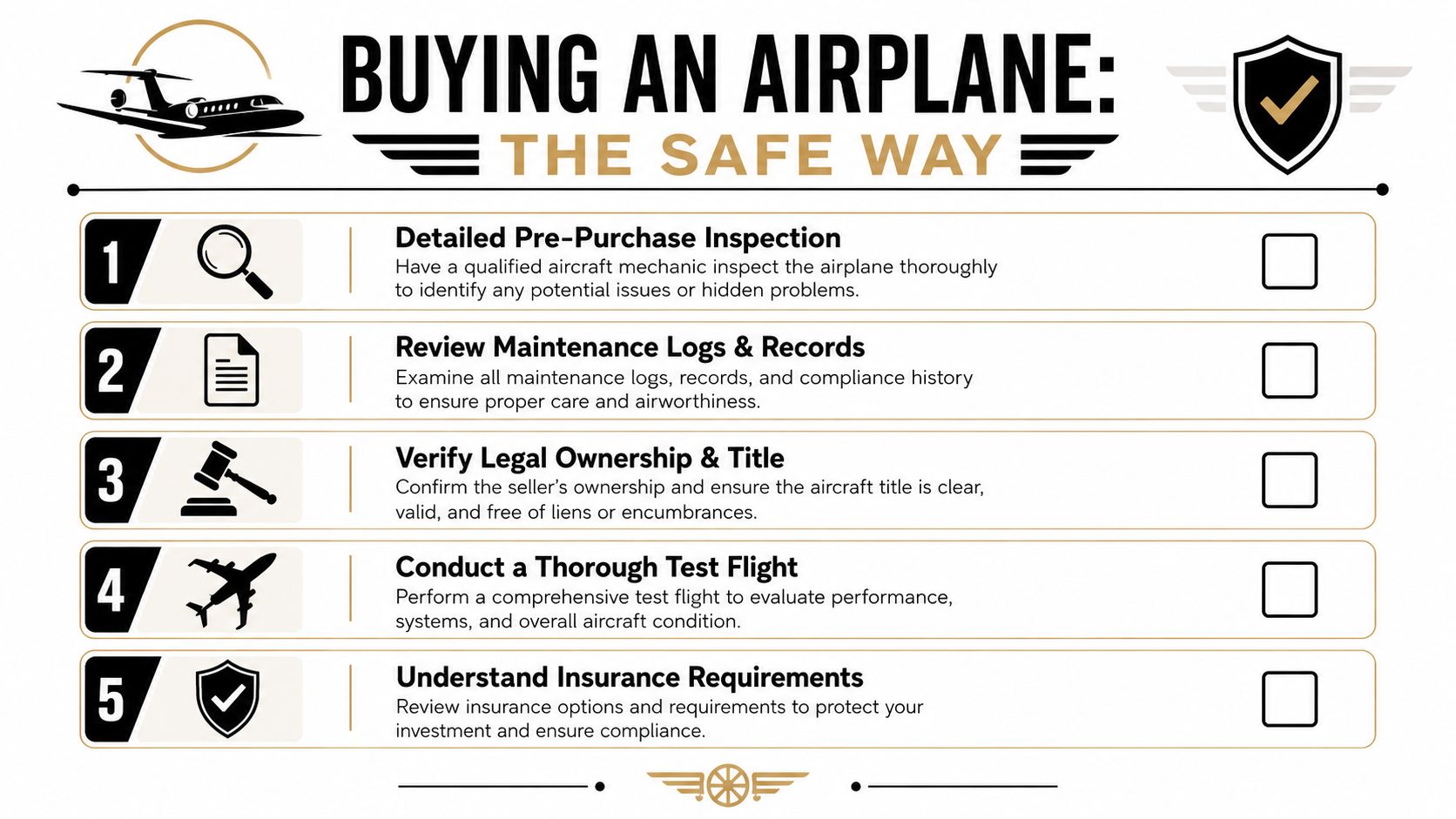
A smart buyer also looks beyond the sales pitch. You want the logs, the title picture, the inspection rights, and a realistic sense of how the aircraft has been operated and maintained.
A practical checklist looks like this:
- Start with identity: Match the make, model, serial number, and registration to the records and the aircraft itself.
- Treat the pre-buy as independent: Use a mechanic or shop that works for the buyer, not the seller.
- Read the logs for patterns: You're looking for continuity, damage history, recurring squawks, and the general quality of maintenance.
- Think operationally: If you're buying a useful-load-sensitive aircraft, understanding aircraft weight and balance basics is part of buying wisely, not something to postpone until after the sale.
- Apply the same discipline to helicopters: The airframe changes, but the need for records, title clarity, inspection rights, and written terms doesn't.
People looking to buy or sell airplanes and helicopters often focus on cosmetics first. Paint and interiors matter, but paperwork, maintenance history, and contract language protect you longer than shiny seats ever will.
Angle of Incidence FAQs for Student Pilots
Quick answers that clear up common confusion
Can a pilot change the angle of incidence in flight?
No. In normal fixed-wing training aircraft, it's a built-in structural relationship between the wing and fuselage.
So what am I changing when I pull back on the yoke?
You're changing the wing's relationship to the relative wind. That means angle of attack changes, not incidence.
Does angle of incidence affect stall speed?
It affects the airplane's design baseline and low-speed characteristics, but from the cockpit, stall awareness still comes back to angle of attack. That's the variable you manage in the moment.
Is angle of incidence the same term used in optics?
The same phrase appears in other fields, but it means something different there. In aviation, we're talking about aircraft geometry, not a light ray striking a surface.
Why do training airplanes feel more forgiving near a stall than some higher-performance airplanes?
A big part of that comes from overall design, including wing shape, tail design, and features such as washout that help preserve control as the stall develops.
Can I find incidence data for a specific airplane?
Sometimes. You may find it in the maintenance manual, approved technical documents, or the Type Certificate Data Sheet.
What's the single best takeaway for a student pilot?
Keep the references straight. Incidence compares wing to fuselage. Angle of attack compares wing to airflow.
Why does this matter on a practical checkride?
Because checkrides reward understanding, not word association. An examiner wants to see that you know what the airplane was built with and what you control in real time.
If you remember only one line, remember this. Incidence is built in. Angle of attack is flown.
If you're ready to turn aerodynamic theory into real cockpit experience, DuBois Aviation offers one-on-one airplane and helicopter instruction, aircraft rental, and personalized training at Chino Airport. It's a strong place to learn how these concepts show up in preflight, takeoff, slow flight, stalls, and every lesson that follows.


