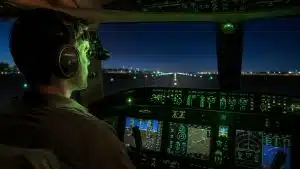
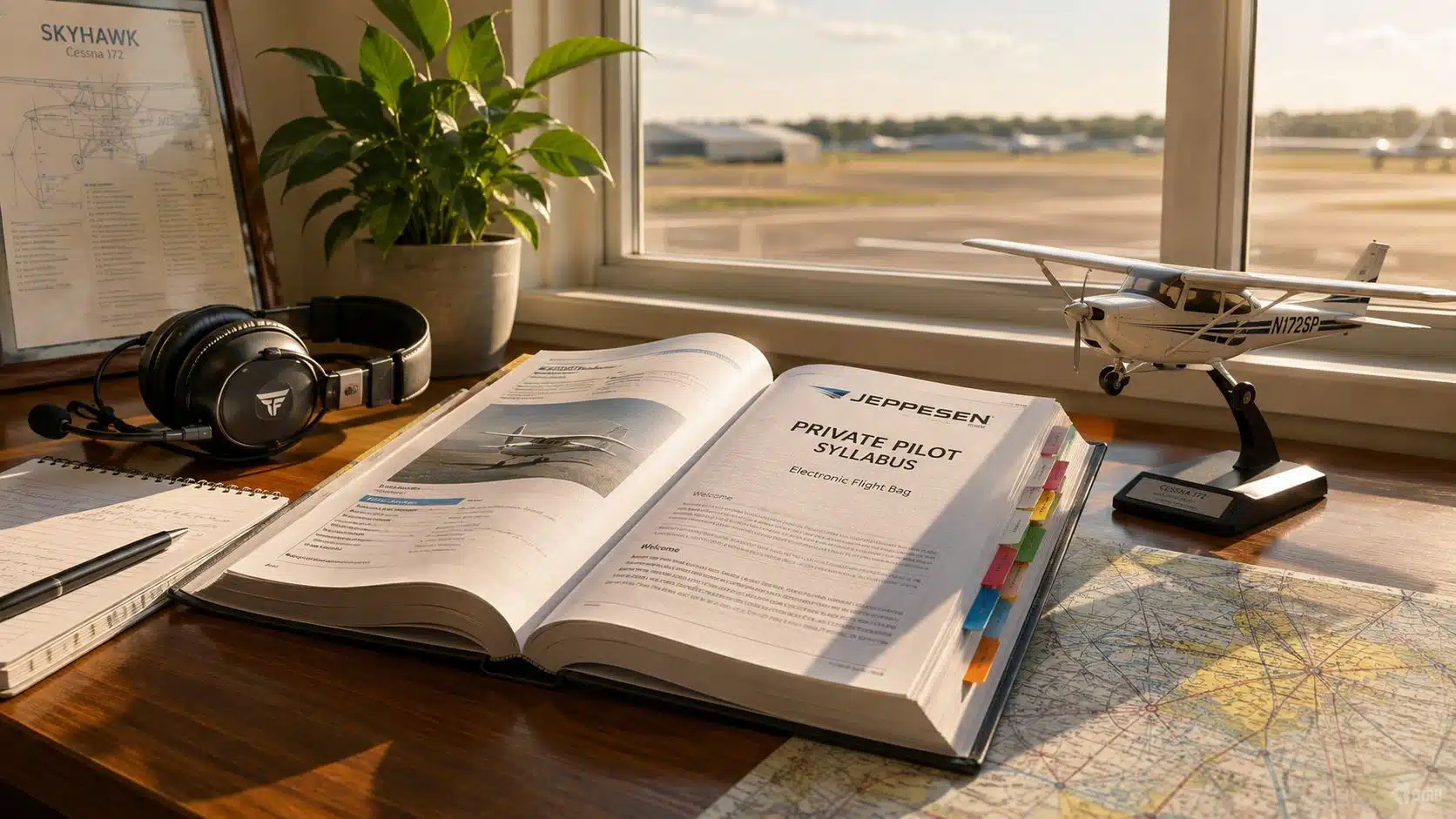
The Jeppesen private pilot syllabus organizes training into three ground stages and three flight stages, totaling 35 ground lessons, 27 flight lessons, and four flight checks, using a building-block sequence aligned with FAA-S-ACS-6C. That structure turns private pilot training into a coordinated progression instead of a loose collection of lessons.
A new student often encounters the syllabus while trying to answer a practical question: what happens after the discovery flight, and how does each lesson lead toward solo and the checkride? At a busy Class D airport such as Chino Airport, the answer involves more than practicing takeoffs and landings. The student must learn airport communications, weather decisions, airspace, navigation, aircraft control, emergency procedures, and the judgment needed to manage all of them together.
The syllabus gives the instructor and student a shared map. It doesn't eliminate weather delays, aircraft availability problems, or the need to repeat a lesson. Instead, it shows what the student should learn, what must be demonstrated, and which gaps need attention before training moves forward.
Two practical options worth comparing
These are specific products pilots commonly compare for this type of flying. Confirm compatibility with your aircraft and instructor before ordering.
 Student headsetDavid Clark H10-13.4 Aviation HeadsetCheck current availability on Amazon (paid link)
 OrganizationASA Flight BagCheck current availability on Amazon (paid link)
Table of Contents
- What the Jeppesen Private Pilot Syllabus Actually Does
- Building-Block Design and the Part 141 Part 61 Question
- Ground Training Stages and Knowledge Testing
- Flight Training Stages and the Four Flight Checks
- Sample Weekly Schedule and Hour Planning
- Stage-by-Stage Habits That Prevent Common Mistakes
- Knowledge Test, Checkride Prep, and the End-of-Course Picture
- Key Takeaways and Pre-Enrollment Questions
What the Jeppesen Private Pilot Syllabus Actually Does
The Jeppesen private pilot syllabus functions as the operating framework for training. It coordinates ground instruction, flight lessons, stage exams, flight checks, lesson records, and preparation for the FAA practical test. Jeppesen describes the syllabus as a framework for both Part 141 and Part 61 ground and flight training, using a building-block method in which each lesson develops material the student has already practiced or mastered. The current product description identifies that structure directly.
The record format divides training into three ground-training stages with 35 ground lessons and three flight-training stages with 27 flight lessons and four flight checks. Jeppesen's Private Record Syllabus presents the stages and checks as an organized training record, not merely a reading list.
Why the current alignment matters
The 2024 syllabus update aligns ground and flight lessons with FAA-S-ACS-6C. It also incorporates topics such as energy management, graphic weather products, and threat-and-error management. Jeppesen's product update information connects those additions to the current certification standard.
That alignment matters because the practical test evaluates tasks and knowledge areas through the Airman Certification Standards. A student who studies one subject on the ground but practices an unrelated version of it in the airplane can develop a preventable gap. An ACS-aligned syllabus helps the CFI connect the briefing, the cockpit exercise, the stage check, and the eventual checkride standard.
At DuBois Aviation, a student can use the syllabus alongside the school's private pilot license training to understand what each lesson is intended to accomplish. The same principle applies to any flight school. A useful instructional-design perspective is available in this guide to build better lessons with MEDIAL, especially for understanding how objectives, practice, and assessment should reinforce one another.
Practical rule: A lesson isn't complete just because the airplane returned to the ramp. The student and instructor should know what was introduced, what was practiced, and what must be improved next.
Building-Block Design and the Part 141 Part 61 Question
The building-block method is simple to describe but important to apply. Early lessons establish aircraft control and basic operating habits. Later lessons combine those skills with navigation, radio work, weather interpretation, performance planning, and judgment. If a student struggles with consistent airspeed control in the pattern, the instructor may delay more complex solo or cross-country objectives until that weakness is under control.
The syllabus supports both training paths, but the daily experience can differ.
| Training path | How the syllabus commonly functions |
|---|---|
| Part 141 | The school follows an approved, structured course sequence with stage checks and documented progress requirements. |
| Part 61 | The instructor uses the syllabus as an organized framework while adapting pacing, lesson order, and review to the student. |
The distinction doesn't mean one path teaches a different certificate. It means the school and instructor may have different procedures for sequencing lessons, documenting progress, and authorizing advancement. A Part 141 student usually encounters clearer stage boundaries. A Part 61 student may revisit subjects or combine lesson elements more freely when weather, aircraft access, or individual learning needs require it.
Why ground and flight should connect
The older syllabus description states that ground and flight training should be taught concurrently when possible. That pairing makes practical sense. A weather briefing becomes more useful after the student has applied it to a real departure. A discussion of airspace becomes easier to retain after the airplane has approached a controlled airport and the student has communicated with the tower.
The 35 ground lessons and 27 flight lessons are therefore not two isolated courses. They are parallel tracks. A student may study navigation on the ground, practice headings and pilotage in the airplane, review the result afterward, and then carry the corrected method into the next lesson.
At a busy towered airport, the instructor may adjust the lesson emphasis without abandoning the syllabus objective. A congested pattern could turn a planned landing lesson into a lesson on sequencing, spacing, go-arounds, and radio discipline. The building block remains intact, but the student learns to operate in conditions that resemble real flying rather than a perfectly quiet practice environment.
Ground Training Stages and Knowledge Testing
At a busy Class D airport, a student may study airspace in the morning and apply that knowledge during a towered departure later the same day. Ground training supplies the reasoning behind those cockpit actions. The three ground stages distribute 35 lessons across the private pilot course, with stage exams checking academic readiness before advancement. The syllabus record outlines the stage sequence, lesson topics, and exams.
Lesson titles can vary by syllabus edition and school procedures. The progression usually remains cumulative, so each stage adds working knowledge rather than replacing what came before.
Stage one builds the vocabulary
The opening ground stage gives the student the language needed to understand the airplane and the airport:
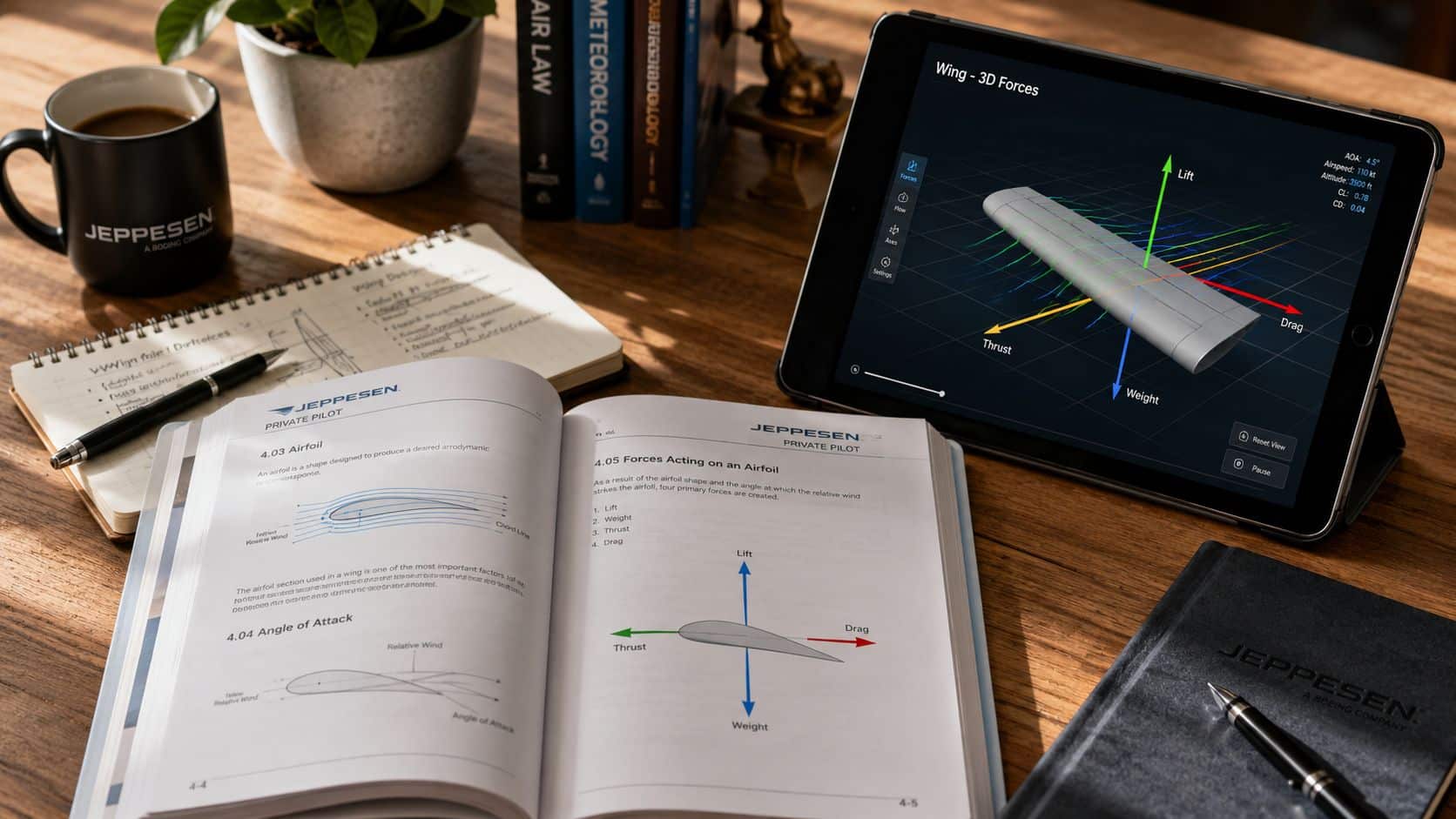
- Aerodynamics: How lift, weight, thrust, drag, angle of attack, and configuration affect performance.
- Aircraft systems: Controls, instruments, engine operation, fuel, electrical equipment, and aircraft limitations.
- Regulations: Operating rules and pilot responsibilities for private flying.
- Airport operations: Runway markings, traffic patterns, lighting, radio procedures, and controlled-airport expectations.
At Chino Airport, those subjects quickly become practical questions. Which runway is active? What does the tower instruction require? Where should the student look for traffic? Does the planned maneuver fit the airplane's limitations? A good briefing prepares the student to answer those questions before engine start, not after a radio call creates pressure.
Stage two connects knowledge to decisions
The middle ground stage develops weather, airspace, navigation, communications, and performance. Students read forecasts and observations, identify airspace requirements, plan routes, calculate fuel and aircraft performance, and revise a plan when conditions change.
The 2024 update gives added attention to energy management, graphic weather products, and threat-and-error management. These subjects support daily decisions in both the classroom and the airplane. Energy management, for example, affects approach planning, go-arounds, runway selection, and the decision to continue or discontinue an approach. It works like managing a limited margin: altitude, airspeed, runway, and attention must be available at the right time.
Understanding how people learn can improve study habits during ground training. Students can browse psychology 101 materials to explore learning and decision-making concepts, while relying on the syllabus, the instructor, and current FAA publications for aviation-specific instruction.
Stage three prepares the student to explain choices
The final ground stage revisits performance, weather, navigation, regulations, emergencies, and practical-test decision-making at a higher level. The student should explain what action is appropriate and why it fits the aircraft, conditions, route, and pilot situation.
Stage exams do not replace the FAA knowledge test. They give the instructor a defined checkpoint for finding weak areas before the student schedules or takes that exam. A student who struggles with airspace, weather interpretation, or aircraft performance needs targeted review, even when recent flight lessons appear satisfactory. That review can change the next briefing, the next dispatch decision, or the timing of a solo recommendation.
For the administrative planning involved in the FAA knowledge test, students can consult DuBois Aviation's information about FAA knowledge test locations.
Flight Training Stages and the Four Flight Checks
The flight stages turn academic knowledge into repeatable cockpit performance. The 27 flight lessons progress from aircraft control and basic maneuvers toward navigation, solo operations, emergency procedures, and practical-test preparation. The four flight checks provide formal gates for evaluating whether the student is ready to advance.
The first stage establishes control
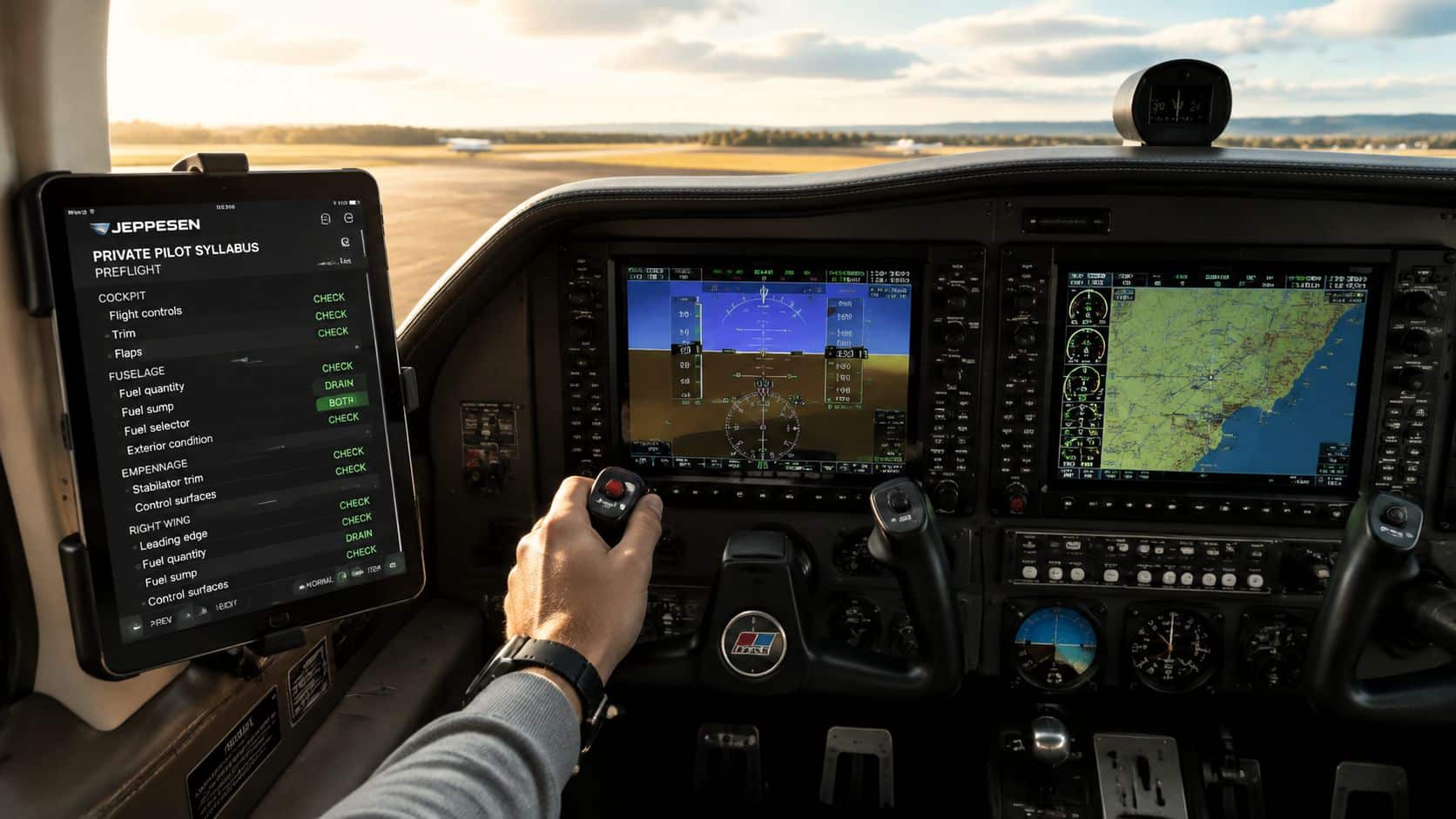
Early flights usually focus on preflight procedures, taxiing, climbs, descents, turns, straight-and-level flight, slow flight, stalls, traffic patterns, takeoffs, and landings. The student isn't expected to perform every task perfectly on the first attempt. The instructor is looking for developing control, appropriate procedures, and the ability to recognize and correct deviations.
At a towered airport, basic flying also includes listening to the radio while maintaining aircraft control. A student may know the correct phraseology during a briefing but still need practice managing a clearance, traffic awareness, checklist use, and runway alignment at the same time.
The second stage combines skills
The middle flight stage brings together cross-country planning, pilotage, dead reckoning, instrument reference, performance management, and more demanding airport operations. The student learns to plan a route, brief weather, calculate aircraft loading and fuel, identify alternates, and revise the plan when conditions change.
Instrument-reference work is especially important because a private pilot must understand how quickly outside visual information can become unreliable. The instructor uses controlled exercises to teach the student to trust appropriate instruments, maintain aircraft control, and recover from an unexpected loss of outside references.
The final stage refines judgment
The final flight stage typically emphasizes short-field and soft-field operations, night training, emergency procedures, cross-country refinement, and practical-test standards. These lessons aren't just a final collection of maneuvers. They test whether the student can select the right procedure, configure the airplane correctly, manage energy, and communicate a decision.
The four flight checks give the CFI opportunities to assess progress before the end-of-course event. A stage check may reveal that a student can perform a maneuver in calm conditions but struggles to explain the risk controls or recognize when a go-around is needed.
A solo endorsement should reflect demonstrated readiness, not a student's impatience with the calendar.
At a busy Class D airport, solo readiness includes more than landing consistency. The instructor must consider radio workload, traffic awareness, runway and taxiway procedures, weather judgment, emergency planning, and the student's ability to stop the flight when conditions exceed the plan.
Sample Weekly Schedule and Hour Planning
The syllabus becomes most useful when the CFI and student turn it into a workable weekly rhythm. For an airplane single-engine private pilot certificate under Part 61, 14 CFR § 61.109 requires at least 40 hours of total flight time, including 20 hours of instructor flight training and 10 hours of solo flight training. The regulation's complete requirements are available through Cornell Law School's publication of 14 CFR § 61.109.
Those figures are regulatory minimums, not a promise that every student will be ready at the same point in the syllabus. Weather, aircraft access, lesson frequency, study habits, proficiency, and the complexity of the operating environment all affect progress. The instructor should use the syllabus to protect continuity without rushing a student through an unfinished skill.
A practical week might include two or three flight lessons and one or two ground sessions, depending on availability. The schedule should pair related subjects whenever possible.
Sample Week in the Middle of Private Pilot Training
| Day | Activity | Syllabus Stage | Focus |
|---|---|---|---|
| Monday | Ground briefing | Ground stage two | Weather interpretation, route planning, and alternate decisions |
| Tuesday | Dual flight | Flight stage two | Local navigation, traffic awareness, and changing the plan when conditions shift |
| Thursday | Ground review | Ground stage two | Airspace, communications, and performance planning |
| Saturday | Dual flight | Flight stage two | Cross-country procedures, checkpoints, aircraft configuration, and diversion practice |
The Monday briefing should not become a disconnected lecture. The student can use the weather information to build a route, identify threats, and decide what would cause a delay or cancellation. On Tuesday, the instructor can ask the student to verbalize those decisions while managing the airplane.
How the rhythm changes
Before solo, the schedule usually concentrates on aircraft control, traffic patterns, abnormal situations, and local procedures. After solo, the student adds supervised planning and individual flights while continuing dual instruction. Cross-country preparation then requires more attention to navigation logs, weather updates, fuel planning, airport information, and diversion options.
Near the checkride, ground and flight lessons become more integrated. The instructor may use scenario-based flights that require the student to plan, brief, fly, communicate, monitor performance, and explain decisions. The syllabus acts as a planning record, while the CFI decides whether the student has demonstrated the required proficiency.
Stage-by-Stage Habits That Prevent Common Mistakes
Students often struggle for predictable reasons. Early in training, the cockpit is full of unfamiliar tasks. In the middle stage, workload expands because navigation and decision-making join basic aircraft control. Near the checkride, students sometimes focus on performing maneuvers while neglecting judgment, documentation, or realistic emergency preparation.
The following comparison helps students identify the habit that should replace each common mistake.
Stage-by-Stage Habits and Pitfalls
| Stage | Common Mistake | Better Habit |
|---|---|---|
| Early ground and flight | Memorizing a maneuver without understanding its objective | Explain the desired aircraft state, control inputs, entry conditions, recovery cues, and safety considerations |
| Early pattern work | Focusing on landing completion instead of stabilized approach criteria | Monitor airspeed, glide path, alignment, configuration, and spacing, then go around when the approach no longer supports a safe landing |
| Middle ground training | Studying isolated answers without connecting them to flight decisions | Apply weather, airspace, performance, and navigation knowledge to a complete route or scenario |
| Middle cross-country work | Arriving at the airport without a current plan for fuel, alternates, or diversion | Brief the route before departure and identify specific triggers for changing or ending the plan |
| Middle radio operations | Rehearsing calls so intensely that aircraft control suffers | Fly the airplane first, listen actively, write down clearances when appropriate, and ask for clarification |
| Final-stage training | Treating night and emergency lessons as boxes to check | Practice recognition, prioritization, aircraft control, communication, and decision-making under realistic workload |
| Checkride preparation | Repeating favorite maneuvers while avoiding weak tasks | Use the ACS and stage-check feedback to build a targeted practice plan with the CFI |
The building-block sequence helps surface these problems early. If the student can't explain the purpose of a maneuver or maintain control while communicating, the instructor has a clear reason to slow the progression. Repeating a lesson isn't failure. It prevents an unresolved weakness from becoming a larger problem during solo, cross-country, or checkride preparation.
A useful self-audit after every lesson asks three questions:
- What task improved?
- What error appeared repeatedly?
- What action will prevent that error next time?
Students who record those answers create a more useful training history than students who only record the lesson title.
Knowledge Test, Checkride Prep, and the End-of-Course Picture
The final phase should feel like a confirmation of prepared skills, not a sudden new course. The 2024 alignment with FAA-S-ACS-6C helps the instructor connect the final lesson set to the standards the evaluator will use, including knowledge, risk-management, and skill elements.
Consider a representative student who has completed the final flight stage and passed the relevant stage checks. The CFI reviews lesson sign-offs, confirms that required training and endorsements are documented, and identifies any ACS areas that still need practice. Ground review then focuses on the student's actual weak areas, such as weather decisions, performance calculations, airspace interpretation, or emergency priorities.
The syllabus supports this process by keeping the training record organized. It shows what the student studied, what the instructor evaluated, and which flight lessons prepared the student for the practical test. That record helps the CFI make a defensible readiness decision instead of relying on a general feeling that the student “seems ready.”
The student should also expect the practical test to involve explanation as well as aircraft control. A checkride preparation flight may require a route briefing, aircraft and weather review, normal and abnormal procedures, communications, navigation, and a clear response when the scenario changes.
Students who want a more deliberate final preparation process can use a checkride-ready training plan with their instructor. The essential principle remains the same: the student should be able to demonstrate the standards consistently and explain the decisions that support safe operation.
Key Takeaways and Pre-Enrollment Questions
The Jeppesen syllabus gives private pilot training a visible structure. It organizes three ground stages, three flight stages, 35 ground lessons, 27 flight lessons, and four flight checks, while the current edition aligns lessons with FAA-S-ACS-6C. It supports both Part 141 and Part 61 training, but the school and instructor still determine how much pacing and lesson adaptation a particular student needs.
Before enrolling, a prospective student should ask:
- Which syllabus edition is being used? Confirm that the school is working from a current edition and understands the ACS alignment.
- How are stage checks conducted? Ask who performs them, what records are completed, and how unsatisfactory areas are corrected.
- How are ground and flight lessons coordinated? A strong schedule connects academic subjects to cockpit practice.
- How does the school handle weather and aircraft availability? The answer should include a realistic rescheduling and review process.
- How are solo and checkride decisions made? Look for demonstrated proficiency and judgment, not an automatic calendar milestone.
Frequently asked questions
How long does private pilot training usually take?
Training time depends on lesson frequency, weather, aircraft access, study habits, and individual proficiency. The FAA minimum is a regulatory floor, while the syllabus provides the progression used to evaluate readiness.
What happens if a student doesn't pass a stage check?
The instructor identifies the unsatisfactory tasks, provides additional instruction, and schedules another evaluation when the student is prepared. A stage check is a quality-control point, not a reason to hide weaknesses.
Can the syllabus support accelerated training?
Yes, the same organized sequence can support a concentrated schedule, provided the student retains the material and demonstrates proficiency. Accelerated training compresses calendar time, but it doesn't remove the need for ground preparation, flight checks, review, or safe solo judgment.
Is the syllabus only for Part 141 students?
No. Jeppesen describes it as a framework for both Part 141 and Part 61 training. Part 61 instructors generally have more flexibility to adapt pacing and lesson order to the student.
Students comparing private pilot programs can ask DuBois Aviation how its Jeppesen-based ground and flight instruction is organized at Chino Airport, including stage checks, scheduling, aircraft access, and preparation for later instrument or commercial training. Visit DuBois Aviation to request training information or discuss a course plan with the school.