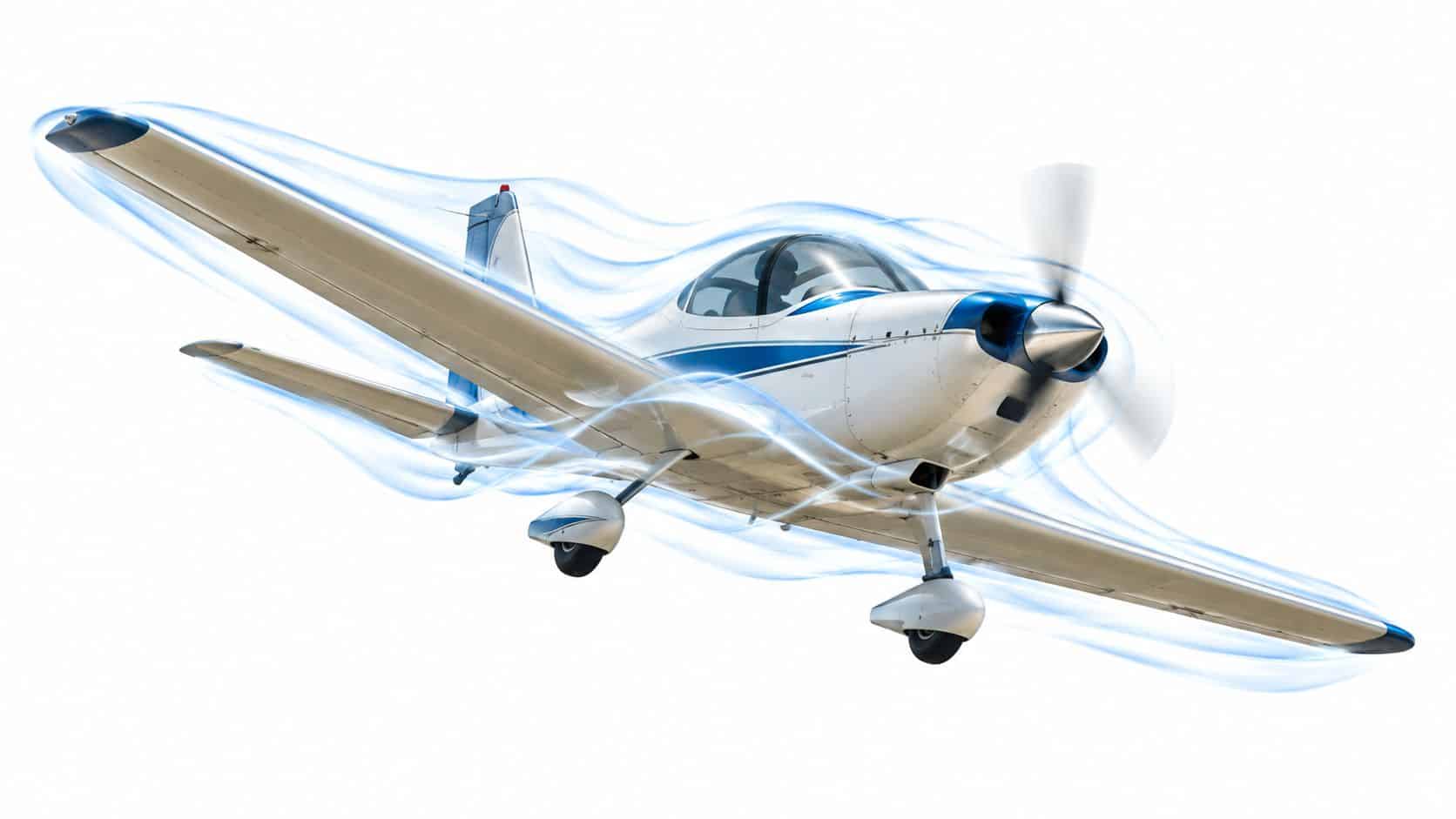
A student pilot adds full power, the engine note rises, and the nose starts drifting left before the airplane has built much speed. Left turning tendencies are the combined effects that produce this behavior in a conventional single-engine airplane with a propeller rotating clockwise when viewed from the cockpit. The four causes are torque reaction, spiraling slipstream, gyroscopic precession, and P-factor. Pilots learn to anticipate them with coordinated rudder, aileron, and pitch control, especially during takeoff, climb, and slow flight.
For pilots training at a busy airport such as Chino, that anticipation matters during runway alignment, radio work, crosswind correction, and the first moments after liftoff. The same fundamentals also support later work in multi-engine ratings, where asymmetric thrust creates a more demanding control problem.
Table of Contents
- Feeling the Pull During Takeoff
- The Four Aerodynamic Causes Explained
- When Left Turning Tendencies Matter Most
- Fixed-Wing Airplanes Versus Helicopters
- Practical Mitigation and Fleet-Specific Training
- Common Mistakes and Checkride Expectations
Feeling the Pull During Takeoff
During the takeoff roll, the airplane may feel as though it wants to leave the centerline even though the pilot hasn't deliberately turned the nose. The first response shouldn't be a sharp control movement or heavy brake pressure. The pilot needs to recognize the developing yaw, apply smooth corrective rudder, and continue checking the airplane's track against the runway.
In a conventional tractor airplane, the engine and propeller rotate clockwise from the cockpit. That rotating system transfers a reaction into the airframe, while the propeller also sends disturbed air around the fuselage. As the airplane accelerates and the nose rises, additional aerodynamic effects increase the tendency for the nose to yaw left and, in some conditions, for the airplane to roll left.
The term left turning tendencies describes the combined result, not one single force. The FAA treats the phenomenon as four distinct elements of the airplane's overall twisting or rotating motion around its longitudinal, vertical, or lateral axes. Those elements are:
- Torque reaction, which tends to roll the airframe counterclockwise, or left.
- Spiraling slipstream, which can strike the left side of the vertical stabilizer and create left yaw.
- Gyroscopic precession, which matters when the pilot changes the propeller's plane of rotation, particularly during pitch changes.
- P-factor, also called asymmetric propeller loading, which produces more thrust on the right side of a typical clockwise-turning propeller disk during a nose-high attitude.
Practical rule: The pilot shouldn't wait for a large heading change. Small, early rudder inputs are smoother and more effective than a late, aggressive correction.
The effect is most noticeable when power is high, airspeed is low, and the airplane is nose-high. Those conditions occur together during the takeoff roll, initial climb, and power-on maneuver training. As airspeed increases, the rudder and ailerons become more effective, and the pilot may need less control pressure to maintain the desired attitude and heading.
The correct cockpit question isn't “How much right rudder is always required?” It is “What is the airplane doing right now?” Power, pitch, speed, wind, propeller design, and aircraft configuration all influence the required correction. That mindset produces better coordination, safer departures, and more reliable checkride performance than memorizing a fixed control position.
The Four Aerodynamic Causes Explained
A propeller-driven airplane responds to several forces at the same time. Separating them makes the airplane's behavior easier to predict.
Torque reaction rolls the airplane
Newton's third law provides the simplest starting point. If the engine turns the propeller clockwise, the airframe experiences an equal and opposite reaction. In the conventional configuration described by the FAA, that reaction tends to roll the airplane counterclockwise, or left.
Torque primarily creates a rolling moment, not a direct yawing force. The pilot may see the left wing drop or feel pressure building toward a left bank. Aileron can help maintain the desired bank, but aileron alone isn't a substitute for rudder when the airplane is yawing.
Spiraling slipstream reaches the tail
The propeller accelerates air rearward and gives that airflow a rotational, corkscrew pattern. The helical wake can wrap around the fuselage and strike the left side of the vertical stabilizer. That contact pushes the tail to the right and yaws the nose left.
This effect is strongest when the propeller is producing substantial airflow and the airplane's forward speed is still low. It can therefore contribute noticeably during the early takeoff roll and initial climb. The relationship between yaw and roll is also important, which is why coordinated control concepts connect naturally with adverse yaw.
P-factor changes thrust across the disk
P-factor is asymmetric propeller loading. When the airplane has a high angle of attack, the propeller disk is tilted relative to the incoming airflow. In a typical American-built airplane with a clockwise-turning propeller, the descending blade on the right side encounters a greater effective angle of attack than the ascending blade on the left.
The right-hand blade therefore produces more thrust. Because that thrust acts to the right of the propeller's center, it creates a left-yawing moment. The nose-high attitude of a climb or power-on stall makes this effect especially important.
Gyroscopic precession appears during attitude changes
A spinning propeller behaves like a gyroscope. When a force changes its plane of rotation, the reaction is felt approximately 90 degrees ahead in the direction of rotation. The result isn't a constant left-turning force that has the same influence throughout flight.
Gyroscopic precession becomes relevant during rapid pitch changes, such as raising the tail during takeoff or changing pitch during a maneuver. Its contribution depends on the direction and rate of the aircraft's movement. A pilot who understands that timing can connect a brief control movement with the aircraft's response instead of treating the reaction as mysterious.
The four effects can act together, but they don't contribute equally at every moment. Torque and slipstream respond strongly to power, P-factor responds strongly to angle of attack, and gyroscopic precession responds to changes in the propeller's orientation. That is why the airplane's leftward behavior changes as the takeoff develops.
When Left Turning Tendencies Matter Most
Left turning tendencies aren't a constant force of equal strength. They become most operationally significant when the airplane combines high power, low airspeed, and high angle of attack, which is why students feel them most clearly during departure and power-on training.
Takeoff roll and initial climb
At the start of the takeoff roll, engine power is high while forward speed is still developing. Torque reaction and spiraling slipstream are already influencing the airplane. As the tail rises, gyroscopic precession becomes relevant because the propeller's plane of rotation is changing.
After liftoff, the nose-high climb attitude increases P-factor. The descending right blade produces more thrust than the ascending left blade, shifting the effective thrust and creating additional left yaw. At the same time, the airplane's control surfaces have less aerodynamic authority than they will have at a higher airspeed.
The pilot should therefore expect the required right-rudder pressure to change during the sequence. A setting that was appropriate early in the roll may not be correct after liftoff, and a correction that works in the climb may be excessive after acceleration.
Slow flight and power-on stalls
Slow-flight training reproduces the conditions that make these tendencies noticeable. The airplane operates near a high angle of attack, and the pilot may use substantial power to maintain altitude or recover from a stall.
During a power-on stall, the airplane can yaw and roll left as the nose rises and thrust remains high. The pilot must maintain directional control while managing pitch and angle of attack. The response should be coordinated, not a sudden attempt to force the nose back with aileron alone.
A useful cockpit scan includes:
- Heading and ground track, to identify yaw before it becomes large.
- Bank attitude, to detect the rolling component.
- Rudder coordination, using control feel and the slip-skid ball.
- Power and pitch, because both change the strength of the tendencies.
- Wind direction, because crosswind effects can reinforce or oppose the airplane's motion.
Crosswind interaction
Crosswind weathervaning adds another variable. In a left crosswind, the wind's tendency to turn the airplane into the wind can compound left yaw from power. In a right crosswind, weathervaning can partly oppose the power-induced yaw and temporarily mask it.
That doesn't eliminate the need for active control. A pilot who relies on a memorized “right rudder” setting may be surprised when wind, power, or pitch changes alter the combined result. The better habit is to track the runway centerline, recognize the actual yaw, and adjust smoothly.
In cruise, higher airspeed improves rudder and aileron effectiveness, while power and angle of attack are usually less concentrated in the takeoff combination. The tendencies still exist as aerodynamic effects, but they generally demand less conscious correction than they do during low-speed, high-power operations.
Fixed-Wing Airplanes Versus Helicopters
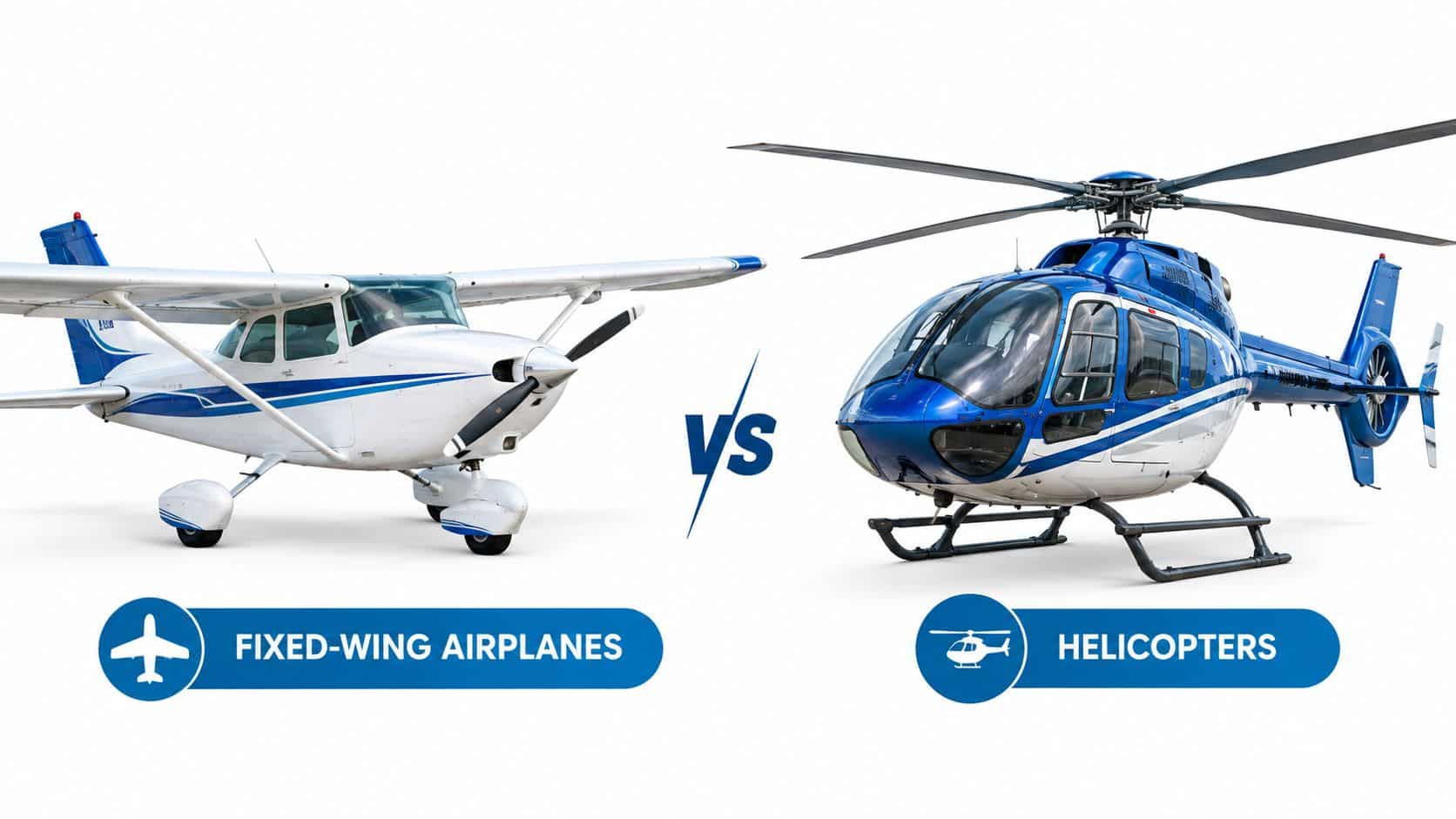
The phrase left turning tendencies belongs most directly to conventional single-engine airplanes, but the underlying idea, rotating mass creates a reaction, also appears in helicopters. The control problem changes because a helicopter uses a main rotor and an anti-torque system rather than a propeller driving an airplane through the air.
| Aircraft type | Rotating system | Primary pilot response |
|---|---|---|
| Conventional fixed-wing trainer | Clockwise propeller viewed from the cockpit | Coordinated rudder and aileron |
| Training helicopter | Main rotor and tail rotor system | Anti-torque pedal input and coordinated attitude control |
In a conventional fixed-wing trainer, clockwise propeller rotation produces the torque, slipstream, P-factor, and phase-specific gyroscopic effects described earlier. The pilot generally counters the resulting yaw with rudder while using aileron to manage bank. The exact response depends on the airplane's engine, propeller, airframe, loading, and flight condition.
A helicopter's main rotor creates torque in the opposite direction from its rotation. The tail rotor produces thrust to counter that torque and keep the fuselage aligned. The pilot controls that anti-torque thrust with the pedals, so the relevant control input is not just “right rudder” in the airplane sense.
Why rotor direction matters
Standard training helicopters such as the Robinson R22 and Enstrom use counter-clockwise main rotor systems. Their pedal behavior and yaw response must be learned from the aircraft's flight manual, instructor demonstrations, and the specific rotor system. A student transitioning from an airplane shouldn't transfer a fixed-wing rudder habit directly to helicopter pedal work.
Helicopter yaw also changes with power, wind direction, airspeed, and relative airflow over the tail rotor. A condition known as loss of tail rotor effectiveness, or LTE, can share a broad conceptual connection with airplane problems involving asymmetric airflow and propeller effects. The causes, recognition cues, and recovery techniques are different, however, so LTE requires helicopter-specific training rather than an airplane-based correction.
The comparison is valuable for dual-rating students. Both aircraft require anticipation, coordinated control, and awareness of how power changes affect yaw. The airplane pilot manages a propeller-driven airframe with rudder and aileron. The helicopter pilot manages main-rotor torque with anti-torque pedals while preserving control of attitude, altitude, and airspeed.
Practical Mitigation and Fleet-Specific Training
The practical correction begins before the nose has visibly moved. During a conventional airplane takeoff, the pilot applies enough right rudder to maintain alignment, then adjusts pressure as acceleration, pitch, power, and wind change. The pilot also keeps the wings at the intended attitude with coordinated aileron rather than allowing a yaw correction to create an unwanted bank.
A simple cockpit sequence
- Set the attitude and power smoothly. Avoid abrupt control movements that make the airplane's response harder to read.
- Track the runway centerline. Use the nose, outside references, and heading information rather than staring at one instrument.
- Add rudder as yaw develops. Correct the nose with rudder, not with aileron alone.
- Use aileron for bank control. Keep the wings aligned with the desired flight path.
- Recheck after liftoff. The nose-high attitude and changing airspeed can alter the required pressure.
- Relax unnecessary pressure during acceleration. More airspeed improves control effectiveness, so a fixed input may become excessive.
Aircraft feel different even when the aerodynamic principles are the same. A light Cessna 150 may provide a different rudder response and control feel from a Piper Cherokee. A heavier or more complex Mooney M20B can present another combination of inertia, power response, and control pressure. Students should learn the specific airplane's behavior from its approved operating guidance and instructor briefings rather than assuming that one trainer's input transfers perfectly to another.
Multi-engine training adds a separate asymmetric-thrust problem. In a Piper Apache, an engine-out condition can produce a strong yawing and rolling response because one engine continues producing thrust while the other does not. Rudder trim can reduce sustained control pressure when appropriate, but trim doesn't replace immediate directional control or the procedures required for an engine failure.
Building coordination before the runway
Ground drills can help students associate power and pitch changes with likely control demands. An instructor can call out changes in power or attitude while the student identifies which control axis needs attention, then verify the result in the airplane or simulator.
A useful exercise is to practice stabilized climbs and power changes while monitoring outside references, heading, bank, and the slip-skid ball. The objective isn't to chase the ball with isolated rudder movements. It is to develop a coordinated scan that keeps the airplane's attitude, track, and yaw under control.
DuBois Aviation provides airplane and helicopter instruction, aircraft rental, and simulator-supported training, allowing pilots to work on these control relationships across different aircraft categories. The most effective fleet-specific lesson remains one that explains what the aircraft is doing, demonstrates the response at a safe altitude or during a supervised departure, and then gives the student repeated opportunities to anticipate the correction.
Common Mistakes and Checkride Expectations
A common ground-control mistake is using brakes to manage a developing directional problem that should be handled with rudder. Brakes can become useful when the aircraft is slow and the operating procedure calls for them, but riding the brakes through the takeoff roll creates unnecessary friction and can hide the underlying coordination issue.
Another frequent error is using aileron to correct yaw. Aileron changes bank, while rudder primarily controls yaw. The controls work together, but replacing rudder with aileron can leave the airplane misaligned even if the wings appear level.
What evaluators look for
During a private or commercial practical test, evaluators generally want to see smooth, coordinated control and an understanding of the airplane's behavior. The pilot should anticipate the tendency during takeoff and climb, maintain runway alignment, coordinate during power-on maneuvers, and explain how power, airspeed, pitch, and wind affect the response.
The checkride standard isn't a memorized amount of right rudder. It is competent aircraft control and sound reasoning. A pilot who can describe why the airplane is yawing, identify whether the nose or bank is changing, and make a measured correction demonstrates a stronger grasp than a pilot who moves a control by habit without monitoring the result.
Frequently asked questions
Do left turning tendencies exist in twin-engine airplanes?
The four effects described here apply most directly to a conventional single-engine tractor airplane. A twin-engine airplane also experiences propeller torque, slipstream, P-factor, and gyroscopic effects, but the combined handling problem includes asymmetric thrust when engine power differs. That situation requires the aircraft-specific procedures and performance knowledge taught in multi-engine training.
Should a pilot set rudder trim for takeoff?
Rudder trim should be used according to the aircraft's approved procedures and the instructor's guidance. Trim can relieve sustained control pressure in an appropriate phase of flight, but it doesn't replace active rudder control during a changing takeoff or correct an unexpected yaw by itself.
Why is the slip-skid ball important?
The ball shows whether the aircraft is coordinated laterally. It isn't the only reference, because runway alignment, outside attitude cues, heading, and control feel also matter, but it provides an immediate indication of whether the pilot is using the controls together effectively.
Can crosswind change the required correction?
Yes. A crosswind can reinforce or oppose the yaw produced by power. The pilot should maintain the intended ground track and adjust control inputs as the combined wind and aerodynamic effects change.
How can students study the aerodynamics more effectively?
A structured study method can help students connect definitions with cockpit cues. The ClassLecture.ai study guide offers general learning techniques that can be adapted to flash cards, chair-flying prompts, and scenario-based oral practice. The most useful aviation study questions ask what changes when power, pitch, airspeed, or wind changes, rather than asking only for a list of terms.
Mastering these fundamentals early makes later work in steep turns, stalls, instrument approaches, and advanced aircraft easier. The student who anticipates yaw and roll can devote more attention to the larger task, maintaining a safe flight path with coordinated control.
DuBois Aviation offers one-on-one airplane and helicopter instruction, simulator-supported practice, aircraft rental, and training pathways from private through commercial and instructor ratings at Chino Airport. Prospective and current pilots can visit DuBois Aviation to ask about course availability, schedule a school tour, or request training information focused on takeoff coordination and aircraft-specific control technique.


