
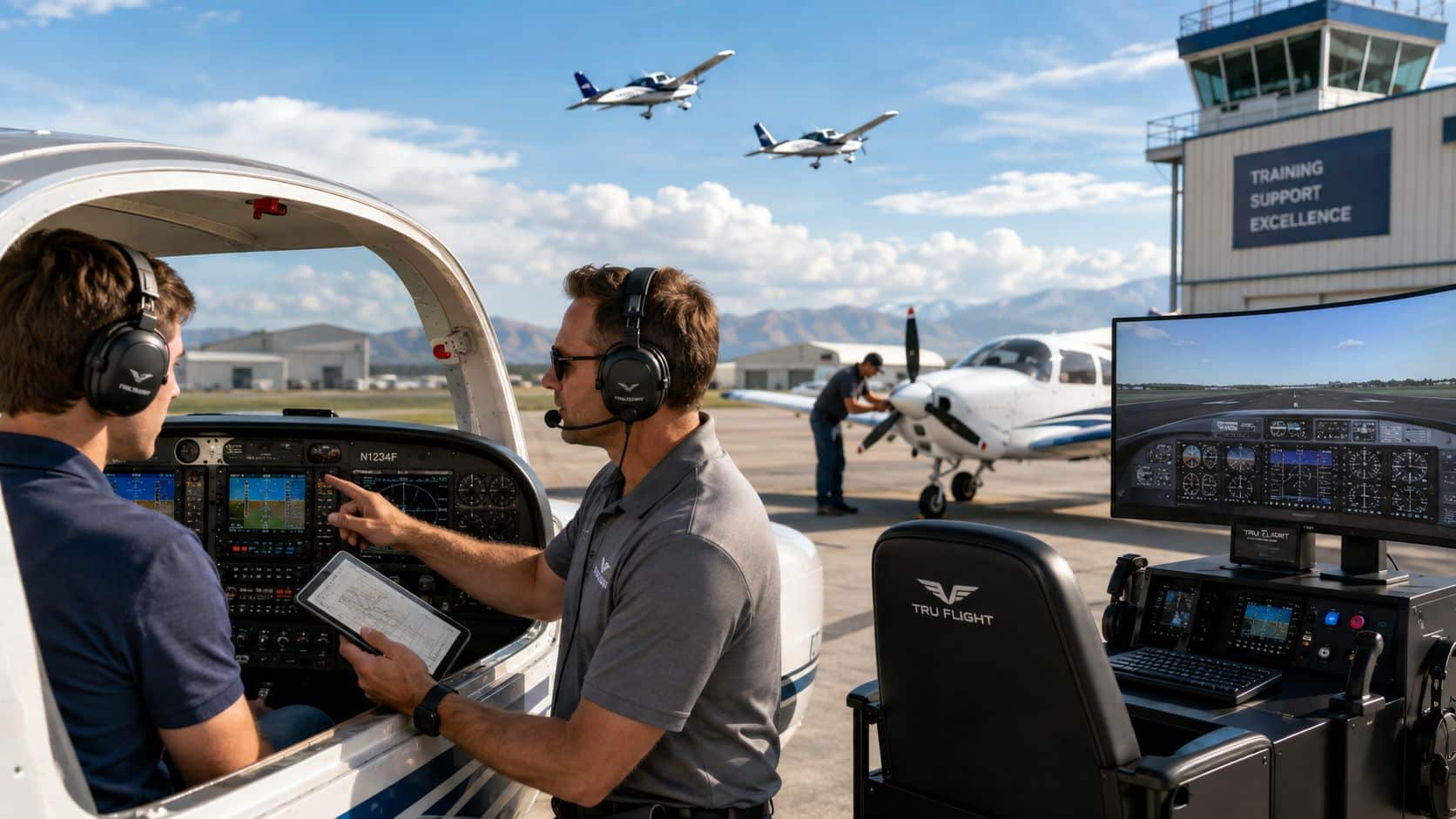
A student arrives at Chino Airport expecting a straightforward lesson: preflight the airplane, start the engine, and fly. In reality, air training support has already shaped that lesson through aircraft maintenance, instructor preparation, scheduling, dispatch coordination, ground study, and possibly simulator practice. It's the integrated system that helps a pilot progress safely from first lesson through private, instrument, commercial, multi-engine, helicopter, or instructor training.
Table of Contents
- What Happens Before You Ever Leave the Ground
- Defining Air Training Support as a Complete System
- The Six Pillars of Effective Air Training Support
- How Simulator Integration Changes Training Outcomes
- What Strong Air Training Support Looks Like at DuBois Aviation
- How to Evaluate Air Training Support Before You Enroll
- Where Air Training Support Is Heading Next
What Happens Before You Ever Leave the Ground
At a busy towered airport such as Chino, a flight lesson begins long before the student reaches the ramp. The scheduling system has to place the right aircraft, instructor, and lesson together. Dispatch personnel need to know whether the airplane is available, whether required inspections are current, and whether the planned activity fits the aircraft's equipment and limitations.
The instructor may have reviewed the student's previous lesson, selected specific maneuvers, prepared a weather and airspace discussion, and decided whether today's objective belongs in the airplane or in a simulator. A maintenance technician may have already examined a reported discrepancy or released an aircraft for service. None of those steps produces a visible takeoff, but each one affects whether the lesson can happen and whether the student can concentrate on learning.
Practical rule: A productive flight is usually the result of several people completing small, coordinated tasks before the engine starts.
A student who sees only aircraft access may misread a cancellation as a simple scheduling problem. Sometimes it reflects maintenance caution, instructor availability, weather, airport traffic, or a mismatch between the planned lesson and the aircraft's equipment. Good support makes those decisions understandable instead of leaving the student to guess.
The same system continues after landing. The instructor records performance, identifies the next training objective, and communicates any aircraft or scheduling needs. The school can then reserve appropriate resources for the next lesson rather than treating every flight as an isolated event.
This is why air training support matters to renters and certificated pilots as well. Aircraft availability, accurate dispatch information, maintenance transparency, and access to knowledgeable instructors affect whether a rental flight remains within the pilot's proficiency and operational limits. A dependable training operation doesn't merely provide an airplane. It coordinates the people, information, equipment, and decisions that make useful flying possible.
Defining Air Training Support as a Complete System
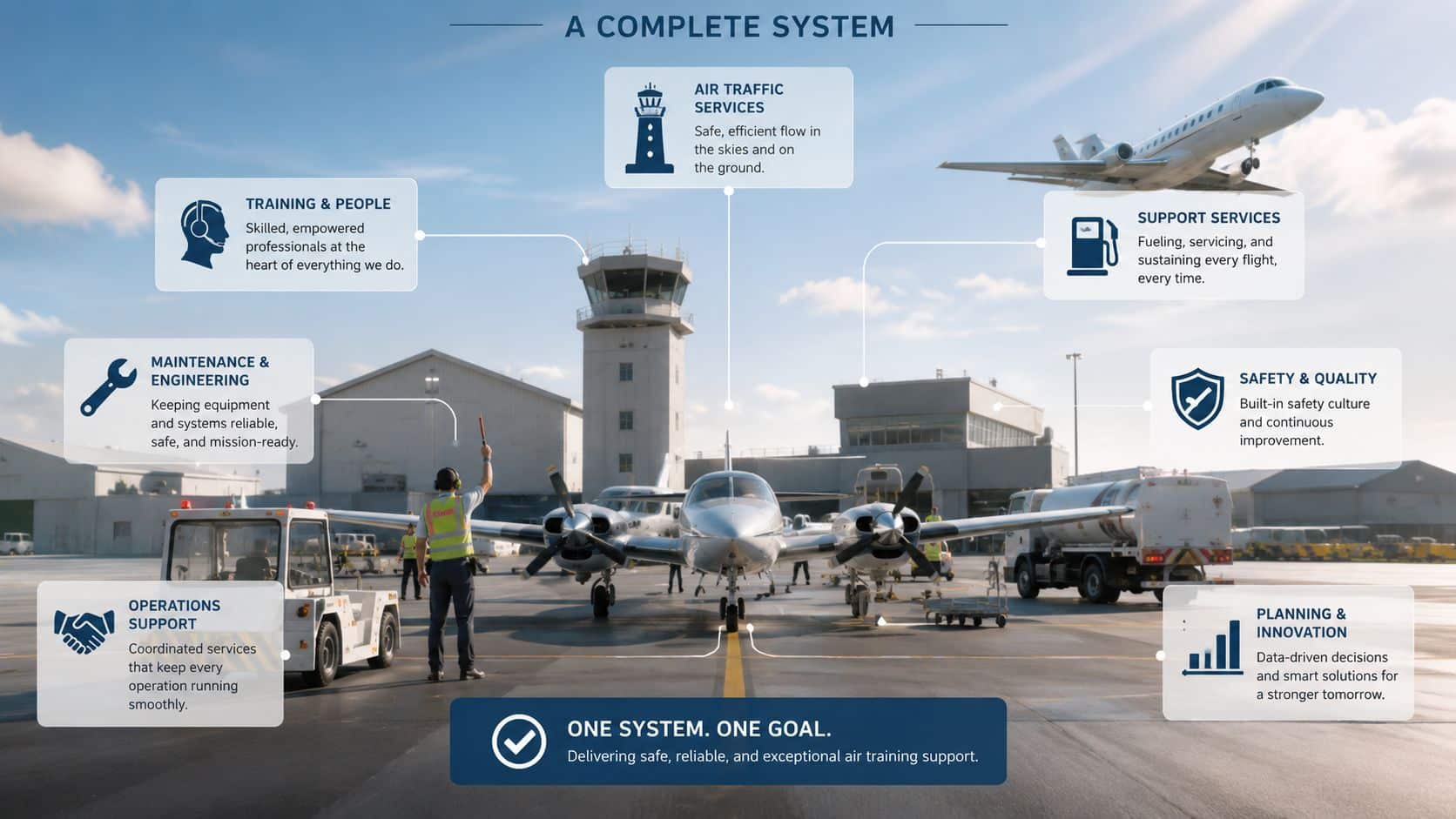
The simplest version of flight training is one instructor teaching one student in one aircraft. That description is accurate, but incomplete. A student also needs ground instruction, lesson planning, aircraft maintenance, scheduling, progress records, mentorship, and a way to rehearse procedures that may be difficult or unsafe to practice repeatedly in flight.
A useful comparison is a medical team. The pilot is the person making decisions in the cockpit, but the result depends on the scheduling desk, the maintenance staff, the instructor's preparation, the training materials, and the systems that provide feedback. If one part repeatedly fails, the pilot may spend more time waiting, repeating lessons, or adapting to inconsistent instruction.
The system in practical terms
Ground instruction gives the student the knowledge needed to understand regulations, weather, airspace, aircraft systems, performance, navigation, and risk management. It should connect directly to flight lessons rather than operate as a separate academic exercise.
Simulation provides a controlled setting for procedures, instrument scans, radio flows, abnormal situations, and repetition. The value comes from structured use, not from placing a student in front of a device without a defined objective.
Maintenance and dispatch protect the training operation's safety and reliability. They determine which aircraft can be assigned, what discrepancies require attention, and whether the planned lesson is suitable for the available equipment.
Scheduling and records help maintain continuity. A student needs reasonable access to aircraft and instructors, but also needs a clear record of what has been completed and what still requires practice.
Mentorship and standardization reduce confusion when several instructors participate in one pilot's development. Consistent terminology, maneuver standards, and debriefing methods make progress easier to measure.
The federal government recognized the value of coordinated aviation education early. The Civilian Pilot Training Program, formally launched in 1939, became the first full-scale, federally funded aviation education program and helped establish the modern U.S. model by connecting government funding, civilian schools, and national pilot-supply goals, as documented in the National Park Service aviation history.
The Six Pillars of Effective Air Training Support
A flight school can have capable instructors and still produce an uneven student experience if the surrounding support is weak. The following six pillars give prospective pilots a practical way to evaluate how an operation works.
Ground instruction and curriculum design
Strong ground instruction answers the question behind each cockpit action. A student learning steep turns should understand energy management and coordination, not just memorize a maneuver sequence. Instrument students should connect procedures, avionics, weather, and decision-making before attempting increasingly demanding scenarios.
Without a structured curriculum, students may receive disconnected lessons and repeat material without understanding what proficiency looks like. That can slow private pilot progress and create larger gaps during instrument, commercial, or CFI preparation.
Simulator integration
A simulator works best when the instructor assigns a specific task, observes performance, and uses the results to shape the next aircraft lesson. Simulation is especially useful for high-repetition work and for abnormal or emergency scenarios that instructors can rehearse without exposing the aircraft or student to operational risk. A U.S. aviation training review describes simulation as an effective instructional tool when integrated into a structured program, while also linking it with safety and training-cost benefits, as explained in this aviation training review.
Aircraft maintenance and availability
A well-supported fleet doesn't hide maintenance issues or encourage students to treat a questionable aircraft as an acceptable substitute. The operation should have a process for reporting discrepancies, reviewing aircraft status, and assigning another suitable airplane when needed.
For renters, clear aircraft status is part of responsible flight planning. For students, it also protects continuity by matching the lesson to an aircraft that is properly equipped and serviceable.
Scheduling and dispatch logistics
A schedule should do more than show open time slots. It should coordinate instructors, aircraft, simulator sessions, stage checks, checkride preparation, and weather-related changes.
When scheduling is opaque, students may arrive without the required aircraft or lose momentum through avoidable gaps. A responsive dispatch process makes cancellations, substitutions, and rescheduling easier to understand.
Instructor mentorship and standardization
Students benefit when instructors communicate about goals, performance, and recurring weaknesses. Standardized maneuver expectations matter even more for commercial and instructor candidates, who must eventually demonstrate not only personal skill but the ability to explain and evaluate that skill.
High instructor turnover can disrupt this continuity. A school should be able to explain how it preserves training records and student support when an instructor changes roles.
Advanced and multi-ship coordination
Multi-engine, helicopter, commercial, and instructor training require more coordination than a basic local flight. The school must match students with appropriately qualified instructors, suitable aircraft, realistic lesson objectives, and a clear sequence of advanced tasks.
| Pillar | What It Covers | Sign of Strong Support |
|---|---|---|
| Ground curriculum | Knowledge, planning, regulations, and systems | Flight lessons connect to organized study |
| Simulation | Procedures, repetition, and scenario practice | Each session has an objective and debrief |
| Maintenance | Aircraft condition and dispatch status | Discrepancies are documented and addressed |
| Scheduling | Aircraft, instructors, simulator, and continuity | Changes are communicated promptly |
| Mentorship | Feedback, standardization, and career guidance | Instructors share consistent expectations |
| Advanced operations | Multi-engine, helicopter, commercial, and CFI work | Resources match the certificate or rating goal |
How Simulator Integration Changes Training Outcomes
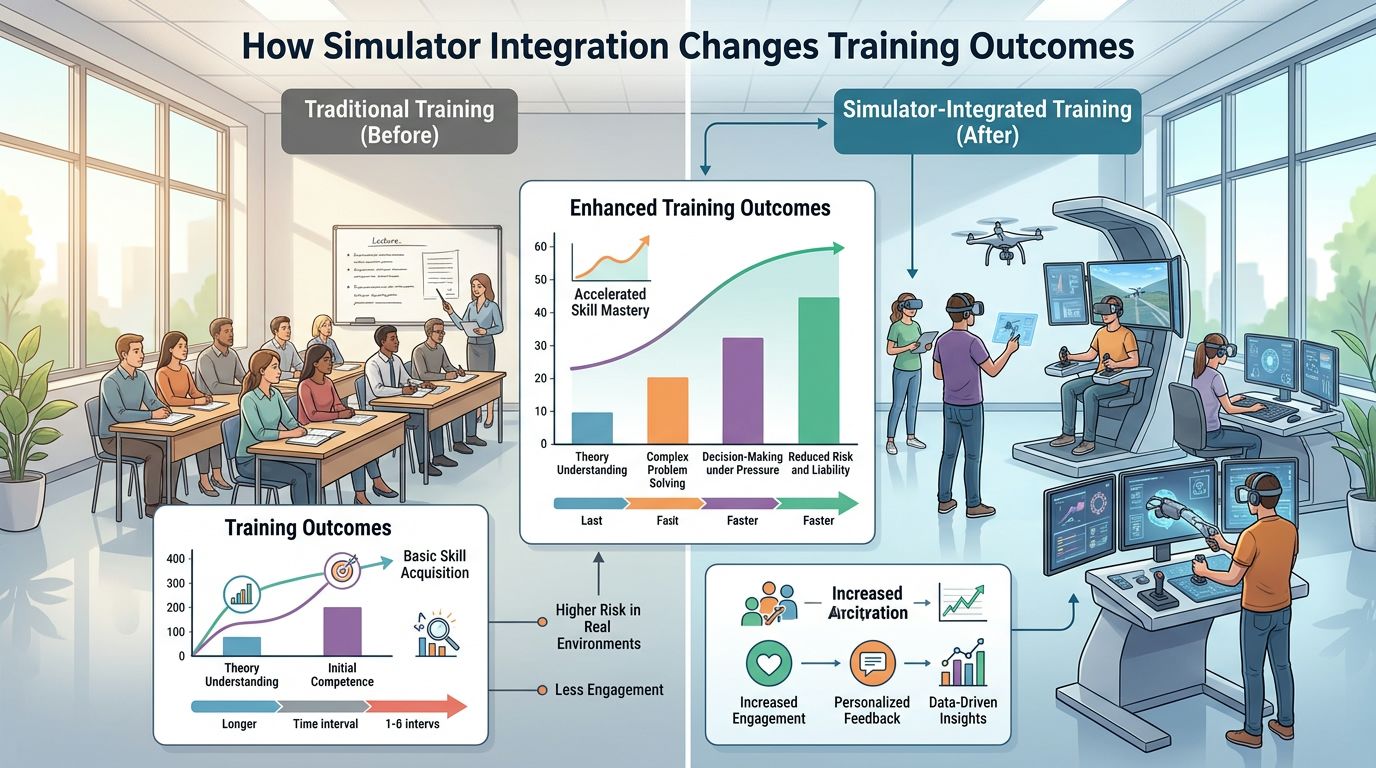
A simulator can be treated as a video game, or it can become part of a deliberate training loop. The difference is the instructor's plan. Effective use starts with a defined objective, continues through scenario practice and performance observation, and ends with feedback that changes what happens in the airplane.
Simulation is well suited to tasks that benefit from repetition without fuel burn, traffic delays, or operational exposure. Instrument scans, checklist flows, radio sequences, navigation setup, cockpit organization, and selected emergency procedures can receive focused attention in a controlled setting. Students can pause, reset, and repeat a sequence while the instructor explains the decision points.
Aircraft time remains necessary for skills that depend on real motion cues, visual depth, changing workload, and the physical consequences of aircraft energy. A simulator can prepare a student for an approach procedure, but it can't fully replace the judgment required when visual references, traffic, turbulence, aircraft handling, and communication demands arrive together.
One ab-initio helicopter training study reported positive transfer from flight training devices to aircraft on 33 of 34 tasks, and 18 tasks required significantly fewer aircraft iterations to reach proficiency standards after simulator preparation, according to the helicopter simulator-transfer study. The practical lesson isn't that every simulator is equally effective. It's that task selection, moderate visual and flight-model fidelity, instructor guidance, and feedback can make lower-cost or fixed-based devices useful.
Students evaluating a program should ask:
- Lesson connection: Which aircraft lesson does the simulator session prepare for?
- Performance tracking: What does the instructor observe and record?
- Task selection: Which skills are assigned to simulation, and which require aircraft time?
- Debriefing: How does the instructor turn simulator performance into the next training objective?
A student or instructor building structured digital lessons may also find training modules that boost learning useful for organizing objectives, practice, and review. The important principle is the same: training material should support a defined outcome rather than add activity without direction.
Students interested in seeing how simulator sessions can fit into a broader curriculum can review the simulator training center. The key question for any school is whether the device is used intentionally, with aircraft lessons and instructor feedback connected to the session.
What Strong Air Training Support Looks Like at DuBois Aviation
An integrated operation can be understood by following the same six pillars through a real training environment. At Chino Airport, DuBois Aviation uses Jeppesen-based ground instruction, in-house simulator sessions, one-on-one instruction, and an aircraft and helicopter fleet that supports multiple training paths.
The fleet includes multiple Piper Cherokees, a Cessna 150, a Mooney M20B, a Piper Apache, and Robinson and Enstrom helicopters. That variety gives students and renters access to different aircraft categories while allowing advanced training to build on earlier experience. The right aircraft still depends on the lesson objective, instructor recommendation, aircraft availability, and pilot qualifications.
Scheduling also belongs inside the training system. Flexible seven-day scheduling through an online system helps students coordinate aircraft and instructor time, while progress records help keep lessons connected. Students can use the student progress tracking system to follow completed work and identify upcoming training needs.
The airport as part of the lesson
KCNO's environment adds operational value beyond the aircraft itself. Published airport information shows multiple paved runways and instrument capability, including runway 26R with an ILS and PAPI, creating opportunities for radio work, stabilized approaches, and instrument procedure practice in a towered Southern California setting, as shown in the KCNO airport information.
That environment also requires disciplined communication and planning. Students encounter the practical demands of operating in controlled airspace, coordinating with air traffic control, managing traffic flow, and adapting a lesson to runway or airport conditions. Those habits support private pilot development and become increasingly important during instrument, commercial, multi-engine, and instructor training.
Experienced CFI, CFII, and MEI instructors provide another layer of support. A student preparing for a private checkride needs clear maneuver standards and risk-management guidance. A career-track pilot needs additional mentorship around instrument proficiency, commercial maneuvers, multi-engine operations, and the transition toward instructor qualifications.
The point isn't that one airport or fleet automatically guarantees effective training. A strong program makes the connections visible: ground work prepares the flight, simulation reinforces selected tasks, maintenance protects dispatch decisions, scheduling preserves continuity, and instructors use progress information to guide the next lesson.
How to Evaluate Air Training Support Before You Enroll
A school tour should include more than a look at the aircraft. Prospective students should ask how the operation coordinates people, equipment, instruction, and records. Clear answers reveal whether the school has a working system or a collection of services.
Questions about instructors and continuity
Ask how the school handles instructor changes, stage checks, progress reviews, and communication between instructors. A healthy mentorship structure should make it possible for another qualified instructor to understand the student's current objectives without restarting the entire process.
Instructor availability also affects training capacity. ICAO's 2026 materials emphasize workforce planning and partnerships between training organizations and industry, while India's DGCA has reported that pilot-training capacity can change when instructors move to airlines after building flight experience, reducing effective throughput, as described in the ICAO and DGCA workforce material.
Questions about simulation and scheduling
A simulator should have a place in the curriculum. Ask which lessons use it, how instructors evaluate sessions, and whether the student receives a briefing and debriefing. A device that sits unused, or is offered without a training objective, adds little value.
Scheduling questions should cover aircraft substitutions, maintenance cancellations, instructor absences, and the process for rescheduling. Students should understand how the school protects lesson continuity when conditions change.
Questions about aircraft and the local environment
Ask how maintenance discrepancies are reported and how aircraft status is communicated. The school should also explain how students gain experience with local airspace, traffic, weather, radio work, and instrument procedures.
Common warning signs include:
- Frequent instructor churn: Students repeatedly change instructors without a clear handoff.
- Unstructured ground training: Flight lessons proceed without organized knowledge preparation.
- Unused simulation equipment: The school owns a device but can't explain its curriculum role.
- Unclear maintenance communication: Students learn about aircraft limitations only after arriving.
- Weak scheduling visibility: Cancellations and substitutions create long, unexplained gaps.
A practical guide to choosing a flight school in Southern California can help organize those questions before a tour. The best choice depends on the student's goals, location, schedule, budget, aircraft needs, and preferred learning environment.
Where Air Training Support Is Heading Next
Training programs are moving toward competency-based and scenario-based instruction, where progress depends on demonstrated performance in realistic situations rather than simple exposure to flight activities. AI-assisted debriefing, virtual reality, portable simulators, and more detailed performance analysis are also becoming part of the wider training conversation.
A recent aviation training paper highlights these developments and cites a market forecast projecting civil aerospace training and simulation growth from USD 1.93 billion in 2025 to USD 2.07 billion in 2026, while also discussing digital-twin analytics that may reduce type-rating time by up to 20%, as reported in the ICAO training-performance paper. These figures are projections and should not be treated as guaranteed outcomes for an individual student.
For pilots, the practical change is straightforward. Future-ready schools will connect training objectives, simulator practice, instructor feedback, aircraft performance, and progress records more closely. Students can ask DuBois Aviation about current course availability, simulator integration, airplane or helicopter training, and the best path for a school tour.
DuBois Aviation offers airplane and helicopter instruction, simulator-supported training, aircraft rental, and pathways through private, instrument, commercial, multi-engine, and instructor qualifications. Visit DuBois Aviation to request training information, ask about course availability, or schedule a tour at Chino Airport.
Frequently Asked Questions
What does air training support include?
Air training support includes instruction, ground study, simulation, aircraft maintenance, scheduling, dispatch coordination, progress tracking, mentorship, and advanced-operation planning. These pieces work together to make training safer and more consistent.
Is a simulator a replacement for aircraft training?
No. A simulator can reinforce procedures, instrument scans, radio flows, cockpit organization, and selected abnormal scenarios. Aircraft time remains necessary for real motion cues, visual depth, workload management, and the handling demands of actual flight.
How can a student tell whether a simulator is being used effectively?
The school should connect each simulator session to a defined lesson objective. The instructor should brief the task, observe performance, provide feedback, and explain how the session affects the next aircraft lesson.
Why does instructor continuity matter?
Consistent instructors and clear handoffs help preserve training progress. Students receive more useful feedback when instructors share expectations, records, maneuver standards, and upcoming objectives.
What should a student ask about aircraft maintenance?
Students should ask how discrepancies are reported, how aircraft status is communicated, and how the school handles substitutions or cancellations. A transparent process helps students make safer decisions and avoid unnecessary disruptions.
Why can a towered airport be useful for training?
A towered airport gives students regular practice with radio communication, traffic awareness, sequencing, runway procedures, and airspace coordination. The value depends on how instructors use those conditions to build decision-making and operating habits.