
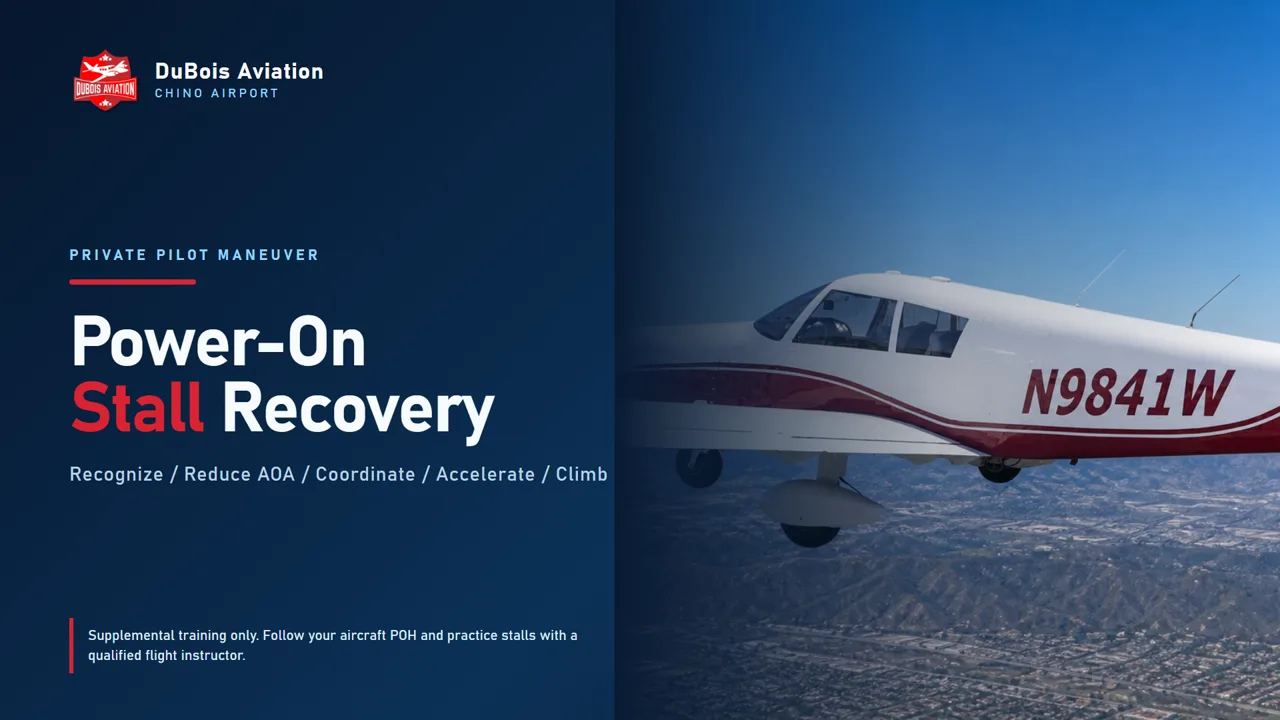
How to Recover From a Power-On Stall
What a power-on stall is designed to teach
A power-on stall is commonly practiced in a takeoff, departure, cruise, or go-around configuration. The airplane is slow, the nose is high, and the engine is producing significant power. That combination makes accurate pitch control and yaw control especially important. The maneuver is not about making the airplane behave dramatically. It is about noticing a developing stall early, keeping the airplane coordinated, and using a calm recovery sequence.
The lesson also reinforces an essential idea: an airplane stalls because the wing exceeds its critical angle of attack, not because the airspeed indicator reaches one universal number. Weight, bank angle, load factor, configuration, turbulence, and control inputs can all change the speed at which a stall occurs.
Set up the maneuver safely
Use the current POH or AFM and your instructor’s procedure for the specific airplane. Before beginning, clear the area, select an altitude that permits recovery no lower than the applicable standard, complete the checklist, and stabilize the airplane. For a private pilot practical test in a single-engine airplane, the maneuver is completed no lower than 1,500 feet AGL.
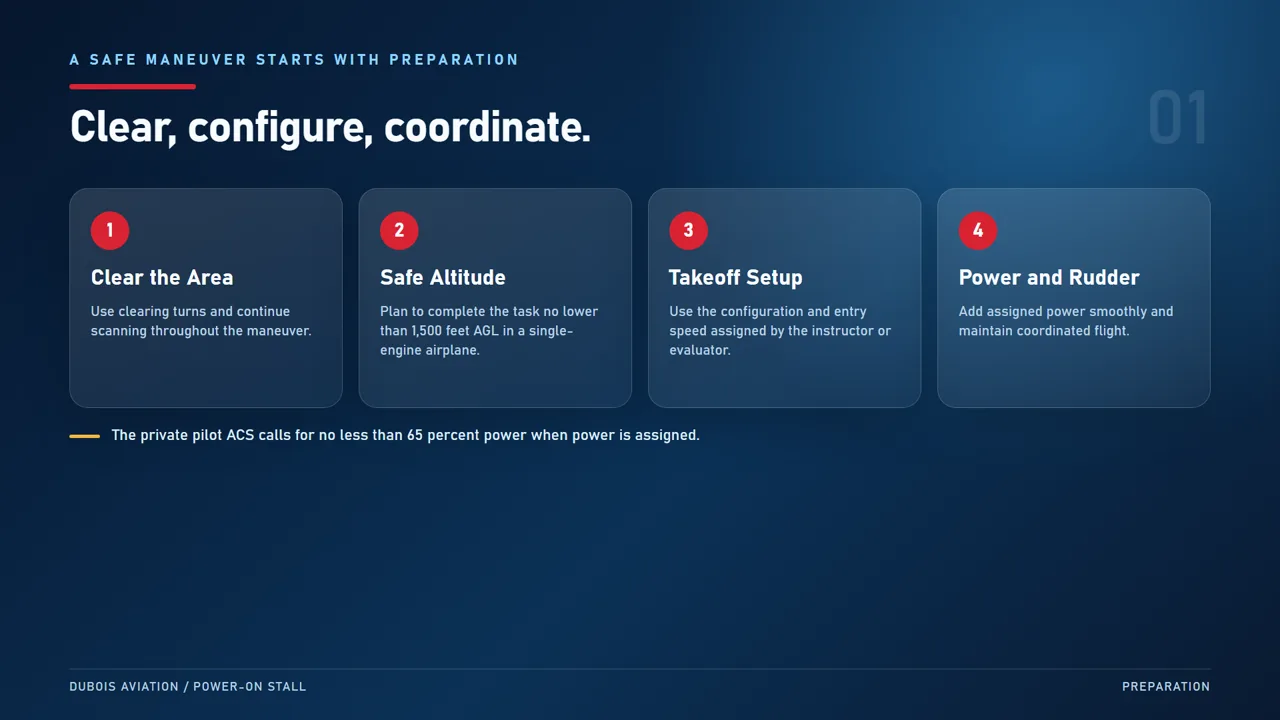
The evaluator may assign a takeoff, departure, or cruise configuration. Establish the requested power setting, which the Private Pilot ACS specifies as no less than 65 percent available power, and smoothly transition to the pitch attitude that produces the stall. Avoid abrupt control movements. They make coordination harder and do not represent good takeoff or departure technique.
Why high power and low airspeed demand coordination
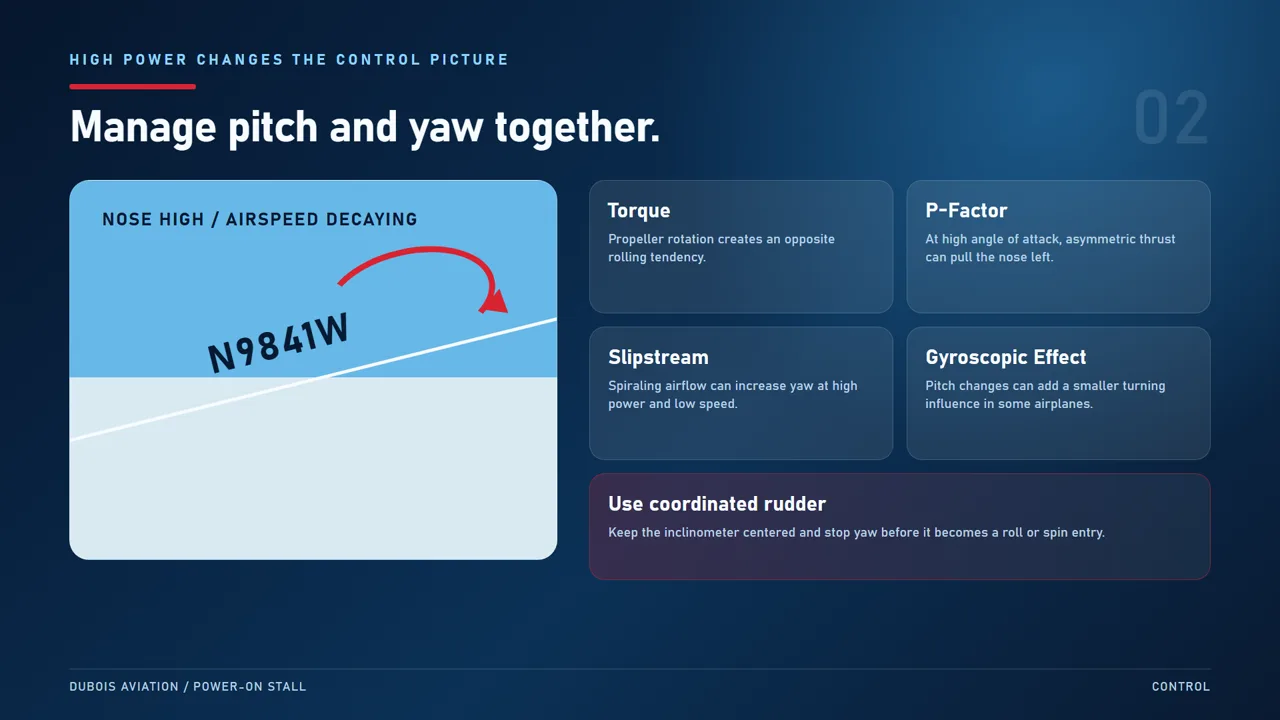
At high power and low airspeed, torque, P-factor, spiraling slipstream, and gyroscopic effects can create a noticeable left-turning tendency. As the elevator becomes less effective and the pitch attitude rises, the pilot may need increasing right rudder to keep the ball centered and the airplane from yawing.
Recognize the stall before the break
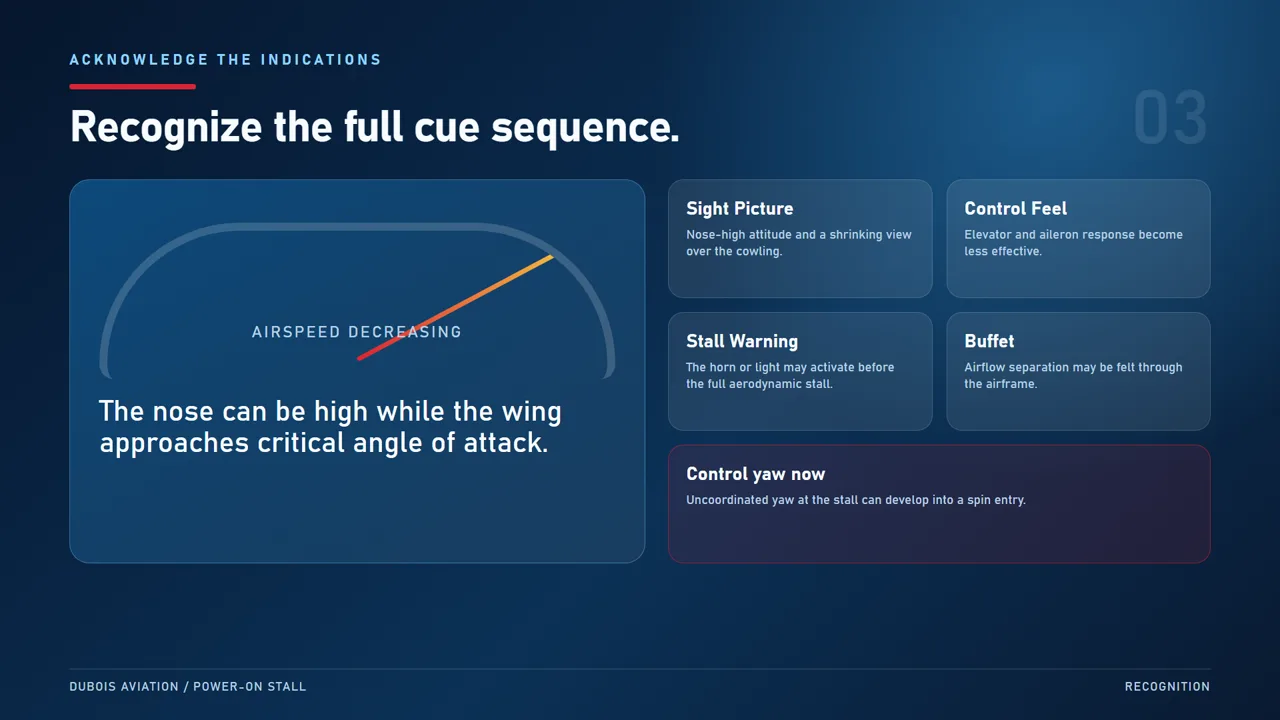
Build a complete picture from several cues. Expect a high nose attitude, decreasing airspeed, increasing control pressure, reduced control effectiveness, the stall warning, buffet, and finally the aerodynamic break or a clear loss of control effectiveness. Keep your eyes moving between the outside sight picture, the coordination indicator, and the flight instruments rather than staring at the airspeed indicator.
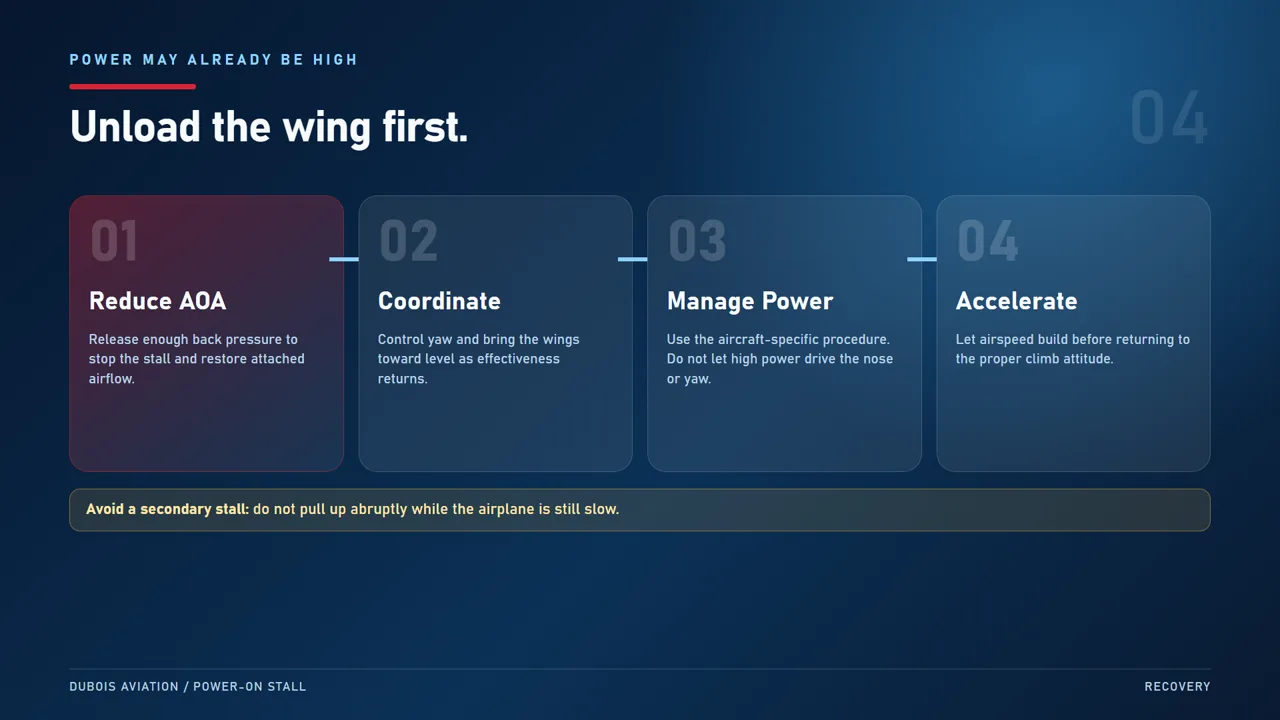
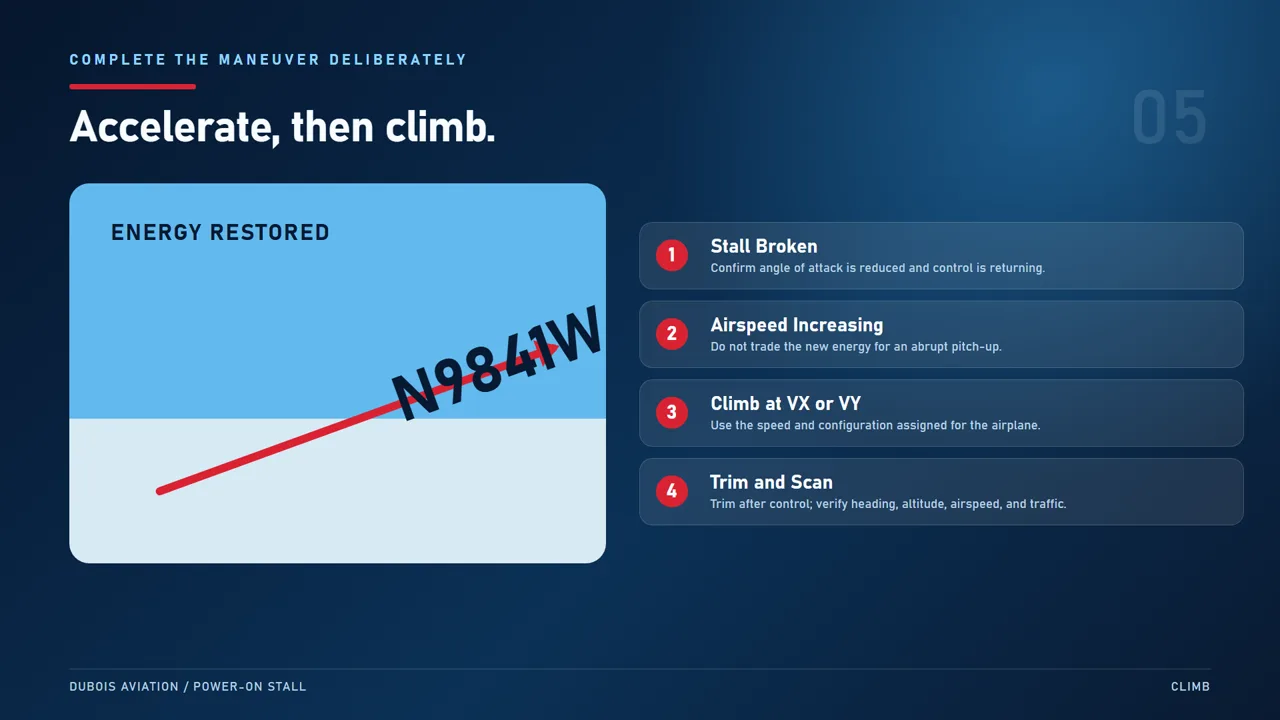
Power-on stall recovery, step by step
Common errors and better corrections
| Common error | Why it causes trouble | Better habit |
|---|---|---|
| Using aileron aggressively near the stall | It can increase the angle of attack on one wing and worsen the roll. | Prioritize coordinated rudder, reduce angle of attack, then level the wings smoothly. |
| Pulling before airspeed returns | The wing may exceed its critical angle again and enter a secondary stall. | Allow the airplane to accelerate before transitioning to the climb. |
| Fixating on the airspeed indicator | The stall can occur at different indicated speeds and outside cues are missed. | Use pitch attitude, sound, control feel, warning, buffet, and instruments together. |
| Ignoring yaw | A stalled airplane with yaw can roll toward a spin entry. | Keep the ball centered with timely rudder throughout entry and recovery. |
| Making the entry abrupt | It reduces learning value and makes altitude, heading, and coordination harder to control. | Use smooth, deliberate pitch and power changes. |
What the Private Pilot ACS expects
The current FAA Airman Certification Standards require the applicant to clear the area, complete the maneuver at a safe altitude, configure the airplane as assigned, establish at least 65 percent available power, maintain coordination, recognize the indications of a full stall, recover promptly using the manufacturer procedure, and accelerate to the assigned VX or VY climb. Heading and bank tolerances apply during the entry.
There is no single predetermined altitude-loss number that replaces good judgment. The goal is a prompt, positive, coordinated recovery without an excessive dive, abrupt pull-up, or secondary stall. Your instructor should teach the exact sequence and callouts appropriate for the airplane you fly.
Power-on stall questions
What is the first action in a power-on stall recovery?
Reduce angle of attack. Release enough back pressure to stop the stall before trying to climb.
Why is right rudder often needed?
High power and low airspeed increase left-turning tendencies. Timely right rudder helps keep the airplane coordinated and prevents yaw from becoming a roll.
Should power be reduced during recovery?
Follow the POH or AFM and your instructor’s procedure. In many trainers, power remains high while the pilot first reduces angle of attack and controls yaw. Some aircraft may require a power adjustment to maintain control.
Can a stall happen above the published stall speed?
Yes. Stall speed changes with load factor, weight, configuration, and other conditions. A wing stalls when it exceeds its critical angle of attack.
Can I practice power-on stalls without an instructor?
This lesson is preparation, not a substitute for flight instruction. Practice stalls with a qualified flight instructor and use the current aircraft checklist and POH or AFM.
Study sources
This lesson is based on the FAA Airplane Flying Handbook, the current Private Pilot for Airplane Category Airman Certification Standards, and aircraft-specific procedures. Always use the current versions of those references.
Practice the maneuver with a DuBois Aviation instructor
Build a better sight picture, smoother coordination, and a reliable recovery sequence in one of our training aircraft at Chino Airport.


